💥Join UPSC 2027,2028 Mentorship (July Batch) + XFactor Notes & Microthemes PDF

Subject: Fundamental Rights,DPSP

1. History + Evolution
2. Features
3. Amendments
4. Basic Structure

  • Raj Bhavan needs radical reforms

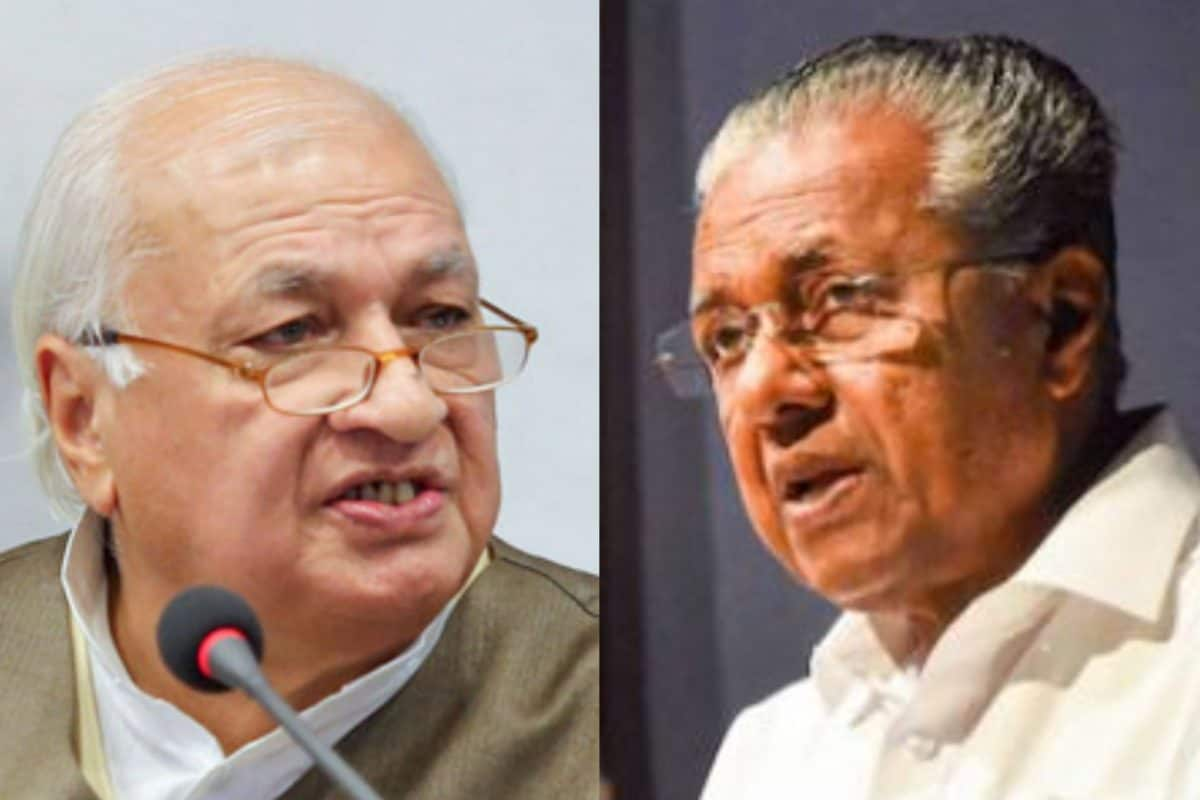
    Kerala Conundrum: As Arif Khan 'Withdraws Pleasure' in FM, News18 Decodes  if Guv Can Sack a Minister - News18

    Central Idea:

    The conduct of Governors in Opposition-ruled States, exemplified by the recent actions of Kerala’s Governor, raises concerns about adherence to constitutional morality, necessitating a reevaluation of their roles and legal consequences.

    Key Highlights:

    • Kerala’s Governor, Arif Mohammed Khan, faced criticism for instructing the removal of posters and accusing the Chief Minister of supporting activists against him.
    • Breaches of protocol, such as an unannounced tour of Kozhikode, added to the growing trend of Governors’ controversial actions.
    • While the Constitution outlines functions, powers, and duties of Governors, the concept of constitutional morality should guide their public behavior.
    • Reference to NCT of Delhi v. Union of India highlights the responsibility of individuals occupying constitutional offices.
    • Article 361 provides limited immunity for Governors, exempting them from court scrutiny for official acts.
    • Rameshwar Prasad v. Union of India establishes judicial review for cases of Governor’s motivated and whimsical conduct, suggesting accountability.
    • Kaushal Kishor v. State of Uttar Pradesh clarifies that public functionaries’ freedom of expression is subject to reasonable restrictions.
    • Ministers can be held personally liable for statements inconsistent with government views, emphasizing personal responsibility.
    • Sarkaria Commission Report (1988) criticized Governors for lacking impartiality and becoming agents of the Union, emphasizing the need for detachment.
    • Justice M.M. Punchhi Commission (2010) recommended restricting Governors from roles not envisaged by the Constitution, citing potential controversies.

    Key Challenges:

    • Governors’ failure to display impartiality and sagacity, engaging in local politics and controversies.
    • Lack of adherence to recommendations for detached roles and limitations on Governors’ powers.

    Key Terms and Phrases:

    • Constitutional morality
    • Limited immunity (Article 361)
    • Judicial review
    • Chancellorship of universities
    • Sarkaria Commission
    • Punchhi Commission
    • Democratic legitimacy
    • Raj Bhavans

    Key Quotes:

    • “Constitutional morality places responsibilities and duties on individuals who occupy constitutional institutions and offices.” – NCT of Delhi v. Union of India (2018)
    • “Some Governors have failed to display the qualities of impartiality and sagacity expected of them.” – Sarkaria Commission Report (1988)
    • “The Governor should be a detached figure and not too intimately connected with the local politics of the State.” – Justice M.M. Punchhi Commission report (2010)

    Key Statements:

    • Judicial review possible for Governor’s misbehavior unconnected with official duty.
    • Sarkaria and Punchhi Commission reports emphasize the need for Governors’ impartiality and limited involvement in local politics.
    • Kerala Assembly’s attempt to abolish Governor’s chancellorship raises concerns about democratic legitimacy.

    Critical Analysis:

    • The Governor’s actions in Kerala highlight a deviation from democratic norms and raise questions about the democratic legitimacy of gubernatorial decisions.
    • Commission reports expose longstanding issues with Governor appointments and their roles, calling for systemic changes.

    Way Forward:

    • Future regimes should consider amending Article 155 to ensure Chief Minister consultation in Governor appointments, addressing recommendations from the Sarkaria report.
    • Establishment of an independent body for Governor selection, with input from the Chief Justice of India, may enhance the quality of the selection process.
    • Legal prohibitions against Governors’ further rehabilitation in official capacities could contribute to improving the functioning of Raj Bhavans.
  • Legal and Ethical Dimensions of Polygraph Tests in India

    polygraph tests

    Central Idea

    • In the ongoing investigation of the Parliament security breach, Delhi Police sought court permission for polygraph tests on six accused to uncover their motives.
    • A polygraph test, commonly known as a lie detector test, measures physiological responses believed to differ when a person lies.

    Mechanics of a Polygraph Test

    • Physiological Monitoring: The test involves attaching instruments like cardio-cuffs or sensitive electrodes to monitor blood pressure, pulse, and other variables.
    • Response Analysis: As questions are asked, responses are numerically evaluated to determine truthfulness, deception, or uncertainty.
    • Historical Origin: First conducted in the 19th century by Cesare Lombroso, an Italian criminologist, to measure blood pressure changes in suspects during interrogation.

    Constitutional and Legal Provisions

    • Article 20(3) of the Indian Constitution: This article protects against self-incrimination, stating that no accused shall be compelled to be a witness against themselves.
    • Infringement Concerns: Forcing an accused to undergo polygraph or narcoanalysis tests is seen as a violation of Article 20(3), making consent essential.
    • Article 21 and Human Rights: Polygraph tests are criticized for mental torture, potentially violating the right to life and privacy under Article 21.

    Limitations and Challenges

    • Scientific Reliability: Neither polygraph nor narco tests are scientifically proven to be 100% accurate, raising questions about their reliability.
    • Impact on Vulnerable Individuals: These tests can adversely affect those unaware of their rights or unable to access legal advice, leading to potential abuse and media exploitation.

    Legal and Constitutional Rulings

    • Selvi vs State of Karnataka & Anr (2010): The Supreme Court ruled that lie detector tests should be voluntary, with legal implications explained to the accused.
    • D.K. Basu vs. State of West Bengal (1997): The Court deemed involuntary administration of these tests as potentially violating the Right to Life and Liberty and the Right to Privacy.
    • Indian Evidence Act, 1871: The results of these tests are not admissible as evidence in court.
    • National Human Rights Commission Guidelines (1999): Established consent and procedural guidelines for administering polygraph tests.

    Way Forward

    • Role as Investigative Tools: While not reliable for conclusive evidence, polygraph tests can aid in complex investigations.
    • Balancing Scientific Techniques and Rights: The government should promote scientific methods in investigations while ensuring strict adherence to ethical and legal standards.
    • Consent and Decency: The administration of these tests must be consensual, respecting the dignity and rights of the individuals involved.
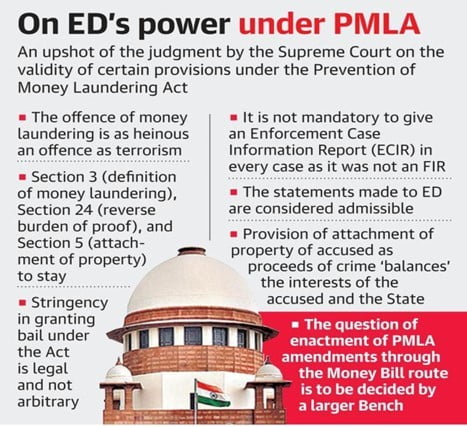
  • Questionable searches under the Money Laundering Act

    Prevention of Money Laundering Act (PMLA) 2002 | IASbaba

    Central idea 

    The Supreme Court’s interpretation of the Prevention of Money Laundering Act (PMLA) emphasizes a strict application tied to scheduled offences and the definition of “proceeds of crime.” Criticism of the Enforcement Directorate’s actions highlights the need for probity and fairness, urging consistency in procedures. The issue raises concerns about potential abuse of authority and its impact on federalism, necessitating clear jurisdictional delineation.

    Key Highlights:

    • Supreme Court Interpretation: The Supreme Court’s unique interpretation of the Prevention of Money Laundering Act, 2002 (PMLA) has raised concerns, limiting its application to “wrongful and illegal gain of property” related to scheduled offences.
    • Definition of “Proceeds of Crime”: The Court emphasized that for the PMLA to apply, the property must qualify as “proceeds of crime” under Section 2(1)(u) of the Act.
    • Critical Observations on ED: Instances of Enforcement Directorate (ED) actions beyond its powers, especially arrests, led to severe criticism. The court highlighted the need for the ED to function with “utmost probity, dispassion, and fairness.”

    Key Challenges:

    • Inconsistent ED Practices: The Court noted the lack of consistent and uniform practices within the ED, especially in furnishing written copies of arrest grounds, raising concerns about procedural irregularities.
    • Abuse of Authority: The ED’s conduct in conducting searches, seizures, and arrests outside its powers resulted in strong criticism, pointing to potential abuse of authority.

    Key Terms and Phrases:

    • Scheduled Offence: Offences specified in the schedule of the PMLA Act to which the Act’s provisions apply.
    • Proceeds of Crime: Property derived or obtained as a result of criminal activity relating to a scheduled offence.

    Key Quotes and Statements:

    • “If the offence so reported is a scheduled offence, only in that eventuality, the property recovered by the Authorised Officer would partake the colour of proceeds of crime…”
    • “The ED, mantled with far-reaching powers under the stringent Act of 2002, must be seen to be acting with utmost probity, dispassion, and fairness.”

    Key Examples:

    • Vijay Madanlal Choudhary Case: The Supreme Court’s interpretation in the Vijay Madanlal Choudhary case set the precedent, emphasizing the need for the existence of “proceeds of crime” for PMLA application.
    • Pankaj Bansal Case: The Court’s criticism of the ED’s style of functioning in the Pankaj Bansal case highlighted the importance of adherence to probity and fairness.

    Critical Analysis: The Court’s focus on the stringent application of PMLA provisions, especially tying them to scheduled offences and the definition of “proceeds of crime,” reflects a commitment to precision and legal rigor. The criticism of ED practices underscores the significance of maintaining ethical standards in enforcement agencies.

    Way Forward:

    • Procedural Consistency: Enforcement agencies, particularly the ED, need to establish consistent and uniform practices, ensuring transparency and adherence to legal procedures.
    • Judicial Scrutiny: Ongoing cases, especially those involving political implications, should undergo thorough judicial scrutiny to prevent potential abuse of authority and protect the principles of federalism.
    • Clarity on Jurisdiction: The ED’s jurisdiction, especially in non-scheduled offences like illegal mining, should be clarified to avoid overreach, respecting the powers vested with the State governments.
  • 14th Amendment of US Constitution and Its Implications

    Central Idea

    • The US top court ordered the removal of former President Donald Trump from the ballot for the next Presidential elections.
    • The decision was based on Section 3 of the Fourteenth Amendment of the US Constitution, relating to Trump’s alleged role in the January 6, 2021, attacks on the US Capitol.

    14th Amendment of US Constitution

    Details
    Ratification Date July 9, 1868
    Primary Purpose To address civil rights issues following the Civil War, particularly regarding former slaves.
    Key Clauses Citizenship Clause: Citizenship for all persons born or naturalized in the U.S.

    Due Process Clause: Fair legal process required for all citizens.

    Equal Protection Clause: Equal legal protection for all citizens.

    Historical Context Response to post-Civil War issues, including the Black Codes in Southern states.
    Major Significance – Extended Bill of Rights protections to state actions.

    – Foundation for numerous civil rights advancements and Supreme Court decisions.

    Notable Cases – Brown v. Board of Education (1954) for desegregation

    – Roe v. Wade (1973) for abortion rights

    Why in news? Section 3 disqualifies anyone who, having taken an oath to support the Constitution, engages in insurrection or rebellion against the same, or aids its enemies, from holding any office, civil or military, in the United States.

    Applied to Donald Trump

    Impact on Federalism Altered the balance of power between the federal government and states, especially in civil rights and liberties.

    Similar Provisions in India

    Details
    Equal Protection Clause Article 14: Indian Constitution guarantees “equality before the law” and “equal protection of the laws” within the territory of India.
    Citizenship Clause Articles 5 to 11: Deal with aspects of citizenship in India, including citizenship by birth, descent, registration, naturalization, and incorporation of territory.
    Due Process Clause Article 21: Provides protection of life and personal liberty, stating “No person shall be deprived of his life or personal liberty except according to a procedure established by law.”
    Protection of Civil Liberties Article 19: Ensures the protection of certain rights regarding freedom of speech, assembly, etc.
    Prohibition of Discrimination Article 15: Prohibits discrimination on grounds of religion, race, caste, sex, or place of birth.
    Disqualification for Public Office Representation of the People Act, 1951 (Sections 8, 9, 10, 11): Lays out disqualifications for membership of Parliament and State Legislatures due to criminal convictions, corrupt practices, and certain office-of-profit positions.
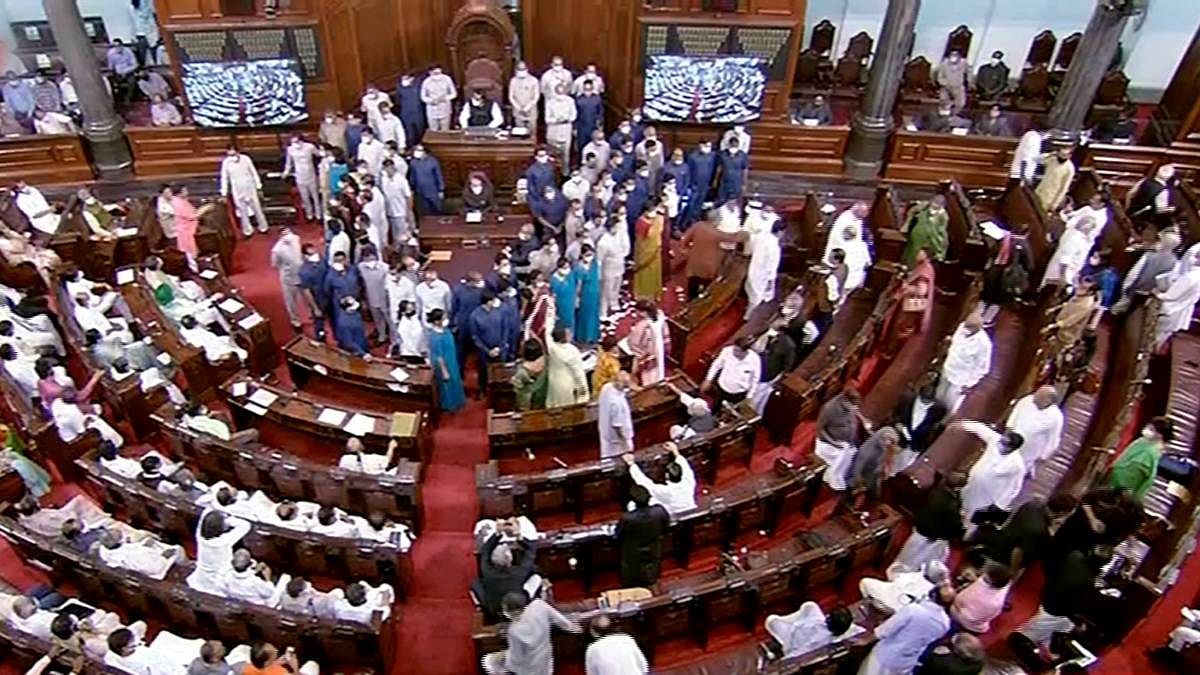
  • Let them speak: Suspension of MPs shows Parliament must find better ways to engage

    Disruptions are as much a part of Indian Parliament now as British rules  and rituals

    Central idea 

    The central theme highlights parliamentary dysfunction due to procedural stagnation and a historical cycle of disruptions. The ongoing impasse, evidenced by the suspension of MPs, underscores the need for a nuanced institutional response and a redefined role for the Opposition in shaping parliamentary discourse. The article advocates procedural changes to grant the Opposition more influence, fostering collaboration and preserving public trust in Parliament.

    Key Highlights:

    • The parliamentary dysfunction is rooted in the absence of procedural mechanisms for deliberation on contentious issues.
    • The ongoing impasse between the government and the Opposition has led to the suspension of 141 MPs.
    • The Opposition demands a statement from the Home Minister regarding a security breach, while the government defers to the Speaker’s directions.
    • Disruptions in Parliament have historical roots, dating back to the 1960s, and have evolved into a political tool.
    • The institutional response to disruptions has been simplistic, focusing on penalizing MPs rather than addressing the underlying issues.

    Key Challenges:

    • Procedural stagnation in the parliamentary system has led to a cycle of disruptions and disciplinary actions.
    • The government’s control over the legislative agenda limits the Opposition’s role, contributing to parliamentary standoffs.
    • The current approach of penalizing MPs for disruptions is deemed ineffective in ensuring the smooth functioning of Parliament.

    Key Terms and Phrases:

    • Parliamentary dysfunction
    • Security breach
    • Disruptions as a political tool
    • Institutional response
    • Legislative and fiscal priorities
    • Opposition’s role and space in Parliament
    • Procedural stagnation
    • Westminster parliamentary principle
    • No-confidence motion
    • National legislature

    Key Quotes and Statements:

    • “The standoff in Parliament is not new…result from years of procedural stagnation.”
    • “Disruptions were going to become the norm in our parliamentary discourse.”
    • “The smooth functioning of the legislature was the responsibility of the government.”
    • “For Parliament to work effectively, penalising MPs will not be enough.”
    • “The recent disruptions and en masse suspension of MPs should be a wake-up call for our national legislature.”

    Key Examples and References:

    • Suspension of 141 Opposition MPs in the ongoing winter session of Parliament.
    • Historical instances of MPs like Ram Sewak Yadav and Mani Ram Bagri being warned and suspended for disruptions.
    • Speaker Chatterjee’s remark in 2005 on the difficulty of regulating proceedings if a group of members disrupts the House.

    Key Facts and Data:

    • Disruptions in parliamentary proceedings by MPs began in the 1960s.
    • The current parliamentary system reflects pre-independence British templates.
    • Private members get two-and-a-half hours every Friday for discussion, but there is no mechanism for a group of MPs to require a specific discussion.

    Critical Analysis:

    • The article highlights the historical context and evolution of parliamentary disruptions.
    • It critiques the current institutional response, emphasizing the need for a more nuanced approach.
    • It challenges the existing view of Parliament as a platform primarily for the government to transact business.

    Way Forward:

    • Proposes a change in parliamentary procedures to allow the Opposition to set the agenda for debate.
    • Suggests incorporating specific days in the parliamentary calendar for Opposition-led discussions.
    • Urges Parliament to find better solutions for fostering debate to prevent the erosion of public faith.
  • Analysis of Declining CAG Audits Tabled in Parliament

    Central Idea

    • In 2023, only 18 audits prepared by the Comptroller and Auditor General (CAG) were tabled in the Indian Parliament, continuing a trend of decreasing numbers in recent years.

    Comptroller and Auditor General (CAG)

    • Constitutional Office: The Comptroller and Auditor General of India (CAG) is an independent constitutional authority responsible for overseeing financial administration in India.
    • Key Responsibilities: As the head of the Indian Audit and Accounts Department, the CAG is the guardian of the public purse, monitoring the financial system at both central and state levels.

    History of the Office of CAG

    • Origins in British India: The role of the CAG evolved with administrative reforms initiated by Lord Canning before the Mutiny of 1857.
    • Establishment and Evolution: The office was formalized under the Government of India Act 1858, with Sir Edward Drummond becoming the first Auditor General in 1860. The title ‘Comptroller and Auditor General of India’ was first used in 1884.
    • Independence and Strengthening: The Montford Reforms of 1919 and the Government of India Act 1935 further solidified the CAG’s independence and role in a federal setup.

    Constitutional Provisions Related to CAG

    • Articles Governing CAG: The Constitution outlines the CAG’s appointment, duties, and powers in Articles 148 to 151.
    • Duties and Powers: The CAG is responsible for auditing all government accounts and advising on financial matters.
    • Audit Reports: The CAG submits audit reports on Union accounts to the President and on state accounts to respective Governors.

    Types of Audits Performed by CAG

    • Regulatory Audit: Ensures authorized and rule-compliant expenditure.
    • Supplementary Audit: Conducted in PSUs for detecting financial leakages.
    • Propriety Audit: Focuses on the public interest and proper expenditure.
    • Efficiency Audit: Assesses optimal utilization of investments.
    • Performance Audit: Evaluates government programs for effectiveness.
    • Environmental Audit: Addresses issues related to conservation and environmental management.

    Independence of the CAG

    • Constitutional Safeguards: The CAG’s independence is protected by various constitutional provisions, including security of tenure, ineligibility for further government office, and non-varying service conditions.
    • Financial Autonomy: The CAG’s administrative expenses are charged upon the Consolidated Fund of India, ensuring financial independence.

    Audit Mandate Sources

    • Constitutional Basis: Articles 148 to 151 of the Constitution.
    • Statutory Framework: The Duties, Powers and Conditions of Service Act, 1971.
    • Regulations: Audit and accounts regulations as notified.

    Duties and Functions of the CAG

    • Audit Responsibilities: CAG audits all government accounts, including the Consolidated Fund, Contingency Fund, and Public Account.
    • Advisory Role: Advises on financial matters and assists parliamentary committees.
    • Reporting: Submits audit reports to the President and state Governors.

    Limitations on the Powers of CAG

    • Post-Facto Reporting: Audits are conducted after expenditures have occurred.
    • Exclusions: Certain expenditures like secret service expenses are outside CAG’s purview.
    • Challenges with PPP Investments: Limited authority to audit public-private partnerships.
    • Limited Audit of NGOs and Local Bodies: No provision for auditing funds given to NGOs and elected local bodies.
    • Document Accessibility Issues: Challenges in obtaining necessary documents for audits.
    • Appointment Process: The selection process for CAG lacks external transparency.
    • Undefined Audit Scope: The term ‘audit’ is not explicitly defined in the Constitution or CAG Act.

    CAG Audits over the Years

    • Recent Trends: Between 2019 and 2023, an average of 22 reports were tabled annually, a significant decrease from the 40 reports tabled on average between 2014 and 2018.
    • Peak and Decline: The number of reports peaked in 2015 with 53 audits but has since declined, with four of the past six years seeing 20 or fewer reports tabled.

    Factors Contributing to the Decline

    • Staffing and Budget Cuts: The decline in the number of CAG reports tabled in Parliament coincides with reductions in staff strength and budget allocations for the CAG.
    • Budget Allocation: In the fiscal year 2023-24, the allocation for the Indian Audit and Accounts Department constituted only 0.13% of the Union Budget.

    Conclusion

    • Impact on Oversight and Transparency: The reduction in the number of CAG audits tabled in Parliament could have implications for governmental oversight and transparency.
    • Need for Adequate Resources: Ensuring the CAG is adequately staffed and funded is crucial for maintaining effective audit practices and upholding the accountability of government operations.
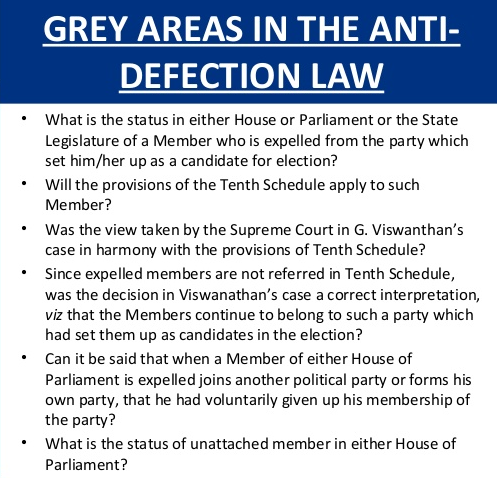
  • The hollowing out of the anti-defection law


    Efficacy of Anti-Defection Law | 30 Jul 2020

    Central idea

    The article explores the persistent challenges and loopholes in India’s anti-defection law, particularly focusing on the strategic exploitation of the Tenth Schedule. It highlights instances of group defections destabilizing democratically elected State governments and proposes urgent reforms, starting with the removal of the merger exception, to restore the efficacy of the anti-defection law and prevent its misuse. The complex scenarios in Maharashtra and historical trends underscore the need for a comprehensive legislative response to strengthen the democratic framework.

    Key Highlights:

    • Eternal Debate: The persistent nature of debates and discussions around political defections and India’s anti-defection law.
    • Speaker’s Balancing Act: Maharashtra Assembly Speaker, Rahul Narwekar, navigating the Assembly’s winter session while handling Shiv Sena factions’ disqualification petitions.

    Key Challenges:

    • Tenth Schedule Critique: Identifying and addressing weaknesses in the Tenth Schedule, allowing for strategic and unpunished political defections.
    • State Government Instability: Instances of defections leading to the collapse of democratically elected State governments in Maharashtra, Madhya Pradesh, Manipur, Karnataka, and Arunachal Pradesh.

    Key Terms/Phrases:

    • Tenth Schedule: Constitutional section housing the anti-defection law.
    • Exemptions and Amendments: Two-thirds majority merger provision, 91st Amendment’s omission of the one-third split provision, splitting and merging trends.
    • Disqualification Petitions: Filed before legislative Speakers under the Tenth Schedule.

    Key Quotes/Anecdotes:

    • Strategic Exploitation: Skillful use of exemptions under the Tenth Schedule causing democratically elected governments to crumble.
    • Defection Strategies: Instances of splits followed by mergers, highlighting a pattern of exploiting the anti-defection law for political maneuvering.

    Key Statements:

    • Legislative Response: The removal of the one-third split provision in 2003 as a response to its frequent and strategic misuse.
    • Limited Safeguard: The merger exception being the primary safeguard, prompting concerns about its efficacy in preventing group defections.

    Key Examples and References:

    • Maharashtra’s Complex Scenario: Shiv Sena and NCP factions claiming the status of the original party, forming alliances without actual mergers.
    • Surveyed Instances: Instances from Uttar Pradesh and Haryana Assemblies illustrating splits followed by mergers and rapid succession defections.

    Key Facts/Data:

    • 91st Amendment Impact: Omission of the provision allowing exemption for one-third splits in the original party in 2003.
    • Recent Instances: A decade marked by group defections leading to the destabilization of State governments.

    Critical Analysis:

    • Ailments in the Tenth Schedule: In-depth scrutiny of flaws in the anti-defection law, questioning its effectiveness and the need for reforms.
    • Strategic Exploitation: Examining how merger provisions have been strategically used to undermine the stability of elected governments.

    Way Forward:

    • Deletion of Merger Exception: Urgent removal of the merger exception as a crucial step in addressing the shortcomings in the Tenth Schedule.
    • Comprehensive Reforms: Advocating for comprehensive reforms post-deletion to fortify the anti-defection law and restore its intended efficacy.
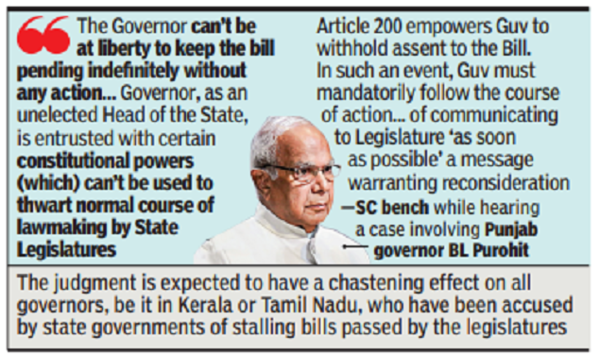
  • A blow for the rights of the legislature, in law making

    Supreme Court: Governors can't sit on bills and veto legislative action |  India News - Times of India

    Central idea 

    Chief Justice D.Y. Chandrachud’s landmark interpretation in the State of Punjab case links the Governor’s power to withhold assent to the immediate reconsideration of Bills, safeguarding legislative rights. The judgment addresses historical delays caused by Governors and raises concerns about potential strategic reservations for the President. The article emphasizes the need for clarity on Governors’ discretion and suggests a constitutional review for a comprehensive legislative framework.

    Key Highlights:

    • Landmark Judgment: Chief Justice D.Y. Chandrachud’s groundbreaking interpretation of Article 200.
    • Innovative Approach: CJI’s creative approach to constitutional nuances in the State of Punjab case.
    • Assent and Reconsideration Link: Linking the withholding of assent to the immediate reconsideration of Bills.

    Key Challenges:

    • Historical Delays: Governors’ Past Practices causing prolonged delays in decision-making.
    • Strategic Reservations: Governors exploiting the option to strategically reserve Bills for the President.

    Key Terms/Phrases:

    • Constitutional Articles: Article 200, Proviso to Article 200, Article 254.
    • Governor’s Powers: Withholding assent, reconsideration, and reservation for the President.
    • Presidential Consideration: Conditions for reserving Bills for the President.

    Key Quotes/Anecdotes:

    • Forward-Thinking Judiciary: “The CJI, in a forward-thinking approach, protects the legislature’s rights.”
    • Supreme Court’s Firm Stance: “The Supreme Court emphatically states Governors cannot unduly delay the decision on Bills.”

    Key Statements:

    • Curbing Arbitrary Power: CJI’s interpretation limits the Governor’s arbitrary power to withhold assent without prompt reconsideration.
    • Judicial Assertiveness: The Supreme Court asserts Governors’ accountability in decision-making, addressing historical lapses.

    Key Examples and References:

    • Governor of Kerala’s Discretion: Arif Mohammed Khan’s discretionary action in sending Bills to the President.
    • Tamil Nadu Governor’s Controversial Move: Sending Bills to the President against constitutional provisions sparks controversy.

    Key Facts/Data:

    • Constitutional Mandates: Second proviso to Article 200 mandates reservation for the President under specific conditions.
    • Article 254 Framework: Outlines conditions for a State law’s supremacy on Concurrent List items.

    Critical Analysis:

    • Safeguarding Legislative Rights: The judgment protects legislative rights but prompts questions about Bills reserved for the President.
    • Governor’s Discretion Scrutiny: The article scrutinizes Governors’ discretion in sending Bills to the President, highlighting potential constitutional issues.

    Way Forward:

    • Clarification Imperative: The need for further clarity on Governors’ discretion in reserving Bills for the President.
    • Constitutional Review: Examining the constitutional framework regarding Bills on State and Concurrent subjects for a comprehensive legislative landscape.
  • Parliament attacks have exposed shameful lack of security preparedness

    2001 Parliament attack: 'A shot missed me and possibly hit a reporter' |  Latest News India - Hindustan Times

    Central idea

    The breach of India’s Parliament, a symbol of democratic strength, on the anniversary of the 2001 attack reveals critical lapses in security, prompting a high-level inquiry. This collective failure of intelligence agencies underscores the need for thorough investigations, corrective measures, and strengthened security protocols to prevent recurring breaches and uphold the sanctity of parliamentary institutions.

    Key Highlights:

    • Fortress Breached: The Parliament building in India, known for its security, faces a significant breach, exposing flaws in the robust system.
    • Anniversary Irony: The intrusion occurs on the anniversary of the 2001 Parliament attack, questioning the preparedness of security agencies.
    • High-Level Inquiry: The government initiates an inquiry to identify lapses and rectify security vulnerabilities.

    Key Challenges:

    • Collective Security Failure: The breach underscores a failure of intelligence and security agencies responsible for safeguarding Parliament.
    • Questionable Access: Intruders obtained an entry pass signed by an MP, raising concerns about verification processes.
    • Efficacy of Corrective Measures: Doubts arise about the effectiveness of measures to prevent recurrent security breaches.

    Key Terms:

    • Security Blanket: Enhanced security measures implemented in a specific area.
    • Inquiry Committee: A high-level committee formed to investigate the breach and recommend improvements.
    • Tear Gas Canisters: Devices used for dispersing tear gas, hidden by intruders during the breach.

    Key Phrases:

    • “Temple of our Democracy”: Symbolic reference to the Parliament building as a stronghold of India’s democratic strength.
    • “Sanctum Sanctorum of India’s Democracy”: Describing the innermost and most sacred area of the Parliament.

    Key Quotes:

    • “How did a breach occur again? This is the main question. Those responsible should be punished.” – The author, a retired director general of Police.
    • “The incident happened on the very day on which the dreadful Parliament attacks took place 22 years ago.” – The article highlighting the irony of the timing.

    Key Examples and References:

    • Arrests Made: Four individuals, including one with an entry pass signed by an MP, are arrested in connection with the breach.
    • Historical Comparison: Drawing parallels with the 2001 Parliament attack to emphasize the breach’s significance.

    Key Statements:

    • “Egg on the Face”: The breach is described as an embarrassment to the security establishment, questioning overall preparedness.
    • “Collective Failure”: The incident is considered a collective failure of intelligence agencies, police, and security agencies responsible for Parliament security.

    Key Facts:

    • Enhanced Security: The new Parliament building, inaugurated earlier in the year, is believed to be more secure than its predecessor.
    • Timely Breach: Occurred on the day Parliament paid tributes to the martyrs of the 2001 Parliament attack.

    Key Data:

    • Total Arrests: Four individuals are arrested in connection with the breach.

    Critical Analysis:

    • Security Vulnerabilities: The breach raises concerns about the ability to prevent intrusions into highly secure areas.
    • Symbolic Timing: The timing on the anniversary adds symbolic weight to the security lapse, emphasizing the need for improvement.

    Way Forward:

    • Thorough Investigation: A comprehensive inquiry is essential to identify lapses and implement corrective measures.
    • Strengthen Security Protocols: Stricter verification processes for entry passes and enhanced security measures are crucial for preventing future breaches.
  • Mahua Moitra has no excuse

    Key Supreme Court hearing in TMC's Mahua Moitra case today. Details |  Latest News India - Hindustan Times

    Key Highlights:

    • Mahua Moitra, a former investment banker turned politician, faced allegations of sharing her Parliament ID and password with an industrialist to post questions about a rival group.
    • The Ethics Committee recommended her expulsion from Parliament, and on December 8, the motion for expulsion was adopted through a voice vote.
    • Moitra admitted to sharing her ID and password, receiving gifts, and made broader allegations that many MPs do not draft their own questions.

    Key Challenges:

    • The credibility of Parliament is at stake due to false claims by Moitra and another MP, Giridhari Yadav, that MPs generally do not frame their own questions.
    • The issue of MPs sharing their ID and password, a violation of rules, raises concerns about the security and integrity of parliamentary processes.
    • The definition of “cash for query” is debated, involving considerations of gifts, hospitality, and other non-monetary benefits.

    Key Terms:

    • Parliament Portal: The online platform where MPs submit questions, Zero Hour submissions, and Special Mentions.
    • Ethics Committee: A parliamentary committee responsible for examining matters related to the ethical conduct of MPs.
    • Cash for Query: The alleged practice of accepting material benefits in exchange for asking questions in Parliament.

    Key Phrases:

    • “Cash for query”
    • “Parliamentary question”
    • “Expulsion from Parliament”
    • “Ethics Committee”
    • “ID and password sharing”
    • “Motion for expulsion”
    • “Voice vote”

    Key Quotes:

    • Giridhari Yadav: “Even I do not remember my password. My PA knows it. I have not asked any questions, thinking God knows what will happen.”
    • Speaker’s Response: “I request all MPs to frame their questions themselves and put it up. No one else is allowed to do that.”

    Key Examples and References:

    • Mahua Moitra’s admission to sharing her ID and password, receiving gifts, and the subsequent recommendation for expulsion by the Ethics Committee.
    • Giridhari Yadav’s statement about not framing his own questions and relying on his PA.

    Key Statements:

    • Sharing ID and password with an outsider is a gross violation of parliamentary rules.
    • Moitra’s confession and broader allegations cast doubt on the autonomy of MPs in drafting their questions.

    Key Facts:

    • Moitra graduated from Mount Holyoke College, worked as an investment banker, and joined politics with stints in the Indian National Congress and Trinamool Congress.
    • The motion for expulsion was adopted through a voice vote after the Opposition walked out of Parliament.

    Key Data:

    • Date of Mahua Moitra’s expulsion: December 8
    • Number of questions MPs are allowed to submit: Five (two starred and three unstarred).

    Critical Analysis:

    • False claims about MPs not framing their own questions undermine the reputation of Parliament.
    • The issue of ID and password sharing raises questions about the security of parliamentary processes.
    • The definition of “cash for query” is explored, considering various non-monetary benefits.

    Way Forward:

    • Strengthen security measures to prevent unauthorized access to parliamentary portals.
    • Emphasize the importance of MPs independently framing their questions for the integrity of parliamentary proceedings.
    • Address the broader ethical concerns raised by Moitra’s allegations to maintain the credibility of Parliament.