💥Mains Ready By December. Smash Mains & Smash PYQ Admissions Open

Subject: Global Groupings and Conventions

Important International institutions, agencies and fora- their structure, mandate.

  • World Economic Forum (WEF) Summit at Davos

    Introduction

    • The World Economic Forum (WEF) has begun its annual summit in Davos, Switzerland.

    World Economic Forum (WEF)

    • Headquartered in Geneva, Switzerland, WEF is an international not-for-profit organization, focused on bringing the public and private sectors together to address the global political, social, and economic issues.
    • It was founded in 1971 by Swiss-German economist and Professor Klaus Schwab in a bid to promote global cooperation on these most pressing problems.
    • The first meeting of WEF was held more than five decades ago in Davos, which has been the home of the annual gathering almost ever since, also becoming the shorthand for the event.

    Purpose and Essence of the WEF

    • Bringing Stakeholders Together: The WEF gathers leaders from business, government, and civil society to address global challenges and brainstorm solutions.
    • Scope Expansion: Initially focusing on European firms catching up with US management practices, the WEF’s scope broadened to encompass economic and social issues.

    Annual Meeting in Davos

    • Membership: In 1975, the WEF introduced a membership system for the world’s top 1,000 companies.
    • Global Diplomacy: Davos serves as a backdrop for international diplomacy, offering leaders a conducive environment to defuse tensions and engage in critical discussions.
    • Historic Meetings: Notable meetings in Davos have included North and South Korea’s first ministerial-level talks and discussions on German reunification.
    • Birth of the G20: The idea for the G20, comprising 20 countries and initially focusing on global finance, emerged from discussions at the WEF in 1998.

    Funding and Davos’s Serene Environment

    • WEF Funding: The WEF is primarily funded by partnering corporations, typically global enterprises with annual turnover exceeding $5 billion.
    • Davos Setting: Davos’s tranquil surroundings provide an ideal backdrop for the WEF’s mission to foster a more prosperous global economy.

    Beyond Discussions: WEF’s Impact

    • Global Rankings: The WEF publishes influential global rankings and indices, such as the Global Competitiveness Report and the Global Gender Gap Report.
    • Significance: WEF Summit serves as a dynamic platform where leaders and stakeholders converge to address pressing global issues, fostering cooperation and innovation on a grand scale.
  • Genocide Convention invoked in Israel-Palestinian War

    Central Idea

    • South Africa has petitioned the International Court of Justice (ICJ) to declare Israel in breach of the 1948 Genocide Convention.

    Genocide Convention, 1948

    Details
    Full Name Convention on the Prevention and Punishment of the Crime of Genocide
    Adoption Date December 9, 1948
    Primary Aim To prevent and punish the crime of genocide
    Definition of Genocide Acts committed with intent to destroy, in whole or in part, a national, ethnical, racial, or religious group
    Key Provisions Includes killing or causing harm to members of a group, deliberately inflicting destructive conditions, imposing measures to prevent births, and forcibly transferring children
    Punishable Acts Genocide, conspiracy, incitement, attempt, and complicity in genocide
    Implementation and Enforcement States must enact legislation to give effect to the Convention’s provisions and provide penalties for perpetrators;

    Genocide recognized as a crime under international law

    Historical Context Created post-Holocaust and World War II as a global commitment against atrocities
    Legal Framework Impact Established legal basis for defining and prosecuting genocide, influencing international criminal law
    India’s Involvement Ratified by India on August 27, 1959;

    Principles incorporated into India’s domestic legal system

    South Africa’s Stance and Actions

    • Preventive Obligation: Following its application to the ICJ, South Africa stated its obligation to prevent genocide, seeking urgent provisional measures to halt violence in Gaza.
    • Israel’s Response: Israel has strongly condemned South Africa’s accusations, terming them as “blood libel.”
    • Potential Impact of ICJ Ruling: Even if the ICJ issues provisional measures, Israel, like Russia in the Ukraine case, may choose to ignore them.

    Historical Roots of South Africa’s Position

    • Longstanding Criticism of Israel: South Africa has a history of criticizing Israel, including suspending diplomatic relations and expressing solidarity with Palestine.
    • Colonialism and Empathy for Palestine: South Africa’s own history of colonialism and apartheid has fostered empathy towards the Palestinian cause.
    • Influential Figures: Leaders like Nelson Mandela have historically supported Palestinian rights.
    • Resistance to Western Influence: South Africa’s stance is partly influenced by a desire to resist Western-dominated worldviews, evident in its approach to global issues like the Russia-Ukraine conflict.

    Economic and Political Considerations

    • Trade Relations with Israel: Despite being Israel’s largest African trading partner, South Africa has maintained its support for Palestine.
    • Shift in African Nations’ Stance: While many African countries have softened their stance towards Israel, South Africa remains steadfast due to the ANC’s anti-discrimination roots and resistance to Western hegemony.

    Conclusion

    • Balancing Trade and Ideology: South Africa’s actions reflect a complex interplay of historical empathy, political ideology, and economic considerations in its foreign policy.
    • Global Implications: This move at the ICJ underscores the ongoing tensions in international relations, particularly in the context of the Israeli-Palestinian conflict and broader geopolitical dynamics.
  • The evolving role of the Colombo Security Conclave

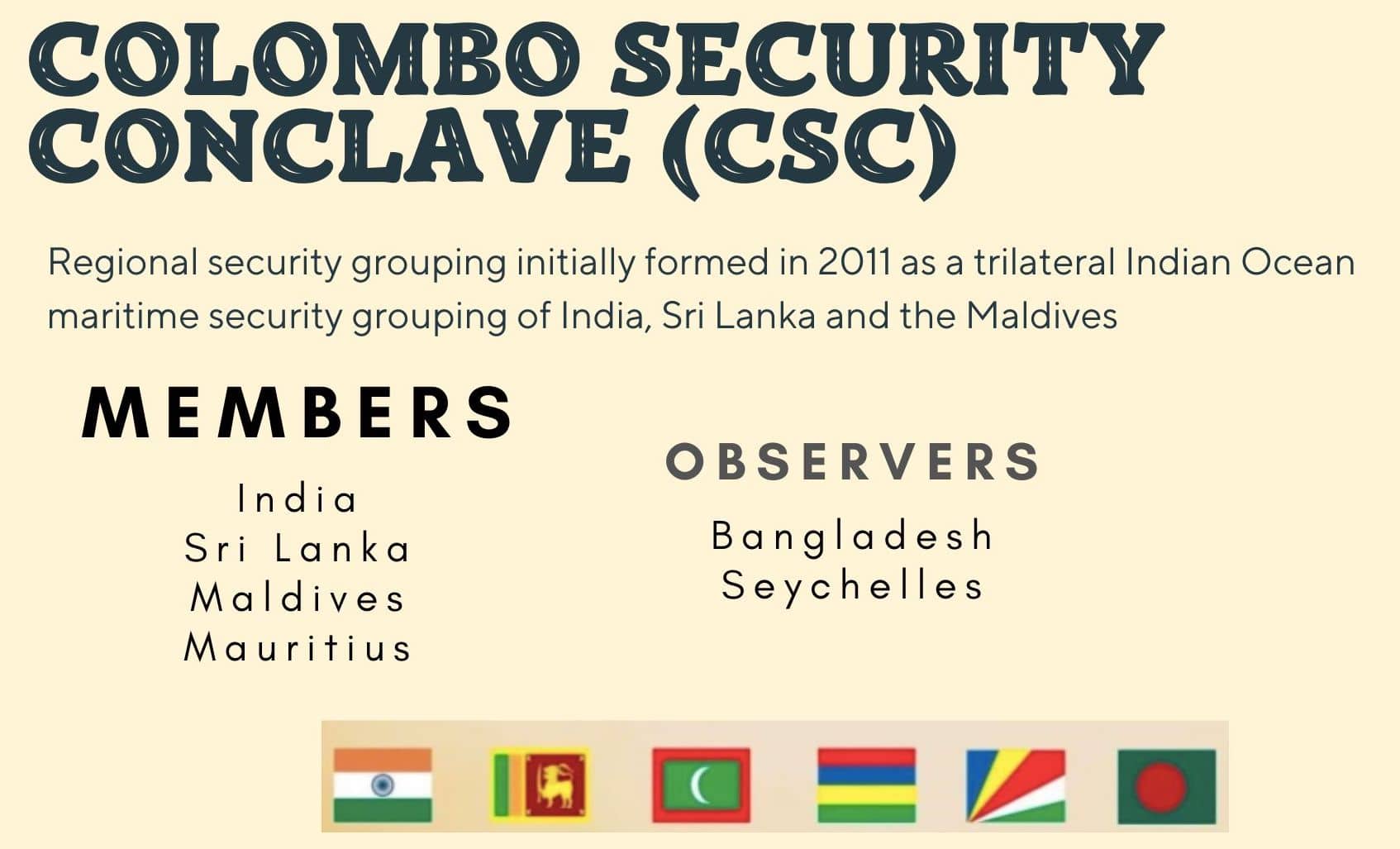
    Colombo Security Conclave

    Key Highlights:

    • The Colombo Security Conclave (CSC) aims to promote a safe, secure, and stable Indian Ocean, with India playing a leadership role.
    • The CSC’s revival in 2020, after a standstill since 2014, reflects India’s evolving strategic vision for the Indian Ocean.
    • India seeks to institutionalize its role in the region, addressing security challenges and emerging threats through the CSC.
    • China’s growing influence in the Indian Ocean is a significant factor driving the CSC’s revival, with Beijing investing in the Belt and Road Initiative (BRI) and establishing a presence in key locations.

    Key Challenges:

    • Domestic political changes in member-states can impact the CSC’s effectiveness, as seen with the Maldives’ absence from a recent meeting.
    • The nationalist and pro-China sentiments in member-states may hinder collaboration, affecting the CSC’s ability to address regional challenges.
    • Despite concerns about China’s actions in the Indian Ocean, some regional countries may not view China as a threat, limiting the CSC’s collective response.

    Key Terms/Phrases:

    • Colombo Security Conclave (CSC)
    • Indian Ocean
    • Belt and Road Initiative (BRI)
    • Maritime security
    • Regional collaboration
    • Extra-regional powers
    • Indo-Pacific
    • National Security Adviser (NSA)

    Key Quotes:

    • “The lack of capacity of island nations to secure the seas and counter transnational threats has continued to motivate India.”
    • “China’s outreach to the Indian Ocean is to control crucial sea lines of communication and trade, limiting India’s influence.”

    Key Statements:

    • “The CSC offers India an opportunity to institutionalize its role, shape the regional security architecture, and better address existing and emerging threats.”
    • “The strategic accommodation and flexibility of the CSC contribute to the security of the Indian Ocean.”

    Key Examples/References:

    • China’s naval capabilities, defense relationships, and infrastructure projects in the Indian Ocean.
    • Maldives’ absence from a recent CSC meeting due to preferences for a close relationship with China or nationalist sentiments.

    Key Facts/Data:

    • The CSC was revived in 2020, with the inclusion of Mauritius, Seychelles, and Bangladesh.
    • China’s investments in the Indian Ocean include the Belt and Road Initiative projects and control of Sri Lanka’s Hambantota port.

    Critical Analysis:

    • The vulnerability of the CSC to domestic political changes highlights challenges in maintaining consistent regional collaboration.
    • The balance between addressing security concerns and managing relationships with China is crucial for the CSC’s success.

    Way Forward:

    • Strengthen institutional mechanisms within the CSC to mitigate the impact of domestic political changes.
    • Continue to focus on the five pillars of cooperation, addressing maritime security, counter-terrorism, cyber-security, humanitarian aid, and disaster relief.
    • Enhance efforts to build trust among member-states and address concerns related to nationalist and pro-China sentiments.
  • Project PRAYAS to help Indian youth migrate abroad

    Central Idea

    • The International Organisation for Migration (IOM) introduced Project PRAYAS (Promoting Regular & Assisted Migration for Youth and Skilled Professionals) to facilitate secure and regular migration for Indian workers and students.

    What is Project PRAYAS?

    Details
    Project Name Project PRAYAS
    Introduced By International Organization for Migration (IOM)
    Partnership Ministry of External Affairs, India
    Objective To facilitate secure and regular migration for Indian workers and students
    Key Focus Enhancing coordination between state and central governments

    Addressing India’s growing role in international migration

    Providing policy recommendations for migration governance

    IOM’s Role Promoting humane and orderly migration as a United Nations agency
    Significance Represents a consolidation of state-level efforts for well-managed international migration
    Focus Areas and Activities Conducting comprehensive studies on migration trends

    Launching awareness programs for safe and orderly migration processes


    Back2Basics: International Organisation for Migration (IOM)

    Details
    Establishment 1951
    Initial Purpose To assist in the resettlement of people displaced by World War II
    Current Role Providing services and advice on migration to governments and migrants, including various displaced persons
    Type Intergovernmental Organization
    Membership 173 member states, 8 observer states
    Headquarters Geneva, Switzerland
    Key Objectives Promote humane and orderly migration Emergency response

    Link migration with development Health and support for migrants

    Facilitate managed labor migration Counter human trafficking

    UN Relationship Became a related organization of the United Nations in 2016
    India and IOM India has been a member of IOM since 1992.
  • World Bank sets up task force for MDB Reform Plan

    Central Idea

    About World Bank

    Details
    Establishment July 1944, during the United Nations Monetary and Financial Conference at Bretton Woods, New Hampshire, USA.
    Initial Purpose To help rebuild European nations devastated by World War II;

    Later expanded to include global development and poverty reduction.

    Components – International Bank for Reconstruction and Development (IBRD)

    – International Development Association (IDA)

    – International Finance Corporation (IFC)

    – Multilateral Investment Guarantee Agency (MIGA)

    – International Centre for Settlement of Investment Disputes (ICSID)

    Membership 189 member countries as of 2021.
    Headquarters Washington, D.C., United States.
    Main Functions Provides loans, credits, and grants; offers technical expertise and policy advice; researches development issues.
    Funding Through issuance of bonds in the international financial markets and earnings from its investments.
    Governance Led by a President, with a Board of Governors and a Board of Executive Directors.
    India’s Involvement – Founding member since 1944.

    – First loan approved in 1949 for Indian Railways.


    Understanding Multilateral Development Banks

    • Definition and Membership: MDBs are financial institutions with multiple country members, both developed and developing, that provide financing and technical assistance for development projects.
    • Operational Focus: Their operations span various sectors, including transport, energy, and urban infrastructure, with developed countries contributing to the lending pool and developing countries primarily borrowing for development projects.

    Rationale behind Proposed Reforms

    • Addressing Global Challenges: The climate crisis and other global issues require mechanisms for global-scale action, particularly in emerging markets and developing economies (EMDEs).
    • Aligning with National Priorities: The expert group recommends that MDBs align more closely with the developmental priorities of individual nations.
    • Enhancing Private Sector Engagement: A shift is suggested towards greater private sector involvement in MDB operations, moving away from the culture of limited interaction between private and sovereign financing arms.

    Key Aspects of the Proposed Reforms

    • Coordination and Stakeholder Involvement: The panel emphasizes the need for greater coordination among stakeholders, including national governments, to develop unified goals and policies.
    • Addressing Coordination Failures: The reforms aim to resolve multiple coordination failures among domestic and international stakeholders, both public and private.
    • Changing Perception and Practices: The current perception of MDBs as bureaucratic and risk-averse is seen as a barrier to private sector involvement, which is crucial for ramping up financing.

    MDBs’ Traditional Lending in Countries like India

    • Role in India’s Development: MDBs have been instrumental in financing key infrastructure projects in India, often with longer gestation periods.
    • World Bank’s Commitments: Since its establishment in 1944, the World Bank has committed $97.6 billion to India, with significant portions in public administration, agriculture, and transport.
    • Asian Development Bank’s Involvement: Formed in 1969, the ADB has committed $59.7 billion to India, focusing on transport, energy, and urban infrastructure.
    • Asian Infrastructure Investment Bank’s Financing: The AIIB, established in 2016, has approved $9.9 billion in financing for India, with a focus on transport, energy, and economic resilience.
    • European Investment Bank’s Contributions: Since 1958, the EIB has committed Euro 4.5 billion to India, primarily in the transport and energy sectors.

    Conclusion

    • Implications of the Recommendations: The proposed shift in MDB operations could lead to more effective and targeted development financing, aligning closely with the specific needs and priorities of individual countries.
    • Potential for Enhanced Global Impact: By addressing coordination challenges and increasing private sector engagement, MDBs could play a pivotal role in meeting global development goals and addressing critical challenges like the climate crisis.
  • Why only 5 countries have Veto Power in UNSC?

    Central Idea

    • A recent UN resolution vote, where 153 countries voted in favor and 10 against, including the USA’s support for Israel, underscores the influence of a few nations in global decisions.
    • This voting pattern brings into focus the veto powers within the UN Security Council (UNSC) and their persistence for over seven decades.

    What is the Veto Power in the UNSC?

    • Exclusive Membership: The UNSC comprises five permanent members (P5) – the USA, UK, France, Russia, and China – along with 10 non-permanent members.
    • Power of Resolutions: Unlike the General Assembly, resolutions passed by the UNSC are legally binding.
    • Veto Mechanism: Any P5 member can veto a resolution, blocking its adoption even with the required majority support.

    Rationale behind Veto Power for Permanent Members

    • Post-WWII Context: The P5, instrumental in forming the UN after World War II, were granted special rights, including veto power, as recognition of their role.
    • Strategic Necessity: The veto was considered vital to ensure the participation of these major powers in global peacekeeping efforts.

    Formation and Evolution of the UN and Veto Power

    • Foundational Discussions: The structure of veto power was developed during key meetings like the Dumbarton Oaks and Yalta Conferences.
    • FDR’s Influence: President Franklin D. Roosevelt envisioned the UN as a post-war peacekeeping body, with the ‘Four Policemen’ (USA, USSR, UK, and China) at its core.
    • USA’s Diplomatic Efforts: The United States employed strategies, including intelligence, to secure veto power in the UN Charter.

    Debate and Criticism of the Veto Power

    • Global Dissatisfaction: The exclusive nature of veto power has been a point of contention for many countries.
    • Resistance to Change: Attempts to expand the P5 or modify veto rights have been largely unsuccessful due to the vested interests of the permanent members.
    • Acknowledging Changes: The increase in non-permanent UNSC members in 1965 was a nod to the changing international environment.
    • Reforms agenda: Proposals include making all 15 seats temporary with five-year terms, encouraging open competition for seats, and imposing lobbying and term limits.

    Conclusion

    • Continued Discussions: The use of veto power in the UNSC remains a contentious issue, reflecting the complex nature of global politics.
    • Adapting to Modern Times: As the world’s political landscape evolves, there may be growing pressure to reform the UNSC’s structure and veto mechanism to better align with the current global order.
  • 75 Years of the Universal Declaration of Human Rights

    human rights

    Central Idea

    • 75th Anniversary: December 10 marked the 75th anniversary of the Universal Declaration of Human Rights, adopted by the UN General Assembly in Paris.
    • Foundation of International Order: Post-World War II, this declaration laid the groundwork for the international order, aiming to prevent future atrocities.

    Understanding the Universal Declaration of Human Rights

    • Document Structure: Comprising a preamble and 30 articles, it outlines fundamental rights and freedoms.
    • Key Provisions: Articles emphasize equality in dignity and rights, non-discrimination, the right to life and liberty, prohibition of slavery and torture, fair trial rights, asylum rights, and freedoms of religion, opinion, expression, and assembly.
    • Right to Education: The declaration also enshrines the right to education for all.

    Origins and Development

    • Post-War Sentiment: Born from the “never again” resolve after the world wars and the Holocaust, it served as a “road map” for individual rights.
    • Drafting Process: Chaired by Eleanor Roosevelt, the drafting committee represented diverse geographical regions, with over 50 countries contributing to the final draft.
    • Global Participation: Despite being drafted during widespread colonial rule, the declaration represented a collective effort, ensuring rights for all, including gender equality.

    Impact and Legacy

    • Non-Binding Nature: While not a treaty or legally binding, its principles have influenced national laws and international human rights treaties.
    • Inspiration for Movements: It spurred decolonization, anti-apartheid, and various human rights movements globally.
    • Universal Standard: Despite criticisms, it remains a universal human rights standard, influencing various subsequent human rights agreements.

    Current Challenges and Relevance

    • Contemporary Conflicts: The declaration’s anniversary comes amid ongoing human rights challenges in conflicts like Israel-Hamas, Russia-Ukraine, and internal strife in Myanmar and Sudan.
    • U.N. Secretary-General’s Concerns: Antonio Guterres noted the misuse and abuse of the declaration, with some governments undermining it.
    • Amnesty International’s View: The organization sees the declaration as a testament to the feasibility of a global human rights vision.
    • Volker Türk’s Perspective: The U.N. High Commissioner for Human Rights emphasizes the declaration’s enduring relevance, urging the world to recognize its successes and learn from its shortcomings.

    Conclusion: Upholding the Universal Declaration

    • Inherent Human Rights: The declaration underscores that human rights are intrinsic to every individual.
    • Leaders’ Responsibility: Leaders are reminded of their duty to uphold these rights, essential for the well-being of the people they serve.
  • Article 99 of the UN Charter

    Central Idea

    • The UN General Secretary wrote under Article 99 about the escalating threats to peace and security due to the situation in Gaza.
    • He mentioned the human suffering, deaths, and destruction in Israel and the Occupied Palestine Territory, emphasizing the need for a humanitarian ceasefire.

    Understanding Article 99

    • Charter as an International Treaty: The UN Charter, the founding document of the United Nations, functions as an international treaty binding member states.
    • Article 99’s Provision: It allows the Secretary-General to bring any matter to the UNSC that may threaten international peace and security.
    • Discretionary Power: This article is seen as a discretionary power, requiring the Secretary-General to exercise political judgment, tact, and integrity.

    Historical Invocation of Article 99

    • Rare Usage: Article 99 has been seldom invoked, with notable instances including the Congo upheaval in 1960 and Tunisia’s complaint against France in 1961.
    • Current Context: It is indicated that Guterres’ invocation of Article 99 over Gaza is a significant constitutional move.
    • Details of the Crisis: He mentioned the human suffering, deaths, and destruction in Israel and the Occupied Palestine Territory, emphasizing the need for a humanitarian ceasefire.

    Potential Impact

    • Draft Resolution by UAE: Following Guterres’ letter, the United Arab Emirates submitted a draft resolution to the UNSC demanding an immediate ceasefire.
    • Voting Dynamics: For the resolution to pass, it requires at least nine votes in favor and no vetoes from the five permanent members.
    • Challenges in Reaching Consensus: The likelihood of unanimous support from permanent members is uncertain, given the US and Britain’s support for Israel’s military actions since October 7.

    Conclusion

    • Guterres’ appeal underscores the severity of the humanitarian crisis in Gaza.
    • The outcome of the UNSC’s actions, influenced by Guterres’ appeal, remains pivotal in addressing the ongoing conflict and humanitarian situation in Gaza.
  • Ram Madhav writes: New India’s diplomacy – nimble and forthright

    Ram Madhav writes: New India's diplomacy – nimble and forthright | The  Indian Express

    Central idea

    India’s foreign policy has evolved, becoming more assertive and nimble. Smart oneliners and proactive diplomacy define its approach, gaining global recognition. Challenges include countering forces threatening India’s integrity, and the focus is on strategic autonomy and assertive engagement on the world stage.

    Key Highlights:

    • Diplomatic Nimbleness: Diplomacy requires swift actions and nimbleness, moving away from decades of numbness and indecision in India’s foreign policy.
    • Policy Shift in the Last Decade: India’s foreign policy underwent a significant shift in the last decade, marked by assertiveness, smart oneliners, and firm actions.
    • Global Recognition: India’s articulation on the world stage, including smart oneliners, gained global recognition and forced the world to take notice of its diplomatic stance.
    • Strategic Autonomy: India’s foreign policy is now characterized by strategic autonomy, resolute responses, and a willingness to take risks.
    • Jaishankar’s Diplomacy Principles: Foreign Minister S Jaishankar’s straightforward oneliners have become essential principles in bilateral and international diplomacy.
    • India-China Relations: Jaishankar’s emphasis on “mutual sensitivity, mutual respect, and mutual interest” forms the basis for the new bilateralism between India and China.
    • Doklam and Eastern Ladakh Standoffs: India’s proactive diplomacy combined with strong ground posturing in Doklam and Eastern Ladakh showcased a policy shift in dealing with such situations.
    • Response to Canadian Accusations: India’s determined response to Canadian Prime Minister Trudeau’s accusations demonstrated the country’s resolve in the face of baseless allegations.
    • Expectations from Allies: India, as the world’s largest democracy, expects friendly countries not to allow their territory to be misused by forces threatening its integrity.

    Key Challenges:

    • Misuse of Territory: India faces challenges from forces openly threatening its dismemberment and seeking shelter in other countries, leading to expectations that allies act against such forces.

    Key Terms and Phrases:

    • Smart Oneliners: Brief and impactful statements by leaders shaping important diplomatic principles.
    • Proactive Diplomacy: Taking initiative in diplomatic efforts to address challenges.
    • Strategic Autonomy: Ability to make independent decisions in alignment with national interests.
    • Bilateralism: Development of relationships and cooperation between two countries.
    • Policy Shift: Significant change in the approach and principles of foreign policy.

    Key Quotes:

    • “Smart oneliners” by leaders, far from being abstruse, turned out to be important policy mantras.
    • “Today’s era is not of war,” resonated well with world leaders, finding its way into the G-20 declaration in 2022.

    Key Statements:

    • India’s leadership stands shoulder-to-shoulder with leading global powers, making PM Modi and FM Jaishankar influential figures in world diplomacy.

    Key Examples and References:

    • India’s response to Canadian accusations demonstrated its determination and refusal to accept baseless allegations.

    Key Facts and Data:

    • India’s foreign policy marked by strategic autonomy, resolute responses, and a willingness to take risks.
    • India’s proactive diplomacy in Doklam and Eastern Ladakh showcased a policy shift in dealing with international challenges.

    Critical Analysis:

    • India’s nimble and forthright diplomacy brings a new assertiveness on the world stage.
    • The shift towards proactive diplomacy and smart oneliners has garnered global recognition and respect.
    • India’s expectations from allies to act against forces threatening its integrity underline its diplomatic priorities.

    Way Forward:

    • Continue proactive diplomacy and assertive foreign policy to protect national interests.
    • Collaborate with allies to address challenges posed by forces threatening India’s integrity.
    • Maintain strategic autonomy while actively engaging with global powers in diplomatic initiatives.
    • Leverage the influence gained on the world stage to further India’s interests and contribute to global stability.
  • Is the emerging global order bipolar?


    The Emerging Global Order Bipolar

    Central idea

    The world order is shifting, with the U.S. leading but China rising fast. India needs to navigate complex relations, address internal challenges, and focus on economic and military growth for a strong role globally. Amid global conflicts, balancing alliances is crucial for India’s position in the evolving geopolitical landscape.

    Key Highlights:

    • Global Order Dynamics: Shifting landscape with China’s rise, Russian challenges, and the emergence of middle powers like India.
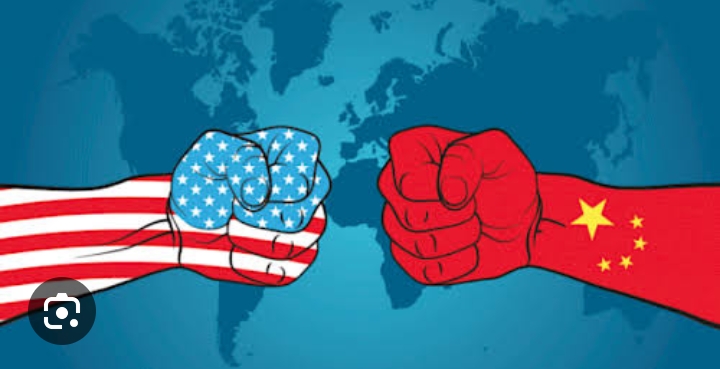
    • Asymmetric Bipolarity: Viewing the world order as asymmetric bipolarity, where the U.S. remains pre-eminent but China rapidly advances.
    • China’s Impact: Unprecedented economic and military growth redefines international power dynamics.

    Key Challenges:

    • Russia-China Nexus: The war in Ukraine strengthens Russia-China ties, posing strategic challenges for India.
    • Global Security Complexities: Conflicts in Eastern Europe and West Asia contribute to a multifaceted global security landscape.
    • Diplomatic Maneuvering: Navigating complex relations with the U.S., China, and Russia amid evolving global power dynamics.

    Key Terms and Phrases:

    • Asymmetric Bipolarity: Understanding the dynamics of uneven power distribution in the current world order.
    • People’s Power: The 21st century characterized by unprecedented connectivity, interactions, and global integration.
    • Military-Industrial Complex: The influence of industries producing destructive weapons on global violence.
    • Two-Front Dilemma: China’s strategic challenge, facing pressures in the Western Pacific and the Line of Actual Control.
    Key Quotes and Anecdotes for extra marks:


    “The present world order is in a state of flux, with asymmetric bipolarity as a defining feature.”

    “China’s GDP growth from $300 billion in 1990 to $19.3 trillion today is a historic shift in global power dynamics.”

    “India must acknowledge China as a long-term competitor, addressing power asymmetry through comprehensive national growth.”

    “Global violence is fueled by the military-industrial complex spreading instruments of death and destruction.”

    Key Statements and Examples:

    • Russia’s Pivot: Economic sanctions and the Ukraine conflict drive Russia towards closer ties with China.
    • India’s Diplomatic Complexities: Balancing trade ties with China and managing strategic challenges with the U.S. and Russia.
    • China’s Economic Surge: Unprecedented GDP growth influencing global power dynamics and necessitating India’s strategic response.

    Key Facts and Data:

    • China’s GDP Growth: A remarkable shift from $300 billion to $19.3 trillion in the last four decades.
    • India-China Trade: Standing at $138 billion, showcasing the intricate nature of bilateral relations.
    • War in Ukraine: Ongoing for the past 20 months, contributing to evolving geopolitical dynamics.

    Critical Analysis:

    • Recognition of Asymmetric Bipolarity: Acknowledging and adapting to the current world order’s uneven power distribution.
    • Comprehensive National Growth: Emphasizing India’s need to strengthen its comprehensive national power amid power asymmetry with China.
    • Global Relations Management: Recognizing and addressing challenges in India’s diplomatic strategy amidst evolving global dynamics.

    Way Forward:

    • Internal Strengthening: Addressing internal fault lines, fostering societal cohesiveness, and focusing on comprehensive national growth.
    • Strategic External Balancing: Balancing relations with the U.S. to maintain China’s two-front dilemma and preserving India’s strategic autonomy.
    • Advocacy for Global Disarmament: Addressing the root issue of the military-industrial complex, promoting global disarmament for a more peaceful world.