The Union Cabinet approved the Unified Pension Scheme (UPS) for 23 lakh central government employees.
About Unified Pension Scheme (UPS):
Explanation
Implementation Date
Effective from April 1, 2025.
Eligibility
Central government employees with at least 10 years of service.
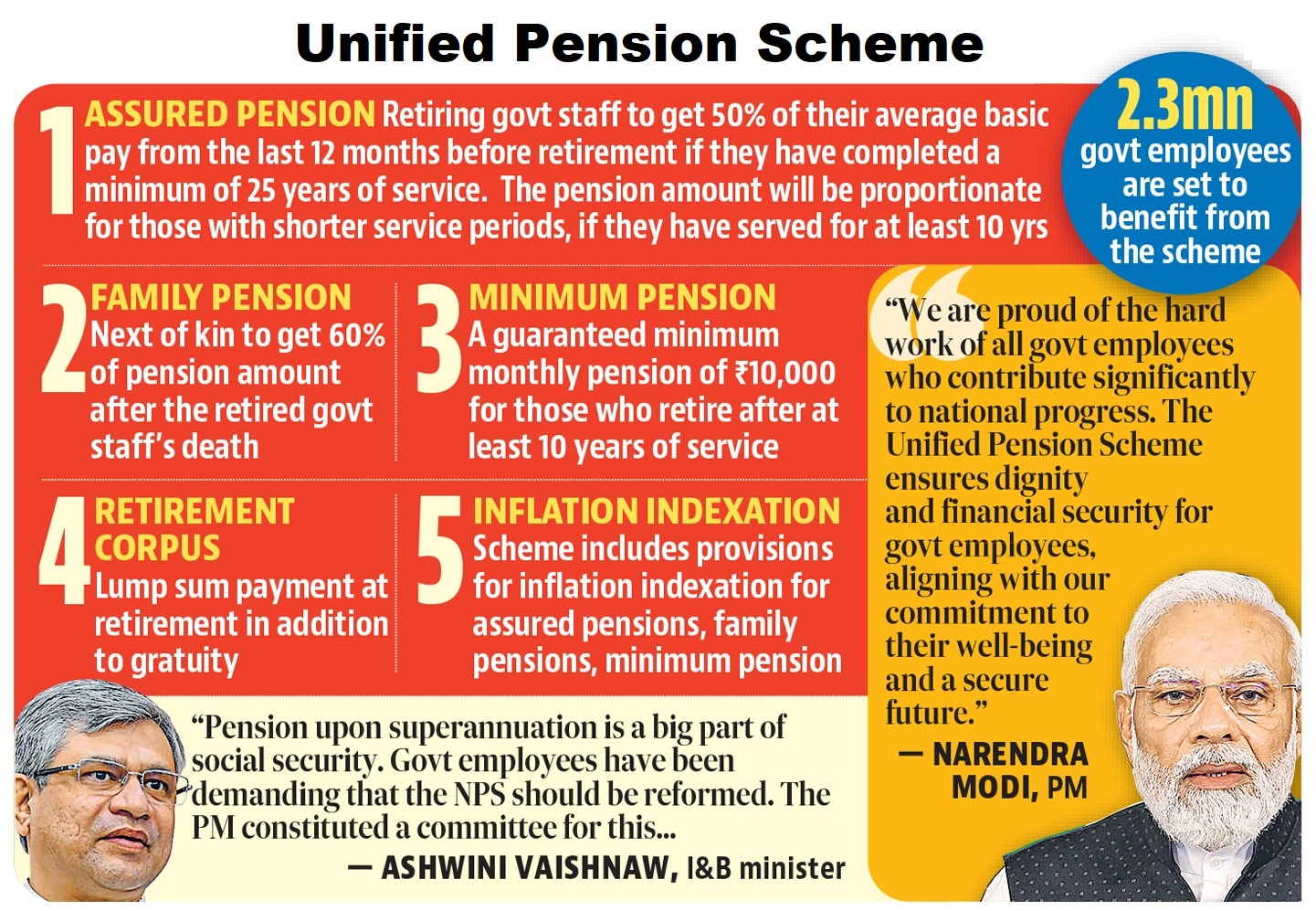
Assured Pension
50% of average basic pay over the last 12 months prior to retirement for employees with 25+ years of service.
Proportionate benefits for 10-25 years of service.
Assured Minimum Pension
₹10,000 per month for employees with at least 10 years of service.
Assured Family Pension
60% of the pension that the employee was drawing before their death.
Inflation Protection
Pensions indexed to inflation;
Dearness Relief (DR) based on the All India Consumer Price Index for Industrial Workers (AICPI-IW).
Government Contribution
18.5% of basic pay and DA, increased from 14% under the National Pension System (NPS).
Employee Contribution
10% of basic pay and DA (same as under NPS).
Lump Sum Payment on Superannuation
One-tenth of the last drawn monthly pay (including DA) for every 6 months of completed service, in addition to gratuity.
Option to Choose
Employees can choose between UPS and NPS starting from the upcoming financial year; the choice is final once made.
Beneficiaries
Initially benefits 23 lakh central government employees;
May extend to 90 lakh if adopted by state governments.
Difference from NPS
Unlike the market-dependent NPS, UPS provides a guaranteed pension amount, a minimum pension, increased government contribution, fixed family pension, and a lump sum payment at superannuation.
Significance of the UPS
Financial Security: Guarantees a pension and family pension for stable post-retirement income.
Minimum Pension: Ensures at least ₹10,000 per month for retirees, supporting lower-income employees.
Inflation Protection: Indexes pensions to inflation, maintaining purchasing power over time.
Increased Benefits: Raises government contribution to 18.5%, enhancing employee retirement benefits.
Flexibility: Allows choice between UPS and NPS based on personal financial needs.
Family Support: Provides 60% of the pension to the spouse if the employee passes away.
Employee Welfare: Aligns with government goals to improve employee welfare and post-retirement life quality.
PYQ:
[2017] Who among the following can join the National Pension System (NPS)?
(a) Resident Indian citizens only.
(b) Persons of age from 21 to 55 only.
(c) All State Government employees joining the services after the date of notification by the respective State Governments.
(d) All Central Government employees including those of Armed Forces joining the services on or after 1st April, 2004.
The recent brutal rape and murder case in Kolkata has sparked widespread calls for the death penalty for the accused.
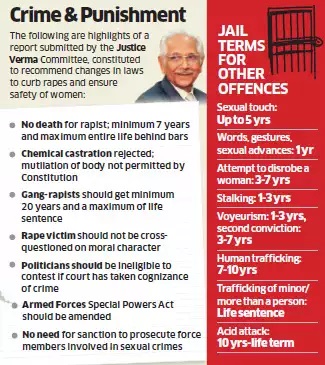
The Justice J.S. Verma Committee, formed in response to the 2012 Delhi gang rape, recommended against the death penalty for rape, even in the rarest of rare cases, arguing that it would be a regressive step.
About Justice J.S. Verma Committee Recommendations
Recommendations on
Explanation
Rape
• It recognized rape as a Crime of Power, not just passion.
• Expand definition to include all forms of non-consensual penetration.
• Remove marital rape exception; marriage should not imply automatic consent. (European Commission of Human Rights in C.R. vs U.K)
Sexual Assault
• Broaden definition to include all non-consensual, non-penetrative sexual acts.
• Penalty: Up to 5 years of imprisonment or fines.
Verbal Sexual Assault
• Criminalize unwelcome sexual threats.
• Punishable by up to 1 year in prison or fines.
Sexual Harassment at Workplace
• Include domestic workers under protections.
• Replace internal complaint committees with Employment Tribunals.
• Employers to compensate victims of sexual harassment.
Acid Attacks
• Propose a 10-year minimum punishment, separate from grievous hurt.
• Establish a compensation fund for victims.
Women in Conflict Areas
• Review AFSPA; exclude government sanction for prosecuting sexual offenses by armed forces.
• Appoint special commissioners to monitor offenses.
Trafficking
• Comprehensive anti-trafficking laws beyond prostitution.
• Protective homes for women and juveniles overseen by High Courts.
Child Sexual Abuse
• Define ‘harm’ and ‘health’ in the Juvenile Justice Act to include both physical and mental aspects.
Death Penalty
• Opposed chemical castration and death penalty for rape.
• Recommend life imprisonment.
Medical Examination of Rape Victims
• Ban the two-finger test; victim’s past sexual history should not influence the case.
Reforms in Case Management
• Set up Rape Crisis Cells, increase police accountability, allow online FIR filing.
• Encourage community policing and increase police personnel.
Union Cabinet’s Decision on the Death Penalty
The Union Cabinet, while clearing an ordinance on sexual assault in 2013, chose NOT to adopt the committee’s recommendation against the death penalty.
Key amendments included:
Section 376A: Death penalty for rape leading to the death of the victim or reducing her to a persistent vegetative state.
Section 376E: Death penalty for repeat offenders.
2018 Amendments: Death penalty for gang rape of a victim under 12 years (Section 376DB) and life imprisonment for rape of a victim under 16 years (Section 376DA).
The Bharatiya Nyaya Sanhita (BNS) includes similar provisions for rape, with specific sections detailing the punishment, including the death penalty for certain cases.
PYQ:
[2014] We are witnessing increasing instances of sexual violence against women in the country. Despite existing legal provisions against it, the number of such incidences is on the rise. Suggest some innovative measures to tackle this menace.
Q The quality of higher education in India requires major improvement to make it internationally competitive. Do you think that the entry of foreign educational institutions would help improve the quality of technical and higher education in the country? Discuss. (UPSC IAS/2015)
Q Professor Amartya Sen has advocated important reforms in the realms of primary education and primary health care. What are your suggestions to improve their status and performance? (UPSC IAS/2016)
Q National Education Policy 2020 conforms with the Sustainable Development Goal-4 (2030). It intends to restructure and reorient education system in India. Critically examine the statement. (UPSC IAS/2020)
Q The Right of Children to Free and Compulsory Education Act, 2009 remains indadequate in promoting incentive-based system for children’s education without generating awareness about the importance of schooling. Analyse. (UPSC IAS/2022)
Mentor comment: The consistently high pass rates, variations across boards, impact on higher education, and CBSE’s own concerns have kept the topic of mark inflation in the news spotlight, with calls for urgent exam reforms to restore credibility to the system. The perception of mark inflation has led to increased demand for entrance exams for college admissions. It also forces colleges to raise cut-offs, making it harder for diligent students to get admitted. The Former Education secretary Anil Swarup had attempted to abolish CBSE’s marks moderation policy in 2017 to check inflation but faced opposition from stakeholders. Experts argue that ending moderation and reforming exams is crucial to address the issue.
Let’s learn!
__
Why in the News?
The Central Board of Secondary Education (CBSE) recently issued an advisory to its affiliated schools, urging them to reevaluate practical exam assessment procedures.
A significant variation was detected between theory and practical marks for over 50% of students in around 500 CBSE schools.
Present status of School Boards in India:
Indian school boards face allegations of inflating marks for classes 10 and 12.
• High Pass Percentages: Evidence includes high pass rates—85% for class 10 and 82% for class 12 in 2023. • Students scoring above 60%: Approximately 61% of class 10 students and 56% of class 12 students scored over 60%. • Mark Compression: High clustering of marks at the top is referred to as mark compression, related to mark inflation.
What are the impacts of such marks inflation?
• Impact on Education Credibility: Both mark inflation and compression undermine the credibility of the education system. • Consequences for Students: These practices hinder student preparedness for higher education and the job market. • Demand for Entrance Exams: The perception of inflated marks has increased demand for higher-education entrance examinations.
What are the current disparities in the Indian School Education System?
Lack of a Standardized Measure: The present examination curriculum pattern makes it difficult to assess the relative academic credentials of students certified by different boards.
For example, in both secondary and higher secondary examinations, the proportion of students securing above 60% was lower than the national average in several states.
However, this does not necessarily mean that students in other states performed better on a comparable scale.
Lack of Corrective Measures: Marks are supposed to reflect a student’s academic knowledge and skills, but comparing them with standardized national-level tests like NEET and JEE is problematic.
These tests are designed as elimination processes for admission to specific higher education programs, and not to evaluate subject knowledge as per the prescribed curriculum.
Moreover, not all class 12 students appear for these entrance exams, and those who do usually undergo special coaching which incurs huge costs.
Lack of Policy Suggestions: The National Achievement Survey (NAS) conducted by NCERT for a sample of students annually is scientifically designed but fails to serve as a benchmark for studying mark inflation.
There is little scope to connect estimated scores with factors like curriculum design, school efficiency, and teaching-learning processes.
Need for Accountability in the System: The current opaque system leads to various issues, necessitating transparency in all processes, from question paper setting to marking and result publication.
What can be done for the System’s Revaluation and Enhanced Accountability?
Establish a standardized system: The govt needs to provide resources outlining how learning outcomes are assessed and marks awarded, including examples.
Further, standardize the procedures for question paper handling, answer book printing, distribution, and collection. Allow students to view their answer scripts post-results and apply for revaluation at a nominal fee.
Need for Technical Intervention: States should establish clear guidelines for question formats and expected answers. Secondly, they need to implement scanning and online evaluation to minimize errors in the marking system.
Updating the curriculum to align with higher educational standards can ensure that students are adequately prepared, reducing the need for inflated marks to reflect competence.
Public Awareness Campaigns: Educating stakeholders about the implications of mark inflation can foster a culture of integrity and accountability in educational assessments.
Collaboration with Educational Institutions: Governments can work with schools and universities to create clear pathways for students, ensuring that grades reflect true academic ability and readiness for further education or the job market.
Conclusion: While the Indian government has managed to make education accessible (SDG 4) for millions of children, the quality of said education remains still poor due to non-transparent examinations. India can attain quality school education in the real sense shortly, but it will require addressing the abovementioned challenges.
Bridge gaps in health, education, and livelihoods; enhance infrastructure in PVTG communities aligned with existing schemes from nine ministries.
Total Outlay
Rs 24,104 crore over three years
Rs 15,000 crore allocated under the Development Action Plan for the Scheduled Tribes (DAPST) for the housing component over three years.
Implementation
Central Sector and Centrally Sponsored Schemes designed to enhance socio-economic conditions of PVTGs.
The Ministry of Tribal Affairs through the State Governments/ UT Administration/departments have undertaken habitation level data collection exercise through PM Gati Shakti mobile application to estimate PVTG population figures and infrastructure gaps under PM-JANMAN Mission.
Coverage
Targets 75 PVTGs in 18 states and 1 Union Territory, focusing on health, education, and livelihoods.
Competitive Federalism
Performance-based ranking of districts; top districts and Ministries recognized and rewarded for outstanding performance.
PYQ:
[2017] What are the two major legal initiatives by the State since Independence addressing discrimination against Scheduled Tribes (STs)?
[2019] Consider the following statements about Particularly Vulnerable Tribal Groups (PVTGs) in India:
PVTGs reside in 18 States and one Union Territory.
A stagnant or declining population is one of the criteria for determining PVTG status.
There are 95 PVTGs officially notified in the country so far.
Irular and Konda Reddi tribes are included in the list of PVTGs.
Which of the statements given above are correct?
(a) 1, 2 and 3
(b) 2, 3 and 4
(c) 1, 2 and 4
(d) 1, 3 and 4
Union Minister of Information and Broadcasting has launched 25 challenges as part of the ‘Create in India Challenge – Season 1’ for the World Audio Visual & Entertainment Summit (WAVES).
About WAVES
It is an international summit organized by the Ministry of Information & Broadcasting, Government of India.
The first edition will take place from 20-24 November 2024 in Goa.
The summit will be hosted in Goa in collaboration with the State Government of Goa.
The Entertainment Society of Goa will act as the Nodal Agency for the event, following an MOU with Ministry of Information & Broadcasting.
It is supported by industry partners like the Federation of Indian Chambers of Commerce & Industry (FICCI) and the Confederation of Indian Industry (CII).
Purpose:
WAVES aims to be a pivotal forum for fostering dialogue, trade collaboration, and innovation within the evolving media and entertainment industry.
The summit will showcase India as a hub for innovation and excellence in the media and entertainment sector, attract investments, and position India as a global leader in the entertainment business.
Location & Collaboration:
WAVES is designed to promote sustainable growth in the media and entertainment industry.
It will help attract global trade and investment to India, positioning the country as a key player in the global entertainment landscape.
The summit will bring together industry leaders, stakeholders, and innovators to explore new opportunities, tackle challenges, and shape the future of the sector.
PYQ:
[2014] Though 100 percent FDI is already allowed in non-news media like a trade publication and general entertainment channel, the government is mulling over the proposal for increased FDI in news media for quite some time. What difference would an increase in FDI make? Critically evaluate the pros and cons.
PYQ Relevance: Mains: Q.1 Bring out the constructive programmes of Mahatma Gandhi during the Non-Cooperation Movement and Civil Disobedience Movement. (UPSC IAS/2021) Q.2 Can the strategy of regional-resource-based manufacturing help in promoting employment in India? (UPSC IAS/2019)
Note4Students:
Prelims: Khadi and Village Industries Commission (KVIC);
Mains:Challenges related to khadi industry;
Mentor comments: The khadi industry in India is a vital segment of the textile sector, known for its hand-spun and hand-woven fabrics made from cotton, silk, and wool. It plays a crucial role in generating employment, particularly in rural areas, with millions of artisans involved in its production. The industry has seen significant growth, with khadi production valued at ₹1,904.5 crore (USD 255.8 million) in FY21, up from ₹1,520.8 crore (USD 204.3 million) in FY17. Promoted by the Khadi and Village Industries Commission (KVIC), khadi symbolizes India’s heritage and commitment to sustainable practices.
Let’s learn —
Why in the News?
The Prime Minister’s ‘Har Ghar Tiranga’ campaign highlights moral contradiction, as machine-made polyester flags, often imported, overshadow the significance of our national flag.
The Flag Code of India has historically required the national flag to be made of “hand spun and hand-woven wool/cotton/silk khadi bunting”
Significance of Khadi Industries:
Second Largest Employer: After agriculture, the khadi industry is the second largest industry to provide employment opportunities to the unemployed and rural people
Preserving Heritage: Khadi is a national heritage fabric of India with a unique identity and a rich tradition dating back to ancient times.
Symbol of Freedom Struggle: Khadi was the fabric of the freedom struggle, with Mahatma Gandhi launching the movement of ‘spin your own cloth and buy hand-spun cloth’ in 1921
Eco-friendly Production: The production of khadi focuses on the environment right from the beginning, using locally manufactured raw materials without chemicals and energy resources.
The reason behind the Khadi procurement has fallen:
Neglect of Mandates: Government departments are reportedly ignoring or overruling mandates requiring them to procure khadi. For instance, many departments shifted to other materials, resulting in a drop in khadi purchases from ₹50-60 crore per year to ₹32 crore over a decade.
Amendment to the Flag Code: In 2022, the Government amended the Flag Code of India to allow for the use of machine-made polyester bunting for the national flag, which historically required khadi.
Tax Exemption for Polyester Flags: The government exempted polyester flags from the Goods and Services Tax (GST), placing them on the same tax footing as khadi flags.
Indefinite Strike by Khadi Producers: The Karnataka Khadi Gramodyoga Samyukta Sangha (KKGSS), the sole national flag manufacturing unit accredited by the Bureau of Indian Standards, resorted to an indefinite strike to protest the government’s actions, which they view as detrimental to the khadi industry.
Market Regulation Failures: The khadi market lacks effective regulation, leading to the sale of khadi produced from semi-mechanized charkhas alongside traditional hand-spun khadi. This situation creates confusion among consumers and undermines the authenticity of traditional khadi.
Lack of Global Promotion: The government has failed to establish a global audience for Indian handlooms, particularly khadi. For instance, khadi’s share remains very low, accounting for less than 0.22% of the total textile sector exports.
Economic Pressures on Workers: Khadi spinners and weavers are facing economic hardships, with wages remaining low at ₹200-₹250 per day despite their labour-intensive work.
Impact of Policy Changes: Recent policy changes, such as the introduction of the Goods and Services Tax (GST), have placed additional burdens on handloom workers. The GST applies to both finished khadi products and raw materials, increasing costs for producers.
Khadi and Village Industries Commission (KVIC)
•Establishment: The KVIC was established in April 1957 by the Government of India under the Khadi and Village Industries Commission Act. It is a statutory body aimed at promoting and regulating the khadi and village industries in India. •Objectives: The KVIC has three main objectives: 1. Social Objective: To provide employment in rural areas. Economic Objective: To produce saleable articles. 2. Wider Objective: To create self-reliance among people and build a strong rural community spirit.
•Affiliation and Oversight: The KVIC oversees approximately 5,600 registered khadi institutions and 30,138 cooperative societies across India. It collaborates with 30 State Khadi and •Village Industry Boards (KVIBs) to implement its programs at the state level.
•Trademark Protection: KVIC holds exclusive rights to the “Khadi” and “Khadi India” trademarks, ensuring that the term is used correctly and protecting the integrity of khadi products in the market.
Way forward:
Revitalize Government Mandates & Incentivize Khadi Procurement: Reinforce mandates requiring government departments to prioritize khadi procurement and introduce subsidies or tax incentives for using traditional hand-spun khadi, ensuring fair competition against synthetic alternatives.
Global Promotion & Fair Wages: Launch targeted campaigns to promote khadi internationally, increasing its market share while ensuring that khadi spinners and weavers receive fair wages through direct government support and better pricing mechanisms.
Q How globalization has led to the reduction of employment in the formal sector of the Indian economy? Is increased informalization detrimental to the development of the country? (UPSC IAS/2016)
Q Examine the role of ‘Gig Economy’ in the process of empowerment of women in India. (UPSC IAS/2021)
Q Besides the welfare schemes, India needs deft management of inflation and unemployment to serve the poor and the underprivileged sections of the society. Discuss. (UPSC IAS/2022)
Mentor comment: The Karnataka Platform-based Gig Workers (Social Security and Welfare) Bill, which was introduced on June 29, 2024, aimed to regulate the welfare and rights of gig workers in the state. It is the second such legislation in India after the state of Rajasthan. The proposed ‘quota-for-local’ Bill in Karnataka aims to reserve a significant percentage of jobs for locals, mandating that 70% of non-management and 50% of management positions be filled by Kannadigas. This legislation has raised concerns about its impact on migrant workers, who comprise a substantial portion of the workforce in IT and gig economy jobs.
Let’s learn!
__
Why in the News?
Karnataka’s Gig Workers Bill has raised concerns about its impact on migrant workers, which comprises a substantial portion of the workforce in IT and gig economy jobs.
Key Features of the Bill:
•Rights Protection: The Bill is designed as a rights-based framework, ensuring gig workers have protections against unfair dismissals and arbitrary payment deductions. •Social Security Fund: A welfare fund will be established, funded by a fee from aggregators based on gig workers’ earnings. This fund aims to provide social security benefits to registered gig workers. •Contractual Clarity: Aggregators must provide clear contracts detailing termination grounds and must give a 14-day notice before contract changes. •Grievance Redressal: The Bill mandates a two-level grievance redressal mechanism, requiring aggregators with over 50 workers to form an internal dispute resolution committee. •Transparency in Operations: Aggregators must disclose parameters related to work allocation and automated decision-making processes affecting workers.
How does the proposed ‘quota-for-local’ Bill impact migrant workers?
Job Opportunities: The bill could limit job opportunities for migrant workers, as companies would be required to prioritize local candidates. This may lead to a reduction in the already precarious employment options available to migrants, who often fill lower-skilled positions.
Increased Competition: The migrant workers might face intensified competition for fewer available roles, particularly in sectors where they have traditionally been employed, such as delivery services and hospitality.
Economic Migration: The bill could lead to a demographic shift in the labor market. Migrants may choose to relocate to states with more inclusive hiring practices, impacting the state’s economy and workforce diversity.
Exploitation Risks: The present Bill could make migrants more vulnerable to exploitation, as companies may feel less inclined to hire them, leading to further marginalization of these workers.
Industry Concerns: Business leaders and industry representatives have expressed concerns that the bill could deter investment and talent from flowing into Karnataka, potentially leading to job losses and reduced economic growth. The focus should be on skills rather than reservations.
What measures can be taken to protect migrant workers from exploitation?
Right to Change Employers: States need to ensure that migrant workers have the freedom to change employers without facing penalties, which can reduce their vulnerability to abuse and exploitation.
Empower Migrant workers: The government/ Private sector needs to provide comprehensive information regarding workers’ rights, including recruitment processes, legal protections, and avenues for reporting abuse.
Strengthening labor laws and legal assistance with counseling services that protect migrant workers and ensure strict enforcement through regular inspections of workplaces is a need of the hour.
Social Security and Housing Access: States need to ensure that migrant workers have access to social services, housing, and healthcare, which can help mitigate their vulnerabilities.
NITI Aayog in its report”India’s Booming Gig and Platform Economy”has said that fiscal incentives such as tax breaks or startup grants may be provided for businesses that provide livelihood opportunities where women constitute a substantial portion of their workers.
International Cooperation: Encourage countries to adopt and implement international standards and conventions that protect the rights of migrant workers, promoting safe and ethical recruitment practices.
Conclusion: The Karnataka Bill, like the Code on Social Security, 2020 and the Rajasthan Act 2023, fails to address employment issues in India. This oversight needs a rightful strategy to look into the issue concerning the gig economy as well as the migration pattern in India in past decades.
Resident doctors across India are on strike, demanding safety laws after a young doctor was tragically raped and murdered at R.G. Kar Medical College in Kolkata on August 9.
Why are Healthcare Workers Protesting?
Response to Violence: The protests were triggered by the brutal rape and murder of a young doctor at R.G. Kar Medical College and Hospital in Kolkata on August 9, 2024.
Demand for Safety: Healthcare workers are demanding laws and measures that ensure their safety while on duty.
Historical Context: Violence against healthcare workers is not a new issue in India. Previous incidents, such as the case of Aruna Shanbaug, a nurse who was sexually assaulted in 1973, underscore a long-standing pattern of violence in healthcare settings.
Working Conditions of Junior Doctors, Interns, and Nurses
Poor Working Environment: Junior doctors, interns, and nurses often work in ill-lit and poorly secured hospital environments.
Long Shifts and Exhaustion: Many healthcare workers, including the victim of the recent incident, are subjected to excessively long shifts—in this case, a 36-hour duty shift—without adequate rest or safe spaces to recuperate.
Mental Health Concerns: The stressful working conditions, combined with the threat of violence, have raised significant concerns about the mental health and well-being of healthcare workers.
Key Demands of the Protesters
Central Protection Act: The Indian Medical Association (IMA) is advocating for a Central protection law specifically for healthcare workers, similar to measures in other countries that classify assaults on medical staff as serious offenses.
Enhanced Security Measures: Protesters are calling for hospital security protocols that match those of airports, including the installation of CCTV cameras, deployment of security personnel, and improved lighting in hospital corridors and wards.
Safe Work Environment: There is a demand for immediate systemic reforms to improve working conditions, including better security arrangements and the establishment of healthcare facilities as safe zones.
Accountability and Justice: The IMA has requested a thorough investigation into incidents of violence against healthcare workers, with a focus on timely and professional handling of cases and ensuring that perpetrators face exemplary punishment.
Government Response: Following the protests, the Ministry of Health and Family Welfare issued an order mandating that any violence against healthcare workers must be reported and acted upon swiftly, with institutional FIRs to be filed within six hours of an incident.
Sole responsible for the safety of Health workers:
State Governments: Health and law enforcement are primarily state subjects in India, meaning that state governments are primarily responsible for ensuring the safety of healthcare professionals. They are tasked with implementing laws, providing adequate security in hospitals, and ensuring a safe working environment for medical staff.
Central Government: The central government plays a role in formulating national policies and frameworks that support the safety of healthcare workers.
Recent initiatives include the Ministry of Health and Family Welfare’s order mandating the filing of FIRs within six hours of any violence against healthcare workers, indicating a push for accountability and swift action.
Way forward:
Implement a Central Protection Law for Healthcare Workers: The government should fast-track the enactment of a Central law specifically designed to protect healthcare workers from violence.
Improve Working Conditions and Mental Health Support: Hospitals should prioritize creating safe and well-secured environments for healthcare workers, including reasonable shift hours, adequate rest periods, mental health support, and robust security protocols to prevent future incidents of violence.
On July 29, 2024, Rahul Gandhi (Leader of the opposition) pointed out the absence of SC/ST officers in framing the 2024 Budget.
Issue of Upper Caste Domination in Services:
Lack of Representation: During his parliamentary address, the Leader of the opposition (Rahul Gandhi) highlighted the absence of Scheduled Caste (SC) and Scheduled Tribe (ST) officers among the 20 officials involved in framing the 2024 Budget proposals. He pointed out that only one officer from the minorities and one from the Other Backward Classes (OBC) were included, underscoring a systemic lack of representation for marginalized communities in key government functions.
Upper Caste Dominance: The dominance of upper castes in senior civil service positions was confirmed by Minister of State (Jitendra Singh), who stated that out of 322 officers holding Joint Secretary and Secretary posts, 254 belonged to the general category, while only 16 were from SC, 13 from ST, and 39 from OBC categories. This indicates a significant underrepresentation of SC/ST officers in policy-making roles.
About Eligibility:
Age Limits: General category candidates can appear for the civil services examination between 21 and 32 years, with a maximum of six attempts.
SC/ST candidates can take the exam until 37 years of age with unlimited attempts.
While OBC candidates have an upper age limit of 35 years with nine attempts.
The upper age limit for Persons with Benchmark Disabilities (PwBD) is 42 years.
Reason behind the underrepresentation of SCs, STs and OBCs in upper posts of civil services:
Late Entry Disadvantage: SC/ST and PwBD candidates often join the civil services later in life and are unable to reach the highest positions due to retirement before attaining senior roles.
Cabinet Secretariat data (2nd ARC) from 2004 shows that on average, unreserved candidates enter the service at the age of 24.7 years, whereas SC, ST, and OBC members do so at 27.6 years, 26.9 years, and 27.1 years respectively.
The Solution Lies in Having a Fixed Tenure: (Way forward)
Fixed Tenure Proposal: To address the disparity, it is proposed that all civil servants, regardless of their age of entry, should have a fixed tenure of service, such as 35 years.
Retirement Age Adjustment: The retirement age limits could be adjusted to ensure all civil servants retire by around 67 years of age, with annual medical fitness checks after the age of 62.
Independent Committee Recommendation: It is suggested that an independent, multi-disciplinary committee with adequate SC/ST, OBC, and PwBD representation be established to examine this fixed tenure proposal to ensure social justice and broader representation at the highest levels of government.
Mains PYQ:
Q What are the two major legal initiatives by the state since Independence, addressing discrimination against Scheduled Tribes (ST)? (UPSC IAS/2017)
![[24th August 2024] The Hindu Op-ed: The annual accusation of board exam mark inflation](https://www.civilsdaily.com/wp-content/uploads/2024/08/24-Aug-1568x882.jpg)
![[20th August 2024] The Hindu Op-ed: The ‘livery of India’s freedom’ is under threat](https://www.civilsdaily.com/wp-content/uploads/2024/08/20-Aug-1568x882.jpg)
![[19th August 2024] The Hindu Op-ed: New migrant realities in Karnataka’s gig sector](https://www.civilsdaily.com/wp-content/uploads/2024/08/19-Aug-1568x882.jpg)