Why in the News
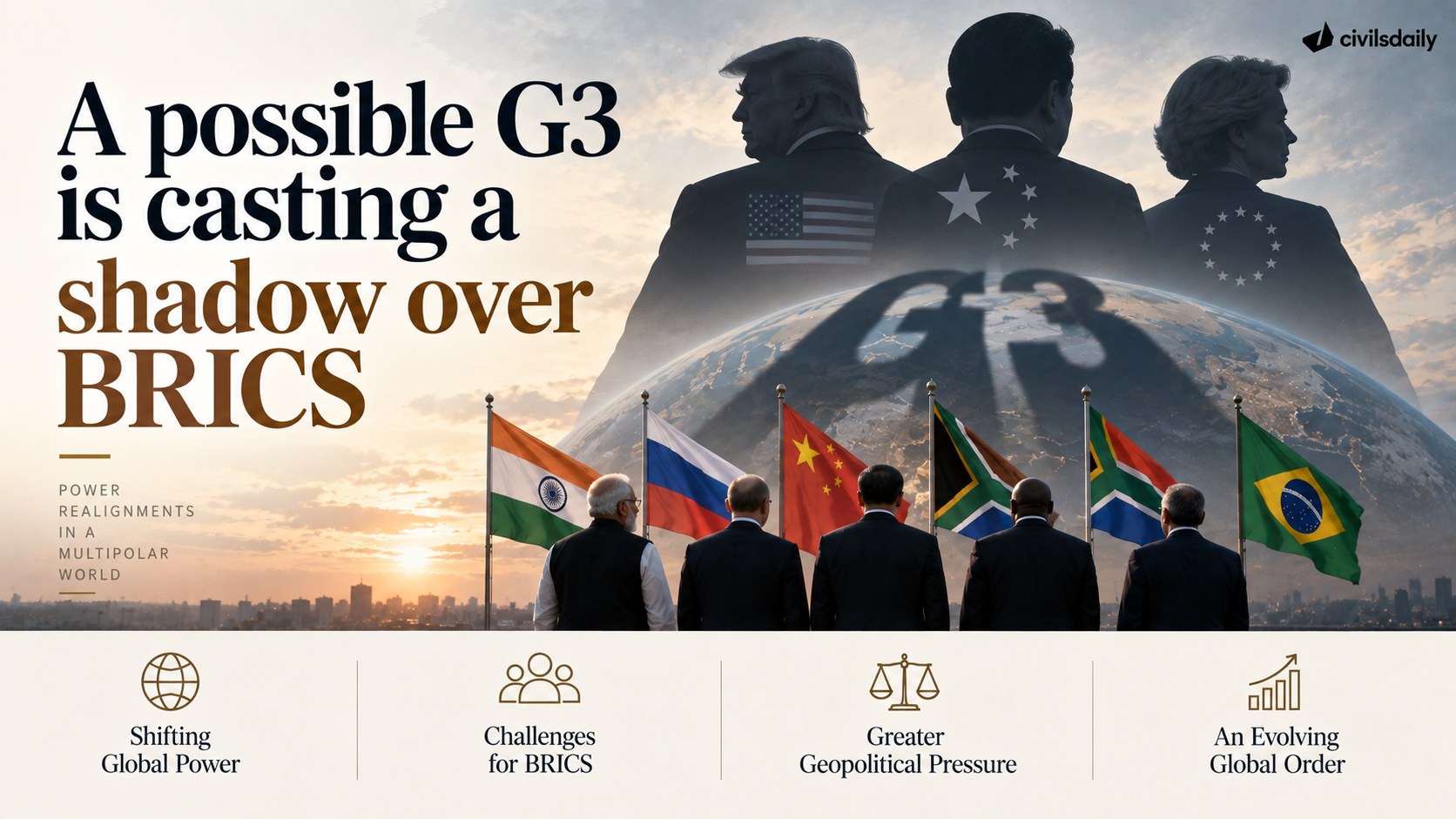
India presides over the BRICS summit in Delhi with a two fold task: to convey the forum’s shared objective of democratising the international system, and to dispel the widespread impression that it seeks to overthrow the United States led order. Both the forum’s champions and its detractors read it through an anti-Western lens. Supporters celebrate BRICS as a vehicle for resisting Western dominance, and critics warn that it is becoming a counter-bloc led by China and Russia. Neither reading survives contact with the membership, which is divided over whether its national aim is accommodation with the West, autonomy from it, parity within it, or direct confrontation. Delhi’s burden at this summit is to keep the forum from conflating autonomy from America with antagonism towards it.
Why does one anti-Western label not fit eleven members?
- Four national aims, not one: Members differ over whether their national aim is accommodation with the West, autonomy from it, parity within it, or direct confrontation, so the forum’s political orientation is a spectrum rather than a position.
- The confrontational pole: Iran sits closest to an anti-Western pole, since resistance to United States power is central to its state ideology and its recent history.
- The other end of the spectrum: At the opposite end sit members with deep economic, security and institutional ties to the West, which they maintain while pursuing greater autonomy.
- Where the two largest powers sit: Russia and China lie between the extremes. Both are in strategic competition with the West, and neither can be understood apart from its desire for status, influence and a seat at the Western high table.
Why does Brazil break the West versus Global South opposition?
- Its standing in the grouping: Brazil is Latin America’s largest power and a strong advocate for reforming global institutions.
- Its institutions are Western in origin: Its geography, language, religion, legal tradition, political institutions and elite reference points are rooted in the Iberian and Euro-Atlantic worlds.
- Its diplomatic tradition reinforces this: Brazil is a constitutional democracy whose diplomatic tradition privileges international law and multilateralism.
- What it is actually dissatisfied with: Brazil is not seeking to overthrow the West from outside. It is a Western power dissatisfied with how authority is distributed within the order it inhabits.
- What that produces in practice: Brasilia rejects automatic alignment with Washington, and is equally uncomfortable with systematic anti-Western mobilisation.
- Distance from Eurasia shapes the position: Brazil sits far from Eurasia and, unlike Delhi, is not emotionally invested in Moscow.
- China is an economic partner rather than a security problem: Brazil has no direct conflict with Russia or China, and does not share India’s security challenges with Beijing. Beijing is a leading economic partner of Brazil.
What is Brazil’s position on de-dollarisation and a common currency?
- What it supports: Brazil supports cheaper and faster bilateral settlement mechanisms, including trade in national currencies where that is useful.
- What it rejects: Brazil has rejected the notion that BRICS must promote de-dollarisation or develop a common currency to displace the dollar.
- The stated reason: A shared currency would require political trust, economic convergence and institutional integration that BRICS does not have.
- What the position reveals: Brazil’s engagement with the great powers rests on national interest rather than on ideology, and its payments position is the clearest instance of that.
How is India’s non-Western position different from an anti-Western one?
- The identity claim: The External Affairs Minister has consistently underlined India’s non-Western identity, which rests on India being a post-colonial state and a developing country.
- Where the distinction lies: India shares political values with the West. It does not want to become a geopolitical appendage to the United States and Europe.
- The record of Western partnership: India’s partnerships with the United States, Europe, Japan and Australia have deepened across trade, technology, defence and diaspora.
- Two memberships held at once: Delhi’s participation in the Quadrilateral Security Dialogue (Quad) sits alongside its membership of BRICS.
- What makes the forum useful, and what would end that: BRICS is useful to India precisely because of its diversity. It ceases to serve Indian interests if it becomes a China-led alliance against the West.
- Why the anti-Western framing is also poor analysis: Delhi knows that Moscow and Beijing, despite their confrontations with Washington, remain interested in negotiating a new balance with it.
Why are Russia and China not seeking an exit from the Western order?
- Russia’s break is structural: Russia’s contradiction with the West is now deep and structural, shaped by the Ukraine war, the North Atlantic Treaty Organization (NATO) role in European security, and sanctions.
- Yet Moscow wants recognition inside it: Russia is also eager for Western recognition as a great power, and for a say in managing European and global security.
- What China challenges: China challenges American primacy in Asia, reduces its exposure to Western technology restrictions, and presents BRICS as part of a more representative order.
- Why it cannot exit: China’s rise was inseparable from access to Western markets, capital and technology, and it retains strong economic interdependence with the United States.
- What Beijing is actually seeking: China is not seeking an exit from the United States led world. It wants to be America’s co-equal in shaping it.
Where do the newer members and Iran sit on the spectrum?
- Egypt: Egypt remains tied to Washington on security.
- The United Arab Emirates: The UAE has extensive commercial and strategic links with the United States and Europe.
- Indonesia: Indonesia’s “free and active” diplomacy is designed to retain manoeuvring room among the major powers.
- What the three have in common: They seek autonomy, closer ties with China and a stronger voice for the Global South. None seeks membership of a unified anti-Western camp.
- Iran is the nearest exception: Resistance to the United States and Israel is central to the Islamic Republic’s political identity, and BRICS offers Tehran legitimacy and a means to counter the American effort to isolate it.
- Even Iran is not settled internally: Iran’s domestic debate continues to pit advocates of resistance against those favouring diplomacy and reconciliation with the United States.
Challenges to India’s position that BRICS is non-Western rather than anti-Western
- A consensus text is attributed to every signatory: Language agreed with members at the confrontational end of the spectrum is read abroad as the position of all eleven, including the host. Eg. Tariff threats were aimed at every BRICS member over an alleged collective plan against the dollar, not only at the members proposing one.
The Fix: Insist that any payments or currency language in a declaration name the specific mechanism and its purpose, so a settlement arrangement cannot be read as currency displacement. - The forum has no charter to bound what it commits members to: BRICS has no treaty and no defined competence, so nothing limits the subjects a declaration may cover. Eg. The grouping’s declarations have expanded from development finance into positions on conflicts in West Asia and in Europe.
The Fix: Adopt a standing framework document defining the forum’s subject areas, so an item outside them needs an explicit decision rather than a paragraph. - Expansion imports the members’ own quarrels: Each admission adds a set of bilateral disputes the forum must now accommodate inside a single text. Eg. Iran and the United Arab Emirates are both members, and the UAE was attacked by Iran during the current war in West Asia.
The Fix: Handle conflict language through a separate chair’s statement rather than the consensus declaration, so one dispute cannot hold the economic agenda hostage. - Hedging is cheap only while both sides decline to price it: Simultaneous membership of the Quad and of BRICS is sustainable while neither partner charges for it, and a partner that does charge converts India’s balance into a cost. Eg. The tariff round on India last year followed disagreements in trade talks alongside its Russian oil purchases.
The Fix: Separate India’s BRICS agenda from its security alignments in public terms, so each partner judges a defined economic programme rather than an alignment.
Conclusion
The anti-Western reading of BRICS is wrong as description and useful as politics, which is why it survives. It lets a critic in Washington treat eleven different national calculations as one bloc, and it lets a member at the confrontational end claim the weight of the other ten. India’s difficulty is that the second use invites the first, and the forum has no rule that stops either. What to watch is whether the Delhi declaration describes the reform of institutions its members intend to remain inside, or the displacement of an order most of them depend on.
About BRICS
- How it began: The acronym BRIC was coined in 2001 by a Goldman Sachs economist to identify four high growth emerging economies. The first meeting of their foreign ministers took place on the margins of the United Nations General Assembly in 2006.
- How it became a summit body: The first formal leaders’ summit was held at Yekaterinburg in Russia in 2009, and South Africa joined in 2011, which gave the grouping its present acronym.
- How it expanded: The 2023 Johannesburg summit decided on enlargement. Egypt, Ethiopia, Iran and the United Arab Emirates joined in 2024 and Indonesia in 2025, with Saudi Arabia’s formal status remaining nuanced.
- The partner tier: A “Partner Country” category was introduced in 2024 to engage states such as Malaysia, Thailand and Nigeria without granting full membership.
Initiatives and Institutions under BRICS
- New Development Bank: Established in 2015 and headquartered in Shanghai, it lends for infrastructure and sustainable development in emerging economies, and had approved over $35 billion in infrastructure loans by 2025.
- Contingent Reserve Arrangement: A $100 billion fund created in 2015 to provide short term liquidity support to a member under balance of payments pressure.
- BRICS Pay: A cross-border payment system in pilot stage, intended to let members settle trade without routing instructions through SWIFT.
- Research and technology bodies: The grouping has set up a Vaccine Research and Development Centre for technology transfer, a Partnership on New Industrial Revolution covering artificial intelligence and green technology, and a Space Council created in 2025 to coordinate deep space and lunar research.
Key Facts about BRICS
- Membership: Eleven full members: Brazil, Russia, India, China, South Africa, Egypt, Ethiopia, Indonesia, Iran, Saudi Arabia and the United Arab Emirates.
- Share of population and output: The grouping represents over 45% of the world’s population and accounts for roughly 37% of global GDP measured at purchasing power parity, which is above the G7’s share.
- Energy weight: Members together control roughly 42% of global oil production and exports.
- How it is organised: BRICS works through an annually rotating chairship, with the chair hosting the leaders’ summit and setting the year’s agenda. Decisions are taken by consensus among all members.
Matching Previous Year Question
“[2026, GS2, 10 marks] “BRICS acts as a powerful counterweight in global governance, actively amplifying the voice and influence of the Global South.” Explain the role of BRICS in projecting itself as an alternative to other groupings.”