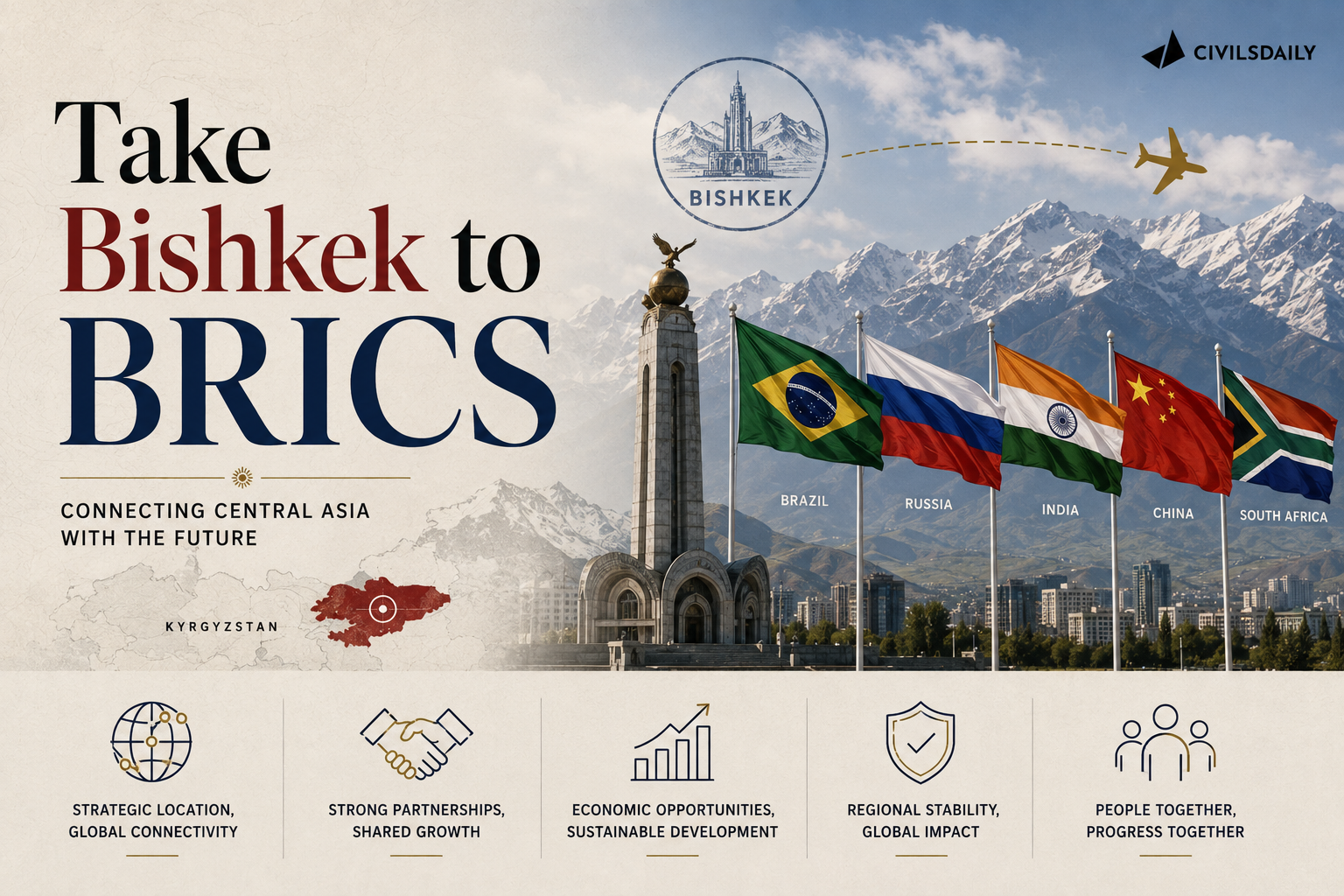
Why in the News
The Bishkek SCO summit offered India a preview of the challenges awaiting BRICS: balancing strategic autonomy, geopolitical rivalry, institutional cooperation and an increasingly diverse, difficult-to-align membership.
Why is Central Asia’s diversification an opening for India?
- A region loosening one dependence: Central Asia was shaped by its Soviet past and still maintains economic links with Russia, but its five countries no longer treat Moscow as their sole partner.
- China, Iran and the Gulf as alternatives: The region now looks to China for trade, investment and infrastructure, and to Iran and the Gulf for access to the south. The ongoing conflict complicates the southern route.
- Shared security concerns: The region’s growing strategic importance and shared concerns, including terrorism, are what led India and all Central Asian states except Turkmenistan to establish strategic partnerships, which gives India standing before the summit began.
How can India build connectivity without a land route?
- Geography blocks the direct routes: There is no overland access through Pakistan, and Afghanistan’s airspace remains beset by security risks. The absence of direct land access has constrained trade and wider economic and cultural engagement.
- Connectivity as strategic geography: Connectivity goes beyond roads and railways. It shapes the economic and strategic geography of Eurasia, so India must expand engagement in ways that overcome the limits geography imposes.
- Start with what does not travel by road: The starting point is products and services that do not depend on roads, namely services, digital systems and technological investments.
Why is the SCO a weak platform for India’s terrorism agenda?
- What India asked for: The Prime Minister called on the international community to collectively dismantle the ecosystem of terror, including its financing and recruitment networks.
- The will has weakened: International political will against terrorism has weakened over the past year, and the forum reflects that shift.
- Pakistan’s recovered standing: Over the past year Pakistan has largely overcome its diplomatic isolation, and it is set to assume the SCO’s rotational chairmanship.
- A forum that could not agree on words: In June last year the SCO defence ministers could not agree on the references to terrorism in their joint statement.
- China’s financial weight: China possesses greater financial resources than any other member and is heavily investing in Central Asian infrastructure under the Belt and Road Initiative, which sets the forum’s centre of gravity.
Why should bilateral ties be the objective inside a multilateral forum?
- Weight on individual partnerships: Given the forum’s limits, Delhi should place greater weight on its individual partnerships with member states.
- The Uzbekistan uranium agreement: The agreement with Uzbekistan on the long-term supply of uranium is a step in that direction.
- Multi-vector actors want options: Central Asian countries are emerging as multi-vector actors. They seek multiple options to improve market access rather than choosing between competing powers, and India should become one of those options.
- The forum as a venue: A multilateral forum like the SCO is best used to advance bilateral relationships, and that is the strategy to carry forward to BRICS as India prepares to host its 18th summit.
Conclusion
The SCO no longer delivers on India’s terrorism agenda, and geography limits what it can deliver on connectivity. What remains useful is the room the summit gives India to sign with individual member states. The test of that approach is whether the BRICS summit in New Delhi produces bilateral agreements of the Uzbekistan uranium kind rather than only a joint declaration.
Back2Basics: Shanghai Cooperation Organisation
- Origin: Founded in 2001 in Shanghai, growing out of the Shanghai Five grouping of 1996 that settled border issues between China, Russia and three Central Asian states.
- Membership: Ten members, China, Russia, Kazakhstan, Kyrgyzstan, Tajikistan, Uzbekistan, India, Pakistan, Iran and Belarus. India and Pakistan joined in 2017, Iran in 2023 and Belarus in 2024.
- Structure: The Secretariat is in Beijing and the Regional Anti-Terrorist Structure is in Tashkent. The chairmanship rotates annually among members, and the chair hosts the next summit.
“[2026, GS2, 10 marks] “IPMDA (Indo-Pacific Partnership for Maritime Domain Awareness) bridges the gap between India’s SAGAR (Security and Growth for All in the Region) vision and the Quad’s collective Indo-Pacific strategy.” Make a critical assessment of the statement focusing on IPMDA.”
