💥Mains Ready By December. Smash Mains & Smash PYQ Admissions Open

Subject: Inflation

  • Retail Inflation Rises to 4.4%

    Why in News?

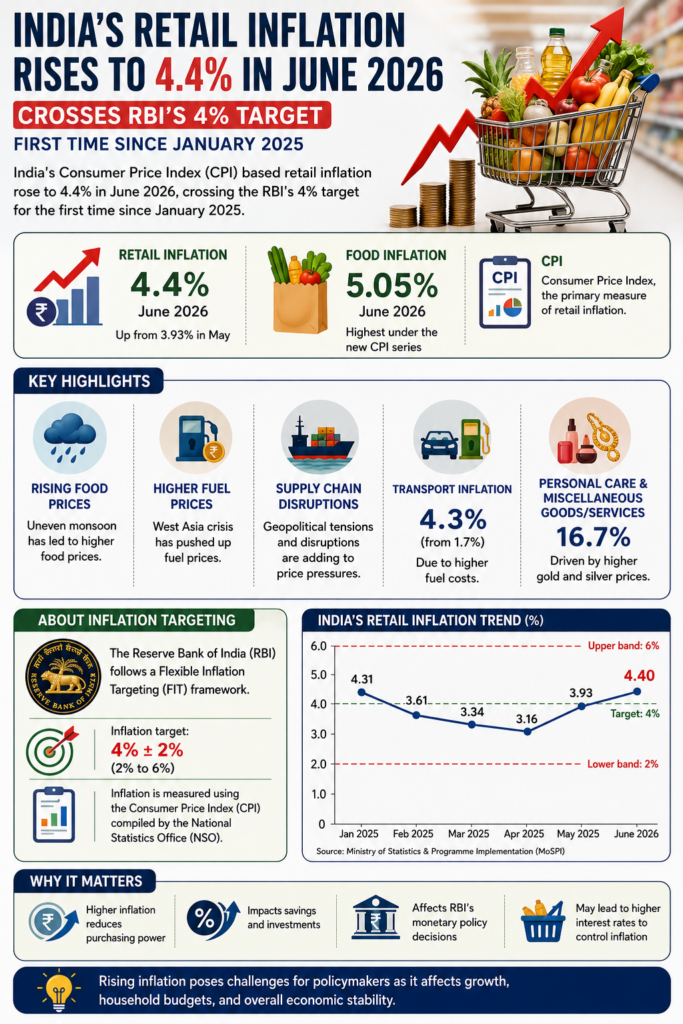
    India’s Consumer Price Index (CPI) based retail inflation rose to 4.4% in June 2026, crossing the RBI’s 4% target for the first time since January 2025.

    Key Highlights

    • CPI: Consumer Price Index, the primary measure of retail inflation.
    • Retail inflation: 4.4% (June 2026), up from 3.93% in May.
    • Food inflation: 5.05%, the highest under the new CPI series.
    • Major drivers:
      • Rising food prices due to an uneven monsoon.
      • Higher fuel prices amid the West Asia crisis.
      • Supply chain disruptions and geopolitical tensions.
    • Transport inflation rose to 4.3% (from 1.7%) because of fuel costs.
    • Inflation in personal care & miscellaneous goods/services reached 16.7%, driven by higher gold and silver prices.

    About Inflation Targeting

    • The Reserve Bank of India (RBI) follows a Flexible Inflation Targeting (FIT) framework.
    • Inflation target: 4% ± 2% (2% to 6%).
    • Inflation is measured using the Consumer Price Index (CPI) compiled by the National Statistics Office (NSO).

    [2022] In India which one of the following is responsible for maintaining for prices stability by controlling inflation?

    [A] Department of Consumer Affairs

    [B] Expenditure Management Commission

    [C] Financial Stability and Development Council

    [D] Reserve Bank of India
  • With reference to India, consider the following Statements

    With reference to India, consider the following Statements:
    1. The Wholesale Price Index (WPI) in India is available on a monthly basis only
    2. As compared to Consumer Price Index for Industrial Workers (CPI (IW)), the WPI gives less weight to food articles.
    Which of the statements given above is/are correct?

  • Consider the following statements

    Consider the following statements :
    1. Inflation benefits the debtors.
    2. Inflation benefits the bond-holders.

    Which of the statements given above is/are correct?

  • Consider the following statements

    Consider the following statements:
    1. The weightage of food in Consumer Price Index (CPI) is higher than that Wholesale
    Price Index (WPI).
    2. The WPI does not capture changes in the prices of services, which CPI does.
    3. Reserve Bank of India has now adopted WPI as its key measure of inflation and to
    decide on changing the key policy rates.
    Which of the statements given above is/are correct?

  • Consider the following statements

    Consider the following statements:

    Other things remaining unchanged, market demand for a good might increase if:

    1.The price of its substitute increases.
    2.The price of its complement increases.
    3.The good is an inferior good, and the income of the consumers increases.
    4. Its price falls.
    Which of the above statements are correct?

  • Base Year Revision of Wholesale Price Index (WPI)

    Why in the news?

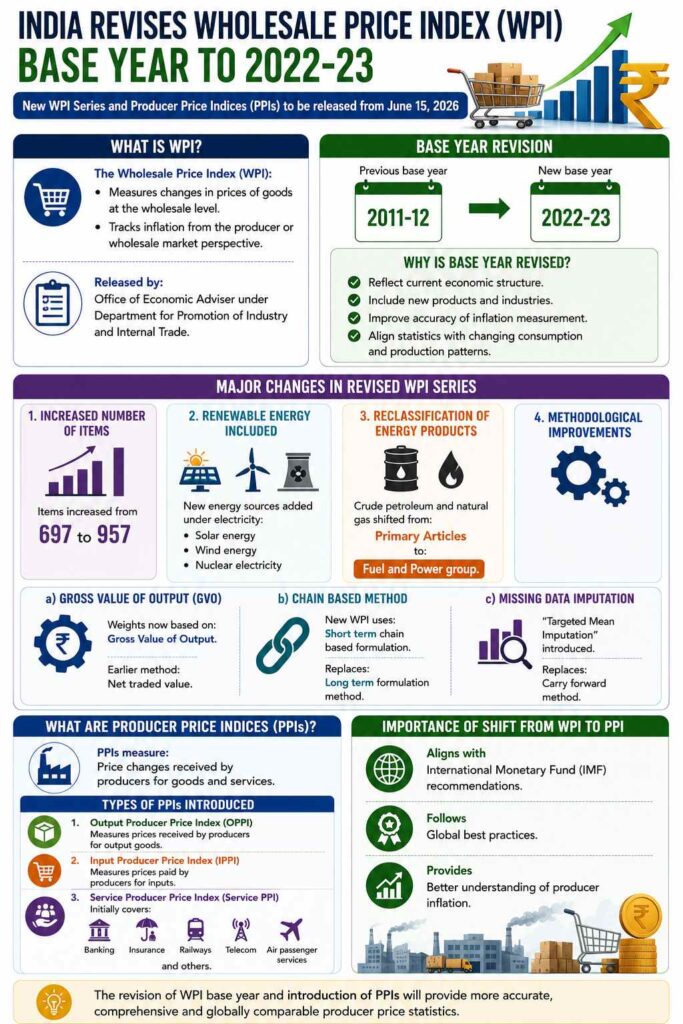
    The Government of India has revised the base year of the Wholesale Price Index (WPI) from 2011-12 to 2022-23. The revised WPI series and new Producer Price Indices (PPIs) will be released from June 15, 2026.

    What is WPI?

    The Wholesale Price Index (WPI):

    • Measures changes in prices of goods at the wholesale level.
    • Tracks inflation from the producer or wholesale market perspective.
    • Released by:
      • Office of Economic Adviser under the Department for Promotion of Industry and Internal Trade.

    Base Year Revision

    • Previous base year: 2011-12.
    • New base year: 2022-23.

    Why is Base Year Revised?

    Base year revision helps:

    • Reflect current economic structure.
    • Include new products and industries.
    • Improve accuracy of inflation measurement.
    • Align statistics with changing consumption and production patterns.

    Major Changes in Revised WPI Series

    Increased Number of Items

    • Items increased from: 697 to 957.

    Renewable Energy Included

    New energy sources added under electricity:

    • Solar energy
    • Wind energy
    • Nuclear electricity

    What are Producer Price Indices (PPIs)?

    • PPIs measure: Price changes received by producers for goods and services.

    How is PPI connected to WPI?

    1. WPI is essentially a traditional form of producer price measurement for goods.
    2. PPI expands the scope of WPI by:
      • including services,
      • measuring both input and output prices,
      • capturing production stage inflation more accurately.
    3. India’s revised WPI and introduction of PPI indicate a gradual transition toward a modern producer inflation framework.

    Components Linking WPI and PPI

    1. Output Producer Price Index (OPPI)

    • Similar to WPI because it measures prices received by producers for selling goods.
    • WPI can be viewed as partially comparable to OPPI for goods.

    2. Input Producer Price Index (IPPI)

    • Measures prices paid by producers for raw materials, fuel, machinery, etc.
    • WPI does not capture this aspect separately.

    3. Service PPI

    • Completely absent in WPI.
    • Covers sectors like banking, telecom, insurance, railways, aviation.

    [2020] Consider the following statements:
    1. The weightage of food in the Consumer Price Index (CPI) is higher than that in the Wholesale Price Index (WPI).
    2. The WPI does not capture changes in the prices of services, which the CPI does.
    3. The Reserve Bank of India uses WPI as its key measure of inflation to decide changes in policy rates.
    Which of the statements given above is/are correct?

    [A] 1 and 2 only

    [B] 2 and 3 only

    [C] 1 and 3 only

    [D] 1, 2 and 3

  • Which one of the following statements is an appropriate description of deflation

    Which one of the following statements is an appropriate description of deflation ?

  • A rapid increase in the rate of inflation is sometimes attributed to the “base effect”. What is “base effect”

    A rapid increase in the rate of inflation is sometimes attributed to the “base effect”. What is “base effect”?

  • India has experienced persistent and high food inflation in the recent past. What could be the reasons

    India has experienced persistent and high food inflation in the recent past. What could be the reasons?

    1. Due to a gradual switchover to the cultivation of commercial crops, the area under the cultivation of food grains has steadily decreased in the last five years by about 30%.
    2. As a consequence of increasing incomes, the consumption patterns of the people have undergone a significant change.
    3. The food supply chain has structural constraints.

  • A rise in general level of prices may be caused by

    A rise in general level of prices may be caused by
    1. an increase in the money supply
    2. a decrease in the aggregate level of output
    3. an increase in the effective demand
    Select the correct answer using the codes given below.