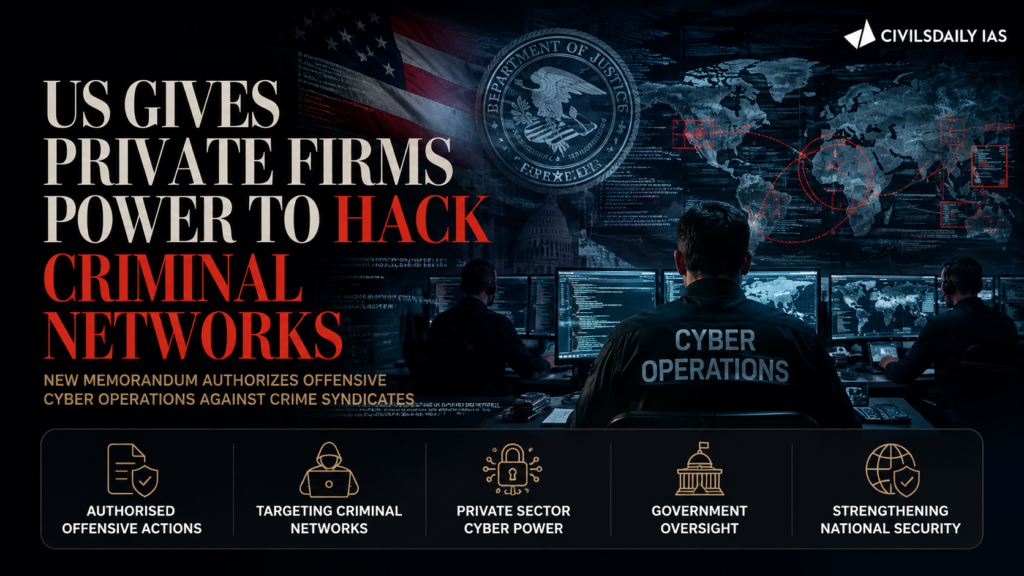
A US presidential memorandum allows vetted private companies to participate in government-authorised offensive cyber operations against overseas transnational criminal organisations (TCOs).
Note: Vetted private firms are privately owned companies that have passed thorough background checks by a client, usually a government agency, to prove they are safe, reliable, and qualified to do sensitive work
What does the memorandum allow?
Private participation: Selected firms can conduct hacking operations under government supervision.
Permitted actions: Operations may include entering, disabling or destroying criminal networks’ systems.
Oversight: Firms require government contracts, security vetting and supervision.
Targets: Criminal organisations attacking US persons or interests, excluding entities formally controlled by foreign governments.
Key Concepts
TCO: Criminal network operating across national borders.
Offensive cyber operation: Entering, disrupting or destroying another computer system.
Attribution: Identifying the actor responsible for a cyberattack.
Hacktivist: Non-state actor conducting cyber operations for political or ideological purposes.
Why is it controversial?
Misattribution: Attacks may hit innocent third-party systems.
Collateral damage: Destructive operations can affect infrastructure in other countries.
Escalation: Private hacking can trigger cross-border conflicts.
Accountability: Commercial actors may have weaker accountability than state agencies.
Proxy problem: It resembles the private or proxy cyber models the US has criticised in China and Russia.
Implications for India
India has no publicly declared offensive cyber doctrine.
Sections 43 and 66 of the IT Act, 2000 criminalise unauthorised access and damage.
Compromised Indian servers could become staging infrastructure for foreign cyber operations.
India continues to advocate state responsibility and opposition to cyber proxies at the UN.
Prelims Pointers
CERT-In: National agency for cyber incident response.
NCIIPC: Protects Critical Information Infrastructure.
I4C: Coordinates India’s response to cybercrime.
Defence Cyber Agency: Handles cyber operations for the armed forces.
Section 70B, IT Act: Provides the statutory basis for CERT-In.
[2022, GS3, 10 marks] What are the different elements of cyber security? Keeping in view the challenges in cyber security, examine the extent to which India has successfully developed a comprehensive National Cyber Security Strategy.”
[2017] In India, it is legally mandatory for which of the following to report on cyber security incidents? 1.Service providers 2.Intermediaries 3.Corporate bodies Select the correct answer using the code given below:
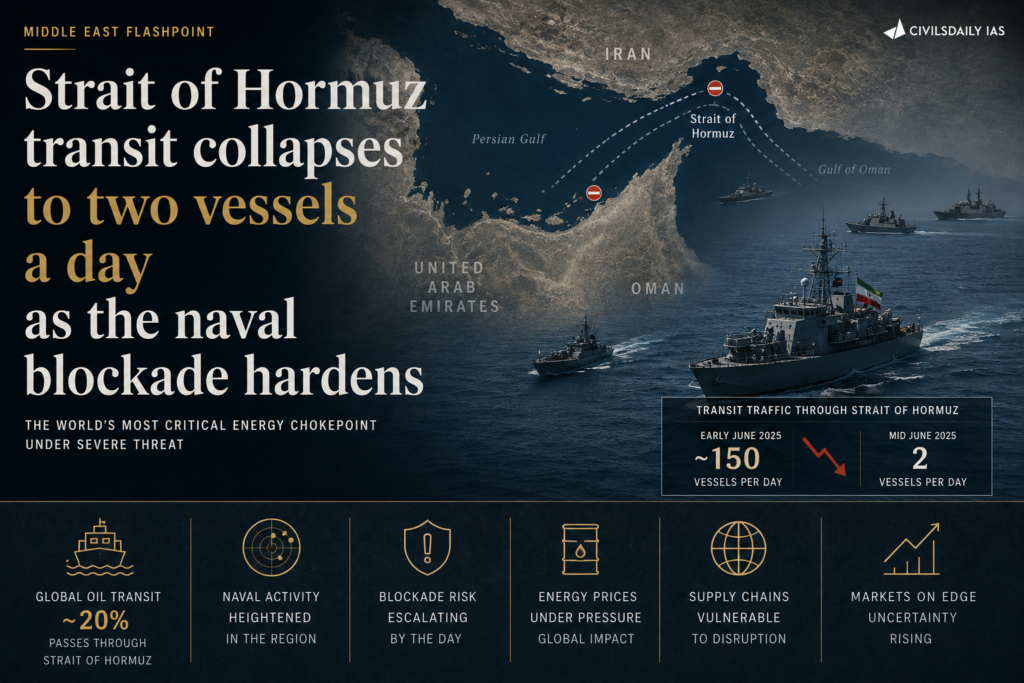
Transit through the Strait of Hormuz fell to two vessels on Friday after two more ships were attacked in the waterway, against more than 130 crossings a day before the war began in February. The near standstill has turned Iran’s ability to close the strait into the decisive bargaining instrument of the war, and has pushed the United States to place cheaper fuel above nuclear denial as its first stated war aim.
What is the Strait of Hormuz?
Location: The strait connects the Persian Gulf to the Gulf of Oman and the Arabian Sea, with Iran on the northern shore and Oman’s Musandam peninsula and the United Arab Emirates on the southern shore.
Dimensions: It narrows to about 21 nautical miles, with inbound and outbound traffic separated into lanes about two nautical miles wide each.
Volume carried: About a fifth of global petroleum liquids consumption passes through it, along with a large share of the world’s seaborne liquefied natural gas.
Why it cannot be bypassed: Gulf producers hold limited pipeline capacity that avoids the strait, so most Gulf crude has no alternative route to the open ocean.
Legal position of the lanes: The shipping lanes lie inside the territorial seas of Iran and Oman, so passage rests on the transit passage regime rather than on high seas freedom of navigation.
What is a maritime chokepoint?
About: A chokepoint is a narrow channel on a high volume shipping route where traffic must converge and cannot be economically rerouted.
Why it matters: Closure at a chokepoint raises freight and insurance costs across an entire trade, because the alternative is a far longer voyage or no voyage at all.
What is a naval blockade?
About: A naval blockade is the use of warships to prevent vessels from entering or leaving an adversary’s ports or coastline.
Its object here: The United States blockade is aimed at stopping Iran from selling oil and at inflicting economic damage rather than at seizing territory.
Who is the Abu Dhabi National Oil Company (ADNOC)?
About: ADNOC is the state owned oil and gas company of the United Arab Emirates and one of the largest producers in the Gulf.
Its role in the news: Two vessels affiliated to ADNOC were attacked while transiting the strait, and the UAE government blamed Iran for the attack.
What is going dark on the Automatic Identification System?
About: Merchant ships broadcast their identity and position through a transponder, and switching it off removes them from public tracking.
Effect on the count: Vessel counts drawn from tracking data understate real traffic, because ships moving with transponders off are not recorded.
How far has traffic through the strait actually fallen?
Friday count: Two vessels passed through the waterway, a grain ship entering Iranian waters and an empty dry bulk ship moving in the opposite direction.
A third movement: A separate empty liquefied petroleum products tanker was sailing into the Gulf through the strait on the same day.
No crude at all: No crude oil shipments were visible on Friday.
Preceding days: Nine vessels passed through on Thursday, up from five on Wednesday.
Benchmark for the month: The August average stands at 12 vessels a day.
Pre war benchmark: More than 130 ships traversed the strait daily before the war launched by the United States and Israel on Iran in February.
Measurement caveat: Some ships may pass undetected with their transponders switched off, so the recorded figures are a floor rather than a full count.
Why is control of the strait Iran’s main leverage?
Analyst assessment: The principal Middle East analyst at a risk intelligence firm assessed that Iran’s ability to restrict shipping through the strait is its main source of leverage in negotiations, alongside the threat to regional energy infrastructure.
A permission regime at sea: Iran has resumed attacks on ships it accuses of trying to transit the strait without its permission.
Talks stalled: A senior Iranian source stated on Wednesday that there had been no progress in talks to build on the June agreement to end the war.
Collapse of the ceasefire: The ceasefire renewed under the June deal has broken down, which preceded the resumption of attacks on shipping.
Conditions for reopening: Iran has said it will not allow the waterway to reopen until economic sanctions are removed and frozen Iranian assets are released.
Legislative backing: An Iranian parliamentary committee approved a plan for the strait on Thursday that bans the transit of United States, Israeli and other hostile countries’ assets and equipment.
Attack on Emirati vessels: ADNOC said two of its vessels were attacked while transiting the strait on Thursday evening, and Iran made no immediate comment on the Emirati accusation.
How has the closure reordered United States war aims?
Stated reversal of priorities: The Vice President stated that goal number one is to keep oil and gas cheap for Americans and that goal number two is to ensure Iran never gets a nuclear weapon.
The original justification: Preventing Iran from obtaining a nuclear weapon had been the consistently stated main reason for the war.
Domestic pressure: The war is unpopular, the President’s approval rating is falling and midterm elections are due in November.
Party calculation: Republicans fear that the war and the gasoline prices it has driven up will cost them control of Congress.
Military constraint: The United States military burned through stockpiles of costly high technology missiles and is running low, which limits the option of resuming large scale attacks.
Blockade endurance: The Defence Secretary stated that the navy can maintain the blockade indefinitely by rotating ships in and out of the region.
Negotiating posture: The President described the approach as low keying it and only semi negotiating, days after saying an agreement to reopen the strait was imminent.
Economic track: The Treasury Secretary announced measures of economic isolation without precedent, with further announcements expected next week.
What do the positions of the other parties show about the cost of the closure?
United Arab Emirates: Its state oil company had two vessels attacked in the strait and the government publicly blamed Iran, which shows that Gulf producers outside the war are absorbing its shipping costs.
Iran: Its parliamentary committee converted the closure into a formal transit ban on the assets and equipment of hostile states, which shows the closure is now settled policy rather than episodic reprisal.
United States: It has moved from strikes to a naval blockade of Iranian ports and a bar on Iranian oil sales, which shows the war has become an economic siege rather than a military campaign.
Israel: It launched the war jointly with the United States in February and is named in Iran’s transit ban, which shows the strait is being used to impose costs directly on the belligerents.
Limits of the evidence: These are the only national positions the reporting supplies, so the effect on Asian importers is documented through prices rather than through stated country positions.
How exposed is India to a prolonged closure of the strait?
Crude dependence: India imports over 85 percent of the crude oil it consumes and is the third largest crude importer in the world.
Route concentration: Iraq, Saudi Arabia, the United Arab Emirates and Kuwait are among India’s largest suppliers, and cargoes from all four leave the Gulf through Hormuz.
Gas contracts: Qatar supplies close to half of India’s liquefied natural gas under long term contracts, and every one of those cargoes transits the strait.
Fertiliser inputs: Urea, ammonia and phosphatic raw material contracted from Oman, Saudi Arabia and Qatar move on the same route, which links the strait directly to the fertiliser subsidy bill.
Seafarers: Indians form a large share of the global seafaring workforce and crew a substantial part of Gulf trade, so attacks on merchant shipping place Indian crews directly at risk.
Price transmission: A sustained rise in crude prices widens the current account deficit, raises the oil import bill and feeds into domestic fuel and freight costs.
Insurance and freight: War risk premiums on Gulf voyages rise sharply during a closure, which adds a cost to every cargo that does move.
Remittances and diaspora: About nine million Indians live and work in the Gulf, so a prolonged war in the region carries an employment and remittance risk alongside the energy risk.
Challenges to keeping the Strait of Hormuz open
Narrow lanes inside territorial waters: The shipping lanes run through Iranian and Omani territorial seas, which lets a littoral state interfere with passage at short notice. e.g. Iranian forces seized the container ship MSC Aries near the strait in April 2024.
Mines and fast attack craft: Sea mines and small armed boats can close a channel at very low cost against far more expensive warships. e.g. the mining of the frigate USS Samuel B. Roberts in 1988 triggered Operation Praying Mantis.
Limited bypass pipeline capacity: Existing pipelines that avoid the strait can carry only a fraction of Gulf export volumes. e.g. Saudi Arabia’s East West pipeline to Yanbu and the Emirati line to Fujairah together fall well short of normal Hormuz throughput.
Insurance and crew availability: War risk premiums and crew refusal can halt trade even where warships keep a route physically open. e.g. attacks on shipping in the Red Sea from late 2023 pushed premiums up several fold and diverted traffic around the Cape of Good Hope.
Attribution difficulties in attacks at sea: Limpet mines and drones leave little evidence, which delays any collective response. e.g. the 2019 attacks on tankers near Fujairah were denied by Iran and never conclusively attributed.
Escalation risk from convoy operations: Naval escorting draws external navies into direct contact with a littoral state’s forces. e.g. the reflagging of Kuwaiti tankers under Operation Earnest Will in 1987 led to repeated armed clashes.
Thin strategic buffers for importers: Importing countries hold limited emergency stocks, so a closure of a few weeks becomes a fiscal event. e.g. India’s strategic petroleum reserves hold about 5.33 million tonnes, close to nine to ten days of imports.
Conclusion
Control of the Strait of Hormuz, and not the nuclear programme, now sets the terms of the war. Iran has converted a waterway into a bargaining instrument, and the United States has answered with a blockade it says it can sustain indefinitely and sanctions it says will be without precedent. Transit stands at two vessels a day against more than 130 before February, and reopening rests on sanctions relief and the release of frozen assets that neither side has conceded.
Maritime Chokepoints and Global Energy Security
About: A small number of narrow sea passages carry most of the world’s traded oil and gas, which makes energy security a function of a few points on the map.
Strait of Hormuz: It carries roughly 20 million barrels of oil a day and the bulk of Qatari liquefied natural gas, and it has no adequate bypass.
Strait of Malacca: It links the Indian Ocean to the South China Sea and carries a comparable volume of oil, mostly bound for China, Japan and South Korea.
Bab el Mandeb: It connects the Gulf of Aden to the Red Sea and is the approach to the Suez Canal for Asia to Europe trade.
Suez Canal and the SUMED pipeline: Together they move Gulf and Red Sea crude to the Mediterranean without the Cape route.
Turkish Straits: The Bosphorus and the Dardanelles carry Russian and Caspian crude out of the Black Sea.
Cape of Good Hope: It is the fallback route when Suez or Bab el Mandeb is unusable, adding roughly two weeks to an Asia to Europe voyage.
India’s position: India is the third largest oil consumer and importer in the world, and its imports pass through Hormuz on the western side and Malacca on the eastern side.
Legal Framework Governing Transit Through International Straits
Article 3 of UNCLOS, 1982: Allows a coastal state a territorial sea of up to 12 nautical miles, which is why the Hormuz lanes fall within national waters.
Article 37 of UNCLOS, 1982: Applies the transit passage regime to straits used for international navigation between one part of the high seas or an exclusive economic zone and another.
Article 38 of UNCLOS, 1982: Grants all ships and aircraft the right of transit passage, which shall not be impeded.
Article 39 of UNCLOS, 1982: Requires ships in transit passage to proceed without delay and to refrain from any threat or use of force against the bordering state.
Article 44 of UNCLOS, 1982: Bars states bordering straits from hampering transit passage and from suspending it.
Article 45 of UNCLOS, 1982: Applies non suspendable innocent passage to straits excluded from the transit passage regime.
SUA Convention, 1988: Criminalises seizure of and violence against ships and obliges parties to prosecute or extradite offenders.
Article 51 of the United Nations Charter: Preserves the right of individual and collective self defence against an armed attack, which is the ground invoked for naval action.
Back2Basics: Strait of Hormuz
Type: It is a maritime chokepoint and the only sea route from the Persian Gulf to the open ocean.
Connects: It joins the Persian Gulf with the Gulf of Oman and further with the Arabian Sea and the Indian Ocean.
Littoral states: Iran lies to the north, and Oman and the United Arab Emirates lie to the south.
Width: Its narrowest point is about 21 nautical miles, roughly 39 kilometres.
Key islands: Qeshm, Hormuz and Larak are Iranian, and Abu Musa and the Greater and Lesser Tunbs are held by Iran and claimed by the United Arab Emirates.
Peninsula on the southern shore: The Musandam peninsula belongs to Oman and is separated from the rest of the country by Emirati territory.
Users: Saudi Arabia, Iraq, the United Arab Emirates, Kuwait, Qatar, Bahrain and Iran export their oil and gas through it.
Volume: It handles roughly a fifth of the world’s petroleum liquids consumption and about a fifth of global liquefied natural gas trade.
Government Initiatives for India’s Energy Security
Indian Strategic Petroleum Reserves: Underground caverns at Visakhapatnam, Mangaluru and Padur hold about 5.33 million tonnes of crude for emergency use, with a second phase planned at Chandikhol and Padur.
Diversification of crude sources: Refiners have expanded purchases from Russia, West Africa, the United States and Latin America to reduce dependence on Gulf cargoes.
Chabahar port and the International North South Transport Corridor: These provide a route to Central Asia and Russia that avoids the Suez and Hormuz corridors.
India Middle East Europe Economic Corridor: A rail and shipping corridor announced in 2023 to link India to the Gulf and Europe with reduced maritime dependence.
National Green Hydrogen Mission: Targets 5 million tonnes of annual green hydrogen production by 2030 to displace imported fossil fuel in industry and transport.
Ethanol Blended Petrol Programme: Raises the ethanol share in petrol to cut crude import volumes and the import bill.
Open Acreage Licensing Policy and the Hydrocarbon Exploration and Licensing Policy: Expand domestic exploration acreage to raise indigenous production.
Maritime India Vision 2030 and Sagarmala: Expand port capacity, coastal shipping and shipbuilding to strengthen India’s own maritime logistics.
Key Facts about World Maritime Chokepoints
Hormuz volume: Roughly 20 million barrels of oil a day pass through the Strait of Hormuz.
Malacca volume: The Strait of Malacca carries a comparable oil volume and is the shortest route between the Indian Ocean and the Pacific.
Suez Canal: Opened in 1869 and nationalised in 1956, it links the Red Sea to the Mediterranean.
Panama Canal: Opened in 1914, it links the Atlantic and the Pacific and is constrained by fresh water availability at Gatun Lake.
Bab el Mandeb: Its name means the Gate of Tears, and it separates Yemen from Djibouti and Eritrea.
Turkish Straits regime: Transit is governed by the Montreux Convention of 1936, which regulates warship passage into the Black Sea.
India’s maritime footprint: About 95 percent of India’s trade by volume and 70 percent by value moves by sea.
Observance: World Maritime Day is observed by the International Maritime Organization in the last week of September.
Challenges in India’s Energy Security
Import dependence in crude: More than four fifths of consumption is met by imports, so any supply shock transmits straight to the fiscal position. e.g. the oil import bill crossed 130 billion dollars in a single year when Brent averaged above 100 dollars a barrel in 2022 and 2023.
Concentration of gas supply: A single supplier accounts for close to half of contracted liquefied natural gas imports. e.g. the long term Qatari contracts renewed in 2024 run to 2048 and all of that volume transits Hormuz.
Thin emergency stocks: Strategic reserves cover only a few days of consumption against the 90 day norm followed by International Energy Agency members. e.g. India’s reserves at Visakhapatnam, Mangaluru and Padur total about 5.33 million tonnes.
Payment and sanctions exposure: Sanctions on suppliers disrupt settlement channels and shipping insurance for Indian refiners. e.g. tightened sanctions on Russian crude in 2025 forced refiners to switch cargoes and payment routes at short notice.
Fertiliser and petrochemical linkage: Gas priced off oil raises the urea subsidy and petrochemical feedstock costs at the same time. e.g. imported urea contracted at 390 dollars a tonne this year illustrates how a Gulf disruption reaches farm input prices.
Domestic production stagnation: Crude and gas output from ageing fields has not risen with demand. e.g. Mumbai High and the Krishna Godavari basin have seen declining production profiles despite repeated bid rounds.
Renewable intermittency and storage gap: Solar and wind capacity growth is not matched by storage, which keeps thermal and imported fuel in the base load. e.g. peak evening demand in northern States is still met largely by coal and imported gas.
Way Forward
Expand strategic petroleum reserves: Complete the Chandikhol and Padur phase two caverns and move coverage towards the 90 day international norm.
Diversify supply and routes: Extend term contracts to non Gulf suppliers and build storage and refuelling arrangements outside the Hormuz corridor.
Invest in bypass connectivity: Operationalise Chabahar, the International North South Transport Corridor and the India Middle East Europe Economic Corridor so a single chokepoint does not carry all trade.
Strengthen naval escort and maritime domain awareness: Sustain deployments and the Information Fusion Centre for the Indian Ocean Region to protect Indian flagged and Indian crewed shipping.
Support seafarers and shipping insurance: Extend war risk cover arrangements and evacuation protocols for Indian crews on Gulf routes.
Accelerate demand substitution: Raise ethanol blending, electric mobility and green hydrogen use to cut the volume of crude that must be imported at all.
Build a price shock buffer in the Budget: Maintain an explicit fiscal cushion for the fuel and fertiliser subsidy so a chokepoint closure does not force mid year expenditure cuts.
“[2026] Ships from which of the following countries have to cross the Strait of Hormuz to reach out to the Indian Ocean?
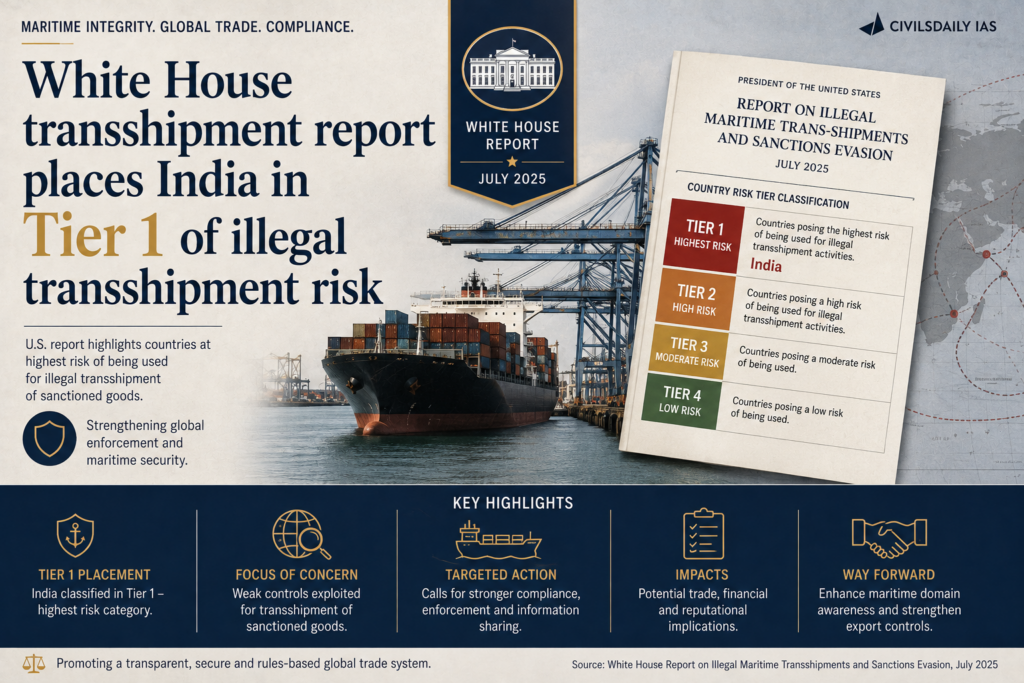
A White House report, The Great Transshipment Scam, places India in Tier 1 for elevated illegal transshipment risk, alleging that some Chinese goods are routed through India to evade US tariffs.
Key Definitions
Illegal Transshipment: Routing goods through a third country and making minimal changes to disguise their actual country of origin and avoid tariffs.
Tariff Arbitrage: Earning a profit by routing goods through a country with a lower tariff.
Rules of Origin: Rules used to determine the country of origin of a product, generally based on where substantial transformation occurs.
Substantial Transformation: A manufacturing process that changes a product sufficiently to give it a new identity, character or use.
Screwdriver Factory: A facility that mainly assembles imported components with minimal domestic value addition.
Section 301: US law allowing action against foreign trade practices considered unfair or discriminatory.
Trade Diversion: Shifting trade flows from one country or route to another due to tariffs, restrictions or other trade barriers.
What does the US report allege?
India is placed in Tier 1.
The Pune, Gujarat and Chennai production belt is specifically mentioned.
Pumps and compressors are cited as examples.
India, Mexico and Vietnam together accounted for an estimated $67 billion of transshipped goods in 2025.
No punitive action has yet been announced.
Why does it matter for India?
Greater scrutiny of Indian exports.
China Plus One manufacturing could face stricter origin verification.
Dependence on Chinese components may complicate origin claims.
Tariff action could affect India’s access to the US market.
[2025, GS3, 10 marks] What are the challenges before the Indian economy when the world is moving away from free trade and multilateralism to protectionism and bilateralism? How can these challenges be met?”
[2017] Consider the following statements: 1. India has ratified the Trade Facilitation Agreement (TFA) of WTO. 2. TFA is a part of WTO’s Bali Ministerial Package of 2013. 3. TFA came into force in January 2016. Which of the statements given above is/are correct?
PYQ Relevance [UPSC 2023] Introduce the concept of Artificial Intelligence (AI). How does AI help clinical diagnosis? Do you perceive any threat to privacy of the individual in the use of AI in healthcare? Linkage: The PYQ examines AI’s applications and its implications for privacy and individual rights. The EU AI Act shows how risk-based AI regulation can address privacy, safety and accountability concerns.
Mentor’s Comment
The European Union Artificial Intelligence Act becoming applicable creates an opportunity for India’s technology services. Its compliance demands could generate work Indian firms can supply.
What is the EU AI Act?
Risk-based law: The European Union Artificial Intelligence (AI) Act regulates AI systems by risk category.
Applicability: It came into force in 2024 and its key obligations apply from 2 August 2026.
High-risk systems: These require a conformity assessment before deployment.
Extraterritorial reach: The Act can apply to entities outside the EU when their AI systems or models are placed on the EU market, used in the EU, or affect people in the EU.
Risk Categories
Unacceptable risk: Systems like social scoring or manipulative/exploitative AI are completely banned.
High risk: Critical sectors like biometrics, employment, and healthcare require rigorous data governance, logging, and conformity assessments.
Transparency (Limited) risk: Chatbots and deepfakes must clearly disclose to users that they are interacting with AI or synthetic media.
Minimal risk: Most everyday utilities like video games or spam filters face no mandatory rules.
Why does the EU regulate AI?
Fundamental rights: Prevent discrimination, manipulation and unlawful surveillance.
Safety: Ensure reliable and safe deployment of high-risk AI.
Transparency: Help users distinguish AI-generated content from human-generated content.
Trust: Create a predictable regulatory environment for responsible AI adoption.
Why does it challenge India’s IT model?
Bespoke services: India’s IT-services firms build customised systems, and any “substantial modification” can trigger a fresh assessment.
Compliance cost: Repeated conformity checks raise the cost of serving EU clients.
Data governance: High-risk AI requires stronger data quality, traceability, record-keeping and governance, requiring firms to upgrade systems.
Shift in competitive advantage: India’s traditional cost-based IT model must evolve towards trusted, auditable and regulation-ready AI services.
Where is the opportunity?
Compliance services: Demand rises for legal, technical, and audit services to meet the Act.
Notified bodies: The India-EU Free Trade Agreement could let Indian conformity assessment bodies be recognised as EU “notified bodies”.
First-mover edge: Early compliance capability positions India as a preferred AI-services partner.
AI Assurance: Indian firms can offer AI risk assessment, algorithmic auditing, testing, documentation and certification support to global clients.
Compliance-by-design: Indian IT companies can build EU-compliant AI systems from the development stage, turning regulatory expertise into a new export advantage.
What are the challenges to capturing the opportunity?
Standards gap: India lacks a mature domestic AI conformity-assessment ecosystem.
Mutual recognition: Recognition of Indian bodies depends on the FTA’s regulatory-cooperation terms.
Talent: Specialised AI-audit skills are scarce.
Regulatory clarity: India’s own AI governance framework is still evolving.
Conclusion
The Act raises compliance costs but also creates a services market India can serve. Capturing it depends on the India-EU FTA delivering mutual recognition of conformity assessment bodies.
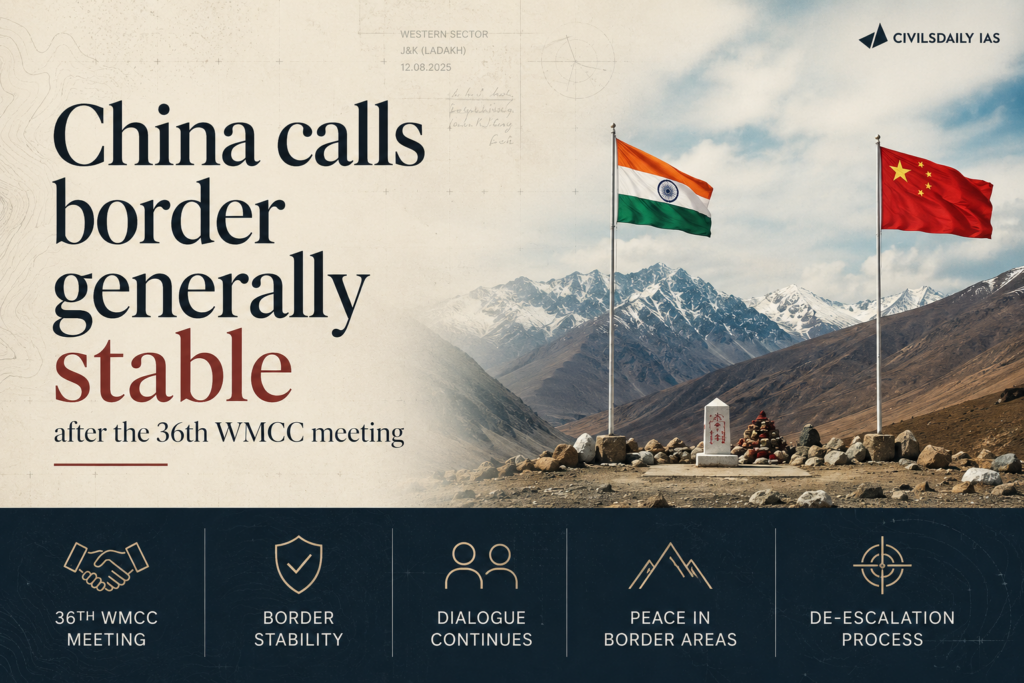
China’s Foreign Ministry described the India-China border as generally stable, responding to reports of rising tensions in Arunachal Pradesh’s eastern sector. The statement followed the 36th meeting of the Working Mechanism for Consultation and Coordination on China-India Border Affairs, held the previous week. The exchange highlights how a diplomatic and military consultation mechanism, rather than a boundary settlement, is what currently manages face-offs along an undemarcated frontier.
What is the Working Mechanism for Consultation and Coordination (WMCC) on China-India Border Affairs?
About: The WMCC is an institutional mechanism, established in 2012, for diplomatic-level consultation and coordination on maintaining peace along the India-China border.
Function: It provides a standing channel to communicate on border developments and defuse face-offs, and it does not itself negotiate the resolution of the boundary question.
What is the Line of Actual Control (LAC)?
About: The LAC is the notional line separating Indian-controlled and Chinese-controlled territory, and it is neither fully demarcated nor mutually agreed on the ground.
Consequence: Because the boundary is undemarcated, patrols from the two sides at times face off against each other in areas of overlapping claims.
What did the 36th WMCC meeting produce?
Communication channels: The two sides agreed to maintain communication via diplomatic and military channels.
Peace commitment: They agreed to jointly uphold peace and tranquillity in the border areas.
Official framing: China’s Foreign Ministry described the situation as generally stable at the moment.
What triggered the current concern in the eastern sector?
Reported crossing: Reports last week suggested that Chinese People’s Liberation Army (PLA) troops crossed the LAC at Pukar La and Ollo in the Taksing circle of Upper Subansiri.
State-level denial: On 7 August the Arunachal Pradesh Chief Minister denied reports of an incursion and said he would verify with the Army and local bodies.
Indian framing: India’s Ministry of External Affairs (MEA) said the maintenance of peace and tranquillity in border areas was of utmost importance, and did not deny a reported rise in tensions since late July.
Ground posture: The Army and the Indo-Tibetan Border Police (ITBP) are positioned to dominate the border and monitor Chinese activities.
Why does the mechanism matter more than the label of stability?
Undemarcated boundary: With no agreed line on the ground, incidents are inherent to patrolling and cannot be eliminated by declarations of stability.
Existing protocols: Face-offs are resolved through existing mechanisms and protocols rather than through a settled boundary.
Communication over settlement: The WMCC manages friction and keeps channels open, but it substitutes crisis management for a final resolution of the dispute.
Conclusion
The current status is that both sides publicly describe the border as generally stable and have agreed through the 36th WMCC meeting to keep diplomatic and military channels open. Reports of a PLA crossing in Upper Subansiri remain unconfirmed by officials. The next expected development is continued WMCC-level engagement and further border-area monitoring by the Army and the ITBP.
Border Management with China: About
Length and sectors: The India-China frontier runs about 3,488 km across three sectors, the western, middle, and eastern.
Nature: The alignment follows the LAC, which is disputed and undemarcated in several stretches.
Institutional layers: Border affairs are handled through the WMCC at the diplomatic level and the Special Representatives mechanism at the political level.
Statutory and Agreement Framework Governing the India-China Border
1993 Agreement: Provided for maintaining peace and tranquillity along the LAC.
1996 Agreement: Established military confidence-building measures in the border areas.
2005 Protocol: Set modalities for implementing military confidence-building measures.
2012 mechanism: Created the WMCC as a standing consultation channel.
2013 Agreement: The Border Defence Cooperation Agreement laid down procedures to avoid escalation during face-offs.
Government Initiatives for Border Areas
Border Area Development Programme (BADP): Funds development of villages near international borders to improve access and living conditions.
Border Infrastructure and Management (BIM) Scheme: Supports roads, fencing, floodlighting, and observation infrastructure along the borders.
Vibrant Villages Programme: Targets comprehensive development of border villages, including those along the northern frontier, to check outmigration.
Challenges in Border Management
Undemarcated LAC: Differing perceptions of the line cause recurring patrol face-offs.
Terrain and access: High-altitude terrain complicates infrastructure and rapid mobilisation.
Infrastructure asymmetry: Faster construction on the Chinese side pressures Indian logistics.
Grey-zone activity: Salami-slicing and forward patrolling test Indian positions below the threshold of conflict.
Coordination: Multiple agencies guarding different stretches require tight inter-force coordination.
Way Forward
Accelerate infrastructure: Complete border roads, tunnels, and forward connectivity to match logistics needs.
Strengthen mechanisms: Use WMCC and Special Representatives channels consistently to de-escalate.
Border-area development: Expand BADP, BIM, and the Vibrant Villages Programme to anchor populations.
Surveillance: Enhance ITBP and Army monitoring with technology-based domain awareness.
“[2024 GS3 15m] India has a long and troubled border with China and Pakistan fraught with contentious issues. Examine the conflicting issues and security challenges along the border. Also give out the development being undertaken in these areas under the Border Area Development Programme (BADP) and Border Infrastructure and Management (BIM) Scheme.”
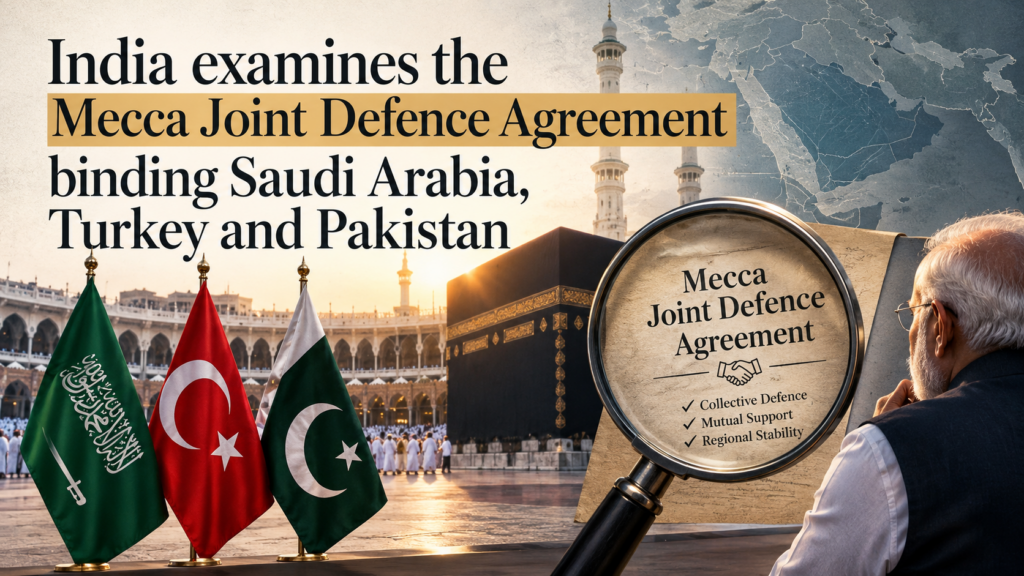
Saudi Arabia, Turkey, and Pakistan have signed the Mecca Joint Defence Agreement, a trilateral mutual defence pact that borrows the collective security logic of Article 5 of the NATO charter. The signing exposes a central question for New Delhi: whether the pact gives Pakistan a shield to escalate against India, or whether it is a loose instrument of strategic hedging without the integration of a real military alliance. India’s foreign ministry says it is tracking the situation carefully.
What is the Mecca Joint Defence Agreement?
About: A mutual defence pact among Saudi Arabia, Turkey, and Pakistan, signed in 2026, that treats an armed attack on any one member as an attack on all.
Design borrowing: It borrows elements of Article 5 of the North Atlantic Treaty Organisation (NATO) charter, including its collective security clause, marking a shift away from the US security umbrella toward regional self-reliance.
What is Article 5 of the NATO charter?
Collective defence clause: It commits every member to treat an armed attack against one member as an attack against all, and to assist in response.
Why it matters here: The Mecca pact replicates this trigger among three states, which raises the question of how Turkey reconciles it with its existing NATO obligations.
What is Operation Sindoor?
About: An Indian military operation against terror infrastructure that serves as the reference case for how the three signatories behaved during an India-Pakistan confrontation.
Behaviour observed: Turkey provided Pakistan diplomatic and rhetorical support and sold drones, but stopped short of tangible military assistance, and Saudi Arabia stayed silent.
What are the three power centres the pact combines?
Pakistan: A declared South Asian nuclear power contributing a powerful conventional military and a functional nuclear arsenal, though it is unclear whether Islamabad has offered a nuclear umbrella.
Saudi Arabia: Provides political and financial clout as leader of the Sunni world and controller of one of the world’s largest oil reserves.
Turkey: The successor of the Ottoman Empire, contributing a powerful military, NATO operational experience, and a highly capable defence industry.
Stated adversaries: The unstated targets are Iran, leader of the Shia world with proxies including Hezbollah and Hamas across Yemen, Iraq, Syria, and Lebanon, and Israel, an intelligence powerhouse and undeclared nuclear power.
What is the pattern of prior cooperation among the three?
Bilateral base: Pakistan has provided military training and technical assistance to Saudi Arabian forces for decades.
September 2025 pact: Riyadh and Islamabad signed a bilateral Strategic Mutual Defence Agreement, which evolved into the trilateral Mecca Agreement with Ankara’s participation.
Force deployment: Pakistan deployed some 8,000 troops, a squadron of JF-17 fighter aircraft, drones, and HQ-9 air defence systems to Saudi Arabia.
Financial and naval ties: Riyadh has repeatedly provided financial bailouts to Islamabad, and Turkey and Pakistan have exchanged warships and training aircraft.
Why does the pact worry India directly?
Cold War precedent: Pakistan has a long record of hitching its wagon to pacts to oblige Western powers and gain geopolitical advantage against India, joining the Southeast Asia Treaty Organisation (SEATO) in 1954 to secure advanced weaponry for its struggle over Jammu and Kashmir.
Global South rivalry: Saudi Arabia and Turkey are seen as piggybacking on Pakistan to seek a bigger strategic role in Asia and to challenge India’s ambition to lead the Global South.
Forum coordination: The bloc can coordinate positions in international forums such as the United Nations (UN) and the Organisation of Islamic Cooperation (OIC) on issues including Kashmir and maritime security.
Technology integration: Turkish defence industry output, funded by Saudi capital and deployed in Pakistan, can enhance Rawalpindi’s capabilities in unmanned aerial vehicles (UAVs), electronic warfare, and naval platforms.
Is this an “Islamic NATO” or strategic hedging? (the central tension)
Case against alarm: Calling it an Islamic NATO is premature because NATO’s efficacy relies on a unified command, pre-assigned forces, and deep interoperability, while the Mecca pact lacks an integrated military headquarters, joint command mechanisms, and institutionalised doctrine.
Divergent priorities: Saudi Arabia is focused on hedging against Iran and Houthi threats, Turkey on defence exports and Islamic-world leadership, and Pakistan on economic bailouts and leverage against India.
Legal limit on the trigger: Mutual defence treaties apply strictly to unprovoked external aggression, so Indian counter-terrorism strikes against Pakistani terror infrastructure do not constitute a treaty trigger.
Saudi restraint: Riyadh’s relationship with New Delhi has evolved into a multi-billion-dollar strategic partnership spanning energy, trade, and intelligence, and the Saudi Crown Prince has no interest in being dragged into a South Asian military conflict.
How could the interlocking alliances backfire?
World War I analogy: A matrix of interlocking military alliances of exactly this kind triggered World War I, and repeating that blunder would be a serious risk.
Unreconciled obligations: If Israel strikes a Saudi facility and Turkey responds under the Mecca pact, it is unclear whether the 32 NATO countries would be treaty-bound to support Turkey.
Operational hedging: Saudi Arabia’s passivity when Pakistan clashed with Afghanistan, and Pakistan’s non-involvement when Saudi Arabia faced Iranian and Houthi strikes, show these pacts often pair political rhetoric with operational hedging.
How has the military balance on India’s borders shifted?
Strike corps repurposed: The Indian Army converted a 60,000-strong strike corps configured for the India-Pakistan border into a mountain strike corps for the China border.
Divisions reassigned: Two mountain divisions raised over the last two decades were assigned entirely to the China border.
Earmarking change: Where 70 per cent of the Indian Army was once earmarked for the Pakistan border, only about 55 per cent is today.
What should India’s calibrated response be?
Discreet engagement: Engage Saudi Arabia candidly through high-level channels to secure assurances that the pact’s defensive clauses apply only to the West Asian theatre and cannot be weaponised by Pakistan.
Firm deterrence: Maintain a firm deterrence doctrine so that Indian responses to state-sponsored terrorism remain resolute and unaffected by third-party arrangements.
Gulf partnerships: Double down on bilateral economic, trade, and strategic partnerships with Saudi Arabia and the broader Gulf Cooperation Council (GCC).
Technology watch: Monitor Turkey-Pakistan military-industrial co-development and prioritise indigenous research to neutralise advanced drones, electronic warfare, and naval platforms.
Procurement reform: Fast-track defence procurement, which has been slowed by bureaucratic caution since the Bofors scandal.
Conclusion
The Mecca Agreement is best understood less as a binding warfighting alliance and more as an instrument of strategic hedging for a volatile region, fusing Saudi capital, Turkish technology, and Pakistani manpower into a collective deterrence shield. The central idea is that its danger to India lies not in an immediate collective-defence trigger but in the technology integration and diplomatic bloc it creates. A pragmatic Indian strategy combines firm counter-terrorism deterrence, deep economic engagement in the Gulf, and targeted defence innovation at home.
West Asian Security Architecture: About
US umbrella in retreat: The United States has signalled limits on its security guarantees to West Asian allies, prompting states to seek self-reliance.
Israeli posture: Israel has demonstrated through its bombing of Iran-linked targets that it will accept no restraints on its perceived security interests.
Realignment: Riyadh, Ankara, and Islamabad have come together in response, marking a shift away from dependence on Washington.
Back2Basics: Organisation of Islamic Cooperation (OIC)
Convening body: An intergovernmental organisation of Muslim-majority states that coordinates political and economic positions.
Relevance: The Mecca bloc can use the OIC to coordinate positions on issues including Kashmir.
India’s stance: India is not a member and has consistently rejected OIC pronouncements on Kashmir as interference in internal affairs.
Challenges for India from the pact
Diplomatic bloc formation: A formal political grouping can coordinate against Indian interests at the UN and OIC.
Capability transfer: Turkish drone, electronic warfare, and naval technology reaching Pakistan raises the conventional threat.
Two-front pressure: Deeper Pakistan alignments complicate India’s management of simultaneous China and Pakistan borders.
Gulf balancing: India must protect its expanding Saudi and Gulf partnerships without endorsing the pact.
Escalation ambiguity: Uncertainty over how the collective clause would be read in a crisis raises the risk of miscalculation.
Way Forward
Bilateral reassurance: Secure written or channelled Saudi and Emirati assurances that the pact excludes India-Pakistan sub-conventional conflict.
Deterrence signalling: Communicate that counter-terror responses will remain resolute and unlinked to third-party pacts.
Indigenous capability: Accelerate counter-drone, electronic warfare, and naval research, seeking foreign partners ahead in these fields.
Economic anchoring: Deepen Gulf trade and energy ties to make India indispensable to Riyadh’s long-term economic vision.
Procurement speed: Streamline defence acquisition to close capability gaps quickly.
“[2023 GS2 15m] ‘The expansion and strengthening of NATO and a stronger US-Europe strategic partnership works well in India.’ What is your opinion about this statement? Give reasons and examples to support your answer.”
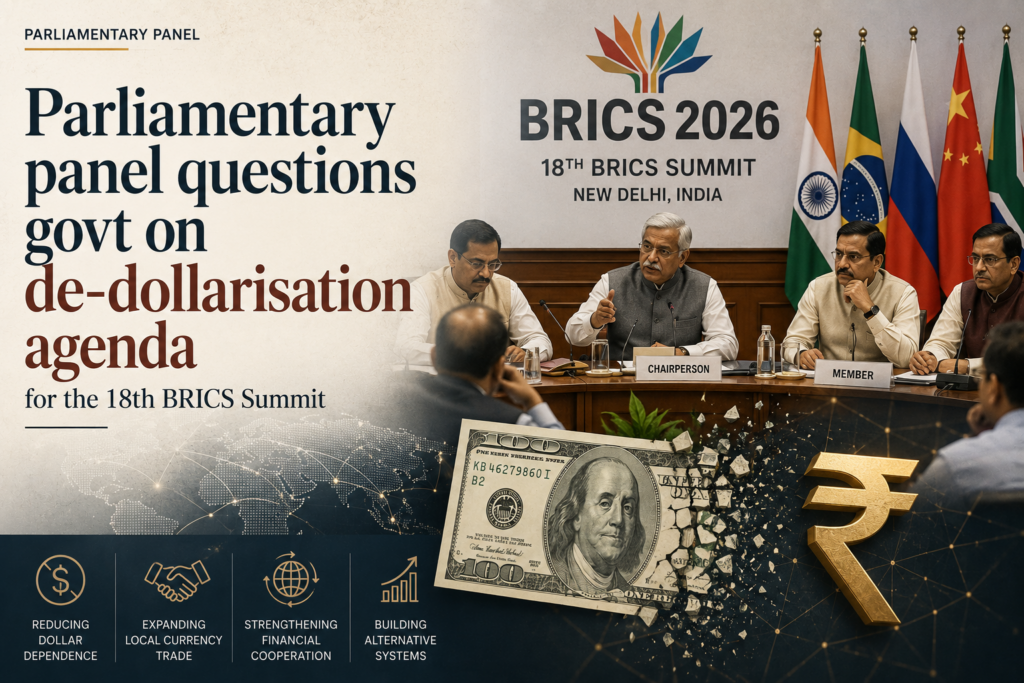
Members of the Parliamentary Standing Committee on External Affairs have asked the government whether it will push a de-dollarisation agenda at the 18th BRICS Summit, which New Delhi hosts in September 2026. The question exposes a tension between the pursuit of greater financial sovereignty and the risk of provoking US retaliation. India holds the rotating chairship of BRICS through 2026, which makes the host nation’s posture on the dollar a live diplomatic choice rather than an abstract one.
What is de-dollarisation?
About: De-dollarisation is a deliberate reduction in the use of the US dollar for international trade invoicing, cross-border settlement, and foreign exchange reserves.
Mechanism: Countries settle bilateral trade in their own national currencies or through a shared settlement arrangement, bypassing dollar clearing and dollar-denominated payment channels.
What is BRICS?
About: BRICS is an intergovernmental grouping originally of Brazil, Russia, India, China, and South Africa, later expanded to admit new members, that coordinates positions on trade, finance, and reform of global governance.
Chairship: The chairship rotates annually among members, and India assumed it on 1 January 2026 and leads the bloc until the end of the year.
What is a Central Bank Digital Currency (CBDC)?
About: A CBDC is a digital form of a country’s sovereign currency issued and backed by its central bank, distinct from private cryptocurrencies.
Relevance here: The Reserve Bank of India (RBI) has repeatedly advocated linking the official digital currencies of BRICS countries to facilitate cross-border trade and tourism payments.
Why is the parliamentary panel pressing the government?
Direct question posed: The panel asked whether the government plans to push a de-dollarisation agenda at the summit New Delhi hosts in September.
Financial sovereignty framing: Members questioned why the government was not pursuing greater financial sovereignty that could help countries bypass US sanctions.
Host-nation leverage: They sought to know whether India, as the host nation, would push a BRICS-led de-dollarisation agenda.
Stalled precedent cited: Members noted that India’s effort to establish a local currency trade mechanism with Russia had not taken off.
What is the case for reducing dollar reliance?
RBI framework: The central bank has argued that linking BRICS digital currencies could reduce reliance on the US dollar amid rising geopolitical tensions.
Sanctions insulation: A shared settlement mechanism would let member economies transact even when cut off from dollar clearing systems.
Payment efficiency: Direct local currency settlement lowers conversion costs in cross-border trade and tourism payments.
Why does a de-dollarisation push carry risks?
US retaliation threat: The US President has repeatedly warned BRICS countries against creating an alternative currency or challenging the dollar’s dominance, threatening punitive tariffs.
Weak internal record: India’s own local currency trade mechanism with Russia has not taken off, exposing the practical difficulty of moving away from the dollar.
Host-nation exposure: As chair and host, a visible Indian push would identify New Delhi with the agenda and concentrate any retaliatory response on it.
Conclusion
The panel has flagged the gap between the RBI’s advocacy for a BRICS payments architecture and the government’s caution on committing to de-dollarisation. The immediate status is that the government has not confirmed whether it will table the agenda. The next milestone is the 18th BRICS Summit in New Delhi in September 2026, where India’s posture as chair will become clear.
About BRICS
Origin: The term BRIC was coined in 2001, the first leaders’ summit was held in 2009, and South Africa joined in 2010 to make it BRICS.
Expansion: The bloc admitted new members from 2024 onward, widening its economic and geographic weight.
Institutions: BRICS created the New Development Bank (NDB), headquartered in Shanghai, and the Contingent Reserve Arrangement (CRA) to provide financing and liquidity support.
Weight: The grouping represents a large share of the world’s population and a substantial share of global output, giving it standing in debates over multilateral reform.
Back2Basics: New Development Bank (NDB)
Convening body: Established by BRICS members to fund infrastructure and sustainable development projects.
Headquarters: Shanghai, China.
Function: Lends to member and partner economies, part of the bloc’s push to build financial institutions parallel to the World Bank and the International Monetary Fund (IMF).
“[2025] Consider the following statements with regard to BRICS:
I. The 16th BRICS Summit was held under the Chairship of Russia in Kazan.
II. Indonesia has become a full member of BRICS.
III. The theme of the 16th BRICS Summit was Strengthening Multilateralism for Just Global Development and Security.
Which of the statements given above is/are correct?
PYQ Relevance [UPSC 2017] The question of India’s Energy Security constitutes the most important part of India’s economic progress. Analyze India’s energy policy cooperation with West Asian Countries Linkage: It connects the pact with India’s energy, strategic and security interests in West Asia. It helps analyse India’s response to emerging regional security alignments while safeguarding its strategic autonomy.
Mentor’s Comment
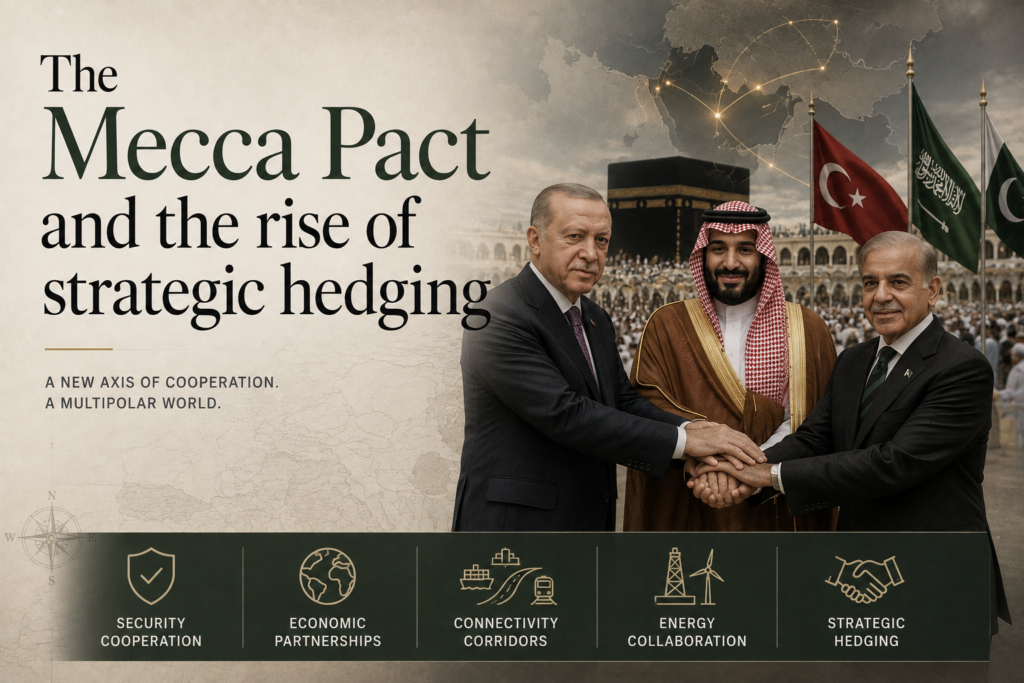
The Mecca Joint Defence Agreement signed on 7 August by Turkiye, Saudi Arabia and Pakistan commits the three states to treat an armed attack on any one of them as an attack on all. The pact exposes a shift in West Asian security away from sole reliance on external guarantors toward arrangements built by regional powers themselves. India, with large economic, energy and strategic stakes in the region, has said it is examining the implications and will safeguard its interests.
What is the Mecca Joint Defence Agreement?
Signing and parties: The mutual defence agreement was signed on 7 August between Saudi Arabia, Turkiye and Pakistan in Mecca.
Core provision: An armed attack against any one of the three states is to be regarded as an attack against all three, aimed at strengthening collective deterrence against aggression.
What it does not do: It does not terminate the three states’ dependence on the United States, since Saudi Arabia remains militarily tied to Washington, Turkiye stays in the North Atlantic Treaty Organization (NATO), and Pakistan retains its own relationship with the United States.
What is strategic hedging?
Definition: Strategic hedging is a policy of supplementing existing external security guarantees with independent arrangements, rather than replacing or breaking from those guarantees.
Why states hedge: It lets a state demonstrate alternative options and reduce exposure to a single unreliable guarantor without provoking an open confrontation with that guarantor.
What complementary strengths do the three partners bring?
Saudi Arabia: It provides financial resources, energy power and political influence across the Arab and Islamic worlds.
Turkiye: It contributes the strongest conventional military among the Muslim states of West Asia and a rapidly expanding indigenous defence industry.
Pakistan: It brings a large professional military and decades of cooperation with Saudi Arabia, and its nuclear weapons force any adversary to factor that capability into an attack on any member.
Why does each participant have distinct reasons to join?
Saudi Arabia: The pact provides strategic insurance after the 2019 attacks on Saudi oil installations and the current confrontation with Iran exposed the risk of depending on a single external guarantor.
Turkiye: It views the arrangement through strategic autonomy, expanding influence into the Gulf and South Asia and creating markets for its defence industry.
Pakistan: The agreement widens its strategic horizons beyond the rivalry with India and converts its military capabilities into greater geopolitical influence.
Why have earlier Arab and pan-Islamic security groupings repeatedly failed?
Baghdad Pact and CENTO: The Baghdad Pact lost Iraq in 1959, became the Central Treaty Organisation (CENTO) and expired in 1979.
United Arab Republic: The Egypt and Syria federation founded in 1958 as the peak of pan Arabism dissolved in 1961.
Regional Cooperation for Development: Launched in 1964 by Iran, Turkiye and Pakistan, it became the Economic Cooperation Organisation in 1985 and achieved little.
Gulf Cooperation Council (GCC): Founded in 1981, it could not stop three members blockading a fourth in 2017 and remains divided on Iran.
Arab League and OIC: The Arab League and the Organisation of Islamic Cooperation (OIC) function as forums for declarations, not instruments of action.
The working alternative: United States led coalitions delivered results, reversing Iraq’s annexation of Kuwait in 1991, intercepting Iranian salvos, and anchoring the current 13 nation Red Sea shipping coalition on United States Central Command.
How should India read the pact?
Not automatically anti Indian: India has cultivated close relations with Saudi Arabia over two decades, and Riyadh has strong economic incentives not to let the pact become an instrument in Pakistan’s disputes with New Delhi.
Pakistan’s leverage: Inclusion in a mutual defense pact as a net security provider could embolden Islamabad, though direct military intervention by Saudi Arabia or Turkey in an India-Pakistan bilateral conflict remains unlikely.
Intelligence and Industrial Sharing: Even without direct combat involvement, Pakistan could benefit from wider intelligence-sharing, diplomatic backing, or defense-industrial cooperation with Middle Eastern partners
Turkiye as the complication: Ankara has repeatedly backed Pakistan on Kashmir and supplied weapons used against India, making it the harder partner to read.
Suggested response: India should seek explicit reassurance from Riyadh that the pact does not apply to an India and Pakistan confrontation, and resist viewing the alignment only through the Pakistan lens.
Official position: The government has said it is examining the pact from the standpoint of national security and regional stability and will take all necessary measures to safeguard national interests.
What are the implications for Iran, Israel and the United States?
Iran: The effect is complicated, since Turkiye and Pakistan share borders with Iran and have reasons to avoid confrontation with Tehran, so it is not a clear anti Iranian coalition.
Israel: The fragmentation of the Muslim world has been a standing Israeli advantage, and a combination of Saudi finance, Turkish conventional strength and Pakistani nuclear capability alters strategic calculations.
United States: The pact presents a paradox, since Washington long sought greater burden sharing by regional partners, but greater responsibility also produces greater autonomy and diminishes American leverage.
Is the Mecca pact genuine security self reliance or another weak grouping?
The sceptical reading:A seven-decade record of collapsed groupings shows that national interest often defeats supranational identity. This is captured in Suhrawardy’s formulation: “zero plus zero plus zero still amounts to zero.”(Suhrawardy’s formulation: It refers to a famous realist maxim coined by Huseyn Shaheed Suhrawardy, the Prime Minister of Pakistan during the 1956 Suez Crisis. He famously dismissed the idea of collective pan-Islamic or regional military alliances among weak developing states by stating that “zero plus zero plus zero still amounts to zero”)
The hedge reading: The accord is best described not as Islamic security self reliance but as a hedge against American unreliability after erratic United States policy.
The cumulative reading: When several major states begin hedging simultaneously, their combined actions can transform the regional order even without a formal realignment.
Structural contradiction: Saudi Arabia and Turkiye both claim leadership of the Islamic world and diverge over the Muslim Brotherhood, so the accord does not dissolve the rivalry between Riyadh and Ankara.
Conclusion
The Mecca pact is an act of strategic hedging by regional powers seeking to supplement, not sever, their external guarantees, and its significance lies in the possibility of a more autonomous West Asian security architecture. Whether it becomes durable or joins the long list of weak groupings will turn on whether regional cooperation can outlast national interest. India cannot remain a spectator to this transformation, and the credible response is to expand its own military and security engagement in the region rather than react with alarm.
Back2Basics:
Foundational Context: India and West Asia
About: West Asia, spanning the Gulf, the Levant and the wider region, is central to India’s energy security, remittances and diaspora, and maritime trade.
Energy and diaspora: The region supplies a large share of India’s crude oil and hosts roughly nine million Indian workers, making stability there a direct national interest.
Strategic posture: India follows a policy of de hyphenated engagement, maintaining ties simultaneously with the Gulf Arab states, Iran and Israel.
Historical footnote: Undivided India was described as the anchor of Persian Gulf security, a role independent India stepped back from after 1947.
Organisation of Islamic Cooperation (OIC)
Type: Intergovernmental organisation of Muslim majority states, the second largest such body after the United Nations.
Formation: Established in 1969.
Headquarters: Jeddah, Saudi Arabia.
Membership: 57 member states across four continents.
Mandate: Safeguards and protects the interests of the Muslim world and coordinates member positions, largely through declarations rather than enforcement.
India context: India is not a member, though it was invited as a guest of honour to the OIC foreign ministers meeting in 2019.
Government Initiatives / Frameworks for India’s West Asia Engagement
I2U2 Grouping: A grouping of India, Israel, the United Arab Emirates and the United States focused on water, energy, food security and technology cooperation.
India Middle East Europe Economic Corridor (IMEC): A connectivity project linking India to Europe through the Gulf, announced on the sidelines of the G20 summit.
Comprehensive Economic Partnership Agreement: India’s trade agreement with the United Arab Emirates deepening economic ties in the Gulf.
Defence diplomacy: Growing military exercises and defence partnerships with Gulf states seeking to diversify their security partners.
Key Facts about India and West Asia
Crude imports: West Asia remains among the largest sources of India’s crude oil imports.
Remittances: The Gulf is a leading source of inward remittances to India.
Strait of Hormuz: A large share of India’s oil imports transit this chokepoint.
Suez crisis reference: The pact debate recalls the 1956 Suez crisis, when Pakistan faced pressure to abandon the Baghdad Pact.
Challenges to India’s West Asia Strategy
Pakistan factor: Turkiye’s consistent support for Pakistan on Kashmir complicates India’s Gulf partnerships.
Regional rivalries: Balancing ties with Saudi Arabia, Iran and Israel simultaneously constrains freedom of action.
Energy exposure: Dependence on Gulf crude leaves India vulnerable to supply and price shocks from regional conflict.
Capability gap: India lacks the power projection capacity to act as a security provider in the region despite being courted.
Great power competition: Rising Chinese economic and diplomatic presence in the Gulf reduces India’s relative influence.
Way Forward
Expand military diplomacy: Deepen exercises, training and defence exports with Gulf states seeking to diversify partners.
Seek bilateral reassurances: Obtain clear assurances from Riyadh that the pact does not apply to an India and Pakistan conflict.
Diversify energy sources: Broaden crude sourcing and strategic reserves to reduce chokepoint exposure.
Build connectivity: Accelerate IMEC and Gulf economic corridors to lock in long term stakes in the region.
Sustain de hyphenated engagement: Maintain simultaneous ties with all regional actors without being drawn into any single bloc.
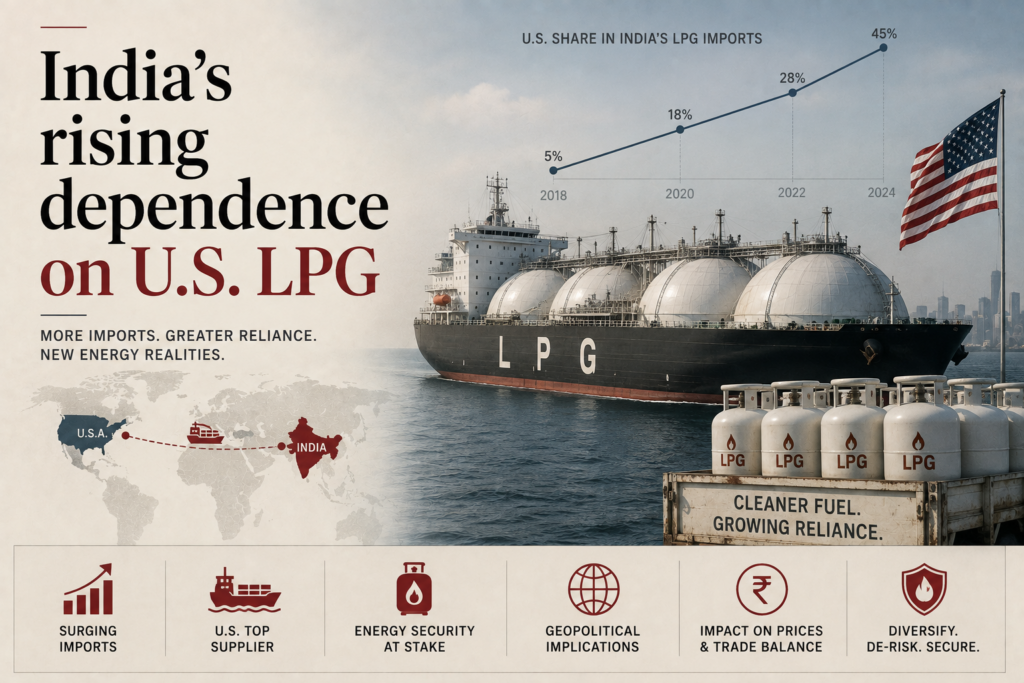
The Union Minister of Petroleum and Natural Gas stated that 67 per cent of India’s liquefied petroleum gas (LPG) now comes from the United States, a drastic shift from an earlier decision to source about 10 per cent of cooking gas there. The pivot, driven by the crisis in the Strait of Hormuz, exposes that LPG security cannot be anchored to a single geography while dependence on the United States carries risks of its own.
What is Liquefied Petroleum Gas (LPG) and how is India’s supply structured?
What it is: LPG is a mix of propane and butane used mainly as cooking gas in India. It is a politically volatile fuel because shortages carry direct social and political consequences.
Import dependence: India, the world’s second largest importer of LPG, imports about 60 per cent of the LPG it consumes, with nearly 90 per cent of that passing through the Strait of Hormuz.
Sourcing shift: State run refiners signed a long term deal for 2.2 million tonnes of United States LPG in 2026, raising the United States share to two thirds of imports.
Why did India pivot to United States LPG?
Hormuz disruption: Disruptions in the narrow Strait of Hormuz threatened the Gulf supply route through which most Indian LPG passes.
Collapse in West Asian flows: India’s LPG imports from West Asia fell almost 85 per cent between February and June 2026.
Partial offset: India replaced the lost flows by lifting imports from other sources, including the United States, from where June imports reached 0.77 million metric tonnes.
Availability over price: Because cooking gas is politically sensitive, the priority is making it available rather than optimising cost, so costlier United States cargoes became attractive during the crisis.
Why is overdependence on the United States risky?
Energy as leverage: Relying more on a partner that views ties through the lens of national interest risks energy being used as a bargaining tool in bilateral trade talks.
History of coercive tools: The United States has historically used financial sanctions, export controls, and technology denial as foreign policy tools, seen in Iran, Iraq, Cuba, North Korea, Syria, Russia, Venezuela, Myanmar, Libya, Sudan, and Afghanistan.
Third country reach:The Lindsey O. Graham Sanctioning Russia and Iran Act of 2026, proposing tariffs of up to 100 per cent on the top five buyers of Russian oil and natural gas, is a non tariff trade barrier that can influence third country transactions.
Monetary spillover: Import dependence complicates monetary policy, as elevated United States inflation could keep the Federal Reserve’s rates higher for longer, strengthening the dollar and raising the rupee cost of each cargo.
Why does proximity pricing matter?
Definition: Proximity pricing is a market benefit where goods cost less when bought from a nearby place. Shorter travel distance means lower shipping costs and faster delivery.
Loss of distance advantage: United States shipments take 25 to 35 days against 5 to 10 days from the Gulf, so India loses the advantage of proximity pricing.
Two price benchmarks: United States LPG is Mont Belvieu propane based, while West Asian supply follows the Saudi Aramco Contract Price, and the Gulf fuel is usually cheaper at the disembarking point due to the shorter distance.
Temporary reversal: Geopolitical risk has temporarily inflated West Asian supply costs, with the Saudi Contract Price rising from about 543 dollars per tonne in February to around 790 dollars in June, making United States cargoes competitive despite the longer voyage.
How does India balance availability with cost optimisation?
The core trade off: For a politically volatile fuel, ensuring supply outweighs cost optimisation, so India accepted higher priced United States cargoes to cut supply risk.
Residual exposure: India may have cut Hormuz risk, but remains exposed to commodity price, dollar, and freight risks.
Under recovery pressure: If domestic prices are held down while global prices rise amid rupee depreciation, oil companies’ under recoveries expand, worsening fiscal and external sector stress.
What are the challenges to India’s LPG security?
Single supplier concentration: Two thirds reliance on one country recreates the concentration risk the pivot was meant to solve.
Stagnant domestic output: LPG production has stayed nearly flat while consumption grows, widening the import gap.
Chokepoint vulnerability: Heavy dependence on the Strait of Hormuz leaves Gulf sourced volumes exposed to any regional conflict.
Fiscal drain: Accumulated under recoveries of state oil marketing companies exceeded Rs 59,000 crore as of 31 July 2026.
Currency and freight risk: Dollar denominated pricing and long shipping routes expose landed costs to exchange rate and freight swings.
Thin strategic reserves: India lacks large dedicated LPG strategic reserves to buffer sudden supply shocks.
Conclusion
Energy security is not about replacing one supplier with another but ensuring no single player holds all the cards. India must strengthen local production, bolster multiple supply chains, and build more strategic reserves. Australia offers a shorter Indo Pacific route outside Hormuz, though its export volumes remain small.
Back2Basics
Energy Security and LPG in India (Foundational Context)
About: Energy security means assured availability of energy at affordable prices with resilience against supply shocks. LPG security is a subset covering cooking gas access for households.
Scale: Public sector oil marketing companies serve 33.14 crore active domestic LPG customers, growing at a compound annual growth rate of 7.6 per cent between 2015 and 2026.
Consumption gap: LPG production was 4.3 million metric tonnes against consumption of 6.5 million metric tonnes in the first quarter of FY27, with the 2026-27 consumption estimate at 34,692 thousand metric tonnes.
Key Facts about India’s LPG Sector
Oil marketing companies: Indian Oil, Bharat Petroleum, and Hindustan Petroleum are the three public sector oil marketing companies distributing LPG.
PPAC: The Petroleum Planning and Analysis Cell tracks LPG consumption, customer base, and pricing data.
Crisis production ramp up: At the peak of the crisis, oil marketing companies raised cumulative daily LPG production from 34,000 metric tonnes to 55,000 metric tonnes.
Output jump: First quarter FY27 LPG production rose 35.73 per cent year on year to 4.26 million metric tonnes after refineries diverted propane and butane streams into the LPG pool.
Government Initiatives for LPG and Energy Security
Pradhan Mantri Ujjwala Yojana: Provides free LPG connections to women from below poverty line households to promote clean cooking.
PAHAL (DBTL): Directly transfers LPG subsidy to beneficiary bank accounts to curb diversion.
Strategic Petroleum Reserves: Underground crude storage to cushion supply disruptions.
Ethanol Blending Programme: Reduces import dependence in the broader energy basket.
Long term supply agreements: State refiner contracts diversifying LPG sourcing across geographies.
Way Forward
Boost domestic output: Maximise refinery LPG yield and invest in production capacity to narrow the import gap.
Diversify suppliers: Spread sourcing across the Gulf, the United States, Australia, and others to avoid single supplier dependence.
Hedge price and currency risk: Use financial instruments to manage commodity, dollar, and freight exposure.
Secure alternate routes: Develop supply chains outside the Strait of Hormuz to reduce chokepoint vulnerability.
PYQ Relevance
[UPSC 2025] “Energy security constitutes the dominant kingpin of India’s foreign policy, and is linked with India’s overarching influence in Middle Eastern countries.” How would you integrate energy security with India’s foreign policy trajectories in the coming years?
Linkage: The PYQ directly relates to energy security as a key driver of India’s foreign policy, especially in West Asia. India’s shift to US LPG highlights the need for supplier diversification, alternate routes and strategic autonomy in energy diplomacy.
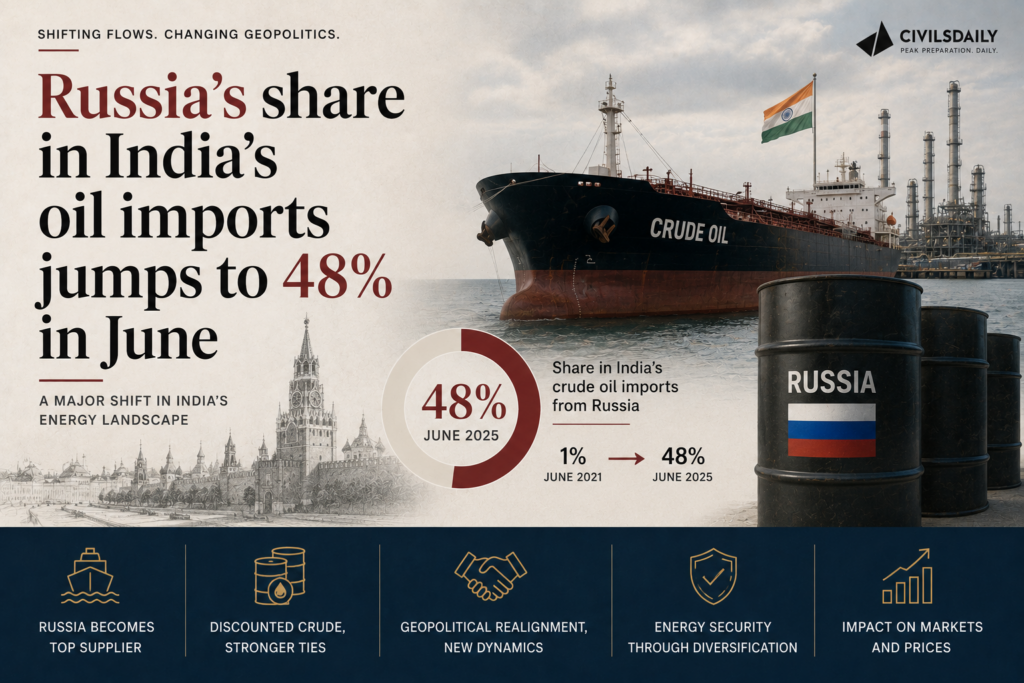
Russia’s share in India’s crude oil imports rose to an all-time high of 48 percent in June 2026, even as India cut its total crude imports. This comes as the US Senate has passed a bill to levy tariffs of up to 100 percent on the top buyers of Russian oil and gas, placing India’s energy security and its trade exposure to the United States in direct tension.
What is the Sanctioning Russia and Iran Act of 2026?
Definition: The Lindsey O. Graham Sanctioning Russia and Iran Act of 2026 is a US bill that authorises secondary tariffs of up to 100 percent on countries that continue to buy Russian oil and gas. It targets the largest purchasers of these products from Russia.
Status: The bill was passed by the US Senate and still requires passage by the US House of Representatives before it becomes law.
What are the tariff triggers under the bill?
Top-buyer test: Tariffs apply to a country that was among the five largest importers of Russian crude oil or natural gas in the 12 months preceding the Act’s enactment.
Continuation test: The tariff applies if that country continues to import Russian oil or gas beyond 30 days after enactment.
Sanctions-evasion clause: Tariffs can also be imposed on countries found to have helped Russia evade sanctions.
India’s exposure: India, alongside China, is one of the top two importers of Russian oil, so it qualifies under these criteria.
What do the June import figures show?
Fall in total imports: June crude oil imports of 18.2 million metric tonnes (MMT) were 16.5 percent lower than in May 2026 and 13 percent lower than in June the previous year.
Import bill still high: The June oil import bill was 22 percent lower than in May but still 40 percent higher than in June last year, due to elevated crude prices.
Russian purchases held up: India imported 8.7 MMT of Russian oil in June, only 1 percent lower than May and 25 percent higher than a year earlier.
Record Russian share: Russia’s share reached 48 percent by quantity and 48.6 percent by value, rising every month since March.
UAE at a high: The United Arab Emirates (UAE) supplied 17.5 percent of imports by volume and 18 percent by value, its highest share so far.
Concentration: Russia and the UAE together accounted for nearly two-thirds of India’s oil imports in June, the highest combined share from any two countries.
Shrinking discount: The premium Russia charged India rose from a discount as recently as February 2026 to a premium of $10.6 per tonne in June, down from $77.7 per tonne in April.
How has India pre-empted sanctions exposure?
Ship-to-ship transfers: The Ministry of Petroleum and Natural Gas said exposure was pre-empted through ship-to-ship transfer operations in international waters via the Red Sea route through Yanbu and Fujairah.
Avoiding a single choke point: The aim was to ensure that no single choke point or sanctions regime could halt India-bound cargo.
Refinery flexibility: Indian refineries spent a decade acquiring the flexibility to switch between crude grades and shipping routes when disruption struck.
Why does the record Russian share expose India?
Energy security dependence: India cannot quickly cut back on Russian oil while supplies through the Strait of Hormuz remain constrained by the West Asia conflict.
Trade and tariff risk: Continued high Russian purchases place India within the top-buyer criteria of the US bill, risking tariffs of up to 100 percent.
Ambiguity on evasion: It is unclear whether India’s ship-to-ship arrangements would be treated as helping Russia evade sanctions.
Conclusion
India’s rising dependence on discounted Russian crude has hit a record 48 percent share, secured through diversified shipping routes even as total imports fell. This leaves India balancing its energy security against the risk of secondary tariffs under the US bill. The immediate milestone is the bill’s fate in the US House of Representatives, which will determine whether the tariff threat becomes law.
Back2Basics:
Strait of Hormuz
Designation: A narrow strait linking the Persian Gulf to the Gulf of Oman and the Arabian Sea.
Bordering states: Bordered by Iran to the north and Oman and the UAE to the south.
Significance: One of the world’s most critical oil transit choke points, carrying a large share of seaborne crude.
What is Energy Security? (Foundational Context)
About: Energy security is the uninterrupted availability of energy sources at an affordable price.
Rationale: It matters because India imports the bulk of its crude oil, leaving growth and prices exposed to external supply shocks.
Core dimensions: It rests on availability, affordability, accessibility, and diversification of both sources and supply routes.
Key Facts about India’s Oil Imports
Import dependence: India imports over 85 percent of its crude oil requirement.
Global standing: India is among the world’s largest crude oil importers and consumers.
Key choke point: The Strait of Hormuz, between the Persian Gulf and the Arabian Sea, carries a large share of India’s West Asian crude.
Challenges to India’s Energy Security
High import dependence: Reliance on imports for most crude exposes the economy to price and supply shocks.
Geopolitical concentration: A large combined share from Russia and the UAE concentrates supply risk in two sources.
Choke-point vulnerability: Disruption at the Strait of Hormuz can constrain West Asian supply.
Sanctions exposure: Purchases from sanctioned suppliers risk secondary tariffs and financial penalties.
Price volatility: War-driven crude price spikes inflate the import bill and widen the current account deficit.
Way Forward
Diversify sources: Expand purchases from a wider set of suppliers to reduce concentration.
Accelerate clean energy: Scale up renewables, biofuels, and electric mobility to cut import dependence over time.
Secure shipping routes: Maintain logistical flexibility across grades and routes to withstand choke-point disruption.
PYQ Relevance
[UPSC 2025] Energy security constitutes the dominant kingpin of India’s foreign policy, and is linked with India’s overarching influence in Middle Eastern countries. How would you integrate energy security with India’s foreign policy trajectories in the coming years?
Linkage: The PYQ examines the integration of India’s energy security with its foreign policy. India’s record 48% dependence on Russian crude highlights the geopolitical dimension of energy security. The article shows the need to diversify suppliers and routes while balancing ties with Russia, the US and West Asia.