The raging fire in Australia gives provides an opportunity for India and Australia to deepen their dialogue including on energy.
Scope for the two countries
At this moment India and Australia have a rare opportunity to translate their converging interests into a partnership.
At Australia India Leadership Dialogue last month in Melbourne, the breadth and depth of the relationship was evident.
As a consequence of the bushfires, the debate on global warming, climate change and fossil fuels is going to intensify in the weeks ahead.
Environmental activism has gained ground throughout Australia.
Indian Ocean Dipole may have triggered the drought that is related to the fires.
The campaign against fossil fuels and the export of coal is sure to intensify.
India and Australia are two economies with a great stakeholding in fossil fuels.
It is critical for India and Australia to ensure that their dialogue on energy acquires momentum.
Both countries must simultaneously strengthen the International Solar Alliance and the search for other alternative green fuels.
Common threat of China
Leadership Dialogue also recognised that we are living through a period of immense turbulence, disruption, and even subversion.
Presence of assertive China is the single biggest challenge to our two countries.
In India, there is a consensus that the Australia-India relationship is an idea whose time has well and truly come.
Area of coordination
India and Australia can work on the area of water management to trauma research to skill and higher education.
Both the countries can also work in the area of maritime security, cybersecurity, counterterrorism,
In a survey, Indians ranked Australia in the top four nations towards which they feel most warmly.
Both have a strategic interest in ensuring a free, open, inclusive and rules-based Indo-Pacific region.
Indians are today the largest source of skilled migrants in Australia.
there is need for an early conclusion of a bilateral Free Trade Agreement.
Conclusion
There is a large scope for both countries to coordinate on wide issues like energy, research, security and work together for the benefit of both countries.
The United Arab Emirates (UAE) has announced a five-year multiple-entry visa scheme for all nationalities, in a move that is geared towards promoting tourism in the country.
What is UAE’s new visa scheme?
According to the Dubai-based Gulf News, prior to this, tourists could get single or multiple-entry visas for a duration of 30 or 90 days.
In the new five-year multiple-entry system, visa holders may be allowed to stay for six months at a stretch.
The details of the scheme are yet to be announced. The country’s Federal Authority for Identity and Citizenship will be implementing the decision.
Travellers from Africa, some South American countries, Arab states outside the Gulf, and European states from outside the European Union and the former Soviet Union previously needed visas.
The UAE currently receives more 2.1 crore tourists annually, and has recently increased its pace of rolling out policies to boost its trade and tourism sectors.
Other reforms
In July 2019, the UAE allowed women employed in the country to sponsor work permits for their husbands, fathers, and adult children, and reduced the fees for obtaining work permits by 50 per cent to 94 per cent for 145 services and transactions.
In the same month, the Emirate of Dubai said it would accept the Indian rupee (INR) for transactions at duty-free stores.
The US has threatened to target few historical sites if Iran retaliates to attack US in revenge. This is a breach of JUS COGENS as targeting cultural sites amounts to a a war crime.
Jus Cogens
The jus cogens rules have been sanctioned by the Vienna Conventions on the Law of Treaties of 1969 and 1986. According to both Conventions, a treaty is void if it breaches jus cogens rules.
Jus Cogens or ius cogens, meaning “compelling law” in Latin, are rules in international law that are peremptory or authoritative, and from which states cannot deviate.
These norms cannot be offset by a separate treaty between parties intending to do so, since they hold fundamental values.
Today, most states and international organisations accept the principle of jus cogens, which dates back to Roman times.
What does the convention say?
Article 53 of the 1969 Convention says: “A treaty is void if, at the time of its conclusion, it conflicts with a peremptory norm of general international law.
For the purposes of the present Convention, a peremptory norm of general international law is a norm accepted and recognized by the international community of States as a whole as a norm.
From this no derogation is permitted and which can be modified only by a subsequent norm of general international law having the same character.
Article 64 says- If a new peremptory norm of general international law emerges, any existing treaty which is in conflict with that norm becomes void and terminates.
Besides treaties, unilateral declarations also have to abide by these norms.
What is included in jus cogens?
So far, an exhaustive list of jus cogens rules does not exist.
However, the prohibition of slavery, genocide, racial discrimination, torture, and the right to self-determination are recognised norms.
The prohibition against apartheid is also recognised as a jus cogens rule, from which no derogation is allowed, since apartheid is against the basic principles of the UN.
What is the problem with targeting cultural heritage?
Following the unparalleled destruction of cultural heritage in World War II, the nations of the world adopted at The Hague in 1954, The Convention for the Protection of Cultural Property in the Event of Armed Conflict.
It was the first international treaty focussed exclusively on the protection of cultural heritage during war and armed conflict.
The Convention defined cultural property as “movable or immovable property of great importance to the cultural heritage of every people, such as monuments of architecture, art or history, whether religious or secular; archaeological sites….”, etc.
There are currently 133 signatories to Convention, including countries that have acceded to and ratified the treaty.
Both the United States and Iran (as well as India) signed the Convention on May 14, 1954, and it entered into force on August 7, 1956.
The Rome Statute of 1998, the founding treaty of the International Criminal Court, describes as a “war crime” any intentional attack against a historical monument, or a building dedicated to religion, education, art, or science.
“Phase one” of the trade deal between the U.S. and China notwithstanding, the ongoing dispute between the U.S. and China and other changing scenarios could turn out opportunities in various forms for India.
Oil prices windfall
Slack demand and increased production by the U.S., had lowered oil prices which was good news for India.
It could also help India address its current account deficit.
But oil prices have surged more than 4% following the killing of Iranian general by the U.S.
An outbreak of hostilities could send the oil prices soaring.
India’s energy import from the U.S. is likely to touch $10 bn by 2019-20.
While China is increasing its stake in Saudi Aramco- one of the largest oil production company in the world.
China is also increasing its ties with the other oil producers which gives China the opportunity to increase its naval presence in the Indian Ocean increasing the Strait of Hormuz.
On trade front
According to the State Bank of India report-Ecowrap, India has scarcely benefited from the trade war.
Of the $35bn decline in China’s export to the U.S. $21bn was diverted to the other countries and the rest $14bn was made good by the U.S. producers.
India contributed only $755-million of this diversion.
The U.S. tariff made some other players-Mexico, Taiwan, Vietnam even more competitive.
China is facing pork shortage but India exports pork indirectly through Vietnam, increasing its cost and reducing market share.
China’s thrust on the AI, robotics, autonomous vehicles, and space technology has raised the U.S. suspicion, raising the prospects of high-tech war.
The big three Chines high-tech companies, Baidu, Alibaba, and Tencent together invested $5bn in India.
India could use this opportunity to insist China open its market for the IT sector and other tech exports.
India has allowed all the players including Huawei to participate in the 5G trials but the outcomes are far from over.
With all that said, the U.S.-China tensions drive supply chains out of China, with the right policies as Vietnam has done, India could emerge as an alternative destination.
Restriction by the U.S. on China could lead to difficulties in reducing emissions and mitigate climate change in China.
Restrictions on technology export often lead to an increase in domestic research.
So, China could succeed in developing all the technologies that are denied to it by the U.S. under the restrictions.
With the protests in Hong Kong showing no signs of abating, India may have to cater to refugees of Indian origin if things turn uglier.
Key regional issues
The situation in the South China Sea is in favour of China as it already has occupied several of them.
Though India is a member of “Quad” dialogue on border issues, it has no role in negotiating the “Code of Conduct” with the ASEAN.
On the connectivity issues, the U.S. position is helpful for India. Recently the U.S. criticised China-Pakistan Economic Corridor.
India is not a member of the Indo-Pacific Business Forum created by the U.S., Japan, and Australia.
India is also not a member of Blue Dot network created by the U.S., Japan, and Australia.
In future India might have to reconcile its regional connectivity issues with BRI projects that have mushroomed in the region.
On the ideological fronts, China is so emboldened by its economic success that it seeks to challenge the liberal democratic model and offers an alternative based on its own system.
India might have to contend with the greater Chinese presence in the Asia-Pacific theatre.
Conclusion
India’s relations with the U.S. and Chinas growing influence in economic as well as all the other sphere represents multiple challenges for India and are likely to grow in the future.
The recent targeted killing of Commander of Quds Forces of the Iranian Revolutionary Guard Corps (IRGC) by the US raised the tension in the region to a new high level. The imminent blowback from Iran could have several consequences for the rest of the world including India.
Different from past killings
Though the U.S. has carried out many such targeted killings in the past but this case bears two important differences to the past killings.
Unlike Osama bin Laden or Abu Bakr, Gen. Soleimani was a state actor.
Unlike the above mentioned two, he was not past his prime.
Roles played by Gen. Soleimani
He was the founder-commander of Iran’s Quds Force-formed for extra-territorial operations.
He enhanced Iran’s influence in the Arab countries by leveraging the disarray in the region.
Arab countries with a significant Shia population such as Lebanon, Syria, Iraq, and Yemen came under Iranian influence.
What could be the fallouts
Tit-for-tat between Iran and the U.S. could easily go out of hand and precipitate into a major confrontation.
Both countries have domestic compulsions- there are elections due in both countries.
These compulsions limit options for both countries to low-intensity skirmishes.
The fact that the killing was carried on the Iraqi soil also assumes significance.
The incident could increase the problems in Iraq which is rocked by three months of youth protests against undue foreign interference by both Iran and the U.S.
The event is also likely to re-polarise the Iraqi society along sectarian lines.
In the worst-case scenario Iraq could turn into the new Syria.
Potential fallout for India
Global oil prices have already seen a 4% rise in within hours of the incident.
India has already faced difficulty in maintaining relations with both countries because of the U.S.-Iran cold war.
While we want to be on the right side of the U.S., our ties with Iran apart from being civilisational have their own geostrategic logic.
With conflict turning hot, its adverse impact on India could magnify.
High oil prices will definitely increase our import bill and increase difficulties in supplies.
Safety of an estimated 8 million expatriates in the Gulf may be affected.
Iran could influence the U.S.-Taliban peace process in Afghanistan which in turn increases India’s woes.
After Iran, India has a large number of Shia population and some of them could be radicalised due to the event.
Conclusion
The event, if turn into a wider conflict between the two countries, could have many consequences for India from soaring oil prices and maintaining the balance between the two countries to the safety of expatriates in the Gulf.
Pakistan has recently shared a list of its nuclear installations with India under the said bilateral agreement.
Exchange of list of nuclear installations
The list was handed over to an Indian High Commission in accordance with Article-II of the Agreement on Prohibition of Attacks against Nuclear Installations and Facilities between Pakistan and India.
It was signed on December 31, 1988.
The agreement contains the provision that both countries inform each other of their nuclear installations and facilities on 1st of January every year.
What is Non-Nuclear Aggression Agreement?
The Non-nuclear aggression agreement is a bilateral and nuclear weapons control treaty between India and Pakistan, on the reduction (or limitation) of nuclear arms.
Both pledged not to attack or assist foreign powers to attack on each’s nuclear installations and facilities.
The treaty was drafted in 1988, and signed by the PM Rajiv Gandhi and his counterpart Benazir Bhutto on 21 December 1988; it entered into force on January 1991.
The treaty barred its signatories to carry out a surprise attack (or to assist foreign power to attack) on each other’s nuclear installations and facilities.
Starting in January 1992, India and Pakistan have annually exchanged lists of their respective military and civilian nuclear-related facilities.
India’s recent actions at home like the decision to amend Article 370, or the CAA 2019, may take a toll on its international relations.
Effects on the relation with the U.S. and Europe:
In the U.S. bipartisan support for India had been the norm for at least two decades.
The dwindling of Democrat support was evident early on during the “Howdy Modi” event in September 2019.
In that event, only three out of the two dozen lawmakers at the event were from the Democratic Party.
In the weeks that followed the event, the State Department and several bipartisan committees have issued statements of concern over continued detentions in Kashmir and the CAA.
They also held hearings in the U.S. Congress, and even referred to Kashmir in the annual Foreign Appropriations Act for 2020.
The same issue found a voice in the U.K. parliament.
In the European Parliament, there was also discussion on Kashmir.
Kashmir became a campaign talking point between Labour and Conservative candidates in the U.K. elections.
Deterioration in relations with Bangladesh and the neighbourhood
In the neighbourhood, Pakistan is predictably angry.
While Afghanistan is more muted.
The real damage has been done to ties with Bangladesh.
In the last decade, Dhaka and New Delhi had worked hard on building connectivity, opening energy routes, trade and developing travel links.
Bangladesh is upset for being clubbed together with Afghanistan and Pakistan on the issue of treatment of minorities.
At the same time, Bangladesh’s repeated requests for help on the Rohingya refugee issue were unheeded.
The OIC plans for a special meet on Kashmir and the CAA in April 2020.
If Bangladesh which defends India at the OIC feels that India’s actions are discriminatory, Arab countries could also become more vocal.
Possible fallouts
The U.S. Commission for International Religious Freedom (USCIRF) has already recommended sanctions be considered against Home Minister.
In the U.S. Congress lawmakers can effectively block defence sales to India, or pursue sanctions on the S-400 missile system purchase from Russia.
On the international stage, the United Nations and its affiliated bodies could provide a platform for India to be targeted.
At FATF, India hopes to blacklist Pakistan for terror financing.
Break in ties with Turkey and Malaysia for their comment at UN on Kashmir could also lead them to veto India’s position at the FATF.
Unrest in the country could lead to a lower number of foreign visitors and visit cancellation/postponement by leaders.
All this also takes a toll on its diplomatic resources that have been diverted for much of the year in firefighting negative international opinion.
Conclusion
The government must consider the impact of its domestic actions on India’s diplomatic capital.
This capital is a complex combination of the goodwill the country has banked on over decades as a democratic, secular, stable power, bilateral transactions it can conduct in the present, and the potential it holds for future ties, particularly in terms of its economic and geopolitical strengths.
Some of the most pressing issues and developmental challenges facing nations in contemporary times have a scientific and technological dimension. Science and Technology (S&T)-led innovation offers an opportunity to address these multifaceted challenges, which are now global in nature.
Role of S&T in national and international obligations:
S&T today has a national obligation.
For a diverse country such as India, S&T is expected to empower the common citizen, making his/her life easier and also being inclusive, which is a national obligation.
It has to also meet the international obligation of a responsible country.
Importance of S&T innovation in achieving the 2030 Agenda for UN Sustainable Development Goals (SDGs)- points towards new opportunities for cross border collaboration.
Science diplomacy, thus, is a crucial policy dimension.
India has launched several global initiatives.
Global Innovation and Technology Alliance (GITA):
It was launched by India a few years ago.
GITA has provided an enabling platform for frontline techno-economic alliances.
It is an industry-led collaboration, with the government as an equal partner.
It is aimed at supporting the last phase of technology-based high-end, affordable product development — which can connect to both global and domestic markets.
Under GITA, enterprises from India are tying up with their counterparts from partner countries.
Partnering countries include Canada, Finland, Italy, Sweden, Spain, and the UK.
International Solar Alliance (ISA):
It has more than 79 sunshine countries as signatories and nearly 121 prospective countries as partners.
The vision and mission of the ISA are to provide a dedicated platform for cooperation among solar resource-rich countries.
ISA can make a contribution to increasing the use of solar energy in meeting the energy needs of member countries in a safe, affordable, equitable and sustainable manner.
Coalition for Disaster Resilient Infrastructure (CDRI):
It was recently announced at the UN Climate Action Summit in New York.
CDRI is an international partnership piloted by India in consultation with 35 countries.
CDRI will support developed and developing nations in their efforts to build climate and disaster-resilient infrastructure.
It will provide member countries with technical support and capacity development, research and knowledge management, and advocacy and partnerships.
It is aimed at risk identification and assessment, urban risk and planning, and disaster risk management.
In the next two-three years, the coalition aims to have three types of impact.
First-impact on country’s policy framework, second-on infrastructure investments, third-reduction in economic losses from climate-related events and natural disasters.
Through this coalition, we can mitigate the fallouts of earthquakes, tsunami, floods.
Conclusion:
No nation alone has the capacity, infrastructure, and human resources to address the massive challenges that the earth and mankind face, threatening our very existence. It is inevitable, therefore, that science, technology, and innovation should increasingly become an intrinsic diplomatic tool for India.
[2022] ‘India is an age-old friend of Sri Lanka.’ Discuss India’s role in the recent crisis in Sri Lanka in light of the preceding statement.
[2013] In respect of India — Sri Lanka relations, discuss how domestic factors influence foreign policy.
Note4Students:
Prelims: NA
Mains: Disruptions in Sri Lanka’s development trajectory post the Civil War
Mentor Comment: A decade and a half after Sri Lanka’s civil war, deep wounds persist, with tens of thousands dead and widespread destruction. Truth, accountability, and justice remain unresolved, and political polarisation hinders progress. Economic reconstruction lags, further stunted by crises. The Tamil middle class aspires to emigrate, while the working class remains destitute.
Let’s learn
___
Why in the News?
The future of the Tamil people relies on creating a renewed vision for themselves and the whole nation, founded on the ideals of equality and freedom.
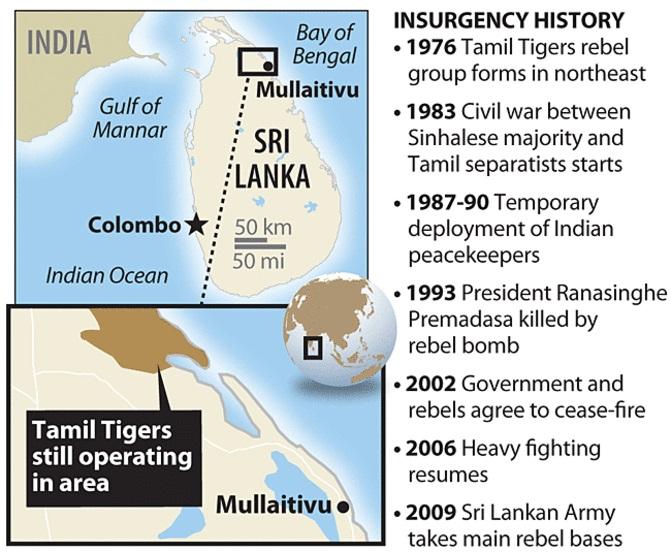
Back2Basics: Sri Lankan Civil War It was a protracted armed conflict that lasted for nearly three decades, from 1983 to 2009, between the government of Sri Lanka and the Liberation Tigers of Tamil Eelam (LTTE).
LTTE was a separatist militant organisation seeking an independent Tamil state in the northern and eastern regions of the island nation. The conflict was characterised by violence, human rights abuses, and widespread displacement of civilians.
The LTTE, known for its guerrilla tactics and suicide bombings, controlled significant territory in the north and east of Sri Lanka and waged a violent insurgency against the government.
Key Hindrances to Sri Lanka’s Progress
Limited Progress: While infrastructure like trains, banks, supermarkets, and hotels returned to the north, rural areas continue to struggle with unstable livelihoods.
Setback from Terror Attack: The Easter bombings in April 2019, followed by the COVID-19 pandemic and an ongoing economic crisis since 2022, have exacerbated economic hardships, marking the worst crisis since Independence.
Economic Crisis: Economic misery is pervasive, with outmigration and hunger becoming the norm, particularly impacting the deprived and landless in war-torn areas.
Challenges in Reconstruction Efforts
Economic Challenges
Failed Investments: Expectations of substantial investments from the Tamil diaspora have not materialised, failing to stimulate local economic revival.
International Donor Projects: Projects focused on infrastructure have not effectively revitalised the local economy, while NGO aid has sometimes led to dependency and microfinance debt traps.
Political Polarisation and Neglect
Political Neglect: Tamil political leadership has often prioritised international accountability over addressing local livelihoods, perpetuating dependency on diaspora remittances.
Parallel Nationalisms: Tamil nationalist politics mirrors Sinhala nationalism, focusing on rights and international intervention, rather than fostering local reconciliation.
Reconciliation Challenges: Efforts towards political reconciliation and power-sharing have faltered due to political expediency, exacerbating tensions and marginalising minorities.
Communal polarization: Relations between Tamil and Muslim communities remain strained, with unresolved issues from historical displacements and marginalization.
Future Prospects for Tamil People
V. Karalasingham’s Reflections (1963): Highlighted the paradox of Tamil leadership and the continued suffering and humiliation of Tamil-speaking people.
Aragalaya Movement (2022): Sri Lankans united to oust a President promoting Sinhala-Buddhist nationalism, showing potential for collective action.
Path to Change: Embracing inclusive politics, moving away from isolationist strategies, and advocating for economic and social justice can pave the way for a democratic future based on equality and freedom.
India’s Economic Assistance to Sri Lanka:
1.Bailout Package: During Sri Lanka’s economic crisis in 2022, India was quick to extend financial support, amounting to over USD 4 billion. This surpassed even the International Monetary Fund’s (IMF) bailout package over 48 months.
2.Facilitating IMF Engagement: India’s role was instrumental in the early stages of Sri Lanka’s negotiations with the IMF. India’s Finance Minister, Mrs Sitharaman, played a significant part in these discussions, showcasing India’s commitment to its neighbour’s recovery.
3.Private Investment: The expansion of the Colombo port’s west container terminal in 2023 by India’s Adani Group was a key development project.
4. Cricket Diplomacy: Cricket surprisingly became a focal point, with international matches hosted in Sri Lanka, including a notable India-Pakistan game during the World Cup.
Way Forward
Political Reconciliation: Advocate for genuine political reconciliation, including devolution of power and addressing historical grievances.
Community Integration: Foster solidarity and mutual understanding between ethnic and religious communities to promote social integration.
Local Empowerment: Support local initiatives and reduce dependency on external aid, empowering communities to drive their development.
Unified Movements: Promote movements that unite diverse groups towards common goals of justice, equality, and inclusive governance.