💥Mains Ready By December. Smash Mains & Smash PYQ Admissions Open

Subject: International Stories of Key Importance

  • This Word Means: Semiconductor

    Why in the News?

    During the ongoing U.S.-China tariff war, the Trump administration announced that smartphones, computers, and some electronics would be excluded from the 125% tariffs, easing concerns for firms like Apple.

    What decision did the Trump administration make regarding smartphones and computers in the tariff war with China?

    • Exemption from High Tariff Slab: The Trump administration decided that smartphones, computers, and certain other electronics would not be subjected to the 125% reciprocal tariffs on China. Eg: Apple products like iPhones and MacBooks were spared from the highest tariff bracket.
    • Reclassification to Lower Tariff Bucket: These items were instead moved to a lower tariff category of 20%, which was presented as a strategic decision, not a full exemption. Eg: Laptops and other consumer electronics faced a reduced tariff rate instead of the originally proposed higher one.

    Why are semiconductors considered critical for the United States’ national security and economy?

    • Foundation of Modern Technology: Semiconductors power essential devices from smartphones and laptops to defense systems and AI tools, making them indispensable to both daily life and strategic operations. Eg: Military drones and radar systems rely on advanced microchips for data processing.
    • Supply Chain Vulnerability: Heavy reliance on a few countries, especially Taiwan, for chip manufacturing exposes the U.S. to supply disruptions and geopolitical risks. Eg: The COVID-19 pandemic highlighted global chip shortages, affecting car and electronics industries.
    • Need for Technological Sovereignty: Boosting domestic semiconductor production ensures technological leadership, economic resilience, and reduces dependence on potentially hostile nations. Eg: New tariffs and subsidies aim to encourage U.S.-based chip manufacturing to reduce reliance on China.

    Where is most of the world’s semiconductor manufacturing currently concentrated?

    • Taiwan: Taiwan leads global semiconductor manufacturing, especially in advanced chips, due to companies like TSMC (Taiwan Semiconductor Manufacturing Company). Eg: TSMC produces over 50% of the world’s advanced semiconductors.
    • South Korea: A major player in memory chip production, with giants like Samsung and SK Hynix dominating the market. Eg: Samsung is a global leader in DRAM and NAND flash memory chips.
    • China: Rapidly expanding its semiconductor industry through state support, though still dependent on foreign technology for advanced manufacturing. Eg: SMIC (Semiconductor Manufacturing International Corporation) is China’s largest chipmaker but faces U.S. export restrictions.

    When did the US’s share in global semiconductor manufacturing decline significantly? 

    • Since the 1990s: The U.S. share fell from 37% in 1990 to 12% by 2020, as production increasingly shifted to Asia due to lower costs and better infrastructure. Eg: Companies like TSMC (Taiwan) and Samsung (South Korea) became dominant players.
    • Post-globalization era: With the rise of global supply chains and outsourcing, the U.S. focused more on chip design than manufacturing, leading to a production gap. Eg: Firms like Intel design chips in the U.S. but get them manufactured overseas.

    Can India grab the semiconductor supply chain?

    India has strong potential to become a major player in the global semiconductor supply chain.

    • Government Push & Incentives: India has launched a ₹76,000 crore (US $10 billion) semiconductor incentive scheme to attract global chipmakers and boost domestic production. Eg: Micron is investing $2.75 billion in a chip assembly plant in Gujarat under this scheme.
    • Strategic Location & Talent Pool: India offers a large, skilled workforce in electronics and IT, and is strategically located between key markets like Southeast Asia and Europe. Eg: Tata Group is setting up a semiconductor assembly and testing unit in Assam to tap both local and export markets.
    • Global Diversification Needs: Countries and companies want to reduce reliance on Taiwan and China due to geopolitical tensions. India is being seen as a reliable alternative. Eg: U.S. firm Lam Research plans to train 60,000 Indian engineers and invest $1 billion to strengthen India’s semiconductor ecosystem.

    Way forward: 

    • Accelerate Ecosystem Development: Strengthen infrastructure for fabs, ensure reliable electricity and water supply, and support R&D and design capabilities to build a complete semiconductor ecosystem.
    • Foster Global Collaborations: Partner with global semiconductor leaders for technology transfer, workforce training, and joint ventures to fast-track domestic capability and integration into the global supply chain.

    Mains PYQ:

    [UPSC 2018] How would the recent phenomena of protectionism and currency manipulations in world trade affect macroeconomic stability of India?

    Linkage:  The basic idea behind a tariff war is protectionism, where countries impose taxes on imports to shield their own industries from foreign competition. In this case, India’s manufacturing sector could benefit from the trade war between the USA and China.

  • [14th April 2025] The Hindu Op-ed: Will Trump’s tariffs bring in a recession?

    PYQ Relevance:

    [UPSC 2018] How would the recent phenomena of protectionism and currency manipulations in world trade affect macroeconomic stability of India?

    Linkage:  Trump’s administration was known for implementing protectionist trade policies, primarily through tariffs, starting around that period as discussed in the article. The question asks about the impact of “protectionism” on “macroeconomic stability,” which is directly linked to concerns about a potential recession.


    Mentor’s Comment:  The U.S. has been a strong supporter of free trade and a key driver of globalization since the mid-20th century. However, in a surprising shift, President Donald Trump took drastic action on April 2, calling it “Liberation Day,” by drastically changing U.S. trade policy. Until 2024, the U.S. had a low tariff rate of 2 to 3% on imports for two decades. But on April 2, Trump announced that the U.S. would now charge a minimum of 10% tariff on all imports. For imports from around 60 countries, the tariffs would be much higher, called “reciprocal” tariffs. These include a 20% tariff on the European Union (EU), 27% on India, and 46% on Vietnam.

    Today’s editorial analyzes how the U.S. tariffs will affect India and the rest of the world. This topic is useful for GS Paper 2 and 3 in the UPSC Mains exam.

    _

    Let’s learn!

    Why in the News?

    On April 2, U.S. President Trump announced that the U.S. would start charging at least 10% tariffs on all imports.

    What change did Trump announce on April 2 regarding U.S. tariffs?

    • Introduction of a Minimum 10% Tariff on All Imports: Trump declared that the U.S. would levy a minimum 10% tariff on all imported goods, ending decades of low tariff policy. Eg: A previously tariff-free $100 imported item would now cost $110 with the new 10% tariff.
    • “Reciprocal” Tariffs for Select Countries: Tariffs would be significantly higher for around 60 countries, based on what the U.S. perceives as unfair trade practices. Eg: Imports from India now face a 27% tariff, Vietnam 46%, and China a staggering 145%.
    • Highest Tariffs Targeted at China: China, the largest source of U.S. imports, was hit hardest — facing 145% tariffs, as part of an aggressive move to reduce trade deficits and pressure China economically. Eg: A $100 Chinese product would now cost $245 after the new tariff.

    How did markets respond?

    • Stock Markets Nosedived: The announcement caused panic among investors, leading to sharp declines in stock markets around the world. Eg: The U.S. stock market dropped significantly, with major indices like the Dow Jones and S&P 500 seeing large declines as investors feared the impact of the tariffs.
    • Increased Economic Uncertainty: The abrupt tariff increases created a sense of economic uncertainty, particularly regarding trade relations and the global supply chain. Eg: The value of the U.S. dollar fluctuated, with the dollar weakening against several currencies as concerns about a trade war heightened.
    • Commodity Prices Rose: The market anticipated higher costs for goods, especially imported items, leading to a rise in the price of key commodities. Eg: Goods like electronics and consumer products became more expensive, reflecting the expected rise in tariffs and trade barriers.

    What could be the chance of recession after US tariffs? 

    • Reduced Consumer Spending Due to Higher Prices: Higher tariffs make imported goods more expensive, which can lead to inflation and reduced purchasing power among consumers. This slowdown in consumer spending—a key driver of the U.S. economy—can drag growth. Eg: A $1,000 smartphone imported from China may now cost $2,450 due to 145% tariffs, making consumers delay or avoid big purchases.
    • Strained Global Supply Chains and Business Uncertainty: Companies reliant on international supply chains may face higher input costs and uncertainty, leading to reduced investments, production delays, and job cuts.Eg: U.S. auto manufacturers sourcing parts from Asia may cut production or delay expansion due to rising costs and disrupted logistics.
    • Global Retaliation and Slowing Trade: Other countries may retaliate with their own tariffs, triggering a trade war that slows global trade and weakens demand for U.S. exports, increasing the risk of a global economic downturn. Eg: If the EU or China impose counter-tariffs on U.S. agricultural or tech exports, American farmers and companies may face losses, increasing joblessness and recession risk.

    Why is China better prepared for a trade war?

    Reason Why China Is Better Prepared Example
    Diversified Export Markets Reduced reliance on U.S. by expanding trade with Asia, Europe, and Africa. U.S. share in China’s exports dropped from 21% (2006) to 16.2% (2022).
    Lower Export Dependence on GDP Exports now form a smaller part of China’s economy, reducing vulnerability. Export-to-GDP fell from 35% (2012) to 19.7% (2023).
    Focus on Tech & Innovation Heavy investment in AI, EVs, and domestic tech industries to cut foreign dependence. Made in China 2025 boosted self-reliance in high-tech sectors.
    Manufacturing Shift to Neighbors Relocating production to East Asia (e.g., Vietnam) to bypass U.S. tariffs. Maintains supply chains while avoiding direct U.S. tariffs.
    Strong Forex Reserves & Bond Holdings Large reserves used to buy U.S. treasury bonds, ensuring financial strength. U.S. dollar assets reduce trade/finance risks and secure China’s position.

    How will higher U.S. tariffs impact India’s exports? 

    • Reduced Export Earnings: Higher U.S. tariffs could decrease India’s export earnings as Indian goods would become more expensive for U.S. consumers, potentially leading to lower demand. Eg: Products like textiles and gems & jewelry, which are major export items to the U.S., might see a drop in sales due to increased tariffs.
    • Impact on Key Sectors: India’s manufacturing sectors, such as automobiles and electrical machinery, might face stiffer competition due to higher tariffs, reducing their ability to compete in the U.S. market. Eg: Indian automobile exports, especially in segments like small cars, might struggle as U.S. tariffs raise the prices and reduce competitiveness.
    • Diversification of Export Markets: Since the U.S. accounts for 21.8% of India’s total exports, any tariff hike could push India to explore new markets outside the U.S., reducing the impact of the tariff increase. Eg: India might increase its focus on the European Union or Southeast Asian markets, where demand for Indian goods remains strong.
    • Pharmaceutical and Service Exports Unaffected: Higher tariffs on goods may not impact India’s pharmaceutical and services exports as significantly, as they are major contributors to India’s trade surplus with the U.S. Eg: Generic medicines and IT services, such as software development, will likely continue to thrive in the U.S. market despite higher tariffs on other goods.
    • Pressure on Domestic Industry: Increased tariffs could also drive higher production costs in India, as it may face higher input costs for raw materials imported from the U.S. This could hurt the competitiveness of India’s export products. Eg: Sectors like steel and chemicals, which rely on U.S. exports for raw materials, may see a rise in production costs, potentially reducing profit margins.

    When did the U.S. maintain low tariffs?

    • Post-World War II Period (1945–1970s): After World War II, the U.S. championed free trade and maintained low tariffs to encourage global economic recovery and integrate global markets. During this period, the U.S. was seen as the chief architect of globalization. Eg: The General Agreement on Tariffs and Trade (GATT), established in 1947, played a crucial role in reducing global tariffs, and the U.S. led many rounds of negotiations to lower its own import duties.
    • 1980s to Early 2000s: During this period, particularly under the Clinton administration, the U.S. kept tariffs low to support global trade liberalization and its dominant position in the world economy. This made the U.S. an attractive market for exports and facilitated the growth of international trade. Eg: The North American Free Trade Agreement (NAFTA) signed in 1994 between the U.S., Canada, and Mexico aimed to eliminate tariffs and increase trade between the countries, further reinforcing the U.S.’s low-tariff approach.

    Why was it seen as the chief architect of globalisation during that time?

    • Promotion of Free Trade Agreements: The U.S. led the establishment of various international trade agreements to reduce tariffs and promote open markets. It actively negotiated trade deals that facilitated the movement of goods, services, and capital across borders. Eg: The General Agreement on Tariffs and Trade (GATT), later replaced by the World Trade Organization (WTO) in 1995, was strongly influenced by the U.S. and aimed at creating a more liberalized global trade system.
    • Economic Influence and Dollar Dominance: The U.S. played a dominant role in global finance, with the dollar as the primary global reserve currency. This position helped facilitate international trade and investment, as countries around the world held U.S. dollars for foreign exchange and international transactions. Eg: Countries like China and Japan invested heavily in U.S. Treasury bonds, reinforcing the U.S.’s economic influence and fostering the expansion of global markets.
    • Technological and Industrial Leadership: The U.S. led technological innovation and industrial development, particularly in sectors like technology, finance, and manufacturing. This leadership helped drive global supply chains, with many countries relying on the U.S. for both innovation and as a key export market. Eg: U.S. tech giants such as Microsoft, Apple, and Google set the global stage for the digital economy, helping integrate economies worldwide into a globalized tech ecosystem.

    Way forward: 

    • Diversify Export Markets: India and other countries should explore new markets outside of the U.S., especially in emerging economies and regional trade agreements, to reduce dependency on the U.S. and mitigate the effects of tariff hikes. Eg: Strengthening ties with the European Union, Southeast Asia, and Africa could help reduce reliance on the U.S. market.
    • Enhance Domestic Innovation and Self-Sufficiency: Countries should focus on boosting domestic production, innovation, and technological advancements to reduce vulnerability to external trade barriers and tariffs. Eg: India could prioritize self-reliance in sectors like pharmaceuticals, electronics, and renewable energy to counter tariff pressures.
  • India-Middle-East-Europe-Economic Corridor (IMEEC)

    Why in the News?

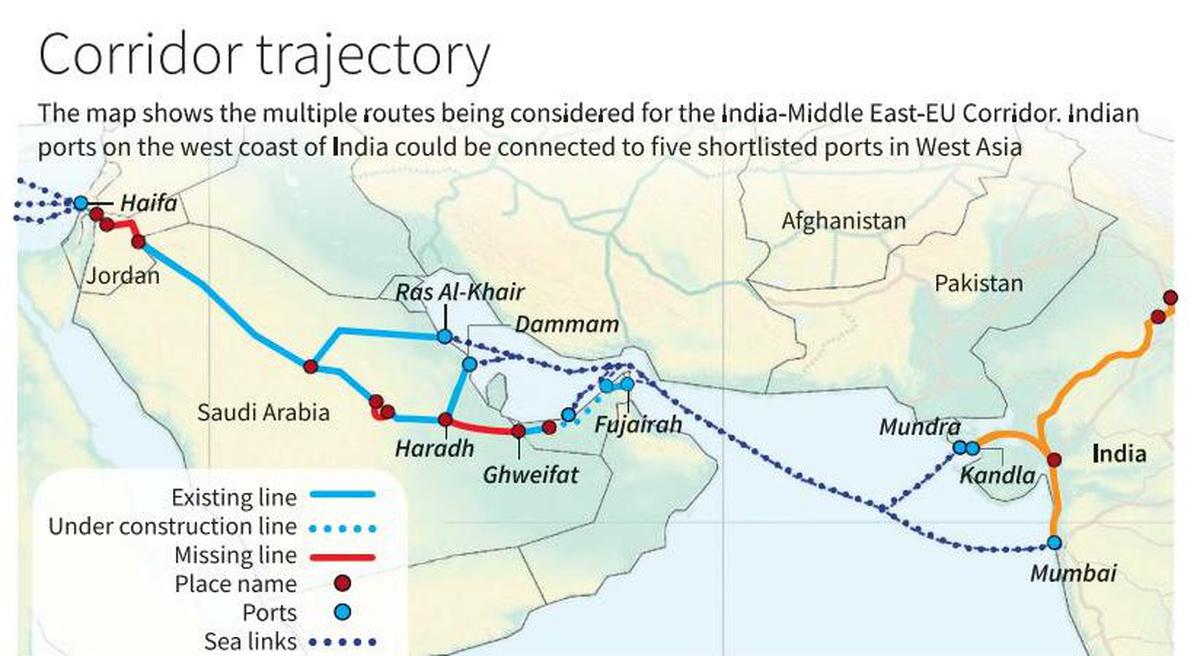
    India and Italy have decided to enhance cooperation in trade, defence, clean energy, and high technology while working jointly on the India-Middle-East-Europe-Economic Corridor (IMEEC).

    imeec

    About IMEEC Project:

    • IMEEC is a key initiative under the Partnership for Global Infrastructure and Investment (PGII), aimed at infrastructure development in developing regions.
    • It was formally endorsed on September 10, 2023, during the 2023 G20 New Delhi summit.
    • Signatories include: India, United States, UAE, Saudi Arabia, France, Germany, Italy, and the European Union.
    • Objective: To integrate Asia, Europe, and the Middle East to boost economic cooperation, trade, and regional connectivity.
    • IMEEC consists of two main corridors:
      1. East Corridor: Connecting India to the Arabian Gulf.
      2. Northern Corridor: Connecting the Gulf region to Europe.
    • Key Ports to be Connected:
      • India: Mundra, Kandla, Jawaharlal Nehru Port Trust (Mumbai).
      • Middle East: Fujairah (UAE), Jebel Ali (Dubai), Dammam (Saudi Arabia).
      • Israel: Haifa Port.
      • Europe: Piraeus (Greece), Messina (Italy), Marseille (France).

    Significance of the Project:

    • IMEEC will create a cost-efficient ship-to-rail transit network, enhancing existing transport links.
    • The project will transform regional trade dynamics and foster sustainable economic growth.
    [UPSC 2023] With reference to India’s projects on connectivity, consider the following statements:

    1. East-West Corridor under Golden Quadrilateral Project connects Dibrugarh and Surat.

    2. Trilateral Highway connects Moreh in Manipur and Chiang Mai in Thailand via Myanmar.

    3. Bangladesh-China -India -Myanmar Economic Corridor connects Varanasi in Uttar Pradesh with Kunming in China.

    Which of the statements given above is/are correct?

    (a) 1 only (b) 2 only (c) Both 1 and 2 (d) Neither 1 nor 2


  • [5th April 2025] The Hindu Op-ed: A case for the Global South in securing Ukraine peace

    PYQ Relevance:

    [UPSC 2019] The long-sustained image of India as a leader of the oppressed and marginalised Nations has disappeared on account of its new found role in the emerging global order”. Elaborate.

    Linkage:  India’s historical role as a voice for the “Global South” and how its current global positioning might be perceived differently. This article argues for the Global South to take a leading role, which resonates with India’s past image.


    Mentor’s Comment:  As the Ukraine war moves toward a fragile ceasefire, the big question is who will ensure lasting peace. Western countries suggest a European-led peacekeeping force, but Russia rejects NATO troops. Instead, nations from the Global South—Africa, Asia, and Latin America—could lead a neutral UN mission, showing they can help maintain global peace and stability.

    Today’s editorial looks at how countries from the Global South could lead a peacekeeping mission in the Ukraine war. This topic is useful for General Studies Paper 2 in the UPSC mains exam.

    _

    Let’s learn!

    Why in the News?

    The war in Ukraine gives the Global South a chance to show it can be a fair and trusted force in bringing peace and stability to the world.

    Why is a Global South-led peacekeeping mission preferred over a European-led one in Ukraine?

    • Neutrality and Trustworthiness: Global South countries are not directly involved in the Ukraine war and have largely remained neutral, making them more acceptable to both parties Example: India maintains diplomatic ties with both Russia and Ukraine — PM Modi met both leaders within weeks, signalling impartiality.
    • Avoiding NATO-Russia Tensions: European-led missions are viewed by Russia as NATO extensions, which could escalate rather than resolve the conflict. Example: Russian Foreign Minister Lavrov warned that European troops would “fuel the conflict,” not ease it.
    • Strong UN Peacekeeping Experience: Global South nations have a proven record in UN peacekeeping across various conflict zones. Example: The African Union has led missions in Somalia and Sudan; India has contributed over 2,90,000 peacekeepers to UN missions.
    • Public Opposition in Europe: European populations are reluctant to support troop deployments in Ukraine, limiting the viability of a European-led mission. Example: French citizens largely opposed Macron’s suggestion to send French troops for peacekeeping earlier this year.
    • Symbol of Multipolar Global Order: A Global South-led mission would demonstrate their growing role in global governance and diplomacy. Example: Countries like Brazil, Indonesia, and South Africa are part of BRICS and actively engage in UN initiatives, signalling rising influence.

    Why does Russia oppose European or NATO-led peacekeeping forces in Ukraine?

    • Perceived NATO Expansion: Russia sees any European-led force as a cover for NATO expansion, violating its red lines on NATO’s eastward movement. Example: Moscow described a European-led mission as a “NATO Trojan horse” — a disguised attempt to increase NATO’s footprint in Ukraine.
    • Threat to Russian Security: A European or NATO presence near Russian borders is seen as a direct security threat, escalating tensions. Example: Russia strongly reacted when NATO troops were deployed in Eastern Europe after 2014, citing encirclement fears.
    • Lack of Impartiality: Russia considers NATO countries partial and hostile, incapable of mediating fairly between Ukraine and Russia. Example: NATO nations have supplied Ukraine with weapons and intelligence, eroding their neutrality in Russia’s view.
    • Potential for Escalation: Deploying NATO-aligned forces could turn peacekeepers into targets, risking direct confrontation between Russia and NATO. Example: Russian Foreign Minister Sergei Lavrov warned that NATO troops in Ukraine would “further fuel the conflict.”
    • Undermining Diplomatic Efforts: Russia believes a NATO role in peacekeeping would delegitimize any ceasefire, making negotiations harder. Example: Russia has supported talks in neutral venues like Riyadh, avoiding NATO-influenced settings for peace discussions.

    Which Global South countries are suited for peacekeeping in Ukraine, and what proves their capability?

    • India has vast experience in UN peacekeeping, having contributed over 2,90,000 troops to 50+ UN missions. Example: In 2007, India deployed the first all-women peacekeeping contingent to Liberia, showcasing professionalism and inclusivity.
    •  Brazil has led several UN missions, especially in Latin America and Africa, and is known for diplomatic balance. Example: Brazil commanded the UN Stabilization Mission in Haiti (MINUSTAH) from 2004 to 2017, showing leadership in volatile environments.
    •  South Africa: With deep regional peacekeeping experience via the African Union and UN, South Africa balances diplomacy with force. Example: South Africa has contributed troops to peacekeeping missions in the Democratic Republic of Congo (MONUSCO) under challenging conditions.
    • Indonesia has a consistent record of contributing troops and police to UN missions, emphasizing neutrality and professionalism. Example: It currently contributes forces to UN missions in Lebanon (UNIFIL) and the Central African Republic (MINUSCA).
    • Chile specializes in demining and post-conflict reconstruction, vital for Ukraine’s recovery. Example: Chilean experts have worked with UN missions on landmine removal in post-war zones, a skill urgently needed in Ukraine.

    How can India’s peacekeeping legacy support a UN mission in Ukraine?  

    • Reputation for Neutrality: India maintains balanced diplomatic relations with Russia, Ukraine, and the West, making it a credible and neutral peacekeeping leader. Example: PM Modi’s meetings with both President Putin and President Zelenskyy within weeks reflect India’s impartial diplomatic posture.
    • Extensive Peacekeeping Experience: India is one of the largest contributors to UN peacekeeping, with over 2,90,000 troops having served in 50+ missions worldwide. Example: India’s leadership in UN missions in South Sudan (UNMISS) and Congo (MONUSCO) shows operational effectiveness in complex conflict zones.
    • Pioneering Gender-Inclusive Peacekeeping: India was the first country to deploy an all-women police contingent in a UN mission. Example: In 2007, Indian women peacekeepers served in Liberia, enhancing community trust and addressing gender-based issues in post-conflict societies.

    Way forward:

    • Leverage India’s Neutral Diplomatic Standing: India can lead or coordinate a Global South-led mission due to its balanced ties with Russia, Ukraine, and the West — ensuring credibility and acceptance by all parties. e.g. India’s PM meetings with both Putin and Zelenskyy show diplomatic neutrality.
    • Utilize India’s Peacekeeping Expertise:
      India should offer experienced troops, including women contingents, to promote trust, inclusivity, and effectiveness in conflict zones. e.g. India’s success in UNMISS and the all-women unit in Liberia reflect its capability.
  • Heard and McDonald Islands

    Why in the News?

    Donald Trump imposed a 10% tariff on imports from the Heard and McDonald Islands, despite no human presence there for nearly a decade.

    About the Heard and McDonald Islands

    • The Heard and McDonald Islands are located in the Southern Ocean, approximately 4,100 km south-west of Perth, Australia, and 1,600 km to the north of the Antarctic coast.
    • The islands are unincorporated external territories of Australia, meaning they are not part of any Australian state but are directly administered by the Australian government.
    • The islands are home to seals, penguins, and albatrosses, and serve as crucial breeding grounds for these species.
    • The islands have been designated as UNESCO World Heritage Sites due to their ecological significance, particularly their rich biodiversity.
    • Heard Island:
      • Heard Island spans an area of approximately 368 square kilometers.
      • The island’s highest point is Mawson Peak, an active volcano standing 2,745 meters (9,006 feet) above sea level.
      • Mawson Peak is one of the most active volcanoes in the southern hemisphere, with eruptions as recent as 2016.
    • McDonald Islands:
      • It is much smaller, covering only 2.5 square kilometers.
      • Geological Nature: These islands are volcanic and part of the same volcanic chain as Heard Island.
      • Climate
      • Both islands experience an extremely cold subantarctic climate, with heavy winds, snow, and ice for much of the year.
      • Temperatures rarely exceed 5°C (41°F) even in summer.

    Strategic Significance

    • The islands are strategically located between Australia and Antarctica, important for monitoring the Southern Ocean, vital for global biodiversity and climate studies.
    • They play a key role in scientific research, particularly in volcanology, glaciology, and climate change, with Australia operating a research station on Heard Island.
    • The islands are protected under the Antarctic Treaty System, ensuring no military activity or commercial exploitation in the region.
    • Rich in marine resources, the surrounding waters are also safeguarded to prevent overfishing and environmental harm.
    • Their geopolitical importance grows as international competition and territorial claims around Antarctica and the Southern Ocean increase.
  • [4th April 2025] The Hindu Op-ed: The other space race — the geopolitics of satellite net

    PYQ Relevance:

    [UPSC 2024] Can India become a space power by solely relying on its indigenous technology, or is it imperative to forge technological alliances and collaborations with other nations to stay competitive in the global space race? Elaborate your views. 

    Linkage:  India’s choice to partner with Starlink, a US-based network, over waiting for indigenous solutions or potentially partnering with China, illustrating the geopolitical considerations in space technology.


    Mentor’s Comment: Many parts of India still lack fiber and mobile networks. Starlink’s tie-up with Airtel and Jio helps bring fast Internet to remote areas without big infrastructure costs. While good for business, it raises concerns about U.S. digital control. Starlink’s dominance, with 7,000 satellites, risks creating a monopoly and giving private firms major control over key infrastructure.

    Today’s editorial analyzes  Starlink’s tie-up with Airtel and Jio and its impact. This will help in GS paper 2 and GS Paper 3.

    _

    Let’s learn!

    Why in the News?

    It’s still unclear whether satellite Internet will help everyone get connected or just make the digital gap worse in a new way from space.

    What are the economic and strategic benefits of India’s partnership with Starlink?

    • Bridging the Digital Divide: Enables high-speed internet access in rural, remote, and hilly areas where laying fiber-optic cables is difficult or expensive. Eg:  Remote villages in Ladakh or Northeast India can access e-learning, telemedicine, and government services through satellite internet.
    • Cost-effective Infrastructure Expansion: Reduces the capital and operational costs for Indian telecom companies like Airtel and Jio, as satellite internet bypasses the need for expensive terrestrial infrastructure. Eg : Instead of building hundreds of towers in sparsely populated areas, Airtel can provide service using Starlink’s satellite network.
    • Strategic Geopolitical Alignment: Aligns India with the U.S.-led democratic digital alliance, distancing itself from authoritarian tech ecosystems like China’s GuoWang. Eg: Choosing Starlink over Chinese alternatives reflects India’s broader Indo-Pacific strategy of cooperation with like-minded nations.
    • Boost to Domestic Capability via Partnership Model: Collaborating through Indian partners (Airtel, Jio) offers regulatory oversight, scope for technology transfer, and growth of India’s tech ecosystem. Eg: Local data routing, domestic satellite ground stations, and service operations can help build technical capacity and expertise in India.
    • Strategic Communication Redundancy Enhances national security by providing backup communication systems during disasters or network blackouts. Eg: During natural calamities like cyclones or earthquakes, satellite internet can keep remote regions connected when ground networks fail.

    Why is Starlink’s monopolistic control a concern, and how does it impact India?

    • Overdependence on a Foreign Private Entity: Reliance on Starlink gives a U.S.-based private firm significant control over India’s digital backbone in remote areas.
      Eg: If Starlink alters service terms or suspends access due to U.S. geopolitical interests, India’s connectivity in border or conflict zones could be compromised.
    • National Security Risks: Communication infrastructure operated from outside the country raises concerns over surveillance, data sovereignty, and wartime disruption. Eg: During the Russia-Ukraine war, Starlink restricted access to its services in conflict zones — India could face similar risks in sensitive areas like Jammu & Kashmir or Arunachal Pradesh.
    • Market Distortion and Limited Competition: Starlink’s first-mover advantage and satellite volume (~7,000 satellites) could outcompete smaller or local satellite internet ventures. Eg: Domestic players like ISRO’s satellite internet plans or private Indian firms may struggle to gain market share or scale up effectively.
    • Pricing Power and Affordability Issues: Monopoly allows Starlink to set high prices, making services unaffordable for large sections of rural and poor populations. Eg: Without competition or regulation, satellite internet packages may remain out of reach for rural schoolchildren or small farmers.
    • Reduced Technological Sovereignty: Long-term reliance may hinder India’s ability to develop indigenous alternatives, stalling progress toward digital self-reliance. Eg: Starlink dominance might delay ISRO’s or IN-SPACe’s efforts in launching Indian LEO satellite constellations.

    Who are the key global players in satellite internet?

    Player Country Project Name Key Features Example / Status
    SpaceX USA Starlink – Operates 7,000+ satellites in Low Earth Orbit (LEO)

    – Provides global broadband internet

    – Services available in 70+ countries

    – Partnerships with Airtel & Jio in India for rural access

    China Satellite Network Group China GuoWang – State-run project for national security & digital sovereignty

    – Aims to deploy 13,000+ satellites

    – Strategic focus on Indo-Pacific and Belt & Road countries
    Amazon USA Project Kuiper – Plans to deploy 3,000+ satellites

    – Emerging competitor in global internet services

    – FCC approved

    – Aims to launch by 2026

    – Focus on North America & developing markets


    How does India’s choice of Starlink over indigenous or Chinese alternatives reflect its Indo-Pacific strategy?

    • Strategic Alignment with Democratic Partners: India’s preference for Starlink (a U.S.-based company) indicates alignment with democratic nations in the Indo-Pacific region. Eg: By avoiding Chinese alternatives like GuoWang, India reinforces its commitment to frameworks like Quad (India, U.S., Japan, Australia) that promote a free, open, and secure Indo-Pacific.
    • Countering China’s Digital Influence: India’s decision helps prevent Chinese technological dominance in Asia, especially in sensitive sectors like space and communication.Eg: Partnering with Starlink counters China’s Digital Silk Road ambitions and limits Beijing’s potential surveillance or control via GuoWang.
    • Enhancing Strategic Interoperability: Collaborating with U.S. technologies builds compatibility with partner nations’ digital and defense infrastructure. Eg: Starlink’s use in defense communication, as seen in Ukraine, could serve as a backup during emergencies in border regions like Ladakh or Arunachal Pradesh.
    • Economic Pragmatism and Speed: India needs fast, scalable connectivity. Starlink offers a quicker solution compared to long timelines for domestic capability development. Eg: Indigenous LEO satellite programs are still in nascent stages, while Starlink is already operational, helping bridge rural digital gaps.
    • Signal of Strategic Autonomy, Not Dependency: By routing Starlink through Indian firms like Jio and Airtel, India retains some control, showing a model of “managed dependency.” Eg: Unlike full foreign control, this hybrid model mirrors India’s “Act East” and “Neighbourhood First” policies that balance strategic autonomy with global partnerships.

    What steps can ensure digital sovereignty? (Way forward)

    • Develop Indigenous Satellite Infrastructure: Investing in homegrown satellite constellations enhances strategic independence and reduces reliance on foreign networks.Eg: ISRO and private players like IN-SPACe can develop India’s own LEO satellite systems to serve rural and border areas.
    • Enforce Strong Regulatory Frameworks: Mandating data localization, technology transfer, and operational oversight ensures control over foreign tech operations. Eg: India can require local data storage and security vetting for Starlink services, similar to norms for other digital services.
    • Strengthen Public Sector Participation: Involving state-owned enterprises like BSNL in satellite internet rollouts can provide public oversight and reduce strategic vulnerabilities.Eg: Partnering Starlink with BSNL could combine reach and regulation, giving the government more control over critical infrastructure.
  • [1st April 2025] The Hindu Op-ed: Why are tensions high in the Arctic?

    PYQ Relevance:

    Question: “If the last few decades were of Asia’s growth story, the next few are expected to be of Africa’s.” In the light of this statement, examine India’s influence in Africa in recent years. [UPSC 2021]

    Linkage: The broader context of competition for influence in the continent. 


    Mentor’s Comment:  The Arctic has been isolated for centuries, but climate change is melting ice, which leads to opening access to valuable resources like oil, gas, and rare earth metals. Melting ice is also creating new trade routes. Unlike Antarctica, the Arctic has no strong legal protections, leading to territorial claims and military activity, increasing global tensions.

    Today’s editorial discusses the geopolitical impact of climate change in the Arctic. This topic is relevant for GS Paper 2 (International Relations) and GS Paper 3 (Environment).

    _

    Let’s learn!

    Why in the News?

    Global experts are concerned about increasing tensions in the Arctic, cautioning that if not controlled, they might cause conflict in the area.

    arctic

    What are the key factors driving increased geopolitical tensions in the Arctic?

    • Climate Change & Melting Ice: The Arctic ice cap is shrinking, making previously inaccessible natural resources and trade routes viable. Example: The opening of the Northeast Passage along Russia’s coast could significantly reduce shipping times between Asia and Europe.
    • Competition for Natural Resources: The region holds an estimated 13% of the world’s undiscovered oil and 30% of untapped natural gas, along with rare earth minerals. Example: Greenland has significant deposits of rare earth elements, attracting interest from China and the U.S.
    • Territorial Disputes & Overlapping Claims: Countries are extending their maritime boundaries under UNCLOS to claim more of the Arctic seabed. Example: Russia, Canada, and Denmark have overlapping claims to the Lomonosov Ridge, a key Arctic seabed area.
    • Military Posturing & Strategic Control: Nations are increasing their military presence to assert dominance and protect interests. Example: Russia has expanded its Arctic military bases and deployed nuclear-powered icebreakers, while NATO has increased Arctic exercises.
    • New Maritime Trade Routes & Geopolitical Rivalry: The melting ice is opening faster, alternative shipping lanes, bypassing traditional routes like the Suez Canal. Example: China is promoting the Polar Silk Road via the Northeast Passage, while Russia maintains strict control over Arctic navigation.

    Who are the primary stakeholders controlling different regions of the Arctic?

    • Arctic Coastal Nations (Arctic Council Members): Eight countries control Arctic land and territorial waters: Canada, Denmark (via Greenland), Finland, Iceland, Norway, Russia, Sweden, and the U.S. Example: Russia has the largest Arctic coastline and controls key ports, while Canada claims sovereignty over the Northwest Passage.
    • International Governance & UNCLOS: The UN Convention on the Law of the Sea (UNCLOS) regulates maritime claims, allowing nations to extend seabed claims if proven as a continental shelf extension. Example: Russia, Canada, and Denmark have all submitted overlapping claims to the Arctic seabed under UNCLOS.
    • Non-Arctic Global Powers & Observers: Non-Arctic nations like China, India, the UK, and the EU monitor Arctic developments due to strategic interests in trade routes and resources. Example: China declared itself a “Near-Arctic State” in 2018 and is investing in icebreaker ships to influence Arctic shipping lanes.

    Where do territorial disputes and conflicting claims arise among Arctic nations?

    • Competing Seabed Claims under UNCLOS: Arctic nations claim extended seabed areas beyond their Exclusive Economic Zones (EEZs) by proving geological extensions of their continental shelves. Example: Russia, Canada, and Denmark (via Greenland) have overlapping claims to the Lomonosov Ridge in the central Arctic Ocean.
    • Northwest Passage Dispute (Canada vs. U.S.): Canada considers the Northwest Passage part of its internal waters, granting it control over navigation. The U.S. and other nations claim it is an international strait, allowing free passage. Example: The U.S. has conducted “freedom of navigation” operations in the passage, challenging Canada’s sovereignty.
    • Svalbard Archipelago (Norway vs. Russia): Norway administers Svalbard under the Svalbard Treaty (1920), granting access to signatory nations for commercial activities. However, Russia argues for broader rights. Example: Russia continues to expand mining operations in Svalbard and has politically challenged Norway’s restrictions on military activity there.
    • Greenland Sovereignty & U.S. Interest (Denmark vs. U.S.): The U.S. has questioned Denmark’s sovereignty over Greenland and previously attempted to purchase the island due to its strategic location and rare earth minerals. Example: In 2019, then-U.S. President Donald Trump expressed interest in buying Greenland, leading to diplomatic tensions with Denmark.
    • Barents Sea & Arctic Borders (Norway vs. Russia): Russia and Norway have had disputes over their maritime boundary in the Barents Sea, an area rich in oil, gas, and fisheries. Example: A 2010 agreement settled much of the dispute, but tensions persist, especially with increasing Russian military activity near Norwegian waters.

    Why is the Arctic considered strategically important for global powers?

    • Rich Natural Resources: The Arctic is estimated to hold 13% of the world’s undiscovered oil and 30% of its untapped natural gas, along with rare earth elements, phosphates, and fisheries. Example: Russia has significantly invested in Yamal LNG projects, while Greenland has attracted interest from China and the U.S. for its rare earth deposits.
    • New Trade Routes Due to Melting Ice: The Northeast Passage (along Russia’s coast) and the Northwest Passage (through Canada) could drastically reduce global shipping distances, saving billions in transportation costs. Example: China’s “Polar Silk Road” seeks to use the Northeast Passage for trade, reducing travel time between East Asia and Europe by 40% compared to the Suez Canal route.
    • Military & Geopolitical Significance: The Arctic provides strategic military advantages, including submarine deployment zones, early warning radar systems, and missile defense capabilities. Example: Russia has established new Arctic military bases, the U.S. has expanded its Thule Air Base in Greenland, and NATO has increased military exercises in the region.

    How are nations like Russia, China, and NATO asserting their influence in the Arctic region?

    • Russia: Militarization and Territorial Claims: Russia has the largest Arctic military presence, including nuclear-powered icebreakers, air bases, and missile defense systems. It has also made territorial claims under UNCLOS to extend its control over the Arctic seabed. Example: In 2007, Russia planted its flag on the Arctic seabed at the North Pole and continues to expand its Arctic military bases, such as in Franz Josef Land and the Kola Peninsula.
    • China: Economic Investments and Strategic Partnerships: China, though not an Arctic nation, calls itself a “Near-Arctic State” and is expanding its influence through investments in Arctic infrastructure, scientific research, and trade routes (Polar Silk Road). Example: China has invested in Arctic mining projects in Greenland and collaborated with Russia on LNG projects, like the Yamal LNG plant. It is also building nuclear-powered icebreakers.
    • NATO: Strengthening Military Presence and Alliances: NATO has intensified military exercises and surveillance in the Arctic, especially after Finland and Sweden joined the alliance following Russia’s invasion of Ukraine. Example: In 2024, NATO conducted large-scale Arctic military drills near the Russian border in Finland and strengthened defense ties with Canada and Norway.

    Way forward: 

    • Strengthening Arctic Governance & Diplomacy: Enhance international cooperation through the Arctic Council and UNCLOS to manage territorial disputes, resource exploration, and environmental challenges. Example: Establish legally binding agreements for sustainable Arctic resource extraction and conflict resolution mechanisms to prevent geopolitical tensions.
    • Balancing Economic Development with Environmental Protection: Promote responsible Arctic development by enforcing strict environmental regulations while ensuring indigenous rights and sustainable economic activities. Example: Encourage renewable energy projects, scientific research, and eco-friendly shipping practices to mitigate the impact of Arctic exploitation.
  • [29th March 2025] The Hindu Op-ed: Advantage China in Africa’s nuclear energy market race 

    PYQ Relevance:

    Question: “If the last few decades were of Asia’s growth story, the next few are expected to be of Africa’s.” In the light of this statement, examine India’s influence in Africa in recent years. [UPSC 2021]

    Linkage: The broader context of competition for influence in the continent. 

    Mentor’s Comment:  The Russia-Ukraine war highlighted the need for energy security, affecting even Africa. As African leaders rethink their energy sources, nuclear power is becoming a key solution. Currently, South Africa has Africa’s only nuclear plant, but countries like Ghana, Nigeria, and Kenya plan to adopt nuclear energy. By 2035, Africa could generate 15,000 MW, attracting $105 billion in investments.

    Today’s editorial talks about how African countries are changing their energy sources and how China is becoming a major player in Africa. This content would help in GS Paper 2 International relation.

    _

    Let’s learn!

    Why in the News?

    With several African nations reshaping their energy sources. China is likely to become their top choice for partnership, offering financial support, technology, and infrastructure to expand their nuclear energy sector.

    What are the key factors driving Africa’s shift toward nuclear energy?

    • Energy Security & Reduced Dependence on Imports: The Russia-Ukraine war exposed energy vulnerabilities, forcing African nations to diversify energy sources. Example: South Africa relies on coal but is now exploring nuclear expansion to ensure stable energy supply.
    • Expanding Electricity Access: Many African countries face severe power shortages, affecting economic growth and quality of life. Example: Nigeria has frequent blackouts and signed an MoU with China to develop nuclear power plants.
    • Clean Energy Transition & Climate Goals: African nations aim to reduce carbon emissions and shift from fossil fuels to meet global climate commitments. Example: Uganda plans a 2 GW nuclear plant to support its clean energy goals by 2031.
    • Economic & Industrial Growth: Nuclear energy can power industries, create jobs, and attract foreign investments. Example: Ghana is developing Small Modular Reactors (SMRs) with U.S.-based NuScale Power to boost industrialization.
    • Foreign Investment & Technological Advancements: Countries like China, Russia, and the U.S. are investing in Africa’s nuclear sector, providing funding and expertise. Example: Burkina Faso, Mali, and Niger signed nuclear agreements with Russia’s Rosatom to develop their energy sector.

    Which countries are leading the race to invest in Africa’s nuclear market, and why?

    • China – The Dominant Player: Offers easy financing and infrastructure development under the Belt and Road Initiative (BRI). Example: Nigeria & Uganda signed MoUs with China to build nuclear power plants, with Uganda planning a 2 GW nuclear plant by 2031.
    • Russia – Strategic Engagement: Through Rosatom, Russia has signed agreements with multiple African nations, leveraging its nuclear expertise. Example: Egypt’s El Dabaa nuclear plant is being built by Rosatom, though progress is slow due to economic challenges.
    • United States – Seeking a Foothold: Organizing the US-Africa Nuclear Energy Summit (USANES) to strengthen ties and push for Small Modular Reactors (SMRs). Example: Ghana partnered with NuScale Power and Regnum Technology Group to develop SMRs.
    • France – Losing Influence: Historically dominated Africa’s nuclear sector but is now struggling to maintain relevance, especially in Francophone Africa. Example: South Africa’s Koeberg nuclear plant was built by a French consortium, but new projects are going to other players.
    • South Korea – Emerging Contender: Korea Hydro and Nuclear Power (KHNP) is actively exploring opportunities in Africa’s nuclear energy sector. Example: South Korea is negotiating to supply nuclear reactors to various African countries, competing with China and Russia.

    How is China strengthening its dominance in Africa’s nuclear energy sector?

    • Financial Support & Infrastructure Investment: China provides easy financing and builds transmission networks through the Belt and Road Initiative (BRI). Example: Uganda signed an MoU with China in 2024 for a 2 GW nuclear plant, with the first 1 GW unit expected by 2031.
    • Training & Scholarships for African Engineers: The China Atomic Energy Authority, in cooperation with the IAEA, offers nuclear training programs for African students. Example: Since 2012, African students have been trained in Chinese nuclear procedures and technology, making China a preferred partner.
    • State-Owned Companies Leading Expansion: China General Nuclear Power Group (CGN) and China National Nuclear Corporation (CNNC) spearhead projects across Africa. Example: Nigeria signed a deal with CNNC in 2024 to develop nuclear power plants, covering design, construction, and maintenance.
    • Comprehensive Agreements Beyond Just Nuclear Plants: China integrates nuclear power development with broader energy and infrastructure investments, making deals attractive. Example: Kenya is considering China for both a research reactor and potential future nuclear plants as part of wider infrastructure projects.
    • Exploiting Gaps Left by Other Players: With France losing influence and Russia struggling financially, China steps in with better financing and execution capacity. Example: Burkina Faso, Mali, and Niger, despite approaching Russia’s Rosatom, may turn to China for funding and technology due to Russia’s economic constraints.

    Where are African countries planning to build new nuclear plants, and what are their projected timelines?

    • Egypt – El Dabaa Nuclear Plant: Egypt is building a large nuclear plant with help from Russia’s Rosatom.The first reactor is expected to start working by 2028.
    • Uganda – 2 GW Nuclear Power Plant: Uganda signed an agreement with China in 2024 to build a big nuclear plant. The first part (1 GW) should be ready by 2031.
    • Nigeria – Future Nuclear Plants: Nigeria signed an agreement with China in 2024 to develop nuclear energy. The timeline is not confirmed yet.
    • Kenya – Research Reactor: Kenya plans to build a small research reactor by 2030 to learn more about nuclear energy. It has not yet chosen a partner for a full power plant.
    • Ghana – SMRs & Large Reactor: Ghana is working with U.S. company NuScale for small reactors and China for a big reactor. The exact timeline is still unclear.

    Why is India’s access to African uranium becoming more challenging?

    • Growing Chinese Influence: China is investing heavily in Africa’s nuclear sector, securing long-term uranium supply deals. Example: China’s Belt and Road Initiative (BRI) funds energy projects, strengthening its ties with uranium-rich nations like Namibia and Niger.
    • Geopolitical Realignments: Many African nations are aligning with China and Russia, reducing India’s negotiating power. Example: Burkina Faso, Mali, and Niger have strengthened ties with Russia, which may affect India’s access to uranium deals.
    • Competition from Other Global Players: France, Russia, and the U.S. are also competing for uranium resources, making it harder for India to secure long-term agreements. Example: France has historical control over Niger’s uranium exports, limiting India’s access.
    • Economic & Infrastructure Constraints: India lacks direct investment in African uranium mining compared to China, which provides infrastructure and financial support. Example: China’s CNNC (China National Nuclear Corporation) has mining rights in Namibia, while India only has agreements without major investments.
    • Security & Political Instability: Many uranium-rich African countries face political instability and security risks, making long-term agreements uncertain. Example: Niger’s 2023 military coup created uncertainty in uranium exports, impacting India’s potential deals.

    What should India do to secure a uranium supply from Africa? (Way forward)

    • Increase Direct Investment in Mining & Infrastructure: India should partner with African nations to develop uranium mines, processing facilities, and infrastructure instead of just relying on purchase agreements. Example: India can invest in Namibia’s uranium mining sector, similar to how China’s CNNC has secured long-term rights.
    • Strengthen Bilateral & Multilateral Agreements: India must negotiate long-term uranium supply deals with African nations through trade pacts and diplomatic engagement. Example: India can expand its agreements under India-Africa Forum Summit (IAFS) to secure uranium from Niger, Malawi, and South Africa.
    • Leverage India’s Civil Nuclear Agreements & Technology: India should offer nuclear technology collaboration to African nations as an incentive to secure uranium supply. Example: Partnering with Ghana and Kenya on Small Modular Reactors (SMRs) could help India gain better access to uranium sources.
  • [19th March 2025] The Hindu Op-ed: What is happening in Balochistan?

    PYQ Relevance:

    Q How far are India’s internal security challenges linked with border management particularly in view of the long porous borders with most countries of South Asia and Myanmar?” (2013)

    Reason: The movement of non-state actors, the potential for cross-border terrorism, and the involvement of external actors in Balochistan could link to India’s internal security challenges and the complexities of managing its own borders.


    Mentor’s Comment:  Balochistan’s ongoing insurgency isn’t just a Pakistan issue—it’s a case study in how internal unrest, resource conflicts, and external interventions shape regional security. For UPSC aspirants, this article is crucial for understanding India’s border security challenges (GS3) and the broader geopolitical game involving China and Pakistan (GS2). The mention of the Balochistan Liberation Army (BLA), the hijacking incident, and Pakistan’s military response highlights patterns of insurgency and counterinsurgency—offering insights into how states manage separatist movements, a key aspect of internal security answers. Additionally, CPEC’s impact on local communities echoes concerns about economic imperialism and sovereignty, making this a relevant talking point in India’s foreign policy discourse.

    Today’s editorial discusses the challenges in Pakistan’s Balochistan province and how India can strategically respond. This analysis is relevant for GS Paper 2 (International Relations) and GS Paper 3 (Internal Security).

    _

    Let’s learn!

    Why in the News?

    Pakistan’s internal politics will shape the unrest in Balochistan. However, due to low trust in the military and government, meaningful talks between insurgents and the leadership seem unlikely.

    What are the key reasons behind the ongoing insurgency in Balochistan?

    • Historical Grievances and Forced Integration (1948): Many Baloch nationalists argue that Balochistan was forcefully incorporated into Pakistan in 1948 without the consent of its people. Example: Multiple insurgencies have occurred over the decades (1950s, 1960s, 1970s, mid-2000s) due to political and economic marginalization.
    • Political and Socio-Economic Marginalization: The region remains underdeveloped despite its vast natural resources (coal, copper, gold, gas). The Baloch people feel excluded from governance and decision-making. Example: Even with rich gas reserves, local communities face power shortages while other provinces benefit from Balochistan’s resources.
    • Military Suppression and Human Rights Violations: Pakistan’s military and intelligence agencies have employed heavy-handed tactics such as enforced disappearances, extrajudicial killings, and crackdowns on dissent. Example: The mass protests led by Baloch women against custodial killings and forced disappearances highlight the ongoing repression.
    • China-Pakistan Economic Corridor (CPEC) and Resource Exploitation: Large-scale infrastructure projects, like Gwadar Port, were developed without consulting local communities, causing displacement and demographic changes. Example: Chinese fishing trawlers have disrupted local fishermen’s livelihoods, leading to economic hardships and resentment.
    • Growing Insurgent Coordination and External Factors: Various Baloch insurgent groups (BLA, BLF, BRG) have improved their coordination, launching high-profile attacks on security forces and infrastructure. Example: The Baloch Raji Aajoi Sangar (BRAS) alliance has intensified attacks, including the March 2024 train hijacking and past assaults on Chinese workers and security installations.

    What is China-Pakistan Economic Corridor (CPEC)? 

    The China-Pakistan Economic Corridor (CPEC) is a $62 billion infrastructure project linking China’s Xinjiang to Pakistan’s Gwadar Port, enhancing trade, energy, and connectivity but facing security, debt, and geopolitical concerns.

    cpec, balochistan

    How has the China-Pakistan Economic Corridor (CPEC) impacted the socio-political landscape of Balochistan?

    • Economic Disparities and Local Alienation: Despite promises of economic growth, local Baloch communities have seen minimal benefits from CPEC projects, leading to resentment. Example: Gwadar Port’s development has largely benefited Chinese and Pakistani investors, while local fishermen face economic hardships due to Chinese deep-sea fishing trawlers.
    • Increased Security Presence and Military Crackdown: To safeguard CPEC projects, Pakistan has intensified military operations in Balochistan, leading to human rights abuses and forced displacements. Example: The establishment of the Special Security Division (SSD) for CPEC has led to increased military checkpoints and reports of enforced disappearances.
    • Rise in Insurgency and Targeted Attacks: Baloch insurgent groups view CPEC as a form of exploitation, leading to increased attacks on Chinese nationals and Pakistani security forces. Example: The Baloch Liberation Army (BLA) has carried out multiple attacks, including the 2022 suicide bombing in Karachi targeting Chinese teachers associated with CPEC projects.
    • Demographic Changes and Marginalization of Locals: Large-scale infrastructure projects have led to an influx of outsiders, creating fears among Baloch communities about losing their cultural and economic dominance. Example: The settlement of non-Baloch workers in Gwadar has fueled protests, with locals demanding control over job opportunities and land rights.
    • Environmental Degradation and Livelihood Losses: Industrialization and large-scale construction under CPEC have led to pollution, water shortages, and destruction of marine ecosystems, affecting local livelihoods. Example: Gwadar’s water crisis has worsened due to excessive resource extraction for CPEC-related industries, forcing residents to rely on water tankers.

    How can India leverage this situation to its advantage?

    • Diplomatic Advocacy for Human Rights: India can raise concerns over human rights violations in Balochistan at international forums like the UN and human rights organizations, building pressure on Pakistan. Example: Indian Prime Minister’s 2016 Independence Day speech highlighted Balochistan’s struggles, signaling diplomatic support.
    • Strategic Engagement with Baloch Leadership: Engaging with Baloch exiled leaders and activists can strengthen India’s regional influence and counter Pakistan’s narrative on Kashmir. Example: India has provided a platform to Baloch leaders like Brahumdagh Bugti, who has sought asylum in India.
    • Intelligence and Strategic Operations: India can enhance intelligence-sharing and non-conventional tactics to counter threats emanating from Pakistan, especially along its western borders. Example: Reports suggest Indian agencies have been monitoring CPEC activities and Pakistan’s military actions in Balochistan.
    • Economic and Cultural Soft Power: India can support Baloch diaspora communities through scholarships, cultural exchanges, and humanitarian assistance to build goodwill. Example: Media outlets in India have amplified Baloch issues, increasing global awareness of Pakistan’s suppression.
    • Countering CPEC’s Strategic Influence: By highlighting the environmental and economic concerns of Balochistan, India can strengthen its ties with countries skeptical of China’s Belt and Road Initiative (BRI). Example: India’s opposition to CPEC, citing sovereignty concerns over PoK, aligns with global criticisms of China’s debt-trap diplomacy, helping form strategic alliances.

    Way forward: 

    • International Advocacy and Strategic Alliances: India should continue raising the Balochistan issue in global forums while strengthening diplomatic ties with nations wary of CPEC and China’s growing influence. Example: Collaborating with the Quad (US, Japan, Australia) and EU on human rights and regional security concerns.
    • Balanced Engagement with Baloch Leadership: India can discreetly support Baloch nationalist movements through political dialogue, humanitarian aid, and economic initiatives, ensuring a calibrated approach without direct intervention. Example: Facilitating educational opportunities and cultural exchanges for Baloch youth to build long-term goodwill.

    Back to Basics: Importance of Balochistan

    • Strategic Location – Balochistan provides Pakistan access to the Arabian Sea, hosting Gwadar Port, a key part of CPEC, enhancing regional trade and connectivity.
    • Natural Resources – It holds rich mineral reserves, including natural gas, coal, gold, and copper (e.g., Reko Diq gold-copper project).
    • Energy Hub – Balochistan is crucial for Pakistan’s energy security, with major gas fields like Sui Gas Field, supplying the country since 1952.
    • Defense and Security – The province borders Iran and Afghanistan, making it vital for border security and counterinsurgency operations.
    • Fisheries and Maritime Importance – Its 1,000 km coastline supports Pakistan’s fishing industry, with Gwadar’s deep-sea port boosting maritime trade potential.


  • The SEC and Hague Service Convention

    Why in the News?

    On February 18, 2025, the U.S. Secuirty and Exchange commission asked the Indian government under the Hague Service Convention, to serve summons on Gautam Adani and Sagar Adani in a securities and wire fraud case.

    What is the Hague Service Convention? 

    • The Hague Service Convention, formally known as the Convention on the Service Abroad of Judicial and Extrajudicial Documents in Civil or Commercial Matters (1965), is a multilateral treaty that facilitates the service of legal documents across international borders in civil and commercial cases.

    How does it function? 

    • The Hague Service Convention standardizes the process for serving legal documents across borders in civil and commercial matters.
    • It operates through Central Authorities in member countries, ensuring efficient service, protecting defendants’ rights, and allowing alternative methods like postal service if permitted. It excludes criminal cases and non-signatory nations.

    How is the U.S. Securities and Exchange Commission attempting to serve summons on the Adanis? 

    • Invoking the Hague Service Convention: The SEC has requested assistance from India’s Ministry of Law and Justice under Article 5(a) of the Hague Service Convention to officially deliver the summons to Gautam Adani and Sagar Adani.
    • Exploring Alternative Service Methods: The SEC is considering alternative methods under Rule 4(f) of the U.S. Federal Rules of Civil Procedure, which allows service through means like email or social media, if conventional methods face delays.
    • Proceeding Despite FCPA Suspension: Although the Trump administration has temporarily paused the Foreign Corrupt Practices Act (FCPA) enforcement for 180 days, the SEC argues that the pause does not apply retroactively, allowing their investigation into the Adanis to continue.

    What are India’s reservations under the Convention? 

    • Opposition to Alternative Service Methods: India rejects all alternative service methods under Article 10 of the Convention, including postal service, diplomatic channels, and direct service by foreign judicial officers.
      • Example: A U.S. court cannot serve legal documents in India via U.S. consular channels unless the recipient is a U.S. national residing in India.
    • Mandatory Use of Central Authority: All service requests must go through India’s Ministry of Law and Justice, which is the designated central authority for processing foreign summons. Requests must be in English or include an English translation.
      • Example: In Punjab National Bank (International) Ltd. v. Boris Shipping Ltd. (2019), a U.K. court ruled that service through alternative methods was invalid due to India’s reservations.

    How long does the service process typically take?

    • The service process under the Hague Service Convention in India typically takes six to eight months.
    • After receiving a request, India’s Ministry of Law and Justice verifies and forwards it to the appropriate authority.
    • Upon completion, an acknowledgement is issued to the requesting country, confirming successful service.

    Way forward: 

    • Expedite Processing Mechanisms: Implement digital tracking and streamlined workflows within the Ministry of Law and Justice to reduce delays in handling service requests.
    • Strengthen Bilateral Cooperation: Enhance legal cooperation with key countries through bilateral agreements to complement the Hague Service Convention and facilitate faster document service.