💥Mains Ready By December. Smash Mains & Smash PYQ Admissions Open

Subject: International Stories of Key Importance

  • In news: Loya Jirga

    The Afghan Loya Jirga approves release of 400 ‘hard-core’ Taliban prisoners.

    The term seems peculiar. We may expect a prelim question on the same.

    What is Loya Jirga?

    • A Loya Jirga is a special type of jirga, or legal assembly, in Pashtunwali, the traditional code of laws of the Pashtun people.
    • It is mainly organized for choosing a new head of state in case of sudden death, adopting a new constitution, or to settle national or regional issue such as war.
    • It predates modern-day written or fixed laws and is mostly favoured by the Pashtun people but to a lesser extent by other nearby groups that have been influenced by Pashtuns (historically known as Afghans).
    • In Afghanistan, Loya Jirgas have been reportedly organized since at least the early 18th century when the Hotaki and Durrani dynasties rose to power.
  • In news: Bhashan Char Island

    Bangladesh has announced that it will not move the Rohingyas settled on the Bhashan char island amid Corona pandemic.

    Try this question from CSP 2018:

    Q.Which one of the following pairs of islands is separated from each other by the ‘Ten Degree Channel’?

    (a) Andaman and Nicobar

    (b) Nicobar and Sumatra

    (c) Maldives and Lakshadweep

    (d) Sumatra and Java

    Bhashan Char Island

    • Bhasan Char also known as Char Piya, is an island in Hatiya, Bangladesh.
    • The island was formed with Himalayan silt in 2006 spanning 40 square kilometres.
    • It is underwater from June to September annually because of the monsoon, and it has no flood fences.
    • In June 2015, the Bangladeshi government suggested resettling Rohingya refugees on the island under its Ashrayan Project.
    • The proposal was characterized by the UN Refugee Agency as “logistically challenging”.
  • What India should do as a stakeholder in South China Sea

    There is growing pushback from the South China Sea littoral countries against Chinese aggressive behaviour. And as a stakeholder, India should consider the options to assert its rights there.

    Legality of China’s ‘nine-dash line’

    • The Philippines invoked the dispute settlement mechanism of the UN Convention on the Law of the Sea (UNCLOS) in 2013.
    • Philippines contest the legality of China’s ‘nine-dash line’ regarding the disputed Spratlys.
    • In response, the Permanent Court of Arbitration (PCA) at The Hague decreed that the line had “no legal basis.”
    • China dismissed the judgment as “null and void.”
    • China dismissed the award as “a political farce under the pretext of law.”

    Let’s analyse the PCA verdict

    • Verdict held that none of the features of the Spratlys qualified them as islands.
    • There was no legal basis for China to claim historic rights.
    • The UNCLOS provides that islands must sustain habitation and the capacity for non-extractive economic activity.
    • Verdict implied that China violated the Philippines Exclusive Economic Zone (EEZ).

    How ASEAN countries are dealing with China

    • Given the power equations, the Philippines did not press for enforcement of the award and acquiesced in the status quo.
    • Not one country challenged China, which agreed to settle disputes bilaterally, and to continue work on a Code of Conduct with countries of the ASEAN.
    • In reality, there is a growing discontent against China.
    • While avoiding military confrontation with China, they are seeking political insurance, strengthening their navies, and deepening their military relationships with the U.S.
    • The Philippines and the ASEAN’s protest is new for China.
    • This does China little credit, and points to its growing isolation.

    Instances of  pushback from ASEAN countries

    • Indonesia protested to China about Chinese vessels trespassing into its waters close to the Nantua islands.
    • The Philippines protested to China earlier this year about violations of Filipino sovereignty in the West Philippine Sea.
    • It also extended the Visiting Forces Agreement with the U.S. which is a strategic setback for China.
    • The Philippines also wrote to the UN Secretary-General (UNSG) in March disputing China’s claim of “historic rights in the South China Sea.”
    • Indonesia too wrote to the UNSG on this issue.
    • It expressed support for compliance with international law, particularly the UNCLOS, as also for the PCA’s 2016 ruling.

    India as a stakeholder

    • India’s foreign and security policy in its larger neighbourhood covers the entire expanse of the Asia-Pacific and extends to the Persian Gulf and West Asia.
    • India straddles, and is the fulcrum of, the region between the Suez and Shanghai.
    • The South China Sea carries merchandise to and from India.
    • It follows that India has a stake in the SCS, just as China has in the Indian Ocean.

    What should be India’s response

    • India must continue to actively pursue its defence diplomacy outreach in the Indo-Pacific region.
    • As a part of this outreach, India should increase military training and conduct exercises and exchanges at a higher level of complexity.
    • India should extend Humanitarian Assistance and Disaster Relief activities.
    • India should share patrolling of the Malacca Strait with the littoral countries.
    • The Comprehensive Strategic Partnerships could be extended to Malaysia, the Philippines, Thailand, and Singapore.
    • India must also strengthen the military capacity of the tri-service Andaman and Nicobar Command. 

    Consider the question “The South China Sea is important not just to its littoral countries but to the others as well. But China’s growing inclination to change the status quo there harms the interests of other stakeholders. In light of this suggest the relevant options that India could exercise.”

    Conclusion

    As a stakeholder in the South China Sea India must explore all the options at its disposal and try to foster respect for international law and rules-based global order.


    Back2Basics: Nine-dash line


  • Issues over Kuwait Expat Bill

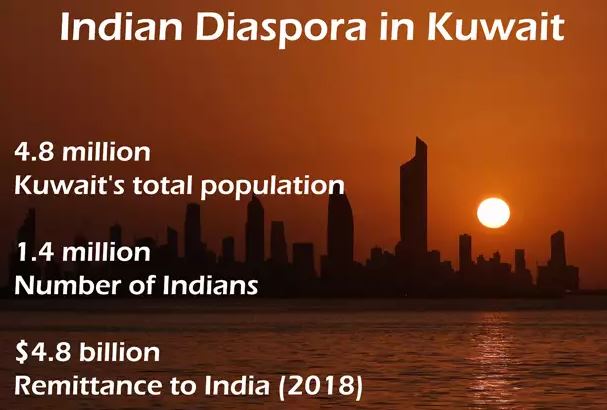
    A total of eight lakh Indians could be forced to leave Kuwait as it’s National Assembly committee has approved a draft expat quota bill seeking to reduce the number of foreign workers in the Gulf country.

    Do you know?

    India is the world’s top recipient of remittances with its diaspora sending a whopping $79 billion back home in 2018 a/c to the World Bank. It is followed by China (USD 67 billion), Mexico (USD 36 billion), the Philippines (USD 34 billion), and Egypt (USD 29 billion).

    What is the Expat Bill about?

    • Amid a slump in oil prices and the coronavirus pandemic, there has been a spike in anti-expat rhetoric as lawmakers and government officials call for reducing the number of foreigners in Kuwait.
    • According to the bill, Indians should not exceed 15% of the population.
    • The draft once turned to the law will impose a cap on the number of expats and gradually reduce them by almost 5% on a yearly basis.

    A demographic issue

    • Kuwait has a real problem in its population structure, in which 70% are expats.
    • The 1.3 million of the 3.35 million expats are either illiterate or can merely read and write.
    • Kuwait has also been working to reduce its dependence on foreign workers.

    A huge diaspora at stake

    • There are about 28,000 Indians working for the Kuwaiti Government in various jobs like nurses, engineers in national oil companies and a few as scientists.
    • The majority of Indians (5.23 lakh) are employed in private sectors. In addition, there are about 1.16 lakh dependents.
    • Out of these, there are about 60,000 Indian students studying in 23 Indian schools in the country.

    Impacts on Indians

    • The current population of Kuwait is 4.3 million, with Kuwaitis making up 1.3 million of the population, and expats accounting for 3 million.
    • This bill would result in 8,00,000 Indians leaving Kuwait, as the Indian community constitutes the largest expat community in the country, totalling 1.45 million.
    • As the MEA says, Indians are present in all segments of society in Kuwait and are largely considered disciplined, hardworking and law-abiding.
    • India has often in the past played up the role of the Indian community in Kuwait as an important factor in bilateral ties.

    Must read:

    India’s rising Forex Reserves

  • Sakteng Wildlife Sanctuary

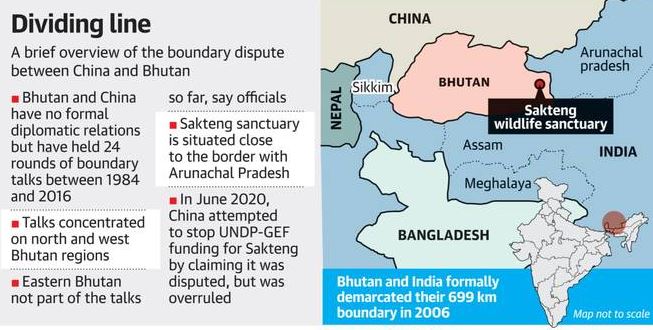
    In a bid to further its territorial ambitions, China has recently claimed the Sakteng wildlife sanctuary in Eastern Bhutan as its own territory.

    Practice question for mains:

    Q.What are the various fronts of Chinese imperial expansionism across the South Asian Region?

    About the Sakteng WLS

    • Sakteng is a wildlife sanctuary located mostly in Trashigang District and just crossing the border into Samdrup Jongkhar District, Bhutan.
    • It is one of the country’s protected areas.
    • It is listed as a tentative site in Bhutan’s Tentative List for UNESCO inclusion.

    Certain unresolved issues

    • The boundary between China and Bhutan has never been delimited.
    • There have been disputes over the eastern, central and western sectors for a long time.
    • China last month attempted to stop funding for the Sakteng sanctuary from the U.N. Development Programme’s Global Environment Facility (GEF) on the grounds that it was “disputed” territory.

    Reasons for the dispute

    • According to written records, there has been no mention of Eastern Bhutan, or Trashigang Dzongkhag (district), where Sakteng is based as per boundary negotiations held between the two countries between 1984 and 2016.
    • The negotiations have not been held since the Doklam standoff between Indian and Chinese troops in 2017.
    • Bhutan has always maintained a discreet silence on its boundary negotiations with China, and it does not have any formal diplomatic relations with Beijing.
  • Crisis facing the global order

    The corona crisis has laid bare the fissures in the global order. This article examines the four issues that are principal global challenges. Pandemic has accentuated these challenges.

    Principal global challenges

    • 1) Geopolitical tensions 2) Climate crisis. 3) Global mistrust. 4) The dark side of the digital world —  are four issues which U.N. Secretary-General Guterres listed as primary threats.
    • The four challenges have, for now, been overshadowed by the corona pandemic crisis.

    1.Climate change challenge

    • The drop in emissions in 2020 is projected to be about 8 per cent down on last year.
    • This drop will just put us on track to where we should be if we are to reach the Paris agreement goal of limiting warming to 1.5 C.
    • The threat of climate change, although raising its head again, has been constrained.

    2.Digital space and its dark side

    • Cyberspace has been a digital saviour during the corona crisis.
    • Virtual communications enhanced through various services, new apps, expanded coverage has been key to enhanced virtual lives for millions by increase of the avenues for working from home, video chat connectivity and online delivery of goods.
    • Companies that have deftly used cyberspace have prospered the most: Amazons net capital gain has been over $400 billion in 2020.
    • However, a surge in cybercrime and cyber fraud is anticipated, if not there already.
    • The logic being that cyberspace use has expanded without commensurate growth in security features.
    • Thee are dire projections of an impending “cyber Pearl Harbour”.

    3.Geopolitical tensions

    • Accentuation of geopolitical tensions during the corona crisis is well-documented.
    • The US-China relationship was already deteriorating, the blame game over the virus has exacerbated it.
    • The brazen behaviour of China in matters relating to Taiwan, Hong Kong, Australia, South China Sea and the India-China border has added to the inflammable state of geopolitics.
    • Rarely has the world seen such paucity of international cooperation since World War II.
    • The unravelling of the international institutions and partnerships that have been built since World War II is stark.

    4.Trust deficit among states

    • Trust amongst states has plummeted to its worst since World War II.
    • When faced with corona crisis shortages, almost all EU states responded at the national level.
    • Globally, at one time, more than 70 per cent of the world’s ports of entry — air, sea and land — restricted travel.
    • According to a Global Trade Alert study, nearly 90 governments blocked the export of medical supplies while 29 restricted food exports.

    Efficiency to self-sufficiency

    • Lack of trust is also impacting diversified supply chains.
    • The corona crisis is driving a shift from efficiency to self-sufficiency.
    • Japan is paying companies to relocate factories from China.
    • President Emmanuel Macron has pledged “full independence” for France in crucial medical supplies by year-end.
    • Prime Minister Modi has called for self-reliance and being vocal for local in India.
    • In the US, support for “Buy American” benchmarks for government health spending has growing bipartisan support.

    India’s role

    •  Challenges that transcend borders are of cardinal importance to India’s well being.
    • It is, therefore, time to conceptualise, in concrete terms, pathways to address them.
    • This will need to include our envisaging the new order and India’s own role in it as well as who our partners in this venture are to be.
    • Others are already working on their game plans.

    Consider the question “The cracks in the global order were apparent but the pandemic has accentuated the challenges to the global order. In light of this, examine the challenges to global order is facing the role that India should play.”

    Conclusion

    If India wants to be “rule shapers” rather than being “rule takers”, then we need to start working in partnership at blueprints for change. It is never too early to plan for the future

  • West Bank Annexation Plan

    Israeli PM Benjamin Netanyahu confirmed that the Israeli leader’s plan to annex parts of the occupied West Bank would not start on the original target date as the British PM made an extraordinary appeal to Israel to call off the plan.

    The strategic location of Gaza strip, West Bank, Dead Sea etc. creates a hotspot for a possible map based prelims question. 

    Consider this PYQ from 2015 CSP:

    Q. The area known as ‘Golan Heights’ sometimes appears in the news in the context of the events related to:

    a) Central Asia
    b) Middle East
    c) South-East Asia
    d) Central Africa

    Must read:

    [Burning Issue] West Asia Peace Plan

    Where is West Bank Located?

    • The West Bank is located to the west of the Jordan River.
    • It is a patch of land about one and a half times the size of Goa, was captured by Jordan after the 1948 Arab-Israeli War.
    • Israel snatched it back during the Six-Day War of 1967 and has occupied it ever since.
    • It is a landlocked territory, bordered by Jordan to the east and Israel to the south, west, and north.
    • Following the Oslo Accords between the Israeli government and the Palestine Liberation Organization (PLO) during the 1990s, part of the West Bank came under the control of the Palestinian Authority.
    • With varying levels of autonomy, the Palestinian Authority controls close to 40 per cent of West Bank today, while the rest is controlled by Israel.
  • In news: Senkaku Islands

    A local council in southern Japan voted to rename an area covering the Tokyo-controlled Senkaku Islands — known by Taiwan and China as the Diaoyus — from “Tonoshiro” to “Tonoshiro Senkaku”.

    Try this:

    Q. Recently, Senkaku Island was in the news. Where is it located?

    a) South China Sea

    b) Indian Ocean

    c) East China sea

    d) Red sea

    Senkaku Island Dispute

    • The Japanese-administered island chain, formed by five islets and three barren rocks, covers an area of 7 square km.
    • It is located about 200km southwest of Japan’s Okinawa Island and a similar distance northeast of Taiwan.
    • Japan annexed the archipelago following China’s defeat in the first Sino-Japanese war from 1894 to 1895.
    • Yet the islands were left out of the Treaty of San Francisco at the end of the second world war that returned to China most of the territories previously occupied by Japan.
    • Under the terms of Japan’s surrender, the island chain was controlled by the US until 1971, when it was returned to Japan along with Okinawa and other surrounding islands.

    Why are the Islands so coveted?

    • The region appears to have great promise as a future oil province of the world.
    • Japan and China are among the world’s top importers of fossil fuels.
    • Abundant fishing resources are found nearby, as can important shipping lanes used by Japan, South Korea and China for energy imports.
    • The islands have also become a focal point of the broader rivalry between the two countries.
  • Why did North Korea blow up a joint liaison office with Seoul?

    North Korea blew up the joint liaison office with South Korea in Kaesong, an industrial township on its side of the border, becoming one of the most serious incidents to have occurred between the two countries, without them actually going to war.

    Must read:

    What is the Korean Armistice Agreement?

    Practice question for mains:

    Q. What is the Korean Armstice Agreement? Discuss the concept of the Demilitarized Zone (DMZ)?

    What is this liaison office?

    • In 2003, North Korea and South Korea jointly set up a liaison office at Kaesong in North Korea.
    • It was set up in 2018 to facilitate communication between North Korea and South Korea.
    • The Kaesong Industrial Complex is a joint industrial zone where factories are operated and run by both North Koreans and South Koreans.
    • At its height, approximately 120 factories were operating in this industrial zone with more than 50,000 North Korean employees and several hundred managers.

    Why did Pyongyang demolish it?

    • Since the past week, tensions between the two countries had increased after Pyongyang objected to activists and defectors in South Korea sending anti-North Korean propaganda leaflets, rice and Bibles using balloons.
    • Experts believe that these moves come after North Korea’s frustrations at South Korea’s inability to revive inter-Korean economic projects under pressure from the US, along with UN sanctions.

    What’s next?

    • The demolition occurred just days after North Korean leader Kim Jong Un’s sister Kim Yo Jong had threatened to destroy the liaison office.
    • Following the demolition, North Korean said that it would be deploying troops in demilitarized areas, including in the Kaesong industrial zone.

    Are they heading towards war?

    • Observers say that these actions by North Korea have been the most provocative in recent years.
    • Experts believe these provocations may have occurred because Pyongyang is hoping to pressure Seoul into giving it more concessions that would be economically beneficial for North Korea that has been hit hard by sanctions.
    • Experts believe these actions, however provocative, are not severe enough for Seoul to contemplate military aggression in retaliation.
  • Why South China Sea matters to India

    What happens in the South China Sea has bearing on India. So far, the U.S. played a major role in the prosperity and security of the Indo-Pacific, but after the Covid, it may be forced to reconsider its stand over the region. So, what is at stake for India? And what are the options available with ASEAN countries and Indian in such a situation? Read to know…

    Dilemma the Indo-Pacific countries faces

    •  As the two most consequential powers of the world, the United States and China which are engaged in a fundamental transformation of their relationship rest of the countries in the region face a dilemma.
    • Almost nobody any longer thinks that China will conform to the US worldview, or that China’s rise from hereon will be unchallenged.
    • The Singapore Prime Minister Lee Hsien Loong’s essay in the latest issue of Foreign Affairs cogently spells out this dilemma.

    How the U.S. contributed to the region’s prosperity

    • The Indo-Pacific has prospered under American hegemony for the previous 40 years not just because of their huge investments.
    • U.S. invested $328.8 billion in the Association of Southeast Asian Nations (ASEAN) alone and a further $107 billion in China.
    • However, it’s not the investment but also because of the security blanket that it provides.
    • China might have replaced the US as the primary engine of growth in the last decade, but it has come with a cost — the assertion of Chinese power.
    • The benign American military presence has afforded countries the opportunity to pursue economic prosperity without substantial increases in their own defence expenditures or having to look over their shoulders.
    • No group of nations has benefitted more from the presence of the US than the ASEAN.

    How Chinese military posture is different from the U.S.

    • Chinese military postures, on the other hand, give cause for concern ever since they unilaterally put forward the Nine-Dash Line in 2009 to declare the South China Sea as territorial waters.
    • Their territorial claim itself is tenuous, neither treaty-based nor legally sound.
    • They act in ways that are neither benign nor helpful for long-term peace and stability.
    • In the first half of 2020 alone, Chinese naval or militia forces have rammed a Vietnamese fishing boat, “buzzed” a Philippines naval vessel and harassed a Malaysian oil drilling operation, all within their respective EEZs.
    • Since 2015, they have built a runway and underground storage facilities on the Subi Reef and Thitu Island as well as radar sites and missile shelters on Fiery Cross Reef and Mischief Reef.
    • They conducted ballistic missile tests in the South China Sea in June 2019 and continue to enhance naval patrols to enforce area denial for others.

    Fundamental choices the region faces

    • Going forward, the US and China face fundamental choices.
    • But then, so do the rest of us living in the Indo-Pacific.
    • America’s role in the preservation of the region’s peace and security should not be taken for granted.
    • As COVID imposes crushing costs on all economies, the US may also be weighing its options.
    • Finding justification for Chinese actions in the South China Sea, even as countries in the region help themselves to Chinese economic opportunities while sheltering under the US security blanket, is also fraught with risk.
    • Accommodation may have worked thus far but regional prosperity has come at a mounting cost in geo-strategic terms.
    • The South China Sea is effectively militarised. In the post-COVID age, enjoying the best of both worlds may no longer be an option.

    But, ASEAN won’t change the course suddenly

    • Nobody should expect that ASEAN will suddenly reverse course when faced with possibly heightened Sino-US competition.
    • China is a major power that will continue to receive the respect of ASEAN and, for that matter, many others in the Indo-Pacific, especially in a post-COVID world where they are struggling to revive their economies.
    • ASEAN overtook the European Union to become China’s largest trading partner in the first quarter of 2020, and China is the third-largest investor ($150 billion) in ASEAN.
    • The South East Asians are skilled at finding the wiggle room to accommodate competing hegemons while advancing their interests.
    • This does not, however, mean that they are not concerned over Chinese behaviour in the South China Sea.
    • They need others to help them in managing the situation.

    Validation of the US military presence and collective efforts of stakeholders

    • A robust US military presence is one guarantee.
    • A stronger validation by the littoral states of the South China Sea helps the US Administration in justifying their presence to the American tax-payer.
    • Others who have stakes in the region also need to collectively encourage an increasingly powerful China to pursue strategic interests in a legitimate way, and on the basis of respect for international law, in the South China Sea.
    • The real choice is not between China and America — it is between keeping the global commons open for all or surrendering the right to choose one’s partners for the foreseeable future.

    What is at stake for India?

    • How the South China Sea situation plays out will be critical for our security and well-being.
    • India must consider the following factors while calibrating its approach.
    • 1) The South China Sea is not China’s sea but a global common.
    • 2) It has been an important sea-lane of communication since the very beginning, and passage has been unimpeded over the centuries.
    • 3) Indians have sailed these waters for well over 1,500 years — there is ample historical and archaeological proof of a continuous Indian trading presence from Kedah in Malaysia to Quanzhou in China.
    • 4) Nearly $200 billion of our trade passes through the South China Sea and thousands of our citizens study, work and invest in ASEAN, China, Japan and the Republic of Korea.
    • 5)  We have stakes in the peace and security of this region in common with others who reside there, and freedom of navigation, as well as other normal activities with friendly countries, are essential for our economic well-being. In short, the South China Sea is our business.
    • We have historical rights established by practice and tradition to traverse the South China Sea without impediment.
    • We have mutually contributed to each other’s prosperity for two thousand years.
    • We continue to do so.
    • The proposition that nations that have plied these waters in the centuries past for trade and other peaceful purposes are somehow outsiders who should not be permitted to engage in legitimate activity in the South China Sea, or have a voice without China’s say, should be firmly resisted.

    India needs to be responsive to ASEAN

    • India needs to be responsive to ASEAN’s expectations.
    • While strategic partnerships and high-level engagements are important, ASEAN expects longer-lasting buy-ins by India in their future.
    • They have taken the initiative time and again to involve India in Indo-Pacific affairs.
    • It is not as if our current level of trade or investment with ASEAN makes a compelling argument for them to automatically involve us.
    • They have deliberately taken a longer-term view.
    • A restructuring of global trade is unlikely to happen any time soon in the post-COVID context.
    • Regional arrangements will become even more important for our economic recovery and rejuvenation.
    • If we intend to heed the clarion call of “Think Global Act Local”, India has to be part of the global supply chains in the world’s leading growth region for the next half-century.
    • It is worth paying heed to the words from Singapore’s prime minister, who writes that something significant is lost in an RCEP without India.
    • And urges us to recognise that the value of such agreements goes beyond the economic gains they generate.
    • Singapore is playing the long game. Are we willing to do so, even if it imposes some costs in the short-term?

    Consider the question “The South China Sea has been witnessing growing militarisation day by day. And how the South China Sea situation plays out will be critical for our security and well-being. In light of this, examine the basis on which India should contest China’s unilateral claims in the area and scope of engagement with the ASEAN countries in this regard.”

    Conclusion

    Indian is a stakeholder in the South China Sea. What happens there have implications for us. In such a scenario, India must form a partnership with other players in the region and should attempt to make China follow international laws and global order.