💥Mains Ready By December. Smash Mains & Smash PYQ Admissions Open

Subject: Emerging Technologies

  • INS Taragiri Commissioned into Indian Navy

    Why in the News?

    India commissioned INS Taragiri (F41), an indigenously built stealth guided missile frigate, at Visakhapatnam, boosting maritime security and indigenous defence capability.

    INS Taragiri: Key Details

    • Name: INS Taragiri
    • Type: Stealth Guided Missile Frigate
    • Commissioned at: Visakhapatnam
    • Fleet: Eastern Fleet
    • Indigenous content: Over 75%
    • Built by: Mazagon Dock Shipbuilders Limited (MDL)

    Project 17A Frigate

    • INS Taragiri belongs to: Project 17A stealth frigates
    • Project 17A ships: INS Nilgiri
      • INS Udaygiri
      • INS Taragiri
      • INS Himgiri
      • INS Dunagiri
      • INS Mahendragiri
      • INS Surat (depending classification variations)
    [2009] Consider the following statements: 
    1 INS Sindhughosh is an aircraft carrier. 
    2 INS Viraat is a submarine. 
    Which of the statements given above is/are correct? (a) 1 only (b) 2 only (c) Both 1 and 2 (d) Neither 1 nor 2
  • INS Aridhaman Joins Indian Navy, Strengthens Nuclear Deterrence

    Why in the News?

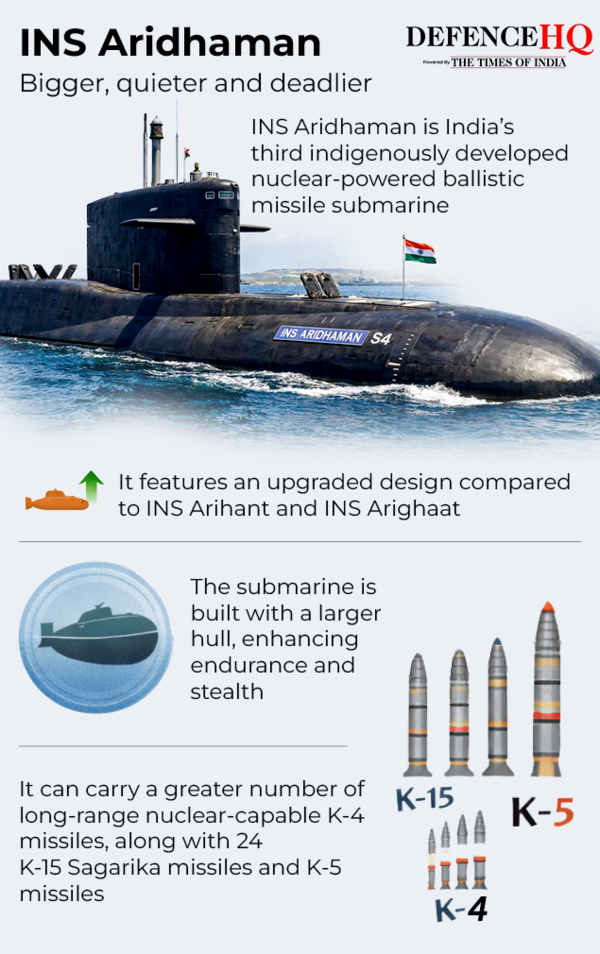
    India quietly commissioned INS Aridhaman, the third indigenously built nuclear powered ballistic missile submarine (SSBN), at Visakhapatnam, strengthening India’s nuclear triad capability.

    INS Aridhaman: Key Details

    • Name: INS Aridhaman (S4)
    • Type: Nuclear Powered Ballistic Missile Submarine (SSBN)
    • Class: Arihant Class
    • Displacement: ~7,000 tonnes
    • Built under: Advanced Technology Vessel (ATV) Project
    • Built at: Ship Building Centre, Visakhapatnam

    Missile Capability

    INS Aridhaman can carry:

    • K 15 Sagarika missiles
      • Up to 24 missiles
      • Range: ~750 km
    • K 4 missiles
      • Up to 8 missiles
      • Range: ~3,500 km
    • Future capability:
      • K 5 nuclear capable missiles (under development)
    • This gives greater firepower compared to earlier submarines.

    India’s Nuclear Triad

    India now maintains Nuclear Triad:

    • Land Based: Agni missiles
    • Air Based: Fighter aircraft nuclear delivery
    • Sea Based: SSBN submarines (like INS Aridhaman)
    • Countries with Nuclear Triad: India, USA, Russia, China, and France

    India’s SSBN Fleet

    • INS Arihant — 2016
    • INS Arighaat — 2024
    • INS Aridhaman — 2026
    • S4* (likely INS Arisudan) — Under trials
    [2016] Which one of the following is the best description of ‘INS Astradharini’, that was in the news recently? (a) Amphibious warfare ship (b) Nuclear-powered submarine (c) Torpedo launch and recovery vessel (d) Nuclear-powered aircraft carrier
  • CSIR Develops Bio Bitumen: Turning Farm Residue into Roads

    Why in the News? 

    The Council of Scientific and Industrial Research (CSIR) transferred Bio Bitumen Technology that converts farm residue into road construction material, promoting sustainable infrastructure and reducing stubble burning.

    What is Bio Bitumen

    • Bio bitumen:
      • Renewable alternative to petroleum based bitumen
      • Made from agricultural biomass
      • Used in road construction
    • Developed by:
      • CSIR Central Road Research Institute (CRRI)
      • CSIR Indian Institute of Petroleum (IIP)

    How Bio Bitumen is Made

    • Raw Material: Crop residue, Agricultural biomass, and Farm waste
    [2025] Consider the following statements: Statement I: Circular economy reduces the emissions of greenhouse gases. Statement II: Circular economy reduces the use of raw materials as inputs. Statement III: Circular economy reduces wastage in the production process. Which one of the following is correct in respect of the above statements? (a) Both Statement II and Statement III are correct and both of them explain Statement I (b) Both Statement I and Statement II are correct and Statement I explains Statement II (c) Only one of the Statements II and III is correct and that explains Statement I (d) Neither Statement II nor Statement III is correct
  • The Drone Revolution in Modern Warfare

    Why in the News?

    On March 29, 2026, reports highlighted the profound impact of Iran’s Shahed drones in the ongoing conflicts in West Asia. These “kamikaze” drones have challenged the supremacy of multi-million dollar air defense systems, signaling a paradigm shift where the economics of attrition are becoming as important as traditional firepower.

    What Makes Drone Warfare a “Game Changer”?

    The rise of Unmanned Aerial Vehicles (UAVs) like the Shahed-136 represents a shift toward Asymmetric Warfare.

    • Cost Imbalance: A Shahed drone costs between $20,000 and $50,000, while the missiles used to intercept them (like the Patriot) cost nearly $4 million each.
    • Swarm Tactics: Drones are often deployed in large numbers to overwhelm sophisticated radar and interceptor batteries.
      • Drone swarms are groups of autonomous drones that coordinate and operate together as a single intelligent system through communication networks, sensors, and AI algorithms.
    • Key Features
      • Autonomous Coordination
      • Each drone can: Share information with nearby drones
      • Adjust movement in real time
      • Collective Intelligence
      • Self-Healing Capability
      • If one drone fails, others reorganize automatically without collapsing the mission.
    • Sustainability: Maintaining an F-16 fighter jet costs roughly $25,000 per hour, nearly the total cost of the drone it is trying to shoot down.
    • Attrition: If a drone is lost, it is merely a financial loss; if a fighter jet is downed, the military loses a high-value asset and a highly trained pilot.

    How Does the Shahed-136 “Kamikaze” Drone Operate?

    The Shahed-136 (and its Russian variant, the Geran) is a “one-way” attack UAV with the following technical specifications:

    • Stealth: It flies at low altitudes (20–30 meters) to stay below traditional radar detection.
    • Navigation: Uses a push-propeller engine (noted for its “lawnmower” sound) and carries explosives in its nose.
    • Range: Capable of traveling up to 3,000 km.
    • Mechanism: It does not fire missiles; it is the missile, detonating upon impact with the target.

    What are the Modern Counter-Drone Solutions?

    To combat the high cost of traditional interceptors (Patriot, THAAD), militaries are moving toward Directed Energy Weapons (DEW) and low-cost interceptors:

    1. Laser Weapons: Systems like the HELIOS Laser (used by the US Navy) destroy targets using concentrated heat. They are extremely cost-effective per shot but can be hindered by bad weather (fog/rain).
    2. Acoustic Detection: Using technology to recognize the specific engine sounds of drones.
    3. Low-Cost Interceptors: * Sting: A $2,000–$4,000 interceptor drone used by Ukraine.
      • Merops: A specialized American anti-drone system being rapidly deployed to West Asia.
      • LUCAS: The US-made “Low-cost Uncrewed Combat Attack System” ($35,000).
    [2025] With reference to Unmanned Aerial Vehicles (UAVs), consider the following statements: 
    1 All types of UAVs can do vertical landing. 
    2 All types of UAVs can do automated hovering. 
    3 All types of UAVs can use battery only as a source of power supply. 
    Which of the statements given above are correct? 
    (a) Only one (b) Only two (c) All the three (d) None
  • DEFENCE NEWS 2026

    1. Integrated Guided Missile Development Programme (IGMDP)

    • Launched: 1983
    • Leader: A.P.J. Abdul Kalam
    • Objective: Self-reliance in missile technology
    • Duration: 1983 to 2012

    Missiles (PATNA):

    • Prithvi: Surface to Surface
    • Agni: Ballistic (later separated)
    • Trishul: Short range SAM
    • Nag: Anti tank, fire and forget
    • Akash: Medium range SAM

    Keywords: Self-reliance, Indigenous missiles, Strategic deterrence

    Prelims Traps:

    • IGMDP not ongoing
    • Agni separated from programme

    2. Ballistic vs Cruise Missiles

    Ballistic Missile:

    • Path: Parabolic trajectory
    • Propulsion: Initial phase only
    • Altitude: Outside atmosphere
    • Speed: Hypersonic

    Cruise Missile:

    • Path: Aircraft-like
    • Propulsion: Continuous
    • Altitude: Low altitude
    • Accuracy: High

    Keywords: Trajectory, Propulsion, Detection

    Prelims Traps:

    • Cruise missiles harder to detect
    • Ballistic missiles less maneuverable

    3. Hypersonic Technology

    • Speed: Mach 5 and above

    Types:

    • HGV: Rocket launched, glide phase
    • Hypersonic Cruise: Scramjet powered

    India:

    • HSTDV by DRDO
    • Scramjet tested by ISRO

    Engine Types:

    • Ramjet: Subsonic combustion
    • Scramjet: Supersonic combustion

    Keywords: Mach 5, Scramjet, Hypersonic

    Prelims Traps:

    • Scramjet requires very high initial speed

    4. Agni Series Missiles

    Agni V:

    • Range: Greater than 5000 km
    • Type: Ballistic
    • Feature: MIRV capable

    Agni Prime:

    • Range: 1000 to 2000 km
    • Feature: Canisterised

    Keywords: MIRV, Canisterisation, Strategic missile

    Prelims Traps:

    • Canisterisation reduces launch time

    5. Pralay Missile

    • Type: Quasi ballistic
    • Range: 150 to 500 km
    • Payload: 500 to 1000 kg

    Features:

    • Maneuverable trajectory
    • Hard to intercept

    Keywords: Quasi ballistic, Tactical missile

    Prelims Trap:

    • Not a cruise missile

    6. Astra Mk III (Gandiva)

    • Type: Air to air missile
    • Range: 300 to 350 km
    • Speed: Around Mach 4.5

    Platforms:

    • Su 30 MKI
    • Tejas

    Keywords: BVR missile, Air combat

    Prelims Trap:

    • Beyond Visual Range missile

    7. BrahMos Missile

    • Type: Supersonic cruise missile
    • Speed: Around Mach 3
    • Range: Around 350 km

    Developed by:

    • India and Russia

    Variants:

    • Land, Air, Sea, Submarine

    Keywords: Supersonic, Ramjet, Fire and forget

    Prelims Traps:

    • Uses ramjet engine

    8. Akashteer System

    • Type: AI enabled air defence system
    • Developer: Bharat Electronics Limited
    • Induction: 2024

    Features:

    • Autonomous monitoring
    • Tri services integration

    Keywords: AI defence, C4ISR integration

    Prelims Trap:

    • Army focused system

    9. IACCS

    • Full Form: Integrated Air Command and Control System
    • Service: Indian Air Force

    Features:

    • Radar integration
    • Real time data sharing
    • Multi layer defence

    Layers:

    • Counter drone
    • Short range
    • Medium range
    • Long range

    Keywords: Network centric warfare, Air defence

    Prelims Trap:

    • Not a Navy system

    10. Project Kusha

    • Type: Long range air defence system
    • Developer: DRDO

    Features:

    • Interceptors: 150, 250, 350 km
    • Comparable to S 400, Patriot

    Keywords: Missile shield, Indigenous defence

    Prelims Trap:

    • Fully indigenous

    11. Directed Energy Weapon (Sahastra Shakti)

    • Type: Laser weapon
    • Power: 30 kilowatt
    • Developer: DRDO

    Targets:

    • Drones
    • Missiles

    Keywords: Laser, Speed of light, DEW

    Prelims Trap:

    • No conventional ammunition

    12. K 4 Missile

    • Type: SLBM
    • Range: Around 3500 km

    Platform:

    • Nuclear submarines

    Keywords: Second strike, Nuclear deterrence


    13. INS Taragiri

    • Type: Stealth frigate
    • Project: 17A
    • Class: Nilgiri

    Features:

    • 75 percent indigenous
    • Multi mission

    Keywords: Stealth, Naval modernization


    14. Fighter Aircraft Generations

    4th Generation:

    • Maneuverability

    4.5 Generation:

    • AESA radar
    • Advanced avionics

    5th Generation:

    • Stealth
    • Sensor fusion

    6th Generation:

    • AI integration
    • Drone teaming

    India:

    • Tejas Mk1A: 4.5 generation
    • AMCA: 5th generation

    Keywords: Stealth, AESA, AI

    Prelims Trap:

    • 4.5 generation not stealth

    15. Drone Systems

    Types:

    • HALE: MQ 9B
    • MALE: TAPAS, Rustom
    • Loitering munition: Harop

    Indian Systems:

    • Indrajaal: Anti drone dome
    • Bhragavastra: Micro missile system

    Keywords: UAV, Loitering munition, Surveillance

    Prelims Trap:

    • Loitering munition is drone missile hybrid

    16. Sonobuoys

    • Use: Anti submarine warfare

    Working:

    • Dropped in water
    • Hydrophone detects sound
    • Data transmitted to aircraft

    Keywords: Underwater detection, Acoustic signals

    Prelims Trap:

    • Not radar based

    17. Mission Sudarshan Chakra

    • Announcement: 15 August 2025

    Objective:

    • National security shield by 2035

    Coverage:

    • Air, land, sea
    • Civilian infrastructure

    Keywords: Integrated defence, National security


    18. Golden Dome

    • Country: USA
    • Type: Missile defence system

    Features:

    • Ground and space based

    Legal Aspect:

    • Outer Space Treaty bans WMD in space
    • Conventional weapons allowed

    Keywords: Space militarisation, Missile shield

    Prelims Trap:

    • Space not fully demilitarised
  • Quantum Battery Breakthrough  

    Why in the News

    • Scientists from CSIRO, RMIT University, and University of Melbourne developed the first proof-of-concept quantum battery (March 2026).

    What is a Quantum Battery

    • A quantum battery is an energy storage device that uses principles of quantum mechanics instead of chemical reactions.
    • It can charge, store, and discharge energy like conventional batteries.

    Key Quantum Principles Used

    • Superposition: A system can exist in multiple states simultaneously.
    • Entanglement: Particles become interconnected, enabling coordinated energy transfer.

    Key Features of the Prototype

    • Built using multi-layered organic microcavity.
    • Wireless charging using laser.
    • Operates at room temperature.
    • Energy stored lasts much longer than charging time (very high efficiency).

    Unique Property

    • Charging speed increases with size
      • Opposite to classical batteries.
      • Known as quantum advantage in charging.

    Potential Applications

    • Ultra-fast charging of electric vehicles.
    • Wireless energy transfer over long distances.
    • High-efficiency next-generation energy storage systems.

    Current Limitations

    • Still at proof-of-concept stage.
    • Major challenge: extending energy storage duration for practical use.

    Significance

    • Confirms theoretical predictions in quantum thermodynamics.
    • Could revolutionize energy storage, transmission, and efficiency.
    [2022] Which one of the following is the context in which the term “qubit” is mentioned? (a) Cloud Services (b) Quantum Computing (c) Visible Light Communication Technologies (d) Wireless Communication Technologies
  • National Quantum Mission: Govt Clears 23 Institutions for Quantum Labs

    Why in the News

    The Government has approved 23 institutions to set up quantum teaching laboratories under the National Quantum Mission, with around 100 more proposals under evaluation.

    About National Quantum Mission (NQM)

    • Approved in 2023 with an outlay of ₹6003.65 crore
    • Duration: 2023–2031
    • Aim: Position India as a global leader in quantum technologies

    Key Objectives

    • Quantum Computing: Develop 50–1,000 qubit quantum computers
      • Higher qubits = more computational power
    • Quantum Communication: Build satellite-based secure communication systems.
      • Enable hack-proof encryption (quantum key distribution)
    • Quantum Sensing & Materials: 
      • Develop: High-precision sensors (defence, navigation) and Advanced quantum materials.

    What are Quantum Labs?

    • Teaching and research facilities in universities
    • Focus on:
      • Training students in quantum technologies
      • Building skilled manpower
    • Help bridge India’s quantum skill gap

    Significance of the Move

    • Capacity Building: Creates a pipeline of skilled researchers and engineers
      • Strengthens India’s R&D ecosystem
    • Strategic Importance: Quantum tech has applications in:
      • Defence (secure communication)
      • Cybersecurity
      • Space & navigation
    • Helps India compete with:
      • United States
      • China
    • Economic Potential: Quantum technologies expected to drive: Next-gen computing and Innovation-led growth. 
    [2022] Which one of the following is the context in which the term “qubit” is mentioned? (a) Cloud Services (b) Quantum Computing (c) Visible Light Communication Technologies (d) Wireless Communication Technologies
  • [11th March 2026] The Hindu OpED: AI and the national security calculus

    PYQ Relevance[UPSC 2023] Introduce the concept of Artificial Intelligence (AI). How does AI help clinical diagnosis? Do you perceive any threat to privacy of the individual in the use of AI in healthcare?Linkage: The article discusses AI as a dual-use technology with security implications, highlighting concerns about surveillance, military integration, and governance of AI systems. The PYQ connects through debates on ethical risks, regulation, and societal impacts of AI deployment.

    Mentor’s Comment

    The rapid rise of Artificial Intelligence (AI) has pushed it from a commercial technology to a strategic national security asset. The debate intensified after American AI company Anthropic urged the U.S. government to classify Chinese AI labs like DeepSeek, Moonshot AI, and MiniMax as national security threats. The controversy reflects a deeper policy dilemma: Should AI be treated like nuclear technology requiring strict controls, or like a dual-use digital technology that thrives on open innovation? The issue has implications for military decision-making, global technological competition, and governance of autonomous systems.

    Is AI becoming a national security technology comparable to nuclear weapons?

    1. Dual-Use Technology: AI functions as a general-purpose technology used for civilian innovation and military operations. Unlike nuclear weapons, AI also drives sectors such as healthcare, finance, and digital governance.
    2. Military Integration: AI models assist in accelerating the military “kill chain”, supporting target identification, intelligence analysis, and operational decisions.
    3. Technological Diffusion: AI research occurs across universities, private firms, and open-source communities, enabling rapid global diffusion.
    4. Comparative Argument: Nuclear non-proliferation succeeds due to scarcity of fissile material, whereas AI relies on widely accessible resources like data and computing.

    What is AI model distillation and why is it controversial?

    1. Model Distillation: Distillation involves training smaller AI models using the outputs of larger frontier models to replicate capabilities at lower computational cost.
    2. Industrial-Scale Claims: Anthropic alleges 16 million interactions with its Claude model through around 24,000 accounts, suggesting systematic distillation efforts.
    3. Strategic Advantage: Distillation enables competitors to achieve frontier-level performance at a fraction of the cost of original research.
    4. Intellectual Property Issues: Companies argue distillation violates terms of service and proprietary model safeguards.

    Why are export controls and technological restrictions facing limitations?

    1. Circumvention of Restrictions: Export controls on advanced chips and inputs often face workarounds through alternative supply chains or domestic development.
    2. Human Capital Mobility: AI researchers frequently work across countries, making technological containment difficult.
    3. Diffusion of Knowledge: AI research spreads through academic publications, open-source models, and global conferences.
    4. Policy Ineffectiveness: Restrictions may fail to prevent competitors from achieving comparable performance, as illustrated by emerging Chinese AI models.

    Do corporate guardrails effectively regulate military uses of AI?

    1. Corporate Governance Limits: Private companies can modify or remove safeguards when responding to government contracts.
    2. Defense Integration: AI firms increasingly compete for military and national security contracts, accelerating integration into defence systems.
      1. Example: Some firms accept permissive contracts allowing military use of AI models, illustrating the competitive pressure in defence technology markets.
    3. Regulatory Gap: Corporate policies alone cannot substitute state-led governance frameworks for military AI use.

    Why does AI governance require international cooperation?

    1. Inevitable Military Adoption: Armed forces globally are integrating generative AI into surveillance, cyber warfare, and autonomous systems.
    2. Need for Global Norms: Effective regulation requires plurilateral commitments among states rather than unilateral corporate decisions.
    3. Human Control: Governance frameworks must ensure meaningful human oversight in lethal decision-making systems.
    4. Restrictions on Mass Surveillance: Global norms should prohibit large-scale civilian surveillance enabled by AI systems.

    Way Forward: Strengthening Global Governance of AI in National Security

    1. Multilateral AI Governance Framework: Establishes global rules for responsible AI deployment through platforms like the United Nations and the UNESCO which already adopted the Recommendation on the Ethics of Artificial Intelligence (2021) promoting transparency, accountability, and human rights protection.
    2. AI Safety and Risk Management Regimes: Strengthens international cooperation through initiatives like the Global Partnership on Artificial Intelligence (GPAI) and the OECD AI Principles, which promote responsible AI innovation, democratic values, and safeguards against misuse.
    3. Regulation of Military AI Systems: Develops binding norms on autonomous weapons through negotiations under the United Nations Convention on Certain Conventional Weapons (CCW), focusing on meaningful human control over lethal autonomous weapons systems (LAWS).
    4. Global Technology Export and Monitoring Mechanisms: Expands export-control regimes such as the Wassenaar Arrangement to include AI algorithms, advanced chips, and surveillance systems to prevent uncontrolled proliferation.
    5. Data Governance and Digital Rights Protection: Aligns AI regulation with frameworks such as the European Union AI Act, which classifies AI systems by risk level and restricts high-risk surveillance technologies.
    6. International Research Collaboration: Promotes open but secure collaboration among states, universities, and companies through forums like the G20 and World Economic Forum, ensuring innovation while maintaining safeguards.
    7. India’s Strategic Role: India can leverage platforms such as the BRICS, Quad, and G20 to push for ethical AI standards, responsible military use, and inclusive technological governance.

    Conclusion

    Artificial Intelligence is transforming the intersection of technology, geopolitics, and national security. Unlike nuclear technology, AI cannot be easily contained due to its open research ecosystem, global talent mobility, and digital diffusion. Effective governance therefore requires international norms, state-led oversight, and responsible corporate practices to balance innovation with security.

  • President Undertakes Sortie in LCH Prachand

    Why in the News

    President Droupadi Murmu undertook a sortie in the indigenous Light Combat Helicopter Prachand at Air Force Station Jaisalmer on February 27, 2026.

    About LCH Prachand

    • India’s indigenously developed Light Combat Helicopter.
    • Designed for high altitude warfare and desert operations.
    • Equipped with:
      • Air to ground missiles
      • Rocket systems
      • 20 mm turret gun
    • Developed by Hindustan Aeronautics Limited

    Significance

    • Highlights indigenous defence capability.
    • Demonstrates operational readiness of the Indian Air Force.
    • Symbolic boost to Aatmanirbhar Bharat in defence manufacturing.

    Prelims Pointers

    • LCH Prachand inducted into Indian Air Force in 2022.
    • Designed for operations at high altitude including Himalayan region.
    • Air Force Station Jaisalmer is a key western sector air base.
    • President is Supreme Commander of the Armed Forces under Article 53.
    [2025] With reference to India’s defence, consider the following pairs: Aircraft type : Description 

    I. Dornier-228 : Maritime patrol aircraft 

    II. IL-76 : Supersonic combat aircraft 

    III. C-17 Globemaster : Military transport aircraft 

    How many of the pairs given above are correctly matched? 

    (a) Only one (b) Only two (c) All the three (d) None

  • INS Anjadip Commissioned

    Why in the News

    The Indian Navy commissioned INS Anjadip, the fourth indigenously designed and built Anti Submarine Warfare Shallow Water Craft, at Chennai Port.

    About INS Anjadip

    • Type: Anti Submarine Warfare Shallow Water Craft
    • Length: 77 metres
    • Built by: Garden Reach Shipbuilders & Engineers at Kattupalli
    • Named after: Anjadip Island off Karwar coast

    Key Capabilities

    • Designed for shallow and coastal waters
    • Detect, track and neutralise enemy submarines
    • Equipped with:
      • Shallow water sonars
      • Lightweight torpedoes
      • Anti submarine rockets
      • Combat management system

    Operational Roles

    • Anti submarine warfare in littoral zones
    • Coastal surveillance
    • Low intensity maritime operations
    • Search and rescue missions

    Significance

    • Enhances India’s anti submarine warfare capability
    • Strengthens coastal defence architecture
    • Reflects Aatmanirbhar Bharat in naval shipbuilding
    • Boosts indigenous defence manufacturing ecosystem
    [2016] Which one of the following is the best description of ‘INS Astradharini’, that was in the news recently? (a) Amphibious warfare ship 

    (b) Nuclear-powered submarine 

    (c) Torpedo launch and recovery vessel 

    (d) Nuclear-powered aircraft carrier