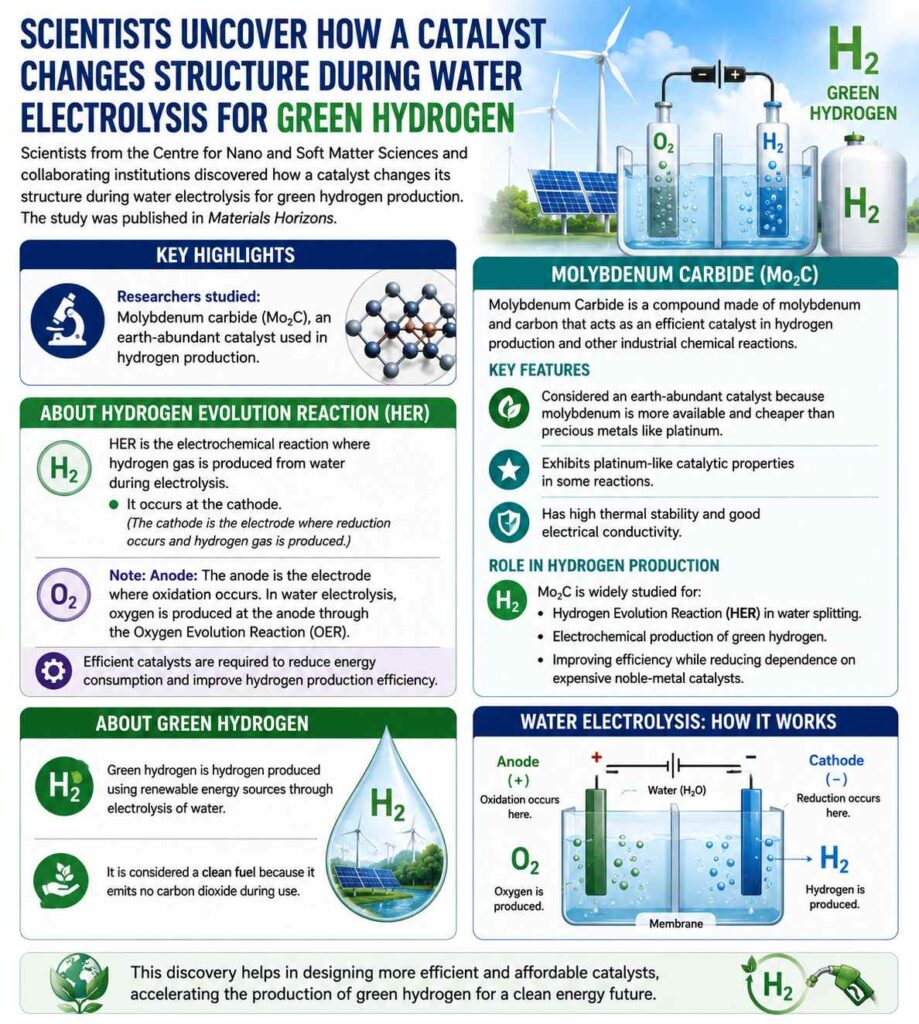
Scientists from the Centre for Nano and Soft Matter Sciences and collaborating institutions discovered how a catalyst changes its structure during water electrolysis for green hydrogen production. The study was published in Materials Horizons.
Key Highlights
Researchers studied:
Molybdenum carbide (Mo₂C), an earth-abundant catalyst used in hydrogen production.
Molybdenum Carbide is a compound made of molybdenum and carbon that acts as an efficient catalyst in hydrogen production and other industrial chemical reactions
Key Features
Considered an earth-abundant catalyst because molybdenum is more available and cheaper than precious metals like platinum.
Exhibits platinum-like catalytic properties in some reactions.
Has high thermal stability and good electrical conductivity.
Role in Hydrogen Production
Mo₂C is widely studied for: Hydrogen Evolution Reaction (HER) in water splitting.
Electrochemical production of green hydrogen.
Improving efficiency while reducing dependence on expensive noble-metal catalysts.
About Hydrogen Evolution Reaction (HER)
HER is the electrochemical reaction where hydrogen gas is produced from water during electrolysis.
It occurs at the cathode. (The cathode is the electrode where reduction occurs and hydrogen gas is produced.)
Note: Anode: The anode is the electrode where oxidation occurs. In water electrolysis, oxygen is produced at the anode through the Oxygen Evolution Reaction (OER).
Efficient catalysts are required to reduce energy consumption and improve hydrogen production efficiency.
About Green Hydrogen
Green hydrogen is hydrogen produced using renewable energy sources through electrolysis of water.
It is considered a clean fuel because it emits no carbon dioxide during use.
[2023] With reference to green hydrogen, consider the following statements: 1. It can be used directly as a fuel for internal combustion. 2. It can be blended with natural gas and used as fuel for heat or power generation. 3. It can be used in the hydrogen fuel cell to run vehicles. How many of the above statements are correct?
Jitendra Singh inaugurated India’s first SkyCast System at Indira Gandhi International Airport under Mission Mausam.
What is SkyCast?
SkyCast is an advanced integrated aviation weather monitoring and forecasting system that provides:
Real-time weather intelligence
Fog monitoring
Turbulence detection
High-impact weather forecasting
Key Features
Helps reduce:
Flight delays
Diversions
Cancellations
Provides short-term weather alerts to pilots and air traffic controllers
Monitors atmosphere up to nearly 3 km above airport
Technologies Used
SkyCast integrates:
Radar Wind Profiler
SODAR
Microwave Radiometer
Ground-based Fog Aerosol Spectrometer (GFAS)
Lidar-based Ceilometer
[2025] GPS-Aided Geo Augmented Navigation (GAGAN) uses a system of ground stations to provide necessary augmentation. Which of the following statements is/are correct in respect of GAGAN? I. It is designed to provide additional accuracy and integrity. II. It will allow more uniform and high quality air traffic management. III. It will provide benefits only in aviation but not in other modes of transportation. Select the correct answer using the code given below.
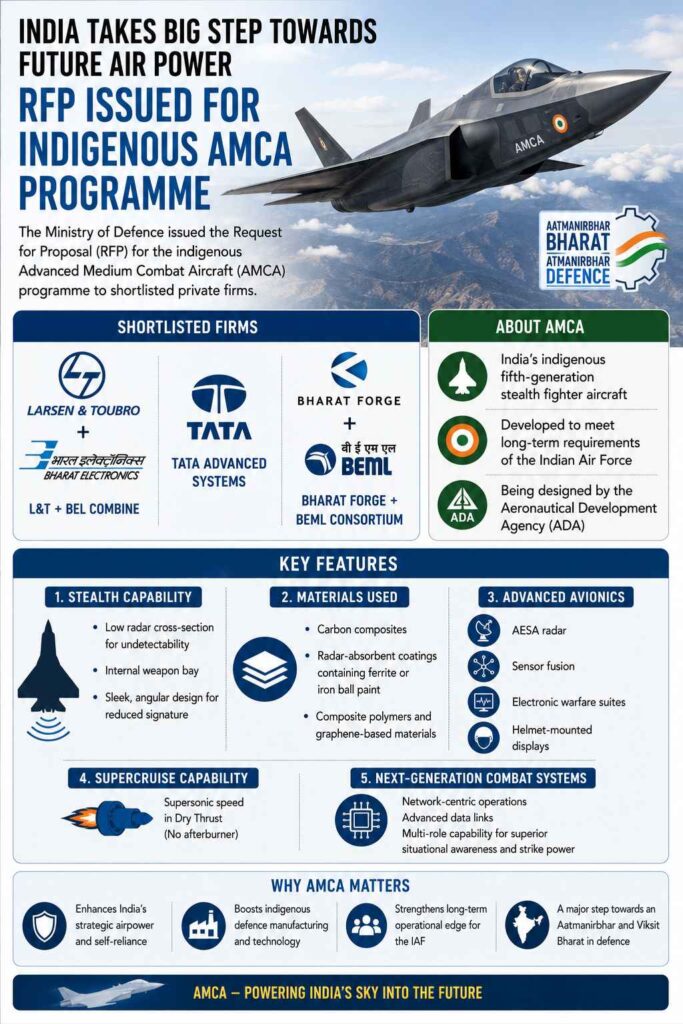
The Ministry of Defence issued the Request for Proposal (RFP) for the indigenous Advanced Medium Combat Aircraft (AMCA) programme to shortlisted private firms.
Developed to meet long-term requirements of the Indian Air Force
Being designed by the Aeronautical Development Agency (ADA)
Key Features
Stealth capability
Materials Used:
Carbon composites
Radar-absorbent coatings containing ferrite or iron ball paint
Composite polymers and graphene-based materials
Advanced avionics includes:
AESA radar
Sensor fusion
Electronic warfare suites
Helmet-mounted displays
Supercruise capability (Supersonic speed in Dry Thrust)
Next-generation combat systems
Programme Highlights
Government plans to build five prototypes
Selected private company will partner with ADA
Part of the “Make in India” and defence indigenisation push
Hindustan Aeronautics Limited (HAL) reportedly excluded from current process
Consider the following statements regarding the fifth-generation fighter jet configurations of India and Russia: 1.The Sukhoi Su-57, Russia’s operational fifth-generation stealth fighter, features supercruise capabilities but utilizes conventional round exhaust nozzles. 2.Under proposed partnerships, Russia has offered a twin-seat variant of the Su-57, which allows a second crew member to manage manned-unmanned teaming operations with stealth drones. 3.India’s indigenous fifth-generation Advanced Medium Combat Aircraft (AMCA) is being developed and manufactured solely under the Defence Research and Development Organisation (DRDO), with zero foreign collaboration for its engines. Which of the statements given above is/are correct?
Google recently introduced “information agents,” AI assistants capable of continuously monitoring the web on behalf of users. These agents aim to automate information gathering, recommendations, and decision-making by integrating data across Google’s ecosystem such as Search, Gmail, Maps, Chrome, YouTube, Android, and Calendar.
What are Information Agents?
Google Information Agents are AI-powered assistants, announced at Google I/O 2026, designed to run continuously in the background of Google Search to monitor the web, synthesize information, and act on your behalf 24/7. They act as an evolution of Google Alerts, proactively providing updates on topics like apartment hunting or price tracking.
Key Features & Capabilities
Proactive Monitoring: Instead of waiting for a manual query, agents constantly check the web for updates tailored to specific goals.
Synthesis & Action: Agents gather data from multiple sources, provide insights, and can trigger actions (e.g., booking, alerting).
“AI Mode” in Search: Activated within the Google App, where users can set up and track these agents.
Personalization: Agents use user-provided details (budget, location, preferences) to provide personalized, actionable results.
Why Do Google’s Information Agents Represent a Structural Shift in the Nature of Internet Use?
Passive-to-Autonomous Transition: Traditional search depends on active human input where users consciously search for information. Information agents shift this model toward persistent AI monitoring that continuously scans the internet without repeated user intervention.
Continuous Monitoring: Agents remain active over time rather than responding to one-time prompts. They monitor categories such as housing, travel, stocks, health, or shopping preferences.
Cross-Ecosystem Integration: Google integrates information from Search, Gmail, Maps, Chrome, Calendar, YouTube, and Android, enabling deeper behavioural profiling than standalone AI assistants.
Predictive Personalization: Agents function by collecting increasing amounts of personal data because improved recommendations depend on richer behavioural information.
Machine-to-Machine Internet: The article highlights a structural change where digital interactions increasingly occur between automated systems instead of humans directly browsing websites.
How Could Information Agents Intensify Data Privacy and Surveillance Concerns?
Behavioural Profiling: Agents require intimate personal details to function effectively. A housing-monitoring request may reveal location preference, family size, budget, commuting constraints, timeline, and travel plans.
Sensitive Data Accumulation: Users may unintentionally disclose religious beliefs, political preferences, sexual orientation, medical history, and financial behaviour, expanding risks of sensitive profiling.
Indefinite Data Storage: Information collected for agentic services may remain stored for prolonged periods, increasing risks of misuse or surveillance.
Data Concentration: Google already possesses vast datasets through existing platforms. Information agents deepen concentration by linking fragmented behavioural data into unified user profiles.
Limited Regulatory Protection: Current frameworks remain underdeveloped regarding liability if AI agents influence financial or personal decisions that later harm users.
Can AI Information Agents Overload the Internet’s Infrastructure?
Bot Traffic Expansion: AI-driven internet activity is already increasing sharply.
Striking Data: The article cites the Thales 2026 Bad Bot Report, which estimates bots account for 53% of global web traffic.
Sharp Increase in Attacks: AI-driven bot attacks reportedly increased 15 times in 2025.
Blocked Requests Surge: Daily blocked bot requests reportedly increased from 2 million to 25 million within a year.
Exponential Crawling: A conventional Google search may trigger one crawl after a query. Information agents repeatedly scan websites, potentially generating hundreds of automated fetches daily per user.
Infrastructure Burden: Millions of subscribers using persistent agents could impose enormous computational and bandwidth costs on websites.
Example
Housing Listings: An agent monitoring apartment prices continuously would repeatedly crawl real-estate websites to detect changes.
Stock Monitoring: Persistent stock monitoring may generate frequent automated queries throughout the day.
How Could Information Agents Threaten the Economic Sustainability of the Open Web?
Publisher Revenue Erosion: AI agents may summarize content directly instead of redirecting users to publisher websites, reducing click-through traffic.
Server Cost Burden: Publishers would continue bearing infrastructure costs while AI systems scrape and synthesize content.
Content Extraction Problem: Information harvesting without proportional traffic or revenue could weaken incentives for quality journalism.
Potential Publisher Pushback: Websites may increasingly block Google crawlers or restrict access to AI scraping.
Negative Feedback Loop: Reduced publisher incentives may degrade content quality, weakening the informational ecosystem itself.
Comparative Contex
AI Search Platforms: Similar debates have emerged around AI-generated search summaries reducing website visits.
Media Compensation Models: Countries such as Australia introduced bargaining mechanisms between digital platforms and news publishers.
Does the Rise of Information Agents Deepen Market Concentration and Digital Inequality?
Platform Entrenchment: Google’s advantage lies in unmatched digital infrastructure across search, email, navigation, devices, and browsing behaviour.
Lock-In Effect: Users embedded in Google’s ecosystem may find switching increasingly difficult due to personalized AI assistance.
Subscription Divide: The information agents may initially launch for Google AI Pro and Ultra subscribers, creating differentiated access.
Informational Inequality: Wealthier users may gain persistent AI assistants while others continue manual searches, widening informational asymmetries.
Market Power Consolidation: Persistent agents could further strengthen dominance of already large digital platforms.
Are Existing Legal and Governance Frameworks Adequate for AI Agents?
Liability Gap: No clear framework exists regarding responsibility if an AI agent nudges users toward harmful financial or medical outcomes.
Assistant-versus-Advisor Problem: Companies classify agents as “assistants” rather than advisors, limiting accountability.
Regulatory Lag: Technology deployment currently outpaces legal adaptation.
Need for Algorithmic Transparency: Users require clarity regarding how recommendations are generated and monetized.
Data Governance Deficit: Existing laws inadequately address persistent behavioural monitoring by autonomous systems.
Possible Governance Measures
Consent Architecture: Ensures granular and revocable consent mechanisms.
Transparency Mandates: Requires disclosure regarding data collection, recommendation logic, and commercial influence.
Publisher Compensation: Develops fair economic arrangements for AI-generated content extraction.
AI Liability Standards: Establishes responsibility for harmful outcomes from automated recommendations.
Bot Governance Framework: Regulates autonomous web crawling and infrastructure burden.
Conclusion
Google’s information agents represent a transformative shift from search-based internet use to persistent AI-mediated interaction. While the model promises convenience and efficiency, it intensifies concerns relating to privacy, concentration of digital power, infrastructure strain, and publisher sustainability. The challenge for policymakers lies in balancing technological innovation with data protection, platform accountability, fair digital markets, and preservation of an open web ecosystem.
Important Value Additions for UPSC MainsKey ConceptsAgentic AI: AI systems capable of autonomous action, monitoring, and decision-making.Surveillance Capitalism: Monetization of behavioural data for predictive commercial outcomes.Platform Monopoly: Dominance arising from control over infrastructure, data, and network effects.Data Colonialism: Extraction and monetization of user data at scale.Algorithmic Governance: Decision-making increasingly shaped through digital systems.
PYQ Relevance
[UPSC 2018] Data security has assumed significant importance in the digitized world due to rising cyber crimes. The Justice B.N. Srikrishna Committee Report addresses issues related to data security. What, in your view, are the strengths and weaknesses of the Report relating to protection of personal data in cyberspace?
Linkage: The PYQ reflects UPSC’s focus on institutional and legal frameworks governing personal data in the digital age. Google’s information agents intensify concerns discussed in the PYQ by enabling persistent behavioural tracking and integrated profiling across digital ecosystems.
Warheads can strike Different targets independently
[2014] With reference to Agni-IV Missile, consider the following statements; 1.It is a surface-to-surface missile. 2.It is fuelled by liquid propellant alone. 3.It can deliver one-tonne nuclear warheads about 4000 kms. Which of the statements given above is/are correct?
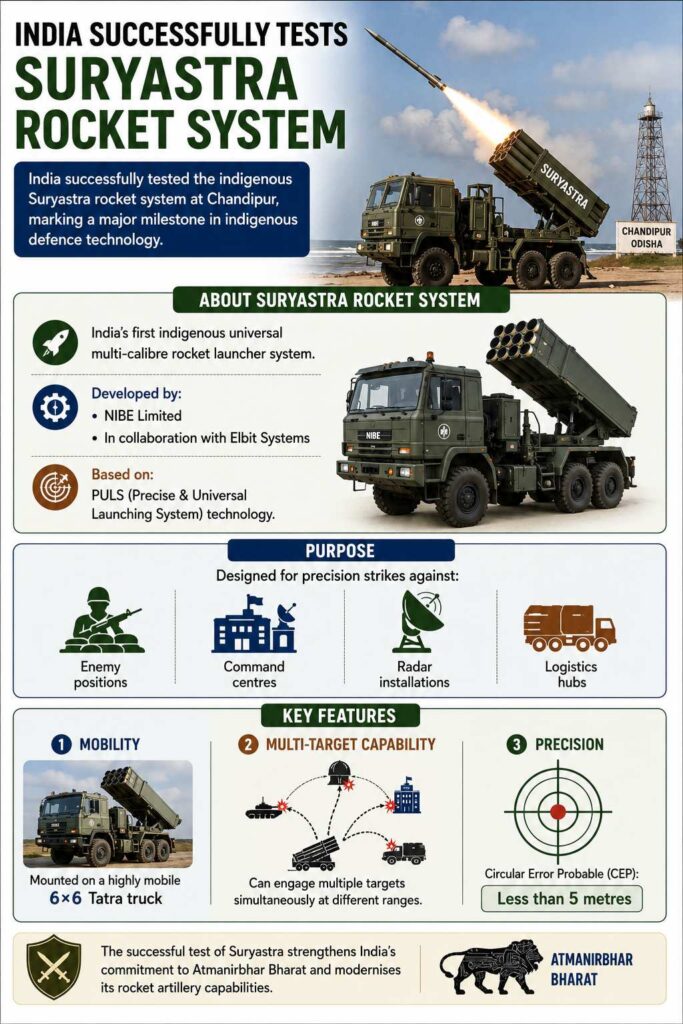
India successfully tested the indigenous Suryastra rocket system at Chandipur, marking a major milestone in indigenous defence technology.
About Suryastra Rocket System
India’s first indigenous universal multi-calibre rocket launcher system.
Developed by:
NIBE Limited
In collaboration with Elbit Systems
Based on: PULS (Precise & Universal Launching System) technology.
Range: 300 KM
Purpose
Designed for precision strikes against:
Enemy positions
Command centres
Radar installations
Logistics hubs
Key Features
Mounted on a highly mobile: 6×6 Tatra truck
Multi-target Capability
Can engage multiple targets simultaneously at different ranges.
Precision
Circular Error Probable (CEP): Less than 5 metres
[2025] With reference to India’s defense, consider the following pairs: Aircraft type Description 1. Dornier-228 Maritime patrol aircraft 2. IL-76 Supersonic combat aircraft 3. C-17 Globe Master IIIMilitary transport aircraft How many of the pairs given above are correctly matched?
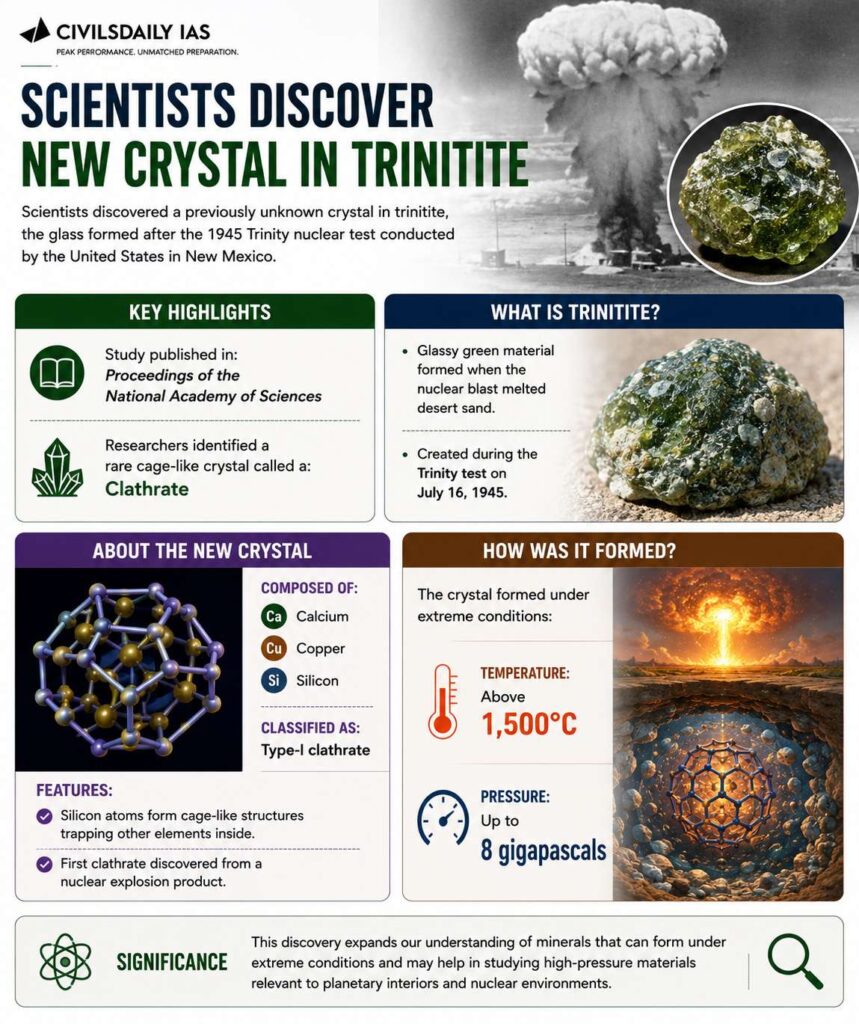
Scientists discovered a previously unknown crystal in trinitite, the glass formed after the 1945 Trinity nuclear test conducted by the United States in New Mexico.
Key Highlights
Study published in: Proceedings of the National Academy of Sciences
Researchers identified a rare cage-like crystal called a Clathrate
What is Trinitite?
Glassy green material formed when the nuclear blast melted desert sand.
Created during the Trinity test on July 16, 1945.
About the New Crystal
Composed of:
Calcium
Copper
Silicon
Classified as a Type-I clathrate
Features
Silicon atoms form cage-like structures trapping other elements inside.
First clathrate discovered from a nuclear explosion product.
How Was it Formed?
The crystal formed under extreme conditions:
Temperature Above 1,500°C
Pressure Up to 8 gigapascals
Rapid cooling preserved the crystal structure.
Link with Quasicrystals
The study followed earlier discovery of a Quasicrystal in red trinitite (2021)
Quasicrystals
Have ordered but non-repeating atomic patterns.
Earlier believed impossible in nature.
Researchers found Clathrates and quasicrystals formed separately during the blast.
Scientific Importance
The findings suggest:
Extreme environments can create entirely new forms of matter.
Nuclear blast conditions may help scientists develop novel synthetic materials.
[2013] The efforts to detect the existence of Higgs boson particle have become frequent news in the recent past. What is /are the importance/importances of discovering this particle? 1. It will enable us to understand why elementary particles have mass. 2. technology to transferring matter from one point to another without traversing the physical space between them. 3. It will enable us to create better fuels for nuclear fission. Select the correct answer using the codes given below:
[A] 1 only [B] 2 and 3 only [C] 1 and 3 only [D] 1, 2 and 3
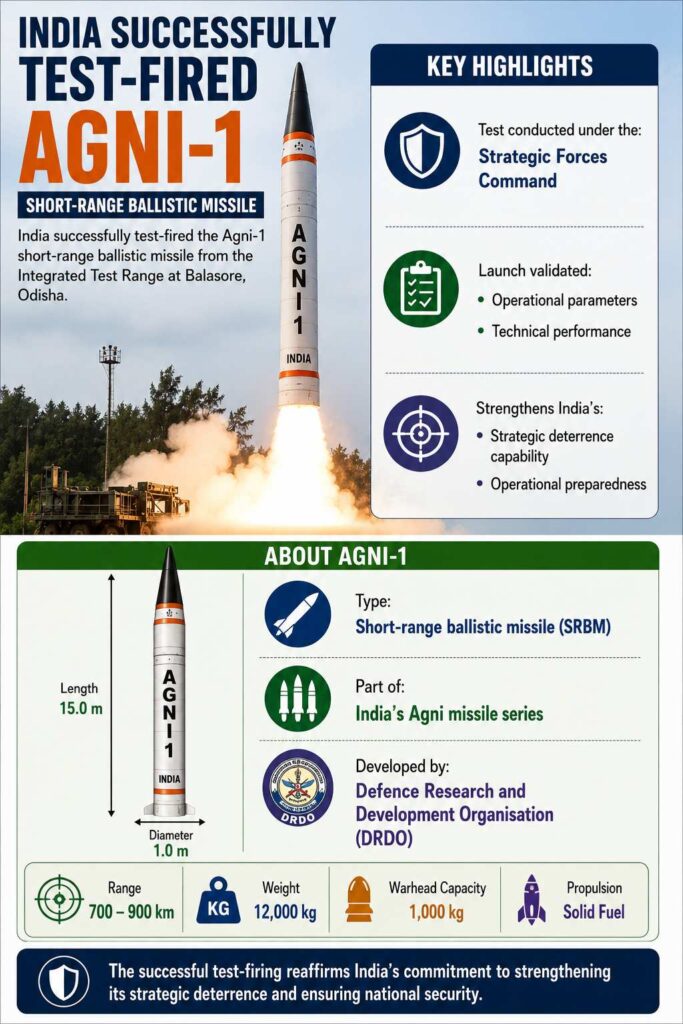
India successfully conducted the flight-trial of an advanced Agni missile equipped with a Multiple Independently Targeted Re-entry Vehicle (MIRV) system on May 8, 2026. The test was carried out from Dr. A.P.J. Abdul Kalam Island.
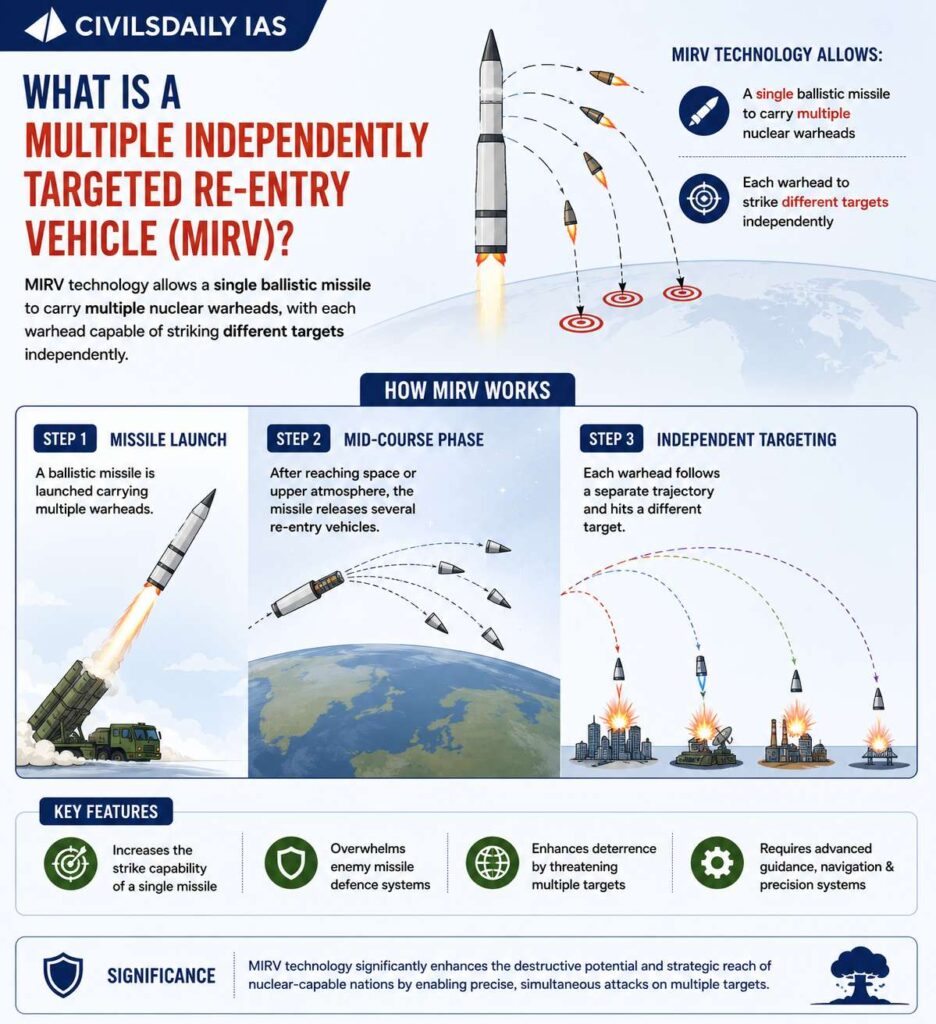
What is a Multiple Independently Targeted Re-entry Vehicle (MIRV)?
MIRV technology allows:
A single ballistic missile to carry multiple nuclear warheads
Each warhead to strike different targets independently
How MIRV Works
Step 1: Missile Launch: A ballistic missile is launched carrying multiple warheads.
Step 2: Mid-course Phase: After reaching space or upper atmosphere:
The missile releases several re-entry vehicles
Step 3: Independent Targeting: Each warhead:
Follows a separate trajectory
Hits a different target
[2026] Consider the following statements 1. Ballistic missiles are jet-propelled at subsonic speeds throughout their fights, while cruise missiles are rocket-powered only in the initial phase of fight. 2. Agni-V is a medium-range supersonic cruise missile, while BrahMos is a solid-fuelled intercontinental ballistic missile. Which of the statements given above is/are correct? [A] 1 only [B] 2 only [C] Both 1 and 2 [D] Neither 1 nor 2
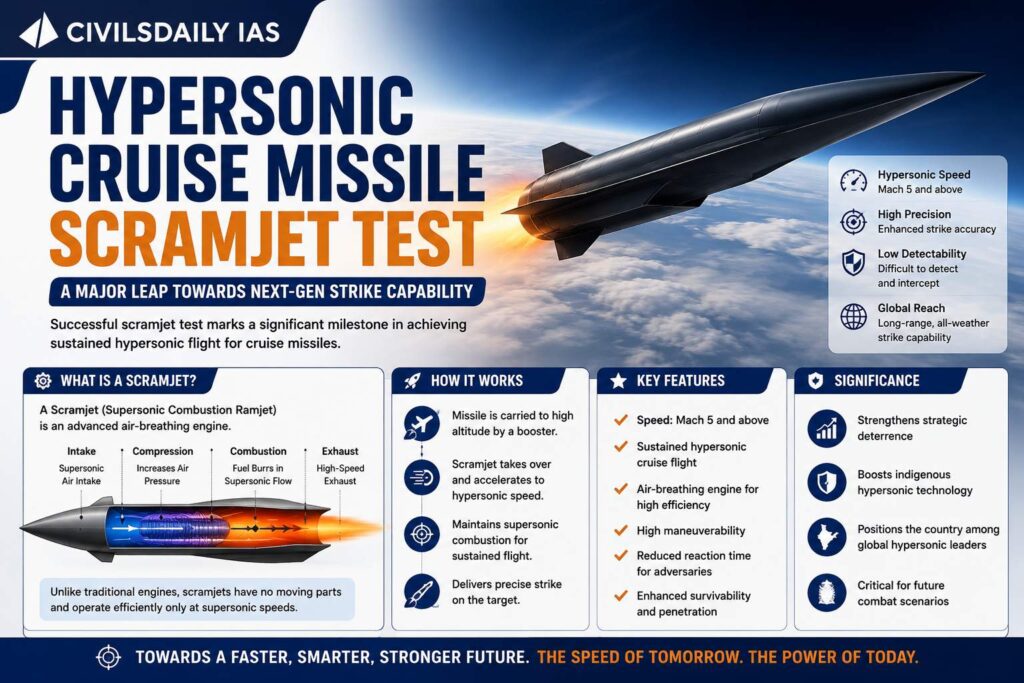
Defence Research and Development Organisation (DRDO) successfully tested the actively cooled scramjet combustor of a new hypersonic cruise missile at the Scramjet Connect Pipe Test facility in Hyderabad.
Key Achievement
DRDO achieved: 1,200 second runtime of the scramjet combustor
Previous successful test: 700 plus seconds in January 2026
About Hypersonic Cruise Missile
Missile capable of travelling at:
More than Mach 5
Over five times the speed of sound
Approximate speed:
Above 6,100 km per hour
What is a Scramjet Engine?
Full Form: Supersonic Combustion Ramjet
Air breathing engine using:
Supersonic airflow during combustion
Operates efficiently at hypersonic speeds (Speed:5 Mach)
Uses atmospheric oxygen instead of carrying oxidiser
Suitable for:
Hypersonic missiles
Advanced aerospace systems
Countries Developing Hypersonic Technology
India
United States
Russia
China
[UPSC 2009] In the context of Indian defence, consider the following statements: 1. The Shourya missile flies with a speed of more than 8 Mach. 2. The range of Shourya missile is more than 1600 km. Which of the statements given above is/are correct? (a) 1 only (b) 2 only (c) Both 1 and 2 (d) Neither 1 nor 2
CSIR-Central Road Research Institute (CSIR-CRRI) and Bharat Petroleum Corporation Limited (BPCL) were recognised by the India Book of Records and Asia Book of Records for constructing the first roadblock section using technical textile geocell made from end of life plastic.
About Geocell
A three dimensional cellular confinement system used in geotechnical engineering
Designed to improve:
Soil stability
Load bearing capacity
Structural reinforcement
Structure of Geocell
Consists of interconnected honeycomb shaped cells
Made from geosynthetic materials such as:
High Density Polyethylene (HDPE)
Polyester
Working Mechanism
Cells are expanded on site to form a mattress like layer
Filled with materials such as: Soil, Sand, Aggregate, and Clay
After compaction:
The geocell integrates with underlying soil
Creates a reinforced and stable structure
[2020] In rural road construction, the use of which of the following is preferred for ensuring environmental sustainability or to reduce carbon footprint? 1. Copper slag 2. Cold mix asphalt technology 3. Geotextiles Hot mix asphalt technology 4. Portland cement Select the correct answer using the code given below: a) 1, 2 and 3 only b) 2, 3 and 4 only c) 4 and 5 only d) 1 and 5 only