💥Join UPSC 2027,2028 Mentorship (July Batch) + XFactor Notes & Microthemes PDF

Subject: Judiciary

  • The challenge of holding judges accountable

    Why in the News?

    Recently, Justice Shekhar Kumar Yadav’s speech at a Vishwa Hindu Parishad event, showing bias against Muslims, has raised concerns about the challenges in holding higher court judges accountable in India.

    Why do the judges need to be accountable?

    • Upholding Judicial Integrity: Judges are the guardians of the Constitution and are expected to exhibit the highest ethical standards to maintain public trust in the judiciary.
    • Safeguarding Democracy: Accountability ensures that the judiciary acts as a fair and impartial arbiter, without overstepping or undermining democratic institutions.
    • Preventing Abuse of Power: Judicial independence is vital, but unchecked power can lead to misconduct or corruption, as seen in cases like Justice V. Ramaswami and Justice Soumitra Sen.
    • Maintaining Public Confidence: Accountability is critical to reinforcing public confidence in the judiciary, especially in a democracy where the judiciary acts as a check on other branches of government.

    What are the accountable-related issues? 

    • High Bar for Impeachment: The process requires “proved misbehaviour or incapacity” and a two-thirds majority in Parliament, making it almost impossible to remove errant judges.
    • Resignation to Evade Accountability: Judges like Justice Soumitra Sen and P.D. Dinakaran resigned before the completion of impeachment proceedings, avoiding scrutiny while retaining post-retirement benefits.
    • Immunity Misuse: Judges continue to enjoy post-retirement benefits even after accusations of misconduct, as seen in Justice Ramaswami’s case, undermining accountability.
    • Limited Scope for Independent Oversight: The judiciary lacks an independent review mechanism outside the Parliament-driven impeachment process, leaving little room for holding judges accountable in real time.

    What is the review mechanism of committee set up under the Judges (Inquiry) Act, 1968?

    • Initiation: A removal motion, signed by 100 Lok Sabha MPs or 50 Rajya Sabha MPs, is submitted and approved by the Speaker or Chairman to initiate the process.
    • Investigation: A three-member committee (Supreme Court judge, Chief Justice of a High Court, and an eminent jurist) is constituted under the Judges (Inquiry) Act, 1968 to investigate allegations of “proved misbehaviour or incapacity.”
    • Parliamentary Decision: If the committee confirms the charges, the motion is debated in Parliament and requires a two-thirds majority in both Houses for the judge’s removal by the President.

    Is there any accountability limitation by the Constitution for the judges? 

    • Article 124(4) and (5): These articles provide for the removal of judges only through impeachment, which is a political and cumbersome process requiring a majority in Parliament.
    • Lack of Disqualification: The Constitution does not explicitly disqualify judges found guilty of misconduct from holding future public office.
    • Insufficient Deterrence: Provisions under the Judges (Inquiry) Act, 1968, do not offer significant penalties apart from removal, leaving gaps in ensuring judicial accountability.
    • Ambiguity in “Proved Misbehavior”: The term is not clearly defined, leading to challenges in establishing guilt and enforcing accountability.

    Way forward: 

    • Streamlining the Impeachment Process: Simplifying procedures and reducing the threshold for initiating impeachment could make it easier to hold judges accountable.
    • Clear Disqualification Guidelines: Introducing clear guidelines regarding disqualification from future judicial roles following findings of misconduct would reinforce accountability.
    • Public Awareness and Advocacy: Increasing public awareness about judicial accountability issues can foster demand for reform and greater scrutiny of judicial conduct.
    • Legislative Reforms: Revisiting the Judges (Inquiry) Act, 1968, to address its limitations and ensure it meets contemporary standards for accountability is crucial for restoring public confidence in the judiciary.

    Mains PYQ:

    Q Critically examine the Supreme Court’s judgement on ‘National Judicial Appointments Commission Act, 2014’ with reference to the appointment of judges of higher judiciary in India.(UPSC IAS/2017)

  • India’s ‘steel frame’ does need a check

    Why in the News?

    The recent government initiatives, such as “Mission Karmayogi,” aimed at enhancing the capacity of civil servants, underscores the ongoing dialogue about reforming India’s “steel frame” of governance.

    What is the current state of India’s bureaucratic structure?

    India’s bureaucratic structure, particularly the Indian Administrative Service (IAS), often referred to as the “steel frame” of Indian governance, has historically been crucial in administration but is now struggling with several issues:

    • Politicization: Frequent transfers and promotions based on political loyalty rather than merit have undermined the professionalism and morale of IAS officers. 
      • This politicization hampers the development of domain expertise, as officers are rotated across various departments without sufficient time to specialise in any particular area.
    • Corruption and Inefficiency: India ranks moderately on the World Bank’s government effectiveness index, indicating persistent corruption and inefficiencies in policy implementation. 
    • Centralized Governance: The current governance model under the Prime Minister has led to increased centralization of power in the Prime Minister’s Office (PMO). 

    What are the previous efforts taken to reform the bureaucracy in India?

    Commission recommendation:

    • First Administrative Reforms Commission (1st ARC, 1966): Highlighted the need for specialization within the Indian Administrative Service (IAS) to improve efficiency by transitioning it into a functional service focused on specific governance areas.
    • Second Administrative Reforms Commission (2nd ARC, 2005): Proposed a transparent lateral entry process for domain experts, mandatory training for civil servants throughout their careers, and the establishment of a National Institute of Public Administration to enhance public administration education and expand the candidate pool for civil services.

    Central Government initiative:

    • Mission Karmayogi (2020): A capacity-building program designed to create a citizen-centric, future-ready civil service by promoting continuous learning and skill enhancement through a dedicated digital platform.
    • Lateral Entry Reforms: Introduced to integrate specialized talent from diverse sectors into senior civil service roles.

    Important judgments given by the Supreme Court:

    • T.S.R. Subramanian v. Union of India (2013): The Supreme Court barred civil servants from following oral political directives, and mandated the creation of a Civil Services Board (CSB) to oversee transfers and postings for ensuring stability and reducing arbitrariness.
    • Delhi Government Services Case (2023): The Supreme Court upheld Delhi’s legislative authority over services, reinforcing federalism and ensuring accountability of officers operating under the Delhi government’s jurisdiction.

    How do proposed reforms impact the independence and specialization of civil servants?

    The proposed reforms aim to modernize India’s bureaucracy by enhancing independence, accountability, and specialization among civil servants.  

    • Lateral Entry Initiatives: The government has introduced lateral entry into senior bureaucratic positions to bring in domain experts from outside the traditional IAS framework.  
    • Performance-Based Promotions: Recommendations from various administrative reform commissions (Second ARC, set up in 2005) suggest linking promotions to measurable performance rather than seniority. 
      • This shift could enhance accountability but may also meet resistance from entrenched interests within the IAS.
    • Protection Against Arbitrary Transfers: Proposals such as the Civil Services Standards, Performance, and Accountability Bill aim to protect bureaucrats from politically motivated transfers. 
      • Implementing such measures could bolster the autonomy of civil servants.

    What risks are associated with centralizing decision-making in the bureaucracy?

    • Reduced Autonomy: Centralization can diminish the independence of senior bureaucrats, making them more susceptible to political pressures. 
      • This undermines their ability to act as effective policy executors and can lead to a culture of compliance rather than innovation.
    • Bottlenecks in Implementation: A centralized approach may create bottlenecks in policy implementation, as decision-making becomes concentrated at the top. 
      • This can slow down responses to emerging challenges and reduce the overall efficiency of governance.
    • Neglect of Bureaucratic Expertise: By sidelining bureaucratic insights in favor of top-down directives, there is a risk that valuable expertise within the civil service goes unutilized. This could hinder effective policymaking and lead to poor outcomes in governance.

    How can ancient Indic principles enhance modern governance?

    • Ethical Leadership and Accountability (Raj Dharma): Ancient Indic principles emphasize leaders as servants of the people, prioritizing fairness, justice, and public welfare. This aligns with modern demands for transparent and accountable governance.
    • Inclusive Development (Antyodaya): The concept of Antyodaya advocates for uplifting the marginalized and ensuring that governance benefits all sections of society, especially the most disadvantaged, which is essential for achieving equitable development.
    • Sustainability and Environmental Harmony (LiFE & Karmayogi): Indic principles stress balance with nature and responsible living, guiding modern governance towards sustainable development practices. Additionally, the Karmayogi concept promotes continuous skill-building for public servants to enhance governance effectiveness.

    In what ways can citizen engagement be improved through Indic ideas?

    • Participative Governance (Sab Ka Prayas): The concept of Sab Ka Prayas emphasizes collective effort, where citizens are actively involved in decision-making and implementation processes.
    • Empathy and Responsibility (P2G2 – Pro-People Good Governance): By incorporating P2G2, which stresses sensitivity, commitment, and a sense of responsibility towards the people.
      • Citizens can be more engaged through empathetic governance that prioritizes their well-being and fosters trust in public institutions.
    • Empowerment through Education and Awareness (Antyodaya and Raj Dharma): Indic ideas like Antyodaya and Raj Dharma promote the empowerment of all individuals, particularly the marginalized, through education and awareness.

    Way forward: 

    • Empower Decentralized Governance: Strengthen local and state-level administrative autonomy to reduce over-reliance on centralized decision-making, enabling more responsive and effective governance.
    • Implement Performance-Based Reforms: Institutionalize meritocratic measures such as performance-linked promotions, lateral entry, and protection against arbitrary transfers to foster accountability, specialization, and independence among civil servants.
    • Efficient bureaucracy: India can draw valuable lessons from the proposed Department of Government Efficiency (DOGE) initiative to make a more efficient bureaucracy in India.
      • DOGE is a proposed initiative introduced by USA President which aims to streamline federal bureaucracy.

    Mains PYQ:

    Q Has the Cadre-based Civil Services Organization been the cause of slow in India? Critically examine. (UPSC IAS/2014)

  • In today’s India, can the Constitution protect individual dignity?

    Why in the News?

    The SC has emphasized the importance of individual dignity within the context of Article 21 in several landmark cases. 

    • Discussions around individual dignity have again gained traction, especially when former SC Justice Kurian Joseph emphasized that the Constitution prioritizes individual dignity, making it a vital topic for contemporary legal discourse.

    How effectively does the Constitution safeguard individual dignity?

    The Constitution of India is designed to protect individual dignity through a framework that entitles citizens to fundamental rights.  

    • Entrenchment of Individual Rights: The Constitution explicitly guarantees individual rights, aiming to protect the freedom and dignity of all citizens. 
      • Fundamental Rights under Part III of the Constitution, such as the Right to Equality (Article 14), Right to Freedom (Articles 19-22), and Right to Life and Personal Liberty (Article 21), explicitly safeguard individual dignity.
    • Checks and Balances: The Constitution establishes institutional checks and balances to prevent the abuse of power.
      • In Maneka Gandhi v. Union of India (1978), the Supreme Court broadened the scope of Article 21, holding that any law depriving personal liberty must meet the standards of fairness, justice, and reasonableness.
    • Political Equality: By affirming political equality among citizens, the Constitution enables individuals to participate actively in the democratic process. 
      • Article 326 guarantees universal adult suffrage, enabling all citizens to participate equally in democratic processes, affirming their political dignity and sense of inclusion.

    What role do societal attitudes and systemic issues play in protecting dignity?

    Societal attitudes and systemic issues significantly influence the protection of individual dignity under the Constitution:

    • Community Identity vs. Individual Rights: The emphasis on community identity whether based on caste, religion, or nation can undermine individual dignity. When societal attitudes prioritize group identities over individual rights, it can lead to discrimination and marginalization.
    • Trust and Cooperation: A lack of trust among citizens can hinder collective efforts to uphold constitutional values. When individuals measure each other against rigid identities, it subverts the freedom that the Constitution aims to protect.
    • Oligarchic Power: Concentration of wealth and power can distort democratic processes, leading to a situation where certain groups’ interests overshadow individual rights. This systemic issue can erode the effectiveness of constitutional protections for dignity.

    Can legal frameworks adapt to evolving understandings of dignity?

    The legal framework established by the Constitution has the potential to adapt to evolving understandings of dignity:

    • Basic Structure Doctrine: The Basic Structure Doctrine, established in Kesavananda Bharati v. State of Kerala (1973), ensures that core principles like dignity remain inviolable while allowing amendments to address evolving needs. 
      • For example, The 103rd Constitutional Amendment (2019) introduced a 10% reservation for Economically Weaker Sections (EWS) in education and public employment.
    • Ongoing Democratic Negotiation: The Constitution leaves questions regarding economic structure open for ongoing negotiation, allowing for discussions around justice and inclusion that are vital for protecting dignity in a changing society.
      • For example, The introduction of the Transgender Persons (Protection of Rights) Act, 2019 marked a significant step toward affirming the dignity and rights of transgender individuals.
    • Judicial Interpretation: Courts play a critical role in interpreting constitutional provisions related to dignity. 
      • For example, Navtej Singh Johar v. Union of India (2018) decriminalized consensual same-sex relationships by reading down Section 377 of the Indian Penal Code.

    Way forward: 

    • Promoting Constitutional Values: Enhance public awareness and foster societal attitudes that prioritize individual dignity, equality, and mutual respect over group identities.
    • Strengthening Institutional Adaptability: Empower judicial and legislative mechanisms to address systemic inequities, interpret evolving notions of dignity, and implement inclusive policies.

    Mains PYQ:

    Q Examine the scope of Fundamental Rights in the light of the latest judgement of the Supreme Court on Right to Privacy. (UPSC IAS/2017)

  • Impeachment of Judges

    Why in the News?

    The Opposition in Rajya Sabha is preparing to move a motion for impeachment of Allahabad High Court Judge for his controversial remarks inciting communal hatred.

    Impeachment Process for Judges in India:

    About
    • The process involves Parliament passing an address to the President to remove the judge.
    • To pass the motion, twothirds of the MPs present and voting in both Lok Sabha and Rajya Sabha;
      • Must approve it, with a majority of more than 50% of the total membership of each House.
    Key Constitutional Provisions
    • Article 124(4): The judge can only be removed by a Presidential order, passed after a majority vote in both Houses of Parliament.
    • The vote must come from two-thirds of the members present and voting.
    • Articles 218 of the Constitution extends the same rules to High Court judges.
    • The impeachment process ensures judicial independence by maintaining a high bar for removal, limiting political influence.
    Grounds for Impeachment
    • A judge of the Supreme Court or High Court can be impeached on two grounds: “proved misbehaviour” or “incapacity” as per the Constitution of India.
    • Further clarified in the Judges (Inquiry) Act, 1968, including:
      • Misuse of office
      • Grave offences that undermine the judge’s integrity
      • Contravention of the provisions of the Constitution.
    What does the process entail? Procedure under the Judges Inquiry Act, 1968:

    Initial Step: The impeachment motion must be signed by at least 100 MPs in the Lok Sabha and 50 MPs in the Rajya Sabha.

    Committee Formation: Once the motion is introduced, the Speaker or Chairperson of the respective House forms a three-member inquiry committee:

    1. Headed by the Chief Justice of India or a Supreme Court judge.
    2. The second member is usually a Chief Justice of any High Court.
    3. The third member is a distinguished jurist, appointed by the Speaker or Chairman.

    Inquiry Process: The committee investigates the charges, cross-examines witnesses, and regulates its procedure.
    The committee may also request a medical test if the charge relates to mental incapacity.

    Outcome: If the committee finds the judge not guilty, the motion is dismissed. If found guilty, it will be reported back to the House for further action.


    Instances of Impeachment in India:

    • 1993: Justice V Ramaswami (Supreme Court) faced impeachment proceedings on financial impropriety. The motion was unsuccessful despite a guilty finding.
    • 2011: Justice Soumitra Sen (Calcutta High Court) was impeached for corruption but resigned before Lok Sabha could take up the matter.
    • 2015: Justice S K Gangele (Madhya Pradesh High Court) faced impeachment on charges of sexual harassment, but the committee cleared him in 2017.
    • 2015: Justice J B Pardiwala (Gujarat High Court) faced impeachment for controversial remarks about reservation but the motion was dropped after the judge expunged the remarks.
    • 2017: Justice C V Nagarjuna (Andhra Pradesh & Telangana High Court) faced impeachment for financial misconduct and victimizing a Dalit judge, but the motion was not pursued.


    PYQ:

    [2019] Consider the following statements:

    1. The motion to impeach a Judge of the Supreme Court of India cannot be rejected by the Speaker of the Lok Sabha as per the Judges (inquiry) Act, 1968.

    2. The Constitution of India defines and gives details of what constitutes ‘incapacity and proved misbehaviour’ of the Judges of the Supreme Court of India.

    3. The details of the process of impeachment of the Judges of the Supreme Court of India are given in the Judges (Inquiry) Act, 1968.

    4. If the motion for the impeachment of a Judge is taken up for voting, the law requires the motion to be backed by each House of the Parliament and supported by a majority of total membership of that House and by not less than two-thirds of total members of that House present and voting.

    Which of the statements given above is/are correct?

    (a) 1 and 2

    (b) 3 only

    (c) 3 and 4 only

    (d) 1, 3 and 4

  • [11th December 2024] The Hindu Op-ed: Sambhal and the perils of judicial evasion

    PYQ Relevance:
    Q) What was held in the Coelho case? In this context, can you say that judicial review is of key importance amongst the basic features of the Constitution? (UPSC CSE 2016)

    Mentor’s Comment: UPSC Mains have previously ‘Judicial review’ (in 2016), and religiousness/religiosity and Communalism (in 2017).

    In a 2005 paper on ‘judicial inactivism,’ scholar Chad M. Oldfather discussed how courts have a “duty to decide” and how judicial inaction can be just as impactful as judicial action. He argued that failures to fulfill this duty are harder to detect than overreaching decisions, making inaction more concerning. A recent example of judicial deferment is the Supreme Court’s handling of the Sambhal masjid case in Uttar Pradesh. The Court refrained from a final decision, temporarily halting a survey-related civil court proceeding and sending the matter to the Allahabad High Court. 

    Today’s editorial underscores the approach adopted by the Supreme Court of India in the Sambhal masjid case (Uttar Pradesh).

    _

    Let’s learn!

    Why in the News?

    The Court’s order shows, once again, a reluctance to deal with the main issue — it should have taken a clear stand on the validity of the Places of Worship (Special Provisions) Act.

    What were the events leading up to the violence in Sambhal?

    • Survey Controversy: The local civil court ordered a survey of the Sambhal masjid, which heightened tensions among community members. This survey was perceived as an infringement on religious sentiments, leading to protests and unrest.
    • Political Context: The backdrop of communal politics in India, where historical grievances are often invoked, contributed to the volatility of the situation. The mosque’s status became a focal point for various groups, exacerbating tensions.
    • Loss of Lives: The unrest resulting from the survey led to violence and loss of human lives, highlighting the severe implications of judicial decisions that touch on sensitive communal issues.

    How did the judicial system respond?

    • Supreme Court’s Order: The Supreme Court ordered a freeze on proceedings related to the survey and directed the matter back to the Allahabad High Court, effectively deferring a decisive ruling on the issue.
    • Judicial Deferment: This approach reflects a pattern of judicial inaction, where the Court avoids making definitive rulings on contentious issues, opting instead for temporary measures to maintain peace.
    • Failure to Uphold Legislation: Critics argue that the Court’s reluctance to uphold the Places of Worship (Special Provisions) Act, 1991, which aims to preserve the status quo of places of worship as they existed in 1947, represents a failure to honour legislative intent.

    What are the implications of judicial inquiries and commissions in addressing communal tensions?

    • Limited Effectiveness: Judicial inquiries and commissions often serve as mechanisms for delay rather than resolution, as seen in previous cases like those involving the Citizenship (Amendment) Act and farm laws. They may lead to temporary solutions without addressing underlying legal issues.
    • Erosion of Trust: When courts engage in deferment rather than decisiveness, it can erode public trust in the judiciary’s ability to handle communal tensions effectively.
    • Potential for Inaction: The reliance on committees or inquiries can create a perception that the judiciary is avoiding its duty to decide, potentially emboldening communal actors who seek to exploit legal ambiguities.

    How does this case reflect broader issues of judicial accountability and public trust in the legal system?

    • Judicial Inactivism: The phenomenon described by Chad M. Oldfather highlights that judicial inaction can have significant consequences, often more difficult to detect than overreach. This in-activism can undermine public confidence in judicial integrity.
    • Need for Assertiveness: The Supreme Court’s reluctance to assertively interpret and uphold laws like the Places of Worship Act raises concerns about its commitment to constitutional principles such as secularism and fraternity.
    • Impact on Communal Harmony: Judicial decisions—or lack thereof—play a crucial role in shaping societal dynamics. Inaction on contentious issues can exacerbate communal tensions rather than mitigate them, leading to further unrest and division within society.

    Way forward: 

    • Assertive Judicial Intervention: The Supreme Court should proactively address sensitive communal issues by upholding laws like the Places of Worship Act, ensuring that judicial decisions reflect the constitutional values of secularism and fraternity, and prevent further exploitation of legal ambiguities.
    • Timely and Decisive Rulings: To restore public trust, the judiciary must avoid deferring critical cases to lower courts or committees and instead issue clear, binding decisions that resolve underlying legal disputes, thereby maintaining social harmony and reinforcing accountability.

    https://www.thehindu.com/opinion/lead/sambhal-and-the-perils-of-judicial-evasion/article68970254.ece 

  • The code of conduct judges need to follow

    Why in the News? 

    Justice Shekhar Kumar Yadav of the Allahabad High Court made comments against the Muslim community at an event organized by the Vishwa Hindu Parishad’s legal cell, which has caused a lot of public criticism.

    What are the key ethical principles outlined in the code of conduct for judges?

    • Majority Rule: Justice Yadav stated that India would function according to the wishes of the majority, referring to Hindus as the “bahusankhyak” (majority) community. He implied that the values taught to children in one community differ significantly from those in another, particularly regarding animal slaughter practices.
    • Critique of Muslim Practices: He criticized certain practices within the Muslim community, such as polygamy and triple talaq, while asserting that Hindus revere women as goddesses. This comparison has been interpreted as a direct attack on Islamic traditions.
    • Response from Legal Community: The Campaign for Judicial Accountability and Reforms has called for an inquiry into Justice Yadav’s conduct, arguing that his statements violate judicial ethics and undermine public confidence in the judiciary. Prominent legal figures have also suggested impeachment proceedings against him.

    How do codes of conduct vary across different jurisdictions and judicial systems?

    • United States: The American Bar Association has established Model Rules of Professional Conduct which emphasize independence, integrity, and impartiality.
    • United Kingdom: The Judicial Conduct Investigations Office oversees judicial behavior, with a focus on maintaining public confidence in the judiciary.
    • India: The Restatement of Values of Judicial Life serves as a guiding document for judges, emphasizing the need for impartiality and respect for constitutional values.

    What are the consequences for judges who violate the code of conduct?

    • In-House Procedures: Many jurisdictions have internal mechanisms allowing for complaints against judges to be investigated without public embarrassment.
    • Impeachment: In severe cases, judges can be impeached for misconduct, requiring a significant legislative majority to proceed.
    • Public Reprimand or Suspension: Depending on the severity of the violation, judges may receive reprimands or temporary suspensions from their duties.

    Way forward: 

    • Strengthen Accountability Mechanisms: Establish clearer and more transparent procedures for addressing judicial misconduct, including an independent body to investigate complaints and ensure timely action, thus preserving public trust in the judiciary.
    • Promote Judicial Sensitivity and Training: Implement regular training programs on diversity, impartiality, and the ethical responsibilities of judges to reinforce the importance of maintaining neutrality and respect for all communities, both in and out of the courtroom.


    The Opposition in Rajya Sabha is preparing to move a motion for impeachment of Allahabad High Court Judge for the same controversial remarks inciting communal hatred.

    Impeachment Process for Judges in India:

    About
    • The process involves Parliament passing an address to the President to remove the judge.
    • To pass the motion, twothirds of the MPs present and voting in both Lok Sabha and Rajya Sabha;
      • Must approve it, with a majority of more than 50% of the total membership of each House.
    Key Constitutional Provisions
    • Article 124(4): The judge can only be removed by a Presidential order, passed after a majority vote in both Houses of Parliament.
    • The vote must come from two-thirds of the members present and voting.
    • Articles 218 of the Constitution extends the same rules to High Court judges.
    • The impeachment process ensures judicial independence by maintaining a high bar for removal, limiting political influence.
    Grounds for Impeachment
    • A judge of the Supreme Court or High Court can be impeached on two grounds: “proved misbehaviour” or “incapacity” as per the Constitution of India.
    • Further clarified in the Judges (Inquiry) Act, 1968, including:
      • Misuse of office
      • Grave offences that undermine the judge’s integrity
      • Contravention of the provisions of the Constitution.
    What does the process entail? Procedure under the Judges Inquiry Act, 1968:

    Initial Step: The impeachment motion must be signed by at least 100 MPs in the Lok Sabha and 50 MPs in the Rajya Sabha.

    Committee Formation: Once the motion is introduced, the Speaker or Chairperson of the respective House forms a three-member inquiry committee:

    1. Headed by the Chief Justice of India or a Supreme Court judge.
    2. The second member is usually a Chief Justice of any High Court.
    3. The third member is a distinguished jurist, appointed by the Speaker or Chairman.

    Inquiry Process: The committee investigates the charges, cross-examines witnesses, and regulates its procedure.
    The committee may also request a medical test if the charge relates to mental incapacity.

    Outcome: If the committee finds the judge not guilty, the motion is dismissed. If found guilty, it will be reported back to the House for further action.


    Instances of Impeachment in India:

    • 1993: Justice V Ramaswami (Supreme Court) faced impeachment proceedings on financial impropriety. The motion was unsuccessful despite a guilty finding.
    • 2011: Justice Soumitra Sen (Calcutta High Court) was impeached for corruption but resigned before Lok Sabha could take up the matter.
    • 2015: Justice S K Gangele (Madhya Pradesh High Court) faced impeachment on charges of sexual harassment, but the committee cleared him in 2017.
    • 2015: Justice J B Pardiwala (Gujarat High Court) faced impeachment for controversial remarks about reservation but the motion was dropped after the judge expunged the remarks.
    • 2017: Justice C V Nagarjuna (Andhra Pradesh & Telangana High Court) faced impeachment for financial misconduct and victimizing a Dalit judge, but the motion was not pursued.


    Mains PYQ:

    Q Distinguish between laws and rules. Discuss the role of ethics in formulating them. (UPSC IAS/2020)

  • [18th November 2024] The Hindu Op-ed: The ‘new’ Justitia and reimagining justice

    PYQ Relevance:
    Q) The judicial systems in India and the UK seem to be converging as well as diverging in recent times. Highlight the key points of convergence and divergence between the two nations in terms of their judicial practices. (UPSC CSE 2020)

    Mentor’s Comment:  UPSC Mains have continuously focused on some micro themes in the Judiciary like – Judicial Governance (2023-24), major decisions taken by Apex Court, and the issues/challenges associated with Indian Judiciary (in 2021).

    World Justice Project’s Rule of Law Index ranks India at 69th out of 139 countries,   reflecting public concerns about corruption and delays within the judiciary. Today’s Editorial talks about the challenges and some of the recent initiatives taken by the Judiciary.

    This Editorial can be effectively used as a ‘case study’ as well as for representing present ‘challenges’ faced by the Indian Judiciary.

    _

    Let’s learn!

    Why in the News?

    The Chief Justice of India unveiled a new statue of Lady Justice at the Supreme Court premises, replacing the earlier version. The new statue features Lady Justice in a saree, without a blindfold, holding scales in one hand and the Indian Constitution in the other.

    What is the Background?

    • Origin of Lady Justice: The modern depiction of ‘lady justice’ is rooted in Justitia, the Roman goddess of justice, characterized by a blindfold (clossed eyes), scales, and a sword.
    • The symbolism of the Blindfold: Introduced during the Renaissance as a satire on corrupt legal systems, it later came to represent impartiality during the Enlightenment, emphasizing justice without bias related to wealth or social status.

    How does this new representation reflect societal demands for justice?

    • Colonial Influence: The British legal system established in India introduced a hierarchical court structure. ‘Lady justice’ became a prominent symbol in Indian courts during this period.
    • Decolonial Intent: The new statue aims to replace colonial symbols with representations more aligned with Indian traditions.
      • Cultural Representation: The statue’s attire is changed to a saree, reflecting Indian heritage.
      • Open Eyes: The removal of the blindfold signifies that justice is not blind. It acknowledges social diversity and the need for nuanced approaches to justice for underprivileged groups.
      • Constitution as Symbol: The sword is replaced with the Constitution, highlighting its supremacy in Indian jurisprudence while maintaining the scales to signify impartiality in weighing evidence.

    What are the implications of it?

    • Controversies Around Statues: Historical controversies surrounding judicial statutes highlight the need for careful consideration of how justice is visually represented. Questions arise about whether justice should embody protest and resistance or reflect lived experiences and struggles.
    • Re-envisioning Justice: There is a call for justice representations to signify virtues such as feminism, anti-caste sentiments, secularism, and judicial independence. The aim is to creatively challenge existing biases within the judiciary while fostering discussions on improving public perceptions without perpetuating new forms of discrimination based on caste or religion.

    Interpretation may differ related to the new statute of Lady justice but the Government should focus on issues related Judiciary in India: 

    What are the challenges related to the judiciary?

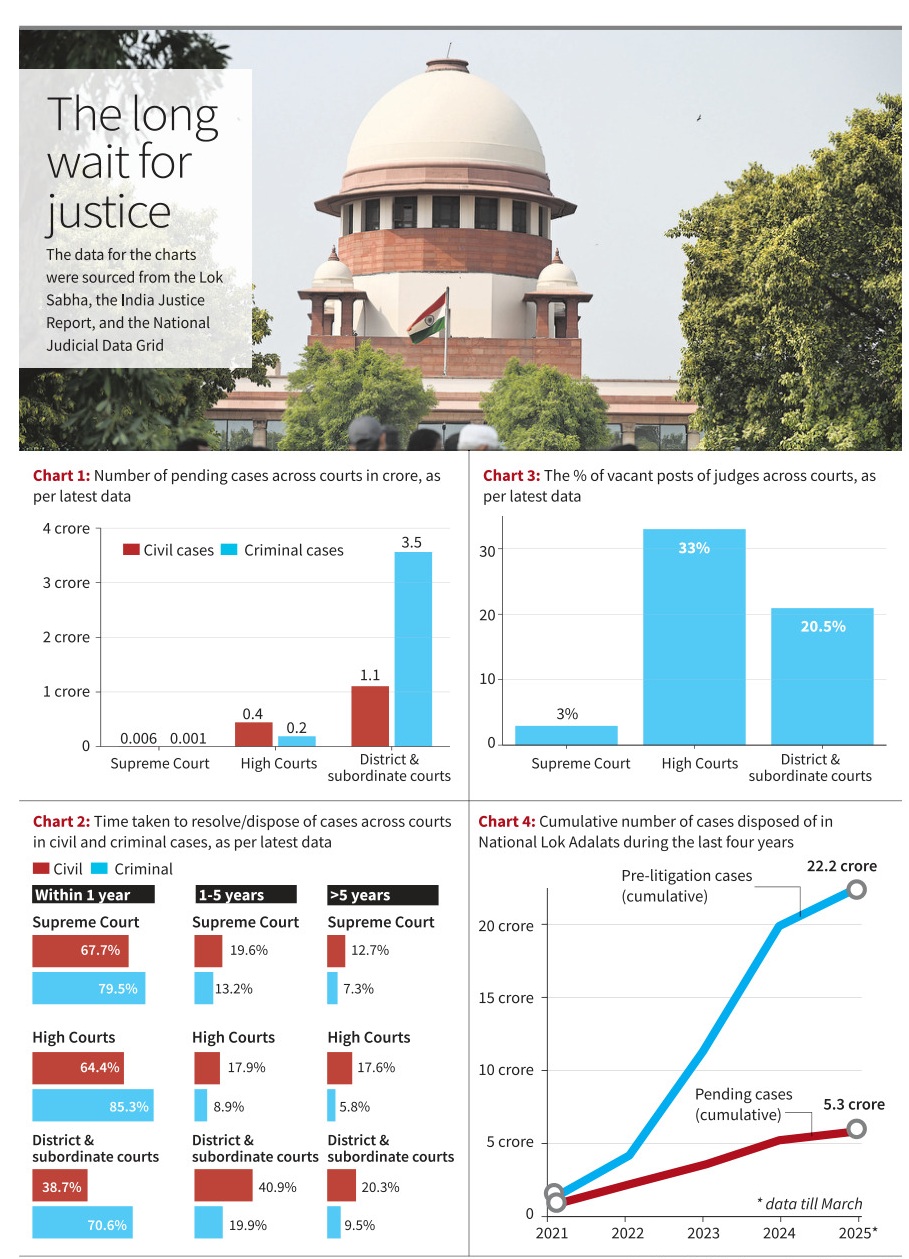
    Judicial Delays: The Supreme Court recently dismissed a plea for a three-year timeline to resolve over five crore pending cases, citing practical challenges due to overwhelming litigation.
    Revised Memorandum of Procedure: There is an urgent need to finalize this document regarding judge appointments to enhance transparency and accountability in the judiciary.
    Representation Issues: Less than 25% representation from backward classes, scheduled castes, tribes, and religious minorities exists in higher judiciary roles; women represent less than 15%. Appointments should reflect India’s social diversity.
    Court Capacity: High Courts operate at only 60-70% capacity, exacerbating case backlogs. The government needs to expedite appointments based on collegium recommendations and fill vacancies in lower courts promptly.
    Priority Cases: Constitutional validity cases and those concerning individual liberties should be prioritized by the higher judiciary to ensure timely justice delivery.

    Way forward: 

    • Strengthen Judicial Capacity: Expedite appointments in higher and lower courts to address vacancies, enhance infrastructure, and streamline case management systems to reduce pendency.
    • Promote Diversity and Transparency: Finalize the Memorandum of Procedure for judicial appointments, ensuring representation of marginalized communities and women to reflect India’s social diversity and foster inclusivity.

    https://www.thehindu.com/opinion/op-ed/the-new-justitia-and-reimagining-justice/article68879316.ece#:~:text=The%20addition%20of%20the%20open,India%20in%20her%20left%20hand.

  • [pib] Commercial Courts (Amendment) Bill, 2024

    Why in the News?

    The Ministry of Law and Justice is inviting comments on the draft Commercial Courts (Amendment) Bill, 2024.

    The GoI has enacted and amended the Commercial Courts Act, 2015 to ensure that commercial cases are resolved quickly, effectively, and affordably.

    • Amendment History:
      • The original Commercial Courts Act was enacted in 2015.
      • Further amendments were made in 2018 to enhance the dispute resolution system.

    Key features and provisions of the Commercial Courts (Amendment) Bill, 2024:

    Details
    Purpose To enhance the speed and efficiency of resolving commercial disputes through specialized courts and procedures.
    Dedicated Commercial Courts Creation of Commercial Courts at the District level and High Court level to exclusively handle commercial disputes.
    Arbitration Matters Provisions to establish specific courts for handling arbitration-related disputes.
    Electronic Communication Includes provisions for the use of audio-video electronic means (video conferencing) for court proceedings, recording of evidence, and communications.
    Pre-Institution Mediation Mandatory mediation before filing a commercial suit, unless urgent relief is required, aimed at reducing litigation burden.
    Time-bound Decisions Judgment must be pronounced within 60 days of the conclusion of arguments. The judgment must be delivered to the parties via email or other electronic means.
    Injunction Applications Courts must dispose of injunction applications within 90 days of filing, with reasons provided for any delay.
    Infrastructure Provisions for setting up infrastructure like video conferencing facilities and other necessary resources for the functioning of Commercial Courts.
    Appeals Process New provisions for expediting appeals, requiring prior notice to the opposing party before filing.
    Witness Management Provisions to streamline the witness list format, requiring comprehensive details, including addresses and documents, and facilitating electronic submission.
    Execution Proceedings Execution proceedings must be disposed of within six months from the date of filing the application.
  • Tackle the issue of adjournments, case pendency

    Why in the News?

    President Droupadi Murmu has called for an end to court delays. In the District Judiciary Conference, she said that frequent postponements make it hard for poor and rural people to seek justice, as they worry cases will take too long to resolve.

    Primary Causes of Case Pendency and Frequent Adjournments in Indian Courts:

    • Judge-Population Ratio: India has a low judge-to-population ratio, with only 21 judges per million people as of 2024, far below the Law Commission’s recommended 50 per million.
    • Vacant Judicial Positions: Delays in filling judicial vacancies lead to understaffed courts, with 30% vacancies in High Courts, adding pressure on the existing judges.
    • Additional Judicial Charges: Judges often handle multiple courts or specialized responsibilities, detracting from their ability to focus on primary cases and adding to delays.
    • Complex Case Load: Courts are burdened by multiple types of cases, including civil, criminal, constitutional, and appeals, many of which end up in higher courts, leading to severe backlogs.
    • Lack of Judicial-Impact Assessment: New laws increase the caseload, but without assessing the impact on court infrastructure, staffing, and resources, exacerbating delays.
    • Delay in Witness Availability: Witnesses are often not available on time, which postpones court hearings and impacts trial timelines.

    How can technology be leveraged to reduce case pendency?

    • Digitization of Case Records: Electronic records reduce administrative delays in case filing, retrieval, and transfer between courts.
    • AI-Powered Case Management Systems: AI can assist in case prioritization, track progress, and predict possible delays, enabling judges and clerks to streamline schedules more effectively.
    • E-Courts and Video Conferencing: Virtual hearings can expedite proceedings, especially for remote cases or minor disputes, saving travel and scheduling time.
    • Automation of Routine Processes: Automating administrative tasks like case status updates, notifications, and scheduling can reduce clerical delays and improve transparency for litigants.
    • Data Analytics for Judicial Insights: Predictive analytics can help in understanding case patterns, enabling policymakers to make data-driven decisions on judicial staffing and resources.

    What reforms are necessary to improve judicial efficiency and reduce backlog? (Way forward)

    • Filling Vacancies and Enhancing Judge Numbers: Quick action on filling judicial vacancies is critical, along with increasing sanctioned positions to meet the demands of the population and growing caseload.
    • Implementing Judicial-Impact Assessments: Adopting the recommendations of the Justice M. Jagannadha Rao Committee for pre-legislative impact assessment would ensure adequate resources accompany new laws.
    • Expanding Mediation and Alternative Dispute Resolution (ADR): Scaling up mediation centers and incentivizing ADR methods can resolve disputes outside court, decreasing the burden on the judiciary.
    • Dedicated Special Courts: Establishing well-staffed, specialized courts for specific categories (e.g., economic offenses, family disputes) would help reduce strain on regular courts.
    • No Additional Charge Policy for Judges: Assigning a single focus area per judge ensures concentration on cases without undue burdens, leading to higher efficiency and better judgment quality.
    • Periodic Judicial Training: Regular training on case management and technological tools can empower judges and court staff to adapt to evolving needs, reducing inefficiencies.
  • New ‘Lady Justice’ Statue

    justice

    Why in the News?

    • The Chief Justice of India unveiled a new ‘lady justice’ statue at the Supreme Court.
      • This new statue replaces the previous version and is clothed in a saree, holds scales in one hand, and the Indian Constitution in the other, with its eyes uncovered—symbolizing that justice sees all equally.

    About the Lady Justice Statue:

    Details
    History
    • Introduced during colonial rule, becoming a common feature in Indian courthouses.
    • Depicted in the Calcutta High Court (1872) and the Bombay High Court, with variations in blindfold status.
    Modern Depiction In 2024, a new 6-foot statue was unveiled by the Supreme Court of India, created by Vinod Goswami.
    Symbolism Absence of the blindfold signifies that “law is not blind,” promoting the idea of equality in justice.
    Origins Traces back to Greek mythology with Themis and Roman mythology with Justitia, traditionally depicted with a blindfold, scales, and a sword.
    Notable Changes
    • Symbolizes that “the law is not blind,” emphasizing equality in justice.
    • Adorned in a Saree, reflecting Indian heritage and tradition.
    • Holds a copy of the Indian Constitution instead of a sword, representing rights and fairness.
    • Continues to hold scales, emphasizing the need for balance in weighing evidence and arguments.
    • Breaks free from colonial influences, aligning with contemporary Indian values.
    • Signifies a justice system that is aware, inclusive, and rooted in constitutional principles.
    • Positioned in the Judges’ Library of the Supreme Court, highlighting its significance in Indian jurisprudence.