💥Join UPSC 2027,2028 Mentorship (July Batch) + XFactor Notes & Microthemes PDF

Subject: Modern History

  • Who are the Girmitiyas?

    Why in the News?

    PM Narendra Modi, while speaking in Trinidad and Tobago, paid tribute to the Girmitiyas—19th-century indentured Indian labourers who helped shape Indo-Caribbean culture.

    About Girmitiyas:

    • Overview: The word “Girmitiya” comes from “agreement,” which was pronounced as “girmit” by Indian labourers who signed contracts to work abroad.
    • Origin of the Labourers: Most Girmitiyas were recruited from eastern Uttar Pradesh and Bihar, especially from areas suffering poverty or famine.
    • Language and Community: These workers primarily spoke Bhojpuri, Awadhi, or Hindi and came from agricultural castes and communities.
    • Role of Recruitment Agents: Agents known as arkatis enticed labourers with promises of good wages while hiding the reality of harsh plantation conditions.
    • Scale and Scope of Migration: Between 1834 and 1920, over 1.2 million Indians were sent to British colonies like Mauritius, Fiji, Trinidad & Tobago, Guyana, South Africa, and Suriname.
    • Cultural Continuity Abroad: Despite minimal belongings, Girmitiyas preserved Indian languages, religious practices, and cultural expressions like Ramleela in the Caribbean.

    Indentured Labour System: A New Form of Slavery:

    • Post-Abolition Labour Need: After slavery ended in 1834, the British created the Indian Indentured Labour System to meet the demand for plantation workers.
    • Contract Terms and Reality: Although the agreement lasted five years, labourers were often deceived, worked in poor conditions, and could not change employers.
    • Criminalisation of Movement: If a labourer was found outside the plantation without documentation, they could be arrested for vagrancy.
    • Punitive Wage Deductions: Tactics like the “double-cut” system—cutting two days’ pay for one day’s absence—made the system exploitative.
    • Wage Withholding: Employers often withheld wages to delay repatriation and trap labourers in economic dependence.
    • Gender Exploitation: Women were underrepresented, often brought for demographic balance, and suffered wage discrimination and sexual abuse, as documented by scholars like Kamala Kempadoo.
    • Critique by Historians: While colonial rulers called it a “Great Experiment,” historian Hugh Tinker famously termed it “a new system of slavery” in his 1974 book.

    Who are the Girmitiyas?

    Gandhiji’s Campaign Against Indenture:

    • Early Opposition: Mahatma Gandhi opposed the system after witnessing its abuse during his legal work in South Africa.
    • Malaviya’s Blocked Attempt: In 1917, Pandit Madan Mohan Malaviya tried to introduce a bill for abolition but was denied by the British colonial government.
    • Protest Strategy: Gandhi launched an all-India movement, using the press, public meetings, and moral advocacy to gather support.
    • Engagement with British: Gandhi met with Viceroy Lord Chelmsford and united national leaders in opposition to the practice.
    • Finally, Abolition: The mounting public pressure led to the official abolition of indentured labour on July 31, 1917.
    • Moral Significance: Gandhi later wrote in My Experiments with Truth that the victory represented India’s moral and spiritual awakening under nonviolent protest.


    [UPSC 2019] With reference to the British colonial rule in India, consider the following statements:

    1. Mahatma Gandhi was instrumental in the abolition of the system of ‘indentured labour’.

    2. In Lord Chelmsford’s ‘War Conference’, Mahatma Gandhi did not support the resolution on recruiting Indians for World War.

    3. Consequent to the breaking of the Salt Law by the Indian people, the INC was declared illegal by the colonial rulers.

    Which of the statements given above are correct?

    Options: (a) 1 and 2 only (b) 1 and 3 only* (c) 2 and 3 only (d) 1, 2 and 3


  • 170th Anniversary of Santhal Revolt 

    Why in the News?

    Jharkhand on observed ‘Hul’ Diwas to commemorate the rebellion’s 170th anniversary of Santhal Revolt which was held on June 30, 1855.

    santhal

    About the Santhal Revolt:

    • Overview: The Santhal Hul (Revolt) began on June 30, 1855, in present-day Jharkhand, and is observed annually as Hul Diwas.
    • The ‘Hul’: It means revolution, symbolising one of India’s earliest organized uprisings against British colonialism, even before the 1857 Revolt.
    • Leaders Associated: It was led by Sidho, Kanho, Chand, Bhairav Murmu, and sisters Phulo and Jhano, and gathered support from 32 different tribal and non-tribal communities.
    • Nature of the Revolt: The Santhal Hul was marked by tribal unity, guerrilla warfare, and was primarily an agrarian uprising, not driven by religion or elite politics.
    • Causes:
      • Exploitation by Landlords: It opposed the British East India Company, the Zamindari system, and moneylenders who exploited tribal communities.
      • Damin-i-Koh Policy: In 1832, the British created Damin-i-Koh in the Rajmahal Hills to resettle Santhals from Bengal and Jharkhand to clear forests and take up agriculture.
      • Alienation: Santhals were subjected to land alienation, forced labor (like kamioti and harwahi), usurious debt traps, and Zamindari-court-police nexus oppression.
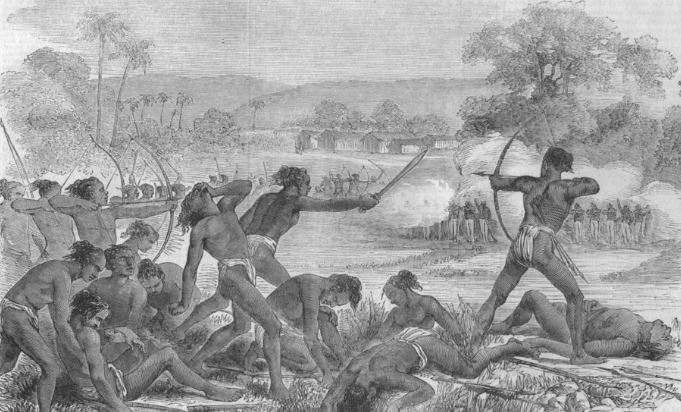
    • Suppression measures: The British imposed Martial Law on November 10, 1855, and crushed the uprising by January 3, 1856, using modern firearms and war elephants; Sidho and Kanho were killed in action.
    • Continued resistance: Even after its suppression, tribal uprisings continued during the 1857 Sepoy Mutiny in areas like Hazaribagh and Manbhum (now Dhanbad and Purulia).

    Key Outcomes of the Revolt:

    • Santhal Pargana Tenancy Act (1876): This law banned land transfers to non-Adivasis, allowed inheritance under tribal customs, and protected Santhal self-governance.
    • Chhotanagpur Tenancy Act (1908): Inspired by later tribal movements, it restricted sale of tribal and Dalit land, and required Collector’s approval for land transfer within caste and locality.
    • Impact on Tribal Identity: The revolt helped shape tribal consciousness, legal land safeguards, and anti-colonial resistance legacies.
    • Modern Legacy: The Santhals are now India’s third-largest tribal group, living in Jharkhand, Bihar, Odisha, and West Bengal, and they use the ‘Ol Chiki’ script to preserve the Santhali language.
    [UPSC 2018] After the Santhal Uprising subsided, what was/were the measure/measures taken by the colonial government?

    1. The territories called `Santhal Parganas’ were created.
    2. It became illegal for a Santhal to transfer land to a non-Santhal.

    Select the correct answer using the code given below:

    Options: (a) 1 only (b) 2 only (c) Both 1 and 2 (d) Neither 1 nor 2


  • Who was Sree Narayan Guru (1856–1928)?

    Why in the news?

    The Prime Minister recently addressed a commemorative event marking 100 years of the historic conversation between Sree Narayana Guru and Mahatma Gandhi.

    About Sree Narayana Guru:

    • Early Life: Sree Narayana Guru was born on 22 August 1856 in Chempazhanthy, Kerala, into the Ezhava community, considered the so-called ‘avarna’ or outside the caste system.
    • Social Reform: He led a peaceful revolution against caste discrimination and promoted social equality and spiritual upliftment in Kerala.
    • Famous Slogan: Guru gave the powerful message — “One Caste, One Religion, One God for All”, calling for unity beyond caste or creed.
    • Spiritual Philosophy: A follower of Advaita Vedanta, he reinterpreted it to assert that divinity exists in every individual, regardless of caste.
    • Death and Legacy: He passed away on 20 September 1928, and his birth and death anniversaries are now observed as public holidays in Kerala and other states.

    His Contributions:

    • Temple Reform: In 1888, he consecrated a Shiva idol at Aruvippuram, challenging Brahminical control over temples.
    • Organisational Impact: He founded the Sree Narayana Dharma Paripalana (SNDP) Yogam in 1903, with Kumaran Asan as its first general secretary.
    • Social Movements: He supported the Vaikom Satyagraha (1924–25) against untouchability in public spaces.
    • Spiritual Centres: Guru established the Sivagiri Mutt (1904), which became the heart of the Sivagiri Pilgrimage (Theerthadanam).
    • Writings: His works, like Advaitha Deepika, Atmavilasam, Daiva Dasakam, and Brahmavidya Panchakam, reflect a spiritual and reformist vision.
    • Holistic Upliftment: He promoted education, cleanliness, agriculture, and handicrafts for self-reliance.
    • Against Conversions: Guru opposed religious conversion as a caste solution, favouring internal reform within Hindu society.

    His Conversations with Gandhiji (1925):

    • Historic Meeting: Mahatma Gandhi met Guru on 13 March 1925 at Sivagiri Mutt during the Vaikom Satyagraha.
    • On Scriptures: Guru clarified that Hindu texts do not support untouchability and backed the Vaikom movement fully.
    • On Salvation: He believed that all religions lead to moksha but stressed that material freedom is key to dignity.
    • Inclusive Ashrams: He shared that his ashrams welcomed all castes, with children studying and praying together.
    • View on Caste: While Gandhi defended varna in principle, Guru critiqued caste as rigid, anti-freedom, and regressive.
    • Mutual Respect: Gandhi was deeply moved and later praised Guru as a “holy soul”, calling Sivagiri a model of harmony.
    • Enduring Legacy: The meeting symbolised a blend of spiritual wisdom and social reform, with lasting national impact.
    [UPSC 2019] Consider the following pairs:

    Movement/Organization Leader

    1. All India Anti-Untouchability League Mahatma Gandhi 2. All India Kisan Sabha Swami Sahajanand Saraswati 3. Self-Respect Movement E. V. Ramaswami Naicker

    Which of the pairs given above is/are correctly matched?

    Options: (a) 1 only* (b) 1 and 2 only (c) 2 and 3 only (d) 1, 2 and 3


  • In news: Servants of India Society

    Why in the News?

    Pune’s Gokhale Institute of Politics and Economics (GIPE) has recently called for a neutral takeover of its parent body, the Servants of India Society (SIS), following allegations of financial irregularities.

    In news: Servants of India Society

    About Servants of India Society:

    • Founding: It was founded on June 12, 1905, in Pune by Gopal Krishna Gokhale, along with N.A. Dravid, G.K. Devadhar, and A.V. Patwardhan.
    • Mission: The Society aimed to train Indians for selfless national service, promote education, and work for social and political reform through constitutional means.
    • Core Values: Members took vows of simple living, secularism, and equality across caste and religion.
    • Non-political Nature: Though non-political and non-sectarian, many SIS members contributed significantly to the freedom movement.
    • Prominent Members: Influential members included V.S. Srinivasa Sastri, Hriday Nath Kunzru, and A.V. Thakkar.
    • Major Activities: SIS established schools, ran night classes, supported healthcare, and published The Hitavada since 1911.
    • Welfare Work: It actively engaged in disaster relief, women’s and child welfare, and rural development.
    • Secular Legacy: It was India’s first secular social reform organisation, focusing on nation-building through service.
    • Current Status: Headquartered in Pune, it continues to operate today, though with limited membership, preserving its foundational values.

    Gopal Krishna Gokhale (1866-1915):

    • Early Life: He was a liberal nationalist, senior Indian National Congress leader, and social reformer.
    • Political Journey: He joined the Indian National Congress in 1889 under Justice M.G. Ranade and became Congress President in 1905.
    • Institution Building: In 1905, Gokhale founded the Servants of India Society to train dedicated public servants.
    • Legislative Work: He served in the Bombay Legislative Council (1899) and the Imperial Legislative Council as a non-official member.
    • Reform Advocacy: Gokhale played a major role in securing the Morley-Minto Reforms (1909) and presented India’s economic conditions to the Welby Commission.
    • Mentor to Gandhi: Gokhale was a political mentor to Mahatma Gandhi and supported his early work, including funding the Sabarmati Ashram.
    • Education and Journalism: He established the Ranade Institute of Economics and launched The Hitavada newspaper (published from Nagpur).
    • Philosophy: Gokhale believed in constitutional reform, education, and social justice as the path to Indian self-rule, bridging social reform and political activism.


    [UPSC 2009] Who among the following rejected the title of knighthood and refused to accept a position in the Council of the Secretary of State for India?

    Options: (a) Motilal Nehru (b) M.G. Ranade* (c) G.K. Gokhale (d) B.G. Tilak


  • Integral Humanism: The Philosophy of Deendayal Upadhyay

    Why in the News?

    A mainstream political party is celebrating 60 years of Integral Humanism (Ekatm Manav-vad), a political philosophy introduced by Pandit Deendayal Upadhyaya.

    About Deendayal Upadhyaya and His Contributions:

    • Birth and Legacy: Born on September 25, 1916, in Mathura, Uttar Pradesh; his birth anniversary is marked as Antyodaya Diwas since 2014.
    • RSS and BJS Roles: He was a pracharak of Rashtriya Swayamsevak Sangh (RSS) and co-founded the Bharatiya Jana Sangh (BJS).
    • Leadership: Served as President of BJS, laying its ideological foundation.
    • Antyodaya Concept: Coined “Antyodaya”, meaning upliftment of the last person, central to several welfare schemes.
    • Advocated Ideas: Promoted Swadeshi (self-reliance) and decentralization of power for inclusive development.
    • Inspired Schemes:
    • Mysterious Death: Found dead on February 11, 1968, near Mughalsarai railway station, now renamed Deendayal Nagar. The case remains unresolved.

    His Philosophy of Integral Humanism:

    • Introduction: Proposed in 1965 through four lectures in Mumbai, promoting Indian values over foreign ideologies.
    • Core Idea: Aims for holistic development — body, mind, intellect, and soul — grounded in cultural and spiritual ethics.
    • Chiti and Dharma: Defined ‘Chiti’ as the soul of the nation and ‘Dharma’ as the ethical base of national integrity.
    • Six Economic Objectives:
      1. Minimum living standard for all citizens.
      2. Global welfare through Indian values.
      3. Employment for all able-bodied individuals.
      4. No wastage of natural resources.
      5. Promotion of indigenous technology.
      6. Flexible industrial ownership based on practicality.
    • Further Influence: Expanded by Dattopant Thengdi, founder of Bharatiya Mazdoor Sangh (BMS).
    • Intellectual Roots: Drew inspiration from Daishik Shastra (1923), a text respected by Gandhi and Tilak; studied during a visit to Almora in 1958–59.
    [UPSC 2020] One common agreement between Gandhism and Marxism is:

    Options: (a) the final goal of a stateless society * (b) class struggle. (c) abolition of private property. (d) economic determinism.


  • Birth Anniversary of Veer Savarkar

    Why in the News?

    The Prime Minister paid tributes to Veer Savarkar on his birth anniversary on May 28th.

    About Veer Savarkar: Life, Contributions, and Legacy

    Details
    Who was Veer Savarkar? Born on May 28, 1883, in Bhagur, Maharashtra,
    • Founded the Abhinav Bharat Society (1904) with his brother Ganesh Damodar Savarkar for armed resistance.
    • Led India House in London (1906) and the Free India Society.
    • Arrested in 1910, sentenced to life imprisonment in Cellular Jail (Kala Pani, Andaman & Nicobar Islands).
    • Became President of the Hindu Mahasabha (1937-1943).
    • Died on February 26, 1966, after fasting till death.
    His Contributions • Advocated armed revolution against British rule.
    • Coined Hindutva (1923), defining Indian identity beyond religion.
    Opposed Partition, emphasizing Hindu political unity.
    • Championed military nationalism over passive resistance.
    • Writings and ideology influenced Indian nationalist movements.
    Literary Works The First War of Indian Independence (1909):  Reinterpreted the 1857 Revolt as a nationalist struggle.
    Hindutva: Who is a Hindu? (1923): Laid the ideological foundation of Hindutva.
    My Transportation for Life (1950): Memoirs of his imprisonment in Cellular Jail.
    Six Glorious Epochs of Indian History: Advocated Hindu resistance against foreign invaders.
    Controversies Gandhi Assassination Case (1948): Arrested but acquitted due to lack of evidence.
    Mercy Petitions (1911-1924): Wrote clemency petitions for early release from prison, debated as tactical or compromising.
    Opposition to Quit India Movement (1942): Rejected Gandhi’s call, favoured military strength over civil disobedience.
    Hindutva Ideology: Critics claim it fostered religious divisions, while supporters see it as reviving Hindu identity.


    [UPSC 2008] During the Indian Freedom Struggle, who of the following raised an army called ‘Free Indian Legion’?

    Options: (a) Lala Hardayal (b) Rashbehari Bose (c) Subhas Chandra Bose * (d) V.D. Savarkar


  • 253rd birth anniversary of Raja Ram Mohan Roy

    One of the most influential social and religious reformers of the 19th century, Ram Mohan Roy, born on May 22, 1772 in what was then Bengal Presidency’s Radhanagar in Hooghly district, would have turned 253 years today.

    Raja Ram Mohan Roy (1772-1833)

    Early life

    • Born into a prosperous upper-caste Brahmin family, Roy grew up within the framework of orthodox caste practices of his time.
    • Child-marriage, polygamy and dowry were prevalent among the higher castes and he had himself been married more than once in his childhood.
    • The family’s affluence had also made the best in education accessible to him.
    • The waning of the Mughals and the ascendancy of the East India Company in Bengal towards the end of the 18th century was also the time when Roy was slowly coming into his own.

    Academics

    • Roy knew Bengali and Persian, but also Arabic, Sanskrit, and later, English.
    • His exposure to the literature and culture of each of these languages bred in him a scepticism towards religious dogmas and social strictures.
    • He spent considerable time studying the Vedas and the Upanishads, but also religious texts of Islam and Christianity.

    Religious belief

    • He was particularly intrigued by the Unitarian faction of Christianity and was drawn by the precepts of monotheism that, he believed, lay at the core of all religious texts.
    • He wrote extensive tracts on various matters of theology, polity and human rights, and translated and made accessible Sanskrit texts into Bengali.
    • Rammohun did not quite make a distinction between the religious and the secular. He believed religion to be the site of all fundamental changes.
    • What he fought was not religion but what he believed to be its perversion.

    Roy, the first among liberals

    • Even though British consolidation of power was still at a nascent stage in India at the time, Roy could sense that change was afoot.
    • Confident about the strength of his heritage and open to imbibing from other cultures what he believed were ameliorative practices, Roy was among India’s first liberals.
    • He was simultaneously interested in religion, politics, law and jurisprudence, commerce and agrarian enterprise, Constitutions and civic rights, the unjust treatment of women and the appalling condition of the Indian poor.

    Establishment of Atmiya Sabha

    • In 1814, he started the Atmiya Sabha (Society of Friends), to nurture philosophical discussions on the idea of monotheism in Vedanta.
    • It aimed to campaign against idolatry, casteism, child marriage and other social ills.
    • The Atmiya Sabha would make way for the Brahmo Sabha in 1828, set up with Debendranath Tagore, Rabindranath Tagore’s father.

    Abolition of Sati, educational and religious reforms

    • He campaigned for the modernisation of education, in particular the introduction of a Western curriculum, and started several educational institutions in the city.
    • In 1817, he collaborated with Scottish philanthropist David Hare to set up the Hindu College (now, Presidency University).
    • He followed it up with the Anglo-Hindu School in 1822 and, in 1830, assisted Alexander Duff to set up the General Assembly’s Institution, which later became the Scottish Church College.
    • It was his relentless advocacy alongside contemporaries such as Ishwar Chandra Vidyasagar that finally led to the abolition of Sati under the governor generalship of William Bentinck in 1829.
    • Roy argued for the property rights of women, and petitioned the British for freedom of the press (in 1829 and 1830).
    • His Brahmo Sabha, that later became the Brahmo Samaj, evolved as a reaction against the upper-caste stranglehold on social customs and rituals.

    Perils of non-conformism

    • Roy, who was given the title of Raja by the Mughal emperor Akbar II, was no exception to the societal enmity.
    • Roy was also often attacked by his own countrymen who felt threatened by his reformist agenda, and by British reformers and functionaries, whose views differed from his.

    Conclusion

    • Roy’s work in the sphere of women’s emancipation, modernising education and seeking changes to religious orthodoxy finds new relevance in this time.
    • He was among the first Indians to gain recognition in the UK and in America for his radical thoughts.
    • Roy was unquestionably the first person on the subcontinent to seriously engage with the challenges posed by modernity to traditional social structures and ways of being.
    • Rabindranath Tagore called him a ‘Bharatpathik’ by which he meant to say that Rammohun combined in his person the underlying spirit of Indic civilisation, its spirit of pluralism, tolerance and a cosmic respect for all forms of life.


    UPSC 2023 countdown has begun! Get your personal guidance plan now! (Click here)

  • Who was Sir Sankaran Nair (1857-1934)?

    Why in the News?

    PM recently remembered Sir Chettur Sankaran Nair, a nationalist and jurist who famously fought a courtroom battle against British officials involved in the Jallianwala Bagh massacre of 1919.

    Nair’s stand in the courtroom is now a subject of a forthcoming film, Kesari Chapter 2.

    Who was Sir Sankaran Nair (1857-1934)?

    About Sir Sankaran Nair:

    • Born in 1857 in Mankara village, Kerala, Nair came from an aristocratic family.
    • He was educated at Presidency College in Madras and pursued a law degree.
    • Nair began his legal career with Sir Horatio Shepherd, Chief Justice of Madras High Court.
    • In 1897, Nair became the youngest president of the Indian National Congress (Amravati (Mh) Session) and was appointed as a permanent judge of the Madras High Court in 1908.

    Role in the Jallianwala Bagh Case:

    • Nair challenged Michael O’Dwyer, the Lieutenant Governor of Punjab, for his role in the Jallianwala Bagh massacre (1919), accusing him of following policies that led to the massacre.
    • O’Dwyer sued Nair in England for defamation. Despite biased British courts, Nair refused to apologize, even when O’Dwyer offered to forgo the £500 penalty.
    • The trial highlighted the bias in the British judicial system and fuelled Indian resentment against British rule.

    Other Contributions:

    • Nair made progressive rulings, like supporting inter-caste and inter-religious marriages and ruling against treating converts to Hinduism as outcasts.
    • He supported India’s self-government and played a key role in expanding the Montagu-Chelmsford reforms (1919).
    • In 1922, Nair critiqued Gandhi‘s methods in his work “Gandhi and Anarchy”.
    • He helped draft the 1919 constitutional reforms, pointing out flaws in British rule, with many of his suggestions accepted.
    [UPSC 2007] Which one of the following aroused a wave of popular indignation that led to the massacre by the British at Jallianwala Bagh?

    (a) The Arms Act (b) The Public Safety Act (c) The Rowlatt Act (d) The Vernacular Press Act


  • Who was Mahatma Jyotiba Phule (1827-1890)?

    Why in the News?

    On April 11, 2025, the Prime Minister paid tribute to Mahatma Jyotiba Phule on his 199th birth anniversary.

    Who was Jyotiba Phule (1827-1890)?

    About Mahatma Phule

    • Jyotirao Govindrao Phule, born on April 11, 1827, near Pune, was from the Mali caste.
    • His father was a vegetable vendor, and his mother died when he was young.
    • He pursued education at the Scottish Mission High School in Pune despite caste-based discrimination.
    • He was inspired by Western thinkers like Thomas Paine and John Stuart Mill, fuelling his social justice dedication.
    • At 13, he married Savitribai Phule, who became his partner in social reforms, particularly promoting education for women and marginalized communities.

    His Contributions as a Social Reformer:

    Educational Reforms:

    • In 1848, Phule and his wife established India’s first girls’ school in Pune.
    • He focused on educating Dalits and lower-caste groups, traditionally excluded from education.
    • He founded night schools for working-class individuals, especially women.

    Fighting Caste Discrimination:

    • Phule criticized the caste system, calling it a means of oppression.
    • In 1873, Phule’s book Gulamgiri condemned caste discrimination, comparing Dalits’ plight to slavery.
    • Phule coined the term ‘Dalit’ to describe those outside the caste system.

    Women’s Welfare and Empowerment:

    • Phule advocated for widow remarriage and provided a dignified life for widows.
    • In 1863, he opened homes to help pregnant widows.
    • He co-founded an infanticide prevention center, tackling the killing of female infants.

    Social Justice and Equality:

    • Phule founded Satyashodhak Samaj in 1873 to promote social equality, rational thinking, and religious reform.
    • The Samaj rejected idolatry and supported a more rational spiritual approach.
    • He broke the social stigma of untouchability by opening his house and water-well to the oppressed.

    Religious and Philosophical Contributions:

    • Phule was an advocate for critical thinking of religion, rejecting superstition and blind faith.
    • He believed in equality and justice across religions and cultures.
    • He was influenced by Bhakti saints like Sant Kabir and Sant Tukaram in his fight against social oppression.

    His Literary Contributions:

    • Gulamgiri (Slavery) (1873): Critiqued the caste system and called for Dalit liberation.
    • Shetkaryacha Asud (Farmer’s Whip) (1881): Addressed the exploitation of farmers and advocated for land reforms.
    • Sarvajanik Satya Dharma Poostak: Promoted rationalist thought and social justice.
    • Tritiya Ratna (1855): A significant work in advocating for social equality.
    • Brahmananche Kasab (1869): Criticized the exploitation by the Brahmin class.
    • Powada: Chatrapati Shivajiraje Bhosle Yancha (1869): A work celebrating the legacy of Shivaji Maharaj.
    • Satsar Ank (1885): Another rationalist work addressing societal issues.
    • Akhandadi Kavyarachana: A literary contribution reflecting Phule’s thoughts on social justice.
    [UPSC 2016] Satya Shodhak Samaj organized:

    (a) a movement for the upliftment of tribals in Bihar’

    (b) a temple-entry movement in Gujarat

    (c) an anti-caste movement in Maharashtra

    (d) a peasant movement in Punjab


  • Tribhuvandas Patel: the Father of Cooperative Movement

    Why in the News?

    The Lok Sabha recently passed a Bill to establish Tribhuvan Sahkari University in Anand, Gujarat, in honour of Tribhuvandas Kishibhai Patel, a visionary leader known as the “father of the cooperative movement” in India, particularly in dairy farming.

    Tribhuvandas Patel the Father of Cooperative Movement

    Who was Tribhuvandas Patel?

    • Patel was born in 1903 to Kishibhai Patel and Lakhiba in Anand, Gujarat. He was an alumnus of Gujarat Vidyapith and was deeply influenced by Mahatma Gandhi.
    • A dedicated freedom fighter, Patel participated in the civil disobedience movement, campaigns against untouchability, and the salt satyagraha.
    • He was jailed in 1930 for his participation in the Salt Movement.
    • He is widely recognized as the “father of the cooperative movement” in India, particularly for his transformative work in the dairy industry.

    Patel’s Contribution to the Cooperative Movement

    • In 1946, Patel founded the Kaira District Cooperative Milk Producers’ Union Limited (KDCMPUL), known later as Amul, to empower farmers and challenge the monopoly of the Polson Dairy in Anand, Gujarat.
    • Patel collaborated with Verghese Kurien, a mechanical engineer, to modernize the dairy plant and increase milk production. This collaboration eventually led to the White Revolution in India.
    • Patel was also instrumental in setting up the Gujarat Cooperative Milk Marketing Federation (GCMMF), the National Dairy Development Board (NDDB), and the Institute of Rural Management Anand (IRMA), which played a pivotal role in cooperative dairy farming and rural development.
    • After his retirement, Patel used funds from the cooperative community to establish the Tribhuvandas Foundation, focused on community health and welfare.

    Cooperative Movement in India:

    • Pre-Independence Era:
      • The cooperative movement originated from informal local initiatives like Chit Funds and Mutual-Loan Associations in places like Madras Presidency and Punjab.
      • The 1904 Cooperative Credit Societies Act formally recognized cooperatives.
      • The Government of India Act, 1919 empowered provinces to legislate on cooperatives, leading to the Bombay Cooperative Society Act of 1925.
    • Post-Independence Developments:
      • Cooperatives became central to India’s economic strategies, particularly for rural development and social justice.
      • The National Cooperative Development Corporation (NCDC) (1963) and NABARD (1982) supported rural cooperatives and provided credit to farmers.
      • The 97th Constitutional Amendment (2011) granted the right to form cooperatives under Article 19.
      • The Ministry of Cooperation was formed in 2021 to strengthen the cooperative framework.
      • The MSCS Amendment Act 2023 aims to improve governance and operational efficiency of cooperatives.

    Key Types of Cooperatives in India:

    1. Consumers’ Cooperatives: Provide affordable goods by removing intermediaries (e.g., Kendriya Bhandar).
    2. Producers’ Cooperatives: Support small producers by supplying essential materials.
    3. Cooperative Marketing Societies: Help producers market products collectively (e.g., Amul).


    [UPSC 2011] In India, which of the following have the highest share in the disbursement of credit to agriculture and allied activities?

    (a) Commercial Banks (b) Cooperative Banks (c) Regional Rural Banks (d) Microfinance Institutions