127th Anniversary of the Battle of Saragarhi was observed on September 12.
About the Battle of Saragarhi
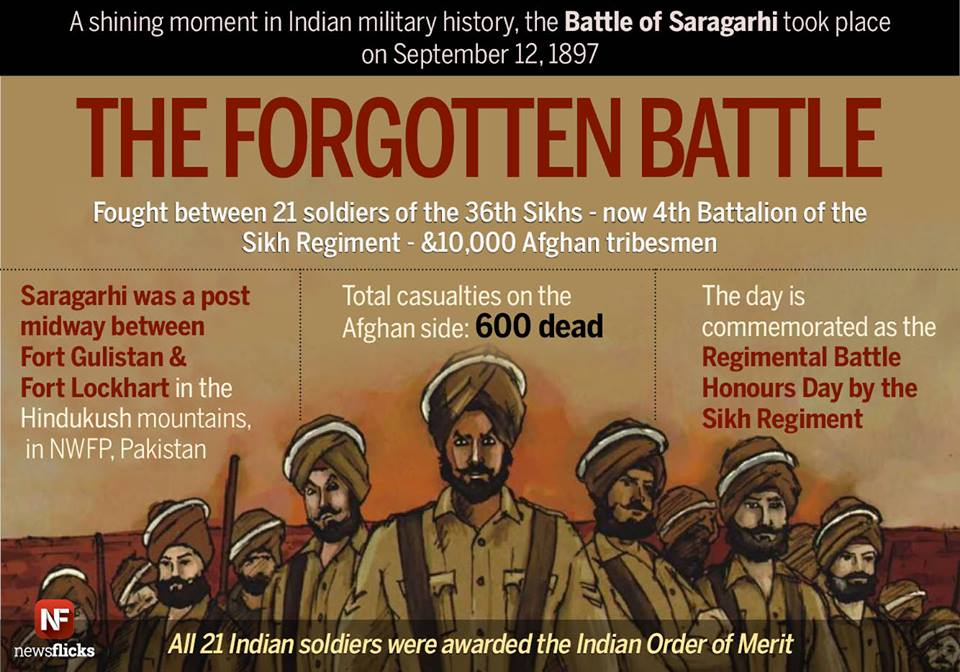
The Battle of Saragarhi occurred on September 12, 1897, between 21 Sikh soldiers of the then 36th Sikh Regiment and around 8,000 Afridi and Orakzai tribals.
The soldiers defended a communication post at Saragarhi, connecting Fort Lockhart and Fort Gulistan in the North West Frontier Province (now Pakistan).
Led by Havildar Ishar Singh, the Sikhs fought to the last man, marking one of the greatest last stands in military history.
Despite their bravery, the soldiers were eventually outnumbered and killed.
Their sacrifice gave the British time to strengthen positions at Fort Lockhart and Gulistan, halting enemy advances.
Implication of the Battle
The Sikh soldiers showed extraordinary courage, fighting against overwhelming odds.
The 21 soldiers killed around 200 militants and injured 600, holding the enemy for seven hours.
The British Government posthumously awarded all 21 soldiers the Indian Order of Merit.
The battle highlighted the importance of discipline, leadership, and sacrifice, and underscored the role of Sikh regiments in the British Indian Army.
PYQ:
[2020] Wellesley established the Fort William College at Calcutta because:
(a) He was asked by the Board of Directors at London to do so
(b) He wanted to revive interest in oriental learning in India
(c) He wanted to provide William Carey and his associates with employment
(d) He wanted to train British civilians for administrative purpose in India
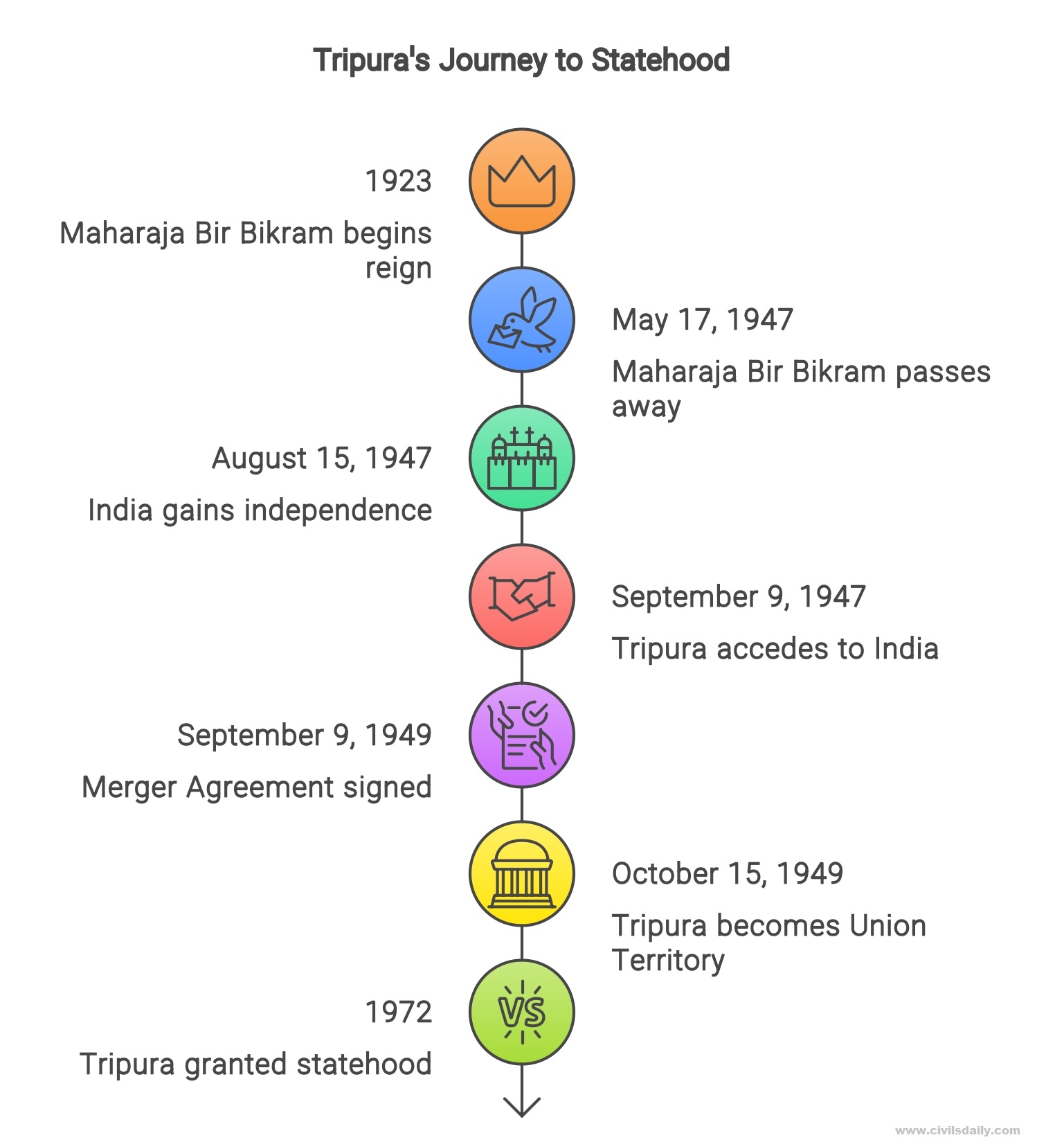
The Prime Minister has paid homage to the great Maharaja of Tripura Bir Bikram Kishore Manikya Bahadur on his birth anniversary.
Who wasMaharaja Bir Bikram Kishore Manikya Bahadur?
Details
Reign
1923 – 1947
Birth
August 19, 1908
Contributions to Tripura
– Modernized Tripura with infrastructure and educational reforms.
– Planned and designed the city of Agartala, earning the title “Architect of Modern Tripura.”-He took initiatives to explore tea cultivation and established several tea estates in Tripura.
Education and Infrastructure
– Established schools, colleges, and hospitals.
– He was instrumental in establishing the first airport in Tripura, the Maharaja Bir Bikram Airport, which greatly improved connectivity and facilitated economic growth
Social Reforms
Introduced land reforms, granted land rights to indigenous people, and worked to abolish untouchability.
Maharaja Bir Bikram was a patron of the arts and culture, supporting various cultural activities and institutions.
Military Role
Supported the British during World War II.
Legacy
Died on May 17, 1947
Remembered as a visionary ruler who played a crucial role in shaping modern Tripura.
PYQ:
[2022] The political and administrative reorganization of states and territories has been a continuous ongoing process since the mid-nineteenth century. Discuss with examples. (250 words, 15 marks)
[2007] Which one of the following is the correct chronological order of the formation of the following states as full states of the Indian Union?
PYQ Relevance: Mains: Q Highlight the importance of the new objectives that got added to the vision of Indian Independence since the twenties of the last century. (UPSC IAS/2017) Q Why did the armies of the British East India Company – mostly comprising of Indian Soldiers – win consistently against the more numerous and better-equipped armies of the then-Indian rulers? Give reasons. (UPSC IAS/2022)
Note4Students:
Subject: GS I (Modern India)
Mains: Significance of Red Fort Trial
Mentor comments: The Red Fort trials, held in 1945-46, were a significant event in India’s struggle for independence. The British colonial government prosecuted key members of the Indian National Army (INA), including Shah Nawaz Khan, Prem Sahgal, and Gurbaksh Singh Dhillon, charging them with waging war against the King. Despite the government’s expectation of public disdain, the trials ignited widespread support for the INA, leading to national demonstrations. The defendants were ultimately found guilty but received lenient sentences, which further fueled the independence movement and contributed to the eventual end of British rule in India.
Why in the news?
Decades after the Red Fort trial, it is hoped that India’s leaders will once again find the wisdom to commit themselves to what unites us as a people.
About the Red Fort Trial:
The Red Fort Trial, also known as the Indian National Army (INA) trials, was a series of court-martials held by the British colonial government in India between November 1945 and May 1946. The trials were held at the Red Fort in Delhi, and they are among the most significant events in the final years leading up to India’s independence.
Background:
Indian National Army (INA): The INA was formed by Indian nationalists during World War II under the leadership of Subhas Chandra Bose. It was composed primarily of Indian prisoners of war who had been captured by the Japanese in Southeast Asia and was aligned with the Axis powers to fight against British rule in India.
The objective of the INA: The INA aimed to overthrow British rule in India through military means, and it played a key role in the campaigns in Burma and the Indian Northeast during the war.
British Reaction: After World War II ended, the British captured several INA soldiers and officers. The British decided to make an example of the INA by trying its officers for treason, murder, and other charges.
Protests that spread across India
Widespread National Support: Protests erupted in multiple cities, including Delhi, Calcutta, Madras, Lahore, Bombay, Patna, and Lucknow, with people from all religious and social backgrounds uniting to demand justice for the INA officers.
Role of Congress and Muslim League: Both the Indian National Congress and the Muslim League supported the INA officers, with leaders from both parties actively participating in and encouraging the protests, showcasing rare political unity against British colonial rule.
Slogans and Symbols of Unity: Protesters chanted slogans like “Laal Quila se aayi aawaaz, Sahgal, Dhillon, Shahnawaaz!” and “Hindu-Muslim Unity Zindabad!”, while the flags of both Congress and the Muslim League were prominently displayed, emphasizing the nationalistic fervour and unity.
Violent Clashes and Sacrifices: The protests were met with brutal police repression in several cities, particularly in Madras and Calcutta, where police firing led to significant casualties—five in Madras and 97 in Calcutta—highlighting the intense opposition to British rule and the high cost of the struggle for independence.
Why is it so significant?
National Unity Across Religious Lines: The trial involved three officers of the Indian National Army (INA)—a Hindu (Prem Kumar Sahgal), a Muslim (Shah Nawaz Khan), and a Sikh (Gurbaksh Singh Dhillon). This symbolized the inclusive and secular nature of India’s struggle for independence.
Mobilization of Public Sentiment: The INA officers were seen as heroes who had fought for India’s freedom, despite the controversial alliance with the Axis powers. Their prosecution by the British was widely perceived as unjust, leading to mass protests, strikes, and demonstrations.
Challenge to British Moral Authority: The trial highlighted the declining legitimacy of British rule in India. The British attempted to portray the INA officers as traitors, but the Indian public saw them as patriots fighting for their country’s freedom.
Catalyst for Independence Movement: The trial also demonstrated the effectiveness of public mobilization and protest in challenging colonial authority, inspiring further actions that ultimately led to India’s independence in 1947.
Conclusion: The Red Fort Trials, featuring INA officers, ignited widespread protests and highlighted national unity, challenging British legitimacy. They symbolized India’s resolve for independence, accelerating the end of colonial rule.
Former CM of West Bengal and leader Buddhadeb Bhattacharya passed away at 80.
Who was Buddhadeb Bhattacharya?
Bhattacharya was a politician who served as CM of West Bengal from 2000 to 2011.
He was known for his attempts to modernize and industrialize West Bengal while navigating the challenges of maintaining communist ideology.
In 2022, Bhattacharya was awarded Padma Bhushan by the Indian government, which he declined, citing his political principles.
Key Contributions:
Category
Details
Political Reforms
Attempted to reduce the influence of powerful trade unions in the state, particularly in the industrial sector, to attract investments and improve work culture.
Social-Cultural Reforms
Played a key role in establishing the Kolkata International Film Festival and promoted Bengali literature.
Authored several books and translated works of Gabriel Garcia Marquez and Vladimir Mayakovsky into Bengali, enriching the state’s cultural heritage.
Introduced measures to eliminate corruption in school recruitments by ensuring all hiring was conducted through transparent exams.
Initiated reforms to integrate mainstream subjects into madrassa education.
Economic Reforms
Led efforts to industrialize West Bengal by attracting investments in IT, steel, and special economic zones (SEZs), including the Tata Nano project in Singur.
Faced significant opposition and protests in Singur and Nandigram over land acquisition, which ultimately contributed to the political decline of the Left Front.
PYQ:
[2011] Karl Marx explained the process of class struggle with the help of which one of the following theories?
On July 31, 1940, Indian revolutionary leader Udham Singh was executed at the Pentonville prison in London for killing Michael O’Dwyer, the former lieutenant governor of Punjab.
Singh was born in Sunam in Punjab’s Sangrur district in 1899.
Political Activism
Became associated with the Ghadar Party while in the US, which was founded by Sohan Singh Bhakna in 1913 and headquartered in California.
Purpose and Actions
In 1934, Singh travelled to London to assassinate Michael O’Dwyer, the former Lieutenant Governor of Punjab during the 1919 Jallianwala Bagh massacre.
Reason for Targeting O’Dwyer
O’Dwyer had ordered Brigadier Reginald Dyer to Amritsar before the massacre, fearing a second Indian mutiny due to Hindu-Muslim unity and demonstrations.
Assassination of O’Dwyer
On March 13, 1940, Singh shot O’Dwyer at a meeting in Caxton Hall, London.
Arrest and Execution
Arrested immediately, held in Brixton prison, sentenced to death, and hanged on July 31, 1940, at Pentonville Prison.
Legacy and Recognition
Regarded as a hero for avenging the Jallianwala Bagh massacre.
Gandhi termed it an “act of insanity”.
He symbolized Hindu-Sikh-Muslim unity by adopting the name ‘RamMohamed Singh Azad’ during his trial.
Posthumous Honors
His remains were returned to India in 1974 and cremated in his village in Sunam.
His statue was installed at Jallianwala Bagh in 2018;
Udham Singh Nagar district in Uttarakhand is named after him.
PYQ:
[2014] The Ghadr (Ghadar) was a:
(a) Revolutionary association of Indians with headquarters at San Francisco.
(b) Nationalist organization operating from Singapore
(c) Militant organization with headquarters at Berlin
(d) Communist movement for India’s freedom with head-quarters at Tashkent
On 22nd July in 1947, the Constituent Assembly of India adopted the National Flag.
PC: The Better India
About the National Flag Day
The Constituent Assembly met in New Delhi at 10 o’clock, chaired by Dr. Rajendra Prasad.
The Assembly had been meeting since December 9, 1946, discussing various subjects.
The Chair announced the first agenda item: “aMotion by Pandit Jawaharlal Nehru about the Flag.”
Jawaharlal Nehru’s Resolution on National Flag
India’s first Prime Minister, Jawaharlal Nehru, moved the Resolution:
The National Flag of India shall be a horizontal tricolour of deep Saffron (Kesari), white, and dark green in equal proportion.
In the centre of the white band, there shall be a navy blue Wheel representing the Charkha.
The design of the Wheel is based on the Chakra from the Sarnath LionCapital of Ashoka.
The diameter of the Wheel approximates the width of the white band.
The ratio of the width to the length of the Flag shall be 2:3.
The motion was adopted unanimously by the Assembly.
Adoption by Popular Acclaim:
Nehru mentioned that the Flag was adopted by popular acclaim and sacrifice over the past decades.
Nehru clarified that the Flag was not meant to be seen in communal terms.
The design was intended to represent the spirit and tradition of India, grown over thousands of years.
Reactions and Support
There were no significant objections to Nehru’s Resolution.
Several members, including Seth Govind Das, V I Muniswami Pillai, Chaudhri Khaliquzzaman, S Radhakrishnan, Saiyid Mohammad Saadulla, Frank R Anthony, and Sarojini Naidu, paid tributes to the Flag and supported the Resolution.
H V Kamath suggested adding a Swastika inside the Chakra to symbolize peace but withdrew the amendment after seeing the Flag’s design.
Dr. P S Deshmukh preferred retaining the original tricolour with the Charkha but did not push his amendment, respecting the House’s preference.
Back2Basics: History of Our National Flag
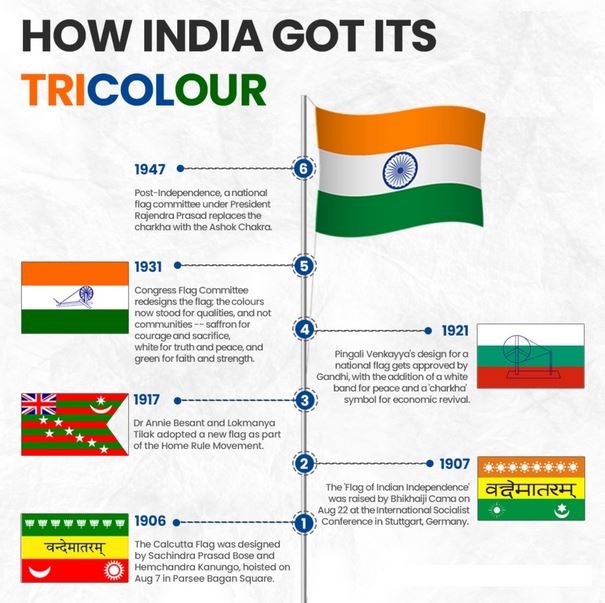
First Public Display in Kolkata (1906):
The first national flag of India was hoisted on August 7, 1906, in Kolkata at Parsee Bagan Square (Green Park).
The flag had three horizontal stripes of red, yellow, and green, with “Vande Mataram” inscribed in the center.
Symbolism: The red stripe included symbols of the sun and a crescent moon, while the green stripe featured eight half-open lotuses.
The flag is believed to have been designed by freedom activists Sachindra Prasad Bose and Hemchandra Kanungo.
Indian Flag in Germany:
In 1907, Madame Cama and her group of exiled revolutionaries hoisted an Indian flag in Germany.
This event marked the first time the Indian flag was hoisted in a foreign country.
Home Rule Movement Flag:
Dr. Annie Besant and Lokmanya Tilak introduced a new flag in 1917 as part of the Home Rule Movement.
The flag featured alternate red and green horizontal stripes, with seven stars in the Saptarishi configuration.
It included a white crescent and star in one top corner, and the Union Jack in the other.
Version by Pingali Venkayya:
Pingali Venkayya, an Indian freedom fighter, is credited with the design of the modern Indian tricolour.
Venkayya first met Mahatma Gandhi in South Africa during the second Anglo-Boer War (1899-1902).
He conducted extensive research and published a book in 1916 that included possible designs for the Indian flag.
At the All India Congress Committee in Bezwada in 1921, Venkayya proposed a basic flag design to Gandhi, featuring two bands of red and green to represent Hindus and Muslims.
PYQ:
[2014] The national motto of India, ‘Satyameva Jayate’ inscribed below the Emblem of India is taken from
India is hosting the UNESCO’s World Heritage Committee meeting for the first time in New Delhi.
Theme: “World Heritage in the 21st Century: Building Capacities and Exploring Opportunities for Youth.”
About the World Heritage Young Professional Forum
The World Heritage Young Professionals Forum is an initiative by UNESCO to engage young professionals in the field of heritage conservation.
The first World Heritage Young Professionals Forum was organized in 1995.
The primary aim is to engage young professionals in heritage conservation and management through capacity building, networking, and awareness-raising.
Back2Basics: UNESCO World Heritage Sites
Description
UNESCO World Heritage Sites
Landmarks or areas selected by UNESCO for their cultural, historical, scientific, or other significant value, legally protected by international treaties.
Importance
World Heritage Sites represent collective and preservative interests of humanity, signifying remarkable accomplishments and intellectual history.
Selection Criteria
Sites must be already-classified landmarks, unique and significant culturally or physically, such as ancient ruins, historical structures, cities, monuments, etc.
Conservation
World Heritage Sites require practical conservation to protect them from risks like trespassing, uncontrolled access, or administrative negligence.
World Heritage Committee
Selects and monitors World Heritage Sites, manages the World Heritage Fund, and provides financial assistance. Composed of 21 states parties elected for a four-year term.
Membership
India is not a member of the World Heritage Committee.
PYQ:
[2014] Consider the following international agreements:
The International Treaty on Plant Genetic Resources for Food and Agriculture
The United Nations Convention to Combat Desertification
The World Heritage Convention
Which of the above has / have a bearing on the biodiversity?
The Santhal Revolt of 1855 was a revolt against imperialism led by four brothers, Sidho, Kanho, Chand, and Bhairav Murmu, along with sisters Phulo and Jhano.
June 30 marks the 169th anniversary of the beginning of the revolt.
About Santhal Hul
The Santhal people revolted against the British East India Company and the Zamindari system, also known as the Santhal Rebellion or Santhal Hul.
The rebellion began on June 30, 1855.
Martial Law was imposed on November 10, 1855, by the East India Company, lasting until January 3, 1856, when the rebellion was suppressed.
Who are the Santhals?
Santhals were agricultural people living in the Rajmahal Hills of Bihar.
Ol Chiki(Ol Chemet) is the writing script of Santhals.
The British asked them to clear forests for agriculture to increase revenue.
Damin-i-Koh (1832) was created as a designated area for Santhals, now known as Santhal Pargana.
Over time, the British began exploiting the Santhals, leading to the Santhal Rebellion.
What makes the revolt so unique?
Marginalized Indigenous Community: Led by the Santhal tribe, a marginalized indigenous community in mid-19th century India.
Agrarian Uprising: Primarily a fight against exploitative land laws, high taxes, and forced labor rather than political or religious issues.
Tribal Unity and Guerrilla Tactics: Characterized by a strong sense of tribal unity and guerrilla warfare tactics, making it unique and significant.
Causes of the Santhal Revolt:
Permanent Settlement System (1793): Introduced by the British East India Company, giving Zamindars long-lasting property rights.
Oppression by Zamindars: Zamindars misused their power to oppress and enslave peasants, leading to resentment.
Exploitation and Debt: Santhals faced exploitation through high-interest loans and lost their land and freedom.
Violent Suppressions: British police supported Zamindars and moneylenders in evicting Santhals violently.
Disruption of Traditional Structures: Traditional social and political structures of the Santhals were disrupted, pushing them into debt and poverty.
Economic Hardship: Led to the Santhals revolting against the British and Zamindars to escape their predicament.
About the Santhal Pargana Tenancy Act (1876) and Chhotanagpur Tenancy Act (1908)
Santhal Pargana Tenancy Act (1876): Enacted by the British as a result of the Hul.
Land Inheritance: Prohibits the transfer of Adivasi lands to non-Adivasis and allows land to be inherited only as per the Act.
Self-Governance: Retains the rights of Santhals to self-govern their land.
Chhotanagpur Tenancy Act (1908): Result of the Birsa Movement.
Land Transfer Restrictions: Allows land transfers within the same caste and geographical areas with District Collector’s approval.
Protection of Adivasi and Dalit Land: Restricts the sale of Adivasi and Dalit land but allows transfers within the same community.
PYQ:
[2018] After the Santhal Uprising subsided, what was/were the measure/measures taken by the colonial government?
The territories called `Santhal Parganas’ were created.
It became illegal for a Santhal to transfer land to a non-Santhal.
Select the correct answer using the code given below:
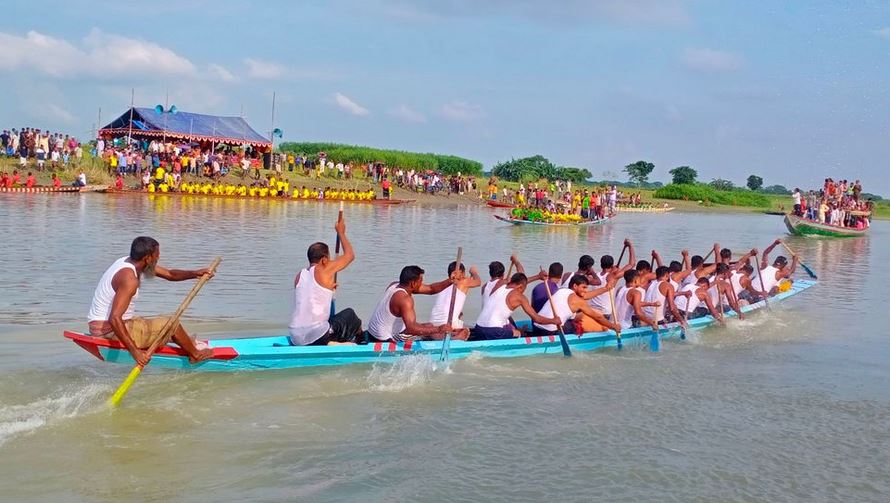
With the southwest monsoon gradually setting in, Nouka Baich boat races will soon commence in West Bengal and Bangladesh.
About Nouka Baich
Nouka Baich is the traditional boat race of Bengal.
It is predominantly held in the rural pockets of West Bengal, including Murshidabad, Nadia, North 24 Parganas, and South 24 Parganas.
Historically male-dominated, recent years have seen increasing participation by women.
Timing and Duration:
Monsoon Season: The races commence with the onset of the south-west monsoon, usually starting in the middle of the rainy season.
Extended Period: The events continue until September, with some races extending into October and November, depending on the region.
Types of Boats Used:
Diverse Fleet: Unlike Kerala’s boat races, which typically feature a single type of boat, Bengal’s races use various traditional boats.
Common Boat Types: Chhip, Kaile Bachhari, Chande Bachhari, Chitoi, Sorpi, and Sorengi are commonly used in the races.
Unique Features: Each boat type has unique design features and historical significance, with some boats like the Sorengi being over 90 feet long and designed to mimic natural forms.
Similar festivals celebrated in other parts that highlight cultural similarities in India:
Location
Occasion
Highlights
Nehru Trophy Boat Race
Punnamada Lake, Alappuzha, Kerala
Second Saturday of August
Named after Jawaharlal Nehru; features snake boats (Chundan Vallams) accommodating over 100 rowers.
Champakulam Moolam Boat Race
Pampa River, Alappuzha, Kerala
June or July
One of the oldest boat races, commemorates the installation of Lord Krishna’s idol at Ambalappuzha Temple.
Aranmula Uthrattadi Vallamkali
Pampa River, Aranmula, Kerala
Onam (August or September)
Features Palliyodams (large snake boats); significant for the Parthasarathy Temple.
Payippad Jalotsavam
Payippad Lake, Alappuzha, Kerala
Onam (August or September)
Celebrates the installation of deity at Subramanya Swamy Temple; features snake boats and canoes.
Indira Gandhi Boat Race
Ernakulam, Kochi, Kerala
Last week of December
Part of Cochin Carnival; attracts tourists, named after Indira Gandhi.
Pongal Boat Race
Bhuvanagiri, Tamil Nadu
Pongal festival (January)
Vibrant cultural displays; local fishermen participate.
Hiyang Tannaba
Manipur
Lai Haraoba festival
Traditional boat race with long narrow boats, reflecting the Meitei community’s traditions.
Sithargal Boat Race
Chennai, Tamil Nadu
Pongal festival
Highlights the maritime culture of the region; attracts numerous participants and spectators.
Karnataka’s Tourism Department plans to highlight Somanathapura Temple, part of the Hoysala temples, in the Mysuru tourism circuit ahead of Dasara, leveraging its UNESCO World Heritage status.
Note: There are 42 World Heritage Sites in India. Out of these, 34 are cultural, seven are natural, and one, Khangchendzonga National Park, is of mixed type.
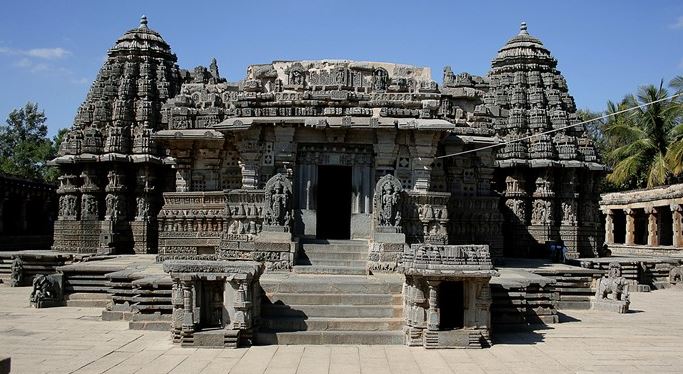
About Keshava Temple, Somanathapura
The Keshava Temple is considered one of the last grand structures built by the Hoysala dynasty.
This Trikuta (three-shrined) temple is dedicated to Lord Krishna and is represented in three forms: Janardhana, Keshava, and Venugopala.
The main Keshava idol is missing, and the Janardhana and Venugopala idols are damaged.
Historical Background:
The Keshava Temple was constructed by Somanatha, a commander of the Hoysala Army, during the reign of Hoysala King Narasimha III.
Somanatha, who had established a town named Somanathapura after himself, sought the king’s permission and resources to build this grand temple.
With the king’s blessing, construction commenced and was completed in 1268 AD.
An inscription in old Kannada on a stone slab in the temple provides details of its construction and consecration.
After demolitions by invaders, it no longer serves as a place of worship.
Architecture:
The temple is constructed from soapstone, which allows for the fine detailing seen in the carvings.
It is built on a raised platform with an outer Pradakshina pathway, allowing devotees to circum-ambulate the sanctum.
The temple features a stellar (star-shaped) plan, which creates multiple corners and niches, providing numerous canvases for the sculptors to showcase their intricate work.
The temple has three shrines, each crowned with a Vimana (tower).
The Hoysala emblem, depicting a warrior fighting a lion, is prominently displayed.
The walls of the temple are adorned with beautiful friezes depicting scenes from Hindu epics, figures of elephants, and battle scenes with cavalry.
![[15th August 2024] The Hindu Op-ed: The trial that progressed rapidly towards Independence](https://www.civilsdaily.com/wp-content/uploads/2024/08/15-Aug-1568x882.jpg)