💥Join UPSC 2027,2028 Mentorship (July Batch) + XFactor Notes & Microthemes PDF

Subject: Polity

  • Revisiting the Anti-Defection Law: Upholding Accountability in Parliamentary Democracy

    Central idea

    • Two recent judgments by the Supreme Court of India have brought attention to the constitutional framework governing the relationship between the executive, legislature, and political parties. While the judgments were unanimous, they present a contradiction in their application. The Delhi case emphasized the importance of accountability of civil services to the elected government, while the Maharashtra case upheld the power of party leadership over legislators, undermining the principles of parliamentary democracy.

    Delhi Case: Reinforcing the Importance of Accountability

    • Importance of Accountability: The case underscores the significance of accountability in a democratic system. It reaffirms the idea that a government elected by the people must be answerable to them through a triple chain of command: civil service officers being accountable to ministers, ministers being accountable to the legislature, and the legislature being accountable to the electorate.
    • Power Distribution: The judgment clarifies the delineation of powers between the Delhi government, headed by the Chief Minister, and the Lieutenant Governor appointed by the central government. It establishes that in matters concerning civil services, the elected government of Delhi should have control and authority, emphasizing the democratic principle of decentralization of power.
    • Constitutional Provisions and Democratic Values: The case highlights the significance of adhering to the constitutional provisions and demarcation of powers in a Union Territory like Delhi. It upholds the principles of parliamentary democracy, emphasizing the importance of a government accountable to the people it serves.
    • Strengthening Democratic Institutions: The judgment emphasizes the role of institutions in upholding democratic values enshrined in the Constitution. By safeguarding accountability and appropriately allocating powers, it sets a precedent for future cases and reinforces the role of institutions in maintaining a robust democratic system.

    What is triple chain of accountability?

    1. Civil Service Officers to Ministers: The first link in the chain is the accountability of civil service officers to the Ministers. Civil service officers are responsible for implementing government policies and carrying out administrative tasks. They are answerable to the Ministers who oversee their work and provide directions.
    2. Ministers to the Legislature: The second link in the chain is the accountability of Ministers to the legislature. Ministers are accountable for their decisions, actions, and policies to the legislature, which represents the voice of the people. They are expected to participate in debates, answer questions, present bills, and seek approval or support for government initiatives from the elected representatives.
    3. Legislature to the Electorate: The third link in the chain is the accountability of the legislature to the electorate. The elected representatives in the legislature are accountable to the people who have chosen them through the electoral process. Legislators are expected to represent the interests and concerns of their constituents, work towards their welfare, and ensure that their voices are heard in the decision-making process.

    Maharashtra Case: Undermining the Triple Chain of Accountability

    • Interpretation of the Tenth Schedule: The case revolves around the interpretation and application of the Tenth Schedule of the Constitution, which deals with the anti-defection law. The judgment focuses on the distinction between the legislature party and the political party, clarifying the power to issue binding directions to members of the legislature.
    • Role of Party Leadership: The judgment reinforces the authority of the political party leadership over the legislature. It establishes that the person in charge of the political party holds the power to issue directions to the members of the party, including MLAs/MPs, and failure to comply can result in disqualification.
    • Limitation on Legislators’ Accountability: The judgment raises concerns regarding the accountability of legislators to their voters. By upholding the authority of the political party leadership, it potentially weakens the accountability of legislators to the electorate and emphasizes their accountability solely to the party that fielded them in the election.
    • Triple Chain of Accountability: The judgment diverges from the principles outlined in the Delhi case concerning the triple chain of accountability. It suggests that legislators should adhere to the directions of the political party, potentially undermining the daily assessment of the government by the legislature and diluting the accountability of the government to the people.
    • Need for Re-evaluation: The judgment indicates the need for re-evaluating the anti-defection law and its compatibility with the principles of parliamentary democracy. It raises questions about the anti-defection law violating the basic structure of the Constitution, calling for a larger bench to examine this issue.

    Facts for prelims: Basics

    Anti-defection Law

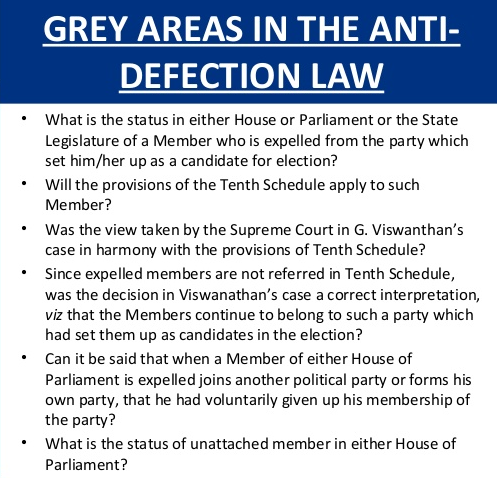
    • The Anti-Defection Law under the Tenth Schedule of the Constitution punishes MPs/ MLAs for defecting from their party by taking away their membership of the legislature.
    • It gives the Speaker of the legislature the power to decide the outcome of defection proceedings.
    • It was added to the Constitution through the Fifty-Second (Amendment) Act, 1985 when Rajiv Gandhi was PM. The law applies to both Parliament and state assemblies.

    Contradictory Conclusions: The Problem of the Anti-Defection Law

    • The contradictory conclusions arising from the application of the anti-defection law in both the cases:
    • Constitutional Position: While the Delhi case emphasizes the accountability of civil services to the Delhi government and upholds the triple chain of command, the Maharashtra case highlights the power of the political party leadership over legislators, as dictated by the Tenth Schedule.
    • Incompatibility with Parliamentary Democracy: The Maharashtra case raises concerns about the anti-defection law, which is at the core of the Tenth Schedule, and its compatibility with the structure underlying parliamentary democracy. The anti-defection law’s assumption that any vote against the party direction is a betrayal of the electoral mandate contradicts the principle of representative democracy.
    • Legislative Accountability: The Maharashtra judgment reinforces the authority of the political party leadership, implying that legislators are primarily accountable to the party that fielded them, rather than to the electorate. This breaks the triple chain of accountability.
    • Impact on Daily Assessment: The Maharashtra judgment’s emphasis on party directions limits the daily assessment of the government by the legislature. If legislators of the party with a majority are bound by party directions, it undermines the meaningfulness of debates, resolutions, and no-confidence motions, as the party leadership controls the votes on every issue, ensuring the government’s victory.
    • Electoral Mandate and Voter Decision: The anti-defection law assumes that voters prioritize party affiliation, disregarding other factors such as candidates’ criminal records, assets and liabilities, and educational qualifications. However, voters’ decisions in elections often contradict this assumption, as demonstrated by instances of legislators winning by-elections after switching parties.

    Way forward

    • Re-evaluation of the Anti-Defection Law: It is crucial to revisit the anti-defection law and assess its compatibility with the basic principles of parliamentary democracy. A thorough examination by a larger Bench of the Supreme Court can help determine if the law violates the basic structure of the Constitution.
    • Reviewing the Tenth Schedule: The Tenth Schedule, which forms the basis of the anti-defection law, should be subject to a critical review. This includes analyzing its impact on the accountability of legislators to their constituents and evaluating whether it aligns with the principles of representative democracy.
    • Strengthening Legislative Accountability: Efforts should be made to reinforce the accountability of legislators to the electorate. This can be achieved by ensuring that legislators prioritize their constituents’ interests over party directives, thereby fostering a stronger connection between legislators and the people they represent.
    • Promoting Informed Voting: Emphasizing the importance of informed voting can help voters make decisions based on factors beyond party affiliation. Providing comprehensive information about candidates, including their track records, assets and liabilities, and educational qualifications, will enable voters to make more informed choices during elections.
    • Balancing Party Discipline and Individual Freedom: Striking a balance between party discipline and individual freedom of legislators is crucial. There should be mechanisms in place that encourage healthy debate, dissent, and the ability of legislators to vote based on their own judgment, while still respecting party affiliations.
    • Enhancing Parliamentary Debates and Oversight: Efforts should be made to strengthen the role of legislatures in holding the government accountable. This can be achieved through robust parliamentary debates, effective question hour sessions, and rigorous scrutiny of government actions and policies.

    Conclusion

    • The contradiction between the Delhi and Maharashtra cases underscores the need to revisit the anti-defection law. A larger Bench should re-examine the law’s compatibility with the basic structure of the Constitution, reaffirming the centrality of accountability in parliamentary democracy. This step is crucial to restore the balance between party loyalty and the representatives’ duty to serve their constituents and uphold democratic values.

    Get an IAS/IPS ranker as your personal mentor for UPSC 2024 | Schedule your FREE session and get the Prelims prep Toolkit!

    Also read:

    [Burning Issue] Shiv Sena Party Symbol Conundrum


  • In news: Sikkim Statehood Day

    sikkim

    Sikkim Statehood Day

    • Sikkim day is annually celebrated on May 16, commemorating the integration of Sikkim with India in 1975.
    • The process of Sikkim joining India occurred about two decades after Sardar Vallabbhai Patel led the integration of princely states into India.

    Sikkim’s History with the Chogyal Royals

    • The kingdom of Sikkim was established in 1642 when Phuntsong Namgyal was consecrated as the first ruler or Chogyal.
    • Sikkim’s monarchy, under the Namgyal dynasty, lasted for 333 years until its integration with India in 1975.
    • Sikkim had a Tibetan origin and was located between India and China. It often faced conflicts over land with Bhutan and Nepal.
    • The British saw Sikkim as a buffer state and established a formal relationship with it.
    • Various treaties like the Treaty of Tumlong (1861), Treaty of Titaliya (1817), Calcutta Convention (1890), and Lhasa Convention (1904) shaped the relationship between Sikkim and the British.

    Independent India and Sikkim

    • After India’s independence, princely states had the option to accede to India or Pakistan.
    • Sikkim’s unique relationship with British rule led to complexities in its integration with India.
    • Sardar Vallabbhai Patel and BN Rau wanted Sikkim to sign the Instrument of Accession to integrate it with India.
    • Jawaharlal Nehru acknowledged the situation in Sikkim and emphasized its autonomous growth.
    • Sikkim State Congress (SSC), Praja Mandal (PM), and Praja Sudharak Samaj (PSS) demanded a popular government, abolition of landlordism, and accession to India.
    • A Standstill Agreement was signed to maintain the existing arrangement while discussions continued.

    War with China

    • Sikkim had a state council with elected and nominated members.
    • Political developments in the 1960s and 1970s played a significant role in Sikkim’s status.
    • The formation of the Sikkim National Congress (SNC) in 1960 and changes in political leadership on both sides influenced the course of events.
    • India-China war of 1962 and containment of border skirmishes made it important to clarify the relationship between India and Sikkim.

    How Sikkim finally joined India?

    • The Indian leadership started supporting pro-democracy forces in Sikkim, such as Kazi Dorji of the SNC.
    • Protests in Sikkim in 1973 led to a tripartite agreement between the Chogyal, the Indian government, and three major political parties.
    • Elections were held in 1974, and a new constitution limited the role of the monarch.
    • A referendum held in 1975 resulted in a majority vote in favor of joining India.
    • The Constitution (Thirty-Sixth Amendment) Bill was passed, recognizing Sikkim as a state in the Union of India.
    • Sikkim’s new parliament proposed a bill for Sikkim to become an Indian state, which was accepted by the Indian government.


    Get an IAS/IPS ranker as your personal mentor for UPSC 2024 | Schedule your FREE session and get the Prelims prep Toolkit!

  • Supreme Court guideline for granting Bail

    bail

    Central Idea: The Supreme Court emphasized that orders in bail cases should adhere to the constitutional principle of personal liberty.

    Supreme Court on Bail

    • Short debates: Prolonged debates on bail may prejudice the accused in their case.
    • Upholding liberty: Delays in pronouncing bail decisions impinge on the personal liberty of the undertrial.
    • No extensive discussions and elaborations: The Supreme Court highlights the significance of brevity (state of being brief, concise) in bail orders.
    • No early delving into case details: Long orders may unnecessarily delve into the details of the case, which is not appropriate at the bail stage.
    • Ensuring fairness and impartiality: Such brevity ensures that the case is not unduly influenced or prejudiced during the bail proceedings.
    • Promptness in pronouncing bail decisions: The Court emphasized the need for prompt pronouncement of bail decisions. Every day of waiting affects the personal liberty of the undertrial.

    What is Bail?

    • Bail is the conditional release of a defendant with the promise to appear in court when required.
    • The term also means the security that is deposited in order to secure the release of the accused.

    Types of Bail in India

    • Depending upon the sage of the criminal matter, there are commonly three types of bail in India:
    1. Regular bail: Regular bail is generally granted to a person who has been arrested or is in police custody. A bail application can be filed for the regular bail under section 437 and 439 of CrPC.
    2. Interim bail: This type of bail is granted for a short period of time and it is granted before the hearing for the grant of regular bail or anticipatory bail.
    3. Anticipatory bail: Anticipatory bail is granted under section 438 of CrPC either by session court or High Court. An application for the grant of anticipatory bail can be filed by the person who discerns that he may be arrested by the police for a non-bailable offense.

    Conditions for Grant of Bail in Bailable Offences

    • Section 436 of the Code of Criminal Procedure, 1973, lays down that a person accused of a bailable offence under IPC can be granted bail if:
    1. There are sufficient reasons to believe that the accused has not committed the offence.
    2. There is sufficient reason to conduct a further inquiry in the matter.
    3. The person is not accused of any offence punishable with death, life imprisonment or imprisonment up to 10 years.

    Conditions for Grant of Bail in Non-Bailable Offences

    • Section 437 of Code of Criminal Procedure, 1973 lays down that the accused does not have the right to apply for bail in non-bailable offences.
    • It is discretion of the court to grant bail in case of non-bailable offences if:
    1. The accused is a woman or a child, bail can be granted in a non-bailable offence.
    2. There is a lack of evidence then bail in non-Bailable offenses can be granted.
    3. There is a delay in lodging FIR by the complainant, bail may be granted.
    4. The accused is gravely sick.

    Why bail needs reform?

    • Huge pendency of undertrials: Referring to the state of jails in the country, where over two-thirds lodged are undertrials,
    • Indiscriminate arrests: Of this category of prisoners, majority may not even be required to be arrested despite registration of a cognizable offense, being charged with offenses punishable for seven years or less.
    • Disadvantageous for some sections: They are not only poor and illiterate but also would include women. Thus, there is a culture of offense being inherited by many of them.
    • Colonial legacy: Theoretically, the court also linked the idea of indiscriminate arrests to magistrates ignoring the rule of “bail, not jail” to a colonial mindset.

    What is the law on bail?

    • The CrPC does not define the word bail but only categories offences under the Indian Penal Code as ‘bailable’ and ‘non-bailable’.
    • The CrPC empowers magistrates to grant bail for bailable offences as a matter of right.
    • This would involve release on furnishing a bail bond, without or without security.

    Way forward

    • Bail Law would certainly take care of not only the unwarranted arrests but also the clogging of bail applications before various courts.
    • With restrictive bail conditions and a conservative view on bail, we may forget the meaning of personal liberty, which is the greatest of human freedoms enjoyed in India.


    Get an IAS/IPS ranker as your personal mentor for UPSC 2024 | Schedule your FREE session and get the Prelims prep Toolkit!

  • Key Takeaways of SC’s Maharashtra Verdict

    The Supreme Court issued a unanimous judgment on various issues related to the split in a political party in Maharashtra in June 2022.

    Key Takeaways

    Here are the key takeaways from the verdict:

    (1) Disqualification

    • MLA disqualifications upheld: The Supreme Court did not interfere with the proceedings related to the disqualification of 16 MLAs (who had gone to Dehradun) including Chief Minister.
    • Onus on Speaker: The court stated that the issue of disqualification should be decided by the Speaker of the Legislative Assembly as per established procedures in law.

    (2) Consideration of Party Constitution

    • Political party constitution: The court emphasized that while deciding disqualification pleas, the Speaker must consider the constitution of the political party, which was submitted to the Election Commission (EC) with the consent of both factions.
    • Split occurred later: The court clarified that the “split” in the party would no longer be a defense available to MLAs facing disqualification.

    (3) Governor’s Role

    • Issue over floor test circumstances: The court criticized the then Governor for calling a floor test without sufficient objective material to show that the incumbent government had lost the confidence of the House.
    • Must remain politically neutral: The court stated that the Governor should exercise their power within the limits of the law and should not enter the political arena nor interfere in intra-party disputes.

    (4) Former CM Resignation

    • Should have faced floor test: The court mentioned that erstwhile CM of tripartite government, who led one of the factions, had resigned and did not face the floor test.
    • Re-instation was possible: The court held that it could not quash a resignation submitted voluntarily, but if ex-CM had refrained from resigning, the court could have considered a remedy to reinstate his government.

    (5) Illegal Appointment of Whip

    • The court deemed the appointment of the whip by the split-led faction to be illegal.
    • The Speaker should have conducted an independent inquiry to verify the decision of the political party regarding the appointment of the whip.

    (6) Distinction between Legislature Party and Political Party

    • The court clarified that the legislature party and the political party cannot be conflated.
    • The court stated that a political party must be registered with the Election Commission, while the legislature party has independent existence to provide defense to legislators’ actions within the political party.

    (7) Concurrent Jurisdiction of Speaker and EC

    • The court rejected the contention that the Election Commission was barred from deciding on the party symbol dispute until the Speaker decided the disqualification pleas.
    • The court stated that both the Speaker and the EC can adjudicate issues concurrently.

    (8) Others

    • Nabam Rebia Case, 2016: Additionally, the court referred certain issues related to its judgment in the Nabam Rebia Case to a larger Bench.
    • Restrictions on the ousted Speaker: This included the restriction of the Speaker’s powers in issuing disqualification notices to MLAs in the presence of a notice for the Speaker’s removal.


    Get an IAS/IPS ranker as your personal mentor for UPSC 2024 | Schedule your FREE session and get the Prelims prep Toolkit!

  • Delhi vs. Centre: Key takeaways of SC’s verdict

    Central Idea

    Key takeaways

    (1) Disagreement with Justice Bhushan’s Judgment

    • The Supreme Court stated that it does not agree with Justice Ashok Bhushan’s judgment that the Delhi government has no power over services.

    (2) Article 239A and Legislative Assembly for NCT

    • The Supreme Court highlighted that Article 239A establishes a legislative assembly for the National Capital Territory of Delhi.
    • The members of the legislative assembly are elected by the electorate of Delhi, and the interpretation of Article 239A should support representative democracy.

    (3) Limits of Power

    • The court clarified that the control over services does not extend to areas related to public order, police, and land.

    (4) Delhi Government Represents Representative Form of Government

    • According to the Supreme Court, the Delhi government, like other states, represents the representative form of government.
    • Any expansion of the central government’s power would contradict the Constitutional scheme.

    (5) Impact on Ministers’ Control

    • The court noted that if administrative services are excluded from the legislative and executive domains, ministers would be excluded from controlling civil servants responsible for implementing executive decisions.

    (6) Executive Power and Existing Law

    • The court clarified that the executive power of the state is subject to existing union laws.

    (7) Principle of Collective Responsibility

    • The Supreme Court emphasized that if officers do not report to ministers or fail to follow their instructions, the principle of collective responsibility will be affected.

    (8) Triple Chain of Accountability

    • Chief Justice of India DY Chandrachud highlighted that denying democratically elected governments the power to control officers would render the principle of the triple chain of accountability redundant.

    Back2Basics: Article 239AA

    • Article 239AA granted Special Status to Delhi among Union Territories (UTs) in the year 1991 through the 69th Constitutional Amendment.
    • It provided a Legislative Assembly and a Council of Ministers responsible to such Assembly with appropriate powers.
    • That’s when Delhi was named as the National Capital Region (NCT) of Delhi.
    • As per this article – Public Order, Police & Land in NCT of Delhi fall within the domain and control of Central Government which shall have the power to make laws on these matters.
    • For remaining matters of State List or Concurrent List, in so far as any such matter is applicable to UTs, the Legislative Assembly shall have the power to make laws for NCT of Delhi.


    Get an IAS/IPS ranker as your personal mentor for UPSC 2024 | Schedule your FREE session and get the Prelims prep Toolkit!

  • Exemptions under Surrogacy Law

    The govt in the Supreme Court has said that same-sex couples and live-in partners are not included in surrogacy and assisted reproduction laws to avoid ‘misuse’ and provide children a ‘complete family’.

    Government’s stance

    • Same-sex couples and live-in partners are excluded from surrogacy and assisted reproduction laws to avoid ‘misuse.’
    • The welfare of the child should be prioritized over any notions of equality among prospective parents or couples.
    • No special provisions or additional rights have been granted to same-sex couples and live-in partners despite the decriminalization of their relationships.

    Why in news?

    • The government’s perspective is not in tune with several Supreme Court judgments that long live-in relationships “presume” marriage.
    • Live-in partners are not bound by law, and the safety of the child born through surrogacy cannot be guaranteed.

    Judiciary in support

    • Same-sex couples are fighting for their right to marry and raise a family as equal parents.
    • CJI heading the Constitution Bench, has remarked that same-sex couples could offer as stable and loving a home, if not better, to children as heterosexual married parents.

    Distinct features of the Surrogacy (Regulation) Act, 2021

    • Definition of surrogacy: It defines surrogacy as a practice where a woman gives birth to a child for an intending couple with the intention to hand over the child after the birth to the intending couple.
    • Regulation of surrogacy: It prohibits commercial surrogacy, but allows altruistic surrogacy which involves no monetary compensation to the surrogate mother other than the medical expenses and insurance.
    • Purposes for which surrogacy is permitted: Surrogacy is permitted when it is: (i) for intending couples who suffer from proven infertility; (ii) altruistic; (iii) not for commercial purposes; (iv) not for producing children for sale, prostitution or other forms of exploitation; and (v) for any condition or disease specified through regulations.
    • Eligibility criteria: The intending couple should have a ‘certificate of essentiality’ and a ‘certificate of eligibility’ issued by the appropriate authority ex. District Medical Board.

    Eligibility criteria for surrogate mother:

    • To obtain a certificate of eligibility from the appropriate authority, the surrogate mother has to be:
    1. A close relative of the intending couple;
    2. A married woman having a child of her own;
    3. 25 to 35 years old;
    4. A surrogate only once in her lifetime; and
    5. Possess a certificate of medical and psychological fitness for surrogacy.
    • Further, the surrogate mother cannot provide her own gametes for surrogacy.

    Basis of the Petition: Right to Reproductive Autonomy

    • The personal decision of a single person about the birth of a baby through surrogacy, i.e., the right of reproductive autonomy is a facet of the right to privacy guaranteed under Article 21 of the Constitution.
    • Thus, the right to privacy of every citizen or person affecting a decision to bear or beget a child through surrogacy cannot be taken away.

    Other issues with Surrogacy Law

    • Medical issue necessity: Married women can only avail surrogacy services if they are unable to produce a child due to medical conditions.
    • Widow/Divorced: Otherwise, for women to avail of surrogacy services, they must be aged between 35 and 45 and widowed or divorced.
    • One child obligation: Women can only offer surrogacy if they are aged between 25 and 35 and married with at least one biological child.
    • Genetic relation obligation: The laws also require a surrogate to be genetically related to the couple who intend to have a child through this method.


    Get an IAS/IPS ranker as your personal mentor for UPSC 2024 | Schedule your FREE session and get the Prelims prep Toolkit!

  • Manipur Riots: CJI questions HC’s power over ST List

    Central Idea

    • The Chief Justice of India has questioned why a 23-year-old Constitution Bench judgment was not shown to the Manipur High Court, which directed the state government to consider the inclusion of Meetei/Meitei community in the Scheduled Tribe list.
    • The Chief Justice observed that a High Court does not have the power to direct changes in the Scheduled Tribes List, as it is a Presidential power to designate a Scheduled Caste or Scheduled Tribe.

    What is the Scheduled Tribes List?

    • Article 342(1) of the Constitution states that it is entirely the President’s power to designate a Scheduled Caste or Scheduled Tribe.
    • It is not open to State governments, courts, tribunals, or any other authority to modify, amend or alter the list of Scheduled Tribes specified in the notification issued under clause (1) of Article 342.
    • A notification issued under clause (1) of Article 342 can be amended only by law to be made by Parliament.

    Notable Judgements:

    (1) The State of Maharashtra vs. Milind verdict

    • The five-judge Constitution Bench in State of Maharashtra versus Milind, in November 2000, held that a notification issued under clause (1) of Article 342, specifying Scheduled Tribes, can be amended only by law to be made by Parliament.
    • Any tribe or tribal community or part of or group within any tribe can be included or excluded from the list of Scheduled Tribes only by Parliament by law and by no other authority.

    (2) FCI vs. Jagdish Balaram Bahira

    • The settled law in the Milind verdict was referred to by a July 2017 judgment authored by Justice Chandrachud for a three-judge Bench of the Supreme Court in CMD, FCI versus Jagdish Balaram Bahira to note that the Presidential Order under Article 342 regarding Scheduled Tribes was always “final”.

    Back2Basics: Scheduled Tribes

    • The term ‘Scheduled Tribes’ first appeared in the Constitution of India.
    • Article 366 (25) defined scheduled tribes as “such tribes or tribal communities or parts of or groups within such tribes or tribal communities as are deemed under Article 342 to be Scheduled Tribes for the purposes of this constitution”.
    • Article 342 prescribes procedures to be followed in the matter of specification of scheduled tribes.
    • Among the tribal groups, several have adapted to modern life but there are tribal groups who are more vulnerable.
    • The Dhebar Commission (1973) created a separate category “Primitive Tribal Groups (PTGs)” which was renamed in 2006 as “Particularly Vulnerable Tribal Groups (PVTGs)”.

    How are STs notified?

    • The first specification of Scheduled Tribes in relation to a particular State/ Union Territory is by a notified order of the President, after consultation with the State governments concerned.
    • These orders can be modified subsequently only through an Act of Parliament.

    Status of STs in India

    • The Census 2011 has revealed that there are said to be 705 ethnic groups notified as Scheduled Tribes (STs).
    • Over 10 crore Indians are notified as STs, of which 1.04 crore live in urban areas.
    • The STs constitute 8.6% of the population and 11.3% of the rural population.


    Get an IAS/IPS ranker as your personal mentor for UPSC 2024 | Schedule your FREE session and get the Prelims prep Toolkit!

  • What does the Constitution say about the sovereignty of India?

    Central Idea

    • The article revolves around the issue of a political party filing a complaint against a politician of foreign origin with the Election Commission of India (ECI).
    • She had allegedly been advocating the secession of Karnataka from India in her election speeches.

    Definition of sovereignty

    • Sovereignty is the idea of having supreme authority over a defined territory.
    • In Western philosophy, the concept is used to describe the supremacy of the state over the people being governed.
    • The state has a legitimate claim to sovereignty in exchange for providing protection to its citizens, keeping society cohesive and at peace, and controlling law and order.

    Sovereignty in India’s Constitution

    • The word sovereignty appears in the beginning of the Preamble to the Constitution of India as the first attribute of the independent republic of India.
    • Its placement as the first among the core principles of the republic underlines its importance in the Constitution.
    • Sovereignty is invoked in the Indian Constitution to “declare the ultimate sovereignty of the people of India and that the Constitution rests on their authority.”
    • It is mentioned in the Constitution under Fundamental Duties, and citizens have a duty to uphold and protect the sovereignty, unity, and integrity of India.

    Relationship of Indian states with the sovereign Union

    • The Indian political system is described as “quasi-federal.”
    • India is a Union of States, and the component units have no freedom to secede or break away from it.
    • The Indian setup is more unitary in nature than the federal one, and the central government has more powers than the states.
    • The choice of a unitary bias that the Constitution makers made was possibly rooted in the difficulty of getting around 600 princely states to accede to India.

    Provisions attesting to the superior position of the Centre

    • The States in India need not be consulted in the matter of amendment to the bulk of the Constitution.
    • Governors in states are appointed “during the pleasure” of the President and are seen as representatives of the Union in the States.
    • The Sixteenth Amendment of 1963 laid down that even the advocacy of succession under Article 19 (1) will not be protected under law in the name of Freedom of Speech as directed under Article 19 (2).
    • The right to alter the boundaries of states and to create new states lies with Parliament alone.
    • The Constitution offers no guarantee to the States against their territorial integrity without their consent since it was not a result of an ‘agreement’ between the States.

    These provisions demonstrate the superior position of the Centre in the Indian political system.


    Get an IAS/IPS ranker as your personal mentor for UPSC 2024 | Schedule your FREE session and get the Prelims prep Toolkit!

  • Article 355 imposed in Manipur

    manipur

    Central Idea

    • Recently, unrest in the state of Manipur was triggered by a decision of the High Court to pursue a 10-year-old recommendation to grant Scheduled Tribe (ST) status to the non-tribal Meitei community.
    • In view of the prevailing unprecedented burning situation, the Centre has imposed Article 355 in the state, in an effort to control the situation, according to reliable sources.

    What is Article 355?

    • Article 355 of the Indian Constitution is a provision that empowers the Union government to protect every state in India against external aggression and internal disturbances.
    • It is a provision under Part XVIII of the Constitution, titled “Emergency Provisions”.
    • It is based on the principle of “duty to protect” enshrined in the Constitution, which makes it mandatory for the Union government to protect every state from external and internal threats.

    Restrictions under Article 355

    Under Article 355, the Union government has the power to issue directions to any state to ensure compliance with the Union’s laws and regulations. However, there are certain restrictions on this power:

    • The directions can only be given when there is a failure of the state machinery to comply with or give effect to any Union law or regulation.
    • The directions should be of an urgent nature and may not extend beyond the necessary period for remedying the failure of the state machinery.
    • The state government should be given an opportunity to submit its views before the issuance of such directions.
    • The Union government cannot use this power to intervene in the internal affairs of a state unless there is a failure of the state machinery.

    Duration of restriction

    • The duration of the assistance provided under Article 355 is not specified in the Constitution.
    • The Union government can withdraw its assistance when the situation is normalized or when the state government requests it to do so.
    • The duration of the assistance provided under Article 355 is subject to judicial review and can be challenged in court if it violates any fundamental rights or constitutional provisions.

    Circumstances of imposition

    Article 355 can be invoked by the President of India in certain circumstances, such as:

    1. When a state fails to comply with or to give effect to any of the directions given by the Union under the Constitution.
    2. When the security of India is threatened by external aggression or internal disturbance.
    3. When there is a threat to the unity and integrity of India due to any violent activities by any group or organization.
    4. When a state requests for assistance from the Union to maintain public order and the Union is satisfied that the situation in the state cannot be controlled by the state’s own forces.
    5. When a state fails to provide adequate protection to minorities, particularly in cases of communal violence.
    6. When a state government fails to ensure that the constitutional machinery is maintained in the state.

    Reasonable restrictions

    It is important to note that the use of Article 355 is subject to certain restrictions:

    1. The President cannot use this article on his/her own initiative; it must be done on the advice of the Union Council of Ministers.
    2. The use of Article 355 does not authorize the President to intervene directly in the affairs of the state.
    3. The President can use this article only to give directions to the state government, and not to the state legislature or the judiciary.
    4. The use of Article 355 should be limited in duration and scope, and should not result in the permanent erosion of the state’s autonomy or the violation of its constitutional rights.

    Centrestage of the row: Meitei Community

    • Manipur is geographically divided into the Imphal Valley and the surrounding hills.
    • The Imphal Valley is dominated by the non-tribal Meitei community, which accounts for more than 64% of the population.
    • The hills, which comprise 90% of Manipur’s geographical area, are inhabited by more than 35% recognized tribes, which are largely Christians.
    • The Meiteis are largely Hindus followed by Muslims, while the 33 recognized tribes are broadly classified into ‘Any Naga tribes’ and ‘Any Kuki tribes.’

    Behind the ST status: The Meitei Argument

    • The Manipur High Court directed the State government to submit a 10-year-old recommendation for the inclusion of the Meitei community in the Scheduled Tribe (ST) list.
    • The ST status is needed to “preserve” the community and “save the ancestral land, tradition, culture, and language” of the Meiteis.
    • The Meiteis were recognized as a tribe before the merger of the State with the Union of India in 1949.

    Tribal groups’ opposition to the ST Status

    • Advantaged community: Many tribal groups say the Meiteis have a demographic and political advantage besides being more advanced than them academically and in other aspects.
    • Benefits at others cost: They feel the ST status to the Meiteis would lead to loss of job opportunities and allow them to acquire land in the hills and push the tribals out.
    • Already benefited: The language of the Meitei people is included in the Eighth Schedule of the Constitution, and many of them have access to benefits associated with the SC, OBC, or EWS status.
    • Political vendetta: The demand for ST status is a ploy to attenuate the fervent political demands of the Kukis and Nagas, as well as a tacit strategy of the dominant valley dwellers to make inroads into the hill areas of the State.

    Immediate triggers of unrest

    • Some tribal groups with vested interests are trying to scuttle Chief Minister Nongthombam Biren Singh’s crusade against drugs.
    • The anti-drug drive began with destroying poppy fields and the theory that “illegal settlers” from Myanmar — ethnically related to the Kuki-Zomi people of Manipur — are behind clearing forests and government lands to grow opium and cannabis.
    • The first violent protest on March 10 was against the eviction of the residents of a Kuki village.
    • The large-scale arson and violence claiming the life of at least one person on May 3 and 4 followed a “tribal solidarity rally” against the reported move to include the Meiteis in the ST list.


    Get an IAS/IPS ranker as your personal mentor for UPSC 2024 | Schedule your FREE session and get the Prelims prep Toolkit!

  • India drops 11 places to rank 161 in World Press Freedom Index

    Central Idea: India’s ranking in the 2023 World Press Freedom Index has slipped to 161 out of 180 countries, according to the latest report released by global media watchdog Reporters Without Borders (RSF).

    What is Press Freedom Index?

    • The PFI is an annual ranking of countries compiled and published by Reporters without Borders since 2002.
    • It is based upon the organisation’s own assessment of the countries’ press freedom records in the previous year.
    • It defines press freedom as “the ability of journalists as individuals and collectives to select, produce, and disseminate news in the public interest independent of political, economic, legal, and social interference and in the absence of threats to their physical and mental safety.”
    • It intends to reflect the degree of freedom that journalists, news organisations, and netizens have in each country, and the efforts made by authorities to respect this freedom.
    • It does not measure the quality of journalism in the countries it assesses, nor does it look at human rights violations in general.

     Irony of the rankings

    • In 2022, India was ranked at 150.
    • Pakistan has fared better when it comes to media freedom as it was placed at 150, an improvement from last year’s 157th rank.
    • Afghanistan was ranked 152nd. This raises some questions about the methodology of the index.

    Global scenario

    • Sri Lanka also made significant improvement on the index, ranking 135th this year as against 146th in 2022
    • Norway, Ireland and Denmark occupied the top three positions in press freedom, while Vietnam, China and North Korea constituted the bottom three.

    Back2Basics: Freedom of Press and Constitutional Provisions

    • The Supreme Court in Romesh Thappar v. the State of Madras, 1950 observed that freedom of the press lay at the foundation of all democratic organisations.
    • It is guaranteed under the freedom of speech and expression under Article 19, which deals with ‘Protection of certain rights regarding freedom of speech, etc.
    • Freedom of the press is not expressly protected by the Indian legal system but it is impliedly protected under article 19(1) (a) of the constitution.
    • The freedom of the press is also not absolute.

    Reasonable restrictions

    • A law could impose only those restrictions on the exercise of this right, it faces certain restrictions under Article 19(2), which are as follows:
    1. Sovereignty and integrity of India
    2. Security of the State,
    3. Friendly relations with foreign States
    4. Public order, decency or morality
    5. Contempt of court
    6. Defamation
    7. Incitement to an offence


    Get an IAS/IPS ranker as your personal mentor for UPSC 2024 | Schedule your FREE session and get the Prelims prep Toolkit!