đŸ’„Join UPSC 2027,2028 Mentorship (July Batch) + XFactor Notes & Microthemes PDF

Subject: Polity

  • Central Committee to find alternative for Death by Hanging

    Central Idea: The government informed the Supreme Court that it is considering the formation of a committee to examine the need for a painless and more dignified alternative to death by hanging.

    Background Information

    • Death by hanging is a mode of execution in India.
    • In March, the Supreme Court had asked the government to provide data on a more acceptable method of executing prisoners other than death by hanging.
    • A petition was filed challenging the constitutionality of death by hanging as a mode of execution.

    death

    Death Sentences imposed so far

    • 539 prisoners were on death row in India at the end of 2021, the highest since at least 2016.
    • In 2022, trial courts imposed 165 death sentences, the highest in over two decades.
    • Gujarat courts imposed 51 death sentences in 2022, the highest among all the States.
    • Uttar Pradesh and Jharkhand also recorded significant increases in death sentences imposed by trial courts in 2022.
    • From the 67 decided cases by the High Court’s involving 101 prisoners in 2022, three prisoners had their death sentences confirmed, 48 prisoners saw their death sentences commuted to life imprisonment, 43 were acquitted of all charges and six had their cases remitted to the trial court.
    • In the 11 cases decided by the Supreme Court involving 15 prisoners in 2022, 5 prisoners were acquitted of all charges; the death sentences for eight were commuted to life imprisonment; and the death penalty was confirmed for two.

    Death Penalty by Hanging: Present Status

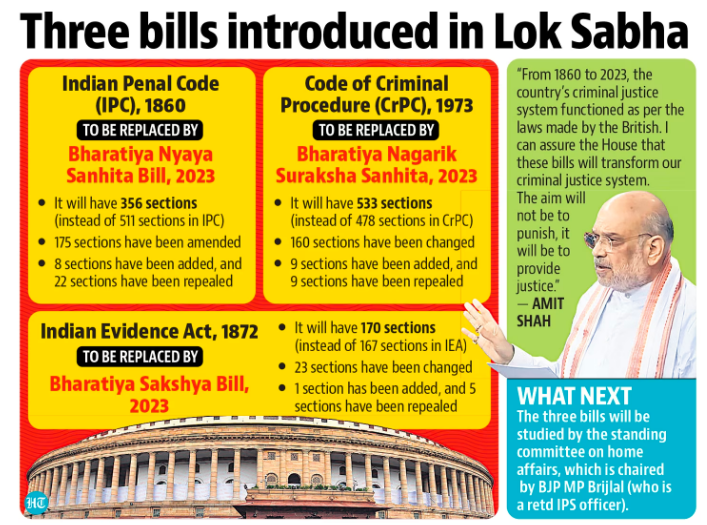
    • Section 354 (5) of the Code of Criminal Procedure mandates that a person sentenced to death shall “be hanged by the neck till he is dead”.
    • In India, the Air Force Act, 1950, the Army Act 1950, and the Navy Act 1957 say that execution has to be carried out either by hanging by the neck until death or by being shot to death.
    • In 2018, the Centre had filed an affidavit supporting death by hanging as a mode of execution.
    • The Centre had not found the method of execution “barbaric, inhuman and cruel” compared to firing squads and lethal injections.

    Various initiatives to alter death by hanging

    • Ensuring dignified death: The government is considering the formation of a committee to examine the need for a painless and more dignified alternative to death by hanging.
    • Panel formation: The Chief Justice of India had suggested the formation of a committee with experts from national law universities, professors of law, doctors, and scientific persons.
    • Humane and painless method: The court indicated that it may even direct an alternative method of executing capital punishments if it was proved that there was a more “humane” method of execution.
    • Voices for psychological tests: The SC has asked for psychological evaluation of condemned prisoners by expert doctors, and access for them by mitigating investigators.

    Concerns raised by Judiciary

    • The Chief Justice had observed that better data was needed to relook at death by hanging.
    • The court wanted to know the-
    1. Impact of the sentence of death by hanging
    2. Pain caused
    3. Period of actual death, and
    4. Availability of resources for hanging a person

    Judiciary at loggerheads

    • The court clarified that it was not questioning the constitutionality of the death penalty, which was well-settled in Deena versus Union of India Case judgment and the Bachan Singh case reported in 1980.
    • The government argued that the mode of execution is a “matter of legislative policy” and the death penalty is awarded only in the rarest of rare cases, with only three executions between 2012 and 2015.

    Debate over Death Penalty

    Arguments in favor of death penalty Arguments against death penalty
    Forfeiture of life: Supporters of the death penalty believe that those who commit murder, because they have taken the life of another, have forfeited their own right to life. – Eye for an eye: Reformative justice is more productive, that innocent people are often killed in the search for retribution, and that “an eye for an eye makes the whole world blind.
    – Moral indignation of the victim: It is a just form of retribution, expressing and reinforcing the moral indignation not only of the victim’s relatives but of law-abiding citizens in general. – Deterrence is a myth: Death penalty is not a deterrent to capital crimes state that there is no evidence to support the claim that the penalty is a deterrent.
    – Highest form of Justice: For heinous crimes such as the Nirbhaya Gangrape Case, no other punishment could have deterred the will of the convicts. – Political tool of suppression: The authorities in some countries, for example Iran and Sudan, use the death penalty to punish political opponents.
    – Deterrent against crime: Capital punishment is often justified with the argument that by executing convicted murderers, we will deter would-be murderers from killing people. – Reverence for life’ principle: Death penalty is an immoral punishment since humans should not kill other humans, no matter the reasons, because killing is killing.
    – Proportional punishment: The guilty people deserve to be punished in proportion to the severity of their crime. – Stigma against killing: With the introduction of lethal injection as execution method, medical professionals participate in executions. Many professionals have now refused to administer such deaths.
    – Prevailing lawlessness: The crimes we are now witnessing cannot be addressed by simple punishments. We are seeing horrific attacks on women, young girls, minority communities and Dalits etc. – Skewed justice systems: In many cases recorded by Amnesty International, people were executed after being convicted in grossly unfair trials, on the basis of torture-tainted evidence and with inadequate legal representation.
    – Prevention of crime is non-existent: Despite of stringent regulations, it is certainly visible that some crimes can never be prevented in our society. – Discriminatory nature: The weight of the death penalty is disproportionally carried by those with less advantaged socio-economic backgrounds or belonging to a racial, ethnic or religious minority.


    Other issues with such executions

    (a) Socio-Economic Factors

    • The recent statistics shows that the death row prisoners in India are more from the backward classes of the society.
    • The death row prisoners belong to backward classes and religious minorities and the majority of convicts’ families are living in adjunct poverty.
    • These people who are backward both in economic and social respects, are not in a position to here expensive lawyers and get proper representation in the Court.

    (b) Delayed Execution

    • The law provides for a long process before the execution of the convicts actually takes place.
    • The unexplained delay in execution can be a ground for commutation of death penalty, and an inmate, his or her kin, or even a public-spirited citizen could file a writ petition seeking such commutation.
    • Their trials are often cruelly forced to endure long periods of uncertainty about their fate.

    Way forward: Law Commission recommendations on death penalty

    The Law Commission of India in its 262nd Report (August 2015) recommended that:

    • Death penalty be abolished for all crimes other than terrorism-related offences and waging war.
    • Measures such as police reforms, witness protection scheme and victim compensation scheme should be taken up expeditiously by the government.
    • It felt that time has come for India to move towards abolition of the death penalty. However the concern is often raised that abolition of death penalty for terrorism-related offences and waging war, will affect national security.


    Get an IAS/IPS ranker as your personal mentor for UPSC 2024 | Schedule your FREE session and get the Prelims prep Toolkit!

  • Constitutional Punctuality: Need of The Hour

    constitutional

    Central Idea

    • The Tamil Nadu Legislative Assembly recently passed a resolution that urges a time frame for Governors to act on Bills passed by the State Legislature. The resolution was passed because the Governor of Tamil Nadu, R.N. Ravi, had withheld assent to as many as 13 Bills passed by the Tamil Nadu Legislative Assembly. This highlights the need for a time-bound constitutional delivery mechanism for Governors, Speakers of Assemblies, and the President of India, emphasizing the importance of time-bound governance.

    What the resolution is all about?

    • The Tamil Nadu Legislative Assembly passed a resolution urging the Union Government and President to advise the Governor to decide on the bills passed by the State Legislatures within a reasonable time period.
    • The resolution, proposed by the Chief Minister, M.K. Stalin, argued that it was important to protect the sovereignty of the Legislatures and, ultimately, safeguard parliamentary democracy.
    • The resolution seeks to provide a time frame for Governors to act on Bills passed by the State Legislature and ensure that they do not sit over Bills indefinitely. The resolution also encourages other Opposition-ruled states to pass similar resolutions in their Assemblies.

    What is mean by Constitutional Punctuality?

    • Timely discharge of duties in accordance with the constitutional provisions: Constitutional punctuality refers to the timely discharge of duties and responsibilities by various constitutional high offices in accordance with the provisions of the Indian Constitution. It involves adhering to a strict time frame to avoid unnecessary delays and ensure the smooth functioning of the constitutional scheme.
    • Growing concerns over misuse of discretionary powers: This concept has gained importance in recent times due to the growing concern over the misuse of discretionary powers by constitutional authorities such as governors, which can lead to a delay in the enactment of important legislation and undermine the principles of parliamentary democracy.

    Need for Constitutional punctuality in terms of Governors role

    • Upholding the sovereignty of legislatures: When the Governor of a state withholds assent to bills passed by the state legislature indefinitely, it undermines the sovereignty of the legislatures. It is essential to provide a time frame for the Governor to act on bills to safeguard the democratic principles enshrined in the Constitution.
    • Ensuring timely delivery of justice: The Constitution of India guarantees the right to speedy justice to all citizens. The delay in the Governor’s assent to bills passed by the legislature leads to a delay in the implementation of new laws, which could impact the timely delivery of justice.
    • Preventing misuse of power: Governors hold a significant position of power, and the discretion they exercise in giving assent to bills should not be misused. The absence of a time frame for them to act on bills provides them with an opportunity to misuse their powers, which could harm the interests of the people.
    • Advancing the constitutional scheme: Providing a time-bound constitutional delivery mechanism advances the constitutional scheme. It ensures the smooth functioning of the democratic process and upholds the principles of accountability and transparency.
    • Building public trust: When constitutional high offices, including that of the Governor, President, and Speakers of Assemblies, discharge their duties in a time-bound manner, it builds public trust in the democratic institutions of the country. It ensures that people’s will, as expressed through their elected representatives, is implemented without undue delay.

    Facts for prelims

    Ambit of judicial review on matters of delays by constitutional authorities

    • In India, matters involving delays in exercising powers by constitutional authorities have been brought under the ambit of judicial review by the courts.
    • In the case of Keisham Meghachandra Singh vs The Hon’ble Speaker Manipur (2020), the Supreme Court issued a writ of mandamus to the Speaker of the Meghalaya Legislative Assembly to decide on disqualification petitions within four weeks.

    Time bound governance

    • The concept of time-bound governance has been successfully implemented in other countries, such as the United Kingdom and the United States, where there are strict timelines for the assent or veto of bills by the respective authorities.
    • In the US, if the President does not sign or veto a bill within 10 days, it automatically becomes an Act.
    • In the UK, there has been no royal veto since 1708.

     Conclusion

    • The resolution passed by the Tamil Nadu Legislative Assembly is a step in the right direction towards a time-bound constitutional delivery mechanism. Constitutional high offices, including Governors, Speakers of Assemblies, and the President of India, must evolve strict time frames and avoid unnecessary delays. Such an approach would advance the constitutional scheme and safeguard

    Mains Question

    Q. What do you understand by mean constitutional punctuality? Discuss the need of constitutional punctuality specifically in terms of Governors role in the state?

    Get an IAS/IPS ranker as your personal mentor for UPSC 2024 | Schedule your FREE session and get the Prelims prep Toolkit!

    Also Read:

    Governor’s Constitutional Limits: A Resolution to President


  • Re-examination of Sedition Law in motion: Govt informs SC

    Central idea: The Centre has informed Supreme Court that it has initiated the “process of re-examination” of Section 124A (sedition) of the Indian Penal Code and consultations are in its “final stage”.

    What is the Sedition Law?

    • Section 124A of the Indian Penal Code lays down the punishment for sedition. The IPC was enacted in 1860, under the British Raj.
    • The then British government in India feared that religious preachers on the Indian subcontinent would wage a war against the government.
    • Particularly after the successful suppression of the Wahabi/Waliullah Movement by the British, the need was felt for such law.
    • Throughout the Raj, this section was used to suppress activists in favor of national independence, including Tilak and Mahatma Gandhi, both of whom were found guilty and imprisoned.

    Do you know?

    Queen-Empress v. Bal Gangadhar Tilak (1897) was the first case in which Section 124A was defined and applied. Again in 1908, when Tilak was tried under same section, then young barrister and a staunch protagonist Mohammed Ali Jinnah defended Tilak.

    What is Sedition?

    • The Section 124A defines sedition as:

    An offence committed when “any person by words, either spoken or written, or by signs, or by visible representation, or otherwise, brings or attempts to bring into hatred or contempt, or excites or attempts to excite disaffection towards the government established by law in India”.

    • Disaffection includes disloyalty and all feelings of enmity.
    • However, comments without exciting or attempting to excite hatred, contempt or disaffection, will not constitute an offense.
    • Sedition is a non-bailable offense.
    • Punishment under Section 124A ranges from imprisonment up to three years to a life term with/without a fine.

    Sedition as a cognizable offense

    • Sedition was made a cognizable offense for the first time in history in India during the tenure of Prime Minister Indira Gandhi in 1973, that is, arrest without a warrant was now permissible.
    • In 1962 the Supreme Court of India interpreted the section to apply only if there is, say, “incitement to violence” or “overthrowing a democratically elected government through violent means”.

    Is it constitutionally valid?

    • Violative of FRs: Two high courts had found it unconstitutional after Independence, as it violated the freedom of speech and expression.
    • Reasonable restrictions: The Constitution was amended to include ‘public order’ as one of the ‘reasonable restrictions’ on which free speech could be abridged by law.
    • Kedar Nath Case: Thereafter, the Supreme Court, in Kedar Nath Singh v. State of Bihar (1962) upheld its validity.
    • Limited use: At the same time, it limited its application to acts that involve “intention or tendency to create disorder” or incitement to violence.
    • Strong criticism doesn’t amount to sedition: Thus, even strongly worded remarks, as long as they do not excite disloyalty and enmity, or incite violence, are not an offence under this section.

    sedition

    Why the controversy now?

    • Frequent use: In recent times, the resort to this section is seen as disturbingly frequent.
    • Curbing dissent: Activists, cartoonists and intellectuals have been arrested under this section, drawing criticism from liberals that it is being used to suppress dissent and silence critics.
    • Misuse for propaganda: Authorities and the police who invoke this section defend the measure as a necessary step to prevent public disorder and anti-national activities.
    • Irrelevance: Many of them have also been detained under the National Security Act and UAPA.

    What is being debated about it?

    • Demand for its scrapping: Liberals and rights activists have been demanding the scrapping of Section 124A.
    • Provision is outdated: It is argued that the provision is “overbroad”, i.e., it defines the offence in wide terms threatening the liberty of citizens.
    • Various calls for its reconsideration: The Law Commission has also called for a reconsideration of the section.
    • Tyranny of the law: It has pointed that Britain abolished it more than a decade ago and raised the question of whether a provision introduced by the British to put down the freedom struggle should continue to be law in India.
    • Doctrine of severability: Some argue that a presumption of constitutionality does not apply to pre-constitutional laws as those laws have been made by foreign legislature or bodies.

    Need for such law

    • There are some tendencies exist even today who wish to overthrow the state apparatus and constitutional scheme of India.
    • It falls on the judiciary to protect Articles 19 and Article 21 of the Constitution.
    • Undue exercise of free speech has led to overture of ordinary dissent into an anti-national insurrection or uprising.
    • There are areas in the country that face hostile activities and insurgencies created by rebel groups, like the Maoists.
    • There must be restrictions on expressing unnecessary contempt or ridiculing of the Government beyond certain limits.

    Way forward

    • India is the largest democracy in the world and the right to free speech and expression is an essential ingredient of democracy.
    • The sedition law should not be abolished as some measures are needed to check communal violence & insurgency activities like Naxals.
    • The definition of sedition should be narrowed down, to include only the issues pertaining to the territorial integrity of India as well as the sovereignty of the country.
    • Section 124A should not be misused as a tool to curb free speech.


    Get an IAS/IPS ranker as your personal mentor for UPSC 2024 | Schedule your FREE session and get the Prelims prep Toolkit!

  • Bangalore Principles of Judicial Conduct

    banglore

    The Supreme Court of India has directed the Registrar General of the Calcutta High Court to investigate an alleged interview given by a judge to a news channel in which he made remarks against a politician. This is cited against Bangalore Principles of Judicial Conduct.

    What are Bangalore Principles?

    • The Bangalore Code of Judicial Conduct was drafted in 2001 for the Judicial Group on Strengthening Judicial Integrity and presented to the Round Table Meeting of Chief Justices in November 2002.
    • Resolution 23 of the United Nations Social and Economic Council promotes implementation of the Bangalore Principles by the judiciaries of Member States.
    • The principles are intended to establish standards for ethical conduct of judges.
    • They are designed to provide guidance to judges and to offer the judiciary a framework for regulating judicial conduct.

    Six core values recognized

    S. No. Principle Description
    1. Independence Judges must be free to make impartial decisions based on the law and facts, without any influence or pressure from external sources.
    2. Impartiality Judges must be unbiased and treat all parties equally, without any favoritism or discrimination.
    3. Integrity Judges must have high moral and ethical principles, be honest, and act with transparency and fairness.
    4. Propriety Judges must avoid any impropriety or appearance of impropriety, such as conflicts of interest or inappropriate behavior.
    5. Equality Judges must uphold the principle of equality before the law, treating all people with respect and dignity.
    6. Competence and diligence Judges must have the necessary knowledge, skills, and qualities to perform their duties effectively, and must work diligently and efficiently.


    Significance of these principles

    • The principles define their meaning and elaborate in detail on what kind of conduct is to be expected in concrete terms of the persons concerned in order to put the respective value into practice.
    • A number of specific instructions are given under each of the values.
    • Not only have some States adopted the Bangalore Principles but others have modelled their own Principles of Judicial Conduct on them.


    Get an IAS/IPS ranker as your personal mentor for UPSC 2024 | Schedule your FREE session and get Prelims prep Toolkit!

  • Governor’s Constitutional Limits: A Resolution to President

    Central Idea

    • The Tamil Nadu Governor’s recent statement implying that he would not give assent to a Bill passed by the legislature if it transgresses constitutional limits has resulted in the Tamil Nadu Assembly passing a resolution requesting the President of India to issue directions to the Governor to function within constitutional limits.

    Who is Governor?

    • Parallel to President: The Governors of the states of India have similar powers and functions at the state level as those of the President of India at the Central level.
    • Nominal head: The governor acts as the nominal head whereas the real power lies with the Chief Ministers of the states and her/his councils of ministers.
    • Similar offices: Governors exist in the states while Lieutenant Governors or Administrators exist in union territories including the National Capital Territory of Delhi.
    • Non-local appointees: Few or no governors are local to the state that they are appointed to govern.

    New Constitutional Development

    • Passing a resolution by the Assembly requesting the President of India to ensure that the Governor functions within the Constitution is a new constitutional development.

    What are the relevant articles?

    • Article 355: Article 355 of the Constitution states that it is the duty of the Union to ensure that every State’s government is carried out according to the Constitution.
    • R. Ambedkar on Article 355: While the general meaning and purpose of Article 355 was explained by B.R. Ambedkar in the Constituent Assembly, the Constitution’s concepts and doctrines have been interpreted and reinterpreted to meet society’s changing needs
    • Article 200: Although Article 200 provides options to the Governor when a Bill is presented to him after being passed by the legislature, withholding assent is not an option given by the Constitution.

    Governor’s Discretionary Powers and the confusion of Withholding assent

    • Options to the Governor: Article 200 provides options to the Governor when a Bill is presented to him after being passed by the legislature.
    • These options are:
    1. To give assent;
    2. To withhold assent;
    3. To send it back to the Assembly to reconsider it; or
    4. To send the Bill to the President for his consideration.
    • Idea of the Third option: In case the Assembly reconsiders the Bill as per the request of the Governor under the third option, he has to give assent even if the Assembly passes it again without accepting any of the suggestions of the Governor.
    • One of the options is required to be exercised:  It is only logical to think that when the Constitution gives certain options to the Governor, he is required to exercise one of them.
    • Sitting on the bill goes against the constitutional direction: Since sitting on a Bill passed by the Assembly is not an option given by the Constitution, the Governor, by doing so, is only acting against constitutional direction. A judicial pronouncement on this matter is needed to eliminate the confusion.

    The issue of justiciability

    Whether the process of assent by the Governor is subject to judicial review?

    • Not justiciable: According to D.D. Basu, quoting judgments of the Supreme Court, it is not justiciable.
    • For instance, Purushothaman Namboothiri vs State of Kerala (1962): In this case the court held that a Bill which is pending with the Governor does not lapse on the dissolution of the Assembly, but this judgment did not deal with the justiciability of the process of assent.
    • Hoechst Pharmaceuticals Ltd. And vs State Of Bihar And Others (1983): In this case the court dealt with the power of the Governor to reserve a Bill for the consideration of the President, and held that the court cannot go into the question of whether it was necessary for the Governor to reserve the Bill for the consideration of the President.
    • Government can challenge the inaction of the Governor in a court of law: The issue that is agitating State governments is the non-decision/indecision on the part of the Governor on a Bill passed by the Assembly. Therefore, the government can challenge the inaction of the Governor in a court of law, and the answer seems to be in the affirmative.

    Way ahead

    • Ensuring constitutional principles are upheld: The state governments and the Governor’s office should work together to establish a mutual understanding of the constitutional provisions and procedures for assent to a bill, with a focus on expediting the process while ensuring constitutional principles are upheld.
    • Avoiding confrontation and legal battles: In case of disagreements between the state government and the Governor, the matter should be resolved through dialogue and mutual agreement, rather than resorting to confrontation and legal battles.
    • Clarity on the issues of justifiability: The Supreme Court could provide clarity on the issue of justiciability of the Governor’s role in assent to a bill, while keeping in mind the constitutional provisions and the principles of federalism.
    • Judicious use of discretionary powers: The Governor should exercise his discretionary powers judiciously and in line with constitutional provisions, without delaying or withholding assent to a bill without any valid reason.
    • Transparent and consultative mechanism: The state government should ensure that bills are passed in a transparent and consultative manner, and the Governor should give due consideration to the views and opinions of all stakeholders before exercising his discretion.
    • Promoting cooperative federalism: There should be a greater emphasis on promoting cooperative federalism, where the Centre, states, and governors work together in a spirit of collaboration and cooperation, while ensuring the protection of the Constitution and the rights of all citizens.

    Conclusion

    • The framers of the Constitution would never have imagined that Governors would sit on Bills indefinitely without exercising any of the options given in Article 200. This is a new development which needs new solutions within the framework of the Constitution. So, it falls to the Supreme Court to fix a reasonable time frame for Governors to take a decision on a Bill passed by the Assembly in the larger interest of federalism in the country.

    Mains question

    1. Passing a resolution by the Assembly requesting the President of India to ensure that the Governor functions within the Constitution is a new constitutional development. In the light of the statement discuss the constitutionality of role of Governor in withholding assent to a bill passed by a state legislature. Suggest a way for this legal battle.

    Get an IAS/IPS ranker as your personal mentor for UPSC 2024 | Schedule your FREE session and get Prelims prep Toolkit!


  • 50 years of Kesavananda Bharati Case

    kesav

    Fifty years ago, on April 24, 1973, the Supreme Court delivered its judgment in Kesavananda Bharati Sripadagalvaru and Ors vs. State of Kerala and Anr, the landmark case that redefined the relationship between Parliament and the Constitution.

    Kesavananda Bharati Case (1973)

    • The Kesavananda Bharati judgement, was a landmark decision of the Supreme Court that outlined the basic structure doctrine of the Indian Constitution.
    • The case is also known as the Fundamental Rights Case.
    • The SC in a 7-6 decision asserted its right to strike down amendments to the constitution that were in violation of the fundamental architecture of the constitution.
    • The Court asserted through the Basic Structure doctrine that the constitution possesses a basic structure of constitutional principles and values.
    • Key outcomes were:
    1. Basic Structure Doctrine: It is a principle that limits Parliament’s power to amend the Indian Constitution. It holds that certain fundamental features of the Constitution, such as the principle of separation of powers, cannot be amended by Parliament.
    2. Judicial Review: The Court partially cemented the prior precedent Golaknath v. State of Punjab, which held that constitutional amendments through Article 368 were subject to fundamental rights review, but only if they could affect the ‘basic structure of the Constitution’.
    3. Exceptions to Judicial Review: At the same time, the Court also upheld the constitutionality of the first provision of Article 31-C, which implied that amendments seeking to implement the Directive Principles, which do not affect the ‘Basic Structure,’ shall not be subjected to judicial review.

    Criticism of the doctrine

    • Dilution of powers: The basic structure doctrine has been criticized for diluting the principle of separation of powers and undermining the sovereignty of Parliament.
    • Ambiguous nature: It has also been criticized as a vague and subjective form of judicial review.

    Landmark cases of the doctrine

    • Indira Gandhi v Raj Narain (1975): The Supreme Court applied the principle laid down in the Kesavananda ruling for the first time in this case. It struck down The Constitution (39th Amendment) Act, 1975, which barred the Supreme Court from hearing a challenge to the election of President, Prime Minister, Vice-President, and Speaker of Lok Sabha.
    • Minerva Mills Ltd vs. Union of India (1980): The Supreme Court struck down a clause inserted in Article 368, which said “there shall be no limitation whatever on the constituent power of Parliament to amend by way of addition, variation or repeal the provisions of this Constitution.”
    • P Sambamurthy v State of Andhra Pradesh (1986): The Supreme Court struck down a portion of the 32nd Amendment (1973), which constituted an Administrative Tribunal for Andhra Pradesh for service matters, taking away the P jurisdiction of the High Court.
    • L Chandra Kumar v Union of India (1997): The Supreme Court struck down a portion of the 42nd Amendment, which set up administrative tribunals excluding judicial review by High Courts.

    Significance of the Judgment and the doctrine

    • Strengthen judicial review: The doctrine forms the basis of the power of the Indian judiciary to review and override amendments to the Constitution of India enacted by the Parliament.
    • Clarification about Article 368: Article 368 postulates only a ‘procedure’ for amendment of the Constitution. The same could not be treated as a ‘power’ vested in the Parliament to amend the Constitution to alter the ‘core’ of the Constitution, which has also been described as the ‘basic structure’ of the Constitution.
    • Not antithetical to legislative authority: Justice Shastri said Judicial Review was undertaken by the courts “not out of any desire to tilt at legislative authority in a crusader’s spirit, but in the discharge of a duty laid down upon them by the Constitution”.
    • A system of checks and balances: The Kesavananda Bharati verdict (1973) made it clear that judicial review is not a means to usurp parliamentary sovereignty. It is a “system of checks and balances” to ensure constitutional functionaries do not exceed their limits.


    Get an IAS/IPS ranker as your personal mentor for UPSC 2024 | Schedule your FREE session and get Prelims prep Toolkit!

  • Horizontal Reservation: Movement of Dalit Trans People

    Horizontal Reservation

    Central Idea

    • Recently, many trans rights activists from The Trans Rights Now Collective, who were peacefully protesting to demand horizontal reservation for transgender people, were detained by the Tamil Nadu police. In Tamil Nadu and in many states across the country, the movement for horizontal reservation has been shaping up to support Dalit trans people who are struggling with transphobia and casteism in educational institutions, workplaces, and larger ecosystems of education and employability.

    What is vertical reservation?

    • Fixed Percentage reservation: Vertical reservation is a policy of reserving a percentage of government jobs and educational seats for individuals from socially and economically disadvantaged communities or categories such as Scheduled Castes (SCs), Scheduled Tribes (STs), and Other Backward Classes (OBCs). It aims to address historical injustices and create equal opportunities for all sections of society.
    • For example: if the Scheduled Caste population in a particular state is 15%, then 15% of the available seats or positions in educational institutions and government jobs in that state will be reserved for SC candidates. This ensures that members of historically oppressed and marginalized communities have greater access to opportunities for education and employment, and helps to address the inequalities that exist due to caste-based discrimination.

    What is Horizontal reservation?

    • Horizontal reservation is a type of affirmative action approach that supplements vertical reservation in India. Horizontal reservation recognizes that individuals from marginalized communities also face multiple layers of discrimination and seeks to provide additional reservation opportunities for them.
    • It involves providing reservations for various intersectional identities such as women, persons with disabilities, and transgender persons within each of the vertical reservation categories.
    • For example, a Dalit woman could access vertical reservation under the SC category, but through horizontal reservation, she could also access reservations for women. Both vertical and horizontal reservations would equally affect her social location.

    Facts for prelims: Horizontal reservation v/s Vertical reservation

    Horizontal Reservation

    Vertical Reservation

    An intersectional approach that is provided for within each vertical reservation category Reservation for specific marginalized communities, such as SC/ST/OBC
    Example: A Dalit woman can access vertical reservation under the SC category, whereas through horizontal reservation she will be able to access reservations for women as well Example: A Dalit person can access reservation under the SC category
    Intended to provide opportunities for people who face multiple forms of marginalization Intended to provide opportunities for specific marginalized communities
    Provides for a more nuanced approach to reservation that takes into account intersectional identities and experiences Provides for reservations for specific communities based on historical injustice and social exclusion
    Allows for better representation of people from diverse backgrounds in public institutions and workplaces Helps to address inequality and improve access to resources and opportunities for specific marginalized communities
    Currently not implemented consistently across all states in India Implemented consistently across all states in India
    Has been demanded for transgender persons in government jobs and education to address caste and gender-based marginalization Has been in place in India since independence and has been expanded over time to include more communities
    Example: Karnataka became the first and only state in India to reserve jobs in public employment for transgender persons through horizontal reservation in 2021 Example: In Tamil Nadu, reservations are provided for SC/ST/OBC communities

    Challenges with Vertical Reservation System?

    • Dominance of creamy layer: The benefits of reservation are often enjoyed by the creamy layer or the affluent members of reserved categories who are not in need of affirmative action. This leads to further marginalization of the truly underprivileged members of these communities.
    • Limited benefits: Vertical reservation benefits are limited to only a particular category of people, leaving out those who may also be disadvantaged due to other factors such as gender, disability, sexual orientation, etc.
    • Stigmatization: The reservation system has led to stigmatization and discrimination against members of reserved categories, with many being perceived as less competent or deserving of their position.
    • Political exploitation: Reservation policies are often used for political gain rather than social justice, with political parties making false promises and manipulating the system to gain votes.
    • Lack of representation: Reservation policies have not led to adequate representation of marginalized communities in decision-making positions, as many still face discrimination and bias in these spaces.
    • Inadequate infrastructure and resources: Reservation policies have not been accompanied by adequate infrastructure and resources for marginalized communities to access opportunities, leading to further marginalization.
    • Conflict among marginalized communities: The current vertical reservation system creates a hierarchy among marginalized communities, with some having greater access to opportunities than others. This has led to conflict and tension among different communities.

    Challenges with Horizontal reservation System?

    • Opposition from dominant castes: Horizontal reservation is often met with resistance from dominant castes and communities who feel that it is unfair and takes away opportunities from them. This can lead to political backlash and opposition to the implementation of such policies.
    • Identification and classification: Another challenge is the identification and classification of individuals who qualify for horizontal reservation. For example, in the case of transgender individuals, there is a lack of clarity on who qualifies as transgender and how to identify them. This can lead to confusion and disputes over who is eligible for reservation benefits.
    • Administrative challenges: Implementing horizontal reservation policies can be administratively complex, especially in larger organizations and government agencies. There may be challenges in tracking and monitoring the implementation of such policies, and ensuring that they are being applied fairly and consistently.
    • Stigma and discrimination: Horizontal reservation policies may also be stigmatizing for some individuals, as they may feel that they are being singled out or labeled based on their identity. This can create additional barriers to social inclusion and participation, and may make it more difficult for individuals to access opportunities.
    • Limited scope: Horizontal reservation policies are often implemented in specific sectors or areas, such as education or public employment. This means that individuals from marginalized groups may still face discrimination and exclusion in other areas of society, such as housing or healthcare.

    Horizontal Reservation

    Value Addition Box form Civilsdaily

    Did you know: NALSA Judgement?

    • NALSA (National Legal Services Authority) judgment of 2014 is a landmark judgment by the Supreme Court of India that recognized the legal recognition of the third gender in India.
    • It directed the central and state governments to legally recognize the transgender community as a third gender and to ensure that they have access to the same rights and protections as other citizens of the country.
    • The judgment also recognized the right of transgender persons to self-identification and directed the government to provide reservations for transgender people in education and employment.
    • This judgment was a significant step towards ensuring the rights and protections of transgender people in India.

    The Transgender Persons (Protection of Rights) Act, 2019

    • The Transgender Persons (Protection of Rights) Act, 2019 is a law enacted by the Parliament of India for the protection of rights of transgender persons and their welfare.
    • The Act defines a transgender person as someone whose gender does not match the gender assigned to them at birth.
    • The Act prohibits discrimination against transgender persons in areas such as education, employment, healthcare, and housing, and recognizes their right to self-perceived gender identity.

    Horizontal Reservation

    What are the policy gaps and ambiguities?

    • The policy gaps and ambiguities that exist, which often used by the courts to refuse horizontal reservation for trans people and instead offer vertical reservation.
    • The judiciary’s easy solution of putting all trans people in OBC categories is restrictive and does not allow trans people who belong to SC/ST categories to claim their right to reservation under both categories.
    • The homogenous understanding of the trans community underplays the caste realities and marginalisations that many trans people come from and how it further hinders their social mobility.

    Horizontal Reservation

    Way ahead

    • There is a need to recognize the intersectionality of identities and provide horizontal reservation for marginalized communities, including transgender people of Dalit, Bahujan, and Adivasi (DBA) backgrounds.
    • State governments and the judiciary need to take a more proactive approach to address the policy gaps and ambiguities about the reservation for trans people.
    • More awareness and education are needed to understand the complexities of caste and gender identity and their impact on social mobility.
    • More research and data collection are needed to understand the challenges faced by trans people from DBA backgrounds and to develop effective solutions to address their unique needs.
    • Ultimately, the goal should be to create a more inclusive and equitable society that recognizes and celebrates the diversity of all its citizens, regardless of their gender identity or caste background.

    Conclusion

    • The movement for horizontal reservation is not only about a Dalit-trans issue; it is cross-cutting and a living testimonial of how certain sections of people are repeatedly forced into the margins. There is need for horizontal reservation to assert that transgender people have an equal stake in this nation’s citizenship and public resources.

    Mains question

    Q. In many states across the country, the movement for horizontal reservation has been shaping up to support Dalit trans people. In this light explain what is horizontal reservation system and discuss the challenges associated with its implementation.

    Get an IAS/IPS ranker as your personal mentor for UPSC 2024 | Schedule your FREE session and get Prelims prep Toolkit!

  • Assam- Arunachal Pradesh Border Dispute

    • assam

    Central idea

    • Ahave had a long-standing border dispute over 123 villages that are located in 12 districts of Arunachal and 8 districts of Assam.
    • On April 21, 2022, an MoU was signed between the two states to resolve the dispute.

    Genesis of the dispute

    • The border dispute between Arunachal Pradesh and Assam has around 1,200 points of conflict along their 804 km boundary, which began in the 1970s and intensified in the 1990s.
    • The issue goes back to 1873 when the British government introduced the inner-line permit, vaguely separating the plains from the frontier hills.
    • In 1954, the North-East Frontier Agency (NEFA) was formed, and 3,648 sq. km of the “plain” area of Balipara and Sadiya foothills was transferred to the Darrang and Lakhimpur districts of Assam based on the 1951 report.
    • Arunachal has been celebrating its statehood with an eye on China since 1987, and its people living in the transferred patches have been resentful, claiming that the transfer was done arbitrarily.
    • However, their counterparts in Assam say the 1951 demarcation is constitutional and legal.

    Past efforts to resolve the border issue

    • Several efforts were made in the past to resolve the border dispute between Assam and Arunachal Pradesh.
    • In 1979, a high-powered tripartite committee was constituted to delineate the boundary, and around 489 km of the 800 km were demarcated by 1983-84.
    • Further demarcation could not take place because Arunachal Pradesh did not accept the recommendations.
    • The apex court appointed a local boundary commission in 2006 to resolve the dispute. However, nothing came of it.

    Process leading up to the signing of the MoU

    • Assam CM and Arunachal CM commenced CM-level talks over the border issue on January 24, 2022.
    • In their second meeting on April 20, 2022, they made key decisions.
    • The border issues between both the states would be confined to a list of 123 villages which Arunachal Pradesh had claimed before the Local Commission in 2007.
    • A boundary line delineated by the high-powered tripartite committee in 1980 would be taken as the notified boundary, and all realignment would be done in relation to it.
    • Both states would set up 12 regional committees covering the 12 districts of Arunachal Pradesh and the 8 counterpart districts of Assam for joint verification of the 123 villages.

    Extent to which the issue has been resolved

    • The MoU has resolved the dispute over 34 villages.
    • The village boundaries of 49 of the remaining villages are unresolved.
    • The MoU states that in these, the Regional Committees will finalize the boundaries within a period of six months “through continuous dialogue.”


    Get an IAS/IPS ranker as your personal mentor for UPSC 2024 | Schedule your FREE session and get Prelims prep Toolkit!

  • The Caste Census and Mandal Politics: Analysis

    Caste Census

    Central Idea

    • The demand for a caste-based census in India has once again brought Mandal politics to the forefront. Mandal politics has succeeded in capturing political power in large parts of India and has shifted the political discourse towards a universal acceptance of OBC reservations. However, the movement has weakened in recent years, and the demand for a caste census is seen as a way for Mandal parties to regain their hold in the public discourse.

    What do you understand by mean Mandal Politics?

    • Mandal politics refers to a political movement initiated by historically marginalized Other Backward Classes (OBCs) or Bahujan caste groups in India in the late 1980s and 1990s.
    • The movement sought to secure a greater share of political and economic power through reservation in the public sector for the OBCs who had been historically excluded from such opportunities.
    • The movement derived its name from the Mandal Commission, a committee appointed by the Indian government in 1979 to identify the socially and educationally backward classes of India and recommend measures for their advancement.
    • The Mandal Commission report in 1980 recommended that 27% of jobs in the public sector be reserved for OBCs, a recommendation that was later implemented by the Indian government in 1990.

    The outcomes of Mandal politics

    Positive outcomes:

    • Increased representation: One of the main positive outcomes of Mandal politics is the increased representation of OBCs and other marginalized groups in the political sphere. This has led to greater inclusivity and diversity in government and a more balanced distribution of power.
    • Reservation policies: Mandal politics has also led to the introduction and expansion of reservation policies, which aim to provide equal opportunities to marginalized groups in education and employment.
    • Recognition of social justice: Mandal politics has brought the issue of social justice to the forefront of political discourse and has highlighted the need for policies that address historic discrimination and disadvantage.

    Negative outcomes:

    • Caste-based politics: One of the negative outcomes of Mandal politics is the perpetuation of caste-based politics. This has led to the further entrenchment of caste divisions and has hindered the development of a more inclusive and egalitarian society.
    • Polarization and conflict: Mandal politics has also led to polarization and conflict between different caste groups, as each group seeks to secure its own interests.
    • Resentment and backlash: The policies introduced by Mandal politics have also led to resentment and backlash from certain upper-caste groups, who view the policies as discriminatory and unjust. This has sometimes led to violent protests and social unrest.

    What is Caste Census?

    • A caste census is basically the counting of people belonging to different castes in a particular marked area.
    • With this two-phase exercise, the Bihar government will try to get numbers of people belonging to SC, ST, and OBC communities and their financial status among other important things.
    • The exercise is termed ‘Jaati Aadharit Ganana’. People belonging to every religion and caste will be covered during the exercise.

    Arguments for caste census

    • Enumerating the marginalized: A caste census would actually bring to the particular the number of people who are at the margins, or who are deprived, or the kind of occupations they pursue, or the kind of hold that institutions like caste have on them. The caste census opens up to enumerating Dalits who are not Hindus, such as Dalit Christians and Muslims.
    • Data for Policymaking: This information is absolutely necessary for any democratic policymaking. The census will be able to answer real public policy questions and direct policies more effectively towards those who most need state assistance and affirmative action policies.
    • Judicial backing: The courts in India have often emphatically said that it is important to have adequate data with regard to the reservation.
    • Caste offers privilege: Caste is not only a source of disadvantage; it is also a very important source of privilege and advantage in our society.
    • Rids away caste rigidities: Counting of caste doesn’t necessarily perpetuate caste or the caste system. Myths of caste elitisms can be debunked through a caste census.

    Arguments against caste census

    • 50% breach of reservation cap: It is argued that a Socio-Economic Caste Census is the only way to make a case to breach the 50% cap on reservation and rationalize the reservation matrix in the country.
    • Caste within Caste: Given the differences in caste hierarchies across various regions of the country, a comparative reading along with generating a common hierarchy may be a challenge.
    • Caste over occupation linked predicaments: Caste linked deprivation or adversity may not be as common as occupation linked predicaments, which become easier to compare across states/regions.
    • Anonymity and bias: An intimate and personalised attribute like caste may have its differential exposition between urban and rural residents. Urban residents’ need for anonymity can always bias the reporting on caste.
    • Identity crisis: Recognition and adherence to caste identity is to a large extent shaped by progressive ideals, cosmopolitanism and education, which has its own regional divide in the country between the north and the south.
    • Hurdle to casteless society: The idea of a national caste census is abhorrent when the stated policy is to strive for a casteless society.

    The Impact of a Caste Census: Analysis In brief

    Positive impact

    • Accurate data: A caste census can provide accurate data on the caste demographics of India, which is necessary for effective policy-making and affirmative action programs.
    • Better targeting of government policies: The data from a caste census can help the government target policies and programs more effectively towards the marginalized and disadvantaged sections of society.
    • Improved representation: A caste census can help improve representation of underrepresented castes in government bodies and institutions.
    • Empowerment of marginalized communities: A caste census can help empower marginalized communities by giving them a voice and recognition in the political and social systems.

    Negative impact

    • Polarization: A caste census can lead to polarization and tensions between different castes, especially if the data is used to allocate resources or benefits based on caste.
    • Stigma and discrimination: There is a risk that the caste census data can be used to further stigmatize and discriminate against marginalized communities.
    • Misuse of data: The data from a caste census can be misused by politicians and other groups to further their own agendas, leading to potential conflicts and social unrest.
    • Privacy concerns: Some people may be hesitant to disclose their caste, leading to concerns about privacy and data protection.

    Conclusion

    • The caste census is seen as a way for Mandal parties to regain their hold in the public discourse and direct policies more effectively towards those who most need state assistance and affirmative action policies. However, the demand for a caste census is a double-edged sword that may create conflicts and shift the discourse from historical injustices to distribution. The Mandal movement faces challenges but remains relevant in the ongoing struggle for social justice.
  • What is Civil Union, how is it different from Marriage?

    Central idea

    • The Indian judiciary is currently hearing arguments about the legal recognition of same-sex unions under the Special Marriage Act.
    • The Centre has contested the maintainability of the petitions, and the judiciary’s right to confer legal recognition on the “socio-legal institution” of marriage.
    • However, the CJI has clarified that the scope of the hearing would be limited to developing a notion of a Civil Union that finds legal recognition under the Act.
    • This article explains what civil unions are, how they differ from marriage, and which countries allow them.

    What is a Civil Union?

    • A civil union is a legal status that allows same-sex couples specific rights and responsibilities normally conferred upon married couples.
    • Civil unions resemble marriages and bring with them employment, inheritance, property, and parental rights, among other things.

    How is a civil union different from marriage?

    • In the US, prior to the Supreme Court’s landmark ruling in “Obergefell v. Hodges” in 2015, a majority of the states had civil union laws that allowed same-sex couples to marry without providing them formal recognition of the same.
    • Civil unions were recognised solely by issuing states and not by federal law, which meant that such couples could not enjoy the benefits of being in a civil union uniformly across all states.
    • After the legalisation of same-sex marriages, several civil unions were converted into marriages.

    What other countries allow civil unions?

    • Several countries allow civil unions.
    • Before Sweden legalised same-sex marriages in 2009, LGBTQ couples there could apply for civil unions and enjoy benefits such as the right to adopt.
    • In Norway, couples could enter into civil unions from 1993, which gave way to a new law 15 years later allowing such couples to marry, adopt, and undergo state-sponsored artificial insemination.
    • In Austria, same-sex couples could form civil partnerships between 2010-2017 until a court ruling deemed civil unions discriminatory, and such marriages were legalised.
    • Similarly, countries like Brazil, Uruguay, Andorra, and Chile recognised the right of same-sex couples to enter into civil unions even before they formally recognised their legal right to marriage.


    Get an IAS/IPS ranker as your personal mentor for UPSC 2024 | Schedule your FREE session and get Prelims prep Toolkit!