💥Join UPSC 2027,2028 Mentorship (July Batch) + XFactor Notes & Microthemes PDF

Subject: Science and Technology

  • Bring genomic sequencing into the pandemic fight

    The article highlights the importance of genomic sequencing in dealing effectively with the pandemic and suggest the scaling up of genomic sequencing.

    Why genomic sequencing is important

    • An effective COVID-19 pandemic response requires, inter alia, keeping track of emerging variants and then conducting further studies about their transmissibility, immune escape and potential to cause severe disease.
    • The success of the United States and the United Kingdom in containing the virus also goes to scaled-up genomic sequencing, tracking the emerging variants and using that evidence for timely actions.
    • The data from genomic sequencing has both policy and operational implications.
    • Our scientific knowledge and understanding about emerging strains is going to be the key to deploy public health interventions (vaccines included) to fight the pandemic.
    • The emerging variants — with early evidence of higher transmissibility, immune escape and breakthrough infections — demand continuous re-thinking and re-strategising of the pandemic response by every country.

    Insufficient genomic sequencing in India

    • Though the procedural steps such as setting up the Indian SARS-CoV2 Genomic Consortia, or INSACOG have been taken, the sequencing has remained at a very low level of a few thousand cases only.
    • The challenge of insufficient genomic sequencing is further compounded by slow pace of data sharing.

    Steps need to be taken

    • 1) Scale-up genomic sequencing: India needs to scale up genomic sequencing, across all States.
    •  More genomic sequencing is needed from large urban agglomerations.
    • A national-level analysis of collated genomic sequencing data should be done on a regular basis and findings shared publicly.
    • 2) Research on vaccine effectiveness: The Indian government needs to invest and support more scientific and operational research on vaccine effectiveness.
    • Rethink vaccine policy: There are early indications of immune escape and reduced vaccine effectiveness against the Delta variant (especially after one-shot).
    • These are the questions that experts need to deliberate and come up with the answers.

    Consider the question “What is genomic sequencing and how it could help in dealing with the Covid-19 pandemic? Suggest the steps India need to take to use genomic sequencing in curbing the pandemic.”

    Conclusion

    As India prepares for the third wave, increasing genomic sequencing and use of scientific evidence for decision making are not a choice but an absolute essential.

  • Supersonic flying: benefits and concerns

    The United Airlines of USA has announced it was ordering 15 Overture planes with the ability to travel at Mach 1.7, faster than the speed of sound, from the Denver-based startup Boom.

    What is a Supersonic Plane?

    • Supersonic aircraft are planes that can fly faster than the speed of sound.
    • The technology for supersonic flights is actually over 70 years old, but only recently has been used for commercial flying.
    • Before 1976, when the first commercial supersonic flight took off, the planes were used entirely for military purposes.
    • Usually, supersonic planes can travel at the speed of around 900 kmph, twice the speed of normal aircraft.

    What about the Overture supersonic plane?

    • The Overture aircraft would travel at the speed of Mach 1.7 or 1,805 kmph with a range of 4,250 nautical miles. In a single flight, it could carry 65 to 88 passengers and reach an altitude of 60,000 ft.
    • The company has expressed confidence in getting an “experimental” jet ready by 2022, start rolling out aircraft by 2025 and eventually open them for passengers by 2029.
    • It claims to build on Concorde’s legacy through faster, more efficient and sustainable technology.

    Challenges with supersonic planes

    Flying passengers at a supersonic speed is accompanied by a whole set of challenges.

    • Firstly, the costs of making “sustainable” supersonic planes are extremely high.
    • The very nature of its flying — using excessive amounts of fuel and energy — is likely to have high environmental costs.
    • Despite the use of sustainable fuels, greenhouse gas emissions are not nullified.
    • Secondly, the very speed of the planes results in producing excessive amounts of noise pollution in the environment.
    • The “Sonic Boom” created by these planes feels like an explosion to the human ear.
    • This, thus, limits where and when the supersonic planes can fly. They can only reach their actual speed until they are far enough from people and completely over the ocean.
    • Lastly, it would not be economically feasible for everyone. Only the very rich can afford supersonic planes, as a ticket is likely to be way costlier than a first-class ticket of a regular plane.
  • How blind people can navigate better using Echolocation

    A technique used by animals such as dolphins, whales, and bats to navigate their surroundings can also be used by blind people to get around better and have greater independence and well-being, researchers at Durham University in the UK have shown.

    What is Echolocation?

    • Echolocation, also called biosonar, is a biological sonar used by several animal species.
    • Echolocating animals emit calls out to the environment and listen to the echoes of those calls that return from various objects near them.
    • They use these echoes to locate and identify the objects.

    What has the new study found?

    • The same technique can help blind people locate still objects by producing clicking sounds from their mouth and hands.
    • The researchers organized a 10-week training programme, in which 12 blind and 14 sighted volunteers aged between 21 and 79 were taught click-based echolocation.
    • The volunteers were trained in distinguishing between the size of objects, orientation perception and virtual navigation.
    • At the end of the training, the participants had been able to improve their ability to navigate using clicking noises either from one’s mouth, walking cane taps or footsteps.
  • CIBER-2 Mission to count the stars in the Universe

    A NASA-funded rocket’s launch window will open at the White Sands Missile Range in New Mexico, USA. The aim of this mission is to count the number of stars that exist in the Universe.

    Answer this PYQ from CSP 2020 in the comment box:

    Q.“The experiment will employ a trio of spacecraft flying in formation in the shape of an equilateral triangle that has sides one million kilometers long, with lasers shining between the craft.” The experiment in question refers to

    (a) Voyager-2

    (b) New horizons

    (c) Lisa Pathfinder

    (d) Evolved LISA

    What is CIBER-2?

    • In order to roughly estimate the number of stars in the Universe, scientists have estimated that on average each galaxy consists of about 100 million stars, but this figure is not exact.
    • The figure of 100 million could easily be an underestimation, probably by a factor of 10 or more.
    • To put this into perspective, an average of 100 million stars in each galaxy (there an estimated 2 trillion of them as per NASA), would give a total figure of one hundred quintillion stars or 1 with 21 zeroes after it.
    • NASA notes that if this figure is accurate, it would mean that for every grain of sand on Earth, there are more than ten stars.
    • But this calculation assumes that all stars are inside galaxies, which might not be true and this is what the CIBER-2 instrument will try to find out.

    How will CIBER-2 count stars?

    • NASA notes that the instrument will not actually count individual stars but it will instead detect the extragalactic background light
    • It is all of the light that has been emitted throughout the history of the Universe.
    • From all of this extragalactic background light, the CIBER-2 will focus on a portion of this called cosmic infrared background, which is emitted by some of the most common stars.
    • Essentially, this approach is aiming to look at how bright this light is to give scientists an estimate of how many of these stars are out there.
    • The ESA infrared space observatory Herschel also counted the number of galaxies in infrared and measured their luminosity previously.
  • [pib] India’s First Indigenous Tumour Antigen SPAG9

    The National Institute of Immunology (NII) has received a trademark for India’s First Indigenous Tumor Antigen SPAG9.

    About SPAG9

    • India’s first indigenous tumor antigen SPAG9 was discovered by Dr Anil Suri in 1998 who is heading the Cancer Research Program at NII.
    • In a recent development, the SPAG9 antigen has received the trademark ASPAGNII-TM.
    • Currently, ASPAGNIITM is being used in dendritic cell (DC) based immunotherapy in cervical, ovarian cancer and will also be used in breast cancer.

    What is immunotherapy?

    • Immunotherapy is a new approach that exploits the body’s inner capability to put up a fight against cancer.
    • With this approach, either the immune system is given a boost, or the T cells are “trained’’ to identify recalcitrant cancer cells and kill them.
    • In this personalized intervention, those patients expressing SPAG9 protein can be treated with DC-based vaccine approach.
    • In DC-based vaccine, patient’s cells called monocytes from their blood are collected and modified into what are called dendritic cells.
    • These dendritic cells are primed with ASPAGNIITM and are injected back to the patient to help the ‘fighter’ cells, or T-cells, in the body to kill the cancer cells.

    Why need such therapy?

    • DC-based immunotherapy is safe, affordable and can promote antitumor immune responses and prolonged survival of cancer patients.
    • The ASPAGNIITM is a true example of translational cancer research and the Atmanirbhar Bharat spirit.
    • This will be a real morale boost in affordable, personalized, and indigenous products for cancer treatment.

    Answer this PYQ in the comment box:

    Q.‘RNA Interference (RNAi)’ technology has gained popularity in the last few years. why?

    1. It is used in developing gene silencing therapies
    2. It can be used in developing therapies for the treatment of cancer
    3. It can be used to developer hormone replacement therapies
    4. It can be used to produce crop plants that are resistant to viral pathogens

    Select the correct answer using the code given below.

    a) 1, 2 and 4

    b) 2 and 3

    c) 1 and 3

    d) 1 and 4 only

    The burden of cancer in India

    • Cancer kills 8.51 lakh people in India every year (International Agency for Research on Cancer, 2020).
    • As per World Health Organization (WHO), one in 10 Indians will develop cancer during their lifetime, and one in 15 will die of cancer.
  • DAVINCI+ and VERITAS missions for exploration of Venus

    NASA has selected two missions to the planet Venus, Earth’s nearest neighbor. The missions are called DAVINCI+ and VERITAS.

    DAVINCI+ and VERITAS

    (1) DAVINCI+

    • DAVINCI+ is short for ‘Deep Atmosphere Venus Investigation of Noble gases, Chemistry, and Imaging’ and is the first US-led mission to the planet’s atmosphere since 1978.
    • It will try to understand Venus’ composition to see how the planet formed and evolved.
    • This mission also consists of a decent sphere that will pass through the planet’s thick atmosphere and make observations and take measurements of noble gases and other elements.
    • Significantly, this mission will also try to return the first high-resolution photographs of a geological feature that is unique to Venus.
    • This feature, which is called “tesserae” may be comparable to Earth’s continents.
    • The presence of tesseraes may suggest that Venus has tectonic plates like Earth.

    (2) VERITAS

    • The second mission called VERITAS is short for ‘Venus Emissivity, Radio Science, InSAR, Topography, and Spectroscopy’.
    • It will map the planet’s surface to determine its geologic history and understand the reasons why it developed so differently from Earth.
    • VERITAS will orbit Venus with a radar that will help to create a 3D reconstruction of its topography which might be able to tell scientists if processes such as plate tectonics and volcanism are still active there.
    • This mission will also map the emissions from Venus’s surface that may help in determining the type of rocks that exist on Venus–a piece of information that is not exactly known yet.
    • It will also determine if active volcanoes are releasing water vapor into the atmosphere.

    Why study Venus?

    • The results from DAVINCI+ are expected to reshape the understanding of terrestrial planet formation in the solar system and beyond.
    • Taken together, both missions are expected to tell scientists more about the planet’s thick cloud cover and the volcanoes on its surface.
    • Further, scientists speculate about the existence of life on Venus in its distant past and the possibility that life may exist in the top layers of its clouds where temperatures are less extreme.

    Have humans visited Venus?

    • Because of the planet’s harsh environment, no humans have visited it and even the spacecraft that have been sent to the planet have not survived for a very long time.
    • Venus’ high surface temperatures overheat electronics in spacecraft in a short time, so it seems unlikely that a person could survive for long on the Venusian surface.
    • So far, spacecraft from several nations have visited the planet.
    • The first such spacecraft was the Soviet Union’s Venera series (the spacecraft, however, could not survive for long because of the planet’s harsh conditions).
    • It was followed by NASA’s Magellan Mission that studied Venus from 1990-1994. As of now, Japan’s Akatsuki mission is studying the planet from Orbit.

    Back2Basics: Venus

    • For those on Earth, Venus is the second-brightest object in the sky after the moon.
    • It appears bright because of its thick cloud cover that reflects and scatters light.
    • Surface temperatures on Venus can go up to 471 degrees Celsius, which is hot enough to melt lead, NASA notes. Surface temperatures on Venus can go up to 471 degrees Celsius, which is hot enough to melt lead, NASA notes.

    Some unknown facts

    • While Venus, which is the second closest planet to the Sun, is called the Earth’s twin because of their similar sizes, the two planets have significant differences between them.
    • For one, the planet’s thick atmosphere traps heat and is the reason that it is the hottest planet in the solar system, despite coming after Mercury, the closest planet to the Sun.
    • Further, Venus moves forward on its orbit around the Sun but spins backwards around its axis slowly.
    • This means on Venus the Sun rises in the west and sets in the East.
    • One day on Venus is equivalent to 243 Earth days because of its backward spinning, opposite to that of the Earth’s and most other planets.
    • Venus also does not have a moon and no rings.
  • OneWeb constellation for Internet from the Skies

    Following the successful launch of 36 satellites, OneWeb’s Low Earth Orbit (LEO) constellation reached 218 in-orbit satellites.

    What is OneWeb?

    • OneWeb is a global communications company that aims to deliver broadband satellite Internet around the world through its fleet of LEO satellites.
    • OneWeb satellites are built at a OneWeb and Airbus joint venture facility in Florida that can produce up to two satellites a day.
    • The launch roll-out of the satellites is facilitated by French company Arianespace using Russian-made Soyuz rockets.
    • The company has announced plans to enter the Indian market by 2022.

    About its constellation

    • The company has one more launch to complete before it obtains the capacity to enable its ‘Five to 50’ service of offering internet connectivity to all regions north of 50 degrees latitude.
    • The Five to 50 service is expected to be switched on by June 2021 with global services powered by 648 satellites available in 2022.

    What are LEO satellites?

    • LEO satellites have been orbiting the planet since the 1990s, providing companies and individuals with various communication services.
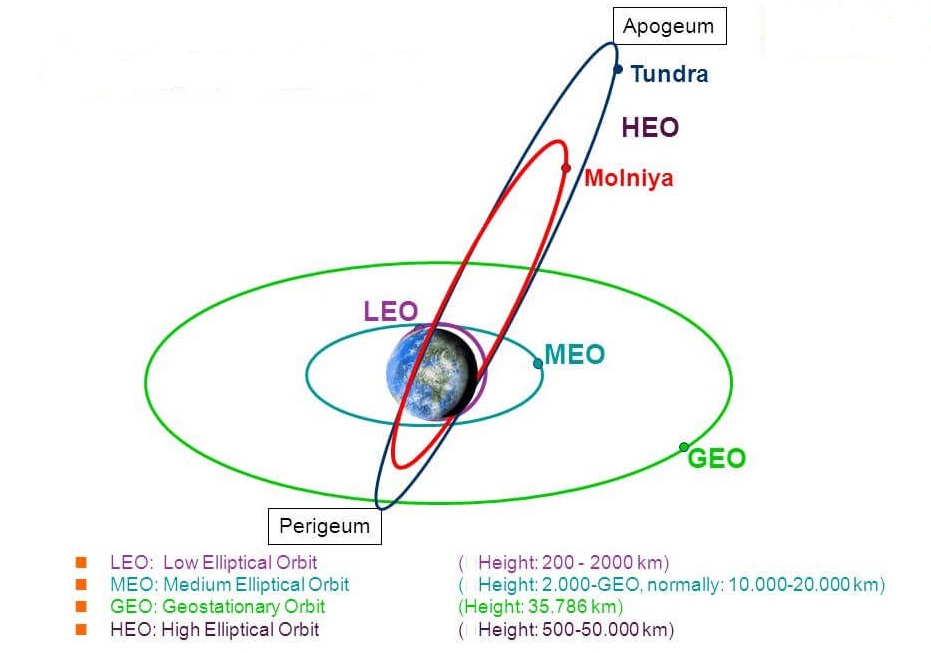
    • They are positioned around 500km-2000km from earth, compared to stationary orbit satellites which are approximately 36,000km away.
    • Latency, or the time needed for data to be sent and received, is contingent on proximity.
    • As LEO satellites orbit closer to the earth, they are able to provide stronger signals and faster speeds than traditional fixed-satellite systems.
    • Additionally, because signals travel faster through space than through fiber-optic cables, they also have the potential to rival if not exceed existing ground-based networks.
    • However, LEO satellites travel at a speed of 27,000 kph and complete a full circuit of the planet in 90-120 minutes.
    • As a result, individual satellites can only make direct contact with a land transmitter for a short period of time thus requiring massive LEO satellite fleets and consequently, a significant capital investment.

    Criticisms of LEO satellites

    • During the days of the Sputnik and Apollo missions, governments dominated and regulated space-based activities.
    • There are logistical challenges with launching thousands of satellites into space as well.
    • Satellites can sometimes be seen in the night skies which creates difficulties for astronomers as the satellites reflect sunlight to earth, leaving streaks across images.
    • Satellites traveling at a lower orbit can also interrupt the frequency of those orbiting above them, an accusation that has been leveled against Starlink satellites already.
    • Another worry is that there are already almost 1 million objects larger than 1cm in diameter in orbit, a byproduct of decades of space activities.
    • Those objects, colloquially referred to as ‘space junk,’ have the potential to damage spacecraft or collide with other satellites.
  • China’s EAST Tokamak Device

    China’s Experimental Advanced Superconducting Tokamak (EAST), which mimics the energy generation process of the sun, set a new record.

    What is China’s ‘artificial sun’ EAST?

    • The Experimental Advanced Superconducting Tokamak (EAST) reactor is an advanced nuclear fusion experimental research device.
    • The purpose of the artificial sun is to replicate the process of nuclear fusion, which is the same reaction that powers the sun.
    • The EAST is one of three major domestic tokamaks that are presently being operated across the country.
    • Apart from the EAST, China is currently operating the HL-2A reactor as well as J-TEXT.
    • Since it first became operational in 2006, the EAST has set several records for the duration of confinement of exceedingly hot plasma.
    • The EAST project is part of the International Thermonuclear Experimental Reactor (ITER) facility, which will become the world’s largest nuclear fusion reactor when it becomes operational in 2035.
    • The project includes the contributions of several countries, including India, South Korea, Japan, Russia and the United States.

    How does the ‘artificial sun’ EAST work?

    • The EAST Tokamak device is designed to replicate the nuclear fusion process carried out by the sun and stars.
    • Nuclear fusion is a process through which high levels of energy are produced without generating large quantities of waste.
    • Previously, energy was produced through nuclear fission — a process in which the nucleus of a heavy atom was split into two or more nuclei of lighter atoms.

    Fission vs. Fusion

    • While fission is an easier process to carry out, it generates far more nuclear waste.
    • Unlike fission, fusion also does not emit greenhouse gases and is considered a safer process with a lower risk of accidents.
    • Once mastered, nuclear fusion could potentially provide unlimited clean energy and very low costs.

    But what is Fusion?

    • For nuclear fusion to occur, tremendous heat and pressure are applied on hydrogen atoms so that they fuse together. `
    • The nuclei of deuterium and tritium — both found in hydrogen — are made to fuse together to create a helium nucleus, a neutron along with a whole lot of energy.
    • Fuel is heated to temperatures of over 150 million degrees C so that it forms a hot plasma “soup” of subatomic particles.
    • With the help of a strong magnetic field, the plasma is kept away from the walls of the reactor to ensure it does not cool down and lose its potential to generate large amounts of energy.
    • The plasma is confined for long durations for fusion to take place.

    What is the latest record and why does it matter?

    • The EAST reactor set a new record on Friday when it achieved a plasma temperature of 216 million degrees Fahrenheit and also managed to run for 20 seconds at 288 million degrees Fahrenheit.
    • To put this in perspective, the sun’s core only reaches about 15 million degrees Celsius, which means the reactor was able to touch temperatures that are 10 times hotter than that.
    • The next goal for the scientists behind the experimental reactor is to maintain the high temperature for a long period of time. Previously, the EAST had reached a record temperature of 100 million degrees Celsius in 2018.

    China is not the only

    • But China is not the only country that has achieved high plasma temperatures.
    • In 2020, South Korea’s KSTAR reactor set a new record by maintaining a plasma temperature of over 100 million degrees Celsius for 20 seconds.
  • Lawsuit against 5G and the debate around

    A notable actor has filed a lawsuit in the Bombay High Court against the 5G telecom technology up-gradation, trial runs for which have started in India now.

    What is 5G technology?

    • 5G or fifth generation is the latest upgrade in the long-term evolution (LTE) mobile broadband networks.
    • It mainly works in 3 bands, namely low, mid and high-frequency spectrum — all of which have their own uses as well as limitations.

    Issues with the rollout

    • However, 5G and its rollout in many countries have been hampered due to fears over health concerns even some conspiracy theories as well, which have tried to link it with the coronavirus among other things.
    • The recent lawsuit is asking questions around the overall impact of 5G and low intensity radiofrequency (RF) electronic magnetic field (EMF) radiation on human health, and its environmental impact as well.
    • These concerns, while not yet proven, have been raised by various scientists before too.

    Arguments raised in the lawsuit

    • It has stated that the ‘radiation’ it will emit will be “extremely harmful and injurious to the health and safety of the people”.
    • While using wireless devices one is in a constant dilemma about “RF radiation from wire-free gadgets and network cell towers”.
    • There is sufficient reason to believe that the radiation is extremely harmful and injurious to the health and safety of the people.
    • It wants the concerned department to certify that 5G technology is safe for humans and also animals and birds.

    Why is 5G essential?

    • 5G promises to revolutionize mobile broadband and is a big generational leap over the existing 4G technology.
    • This new technology will be capable of not just ensuring fast internet on our phones, but also help power IoT (Internet of Things) networks to run connected cars and homes smarter.
    • It will also support the streaming of rich media.

    Rollout status in India

    • 5G has not yet been rolled out in India though some companies have been given a trial spectrum to test 5G technology in the country.
    • Once this is over, it is expected that networks will go live with the 5G bands by the end of this year.
    • The 5G rollout is expected to gather pace in the country by 2022.

    Fear around the impact of 5G radiation on human health

    • The claim is that the more powerful 5G waves will emit more radiation and cause harm to humans as well as other living beings.
    • Also, 5G will require more towers in order to ensure better connectivity, and since it will power more than just our smartphones, it will increase human exposure to such radiation in general.
    • This is an extension of the idea that cellular towers, which emit low-level RF-EMF radiation, are in general damaging our bodies.
    • But radiation from cellphone towers, mobile phones, WiFi routers is typically called non-ionizing radiation like radio waves, microwaves, and optical radiation.
    • RF fields have been classified by WHO’s International Agency for Research on Cancer (IARC) as possibly carcinogenic to humans (Group 2B).

    Layman understandings over such radiations

    • There’s no doubt that radiation at very high levels, also referred to as ionizing radiation, heats up our tissue and can eventually lead to cancer.
    • This applies to medical devices such as a CT-scan machine or X-ray machine, which emit high-level ionizing radiation.
    • That’s exactly why doctors don’t recommend that you go get a CT scan for every health issue because it does increase unnecessary exposure to radiation.
    • But there are increasing concerns that our smartphones, other WiFi-ready devices such as laptops, and mobile phone towers which also emit low-level RF radiation are damaging our bodies given the constant exposure.

    What WHO has to say?

    • On its page on 5G, the World Health Organization (WHO) says “no adverse health effect has been causally linked with exposure to wireless technologies.”
    • But it also states that “only a few studies have been carried out at the frequencies to be used by 5G.”
    • Given the growing concerns, the WHO is conducting “a health risk assessment from exposure to radio frequencies, covering the entire radiofrequency range, including 5G.”
    • This study will be published by 2022.
  • [pib] “AmbiTAG”- India’s first indigenous temperature data logger

    IIT Ropar in (Punjab) has developed a first-of-its-kind IoT device – AmbiTag that records real-time ambient temperature during the transportation of perishable products, vaccines, and even body organs and blood.

    AmbiTag

    • Shaped like a USB device, AmbiTag continuously records the temperature of its immediate surroundings “from -40 to +80 degrees in any time zone for a full 90 days on a single charge.
    • Most of the similar devices available in the international market record data only for a duration of 30- 60 days.
    • It generates an alert when the temperature goes beyond a pre-set limit. The recorded data can be retrieved by connecting the USB with any computer.
    • So far, such devices are being imported by India in a massive quantity from other countries such as Singapore, Hong Kong, Ireland, and China.
    • The device has been developed under Technology Innovation Hub – AWaDH (Agriculture and Water Technology Development Hub) and its Startup ScratchNest.

    Its applications

    • The device helps know whether that particular item transported from anywhere in the world is still usable or perished because of temperature variation.
    • This information is particularly critical for vaccines including the Covid-19 vaccine, organs, and blood transportation.
    • Besides perishable items including vegetables, meat, and dairy products it can also monitor the temperature of animal semen during transit.