💥Join UPSC 2027,2028 Mentorship (August Batch) + XFactor Notes & Microthemes PDF

Subject: Science and Technology

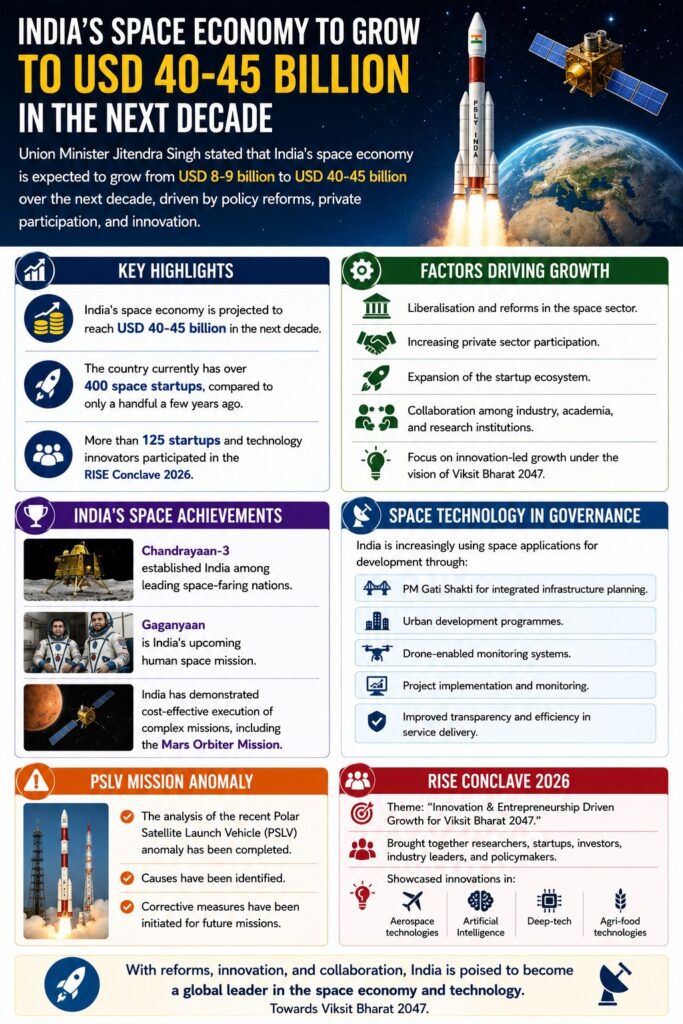
  • India’s Space Economy Poised to Reach USD 45 Billion

    Why in the news?

    Union Minister Jitendra Singh stated that India’s space economy is expected to grow from USD 8-9 billion to USD 40-45 billion over the next decade, driven by policy reforms, private participation, and innovation.

    Key Highlights

    • India’s space economy is projected to reach USD 40-45 billion in the next decade.
    • The country currently has over 400 space startups, compared to only a handful a few years ago.
    • More than 125 startups and technology innovators participated in the RISE Conclave 2026.

    Factors Driving Growth

    • Liberalisation and reforms in the space sector.
    • Increasing private sector participation.
    • Expansion of the startup ecosystem.
    • Collaboration among industry, academia, and research institutions.
    • Focus on innovation-led growth under the vision of Viksit Bharat 2047.

    India’s Space Achievements

    • Chandrayaan-3 established India among leading space-faring nations.
    • Gaganyaan is India’s upcoming human space mission.
    • India has demonstrated cost-effective execution of complex missions, including the Mars Orbiter Mission.

    Space Technology in Governance

    India is increasingly using space applications for development through:

    • PM Gati Shakti for integrated infrastructure planning.
    • Urban development programmes.
    • Drone-enabled monitoring systems.
    • Project implementation and monitoring.
    • Improved transparency and efficiency in service delivery.

    PSLV Mission Anomaly

    • The analysis of the recent Polar Satellite Launch Vehicle (PSLV) anomaly has been completed.
    • Causes have been identified.
    • Corrective measures have been initiated for future missions.

    RISE Conclave 2026

    • Theme: “Innovation & Entrepreneurship Driven Growth for Viksit Bharat 2047.”
    • Brought together researchers, startups, investors, industry leaders, and policymakers.
    • Showcased innovations in Aerospace technologies, Artificial Intelligence, Deep-tech, and Agri-food technologies.

    [2025] GPS-Aided Geo Augmented Navigation (GAGAN) uses a system of ground stations to provide necessary augmentation. Which of the following statements is/are correct in respect of GAGAN?
    I. It is designed to provide additional accuracy and integrity.
    II. It will allow more uniform and high quality air traffic management.
    III. It will provide benefits only in aviation but not in other modes of transportation.
    Select the correct answer using the code given below.

    [A] I, II and III

    [B] II and III only

    [C] I only

    [D] I and II only

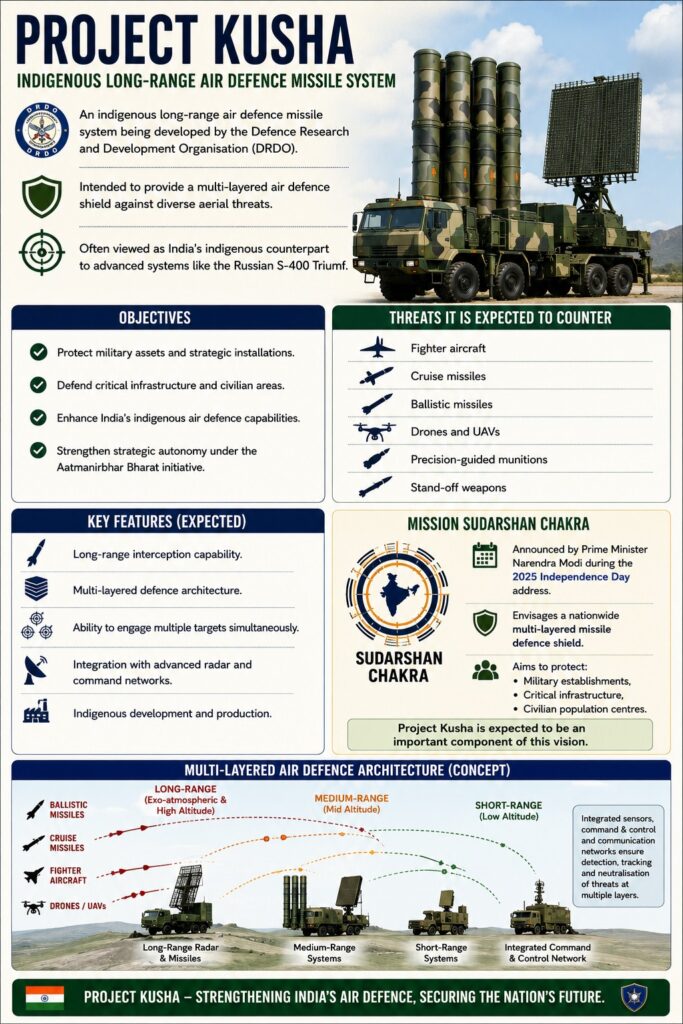
  • Project Kusha: India’s Indigenous Long-Range Air Defence System

    Why in the news?

    Defence Minister Rajnath Singh described Project Kusha as a “game changer” for India’s security architecture and stated that its significance had been demonstrated during Operation Sindoor.

    What is Project Kusha?

    • An indigenous long-range air defence missile system being developed by the Defence Research and Development Organisation (DRDO).
    • Intended to provide a multi-layered air defence shield against diverse aerial threats.
    • Often viewed as India’s indigenous counterpart to advanced systems like the Russian S-400 Triumf.

    Objectives

    • Protect military assets and strategic installations.
    • Defend critical infrastructure and civilian areas.
    • Enhance India’s indigenous air defence capabilities.
    • Strengthen strategic autonomy under the Aatmanirbhar Bharat initiative.

    Threats It Is Expected to Counter

    • Fighter aircraft, Cruise missiles, Ballistic missiles, Drones and UAVs, Precision-guided munitions, and Stand-off weapons

    Mission Sudarshan Chakra

    • Announced by Prime Minister Narendra Modi during the 2025 Independence Day address.
    • Envisages a nationwide multi-layered missile defence shield.
    • Aims to protect: Military establishments, Critical infrastructure, and Civilian population centres.
    • Project Kusha is expected to be an important component of this vision.

    [2018] What is “Terminal High Altitude Area Defense (THAAD)”, sometimes seen in the news?

    [A] An Israeli radar system

    [B] India’s indigenous anti-missile programme

    [C] An American anti-missile system

    [D] A defence collaboration between Japan and South Korea.

  • Sound Waves for Energy-Efficient Next-Generation Computing

    Why in the news?

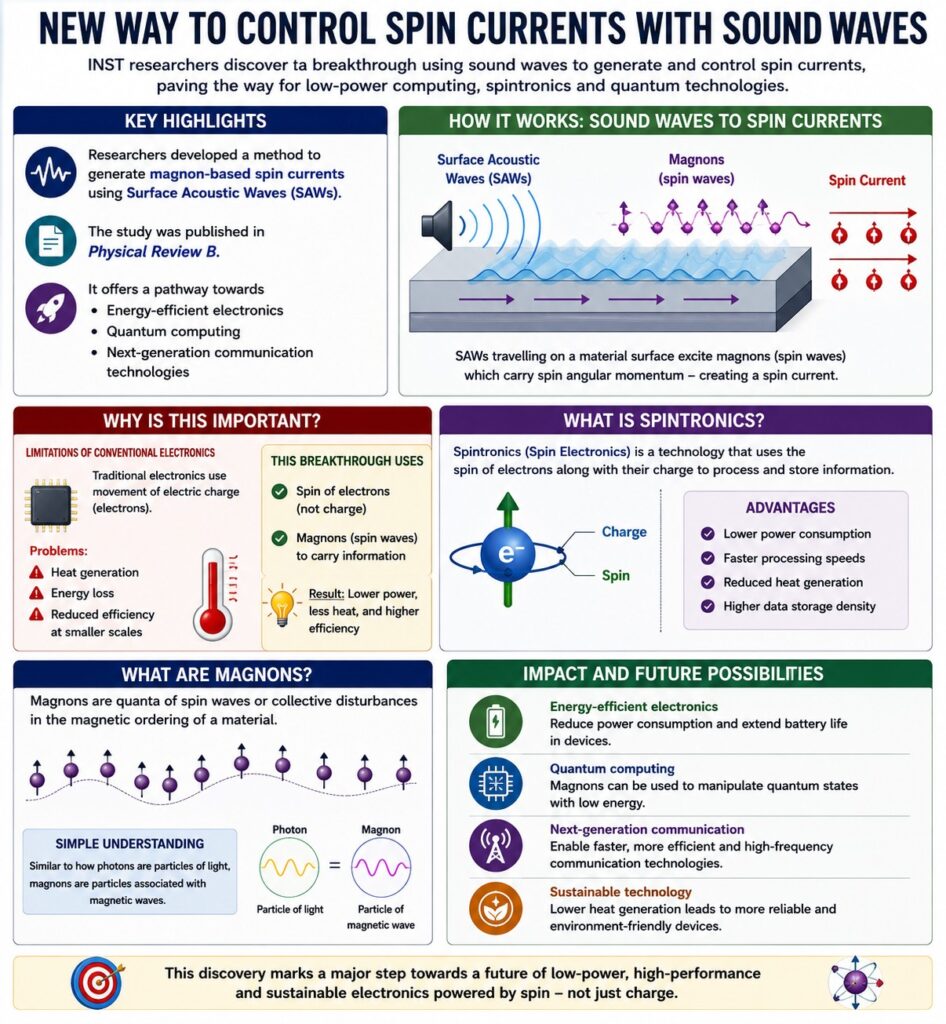
    Researchers from the Institute of Nano Science and Technology (INST) have discovered a new mechanism to generate and control spin currents using sound waves, opening avenues for low-power computing, spintronics, and quantum technologies.

    Key Highlights

    • Researchers developed a method to generate magnon-based spin currents using Surface Acoustic Waves (SAWs).
    • The study was published in Physical Review B.
    • It offers a pathway towards Energy-efficient electronics, Quantum computing, Next-generation communication technologies.

    Why is this Important?

    • Limitations of Conventional Electronics: Traditional electronics use: Movement of electric charge (electrons)
    • Problems: Heat generation, Energy loss, Reduced efficiency at smaller scales

    What is Spintronics?

    Spintronics (Spin Electronics) is a technology that uses the Spin of electrons. Along with their charge to process and store information.

    Advantages

    • Lower power consumption.
    • Faster processing speeds.
    • Reduced heat generation.
    • Higher data storage density.

    What are Magnons?

    Magnons are Quanta of spin waves or collective disturbances in the magnetic ordering of a material.

    What are Surface Acoustic Waves (SAWs)?

    Surface Acoustic Waves are Sound waves that travel along the surface of a material.

    Characteristics

    • Cause tiny mechanical vibrations.
    • Commonly used in: Mobile communication filters, Sensors, Signal processing devices.

    [2022] Which one of the following is the context in which the term “qubit” is mentioned?

    [A] Cloud Services

    [B] Quantum Computing

    [C] Visible Light Communication Technologies

    [D] Wireless Communication Technologies

  • Is a text AI-aided? Science, limits of detection tools 

    Why in the News?

    Allegations of AI-generated writing surfaced after three winners of the Commonwealth Short Story Prize were flagged by AI-detection tools, including Pangram, which classified one story as “100% AI-generated.” The controversy has reignited debate over whether AI detectors can reliably distinguish human-written content from AI-generated text. 

    Why is the Human vs AI Binary Becoming Obsolete?

    1. Collaboration Model: Increasingly, writing exists on a spectrum ranging from fully human-written to AI-assisted and heavily AI-generated.
    2. Hybrid Authorship: Writers often use AI for brainstorming, editing, structuring, or refining content.
    3. Future Challenge: Determining acceptable levels of AI assistance may become more important than identifying AI use itself.
    4. Example: The article cites categories such as lightly assisted, moderately assisted, and heavily assisted writing

    What is the machine learning foundation behind AI detection?

    1. Machine Learning (ML): Uses large datasets and statistical patterns to train systems to distinguish AI-generated text from human-written text.
    2. Training Data: Requires massive datasets containing both AI-generated and human-written content.
    3. Pattern Recognition: Learns recurring features such as vocabulary, sentence structure, punctuation, and stylistic patterns.
    4. Classification Function: Assigns probability scores indicating whether content appears AI-generated or human-authored.
    5. Example: Models may learn that AI systems frequently use formal verbs such as “delve”, “imperative”, or “devolve”.

    How are AI detectors trained to recognise AI-generated writing?

    1. Dataset Feeding: Large volumes of labelled human and AI text are fed into detection models.
    2. Statistical Learning: Models identify correlations and recurring linguistic features.
    3. Annotation-Based Training: Human annotators and data vendors classify examples to create training datasets.
    4. Behavioural Modelling: Since many frontier AI systems are trained on internet text, detectors attempt to identify common writing behaviours reproduced by these systems.
    5. Industry Dependence: Most training datasets are created by large technology firms, researchers, and annotation platforms.

    How is AI Detection Different from Plagiarism Detection?

    1. Plagiarism Detection: Identifies copied content by matching text with existing sources.
    2. AI Detection: Attempts to infer whether a text resembles AI-generated writing based on statistical patterns.
    3. Key Difference: AI detection relies on probability, whereas plagiarism detection relies on direct textual matches

    Linguistic signals that AI detectors rely upon

    Which ‘AI tells’ are commonly identified by detectors?

    1. Uncommon Vocabulary: Frequent use of words and phrases rarely encountered in ordinary conversation.
    2. Dash Usage: Excessive use of em dashes (—), often highlighted as a stylistic indicator.
    3. Structured Formatting: Frequent use of bullet points accompanied by descriptive headings.
    4. Neat Conclusions: Tendency to end content with highly organised summary paragraphs.
    5. Negative Parallelism: Repeated rhetorical structures such as “Not X, but Y.”
      1. Example: “These headphones are not just hearing devices, but sound-cancelling devices.”

    Why are these indicators not reliable proof of AI authorship?

    1. Overlap of Styles: Human writers can naturally employ the same stylistic features.
    2. Professional Writing Norms: Academic and journalistic writing often uses structured formatting and formal language.
    3. False Attribution Risk: Presence of a pattern does not establish authorship.
    4. Statistical Nature: Detection relies on probabilities rather than certainty.

    What are the inherent limitations of AI detectors?

    1. Low-Entropy Text: Text that is highly predictable and information-poor provides fewer linguistic signals, making AI detection less accurate.
      1. Example: Short responses, formulaic writing, or heavily edited text may be difficult to classify reliably
    2. Insufficient Signals: Short or highly edited content may not contain enough indicators for reliable classification.
    3. Probability-Based Judgments: Models provide likelihood estimates rather than definitive proof.
    4. Absence of Ground Truth: Detectors cannot directly observe whether a human or AI produced the text.
    5. Generalisation Problem: If a detector has not been specifically trained on outputs from a model such as Claude, it can only make an educated guess rather than a definitive classification.
    6. Implication: Detection tools struggle to keep pace with rapidly evolving AI models.

    How does editing affect detection accuracy?

    1. Mixed Authorship Challenge: Human-written text edited by AI, or AI-generated text edited by humans, creates ambiguity.
    2. Slight Modifications: Even limited editing can alter detectable patterns.
    3. False Positives: Human-written content may be incorrectly flagged as AI-generated.
    4. False Negatives: AI-generated content may evade detection after revision.

    Reliability of current AI-detection technologies

    Can AI detectors provide definitive evidence of AI use?

    1. False Positive Rate: Pangram reports a false-positive rate of 0.01%, equivalent to 1 error per 10,000 cases.
    2. Independent Validation: The figure has reportedly been supported by some independent studies.
    3. Operational Reliability: Suitable for risk assessment but not for conclusive judgment.
    4. Expert Assessment: Developers acknowledge that models cannot achieve 100% accuracy.

    Why is perfect detection technologically difficult?

    1. Continuous AI Evolution: New language models constantly improve linguistic sophistication.
    2. Human-AI Convergence: AI-generated text increasingly resembles human writing.
    3. Spam Detection Analogy: Similar to email spam filters, detection systems reduce risk but cannot eliminate errors.
    4. Adaptive Behaviour: AI systems learn to avoid patterns commonly targeted by detectors.

    Implications for writers and publishers

    How can false positives affect genuine authors?

    1. Reputational Damage: Writers may face allegations despite producing original work.
    2. Creative Discouragement: Fear of misclassification may discourage experimentation in writing styles.
    3. Publishing Risks: Manuscripts may be rejected based on uncertain evidence.
    4. Trust Deficit: Excessive dependence on detection tools can undermine confidence in evaluation systems.

    What challenges do publishers face in the AI era?

    1. Verification Difficulty: Establishing authorship becomes increasingly complex.
    2. Transparency Requirements: Growing demand for disclosure regarding AI assistance.
    3. Editorial Standards: Need for clear policies defining acceptable AI use.
    4. Reader Trust: Publishers must maintain credibility while adapting to technological change.

    Should AI assistance be treated differently from AI authorship?

    1. Spectrum of Use: Writing may be fully human-written, AI-assisted, moderately AI-assisted, or heavily AI-generated
    2. Collaborative Creation: Many authors increasingly use AI for brainstorming, editing, and research assistance.
    3. Policy Challenge: Institutions must determine acceptable levels of AI involvement.
    4. Binary Classification Problem: Human-versus-AI framing often oversimplifies modern writing practices.

    How does the issue intersect with ethics and regulation?

    1. Accountability: Establishes responsibility for content creation and originality.
    2. Intellectual Property: Raises questions regarding ownership of AI-assisted works.
    3. Academic Integrity: Challenges traditional plagiarism and authorship norms.
    4. Due Process: Prevents punitive actions based solely on probabilistic detection tools.Transparency: Encourages disclosure-based approaches rather than purely detection-based approaches.

    Should Transparency Replace Detection as the Primary Governance Tool?

    1. Disclosure-Based Regulation: Encourages authors to declare AI use.
    2. Reduced False Accusations: Minimises harm caused by false positives.
    3. Practical Governance: More feasible than attempting perfect detection.
    4. Institutional Trust: Builds confidence among publishers, educators, and readers.

    Conclusion

    AI-detection tools can serve as useful indicators but not definitive arbiters of authorship. The future of AI governance in publishing and academia will depend less on achieving perfect detection and more on developing credible standards for disclosure, accountability, and ethical human-AI collaboration.

    Value Addition

    AI Governance Frameworks

    UNESCO Recommendation on the Ethics of AI (2021)

    1. Promotes transparency, accountability, fairness, and human oversight.
    2. Calls for responsible deployment of AI technologies.

    OECD AI Principles

    1. Supports trustworthy AI.
    2. Emphasises explainability and human-centric design.

    G7 Hiroshima AI Process

    1. Develops international guardrails for advanced AI systems.
    2. Focuses on safety, transparency, and risk management.

    EU AI Act

    1. Adopts a risk-based regulatory framework.
    2. Imposes transparency obligations for certain AI applications.

    AI and India

    IndiaAI Mission

    1. Strengthens domestic AI capabilities.
    2. Supports compute infrastructure, datasets, innovation, and skill development.

    Digital Personal Data Protection Act, 2023

    1. Provides safeguards for personal data used in AI ecosystems.

    National Strategy for Artificial Intelligence

    1. Identifies AI applications in education, healthcare, agriculture, smart mobility, and governance.

    PYQ Relevance

    [UPSC 2023] Introduce the concept of Artificial Intelligence (AI). How does AI help clinical diagnosis? Do you perceive any threat to privacy of the individual in the use of AI in healthcare?

    Linkage: The PYQ examines the opportunities and challenges associated with Artificial Intelligence and its growing societal impact. The article highlights the limitations of AI systems and the need for transparency, accountability, and responsible AI governance.
  • 100 Years of Solar Data Reveal Clues About Sun’s Activity Cycle

    Why in News?

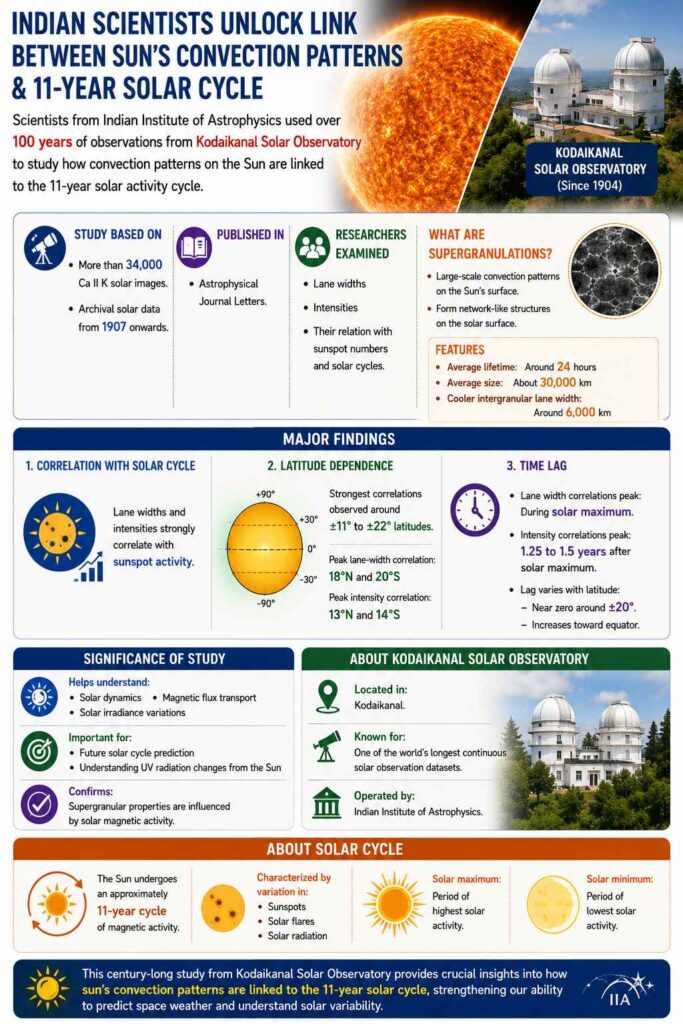
    Scientists from Indian Institute of Astrophysics used over 100 years of observations from Kodaikanal Solar Observatory to study how convection patterns on the Sun are linked to the 11-year solar activity cycle.

    Key Highlights

    • Study based on: More than 34,000 Ca II K solar images.
    • Published in: Astrophysical Journal Letters.
    • Researchers examined:
      • Lane widths
      • Intensities
      • Their relation with sunspot numbers and solar cycles.

    Note: The 34,000 Ca II K solar images mean a historic, 100-year-old archive of solar photographs from India’s Kodaikanal Solar Observatory that scientists recently digitized and used to solve mysteries about the Sun’s 11-year magnetic cycle.

    What are Supergranulations?

    • Large-scale convection patterns on the Sun’s surface.
    • Form network-like structures on the solar surface.

    Features

    • Average lifetime: Around 24 hours.
    • Average size: About 30,000 km.
    • Cooler intergranular lane width: Around 6,000 km.

    Note: An intergranular lane is the darker, cooler region found between bright granules (bright cellular structures visible on the Sun’s surface) on the Sun’s surface.

    Major Findings

    Correlation with Solar Cycle

    • Lane widths and intensities strongly correlate with Sunspot activity.

    Latitude Dependence

    • Strongest correlations observed around ±11° to ±22° latitudes.
    • Peak lane-width correlation 18°N and 20°S.
    • Peak intensity correlation 13°N and 14°S.

    Time Lag

    • Lane width correlations peak:
      • During solar maximum.
    • Intensity correlations peak:
      • 1.25 to 1.5 years after solar maximum.
    • Lag varies with latitude:
      • Near zero around ±20°.
      • Increases toward equator.

    Significance of Study

    • Helps understand:
      • Solar dynamics
      • Magnetic flux transport
      • Solar irradiance variations.
    • Important for:
      • Future solar cycle prediction.
      • Understanding UV radiation changes from the Sun.
    • Confirms:
      • Supergranular properties are influenced by solar magnetic activity.

    About Kodaikanal Solar Observatory

    • Located in: Kodaikanal.
    • Known for: One of the world’s longest continuous solar observation datasets.
    • Operated by: Indian Institute of Astrophysics.

    About Solar Cycle

    • The Sun undergoes an approximately: 11-year cycle of magnetic activity.
    • Characterized by variation in:
      • Sunspots
      • Solar flares
      • Solar radiation.
    • Solar maximum: Period of highest solar activity.
    • Solar minimum: Period of lowest solar activity.

    [2022] If a major solar storm (solar flare) reaches the Earth, which of the following are the possible effects on the Earth?:
    1. GPS and navigation systems could fail.
    2. Tsunamis could occur at equatorial regions.
    3. Power grids could be damaged.
    4. Intense auroras could occur over much of the Earth.
    5. Forest fires could take place over much of the planet.
    6. Orbits of the satellites could be disturbed
    7. Shortwave radio communication of the aircraft flying over polar regions could be interrupted.
    Select the correct answer using the code given below;

    [A] 1, 2, 4 and 5 only

    [B] 2, 3, 5, 6 and 7 only

    [C] 1, 3, 4, 6 and 7 only

    [D] 1, 2, 3, 4, 5, 6 and

  • Catalyst that Transforms to Perform

    Why in the news?

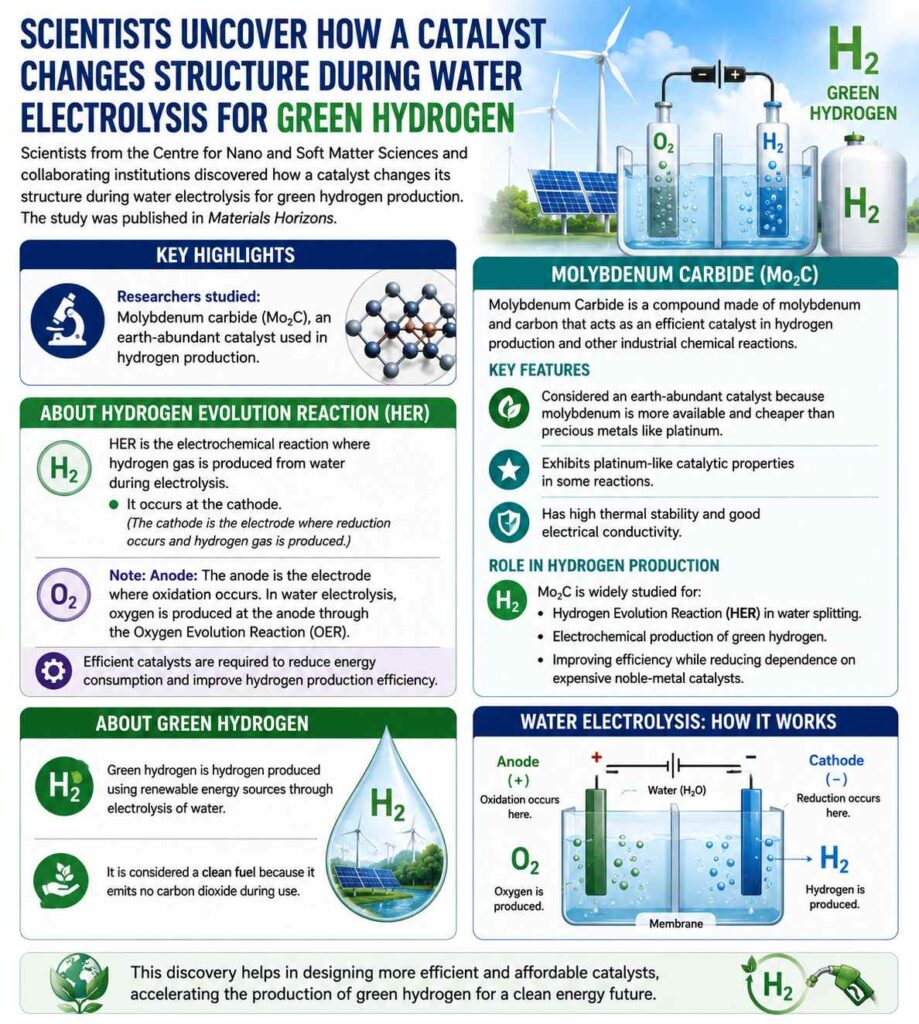
    Scientists from the Centre for Nano and Soft Matter Sciences and collaborating institutions discovered how a catalyst changes its structure during water electrolysis for green hydrogen production. The study was published in Materials Horizons.

    Key Highlights

    • Researchers studied:
      • Molybdenum carbide (Mo₂C), an earth-abundant catalyst used in hydrogen production.
    • Molybdenum Carbide is a compound made of molybdenum and carbon that acts as an efficient catalyst in hydrogen production and other industrial chemical reactions
    • Key Features
      • Considered an earth-abundant catalyst because molybdenum is more available and cheaper than precious metals like platinum.
      • Exhibits platinum-like catalytic properties in some reactions.
      • Has high thermal stability and good electrical conductivity.
    • Role in Hydrogen Production
      • Mo₂C is widely studied for: Hydrogen Evolution Reaction (HER) in water splitting.
      • Electrochemical production of green hydrogen.
      • Improving efficiency while reducing dependence on expensive noble-metal catalysts.

    About Hydrogen Evolution Reaction (HER)

    • HER is the electrochemical reaction where hydrogen gas is produced from water during electrolysis.
    • It occurs at the cathode. (The cathode is the electrode where reduction occurs and hydrogen gas is produced.)
      • Note: Anode: The anode is the electrode where oxidation occurs. In water electrolysis, oxygen is produced at the anode through the Oxygen Evolution Reaction (OER).
    • Efficient catalysts are required to reduce energy consumption and improve hydrogen production efficiency.

    About Green Hydrogen

    • Green hydrogen is hydrogen produced using renewable energy sources through electrolysis of water.
    • It is considered a clean fuel because it emits no carbon dioxide during use.

    [2023] With reference to green hydrogen, consider the following statements:
    1. It can be used directly as a fuel for internal combustion.
    2. It can be blended with natural gas and used as fuel for heat or power generation.
    3. It can be used in the hydrogen fuel cell to run vehicles.
    How many of the above statements are correct?

    [A] Only one

    [B] Only two

    [C] All three

    [D] None

  • Next Generation Nanomedicine for Breast Cancer

    Why in the news?

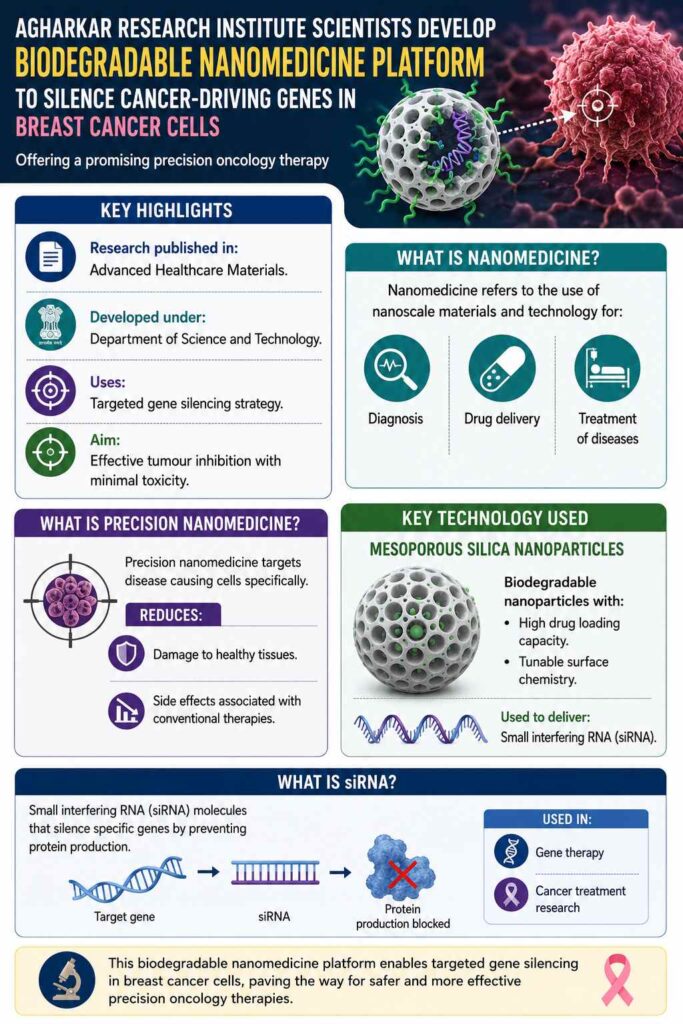
    Scientists from Agharkar Research Institute developed a biodegradable nanomedicine platform capable of silencing cancer driving genes in breast cancer cells, offering a promising precision oncology therapy.

    Key Highlights

    • Research published in: Advanced Healthcare Materials.
    • Developed under: Department of Science and Technology.
    • Uses: Targeted gene silencing strategy.
    • Aim: Effective tumour inhibition with minimal toxicity.

    What is Nanomedicine?

    Nanomedicine refers to the use of nanoscale materials and technology for:

    • Diagnosis
    • Drug delivery
    • Treatment of diseases.

    What is Precision Nanomedicine?

    • Precision nanomedicine: Targets disease causing cells specifically.
    • Reduces:
      • Damage to healthy tissues.
      • Side effects associated with conventional therapies.

    Key Technology Used

    Mesoporous Silica Nanoparticles

    • Biodegradable nanoparticles with:
      • High drug loading capacity.
      • Tunable surface chemistry.
    • Used to deliver: Small interfering RNA (siRNA).

    What is siRNA?

    • Small interfering RNA (siRNA): Molecules that silence specific genes by preventing protein production.
    • Used in:
      • Gene therapy
      • Cancer treatment research.

    [2015] With reference to the use of nanotechnology in health sector, which of the following statements is/are correct?
    1.Targeted drug delivery is made possible by nanotechnology
    2.Nanotechnology can largely contribute to gene therapy
    Select the correct answer using the code given below.

    [A] 1 only

    [B] 2 only

    [C] Both 1 and 2

    [D] Neither 1 nor 2

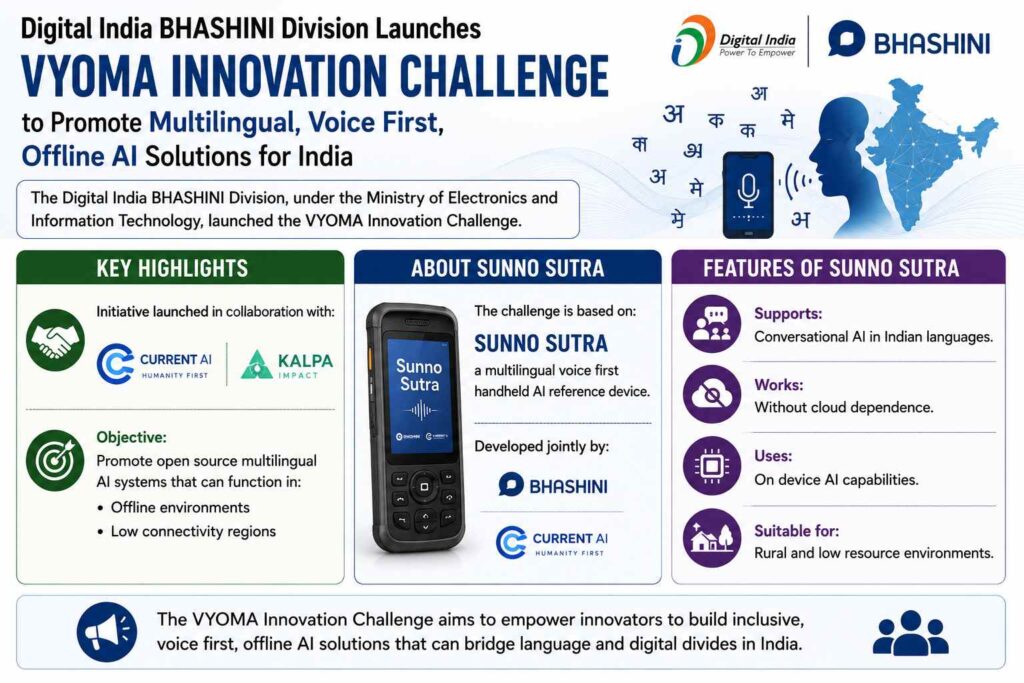
  • VYOMA Innovation Challenge

    Why in the news?

    The Digital India BHASHINI Division, under the Ministry of Electronics and Information Technology, launched the VYOMA Innovation Challenge to promote multilingual, voice first, offline AI solutions for India.

    Key Highlights

    • Initiative launched in collaboration with:
      • Current AI
      • Kalpa Impact.
    • Objective:
      • Promote open source multilingual AI systems that can function in:
        • Offline environments
        • Low connectivity regions.

    About Sunno Sutra

    The challenge is based on:

    • Sunno Sutra: A multilingual voice first handheld AI reference device.
    • Developed jointly by: BHASHINI and Current AI.

    Features of Sunno Sutra

    • Supports: Conversational AI in Indian languages.
    • Works: Without cloud dependence.
    • Uses: On device AI capabilities.
    • Suitable for: Rural and low resource environments.

    Objectives of the VYOMA Innovation Challenge

    • Encourage development of:
      • Multilingual AI applications.
      • Voice based technologies.
    • Improve:
      • Digital accessibility.
      • Language inclusion.
    • Promote: Edge AI innovation in India.

    What is Edge AI?

    Edge AI refers to: Artificial Intelligence processing directly on local devices instead of remote cloud servers.

    Advantages:

    • Faster processing
    • Offline functionality
    • Better privacy
    • Reduced internet dependence

    Sectors Targeted

    Potential applications include:

    • Education
    • Agriculture
    • Healthcare
    • Governance
    • Public service delivery

    [2020] With the print state of development, Artificial Intelligence can effectively do which of the following?
    1. Bring down electricity consumption in industrial units
    2. Create meaningful short stories and songs
    3. Disease diagnosis
    4. Text -to -Speech Conversion
    5. Wireless transmission of electrical energy
    Select the correct answer using the code given below:

    [A] 1, 2, 3 and 5 only

    [B] 1, 3 and 4 only

    [C] 2, 4 and 5 only

    [D] 1, 2, 3, 4 and 5

  • Prime Minister Research Chair (PMRC) Scheme 2026

    Why in the news?

    The Department of Higher Education under the Ministry of Education launched applications for the Prime Minister Research Chair (PMRC) Scheme 2026 to attract global Indian talent into India’s research and innovation ecosystem.

    Key Highlights

    • The scheme aims to connect:
      • Indian origin researchers and professionals working abroad
        with:
      • India’s higher education and research institutions.
    • Focus areas include:
      • Research
      • Innovation
      • Technology development.

    Objectives of PMRC Scheme

    • Strengthen: India’s research ecosystem.
    • Promote: International academic collaboration.
    • Enhance: Innovation in strategic sectors.
    • Support: Mission oriented research in national priority areas.

    Thematic Areas Covered

    The scheme focuses on 13 national priority sectors including:

    • Artificial Intelligence
    • Quantum Computing
    • Semiconductors
    • Cybersecurity
    • Biotechnology
    • Healthcare and MedTech
    • Space and Defence
    • Advanced Materials
    • Blue Economy
    • Atomic Energy
    • Climate Change and Sustainability.

    [2018] Consider the following statements :
    Human capital formation as a concept is better explained in terms of a process which enables
    1. individuals of a country to accumulate more capital.
    2. increasing the knowledge, skill levels and capacities of the people of the country.
    3. accumulation of tangible wealth.
    4. accumulation of intangible wealth.
    Which of the statements given above is/are correct?

    [A] 1 and 2

    [B] 2 only

    [C] 2 and 4

    [D] 1, 3 and 4

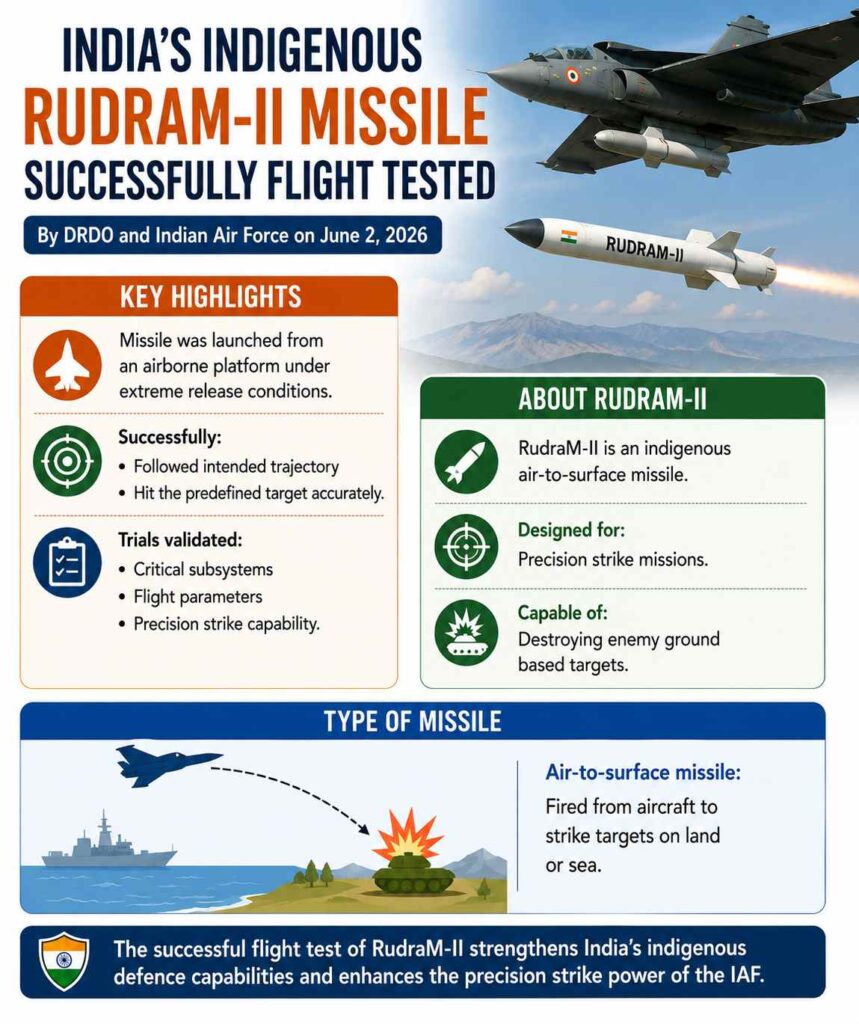
  • Successful Flight Test of RudraM-II Missile

    Why in the news?

    Defence Research and Development Organisation and the Indian Air Force successfully flight tested the indigenous RudraM-II air-to-surface missile on June 2, 2026.

    Key Highlights

    • Missile was launched from: An airborne platform under extreme release conditions.
    • Successfully:
      • Followed intended trajectory
      • Hit the predefined target accurately.
    • Trials validated:
      • Critical subsystems
      • Flight parameters
      • Precision strike capability.

    About RudraM-II

    • RudraM-II is an indigenous air-to-surface missile.
    • Designed for Precision strike missions.
    • Capable of destroying enemy ground-based targets.

    [2023] Consider the following statements
    1. Ballistic missiles are jet-propelled at subsonic speeds throughout their fights, while cruise missiles are rocket-powered only in the initial phase of fight.
    2. Agni-V is a medium-range supersonic cruise missile, while BrahMos is a solid-fuelled intercontinental ballistic missile.
    Which of the statements given above is/are correct?

    [A] 1 only

    [B] 2 only

    [C] Both 1 and 2

    [D] Neither 1 nor 2