💥Mains Ready By December. Smash Mains & Smash PYQ Admissions Open

Subject: Internal Security

  • Centre bans Pak-based Shahzad Bhatti terror network under UAPA

    Why in the News

    The Ministry of Home Affairs has declared the Pakistan-based Shahzad Bhatti Network (SBN) a terrorist organisation under the Unlawful Activities (Prevention) Act, 1967. A gazette notification invoked Section 35 of the Act to add the network to the First Schedule, which lists banned terrorist organisations. The notification records that the network draws gullible youth and local criminals into smuggling arms, explosives and narcotics from across the border, and that it uses digital communication platforms to circulate provocative messages. The designation follows a nationwide crackdown on an alleged SBN linked network last month, in which security agencies detained 253 people across 14 States. The question it raises is what a domestic ban adds against a syndicate whose leadership, funding and handlers all sit outside Indian jurisdiction.

    How does a Section 35 designation under the UAPA work?

    1. The power: Section 35 empowers the Central Government to add an organisation to the First Schedule by notification in the Official Gazette, where it believes the organisation is involved in terrorism. The listing is what makes the organisation a terrorist organisation in law.
    2. The threshold: An organisation is treated as involved in terrorism where it commits or participates in acts of terrorism, prepares for them, promotes or encourages terrorism, or is otherwise concerned in it. The present notification records that the network has participated in various acts of terrorism in India.
    3. The consequences: Membership, support, fundraising and arranging meetings for a listed organisation become distinct punishable offences under the Act. The listing therefore reaches the domestic support structure rather than the organisation’s leadership abroad.
    4. The remedy: A listed organisation may apply to the Central Government for removal from the Schedule, and a refusal goes to a Review Committee headed by a sitting or retired High Court judge. That committee is the only statutory check on the designation.

    What is the network accused of doing?

    1. Cross border smuggling: The network is accused of moving arms, explosives and narcotics across the border using local conduits. The notification treats the smuggling as the resource base for the terrorist activity rather than as a separate crime.
    2. Recruitment of petty criminals: The stated method is to offer allurements to gullible youth and local criminals, motivate them for anti-national activity and mobilise resources through them. Recruitment runs through the criminal economy rather than through an ideological cadre.
    3. Online radicalisation and propaganda: The network published hateful digital content and used communication platforms to circulate provocative messages. The stated targets are India’s democratic structure and communal harmony.
    4. Espionage and reconnaissance: The network is suspected of paying local conduits to conduct reconnaissance and install CCTV cameras for surveillance of police, defence and religious sites. It is also linked to grenade, improvised explosive device and petrol bomb attacks and to targeted killings.
    5. Attribution to a named handler: Shahzad Bhatti is accused of using social media to recruit young people, and is suspected of a link to the grenade attack at the residence of a YouTuber in Jalandhar in March last year.
    6. State backing: The network is described as a Pakistan-based syndicate backed by the Inter-Services Intelligence (ISI), Pakistan’s military intelligence agency. That characterisation is what moves it from an organised crime case to a national security one.

    What did the crackdown recover?

    1. Scale of the operation: Security agencies detained 253 people across 14 States days before Independence Day. The geographic spread indicates a recruitment base well beyond the border States.
    2. Ordnance recovered: Recoveries included improvised explosive devices, grenades bearing Pakistan Ordnance Factory markings, pistols and live cartridges. State factory markings on recovered grenades are the material link between the network and an official supply chain.
    3. Surveillance equipment: CCTV cameras allegedly installed for espionage were among the recoveries. The presence of surveillance hardware alongside weapons indicates a network doing target development, not only delivery.

    Why does the crime and terror linkage change the security problem?

    1. Self financing structure: Narcotics trafficking funds weapons movement, so the network does not depend on transfers through the formal financial system. Financial intelligence tools built for tracing bank flows have little purchase on a cash and contraband economy.
    2. Deniable local execution: Using petty criminals rather than trained cadre gives the handlers distance from the act and makes attribution harder after an arrest. The person caught rarely knows the chain above him.
    3. Shared border infrastructure: The same tunnels, drone routes and courier networks serve both narcotics and weapons consignments. Eg. Drone borne consignments recovered along the Punjab border have carried both heroin and small arms in the same drop.
    4. Broader footprint than a conventional outfit: A syndicate built on crime scales through existing criminal markets in the interior rather than through ideological recruitment. That explains a detention footprint across 14 States for a single network.

    Challenges to the UAPA designation route

    1. No reach over handlers abroad: A domestic listing criminalises support inside India and does nothing to a leadership operating under state protection across the border. Eg. Individuals designated globally under the United Nations Security Council’s 1267 sanctions regime have continued to operate from Pakistan for years.
      The Fix: Pair every domestic listing with a dossier submitted for designation under the 1267 Committee and under partner countries’ national sanctions lists.
    2. Designation is not conviction: Proscription restricts an organisation and still requires the ordinary burden of proof in each prosecution that follows. Eg. Cases registered under the Act routinely run for years before trial concludes, and conviction rates recorded in them are low.
      The Fix: Resource the National Investigation Agency’s prosecution capacity and set internal timelines for filing charge sheets, so a listing converts into completed trials.
    3. Renaming and reconstitution: A proscribed network can resume operations under a fresh name, which requires a fresh notification each time. Eg. Front organisations of banned outfits have repeatedly reappeared under new banners after a ban.
      The Fix: Notify successor and front entities in the same instrument that lists the parent organisation, so a name change does not restart the process.
    4. Civil liberties objections to the statute: Section 43D(5) bars bail where the accusation is prima facie true, so pre-trial custody can extend for years. Eg. In Union of India v. K.A. Najeeb (2021) the Supreme Court held that prolonged incarceration with no prospect of an early trial permits bail despite that bar.
      The Fix: Fix a statutory outer limit for filing the charge sheet in listed organisation cases, after which the bail bar lapses.
    5. Weak seizure of assets: A ban restricts an organisation’s property in law, and the proceeds of narcotics trafficking sit in cash and in benami holdings that are hard to attach. Eg. Terror funding investigations frequently record hawala transfers with no identifiable account holder at either end.
      The Fix: Route listed organisation cases through the Prevention of Money Laundering Act, 2002 machinery in parallel, so attachment proceedings run alongside the terror prosecution.

    Conclusion

    The Shahzad Bhatti Network now sits in the First Schedule, and the immediate effect is to make support for it inside India a separate offence. The designation lands on the domestic layer of the network, which is the layer the August detentions had already reached. Whether the ban changes anything depends on what follows it: charge sheets against those detained, attachment of the assets the smuggling generated, and a listing request carried into international forums. The point to watch is the first prosecution filed against a person charged as a member, since that is where the notification is tested rather than announced.

    Matching Previous Year Question

    “Indian government has recently strengthened the anti-terrorism laws by amending the unlawful activities (Prevention) Act (UAPA), 1967 and the NIA Act. Analyze the changes in the context of prevailing security environment while discussing the scope and reasons for opposing the UAPA by human rights organizations.”

  • Meta to share child safety reports with govt. directly

    Why in the News

    Meta Platforms Inc., the parent company of Facebook and Instagram, will report child sexual abuse material (CSAM) cases directly to the cybercrime portal run by the Indian Cyber Crime Coordination Centre (I4C) under the Union Ministry of Home Affairs. Indian agencies have had access to such reports for years through a 2019 memorandum of understanding between the National Crime Records Bureau (NCRB) and the United States based National Center for Missing and Exploited Children (NCMEC), which received them first. The change follows scrutiny of the company by the Union government and the National Commission for Protection of Child Rights (NCPCR) over reports of such material being served in advertisements on its platforms. The NCPCR has opened an investigation after an initial exchange of correspondence with the company. The question the arrangement raises is whether a voluntary reporting channel can substitute for a duty the company can be held to.

    What is the Indian Cyber Crime Coordination Centre?

    1. I4C: It is the Union Ministry of Home Affairs body that coordinates the response of law enforcement agencies across States to cybercrime.
    2. The reporting portal: It runs the National Cyber Crime Reporting Portal, through which a complaint filed by a citizen or an agency is routed to the police jurisdiction concerned.
    3. Why a national portal exists: Policing is a State subject, so a central entry point is needed to move a report to the State that can act on it.
    4. Founding: It was established in 2018 as a centralised mechanism against cybercrime, and it also runs the national cybercrime helpline.

    How did the reporting route work until now?

    1. The American obligation: A technology company based in the United States is required by its own law to report apparent child sexual exploitation on its services to NCMEC, which operates the CyberTipline.
    2. The 2019 memorandum: NCRB signed a memorandum of understanding with NCMEC that year, giving Indian agencies access to tipline reports concerning India.
    3. The volume involved: More than 69.05 lakh CyberTipline reports had been shared with the States and Union Territories concerned as on 31 March 2024, per the Union government’s reply in the Rajya Sabha that year.
    4. The extra step: Every report reached an Indian agency only after passing through a body in another jurisdiction, so the Indian system received reports rather than generated them.

    What prompted the change?

    1. Advertising as the vector: News reports described child sexual abuse material being served in advertisements on Facebook and Instagram, which placed the material inside the paid inventory the company itself sells.
    2. The company’s account: Meta stated that it screens all advertisements posted by third parties, and that some bad actors were able to get such content posted anyway.
    3. The regulatory response: The Union government and the NCPCR examined the company over those reports in recent weeks.
    4. The commission’s step: NCPCR has initiated an investigation on the basis of its correspondence with the company.
    5. The company’s commitment: Meta has said that protecting children on its platforms is a priority and that it will work with the government to hold the perpetrators of these crimes responsible.

    What does direct reporting change in practice?

    1. One less jurisdiction in the chain: A report moves from the company to the Indian portal without first being filed with a body governed by another country’s law and disclosure rules.
    2. Speed against evidence decay: Subscriber records, device logs and uploaded content are retained for limited periods, so the interval between detection and a police request decides whether the evidence still exists.
    3. Routing to the police station: A report arriving at the portal can be sent directly to the district and the State in which the account holder sits.
    4. The existing channel continues: Reporting to NCMEC runs alongside, so the direct route is an addition rather than a replacement.
    5. A first among intermediaries: No other major intermediary currently reports child safety matters directly to the Indian portal, so this arrangement becomes the reference point for what others may be asked to do.

    Challenges to intermediary reporting of child sexual abuse material

    1. The channel is a commitment, not a duty: An undertaking offered by a company can be narrowed or withdrawn without breaching anything. Eg. Section 19 of the Protection of Children from Sexual Offences Act, 2012 places a reporting duty on any person with knowledge of an offence, and it was not drafted for automated detection at platform scale.
      The Fix: Notify a platform level reporting standard under the Information Technology Act, 2000 specifying the format, the timeline and the designated recipient for every significant social media intermediary.
    2. Detection is limited to what a platform can scan: Hash matching finds material already known to investigators, and end to end encrypted messaging carries content no server side scan can read. Eg. Meta completed the rollout of default end to end encryption on its messaging services, which removes the message body from inspection.
      The Fix: Require reporting of behavioural and metadata signals, such as bulk contact of minor accounts from a single adult account, where the content itself cannot be inspected.
    3. Reports outrun the capacity to act on them: Millions of tipline reports have reached Indian agencies while forensic examination capacity sits in a small number of units. Eg. The Cyber Crime Prevention against Women and Children scheme funds State cyber forensic laboratories and training precisely because examination capacity lags complaint volume.
      The Fix: Publish the disposal rate of tipline reports alongside the number shared, so capacity is measured against the load rather than assumed.
    4. Paid distribution fails differently from user posts: An advertisement that clears review is then delivered to a selected audience by the platform’s own targeting machinery, so a single screening failure is amplified rather than contained.
      The Fix: Require human review before first delivery for any advertisement flagged by an automated child safety classifier, with the reviewer’s decision recorded.
    5. Takedown is not victim identification: Removing a file closes the platform’s obligation and leaves the child in it unidentified. Eg. NCMEC runs a dedicated child victim identification programme precisely because a removed image still points to an offence that is continuing.
      The Fix: Route every report to a designated child protection unit alongside the police, so identification and rehabilitation begin with the investigation rather than after it.
    6. Cross border evidence still needs the treaty route: Content and subscriber data held on servers abroad are obtained through mutual legal assistance, which a reporting channel does not shorten. Eg. Mutual legal assistance requests to the United States routinely take many months to return data.
      The Fix: Issue a data preservation request at the moment the report is received, so the material is held while the formal request is processed.

    Conclusion

    Reporting is the point at which a platform’s private detection becomes a matter for the state, and that point has now moved from a body in another country to one in India. What has not changed is the basis of the arrangement, which is an undertaking the company has offered rather than an obligation it owes. The unresolved tension is between voluntary cooperation from the largest intermediaries and a statutory duty that would bind all of them equally. The marker to watch is what the NCPCR investigation concludes about advertisement screening, since that finding will decide whether reporting alone is accepted as a sufficient answer.

    Back2Basics: National Center for Missing and Exploited Children

    1. Nature: It is a private non profit organisation in the United States, not a law enforcement agency.
    2. Founding: It was established in 1984 and operates under a mandate from the United States Congress.
    3. The CyberTipline: It runs the centralised reporting line to which technology companies based in the United States are legally required to report apparent child sexual exploitation.
    4. What it does with a report: It reviews each report and forwards it to the law enforcement agency with jurisdiction, whether in the United States or abroad.

    Matching Previous Year Question

    “Discuss different types of cyber crimes and measures required to be taken to fight the menace”

  • Ahead of election, Punjab talks drugs again; its children are still paying the price

    Ahead of election, Punjab talks drugs again; its children are still paying the price

    Why in the News

    Punjab’s narcotics trade has changed its form without shrinking. A transit route for opium derivatives has hardened into an entrenched narcotics economy, and it now runs on cheaper pharmaceutical drugs, on drone deliveries across the international border and on supply reaching inmates inside prisons. The state police campaign Yudh Nasheyan Virudh, launched in March 2025, has produced large arrest and seizure numbers, and the Punjab Governor has said the trade cannot survive even 10 days without the support of the police and the administration. With Assembly elections approaching, every party has again made drug eradication a campaign promise, which is what the previous three campaigns were as well. The contest is between the scale of enforcement recorded on paper and the availability of the drug on the street.

    How has the nature of Punjab’s narcotics trade changed?

    1. From transit route to economy: The origin of the crisis is traced to Punjab’s geography and its proximity to the Golden Crescent, the major opium producing region spanning Afghanistan, Iran and Pakistan. What began largely as a transit route evolved into a far more entrenched narcotics economy.
    2. Pharmaceutical substitution: Cheaper pharmaceutical drugs now flood local markets alongside narcotics.
    3. Misuse of prescription medicine: Chemists speak openly about the misuse of medicines meant for pain relief and neurological disorders. A pharmaceutical company based in Dehradun discontinued a pill, known locally as the “ghodeyanwala capsule”, after widespread allegations of its abuse.
    4. The vocabulary of the crisis: Words such as “chitta” (heroin), “goliyan” (pills) and “sooiyan” (injectables) have become part of everyday language in the state.
    5. A shift in public reaction: When the film Udta Punjab was released in 2016, many in the state objected that it tarnished Punjab’s image. That outrage has given way to grim acceptance.

    What do the enforcement numbers under the current campaign show?

    1. Case volume: Between 1 March 2025 and 2 September 2026 the police registered 59,293 FIRs under the Narcotic Drugs and Psychotropic Substances Act, 1985 (NDPS Act).
    2. Arrests and seizures: 696 major traffickers were arrested, 3,757 kg of heroin and 62 lakh tablets were seized, and Rs 22 crore in drug money was recovered.
    3. Property action: Punjab also began attaching and demolishing properties allegedly built from drug proceeds, a method taken from Uttar Pradesh.
    4. Availability unchanged: Voices on the ground insist the supply has not dried up, and that chitta remains as easily available as salt.

    What does complicity inside the enforcement machinery do to the campaign?

    1. The Governor’s assessment: The Punjab Governor, who has walked with Mothers Against Drugs, said the trade cannot survive even 10 days without the support of the police and the administration.
    2. An admission in court: In an affidavit before the Punjab and Haryana High Court, the police admitted that drugs are available inside prisons.
    3. What the prison figures show: Inmates registered for opioid treatment rose from 2,540 at the time of entry to 15,768.
    4. The court’s observation: The Chief Justice of the Punjab and Haryana High Court observed that addiction had multiplied four to five times after incarceration.

    How have the supply routes outrun the counter measures?

    1. Drone deliveries: Drones now ferry drugs and weapons across Punjab’s nearly 500 km international border.
    2. Daylight runs: Counter drone systems are deployed, and this summer drones still made deliveries in daylight.
    3. A riverine route: During the 2023 floods the police cracked a case in which a trafficker from Jalandhar sent three swimmers across the Sutlej to retrieve 50 kg of heroin.
    4. What the run paid: The swimmers were reportedly paid between Rs 1 lakh and Rs 2.5 lakh for every kilogram ferried, and consignments grew larger during last year’s floods.

    What is the human cost the enforcement figures do not capture?

    1. A death in Sangrur: A labourer from Sangrur consumed Celphos tablets after allegedly being threatened by the local sarpanch and others for questioning a sitting minister about rampant drug abuse in the area.
    2. Compensation still pending: His widow and his sons say they are yet to receive the compensation and the job they were promised.
    3. Earnings consumed by the drug: One of his sons said he spent every paisa he earned as a daily wage labourer on chitta.
    4. Children as collateral damage: In Badshahpur village in Kapurthala three children were left alone at home after their father came out on bail in a case under the NDPS Act, their mother went to prison and their elder sister was detained over a video of her allegedly selling drugs.

    Why have successive campaigns and political promises left the trade intact?

    1. The 2014 campaign: The Shiromani Akali Dal and BJP government launched the state’s first anti drug campaign during its tenure in 2014.
    2. The 2017 pledge: The Congress leader who became Chief Minister in 2017 swore on a holy book to eradicate drugs within four weeks.
    3. The 2022 promise: The Aam Aadmi Party came to power in 2022 with the Chief Minister promising decisive results within a year.
    4. Drugs as a campaign asset: In 2017 the Aam Aadmi Party, then in Opposition, gained traction by making drug abuse one of its biggest campaign issues.
    5. The current round: The Shiromani Akali Dal (Waris Punjab De) made drugs the centrepiece of its speeches at the Rakhar Puniya rally, and the BJP’s Nasha Mukt Yatras begin in mid September and end in a rally to be addressed by the Union Home Minister.
    6. Treatment through faith: A jailed Member of Parliament built much of his early popularity on promises of rehabilitation centres in gurdwaras, and families have arrived at the gurdwara in his native village of Jallupur Khera with drug dependent relatives.

    Challenges to Punjab’s anti narcotics effort

    1. Arrests that do not become convictions: Cases collapse at trial over procedural lapses in search, seizure and sampling, so enforcement volume does not produce deterrence. Eg. Section 50 of the NDPS Act requires a search to be offered before a gazetted officer or a magistrate, and failures there have repeatedly voided recoveries.
      The Fix: Route every commercial quantity case through dedicated NDPS special courts with trained prosecutors and time bound forensic reporting.
    2. Users charged in place of suppliers: Most registered cases are small quantity cases against consumers, which fills prisons without reaching the supply chain. Eg. Section 64A of the NDPS Act offers immunity from prosecution to an addict who volunteers for treatment, and it is rarely invoked.
      The Fix: Divert small quantity cases into treatment under Section 64A and judge the campaign on trafficker convictions rather than on FIR counts.
    3. Treatment capacity expanding faster than supervision: Opioid substitution treatment scales up without dispensing controls, so the substitute itself leaks into the market. Eg. Buprenorphine tablets dispensed at treatment centres are resold outside them.
      The Fix: Move outpatient opioid substitution to daily supervised dosing with a digital dispensing record at every centre.
    4. A state campaign against an interstate supply chain: Diverted pharmaceutical stock and precursor chemicals enter from manufacturing states that a state police campaign cannot reach. Eg. Tramadol and similar opioid formulations move in from units outside Punjab.
      The Fix: Place licensed pharmaceutical distributors in the border districts on a common online sales trail audited against prescription records.

    Conclusion

    Punjab’s drug problem is not one of not knowing what to do. Successive campaigns have named the same targets, produced the same pledges and left the trade to change its form rather than its size. What has never been tested is action against the part of the machinery the Governor named, and that is the one variable the state fully controls. The measure to watch after the election is not the weight seized but the number of major traffickers convicted and the number of enforcement personnel prosecuted.

    Drug trafficking in India

    1. Narco terrorism: The use of drug trafficking by terrorist organisations or insurgent groups to fund, sustain and expand their operations, so proceeds from the narcotics trade finance violence and subversion against the state.
    2. Financing of terror groups: Narcotics profits are a major source of funding for terrorist groups. Eg. Lashkar e Taiba, Babbar Khalsa International and Hizbul Mujahideen have used drug revenues to sustain operations.
    3. The eastern corridor: Porous borders with Myanmar carry both drug trafficking and insurgent financing. Eg. The Moreh corridor in Manipur.
    4. Maritime exposure: A long coastline with limited marine policing enables sea based narcotics trafficking into Indian ports.

    Government Initiatives for drug trafficking control

    1. Narcotics Control Bureau: The central agency that coordinates drug law enforcement across state and central agencies and handles trafficking cases with an interstate or international reach.
    2. Four tier NCORD mechanism: The Narco Coordination Centre integrates effort from the national level down to the district level, bringing enforcement and intelligence agencies onto a single platform.
    3. Seizure Information Management System: A portal developed under the NDPS Act to coordinate seizure data across all drug law enforcement agencies.
    4. Anti Narcotics Task Forces: Dedicated State and Union Territory units led by senior police officers, set up to implement anti drug strategies and strengthen local enforcement.
    5. National Policy for Drug Demand Reduction: Run by the Ministry of Social Justice and Empowerment to reduce addiction among users rather than to police supply.
    6. Nasha Mukt Bharat Abhiyaan: A demand reduction campaign of the same Ministry, focused on the most affected districts and combining awareness, community outreach and linkage to treatment facilities.

    Back2Basics: Narcotic Drugs and Psychotropic Substances Act, 1985

    1. India’s principal anti drug legislation, criminalising the production, manufacture, possession, sale, transport and trafficking of narcotic drugs and psychotropic substances.
    2. Penalties are graded by the quantity involved, with the harshest reserved for commercial quantity offences.
    3. Bail in a commercial quantity case is barred unless the court records satisfaction that the accused is not guilty and is unlikely to offend again.
    4. An addict charged with a small quantity offence may seek immunity from prosecution by volunteering for treatment.

    Matching Previous Year Question

    “[2018, GS3, 15 marks] India’s proximity to two of the world’s biggest illicit opium-growing states has enhanced her internal security concerns. Explain the linkages between drug trafficking and other illicit activities such as gunrunning, money laundering and human trafficking. What counter-measures should be taken to prevent the same?”

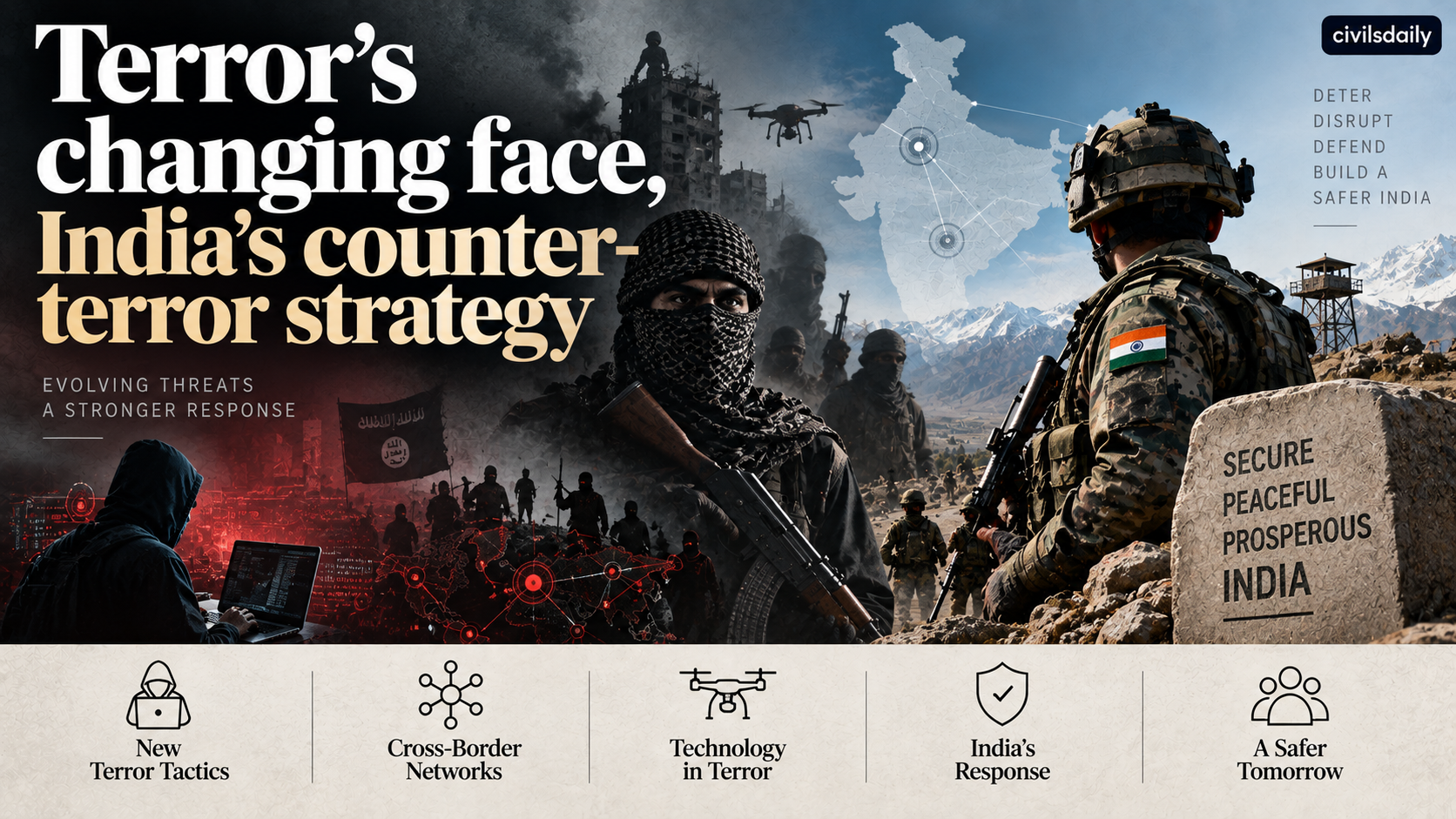
  • Terror’s changing face, India’s counter-terror strategy

    Terror’s changing face, India’s counter-terror strategy

    Why in the News

    India has unveiled PRAHAAR, its first comprehensive National Counter Terrorism Policy and Strategy, which sets a national framework for preventing and responding to terrorist activity and radicalisation through coordinated “whole of government” and “whole of society” approaches. The policy follows Operation Sindoor, the strikes of 6 and 7 May on the Pakistan based terror network launched after the Pahalgam attack of 22 April 2025, and follows the three declarations India issued immediately after that operation. The first of those declarations ended the stated era of restraint, the second classified any future act of cross border terrorism emanating from Pakistan as an “act of war”, and the third removed Pakistani nuclear blackmail as a restraining factor. The tension is that the doctrine India has hardened is built for a state sponsor with a return address, while the threat itself has fragmented into lone wolf attackers, autonomous cells and drone, cyber and artificial intelligence enabled methods that a retaliatory strike does not reach.

    What is PRAHAAR?

    1. PRAHAAR as a national policy: PRAHAAR is India’s first comprehensive National Counter Terrorism Policy and Strategy, unveiled on 23 February 2026.
    2. Scope of the framework: It sets out a national counter terrorism framework for preventing and responding to terrorist activities and to radicalisation.
    3. Whole of government and whole of society approach: It works through coordinated “whole of government” and “whole of society” approaches, so prevention is not left to security agencies alone.

    How has the form of terrorism changed in 25 years?

    1. The organisational form has fragmented: Large terror groups run by single leaders, such as al-Qaeda under Osama bin Laden or the Islamic State under Abu Bakr al-Baghdadi with its call for an Islamic Caliphate, have given way to smaller and more autonomous entities.
    2. The attacker is now often solitary: Lone wolf attacks are becoming the norm, which removes the network that intelligence collection is designed to detect.
    3. Drones, cyber capability and artificial intelligence: Drones, cyber capabilities and artificial intelligence are now used to perpetrate terror.
    4. Counter terrorism use of the same technologies: Those technologies are used by the nations combating terrorism as well, so capability advantage is contested rather than assured.

    What is a lone wolf attack?

    1. The definition: A lone wolf attack is an attack planned and executed by a single individual, or by a pair acting alone, who belongs to no organisation and takes no operational direction from one.
    2. How the attacker is produced: Radicalisation runs through online propaganda rather than through recruitment by a handler, so the individual adopts a group’s cause without ever joining its structure. Eg. Self radicalised modules assembled around professionals, rather than around infiltrators, in recent hinterland cases.
    3. Why detection fails: Intelligence collection works by intercepting communication between conspirators and by penetrating networks, and an attacker who communicates with nobody generates neither signal.
    4. Why a retaliation doctrine does not reach it: A cross border response needs attribution to a sponsoring state, and an individual acting alone offers no camp, handler or command node to strike.

    Why did the early Indian response stay passive, and which attacks fell inside that period?

    1. Assassination of a former Prime Minister, 1991: The assassination of former Prime Minister Rajiv Gandhi by the Liberation Tigers of Tamil Eelam on 21 May 1991 at Sriperumbudur in Tamil Nadu came while cross border terror was only beginning in Kashmir.
    2. Internal detection failed repeatedly: The March 1993 Mumbai serial blasts killed over 250 people in 13 coordinated blasts, and the synchronised blasts across Coimbatore in February 1998 exposed the inadequacy of internal security mechanisms.
    3. Pakistan’s direct role was first exposed by a hijack: The hijack of Indian Airlines flight IC-814 on 24 December 1999 forced India to release the Pakistan based terrorists Ahmed Omar Sheikh and Masood Azhar in exchange for more than 160 civilian hostages.
    4. Operation Parakram and its outcome: The Jaish-e-Mohammed (JeM) attack on Parliament on 13 December 2001 triggered a large scale military mobilisation under Operation Parakram, and after almost two years of standoff the disengagement took place with no direct punishment on Pakistan.
    5. Nuclear parity was the restraint: With both countries holding nuclear weapons, the threat of escalation drew the international community in to cool tempers each time.
    6. The 26/11 Mumbai attacks and the absence of retaliation: The 26/11 Mumbai attacks of November 2008, which brought the world’s solidarity with India’s fight against cross border terrorism, produced no military action against Pakistan.
    7. The Red Fort attack of 2000: An Army garrison within the Red Fort was targeted on 22 December 2000 by Lashkar-e-Taiba (LeT) terrorists, killing three soldiers.
    8. Delhi market blasts of 2005: Over 60 people were killed in serial blasts across Delhi markets including Sarojini Nagar and Paharganj in October 2005.
    9. Delhi commercial district blasts of 2008: Multiple blasts hit Connaught Place, Greater Kailash and Karol Bagh in September 2008, months before the Mumbai attacks.
    10. The Delhi High Court blast of 2011: A briefcase bomb outside the Delhi High Court on 7 September 2011 killed 15 people, claimed by Harkat-ul-Jihad Islami (HUJI), an al-Qaeda affiliated group largely based in Pakistan.
    11. Akshardham, Varanasi and Pune attacks: The 2002 Akshardham Temple attack, the 2006 Varanasi serial blasts and the 2010 German Bakery blast in Pune are part of the same record.
    12. Proof did not produce a response: In each of these cases India chose not to respond directly and decisively, even after conclusive proof of Pakistan’s support.

    What changed when the fight moved across the border?

    1. The Uri attack and the 2016 surgical strikes: The JeM attack on an Army camp at Uri in Kashmir on 18 September 2016 led to the first cross border surgical strikes on 28 and 29 September.
    2. Message conveyed by the surgical strikes: They sent a message and served as a statement of intent that terror would not go unpunished.
    3. The Balakot air strike of 2019: After the attack on a Central Reserve Police Force convoy at Pulwama on 14 February 2019, the Indian Air Force struck a JeM terror camp at Balakot, the first time it had crossed into Pakistani airspace to hit a terror target.
    4. Operation Sindoor, 2025: Operation Sindoor was launched on 6 and 7 May after the Pahalgam attack, and in 96 hours the leaders and headquarters of the LeT and JeM networks were destroyed and Pakistani military assets were hit.

    What is the four fold strategy proposed from here?

    1. Elimination of the residual network: Continue to hunt down and eliminate the remnants of the terror network inside the country, particularly in Kashmir.
    2. Pre emptive action across the Line of Control: Take pre emptive military action against any potential terror threat building across the Line of Control (LoC), including at terrorist launch pads, which years of experience and an embedded intelligence network make possible.
    3. The de radicalisation programme: Run an exhaustive de radicalisation programme that motivates young people towards the mainstream and makes joining or supporting a terror outfit unattractive and prohibitively costly.
    4. Terror financing: Take all necessary steps to cut off terror financing, in close coordination with friendly countries.

    What is India pressing for at the multilateral level?

    1. The charge of double standards: At the Shanghai Cooperation Organisation Summit in Bishkek on 1 September the Prime Minister said, “We must send a strong message to countries that use terrorism as an instrument of policy and provide safe haven and support to terrorists that terrorism can never be a strategic asset for anyone.”
    2. A named attack entered a group declaration: The 18th BRICS Summit in New Delhi included an exclusive paragraph on the Pahalgam attack in the Delhi Declaration.
    3. Effect of a grievance carried in multilateral text: A specific Indian grievance is now carried in the text of a multi country declaration rather than only in national statements.

    Challenges to India’s counter terrorism strategy

    1. A retaliation doctrine has no target in a lone wolf attack: An “act of war” classification presumes an attributable state sponsor, and a self radicalised individual acting alone gives no address to strike. Eg. Self radicalised modules assembled around professionals, rather than infiltrators, in recent hinterland cases.
      The Fix: Pair the declaratory doctrine with a published attribution standard, so the threshold of evidence that triggers a cross border response is fixed in advance rather than argued after each attack.
    2. Police and public order are State subjects: A national policy has to be executed through State police forces that the Union does not control, which is where coordination breaks down. Eg. The delay in National Security Guard deployment during the 26/11 Mumbai attacks.
      The Fix: Route PRAHAAR’s obligations through a standing Centre State counter terrorism council with State specific implementation timelines, rather than through advisories.
    3. Intelligence remains fragmented across agencies: Multiple collection agencies without seamless real time sharing means a warning held by one is not actionable by another. Eg. Intelligence fusion is attempted through the Multi Agency Centre and the National Intelligence Grid, which depend on voluntary feeds from database holding agencies.
      The Fix: Give a single fusion centre statutory authority to task and receive feeds, on the model of a national counter terrorism centre, so sharing is an obligation rather than a courtesy.
    4. De radicalisation has no measurable output: A programme aimed at intent rather than at incidents cannot be judged by attack counts, and India runs no published evaluation of one. Eg. Online influence of the kind that drove youth radicalisation in Kashmir operates outside any programme’s reach.
      The Fix: Fix published indicators for the programme, such as recruitment attempts intercepted and cases of disengagement sustained over a stated period, and report them annually.
    5. Terror financing has moved to channels outside the banking system: Hawala, counterfeit currency and cryptocurrency route funds without touching a reportable transaction. Eg. Informal channel financing was traced in the ISIS linked Padgha module.
      The Fix: Bring virtual digital asset service providers fully under reporting obligations to the Financial Intelligence Unit India, so the fastest growing channel is monitored on the same terms as banks.
    6. There is no agreed international definition of terrorism: The absence of one lets states label selectively and refuse cooperation on legal grounds. Eg. Repeated holds placed on listings under the United Nations Security Council 1267 sanctions committee.
      The Fix: Press the Comprehensive Convention on International Terrorism, which India first proposed in 1996, to a vote rather than leaving it in open ended negotiation.

    Conclusion

    The doctrine India adopted after Operation Sindoor answers one form of the threat well and leaves the other untouched. A declared willingness to retaliate raises the cost of sponsoring an attack from across the border; it does nothing about an attacker who was recruited online and never crossed anything. PRAHAAR is the first instrument that addresses the second half, which is why its prevention and radicalisation components, rather than its enforcement components, are the part worth watching. The marker is whether the policy produces named nodal responsibilities and reported outcomes, or remains a framework document that the next attack is measured against.

    Terrorism in India

    1. Definition of terrorism: Terrorism is the deliberate use of violence, or the threat of violence, to instil fear and achieve political, ideological or religious goals.
    2. The statutory definition: Under Section 15 of the Unlawful Activities (Prevention) Act, 1967, a terrorist act is any act intended to threaten India’s sovereignty, security or unity, or to create terror through violence, explosives or disruption of essential services.
    3. The four recognised strands in the Indian context: Cross border terrorism driven by Pakistan based groups in Jammu and Kashmir and by Khalistani networks, North East insurgencies run by ethno nationalist groups such as NSCN and ULFA, Left Wing Extremism across the Red Corridor, and hinterland terrorism by modules operating outside traditional conflict zones.
    4. The direction of change: The terror and organised crime nexus supplies funding, arms and logistics, and technology acts as a force multiplier through drones, encrypted platforms and 3D printing. Eg. The Houthi drone attack on Saudi Aramco in 2019.

    Institutional Architecture and Initiatives Against Terrorism

    1. Multi Agency Centre and Cyber Multi Agency Centre: Fuse intelligence inputs across central and State agencies.
    2. National Intelligence Grid: Networks databases held by different departments to give agencies real time access.
    3. Indian Cyber Crime Coordination Centre: Acts as the nodal point against cybercrime with a citizen reporting route. Eg. The 1930 helpline.
    4. Border management systems: Smart fencing under the Comprehensive Integrated Border Management System plugs infiltration gaps, backed by a layered coastal security grid.
    5. Surrender and rehabilitation policies: Pull cadres out of insurgency through reintegration rather than through prosecution alone.

    Matching Previous Year Question

    “[2025, GS3, 10 marks] Terrorism is a global scourge. How has it manifested in India? Elaborate with contemporary examples. What are the counter measures adopted by the State? Explain.”

  • Looking up at the drones

    Why in the News

    Data pooled from over 1,200 drones intercepted in Punjab since 2024 has mapped the cross border smuggling network that flies them. The mapping names the launch pads inside Pakistan’s Punjab, the Indian villages where payloads are dropped, the hours of peak activity and the altitudes flown. It follows an interception count that has held steady rather than fallen, with 294 Pakistani drones downed by the Border Security Force (BSF) and allied agencies in Punjab in 2024, 287 in 2025 and roughly the same number again by August 2026. Punjab had answered the threat in August 2025 with the Rs 51.4 crore ‘Baaz Akh’ (Hawk Eye) Anti-Drone System (ADS), the first state level anti-drone grid in the country. The same dataset shows why that answer is not holding, since drones now carry satellite links and a return to home fail-safe that turns them back before they can be brought down. The network along Punjab’s 550-km International Border is therefore better understood than at any point since 2019 and no easier to stop.

    What is the ‘Baaz Akh’ Anti-Drone System?

    1. What it is: A state funded anti-drone grid deployed by the Punjab government as a second line of defence behind the BSF’s own portable interception equipment.
    2. The four functions it performs: It detects a drone’s movement and signal, tracks it on a digital map, jams its control link, and forces an emergency landing for ground recovery.
    3. What it jams: It disrupts either radio frequency control signals or satellite navigation frequencies, and can identify the ground control station operating the drone.
    4. Its reach: The system works over a range of 8 to 10 km and issues automated alerts to security agencies.

    What does the intercepted drone data reveal about the network’s geography?

    1. Eight launch pads, two of them primary: Sustained sorties come from at least eight launch pads in Pakistan’s Punjab, with the villages of Jahman and Masteki as the main two.
    2. Both primary pads face Tarn Taran: Jahman sits directly across from the Khalra sector in Tarn Taran district. Masteki lies in the Sehjra enclave, a pocket of Pakistani territory surrounded by India on three sides, roughly opposite Khem Karan town.
    3. The remaining pads: They lie near Kasur, opposite Khem Karan; Qila Jiwan Singh, opposite Rajatal in the Attari sector; Wagah, opposite Attari; and Narowal, across from Dera Baba Nanak in Gurdaspur district.
    4. The landing areas: Payloads are dropped at Bhindi Saidan, Attari, Rajatal, Dall, Daleri, Maari Meghaan, Wan and villages around Khem Karan including Kals and Mastgarh.
    5. Where the drones are recovered: The highest number of interceptions on the Indian side occur 3.5 km to 10 km from the International Border.

    What do the timing and flight patterns show?

    1. A fixed nightly window: Maximum activity falls between 10 pm and 4 am, at an average of 12 to 15 drones an hour.
    2. The drops cluster on two days: The highest number of consignment drops take place on Thursdays and Saturdays.
    3. Sortie length separates stock from modified platforms: The average sortie runs 45 minutes, and modified drones average 24 minutes. Eg. One DJI Matrice drone recorded 42.67 minutes and a DJI Matrice 4 Pro recorded 15 minutes before it was downed.
    4. Altitude separates them too: Commercial DJI platforms fly at about 500 feet, and a modified eight rotor platform, the octocopter, was tracked at 2,500 feet.
    5. The drop point is chosen for pickup, not for accuracy: Consignments are dropped on agricultural fields for couriers to collect. Navigational error and incorrect GPS data put some payloads onto farmhouses and homes instead.

    How has the technology changed since the incursions began?

    1. The 2019 baseline: Pakistani drones were first noticed in Punjab around 2019, operating on rudimentary radio frequency direction control.
    2. The 2026 platform: Drones now operating in Punjab carry satellite communication and anti-jamming capability, and some downed in Punjab were navigating on Starlink satellite links.
    3. The airframes are commercial and Chinese made: The platforms in use for drug smuggling include the DJI Mavic 4 Pro, which can fly multiple sorties, and the DJI Matrice 300 RTK, which carries a large payload.
    4. The payload has not narrowed: The consignments carry narcotics, weapons and explosives, launched from pads deep inside Pakistan’s Punjab and dropped across the border under cover of darkness.

    Why does the fence no longer decide what crosses the border?

    1. It was built for a different mode of entry: The 462-km fence along the International Border went up mainly in the late 1980s and early 1990s to stop infiltration and smuggling during the militancy years.
    2. What it consists of: It is a multi-layered barrier of 8 to 12 feet, topped with rows of concertina and razor wire and, in places, high voltage ‘cobra’ wires, with a patrol track, observation towers and border outposts along it. Most of the feasible land border had been fenced and floodlit by 1993.
    3. It does not stand on the border: Older ground rules placed it some 150 yards inside Indian territory. In many stretches it was built two to three km in, leaving large tracts of farmland between the fence and the Zero Line.
    4. The gaps are physical as well as aerial: The line carries riverine and flood related gaps, and the incursions it was built to stop now arrive over it rather than through it.

    Why does detection not translate into seizure?

    1. The return to home fail-safe defeats the jam: Drones detect the interference from jamming, locking or control signal disruption and fly back to their launch point in Pakistan before they can be neutralised or recovered on the Indian side.
    2. Jamming weakens with distance: Some attempts fail simply because the drone is too far from the jamming unit when it is engaged.
    3. Autonomous platforms are not vulnerable to the method: Current systems fail against resilient drone networks built with features that reduce dependence on radio frequency control, which is what jamming targets.
    4. Coverage is thin: Security officers put the requirement at at least 100 jamming units for effective wider coverage, against the units now deployed on vehicles and in fixed positions.
    5. Recovery depends on people, not the grid: Interception is a layered system requiring coordination between the BSF, police quick reaction teams and ground recovery parties, so detection without a rapid ground response yields no seizure.
    6. Three threats the grid does not yet address: Small and low signature drones go undetected, drones operating together in swarms on artificial intelligence and decentralised communication are anticipated, and remote terrain with harsh weather leaves some drop zones inaccessible.

    What role do the border villages play in interception?

    1. They are the first reporting layer: Punjab set up village defence committees to help tackle cross border smuggling and drones, and their members coordinate with the BSF and local authorities on stray drones and recovered weapons.
    2. The reporting chain is unreliable: A committee member in Gilpan, where a drone dropped a kg of contraband in his kitchen garden 700 metres from the fence, got no response from the local police station or the Deputy Superintendent of Police, and the local police moved only after the Senior Superintendent of Police in Tarn Taran was called.
    3. Recovery is a race the couriers usually win: In the same village a second drone dropped a payload at the village edge that evening. The BSF received the location and moved to cordon the area, and the men had already collected the consignment and fled by the time it arrived.
    4. Farmers fear prosecution more than the drop: A farmer whose field received a consignment in Mahawa, Amritsar, approached the committee fearing arrest, and the police eventually filed a case against unidentified persons.
    5. Some settlements sit inside the flight path: Mahawa lies a kilometre from the Zero Line with nearly 150 of its 2,800 acres between the Zero Line and the fence, and drones travel up to six kilometres inside the border directly over houses and fields.
    6. Activism against the trade carries a cost: The sarpanch of Attari village, a settlement of around 25,000 known for its campaigning against drugs and smuggling, was injured in an alleged attack by narcotics smugglers.

    Challenges to countering cross border drone smuggling

    1. The cost asymmetry runs the wrong way: A commercial quadcopter costs a fraction of the detection and jamming equipment needed to stop it, so the defender pays more per sortie than the smuggler. Eg. The DJI platforms recovered in Punjab are off the shelf civilian models sold for survey and photography work.
      The Fix: Shift procurement toward cheap distributed sensors feeding one command picture, rather than a small number of high cost integrated units.
    2. Jamming cannot be used freely in civil airspace: Broad spectrum jamming and navigation spoofing interfere with civil aviation and telecom signals, which limits where and how long a grid can be switched on. Eg. Amritsar’s Sri Guru Ram Dass Jee International Airport sits within a few tens of kilometres of the border stretches under surveillance.
      The Fix: Authorise narrow band directional jamming tied to a designated counter drone corridor, cleared in advance with the civil aviation regulator.
    3. Attribution stops at the launch pad: A recovered drone establishes the route and the airframe, and it does not establish who financed or ordered the consignment. Eg. Cases from border villages routinely close against unidentified persons because the courier is the only link recoverable on the ground.
      The Fix: Treat each recovered drone as a forensic exhibit, with serial, flight log and payload traced through a single dedicated investigation unit rather than by the local police station.
    4. Responsibility is split across agencies: Border guarding, state policing and airspace regulation sit with different authorities, so no single body owns the counter drone task end to end. Eg. Punjab’s grid is a state asset operating alongside the BSF’s own portable interception equipment on the same stretch of border.
      The Fix: Place the state grid, the border force’s equipment and police response under one joint operations centre per border district.
    5. Interdiction does not touch demand: Stopping a consignment in the air does nothing to the narcotics market that pays for the next one. Eg. Village committee members link the drone drops directly to drug use among young people in the border belt.
      The Fix: Pair the counter drone grid with treatment and de-addiction capacity in the border districts, so the seized supply is not simply replaced.
    6. Legal cover for the technology is thin: Bringing down an aircraft, jamming a signal and seizing a payload each rest on different statutory powers, and none was written with armed drones in mind. Eg. Civil drone operations in India are governed by the Drone Rules, 2021, which regulate lawful operators rather than hostile cross border flights.
      The Fix: Enact a standing counter unmanned aircraft framework naming the authorities empowered to detect, jam, down and seize, and the evidentiary status of what is recovered.

    Conclusion

    The border belt’s smuggling geography is no longer a matter of inference, since the launch pads, the drop villages, the flying hours and the altitudes are now on record. That record shifts the problem from intelligence to coverage, because a mapped network still needs equipment dense enough to engage it before it turns back. The measure to watch is whether the jamming grid reaches the density its own operators have asked for, and whether the annual interception count starts falling rather than holding flat. A count that stays level while the grid expands would show the platforms are outrunning the countermeasure rather than being contained by it.

    Back2Basics: Border Security Force

    1. What it is: India’s primary border guarding force, raised on 1 December 1965 after the India-Pakistan war exposed the limits of relying on state armed police on the border.
    2. Who it reports to: It is a Central Armed Police Force under the Ministry of Home Affairs, and it guards the India-Pakistan and India-Bangladesh borders in peacetime.
    3. Where its powers come from: The Border Security Force Act, 1968 gives its personnel powers of search, seizure and arrest within a notified belt running inland from the border.
    4. How far that belt extends: The Union government extended that jurisdiction to 50 km from the border in Punjab, West Bengal and Assam in 2021, up from 15 km in Punjab.

    Matching Previous Year Question

    “[2023, GS3, 10 marks] The use of unmanned aerial vehicles (UAVs) by our adversaries across the borders to ferry arms / ammunitions, drugs, etc., is a serious threat to internal security. Comment on the measures being taken to tackle this threat.”

  • Financial Fraud Risk Indicator crosses ₹5,000 crore in prevented fraud

    Why in News

    1. Milestone crossed: The Financial Fraud Risk Indicator (FRI) has prevented suspected cyber fraud transactions of over ₹5,000 crore.

    Core facts

    1. What FRI is: The Financial Fraud Risk Indicator is a real time risk assessment framework. It flags whether a mobile number may be linked to cyber crime or fraud.
    2. Administering body: The Department of Telecommunications (DoT) developed and operates it. It launched on 22 May 2025.
    3. Risk classes: FRI classifies mobile numbers into three categories. These are Medium, High and Very High risk.
    4. Data sources: It draws on citizen reports through Sanchar Saathi, the National Cybercrime Reporting Portal, telecom operators and financial institutions.
    5. Use by institutions: Banks, payment providers, insurers and pension entities use the risk signal for transaction monitoring.
    6. Amount protected: FRI prevented ₹5,043.73 crore in suspected fraud as of August 2026.
    7. Recent record: Over ₹2,000 crore was prevented between April and August 2026. More than 1,600 organisations are on the platform.

    Static Context

    1. The Digital Intelligence Platform was launched by the Department of Telecommunications in 2024. FRI operates within it.
    2. Sanchar Saathi is a citizen portal to report suspected fraud communication and to block lost or stolen mobile handsets.
    3. The National Cybercrime Reporting Portal is run by the Indian Cyber Crime Coordination Centre (I4C) under the Ministry of Home Affairs.

    Prelims angle

    1. FRI custodian: Department of Telecommunications, within the Digital Intelligence Platform.
    2. Related platforms: Sanchar Saathi, National Cybercrime Reporting Portal and I4C are frequently tested.

    Mains angle

    1. GS3, internal security: A question can assess how real time data sharing between telecom and banking systems strengthens India’s response to cyber financial fraud.

    Matching Previous Year Question

    “No direct Prelims PYQ on financial fraud prevention was traced in the provided files. Closest Microtheme: Cyber Security (Internal Security).”

    “[2022, GS3, 10 marks] What are the different elements of cyber security? Keeping in view the challenges in cyber security, examine the extent to which India has successfully developed a comprehensive National Cyber Security Strategy.”

  • India, China Corps Commander talks went on for two days: MEA

    Why in the News

    India and China held Corps Commander-level military talks in the eastern sector on 6 and 7 September, the Ministry of External Affairs has said. The talks were the first Senior Highest Military Commander-Level Flag Meeting, and were held on two consecutive days at Wacha on the Indian side in Arunachal Pradesh and at Damai on the Chinese side. They took place amid ongoing tensions in the Taksing area of the Upper Subansiri district of Arunachal Pradesh. The meeting was held pursuant to understandings reached between the Special Representatives of the two countries, and comes days before the Chinese President’s likely visit to India. The question it raises is whether a channel built to manage friction points can do anything about the undefined boundary that keeps producing them.

    What is the Corps Commander-level mechanism?

    1. Talks between field commanders: It is a military-to-military channel in which the corps commander responsible for a sector meets his counterpart, with other officers present, to resolve issues on the ground.
    2. It began in the west: The mechanism has existed in eastern Ladakh since 2020 to resolve the military standoff between India and China along the Line of Actual Control (LAC), the notional line separating the two sides’ areas of control.
    3. Its record there: India and China have held 23 rounds of Corps Commander-level meetings at the Chushul-Moldo border meeting point in eastern Ladakh.
    4. Both sectors now carry it: The Ministry of External Affairs has confirmed that a similar mechanism also exists in the Western Sector.

    Who met, and where?

    1. A two day, two country format: The flag meeting was held at Wacha on the Indian side on Sunday, 6 September, and at Damai on the Chinese side on Monday, 7 September.
    2. A corps commander led the Indian side: The commander of the Army’s III Corps, also called the Spear Corps, met his Chinese counterpart along with other officers.
    3. The formation involved: III Corps is headquartered at Rangapahar near Dimapur in Nagaland.
    4. The announcement: The Ministry of External Affairs confirmed the talks at a press conference on Tuesday, 8 September.

    What produced the meeting?

    1. A political track above it: The talks took place pursuant to understandings reached between the Special Representatives of India and China in August 2025 and August 2026.
    2. Who the Special Representatives are: India is represented by the National Security Adviser and China by its Foreign Minister, and the two met in Beijing on 25 August.
    3. An officials track below it: The talks also followed discussions at the Working Mechanism for Consultation and Coordination (WMCC), the standing forum of diplomatic and military officials on border affairs, which met in Beijing in May 2026 and in New Delhi in August 2026.

    Why does the timing matter?

    1. The friction has moved east: The mechanism that produced 23 rounds was built for eastern Ladakh. The tension now being managed is in Arunachal Pradesh.
    2. A summit is days away: The talks come ahead of the Chinese President’s likely visit to India for the BRICS Summit on 12 and 13 September.
    3. The diplomatic track has been busy: Two rounds of Special Representative understandings and two meetings of the officials’ forum preceded this flag meeting in the year before it.

    Challenges to the border talks mechanism

    1. The channel manages friction, not the boundary: Commander level talks settle patrolling, deployment and local incidents, and they do not address where the line itself runs. Eg. The rounds held in eastern Ladakh produced disengagement at specific points without altering any claim on the alignment.
      The Fix: Return the Special Representatives’ track to sector by sector clarification of the alignment, with an agreed exchange of maps as the first deliverable.
    2. Disengagement is not de-escalation: Troops pulled back from a friction point remain deployed in depth, with the roads, habitat and airfields built during the standoff still in place. Eg. Buffer zones created after 2020 removed contact but also removed patrolling access for both sides.
      The Fix: Pair every disengagement step with a verified and reciprocal reduction in rear area deployments, checked by agreed technical means.
    3. Routine contact in the east runs at a lower level: Day to day communication between the two armies operates through Border Personnel Meeting points staffed well below corps level, which slows the handling of a serious incident. Eg. In the eastern sector these points are at Bum La and Kibithu in Arunachal Pradesh.
      The Fix: Convert the new commander level flag meeting into a scheduled annual mechanism rather than an incident driven one, with a dedicated hotline between the two corps headquarters.

    Conclusion

    The commander level channel now exists in the eastern sector and has met once. What it can settle is patrolling, deployment and local incidents. What it cannot settle is where the line runs, which stays with the political track above it. The next marker is the Chinese President’s visit to Delhi later this month, and whether the two leaders convert a new military channel into a dated timetable for clarifying the alignment in the east.

    Matching Previous Year Question

    “[2024, GS3, 15.0 marks] India has a long and troubled border with China and Pakistan fraught with contentious issues. Examine the conflicting issues and security challenges along the border. Also give out the development being undertaken in these areas under the Border Area Development Programme (BADP) and Border Infrastructure and Management (BIM) Scheme.”

  • Inside India’s problem with reporting child sexual abuse material

    Why in the News

    The National Human Rights Commission (NHRC) has issued notices to two Union ministries and the Delhi Police over paid Instagram advertisements. The advertisements allegedly used search terms such as “rape video” and “child video” to direct users to Telegram channels offering child sexual abuse material (CSAM). The Commission has directed that an Action Taken Report reach it within two weeks. The advertisements had passed the review systems of Meta, which owns Instagram, and remained available until the company’s attention was drawn to them. Two questions follow from that failure: whether the statutory duty to report the offence was complied with, and whether a platform whose artificial intelligence systems actively shape content can still claim the legal protections available to intermediaries.

    What is a CyberTipline report?

    1. An alert raised by the platform: A CyberTipline report is generated when a technology platform detects suspected child sexual abuse material and refers it for law enforcement follow up.
    2. It locates the material, not its source: A report often identifies where the material was found, not where it originated, and establishing origin requires a separate investigation.
    3. How it reaches an Indian investigator: Reports are processed by the National Crime Records Bureau (NCRB) and the Indian Cybercrime Coordination Centre (I4C), and are then routed and assigned to the relevant State and district authorities.

    What has the Commission asked of the platform?

    1. Whether the offences were reported at all: Meta has been asked whether the alleged offences were reported, and, if they were not, to identify those responsible for ensuring compliance.
    2. The duty lies on any person: Section 19 of the Protection of Children from Sexual Offences (POCSO) Act, 2012 requires any person who apprehends that an offence under the Act is likely to be committed, or who knows one has been committed, to report it to the Special Juvenile Police Unit or the local police.
    3. Internal processes do not discharge it: The Commission’s stated position is that the obligation cannot be substituted by internal correspondence, grievance redressal or regulatory engagement.

    Is a platform that shapes content still an intermediary?

    1. The systems do more than host: A supplementary representation before the Commission argued that Meta’s artificial intelligence assisted tools generate captions, recommend posting schedules, optimise engagement and assist monetisation.
    2. The classification question has been referred: The Ministry of Information and Broadcasting has been asked to examine whether such functions remain consistent with intermediary status, or whether they resemble the role of a publisher of online curated content under the Information Technology Rules, 2021.
    3. The stake in the answer: Intermediary status carries protection from liability for content that others post. A publisher of curated content carries responsibility for what it puts out.

    How many reports arrive, and how many become cases?

    1. The volume: India received around 1.9 million CyberTipline reports in 2025.
    2. The conversion is small: Only a fraction of those reports translate into police action.
    3. Verification precedes registration: Authorities conduct a preliminary verification before a first information report is registered, and not every report progresses beyond that stage.

    Where does a report stall before an FIR?

    1. Report quality varies: The reports vary significantly in quality and completeness, so many cannot carry a preliminary verification at all.
    2. A prima facie test on the material: Investigators assess whether the flagged material prima facie depicts child sexual abuse material. Once jurisdiction is identified and the material verified, the case is forwarded to the local police station or cyber police unit.
    3. Age is the recurring obstacle: Verifying the age of the victim is among the more recurring difficulties, since poor image quality, blurred visuals or uncertainty about age obstruct that finding.
    4. Attribution comes last: Only once a first information report is registered do investigators begin identifying the individual behind the account.

    What decides the outcome in court?

    1. A designated forum: Cases are generally tried before the special courts designated under the POCSO Act.
    2. Convictions turn on digital evidence: Defence arguments frequently focus on whether the accused was actually the person using the device, the SIM card or the internet connection linked to the offence.
    3. An unidentified offender ends the case: Where investigators cannot identify the person responsible, police may file a closure report.

    Challenges to CSAM detection and prosecution in India

    1. Encryption removes the point of detection: Offenders increasingly use encrypted platforms, where the service provider cannot scan content and therefore generates no report at all. Eg. End to end encrypted messaging leaves no server side copy for a platform to match against a database of known material.
      The Fix: Require significant platforms to report metadata level signals, such as advertising keywords and channel invitation links, where the content itself is not visible to them.
    2. Synthetic material defeats hash matching: Detection relies on matching a file against databases of known material, and newly generated images produce no match. Eg. Images of children produced by generative models carry no prior hash record.
      The Fix: Extend detection to classifier based models and recognise synthetic child sexual abuse material explicitly as an offence in the governing statute.
    3. The reporting duty has no platform specific machinery: Section 19 places the duty on any person, and prescribes no route by which a foreign incorporated platform files with an Indian police unit. Eg. Reports currently arrive through the CyberTipline chain rather than as a statutory filing by the company.
      The Fix: Prescribe a designated reporting channel and a fixed filing deadline for significant social media intermediaries under the Information Technology Rules.
    4. Judicial expansion has outpaced investigative capacity: The offence has been widened by the courts, and district cyber units have not grown to match it. Eg. In Just Rights for Children Alliance v. S. Harish (2024) the Supreme Court held that storing and viewing child sexual abuse material is itself an offence under Section 15 of the POCSO Act.
      The Fix: Fund district cyber forensic units and a national facility for medical and forensic age estimation, so verification is not left to the investigating officer’s judgement.

    Conclusion

    Detection is not the constraint in this system. The constraint sits between an automated alert and a chargeable case, where verification, jurisdiction and identification each remove a share of what was reported, and a closure report is the default outcome when identification fails. A platform whose systems recommend, caption and monetise what appears on it is not simply carrying what other people post, and the protection designed for a passive carrier does not obviously fit it. How the Ministry of Information and Broadcasting answers that classification question is the thing to watch.

    Back2Basics: National Human Rights Commission

    1. A statutory body: The NHRC was constituted under the Protection of Human Rights Act, 1993, and is not a constitutional body.
    2. Composition: It has a Chairperson and members, with the chairpersons of specified national commissions, including the National Commission for Protection of Child Rights, as ex officio members.
    3. Powers: It inquires suo motu or on a petition into a violation of human rights or negligence in preventing one, and holds the powers of a civil court for that inquiry.
    4. Limits: Its findings are recommendatory, and it can require the concerned government to report the action taken on them.

    Matching Previous Year Question

    “[2017] In India, it is legally mandatory for which of the following to report on cyber security incidents? 1. Service providers 2. Data Centres 3. Body corporate Select the correct answer using the code given below: (a) 1 only (b) 1 and 2 only (c) 3 only (d) 1, 2 and 3 ANSWER: (d)”

  • Vibrant Villages Programme

    Why in News

    PIB published a Backgrounder on the Vibrant Villages Programme (VVP) on 6 September 2026, setting out the scheme’s design and its border development record.

    What it is

    1. Core idea: The Vibrant Villages Programme is a Centrally Sponsored Scheme for the comprehensive development of villages along India’s land borders. It reframes the border village as the first village of India rather than the last.
    2. Implementing ministry: The Ministry of Home Affairs (MHA) runs the programme.
    3. Phase I coverage: The first phase covered villages in 46 border blocks across 19 districts in four States and one Union Territory along the northern border with China.
    4. Phase II scale: The second phase, Vibrant Villages Programme II (VVP II), carries an outlay of ₹6,839 crore. It covers 1,954 villages across 334 blocks in 17 States and Union Territories. It extends the model to international land borders beyond the northern frontier.

    Context

    1. Rationale: Border villages face out migration, weak roads and thin connectivity. The scheme saturates them with roads, telecom, housing, drinking water and livelihood support. Reverse migration and local perception management carry a direct security value.
    2. Delivery mode: Development happens through District administrations and Gram Panchayats. Convergence with existing central and state schemes funds the works.
    3. Distinct from BADP: The older Border Area Development Programme (BADP) funds infrastructure in border blocks generally. VVP targets identified border villages for saturation and reverse migration.

    [2026] Which of the following statements with respect to the Revamped Rashtriya Gram Swaraj Abhiyan (RGSA) is/are correct?
    1.The period of its implementation is 1st April, 2021 to 31st March, 2026.
    2.The key objective of the Revamped RGSA is to develop the governance capabilities of the Panchayati Raj Institutions to deliver on the Sustainable Development Goals.
    3.The share of the Central funding for the Revamed RGSA is 100% for all states and Union Territories.
    Select the answer using the code given below:

    [A] 1 and 2

    [B] 2 only

    [C] 1 and 3

    [D] 2 and 3

  • Global watchdog says rise of ‘digital hawala’ is aiding money laundering, terror financing

    Why in the News

    The latest report of the Financial Action Task Force (FATF), the inter-governmental body that sets the global standards against money laundering and terrorist financing, identifies the fusion of virtual assets with the traditional hawala system as one of the most significant developments in underground banking. The report is titled “Investigating Professional Money Laundering, Underground Banking, and the Use of Hawala and Other Similar Service Providers”. Nearly 70 per cent of surveyed jurisdictions have reported the integration of new technologies into such networks. The uses run from routine money laundering to the financing of terrorist organisations. The difficulty this creates is that a system built on trust between operators has acquired the speed and reach of digital finance without acquiring any of its supervision.

    What is “digital hawala”?

    1. The underlying system: Hawala is a centuries-old value transfer arrangement in which an operator in one country pays out to a recipient on the instruction of an operator in another, and the two settle their standing balance later between themselves.
    2. What makes it digital: “Digital hawala” covers the spectrum of technologies that facilitate the coordination, execution, settlement or concealment of these transactions.
    3. What has changed: Virtual assets now supply a settlement layer to a network that previously balanced its books through cash and trade alone.

    What are the six configurations the report identifies?

    1. Digital coordination with traditional settlement: Operators use encrypted messaging applications, shared ledgers and online platforms to communicate instructions, recruit clients and couriers, and maintain records, and settlement between them still moves through cash or trade.
    2. Digital customer interface: The client faces a mobile wallet or a fintech application, and settlement between operators again happens via cash or trade.
    3. Virtual asset-based settlement: Stablecoins are used to settle balances between operators directly, replacing the cash leg of the arrangement.
    4. Integration with formal digital infrastructure: Funds are moved through payment service providers, fintech platforms and virtual International Bank Account Numbers (IBANs), which are account identifiers issued without a physical branch relationship behind them.
    5. Artificial intelligence based tools: These automate transaction structuring, route value dynamically through mule accounts, and convert between currency and cryptocurrency at high speed.
    6. “Hawala” apps: These are bundled digital ecosystems combining messaging, cloud storage, social media, Virtual Asset Service Providers (VASPs), lending applications and gaming platforms in one product.

    Why do these configurations make detection harder?

    1. Speed and opacity rise together: The configurations make transactions faster, more opaque and more complex than the courier and ledger version they build on.
    2. The network gets larger and more durable: Digitisation expands both the reach of a network and its resilience, so removing one operator no longer breaks the chain.
    3. Digitisation is a catalyst and not a replacement: Traditional settlement mechanisms persist alongside the new layers rather than disappearing under them.
    4. Cash remains the pressure point: Cash stays critical at the collection and exit points, which is where an investigation still has a physical trail to find.

    What does the Turkiye case show about terror financing?

    1. The network’s purpose: Turkiye uncovered a “digital hawala” network financing the Islamic State of Iraq and the Levant (ISIL).
    2. The seizures: Raids in 2023 on a self-described ISIL “administrative officer” produced about $57,250 in cash, followed by a further $554,000.
    3. The evidence trail: Investigators recovered “hawala” notebooks alongside digital transfer receipts, so the paper ledger and the digital layer were running in parallel.
    4. The cover used: A jeweller and two mobile phone shops operated as fronts, and the transfers themselves were disguised as charity donations.

    Challenges to countering digital hawala

    1. Token settlement clears outside supervised payment rails: Balances settled in stablecoins move on public blockchains that no single national payments regulator oversees. Eg. FATF’s periodic reviews have found most assessed jurisdictions only partly compliant with its Travel Rule for virtual asset transfers.
      The Fix: Enforce originator and beneficiary information requirements on every registered Virtual Asset Service Provider, which in India are reporting entities under the Prevention of Money Laundering Act, 2002.
    2. Mule accounts scatter the trail across thousands of holders: Automated routing splits a single transfer across accounts opened in other people’s names, so no account shows an abnormal balance. Eg. The Indian Cyber Crime Coordination Centre has identified mule accounts as the standard cash-out layer in online fraud networks.
      The Fix: Require banks to share mule account indicators in near real time through a common registry rather than case by case after a complaint.
    3. Cooperation moves slower than the transaction: Formal evidence requests between countries take months while a chain of transfers completes in minutes. Eg. FATF’s 2024 mutual evaluation of India recorded delays in concluding money laundering prosecutions despite a broadly compliant legal framework.
      The Fix: Use the Egmont Group channel between financial intelligence units for immediate operational exchange, reserving formal treaty requests for trial-admissible evidence.
    4. The fronts are ordinary licensed businesses: Jewellers, phone dealers and travel agents handle high cash turnover legitimately, so the anomaly is invisible in the trading pattern itself. Eg. Dealers in precious metals and stones are treated as designated non-financial businesses under the FATF standards precisely because of this exposure.
      The Fix: Extend beneficial ownership disclosure and threshold reporting to these trades, and audit compliance rather than relying on registration alone.
    5. The regulated perimeter lags the product: Bundled applications combining messaging, lending and gaming fit no single licensing category, so no regulator holds clear jurisdiction over them. Eg. Application stores continue to host unregistered lending and wallet products that operate across borders.
      The Fix: Adopt an activity-based test that applies value transfer obligations to any product that moves value, whatever licence category it claims.

    Conclusion

    Underground banking has not been displaced by digital finance, it has absorbed it. Enforcement is left holding a mandate built for couriers and ledgers against a network that settles in tokens and routes itself automatically. Two things decide whether that gap closes. The first is whether virtual asset supervision reaches operators who never register, and the second is whether financial intelligence units can exchange information at the speed a transfer actually moves. The next marker is India’s follow-up reporting under the FATF mutual evaluation process, where the treatment of virtual asset service providers is the specific item under assessment.

    Back2Basics

    1. What it is: FATF is the inter-governmental standard setter on money laundering, terrorist financing and proliferation financing, established in 1989 at the G7 summit in Paris.
    2. How it works: Its Secretariat is housed at the Organisation for Economic Co-operation and Development in Paris, and its standards are the 40 Recommendations that member states are assessed against.
    3. Its enforcement tool: It maintains two public lists, jurisdictions under increased monitoring and high-risk jurisdictions subject to a call for action, which affect a listed country’s access to international finance.
    4. India’s position: India has been a full member since 2010, and is also a member of the Asia/Pacific Group on Money Laundering.

    Matching Previous Year Question

    “[2026, GS3, 15 marks] Discuss counterfeit currency and money laundering as major sources of terror funding in India. State the actions being taken at International level to check these menaces. Highlight the role of Financial Action Task Force (FATF) and methods of compliance by its member states in preventing terror funding.”