Why in the News
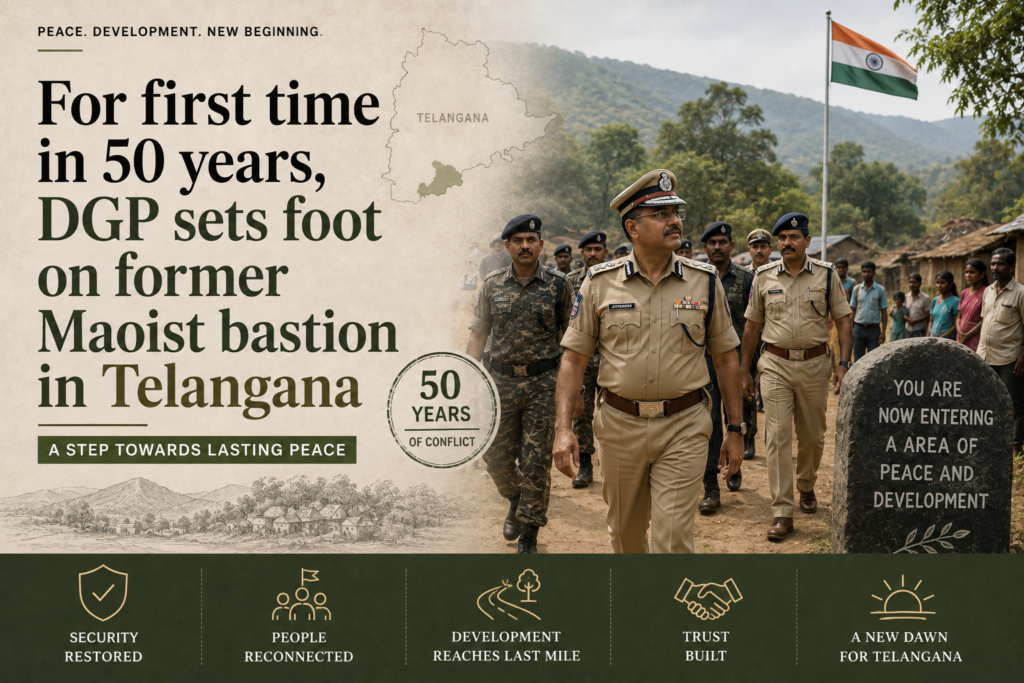
The Centre declared the country free from Naxalism on 31 March 2026, closing a security campaign that ran for decades across the forests of Chhattisgarh, Jharkhand and the rest of the former Red Corridor. The tension this exposes is that the military defeat of an insurgency does not by itself produce the economic activity that must occupy the space the guns have vacated.
What is Left Wing Extremism and what was the Red Corridor?
- The movement: Left Wing Extremism (LWE), commonly called Naxalism, is an armed insurgency pursuing the capture of state power through protracted rural armed struggle, drawing on Maoist doctrine.
- The territory: The Red Corridor was the contiguous belt of forested and mineral-rich districts across central and eastern India where Maoist cadres exercised effective control and the state's writ was contested.
- What that control looked like: For decades the region was associated with ambushes, armed cadres and Maoist control rather than with routine administration.
- The declared end point: The Centre declared the country free from Naxalism on 31 March 2026, which is treated as a turning point rather than as the end of the task.
What are CoBRA units?
- What they are: Commando Battalion for Resolute Action (CoBRA) is the specialised jungle warfare and guerrilla warfare force raised within the Central Reserve Police Force for anti-Naxal operations.
- Their role here: CoBRA units, deployed alongside state police forces, carried out the operations that dismantled strongholds which had remained difficult to penetrate for years.
What was the strategy that dismantled the insurgency?
- Intelligence-led operations: Operations were driven by actionable intelligence on cadre location and movement rather than by area domination alone.
- Centre and state coordination: Greater coordination between central and state forces removed the seams across state borders that cadres had used to evade pursuit.
- Disruption of Maoist financing: Agencies targeted the financial networks that sustained the insurgency, cutting the flow that paid, armed and supplied cadres.
- Rehabilitation: A surrender policy sought to bring former cadres back into civilian life through financial assistance, training and support for reintegration.
- Sustained expansion of the security grid: The security presence was expanded continuously rather than surged and withdrawn, so that recovered territory was held.
- Political direction from the top: Repeated engagement by the Union Home Minister, including visits to Bastar and security review meetings on the ground, kept the Centre involved in an operational challenge requiring coordination between Delhi, state governments and personnel deployed deep inside difficult terrain.
Which operations broke the strongholds?
- Black Forest: One of the named operations conducted by CoBRA units alongside state police forces.
- Octopus: A second named operation in the same series.
- Double Bull: A third named operation in the same series.
- Chakrabandha: A fourth named operation in the same series.
- The common outcome: Together these operations helped dismantle strongholds that had remained difficult to penetrate for years, which is what allowed a more permanent state presence to be established.
What has the development push delivered since 2014?
- Security infrastructure: 408 new security camps and 597 fortified police stations have been established in LWE-affected areas since 2014.
- Road connectivity: More than 12,000 km of roads have been constructed in the affected regions.
- Formal finance: 1,804 bank branches and 1,321 ATMs have been added.
- Postal reach: 6,025 post offices have been added.
- Telecommunications: Mobile connectivity has expanded across most villages in the affected regions.
- Education and skills: Eklavya Model Residential Schools, Industrial Training Institutes and skill development centres have been established alongside the physical infrastructure.
Why does a road, a bank branch or a tower change more than the statistic suggests?
- Roads change access, not distance: A road changes access to a market and to a hospital, converting a physical distance into a usable one.
- Bank branches change the terms of credit: A bank branch connects households to formal finance and displaces the informal lender who set the terms in its absence.
- Towers change the relationship to the state: A telecom tower brings a remote village closer to the rest of the country, which affects everything from grievance redress to remittances.
- Schools change the option set: A school or a skill centre expands the choices available to young people, which is the mechanism by which recruitment into an insurgency loses its appeal.
- The sequencing that made it possible: These interventions became feasible only once security forces could establish a more permanent presence in areas where the state had previously struggled to maintain one.
Why is the end of armed conflict the easier half of the task?
- The achievement is a milestone, not an outcome: The guns going silent is an important milestone, and the harder task is ensuring that the space they leave behind is filled with roads, schools, businesses, livelihoods and functioning institutions.
- The nature of the state's presence must change: The objective now is a state presence defined by institutions and opportunity rather than by the security challenge that once dominated the landscape.
- Infrastructure is an input, not a result: Roads, branches and towers must begin to generate sustained economic activity, better education and greater integration with the rest of India, which is not automatic.
- The next phase is less visible: The coming phase will be less dramatic than the operations that made the headlines, and could be more important in determining the legacy of the campaign.
- Reversibility is the risk: Rehabilitation must hold, since the surrender policy's purpose is to prevent former cadres from returning to the movement and to prevent the movement from replenishing its ranks.
- The test stated: The former Red Corridor becomes a development corridor only when the infrastructure now reaching these regions begins to generate sustained economic activity, which is where the larger test begins.
Conclusion
The military campaign against Left Wing Extremism succeeded through intelligence-led operations, central and state coordination, disruption of financing, rehabilitation and a sustained security grid, and the Centre declared the country free from Naxalism on 31 March 2026. The infrastructure that followed, 408 camps, 597 fortified police stations, over 12,000 km of roads, 1,804 bank branches, 1,321 ATMs and 6,025 post offices, has changed the physical reach of the state. What remains unresolved is whether that reach converts into sustained economic activity and institutions, since the durability of the achievement will be judged on that conversion and not on the operations.
Left Wing Extremism in India
- What it is: Left Wing Extremism is an armed movement seeking to overthrow the state through protracted people's war, organised around rural base areas, guerrilla zones and armed squads.
- Origin: The movement takes its popular name from the 1967 peasant uprising at Naxalbari in West Bengal.
- Present organisation: The Communist Party of India (Maoist) was formed in 2004 through the merger of the People's War Group and the Maoist Communist Centre of India, and is proscribed as a terrorist organisation.
- Geographic concentration: Activity was concentrated in a forested, mineral-rich and tribal-majority belt spanning Chhattisgarh, Jharkhand, Odisha, Bihar, Maharashtra, Andhra Pradesh, Telangana, Madhya Pradesh and West Bengal.
- Structural drivers: The movement drew on land alienation, displacement by mining and infrastructure projects, denial of forest rights, absence of administration and the weakness of local grievance redress in Fifth Schedule areas.
- The doctrinal frame: The Union government's approach has been organised around the SAMADHAN doctrine, which sets out the components of the counter-insurgency response.
- Institutional lead: The Ministry of Home Affairs coordinates the response through the Left Wing Extremism Division, with the Central Reserve Police Force as the principal central force deployed.
Laws Governing the Response to Left Wing Extremism
- Unlawful Activities (Prevention) Act, 1967: The principal central law used to proscribe the Communist Party of India (Maoist) and its front organisations and to prosecute membership and support.
- The 2019 amendment allows the designation of individuals, not only organisations, as terrorists.
- Prevention of Money Laundering Act, 2002: The instrument used to trace and attach the financial networks that sustained the insurgency.
- Chhattisgarh Special Public Security Act, 2005: A state law empowering the declaration of organisations as unlawful and criminalising membership and assistance in the most affected state.
- Andhra Pradesh Public Security Act, 1992: The corresponding state instrument in the southern part of the former corridor.
- Arms Act, 1959 and Explosive Substances Act, 1908: Govern possession and use of weapons and explosives, which are the principal charges alongside the terrorism statutes.
- Provisions of the Panchayats (Extension to the Scheduled Areas) Act, 1996 (PESA): Extends panchayat provisions to Fifth Schedule areas and vests the Gram Sabha with powers over land, minor minerals and local plans, addressing a grievance the insurgency mobilised.
- Scheduled Tribes and Other Traditional Forest Dwellers (Recognition of Forest Rights) Act, 2006: Recognises individual and community forest rights, addressing the land and forest alienation that underpinned recruitment.
- Fifth Schedule to the Constitution: Governs the administration of Scheduled Areas through the Governor and the Tribes Advisory Council, and is the constitutional frame within which most affected districts sit.
Government Initiatives for Left Wing Extremism Affected Areas
- National Policy and Action Plan, 2015: The overarching framework combining security measures, development interventions, rights and entitlements of local communities, and public perception management.
- Security Related Expenditure (SRE) Scheme: Reimburses state governments for security-related expenditure including training, operational costs, ex gratia payments and the surrender and rehabilitation of former cadres.
- Special Central Assistance (SCA) for the most affected districts: Funds public infrastructure and services in the districts of highest concern, filling critical gaps identified by district administrations.
- Special Infrastructure Scheme (SIS): Strengthens state police infrastructure, including special forces and fortified police stations, in affected states.
- Road Connectivity Project for LWE Affected Areas (RCPLWEA): Successor to the Road Requirement Plan, it constructs and upgrades roads and bridges to open isolated blocks to administration and markets.
- LWE Mobile Tower Project: Installs mobile towers in affected districts to extend telecommunications where commercial operators would not otherwise invest.
- Eklavya Model Residential Schools: Provide residential schooling for tribal children in blocks with high Scheduled Tribe population, extending secondary education in the affected belt.
- Aspirational Districts Programme: Targets the least developed districts, a large share of which fall in the former corridor, on health, nutrition, education, agriculture, financial inclusion and infrastructure indicators.
- Civic Action Programme: Funds central armed police forces to conduct welfare activities that build confidence between security forces and local communities.
Back2Basics: The SAMADHAN Doctrine
- What it is: SAMADHAN is the Union government's stated doctrine for countering Left Wing Extremism, articulated as an eight-point formulation.
- S, Smart leadership: Leadership capable of directing an operation that spans police, intelligence and administration.
- A, Aggressive strategy: A posture of sustained offensive operations rather than defensive holding.
- M, Motivation and training: Continuous training and morale management for deployed forces.
- A, Actionable intelligence: Intelligence specific enough to act on, which is the input the campaign was built around.
- D, Dashboard-based key result areas and key performance indicators: Measured performance targets for units and districts.
- H, Harnessing technology: Use of surveillance, communications and data tools in operations.
- A, Action plan for each theatre: A theatre-specific plan rather than a uniform national approach.
- N, No access to financing: Cutting the financial networks that sustain cadres, weapons and logistics.
Key Facts about the Left Wing Extremism Campaign
- The declaration: The Centre declared the country free from Naxalism on 31 March 2026.
- Central Reserve Police Force: The largest central armed police force, it marked its Raising Day on 27 July and has been the principal force deployed in the campaign.
- CoBRA: The Commando Battalion for Resolute Action is the Central Reserve Police Force's specialised jungle and guerrilla warfare unit for anti-Naxal operations.
- Named operations: Black Forest, Octopus, Double Bull and Chakrabandha are the operations named as having dismantled entrenched strongholds.
- Bastar: The Bastar division of Chhattisgarh was the operational centre of the campaign and the site of repeated ministerial review visits.
- Infrastructure since 2014: 408 new security camps, 597 fortified police stations, over 12,000 km of roads, 1,804 bank branches, 1,321 ATMs and 6,025 post offices in affected areas.
- The origin marker: The movement is named after Naxalbari in West Bengal, the site of the 1967 uprising.
Challenges in Consolidating the Post-Insurgency Transition
- Infrastructure without economic activity: Physical assets do not automatically generate livelihoods, e.g. more than 12,000 km of roads open access to markets only where there is production to move.
- Reversibility of surrender: Rehabilitation fails where former cadres find no economic footing, e.g. surrendered cadres receiving one-time financial assistance without sustained employment remain vulnerable to re-recruitment.
- Unsettled land and forest rights: The grievance that fed recruitment persists where titles remain unrecognised, e.g. pending individual and community claims under the Forest Rights Act, 2006 in Fifth Schedule districts.
- Displacement from mining and industry: Development in a mineral-rich belt can reproduce the alienation the insurgency mobilised, e.g. resettlement disputes around iron ore and coal projects in Bastar and Jharkhand.
- Thin administrative capacity: Newly opened blocks lack the staffing to run the institutions now built, e.g. teacher and health worker vacancies in interior blocks leave schools and health centres nominally functional.
- Security-first institutional habits: Areas administered through a security grid do not convert automatically to civil administration, e.g. 408 security camps and 597 fortified police stations remain the most visible state presence in many blocks.
- Justice system backlog: Cases registered during the campaign remain unresolved and undercut confidence, e.g. long undertrial detention of tribal accused under the Unlawful Activities (Prevention) Act, 1967.
- Residual and displaced cadres: Movement remnants may relocate rather than dissolve, e.g. cadre movement across inter-state boundaries has historically shifted the problem rather than ended it.
- Fragile fiscal continuity: Development spending contingent on the insurgency's salience declines once the emergency is declared over, e.g. schemes framed as LWE-specific lose their justification the moment the region is declared free.
Way Forward
- Shift funding from security-tagged to development-tagged windows: Convert LWE-specific central assistance into sustained district development funding, so financing does not lapse with the security declaration.
- Complete forest rights recognition: Clear the backlog of individual and community forest rights claims in the former corridor, which addresses the grievance the movement recruited on.
- Staff the institutions already built: Fill teacher, health worker and revenue staff vacancies in the newly connected blocks, since a building without staff does not constitute a functioning institution.
- Link infrastructure to production: Tie the road, banking and connectivity network to minor forest produce value chains, agro-processing and local enterprise credit, so that access converts into income.
- Make rehabilitation employment-linked: Extend the surrender policy beyond financial assistance into guaranteed placement in skill centres, Industrial Training Institutes and public works, so reintegration is durable.
- Strengthen PESA implementation: Operationalise Gram Sabha powers over land, minor minerals and local plans under the Provisions of the Panchayats (Extension to the Scheduled Areas) Act, 1996, so local consent governs the next phase of development.
- Fast-track pending cases: Establish dedicated courts to clear the backlog of insurgency-era cases, since prolonged undertrial detention undermines the legitimacy the campaign gained.
Matching Previous Year Question
“[2025, GS3, 10 marks] The Government of India recently stated that Left Wing Extremism (LWE) will be eliminated by 2026. What do you understand by LWE and how are the people affected by it? What measures have been taken by the government to eliminate LWE?”