The Supreme Court directed the Centre, States, and Union Territories to implement Standard Operating Procedures (SOPs) within four weeks to curb digital arrest cyber fraud, including freezing mule accounts, strengthening grievance redressal, and improving cybercrime coordination.
What is a Digital Arrest Scam?
A cyber fraud where scammers impersonate police or enforcement agencies through video/audio calls.
Victims are falsely told they are under “digital arrest” and coerced into transferring money.
What is a Mule Account?
A bank account used to receive and transfer proceeds of cyber fraud.
Often opened by unsuspecting or paid individuals.
Banks can impose temporary debit holds to prevent fraudulent withdrawals.
What is the Indian Cyber Crime Coordination Centre (I4C)?
A nodal agency under the Ministry of Home Affairs (MHA) for coordinating India’s response to cybercrime.
Operates the National Cyber Crime Reporting Portal (NCRP) and the 1930 Cyber Helpline.
Supreme Court Directions
Reserve Bank of India (RBI) to issue SOPs for temporary debit holds on mule accounts.
States/UTs to operationalise:
State Cyber Crime Coordination Centres.
e-Zero FIR mechanism.
Strengthen grievance redressal, money restoration, and public awareness.
Challenges
Cross-border cybercrime networks.
Rapid movement of funds through mule accounts and cryptocurrencies.
Weak inter-agency coordination.
SIM spoofing and fake identities.
Low public awareness, especially among the elderly.
Value Addition
e-Zero FIR
Enables registration of a cybercrime complaint without jurisdictional barriers.
The complaint is later transferred to the appropriate police station.
Citizen Response to Financial Cyber Fraud
Call 1930 immediately.
Report the incident on the National Cyber Crime Reporting Portal (NCRP).
Early reporting increases the chances of freezing fraudulent transactions.
Back2Basics: Indian Cyber Crime Coordination Centre (I4C)
Parent Ministry: Ministry of Home Affairs (MHA).
Established: 2020.
Key Components:
National Cyber Crime Reporting Portal (NCRP).
1930 Financial Cyber Fraud Helpline.
Mandate: Coordinate law enforcement, banks, telecom operators, and other stakeholders to prevent and investigate cybercrime.
“[2017] In India, it is legally mandatory for which of the following to report on cyber security incidents? 1. Service providers 2. Data Centres 3. Body corporate (a) 1 only (b) 1 and 2 only (c) 3 only (d) 1, 2 and 3
Artificial Intelligence (AI) and cyber threats have merged into a single, compounding security risk that traditional defences cannot contain. AI-powered malware now adapts on its own, autonomous agents undermine established protocols, and the newest models can find and exploit vulnerabilities faster than humans. The deeper conflict is that the technology capable of defending systems is the same technology enabling attacks, while the rules to govern it remain undeveloped.
What is Agentic AI?
Definition: Agentic AI refers to systems that act autonomously to pursue goals, taking sequential actions with minimal human prompting. It differs from Generative AI, which produces content in response to a user request.
Significance: Autonomous agents can perform complex tasks once reserved for people. As agentic operations grow more sophisticated, threat levels rise further.
Working
Perception: Gathers real-time data from tools, screens, or sensors.
Reasoning: Uses large models to break a big goal into small steps.
Action: Uses external software or APIs to complete the work.
Learning: Adapts its future choices based on past results
What is Zero Trust?
Definition:Zero Trust is a security model that assumes no user or device is trustworthy by default, verifying every access request continuously. It replaces the older assumption that anything inside a network is safe.
Erosion: Malicious autonomous agents are positioned to undermine Zero Trust protocols. This aggravates insider threat vectors within organisations.
How is AI transforming cyber threats?
Adaptive malware: AI-powered malware can adapt and evolve in response to its environment. This makes it harder for traditional anti-virus software to detect. Example: Self-Modifying Code: Rewrites internal structures or instructions continuously to change file fingerprints
Vulnerability discovery: The latest AI systems can detect zero-day vulnerabilities across major operating systems. A zero-day is a software flaw unknown to the vendor and unpatched at the time of attack.
Capability transfer: Newer AI machines let rogue groups demonstrate capabilities once limited to nation states. This lowers the barrier to sophisticated attacks.
Dual-use warning: The World Economic Forum warns AI will strengthen cyber defences while also enabling more sophisticated automated attacks. The same model can render current Zero Trust protocols ineffective.
How is AI reshaping warfare?
Precision targeting: AI-powered smart systems detect, track and predict missile trajectories with high accuracy. This was demonstrated in recent conflicts.
Autonomous munitions: Systems can independently identify and strike targets. This shifts elements of the kill decision away from human operators.
Multi-source intelligence: AI can fuse intelligence from photos, text, radio and electromagnetic signals. This denies adversaries a tactical advantage.
Cognitive core: Automated analytics platforms (such as Palantir Technologies or military software like Ukraine’s Delta) manage vast data inputs to recommend strikes and run logistics.
Drone accuracy: Software upgrades have pushed first-person view drone hit rates from roughly 30–50% up to 80%.
Where does the deeper tension lie?
Concentrated power: A handful of Western firms hold the most advanced models and behave as owners of future technology. Control over the mightiest technology is concentrating in a few private hands.
Governance vacuum: AI has the potential to become the dominant source of military and economic power. The rules to govern it remain in a fledgling state.
Escalating rivalry: The United States has accused China of stealing from its most advanced language model to build a rival. This reflects the intensity of the US-China technology competition.
What are the challenges to safe AI and cyber governance?
Hallucinations: Advanced models produce distortions and misleading outputs. Judgments built on them become unreliable and subjective.
Algorithmic bias: Biases creep into AI-driven decisions, including a bias towards national security framing. Unrestricted reliance on such outputs magnifies risk.
Algorithmic radicalisation: AI platforms can push opinion makers towards extreme views. Guarding against this requires active oversight.
Warning-understanding gap: In defence sensing, AI-dictated warnings can outrun proper understanding of reality. Acting on premature warnings carries strategic danger.
Loss of human control: Increasingly capable models and robots are replacing human roles in critical decisions. Keeping machines under human oversight is becoming harder.
Conclusion
The convergence of AI and cyber capability creates a civilisation-scale threat because the technology that defends systems is the same one that attacks them, and no adequate governance exists. The single most important precondition, human oversight backed by enforceable rules, is missing, and altruism from AI firms is not a substitute for it.
Back2Basics
CERT-In:
Indian Computer Emergency Response Team is the national nodal agency for cyber security incidents under the Ministry of Electronics and Information Technology.
Statutory basis: Operates under the Information Technology Act, 2000.
Generative vs Agentic AI
Generative AI
Agentic AI
Creates content (text, images, code, audio) from user prompts.
Performs tasks autonomously to achieve a goal.
Responds to instructions but does not independently plan actions.
Plans, reasons, makes decisions, and executes multi-step workflows.
Output-focused.
Outcome-focused.
Requires frequent human prompts for each step.
Needs minimal human intervention after receiving the objective.
Limited memory and action capability.
Can use memory, APIs, tools, and feedback to adapt actions.
Example: ChatGPT writing an essay or generating code.
Example: An AI assistant that books travel, compares prices, sends emails, and updates the calendar automatically.
PYQ Relevance
[UPSC 2022] What are the different elements of cyber security? Keeping in view the challenges in cyber security, examine the extent to which India has successfully developed a comprehensive National Cyber Security Strategy.
Linkage: UPSC has examined India’s cyber security architecture and the challenges in developing a comprehensive cyber security strategy. The article shows how AI-powered cyber threats and autonomous agents demand an AI-enabled, adaptive cyber security framework beyond traditional defences.
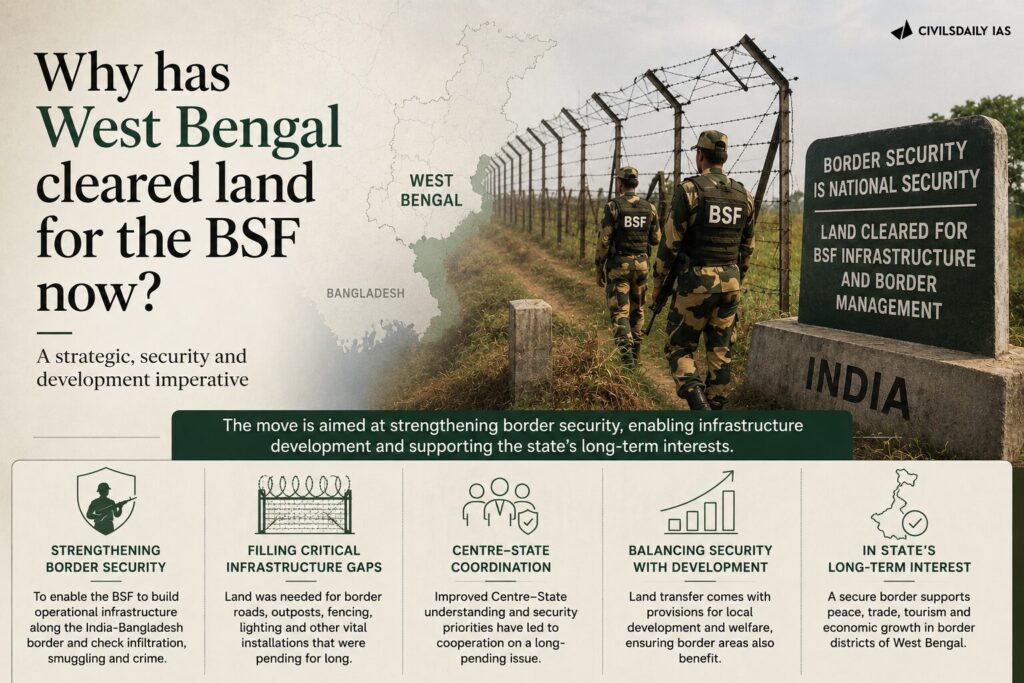
The West Bengal Cabinet approved the transfer of 31.905 acres of land at nine locations and 1.53 acres for three new Border Outposts (BOPs) to the Border Security Force (BSF) for border fencing and security infrastructure.
Why Does the Centre Need State Approval for Border Fencing?
Although border security is a Union subject, the land on which fencing and Border Outposts are built is administered by the State Government under State List Entry 18.
Therefore, the Centre must rely on the State for:
Transfer of government land.
Acquisition of private land.
Revenue and environmental clearances.
Compensation and rehabilitation.
Support from district administration.
Centre-State Disputes over BSF Jurisdiction
In 2021, the Centre extended the BSF’s jurisdiction from 15 km to 50 km inside Punjab, West Bengal, and Assam (while reducing it in Gujarat).
Some States opposed the move, citing federalism and State autonomy.
2024 Supreme Court Judgment: Upheld the Centre’s notification, holding that it does not dilute the powers of State Police and is intended to strengthen border security.
What is the Border Security Force (BSF)?
Border Security Force (BSF): A Central Armed Police Force (CAPF) under the Ministry of Home Affairs (MHA).
Guards India’s borders with Pakistan and Bangladesh during peacetime.
Prevents cross-border crimes and manages Border Outposts (BOPs).
Key Highlights
Land transferred for border fencing and construction of three new BOPs.
Implements the Calcutta High Court’s January 2026 directive.
Aims to strengthen border surveillance and security.
Why is West Bengal Important?
Shares 2,216.7 km of the 4,096.7 km India-Bangladesh border (about 54%), the longest among all States.
Around 569 km of the border remains unfenced, making it crucial for completing the national fencing project.
Key Agreements
Coordinated Border Management Plan (CBMP), 2011: Framework for coordination between BSF and Border Guard Bangladesh (BGB).
Land Boundary Agreement (LBA), 2015: Resolved enclave exchange and adverse possession issues between India and Bangladesh.
Challenges
Riverine and marshy terrain limits conventional fencing.
Land acquisition and environmental clearances delay projects.
Border communities face livelihood and mobility concerns.
Persistent issues of smuggling, illegal migration and human trafficking.
[2016, GS3, 12.5 marks] Border management is a complex task due to difficult terrain and hostile relations with some countries. Elucidate the challenges and strategies for effective border management. [2026] Which of the following with reference to Indian States is/are not correct? 1. Uttar Pradesh shares its boundary with the highest number of other Indian States. 2. Rajasthan shares the longest international border among all Indian States. 3. Sikkim is the only State that shares its boundary with just one other Indian State. Select the answer using the code given below :
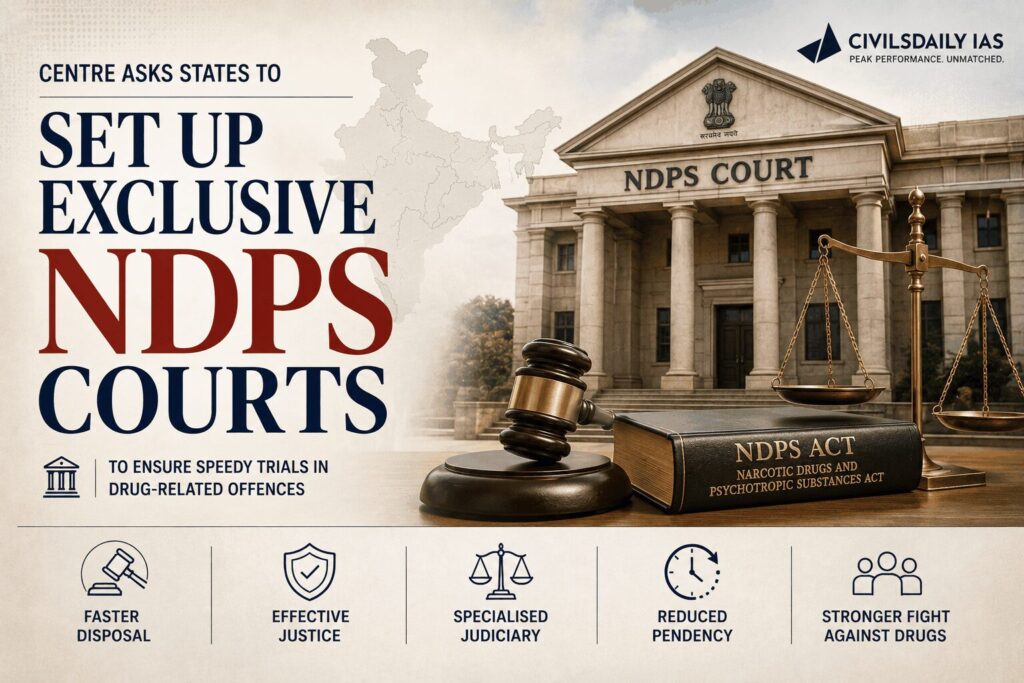
The Ministry of Home Affairs (MHA) has directed States and Union Territories to establish exclusive NDPS courts to tackle the backlog of nearly 39 lakh drug-related cases. However, 22 States are yet to comply.
What is the NDPS Act?
The Narcotic Drugs and Psychotropic Substances (NDPS) Act, 1985 is India’s primary law to regulate and prohibit narcotic drugs and psychotropic substances.
The Narcotics Control Bureau (NCB) is the apex agency for enforcement.
The Narco-Coordination Centre (NCORD) coordinates anti-drug efforts among Central and State agencies.
Why Exclusive NDPS Courts?
Speed up disposal of nearly 39 lakh pending cases.
Ensure specialised and faster trials for drug offences.
Improve conviction rates and reduce judicial delays.
Significance
Strengthens deterrence against drug trafficking.
Helps curb crimes linked to money laundering, organised crime and terror financing.
Enhances India’s internal security, especially along vulnerable border regions.
Challenges
22 States have not yet established exclusive NDPS courts.
Need for adequate judges, prosecutors and infrastructure.
Court reforms must be complemented by effective enforcement and rehabilitation.
Is it Mandatory?
Legally: The NDPS Act empowers State Governments to establish Special Courts, but it does not make exclusive NDPS courts mandatory in every district.
Administratively: The Ministry of Home Affairs (MHA) has strongly directed States and Union Territories to establish exclusive NDPS courts due to the huge backlog. While this directive is not directly enforceable like a statute, States are expected to comply in the interest of effective criminal justice and internal security.
Prelims Facts
NCORD was established in 2016 to improve inter-agency coordination against drug trafficking.
NDPS Act, 1985 replaced the Opium Act, 1857, the Opium Act, 1878, and the Dangerous Drugs Act, 1930.
The NCB functions under the Ministry of Home Affairs (MHA).
[2018, GS3, 15 marks] India’s proximity to two of the world’s biggest illicit opium-growing states has enhanced her internal security concerns. Explain the linkages between drug trafficking and other illicit activities such as gunrunning, money laundering and human trafficking. What counter-measures should be taken to prevent the same?”
PYQ Relevance [UPSC 2022] What are the maritime security challenges in India? Discuss the organisational, technical and procedural initiatives taken to improve the maritime security. Linkage: It examines India’s maritime security challenges and initiatives to strengthen regional maritime governance.The article analyses SHANTI as India’s new framework to enhance maritime cooperation, security, and resilience in the Bay of Bengal through BIMSTEC.
Mentor’s Comment
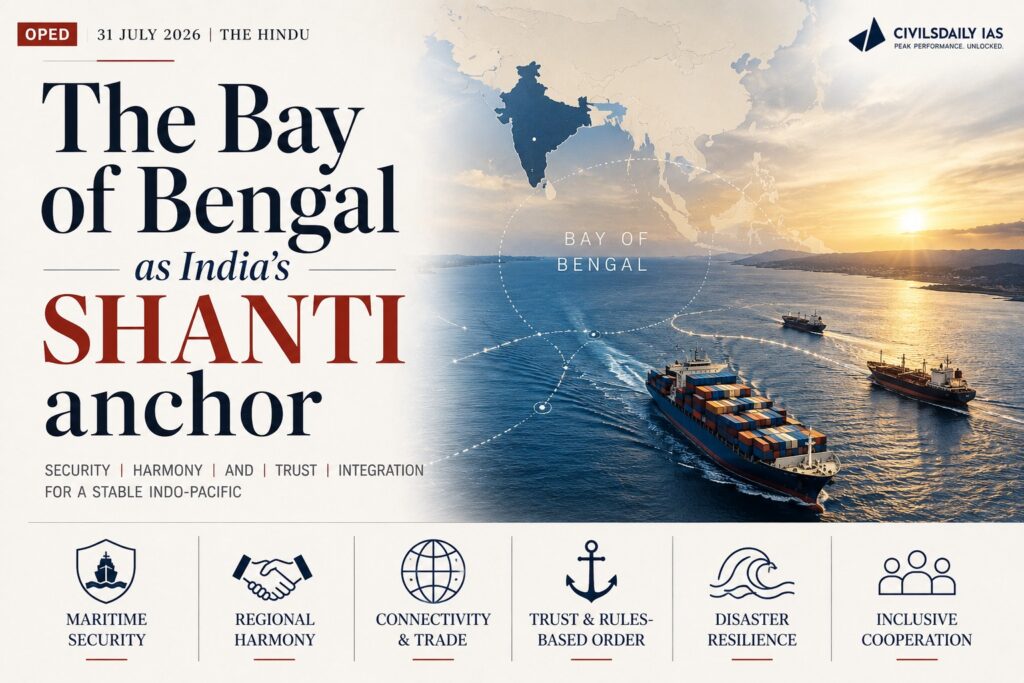
The External Affairs Minister introduced Securing Holistic Advancement through Norms, Trust and Integrity (SHANTI) on 13 July while launching India’s candidature for the United Nations Security Council (UNSC) 2028-29 term, naming the Bay of Bengal as the region to operationalise it first. The framework arrives in a region where growing naval and infrastructure capacity has outpaced any shared set of maritime norms among its littoral states.
What is SHANTI?
Full form and origin: SHANTI stands for Securing Holistic Advancement through Norms, Trust and Integrity, introduced on 13 July alongside India’s UNSC candidature announcement.
Lineage: It builds on Security and Growth for All in the Region (SAGAR), articulated in 2015 around the idea of equity in development, and Mutual and Holistic Advancement for Security and Growth Across Regions (MAHASAGAR), announced in 2025 to widen that vision to the interconnectedness of security across the Indo Pacific and the Global South.
Function: SHANTI is presented as a normative framework, offering shared principles for maritime security, disaster response, the blue economy and environmental resilience, rather than a new institution or treaty.
Rollout sequence: The Bay of Bengal is named as the first region where SHANTI is meant to move from principle to practice, before any wider application across the Indo Pacific.
What is BIMSTEC?
The Bay of Bengal Initiative for Multi Sectoral Technical and Economic Cooperation (BIMSTEC) is a regional grouping of Bangladesh, Bhutan, India, Myanmar, Nepal, Sri Lanka and Thailand, connecting South and Southeast Asia around the Bay of Bengal.
At its National Security Advisers’ meeting in New Delhi in July 2026, BIMSTEC members adopted common principles for maritime law enforcement and humanitarian assistance and disaster relief. They also agreed to hold their first joint maritime security exercise in the Bay in November 2026.
Why is the Bay of Bengal treated as SHANTI’s proving ground?
Strategic centrality: The Bay links India’s Act East policy with the Association of Southeast Asian Nations (ASEAN), gives access to the Malacca Strait, and connects the eastern Indian Ocean to major global trade and energy routes.
Comparative advantage: The western Indian Ocean is marked by active conflict and fragile economies. The Bay’s littoral states instead face similar, non military challenges such as cyclones, coastal erosion, fisheries management and undersea cable protection, which makes cooperation more feasible than confrontation.
Institutional gap: The region is not short of institutions but suffers from fragmentation among them, and SHANTI is framed as a common framework to align existing mechanisms rather than add another one.
Geopolitical pressure: China’s reliance on the Malacca Strait, often called its Malacca dilemma, has driven an expanding Chinese presence through ports and infrastructure projects in the same littoral states SHANTI seeks to anchor.
Can SHANTI move beyond being another acronym?
Fragmentation risk: The region’s stated problem is institutional fragmentation, and a new framework risks adding to that fragmentation unless it visibly aligns existing mechanisms.
Stewardship versus dominance: India’s convening role depends on being accepted as a preferred security partner and first responder, a position that rests on restraint rather than the naval and economic weight India commands in the region.
Early stage outputs: Concrete outcomes so far are limited to a declaration of common principles, a first joint maritime exercise scheduled for November 2026, and a white shipping information sharing agreement still under discussion, none of which are yet operational.
Norms without enforcement: SHANTI rests on shared principles rather than a binding treaty, leaving compliance dependent on the willingness of littoral states rather than an enforceable obligation.
What are the challenges to SHANTI?
Overlap with existing bodies: SHANTI must coordinate with, rather than duplicate, existing mechanisms such as BIMSTEC, the Indian Ocean Rim Association and the Indian Ocean Naval Symposium, each with its own membership and mandate.
Financing gap: Disaster response, undersea cable protection and blue economy cooperation require capital that several BIMSTEC members cannot supply on their own, raising the risk that shared projects become dependent on Indian or external financing.
Limited replicability: The Bay of Bengal is easier ground precisely because it lacks the active conflict of the western Indian Ocean, so success there does not guarantee the same framework will work in more contested Indo Pacific waters.
Competing infrastructure presence: Continued Chinese port and infrastructure investment in the same littoral states complicates India’s claim to a natural convening role.
Dependence on voluntary compliance: Because SHANTI is a set of norms rather than a binding agreement, its durability depends on continued political will among BIMSTEC members rather than any enforcement mechanism.
Conclusion
SHANTI’s substance will not be judged by its acronym but by whether the Bay of Bengal’s BIMSTEC linked initiatives, the first joint maritime exercise due in November 2026 and the pending white shipping information sharing agreement, convert shared principles into functioning practice. Until those steps are completed, SHANTI remains a stated framework rather than a demonstrated one.
Back2Basics:
BIMSTEC
The Bay of Bengal Initiative for Multi Sectoral Technical and Economic Cooperation was formed in 1997 and renamed after Bhutan and Nepal joined in 2004, expanding it from its original five members to seven.
Its secretariat is based in Dhaka, Bangladesh, and its membership spans Bangladesh, Bhutan, India, Myanmar, Nepal, Sri Lanka and Thailand.
The 6th BIMSTEC Summit, held in Bangkok in April 2025, adopted the Bangkok Vision 2030 and a Maritime Transport Agreement covering national treatment for vessels, crew and cargo among member states.
BIMSTEC connects South Asia and Southeast Asia and has expanded its cooperation beyond trade into security, disaster management, energy and connectivity.
The Ministry of Home Affairs (MHA) announced that India became free from Left Wing Extremism (LWE) in March-April 2026, following sustained implementation of the National Policy and Action Plan (2015).
Key Highlights
No district is currently categorized as LWE-affected.
37 districts are now classified as Legacy & Thrust Districts for continued security and development support.
1 district remains a District of Concern for continued surveillance.
National Policy and Action Plan (2015)
Adopts a Whole-of-Government Approach focusing on: Security operations. Infrastructure and connectivity. Welfare and development. Protection of tribal rights. Good governance and financial inclusion.
Major Government Initiatives
Security Measures
Security Related Expenditure (SRE) Scheme.
Modernisation of Police Forces (MPF).
Special Infrastructure Scheme (SIS).
Assistance to Central Agencies for LWE Management (ACALWEMS).
Surrender-cum-Rehabilitation Policy for Maoist cadres.
Development Measures
15,189 km roads constructed in LWE areas.
9,497 telecom towers commissioned.
179 Eklavya Model Residential Schools (EMRS) functional.
47 ITIs and 49 Skill Development Centres established.
6,025 post offices with banking services opened.
Security camps are being converted into Jan Suvidha Kendras.
Other Initiatives
Special Central Assistance (SCA) for infrastructure.
Tribal Youth Exchange Programme (TYEP).
Civic Action Programme (CAP) to improve community engagement.
Distribution of over 21 lakh Forest Rights Act title deeds.
[2023] Consider the following statements: 1. According to the Constitution of India, the Central Government has a duty to protect States from internal disturbances. 2. The Constitution of India exempts the States from providing legal counsel to a person being held for preventive detention. 3. According to the Prevention of Terrorism Act, 2002, confession of the accused before the police cannot be used as evidence. How many of the above statements are correct?
The “Status of Policing in India 2025” report finds that over 70% of police personnel favour immunity for using force without accountability. The report also flags that National Crime Records Bureau (NCRB) custodial injury data is unreliable, undermining independent verification of police conduct.
Why does the immunity preference expose an accountability gap?
Majority preference: A 70% plus preference for immunity among serving police personnel indicates the demand for accountability protection is not a fringe view but a majority institutional stance.
Data unreliability: If NCRB custodial injury data is unreliable, external oversight bodies cannot independently verify whether force used against civilians was proportionate, regardless of internal police attitudes.
Compounding effect: An accountability averse police culture combined with unreliable official data on custodial injury creates a structure where excessive force is both preferred by personnel and difficult to prove externally.
Conclusion
The central idea is that police demand for immunity and unreliable custodial injury data reinforce each other, since neither internal culture nor official data currently supports independent verification of force used against civilians. Addressing this requires fixing NCRB data reliability before any accountability reform on use of force can be meaningfully enforced.
Back2Basics
National Crime Records Bureau (NCRB): Statutory body under the Ministry of Home Affairs that compiles crime and criminal justice statistics across India, including custodial injury and death data.
A ransomware breach at Yotta Data Services, a third-party data-centre vendor for Reliance Infrastructure Ltd, led to the leak of 14.3 GB of operational data related to the Kudankulam Nuclear Power Plant on the dark web platform World Leaks. Nuclear Power Corporation of India Limited (NPCIL) states the breach did not touch core reactor or nuclear-security systems, but the incident exposes how strategic nuclear infrastructure remains vulnerable through third-party digital supply chains.
What exactly happened, and how did the breach occur?
Breach reported: Reports emerged that multiple gigabytes of data on Kudankulam Nuclear Power Plant operations were copied and leaked as part of a ransomware attack.
Point of infiltration: The infiltration targeted Reliance Anil Dhirubhai Ambani Group’s Reliance Infrastructure Ltd, not NPCIL directly.
Scale of leak: 14.3 GB of Kudankulam-related data formed part of a larger 1.2 TB dataset hosted on World Leaks.
World Leaks: World Leaks is a dark web site operated by cybercriminals who infect firms with ransomware and threaten to publish stolen data if a ransom is not paid.
Trigger for publication: The site claims the ransom was not paid, resulting in the data being leaked publicly.
Was the reactor or nuclear-safety systems compromised?
NPCIL’s position: NPCIL states the leaked files pertain only to Balance of Plant (BOP: conventional common service facilities of a power plant, distinct from the reactor core) and not to nuclear safety or security-related systems.
Reliance’s position: Reliance states no ransomware execution, data loss, or lateral movement occurred, despite confirming a partial breach of data hosted on Yotta’s servers.
Nature of leaked files: The files reportedly include equipment blueprints, supplier details, meeting and inspection records, and equipment reviews.
Insurance detail exposed: A $112 million insurance policy against terrorist attacks was among the leaked details, with the premium amount undisclosed.
Why does the official reassurance not fully resolve the concern?
Narrow definition of harm: Restricting concern to “core reactor systems” ignores that BOP data such as blueprints and inspection records can still aid reconnaissance or attack planning against a strategic facility.
Layered outsourcing risk: Reliance itself depends on a third-party vendor, Yotta, for data hosting, showing that critical infrastructure security depends on vendors several steps removed from NPCIL.
Self-assessment, not independent audit: Both Reliance and Yotta’s claims that no ransomware execution or lateral movement occurred rest on the vendor’s own internal forensic assessment, not an independent verification.
Transparency gap: The premium amount for the $112 million terrorism insurance policy remains undisclosed even after the leak, showing incomplete disclosure despite the reassurances offered.
What does the incident reveal about the plant’s strategic significance going forward?
Current capacity: Kudankulam has commissioned two 1,000 MWe VVER (a Russian-designed pressurised water reactor type) units, supplying up to two gigawatts, built in partnership with Russian firm Rosatom.
Expansion underway: The government plans four more units at the site, which would triple installed capacity, expanding the facility’s strategic value and its digital attack surface.
Gap between messaging and internal concern: The revelations have caused “absolute commotion” among plant officials internally, even as public statements downplay the breach’s significance.
Conclusion
The Kudankulam leak shows that reassurances confined to “core reactor safety systems” do not address the full risk profile of a strategic nuclear facility. This is because non-core operational data hosted through layered third-party vendors remains commercially and strategically sensitive. As Kudankulam’s capacity is set to triple, critical infrastructure protection frameworks need to extend cybersecurity accountability across the entire vendor supply chain, not the reactor core alone. Additionally this requires independent verification rather than self-reported vendor assessments.
PYQ Relevance
[UPSC 2023] What are the different elements of cybersecurity? Keeping in view the challenges in cybersecurity, examine India’s preparedness in preventing cyber attacks.
Linkage: The article highlights cybersecurity challenges in protecting India’s critical infrastructure from ransomware and third-party data breaches. The Kudankulam data leak underscores the need to strengthen cyber resilience, vendor security, and protection of critical infrastructure despite no compromise of reactor systems.
PYQ Relevance[UPSC 2021] Analyse the complexity and intensity of terrorism, its causes, linkages and obnoxious nexus. Also, suggest measures required to be taken to eradicate the menace of terrorism. Linkage: The PYQ examines the evolving nature, drivers and counter-terrorism strategies against terrorism. The article builds on this by arguing that terrorism has transformed into decentralised, conflict-driven and digitally networked ecosystems, requiring a shift from reactive security measures to preventive state-building and institutional resilience.
Mentor’s Comment
The Global Terrorism Index (GTI) 2025 reported a significant decline in global terrorism, with 5,582 deaths across 2,944 attacks, reflecting a 28% fall in fatalities, a 22% decline in attacks, and improvements in the security landscape of 81 countries. However, the apparent statistical success has exposed a deeper strategic concern: terrorism is not disappearing but reorganising into decentralised, conflict-driven and digitally networked forms that conventional global indicators increasingly fail to capture.
Why do declining global terrorism indicators present a misleading picture of security?
Geographical concentration: Nearly 70% of global terrorism deaths are confined to five countries, Pakistan, Burkina Faso, Nigeria, Niger and the Democratic Republic of Congo.
Organisational concentration: The threat is increasingly driven by a handful of organisations such as IS, JNIM, TTP, LeT and Al-Shabaab, indicating consolidation rather than disappearance of terrorism.
Regional redistribution: Terrorism has retreated from many regions but intensified across fragile conflict theatres, particularly the Sahel, which now accounts for over half of global fatalities.
Uneven security gains: Although 81 countries recorded improvement, the global decline largely reflects better security in stable regions rather than reduced terrorist capability.
Misleading averages: Aggregate global indicators obscure localised escalation and encourage the mistaken belief that terrorism is steadily disappearing.
Why is terrorism undergoing a structural transformation rather than a strategic decline?
Decentralised networks: Terrorism has shifted from hierarchical organisations to autonomous cells and loosely connected affiliates.
Digital radicalisation: Extremist recruitment, propaganda and operational coordination increasingly occur through online ecosystems instead of physical networks.
Conflict dependence: Around 99% of terrorism-related deaths occur in countries already affected by armed conflict, making violence inseparable from state fragility.
Border-centric operations: More than 60% of terrorist attacks occur within 100 km of international borders, reflecting growing dependence on poorly governed frontier regions.
Adaptive resilience: Counter-terrorism operations fragment terrorist organisations but rarely eliminate their ideological and organisational capacity to regenerate.
Operational normalisation: Terrorism is increasingly becoming a chronic feature of conflict zones rather than an exceptional global security crisis, reducing international attention despite persistent violence.
Cross-border sanctuaries: Pakistan illustrates how safe havens continue to sustain transnational terrorism despite sustained counter-terrorism operations.
What do contemporary terrorism hotspots reveal about the changing geography of terrorism?
Burkina Faso: It has emerged as the world’s deadliest terrorism hotspot, illustrating the shift of global terrorism towards the Sahel.
Pakistan: The resurgence of Tehrik-e-Taliban Pakistan (TTP) shows that terrorist organisations continue to expand despite declining global attack numbers.
Nigeria: Boko Haram and ISWAP demonstrate how weak governance sustains long-term insurgencies.
Niger: Political instability and military coups have weakened state capacity against extremist organisations.
Democratic Republic of Congo: Armed conflict continues to fuel terrorist violence despite improvements elsewhere.
Sahel Region: The region now accounts for over half of global terrorism deaths, making Africa the new epicentre of global terrorism.
Why has the traditional counter-terrorism paradigm become inadequate?
Military bias: Eliminating terrorists does not remove the governance failures that continuously generate extremism.
Leadership decapitation: Killing leaders fragments organisations but produces smaller and harder-to-detect affiliates.
National responses: Domestic strategies struggle against cross-border financial, ideological and logistical networks.
Technology gap: Security agencies remain better prepared for physical organisations than encrypted digital radicalisation.
Reactive approach: Counter-terrorism continues to respond to attacks instead of preventing the ecosystems that produce them.
Why is statistical success producing strategic complacency?
Misleading metrics: Falling attacks measure frequency but not organisational resilience.
False optimism: Improving global rankings reduce political urgency for long-term institutional reforms.
Persistent conflict: Ongoing wars continue to replenish extremist ecosystems despite declining global averages.
Strategic mismatch: Governments celebrate declining numbers while terrorist organisations continuously adapt their methods.
What should next-generation counter-terrorism architecture prioritise?
State capacity: Strengthen policing, justice delivery and local administration.
Conflict prevention: Address armed conflict as the principal enabler of terrorism.
Border governance: Improve surveillance, intelligence integration and frontier administration.
Digital resilience: Disrupt online recruitment, financing and propaganda ecosystems.
International cooperation: Expand intelligence sharing and coordinated action against transnational networks.
Conclusion
The central challenge confronting global security is not the persistence of terrorism but its transformation. Declining attacks and fatalities represent a quantitative improvement, whereas terrorism has reorganised into decentralised, conflict-driven and digitally networked ecosystems. Counter-terrorism success must therefore be measured not by annual attack counts but by the ability of states to build resilient institutions, prevent conflict and dismantle the conditions that allow violent extremism to regenerate.
The Narcotics Control Bureau (NCB) released its 2026 annual report on 27 June 2026, tabled by Home Minister Amit Shah. The report documents Myanmar’s emergence as the primary global opium source following the Taliban’s 2022 ban on drug cultivation in Afghanistan. Infact, India’s northeastern border corridor is identified as the most direct and porous entry point for this expanding production base.
What change in the global narcotics supply chain has created new pressure on India’s northeastern borders?
Taliban-imposed ban: The Taliban government’s 2022 ban on drug cultivation in Afghanistan eliminated the world’s largest opium producer from the supply chain, creating a vacuum in global opium supply.
Myanmar’s replacement role: Myanmar filled this vacuum rapidly. The NCB’s 2026 annual report identifies Myanmar as the alternative global opium source, with consequences already visible along India’s eastern borders.
Scale of cultivation expansion: Myanmar’s illicit opium cultivation expanded by approximately 56% between 2021 and 2023. The area under poppy cultivation reached 45,200 hectares.
Golden Triangle transformation: Myanmar’s Golden Triangle has expanded beyond its traditional opiate role. Shan State now produces both opium and methamphetamine (Yaba), making it a major poly-drug hub.
Manipur corridor as primary entry point: National Highway-102 through Manipur is the main land route for heroin and methamphetamine into India.
Secondary corridor via Mizoram: Champhai in Mizoram provides the second major trafficking route via Myanmar’s Chin State. Drugs are routed through Assam’s Barak Valley via Aizawl and adjoining road networks.
How have India’s northeastern states been transformed from transit zones into active narcotics staging grounds?
Porous border mechanisms: The Free Movement Regime (FMR) along the India-Myanmar border and unfenced border stretches have converted the Northeast from a transit route into a distribution hub.
States bearing frontline exposure: The NCB report specifically identifies that Manipur, Mizoram and Nagaland face the highest exposure due to increased drug production in Myanmar.
Mizoram’s seizure data: Mizoram seized 1,477 kg of amphetamine-type stimulants (ATS) in 2025 out of the national total of 3,485 kg.
Manipur’s seizure data: Manipur accounted for 535 kg in recoveries from other reported states. Delhi (454 kg), Gujarat (308 kg), and Karnataka (164 kg) reported significant quantities, demonstrating that narcotics originating from the northeast are penetrating deep into the hinterland.
Distribution geography: Drugs move through the Barak Valley to Punjab, Gujarat and Maharashtra, making the Northeast a distribution node rather than a consumption centre.
What does the drone-based trafficking data reveal about the operational maturity of trafficking networks?
Five-fold increase from Pakistan border: Drone-based drug trafficking from across the Pakistan border into India has increased five-fold over the past five years, particularly in Punjab, demonstrating aerial circumvention of border controls.
Incident trajectory (NCB data): Drone trafficking incidents surged from 3 in 2021 to 35 in 2022, 28 in 2023, 178 in 2024, and 305 in 2025, This is a 100-fold increase in incident count over five years.
Seizure volume in 2025: In 2025, drone-related cases resulted in the seizure of 468 kg of narcotics, a 96% increase in quantity over 2024. Punjab recorded 298 cases and 461 kg seized.
UAV sophistication: Trafficking networks are using unmanned aerial vehicles (UAVs) to circumvent traditional border controls, the NCB stated.
Additional reporting states: Geographical spread: Rajasthan and Jammu & Kashmir also reported drone-related trafficking incidents.
Where does the structural vulnerability in India’s border architecture lie and why cannot existing mechanisms address it?
The FMR design conflict: The FMR facilitates movement of border communities. This objective conflicts with effective narcotics interdiction.
Unfenced stretches: Drugs are smuggled through unfenced and porous stretches of the border.
Geographic chokepoint: National Highway No. 102 through the Manipur corridor, the Champhai route in Mizoram carry both legal trade and illicit narcotics, making interception difficult.
Ethnic armed group control: The poly-drug production in Myanmar is primarily concentrated in areas controlled by ethnic armed groups in Shan State. These groups operate outside the reach of both the Myanmar state and Indian border enforcement, making source-side interdiction impossible.
South Asian arm of Afghan trade: The NCB specifically identifies that the South Asian arm of the Afghan drug trade flows through Pakistan into India via both the land frontier (Punjab, Rajasthan) and the maritime frontier (Gujarat, Maharashtra coastlines).
Conclusion
Myanmar’s rise as the world’s alternative opium supplier has created a structural narcotics challenge for India. The Northeast has become an active distribution hub rather than merely a transit corridor. Drone-enabled trafficking further weakens conventional border controls. Addressing the challenge requires technology-driven surveillance, calibrated reforms to the FMR and stronger cooperation with Myanmar.
PYQ Relevance
[UPSC 2018] India’s proximity to two of the world’s biggest illicit opium-growing states has enhanced its internal security concerns. Explain the linkages between drug trafficking and other illicit activities such as gunrunning, money laundering, and human trafficking. What countermeasures should be taken to prevent the same?
Linkage: The PYQ examines the internal security implications of cross-border drug trafficking and its nexus with organised crime. The article explains how Myanmar-origin narcotics trafficking through India’s northeastern border has become a major cross-border security challenge.