💥Join UPSC 2027,2028 Mentorship (August Batch) + XFactor Notes & Microthemes PDF

Subject: Space Technology

  • After Chandrayaan-3, what has ISRO planned?

    isro missions

    Central Idea

    • ISRO’s triumphant landing of the Chandrayaan-3 lander on the moon’s South Polar Region marks a significant achievement in space exploration.
    • As India emerges as a key player in the field, the focus now shifts to its multifaceted activities, upcoming missions, and technological advancements.

    Diverse ISRO Activities

    • Multifaceted Endeavors: ISRO’s operations span research, satellite development, rocket production, satellite tracking infrastructure maintenance, and more, catering to diverse space-related needs.
    • Key Focus Areas: Prominent areas of focus include the ‘Gaganyaan’ human spaceflight mission, Reusable Launch Vehicle Technology Demonstrator (RLV-TD), SCE-200 engine development, and the Small Satellite Launch Vehicle (SSLV).

    Glimpses of Upcoming Missions

    • Aditya L1: Scheduled for September 2023, Aditya L1 is a scientific mission to study the sun in detail, providing critical insights into solar activities.
    • NISAR Satellite: In January 2024, the joint ISRO-NASA NISAR satellite will study earth’s surface processes using advanced radar technology.
    • Gaganyaan G1 and G2 Flights: 2024 witnesses test flights of human-rated rockets, a prelude to India’s ambitious Gaganyaan human spaceflight.

    Beyond Launches: Technology Innovations

    • Reusable Launch Vehicle (RLV-TD): Resembling the NASA Space Shuttle, RLV-TD’s design enables air propulsion or gliding, capable of lifting 20,000 kg to low-earth orbit.
    • Advanced Propulsion: ISRO explores advanced rocket fuels like methalox propellant and electric propulsion systems, enhancing efficiency and safety.

    Moon Missions and Lunar Exploration

    • Chandrayaan-3 and Beyond: Chandrayaan-3 paves the way for further lunar exploration, with plans for missions like LUPEX (Lunar Polar Exploration) in collaboration with JAXA.
    • LUPEX’s Ambitions: LUPEX aims to deploy a sophisticated lander and rover to study the moon’s South Polar Region, including subsurface sample extraction and night survival.

    Expanding Collaborations and Global Partnerships

    • Alternative Space Service Providers: ISRO fills gaps left by sanctions on Russia, launching OneWeb satellites and expectedly launching the European Space Agency’s PROBA-3 satellites.
    • Lunar Exploration with JAXA: Collaborating with JAXA for LUPEX showcases ISRO’s commitment to global partnerships in space exploration.

    Mars and Venus Missions

    • Mars Return Mission: ISRO plans a return to Mars, building on its previous successful Mars Orbiter Mission (Mangalyaan).
    • Venus Exploration: ‘Shukrayaan’: Ambitious plans to study Venus through the ‘Shukrayaan’ mission demonstrate ISRO’s expanding horizons in planetary exploration.

    Conclusion

    • ISRO’s remarkable accomplishments and future undertakings illuminate its stature as a global space powerhouse.
    • From lunar landings to solar studies, human spaceflight to interplanetary missions, ISRO continues to shape the landscape of space exploration.
    • By pushing boundaries, fostering innovation, and fostering international cooperation, ISRO cements its role in humanity’s journey to unravel the mysteries of the cosmos.
  • Unraveling the Lunar Landscape: Near, Far, and Dark Sides

    far dark side lunar moon

    Central Idea

    • The Chandrayaan-3 mission’s recent lunar landing has sparked curiosity about the moon’s various sides – near, far, and even the intriguing ‘dark’ side.
    • Delving into these distinctions sheds light on the moon’s enigmatic nature and how space exploration helps us unravel its mysteries.

    Facts for Prelims

    Impact/Landing point names on Moon:

    1. Chandrayaan 1: Jawahar Point

    2. Chandrayaan 2: Tiranga Point

    3. Chandrayaan 3: Shivshakti Point

     Moon’s Visible and Hidden Faces

    • Near and Far Sides: The moon’s ‘near side,’ visible from Earth, covers around 60% of its surface. In contrast, the ‘far side’ remained hidden from us until modern spacecraft brought it into view.
    • Clarifying the ‘Dark’ Side: Often misconstrued as constantly dark, the ‘dark side’ simply refers to the unseen side. It gets illuminated during the ‘new moon’ phase, challenging the misconception of its perpetual darkness.

    Why is their composition different?

    • The composition of the Moon’s near and far sides is different, and scientists believe they have identified the reasons behind this discrepancy.
    • A study published in the journal Nature Geoscience reveals that the presence of KREEP, a rock enriched in potassium (K), rare-earth elements (REE), and phosphorus (P), plays a crucial role.

    Key Points from the Study:

    • Moons Near and Far Sides: The Moon’s near side, always facing Earth, has visible dark and light patches known as “maria.” Telescopic observations showed that these were not seas as early astronomers thought, but rather craters or volcanic features. The far side of the Moon has fewer maria than the near side.
    • Moon’s Formation: The uneven distribution of volcanism and the KREEP signature between the near and far sides of the Moon puzzled scientists.
    • Radioactive Unstable Elements: Potassium (K), thorium (Th), and uranium (U) are unstable, radioactive elements that have various isotopes with different numbers of neutrons. The radioactive decay of these elements generates heat that can melt rocks and contribute to volcanic activity.
    • Heat and Melting: The study found that the inclusion of KREEP in rocks not only enhances heating but also lowers their melting temperature. This combination increases volcanic activity beyond what is predicted by radiogenic decay models.
    • Geological Record: The Moon’s surface preserves geological events from the early history of the Solar System due to the absence of erosion processes. Concentrations of radioactive elements like uranium (U) and thorium (Th) on the near side provide insights into the Moon’s formation and early Earth conditions.

    Phases and Illumination

    • New Moon Phase: The ‘new moon’ phase unveils the moon’s ‘far side,’ exposing it to sunlight for about two weeks.
    • Historic Revelation: In 1968, astronauts aboard Apollo 8 became the first humans to observe the ‘far side,’ demystifying its hidden features.

    Chandrayaan-3’s Approach

    • Closest South Pole Landing: Chandrayaan-3’s landing at coordinates 69.36 S and 32.34 E marks the closest approach to the lunar South Pole.
    • Exploring Permanently Shadowed Regions: The strategic landing aimed to study regions that never receive sunlight, potentially containing frozen water ice and other lunar resources.
    • Sunlight Necessity: Vikram’s nearness to the South Pole ensures sunlight for solar battery recharging, crucial for its operation.
    • Choice of Landing Site: The decision to land on the ‘near side’ was driven by mission objectives, including real-time communication with Earth. Landing on the ‘far side’ would have required relay satellites and introduced delays.
  • K Kasturirangan explains: Chandrayaan-3 and India’s Evolving Space Ambitions

    Central Idea

    • The successful Chandrayaan-3 mission not only marks a significant achievement for India’s space program but also signifies the nation’s attainment of a pivotal capability: direct physical access to another celestial body.
    • This accomplishment propels India into an elite group of spacefaring nations and affords participation in shaping future planetary exploration endeavors and resource extraction from space.

    Who is Dr. K. Kasturirangan?

    • Dr. K. Kasturirangan is a prominent Indian space scientist and engineer.
    • He led ISRO as Chairman from 1994 to 2003, overseeing achievements like PSLV launches and Chandrayaan-1.
    • Chandrayaan-1, under his leadership, discovered water molecules on the Moon.
    • He’s been active in promoting science education and enhancing research quality.
    • Dr. Kasturirangan chaired the committee behind India’s NEP 2020, focusing on holistic education.
    • His accolades include Padma Shri and Padma Bhushan awards.
    • He’s been involved in international collaborations and represented India globally.
    • Besides leadership, he’s made academic contributions in space and atmospheric sciences.
    • His influence spans various positions in scientific and academic institutions.

    India’s Integration into Planetary Exploration and Decision-Making

    • Access to Celestial Bodies: Chandrayaan-3 provides India with a tangible gateway to planetary bodies, elevating its status in space exploration.
    • Frontiers of Technology: India’s pioneering capabilities place it at the forefront of space technology, enabling participation in shaping future planetary explorations and resource extraction policies.
    • A Seat at the Table: India’s involvement in this realm positions it naturally within the club of nations that influence and formulate space-related policies, ending a history of exclusion.

    Now, India’s stature in Global Space Dynamics

    • Historical Context: India’s past exclusion from technological clubs has driven its pursuit of self-reliance and global influence, transforming from a dependent to a self-sufficient nation.
    • Space Diplomacy: Space capabilities will play a pivotal role in shaping global equations in the 21st century, and India’s active participation will bolster its international standing.
    • Equitable Contributions: Chandrayaan-3 bolsters India’s potential to play a decisive role in space-related international decision-making, strengthening its voice on equal terms.

    Chandrayaan-3’s Significance for ISRO

    • Planetary Exploration Strategy: Chandrayaan-3 showcases ISRO’s comprehensive planetary exploration capabilities, encompassing satellite deployment, lunar orbits, surface study, and landing.
    • Direct Lunar Access: The mission grants India direct physical access to the Moon, offering new avenues for lunar exploration and resource utilization.
    • Kasturirangan’s Vision: The vision of Dr. K. Kasturirangan, former ISRO chairman, harmonizes with Sarabhai’s principles, building upon a foundation of technological self-sufficiency.
    • Progressive Continuation: ISRO’s pursuits of planetary exploration and Chandrayaan missions align with the trajectory Kasturirangan initiated, enhancing the nation’s profile on the global stage.

    Completing the Transformation: From Development to Exploration

    • Sequential Alignment: ISRO’s evolution from developmental needs to commercial launches and now to scientific and planetary exploration reflects its responsiveness to India’s evolving requirements.
    • Government Support: ISRO’s consistent success has been underpinned by unwavering government backing, which has enabled the organization to expand its horizons.
    • Strategic Role: Space technology’s growing influence necessitates robust capabilities, and ISRO’s achievements foster meaningful international partnerships, enhancing India’s global prestige.

    Conclusion

    • Chandrayaan-3 is more than a singular event; it signifies India’s ascendancy as a formidable force in space exploration.
    • As the nation transitions from a developing to a developed status, its capabilities to explore, innovate, and collaborate extend far beyond Earth’s boundaries.
    • Chandrayaan-3’s impact extends beyond the Moon’s surface, fostering diplomatic connections, winning allies, and amplifying India’s influence on the global stage under the visionary guidance of Dr. K. Kasturirangan.
  • Chandrayaan-3’s Success: Future Objectives

    Chandrayaan

    Central Idea

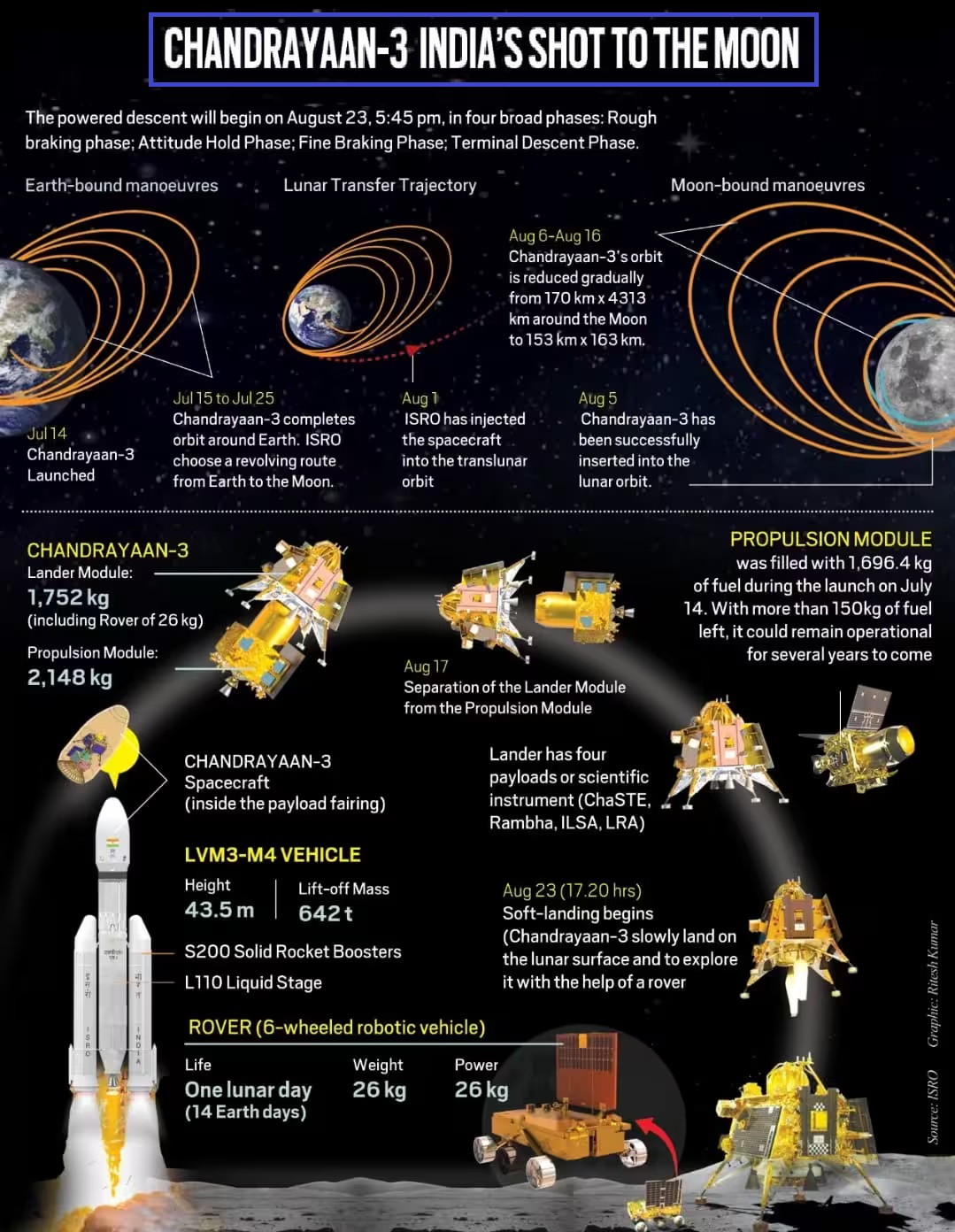
    • As Chandrayaan-3 succeeded on its lunar soft landing, its six-wheeled rover begins a journey to unravel the mysteries of the Moon.
    • With its payloads and instruments, the mission aims to build on the knowledge gained from its predecessors, investigating lunar quakes, mineral compositions, and water-ice presence.

    Chandrayaan-3 Mission: Journey post soft landing

    • Rover’s Arrival: The 26-kg rover, launched from the Chandrayaan-3 lander, is poised to cover up to 500 meters, commencing its lunar exploration.
    • Duration: The lander and rover, equipped with six payloads, are primed to collect valuable data during the single lunar day (equivalent to 14 Earth days) of operation.
    • Studying Lunar Quakes: The Chandrayaan-3 mission seeks to deepen insights into lunar quakes, expanding on the knowledge gained from its predecessors.
    • Mineral Composition: The rover’s endeavors include examining the mineral compositions of the Moon’s surface, shedding light on its geological history.
    • Electrons and Ions Study: The Radio Anatomy of Moon Bound Hypersensitive ionosphere and Atmosphere (RAMBHA) payload aims to study the behavior of electrons and ions near the lunar surface over time.
    • Thermal Properties: Chandra’s Surface Thermo physical Experiment (ChaSTE) will explore the thermal characteristics of the Moon’s Polar Regions.
    • Lunar Seismic Activity: The Instrument for Lunar Seismic Activity (ILSA) endeavors to measure lunar quakes and study the Moon’s crust and mantle composition.
    • Laser Retroreflector Array: A passive experiment by NASA, the LASER Retroreflector Array (LRA), will serve as a target for precise laser measurements in future missions.
    • Chemical Insights: The LASER Induced Breakdown Spectroscope (LIBS) aboard the rover is designed to identify the chemical and mineral composition of the lunar surface.
    • Elemental Analysis: The Alpha Particle X-ray Spectrometer (APXS) aims to analyze elements such as magnesium, aluminium, silicon, potassium, calcium, titanium, and iron in lunar soil and rocks.
    • Mineral Mapping: The CLASS X-ray Fluorescence experiment, covering nearly 95% of the lunar surface, offers detailed mineral mapping. Oxygen-rich minerals hold potential for future missions as fuel resources.

    Earlier Chandrayaan: Pioneering discoveries

    • Water Unveiled: Chandrayaan-1 played a pivotal role in uncovering the presence of water and hydroxyl molecules in the Moon’s atmosphere and surface, particularly in its southern polar regions.
    • Subsurface Water-Ice: Payloads like mini-SAR and Moon Mineralogy Mapper (M3) detected subsurface water-ice deposits within craters near the lunar South Pole.
    • Lava Tubes for Habitability: Terrain mapping on Chandrayaan-1 unveiled buried lava tubes that could provide protective habitats for humans, shielding against radiation and extreme lunar conditions.
    • Magma Ocean Hypothesis: M3 payload data suggested the possibility of a past magma ocean on the Moon, pointing to its formation and evolution.
    • Active Moon: Contrary to previous notions of lunar inactivity, Chandrayaan-1 revealed dynamic lunar processes, including volcanic activity evidenced by lava channels and vents less than 100 million years old.
    • Surface-Exosphere Interaction: Measurements indicated that the lunar surface interacts with the exosphere, evident in the emission of carbon dioxide and other gases.
    • Solar Mysteries: The Solar X-Ray Monitor on Chandrayaan-2’s orbiter observed solar microflares outside active regions, providing insights into coronal heating mysteries.

    Conclusion

    • Chandrayaan-3’s scientific journey exemplifies India’s dedication to unraveling the Moon’s mysterious nature.
    • As data pours in from its payloads and instruments, the mission builds upon its predecessors, propelling our understanding of lunar geology, composition, and mysteries.
  • ISRO gears up for Aditya-L1 Mission

    aditya-l1

    Central Idea

    • Although the mission launch date is yet to be announced, the Aditya-L1 satellite has arrived at the Satish Dhawan Space Center (SDSC) in Sriharikota, Andhra Pradesh, for integration with the launch vehicle, PSLV.

    Aditya-L1 Mission

    • Aditya-L1’s primary objective is to closely observe the Sun and gather insights into its corona, solar emissions, flares, solar winds, and Coronal Mass Ejections (CMEs).
    • The satellite is equipped with seven advanced payloads for these scientific endeavors.
    • The mission promises round-the-clock imaging of the Sun, enabling an unprecedented understanding of its behavior and impacts.

    Significance of the mission

    • Solar Influence: The evolution of every celestial body, including Earth and distant exoplanets, is intricately linked to its parent star. The Sun’s weather and environment have a profound impact on the entire solar system.
    • Space Weather Impact: Variations in solar activity can disrupt satellite orbits, damage electronics, trigger power blackouts, and induce disturbances on Earth. Accurate knowledge of solar events is essential for comprehending and predicting space weather phenomena.

    L1 Lagrange Point Advantage

    • Continuous Solar Observations: Positioned at the Lagrangian Point 1 (L1) — about 1.5 million km from Earth — Aditya-L1 will be uniquely positioned to observe the Sun without the interference of occultation or eclipses. L1 is an orbital location where gravitational forces create stable regions of attraction and repulsion.
    • L1’s Significance: The Solar and Heliospheric Observatory Satellite (SOHO) is stationed at L1 and has facilitated groundbreaking solar research. Aditya-L1’s observations will contribute to a more comprehensive understanding of solar behavior.

    Comparison with International Missions

    • Closer than Ever: While NASA’s Parker Solar Probe has ventured closer to the Sun, Aditya-L1 will focus on direct solar observations from a greater distance.
    • Technical Challenges: Many instruments and components for Aditya-L1 are being developed in India for the first time, representing both a challenge and an opportunity for the nation’s scientific and engineering communities.
  • Lunar South Pole Mission: Russia’s Luna 25 and India’s Chandrayaan-3

    luna

    Central Idea

    • The moon exploration scene has intensified as Russia’s “Luna 25” mission prepares for a soft landing near the lunar South Pole, challenging India’s “Chandrayaan-3” in the race to touch down first.
    • While Luna 25’s earlier launch and more direct trajectory give it an edge, Chandrayaan-3’s unique features and India-Russia collaboration in space activities also merit attention.

    Luna 25’s Accelerated Journey

    • Launch and Orbit: Luna 25 was launched on August 10, aiming to enter lunar orbit by August 16.
    • Lunar Landing Date: The Russian lander is anticipated to attempt a soft landing between August 21 and 22, ahead of Chandrayaan-3’s possible landing date of August 23.

    Key Factors behind Luna 25’s Lead

    • Trajectory and Fuel Storage: Luna 25 followed a direct trajectory due to its lighter payload and higher fuel efficiency.
    • Payload Comparison: Luna 25’s lift-off mass is 1,750 kg, significantly lighter than Chandrayaan-3’s 3,900 kg. The latter includes a Lander-Rover and propulsion module.
    • Lunar Dawn Advantage: Luna 25 benefits from an earlier lunar dawn at its landing site, ensuring optimal power generation through solar panels.

    What is Lunar Dawn?

    • Lunar dawn is the period on the Moon when the Sun is about to rise over the lunar horizon, resulting in the gradual illumination of the lunar surface, similar to Earth’s sunrise.
    • During lunar dawn, the Moon’s surface transitions from darkness to light as the Sun’s rays gradually touch and illuminate different areas.
    • It occurs due to the Moon’s rotation on its axis, causing changing lighting conditions as it orbits the Earth.
    • Unlike Earth, the Moon lacks a significant atmosphere, resulting in distinct lighting, sharp shadows, and no diffusion of sunlight.
    • Astronauts on lunar missions, like the Apollo missions, have observed lunar dawn first-hand, providing unique perspectives on the Moon’s surface.

    Chandrayaan-3’s Distinct Features

    • Coated Rover: Chandrayaan-3 boasts a rover with a 500-metre range, unlike Luna 25.
    • Scientific Objectives: Chandrayaan-3 emphasizes soil and water-ice study, especially near the southern pole, owing to craters in permanent shadow.
    • Experiment Suite: Chandrayaan-3’s Lander carries experiments like RAMBHA, ChaSTE, ILSA, and LRA, providing crucial insights into moon’s properties.

    Collaboration and Competition

    • India-Russia Space Collaboration: Both countries have collaborated extensively in space activities, such as Russia’s contribution to India’s Chandrayaan-2 mission’s lander-rover design.
    • Chandrayaan-1 to Chandrayaan-2 Gap: India developed its lander-rover technology independently after Russia’s withdrawal, leading to an 11-year gap between Chandrayaan-1 and Chandrayaan-2 missions.

    Future Prospects

    • Human Moon Missions Race: India, the US, and China are actively pursuing human moon missions after India’s Chandrayaan-1’s water molecule discovery in 2008.
    • Progress and Challenges: While India has made strides, countries like the US and China have achieved landing and sample return missions. India’s efforts to develop heavier launch vehicles for more ambitious missions continue.
  • Earendel: Most distant Star discovered

    Earendel

    Central Idea

    • The remarkable discovery of the star Earendel by the Hubble Space Telescope in 2022 has been further illuminated by the James Webb Space Telescope.

    About Earendel

    • Earendel is the farthest star ever detected, observed within the first billion years after the big bang.
    • It’s a massive B-type star, more than twice as hot as the Sun, and a million times more luminous.
    • The star is part of the Sunrise Arc galaxy, detectable due to the gravitational lensing
    • Gravitational lensing is a natural phenomenon where the mass of a massive object bends and magnifies light from a background object.
    • The massive galaxy cluster WHL0137-08 acts as a “magnifying glass,” allowing telescopes to observe Earendel even though it’s distant.

    How was it discovered?

    • JSWT discovery: The James Webb Space Telescope employed its Near-Infrared Camera (NIRCam) to build upon Hubble’s observations of Earendel.
    • Star’s Characteristics: The revelations from NIRCam showcase Earendel as a massive B-type star, surpassing our Sun’s heat by over twofold and radiating luminosity a million times greater.
    • 9 Billion Light-Years Away: Situated approximately 12.9 billion light-years from Earth, Earendel holds insights into the early universe’s cosmic evolution.
    • Gravitational Lensing: Both Webb and Hubble harnessed gravitational lensing—a phenomenon where foreground galaxies magnify distant objects—to detect Earendel, with galaxy cluster WHL0137-08 acting as a cosmic magnifying lens.

    Glimpse into it’s Past

    • Single Point of Light: Due to its immense distance, Earendel appears as a solitary point of light even on Webb’s high-resolution infrared imagery.
    • Snapshot from 1 Billion Years Post-Big Bang: Although Earendel remains a faint pinpoint, the telescope’s data indicates that we are witnessing the star as it appeared 1 billion years after the Big Bang.
    • Historic Perspective: This revelation pushes the boundaries of our knowledge, as the previous farthest observed star had been documented around 4 billion years post-Big Bang.
  • Integration of NavIC with Aadhaar Enrolment Devices

    navic

    Central Idea

    • The Navigation with Indian Constellation (NavIC), India’s indigenous satellite navigation system, is set to be integrated into Aadhaar enrolment devices.
    • This strategic move, as revealed by the Department of Space (DoS) showcases the seamless amalgamation of advanced technologies to enhance the functionality and reach of essential services.

    What is NAVIC?

    • History: Originally conceptualized as the Indian Regional Navigation Satellite System (IRNSS), the project sought to establish an autonomous navigation infrastructure to fulfill both civilian and strategic requirements.
    • Reducing Foreign Dependency: The core motivation behind NAVIC was to lessen dependence on foreign navigation systems like GPS and cultivate a self-reliant platform.
    • Comprehensive Constellation: The NAVIC constellation encompasses a total of 7** satellites.
    • Deployment Chronology: Launches of satellites such as IRNSS-1A, IRNSS-1B, IRNSS-1C, IRNSS-1D, IRNSS-1E, IRNSS-1F, and IRNSS-1I commenced in July 2013, continuing the phased deployment.

    Key Features and Technical Excellence

    • Standard Position Service (SPS) and Restricted Service (RS): NavIC offers two services – SPS for civilian users and RS for strategic users. These services are available in both L5 (1176.45 MHz) and S band (2498.028 MHz).
    • Coverage Area: NavIC covers India and extends up to 1,500 km beyond its borders. Upcoming satellites will include the L1 band compatible with civilian applications.

    NavIC and Aadhaar Enrolment Devices

    • Field Trials and Technical Expertise: The DoS has successfully conducted field trials and provided technical expertise to finalize the procurement specifications for integrating NavIC into Aadhaar enrolment devices.
    • Current Setup: The Aadhaar enrolment kits presently use GPS for location-based services, which gather and authenticate personal information during enrolment.

    Utilization in other areas

    • Disaster Management: NavIC plays a pivotal role in the National Disaster Management Agency’s alert dissemination system for natural calamities like landslides, earthquakes, floods, and avalanches.
    • Ocean Information Broadcast: The Indian National Centre for Ocean Information System employs NavIC to broadcast alerts regarding cyclones, high waves, and tsunamis to fishermen operating in deep-sea regions.
    • Standardization Efforts: Various organizations, including the Bureau of Indian Standards (BIS), Telecom Standards Development Society of India (TSDSI), Telecom Engineering Centre (TEC), and international bodies like the International Electrotechnical Committee (IEC), are actively working on setting interoperability standards for NavIC.
  • Perseid Meteor Shower to be visible soon

    perseid

    Central Idea

    • The Perseid meteor shower is anticipated to peak around August 13.

    Perseid Meteor Shower

    • Origin of Phenomenon: The Perseid meteor shower originates from Earth’s passage through debris consisting of ice, rock, and dust, shed by Comet Swift-Tuttle.
    • Orbital details: This comet, with an orbital period of 133 years, last illuminated the skies in 1992 and will not grace Earth’s vicinity until 2125, as confirmed by NASA.
    • Historic Discovery: Astronomers Lewis Swift and Horace Tuttle discovered Comet Swift-Tuttle in 1862, laying the foundation for understanding this celestial spectacle.

    Its occurrence

    • Annual Affair: A time-honoured spectacle, the Perseids meteor shower reaches its zenith every mid-August, enchanting both astronomers and laymen with its celestial display.
    • Residual Cosmic Debris: The Perseids meteor shower unfolds as our planet intersects the path of cosmic remnants cast adrift by Comet Swift-Tuttle. This cosmic cloud spans approximately 27 km in width.
    • Dazzling Cascade: Amidst this cosmic choreography, a breathtaking scene emerges as Earth encounters these fragments. During the peak, between 160 and 200 meteors elegantly streak through the atmosphere each hour, leaving behind a luminous trail of splendour.
    • Speed and Splendor: Travelling at a staggering speed of around 214,000 km per hour, these meteors ignite a fiery display as they disintegrate nearly 100 km above the Earth’s surface.

    What are Meteoric Showers?

    • Cosmic Origins: Meteors, fragments of rock and ice, are expelled from comets during their celestial orbits around the sun. The Earth’s atmosphere heats these space rocks as they descend, leaving luminous streaks of gas in their wake.
    • A Symphony of Debris: Meteor showers unfold when our planet traverses the debris trail left behind by comets or asteroids during their celestial journey. A cascade of meteorites gracing the skies in unison constitutes a meteor shower.
    • Celestial Tapestry: NASA’s records attest to the existence of over 30 meteor showers annually, painting the skies with celestial beauty observable from our terrestrial vantage point.
  • DRACO Program: Nuclear Propulsion for Faster Space Travel

    draco

    Central Idea

    • NASA, in collaboration with DARPA, has selected Lockheed Martin to design and build a nuclear-powered propulsion system for DRACO program.
    • It is a breakthrough technology that could propel astronauts on a faster journey to Mars.

    What is DRACO Program?

    • DRACO stands for Demonstration Rocket for Agile Cislunar Operations.
    • It aims to leverage nuclear reactions to significantly reduce travel time, making interplanetary missions more efficient and safer.
    • The spacecraft will orbit at an altitude of approximately 700 to 1,994 kilometers, staying in orbit for over 300 years to ensure safe decay of radioactive elements.

    How it is different from conventional spacecraft?

    • DRACO, a nuclear thermal rocket (NTR) utilizes a nuclear reactor to heat propellant to extreme temperatures before exhausting the hot propellant through a nozzle to produce thrust.
    • Compared to conventional space propulsion technologies, NTRs offer a high thrust-to-weight ratio.
    • This thrust is around 10,000 times greater than electric propulsion, and a specific impulse (i.e., propellant efficiency) two-to-five times greater than in-space chemical propulsion.

    Benefits of DRACO

    • Shorter Journey to Mars: With nuclear-powered propulsion, astronauts could reach Mars in just three to four months, cutting the current travel time in half. The spacecraft could continue accelerating through the first half of the journey and then start slowing down again, reducing the need for extensive propellant storage.
    • Enhanced Fuel Efficiency: Nuclear reactions, using the splitting of uranium atoms, are far more efficient than conventional rocket engines that rely on fuel combustion. The DRACO engine features a nuclear reactor that heats hydrogen gas to generate thrust, offering greater fuel efficiency for interplanetary travel.
    • Reduced Exposure to Deep Space: Faster journeys to Mars would minimize astronauts’ exposure to the harsh environment of deep space, reducing potential risks and health hazards.

    Nuclear Propulsion: Historical Context

    • Legacy: The concept of nuclear propulsion for space is not new. In the 1950s and 1960s, Project Orion explored using atomic bomb explosions to accelerate spacecraft. NASA’s Project Rover and Project NERVA in the same era aimed to develop nuclear-thermal engines for space missions.
    • Advancements in Safety Protocols: Unlike earlier nuclear propulsion projects, DRACO uses a less-enriched form of uranium and incorporates advanced safety protocols. The reactor will only be activated in space to minimize the risk of a radioactive accident on Earth.

    Potential Applications and Future Testing:

    • Military Satellite Maneuvers: DARPA’s investment in the DRACO program indicates potential military applications, such as enabling rapid maneuvers of military satellites in Earth’s orbit.
    • Nuclear-Thermal Engine Test: Lockheed Martin plans to launch the demonstration spacecraft in late 2025 or early 2026.