💥Join UPSC 2027,2028 Mentorship (August Batch) + XFactor Notes & Microthemes PDF

Subject: Space Technology

  • A renewed focus on emerging technologies

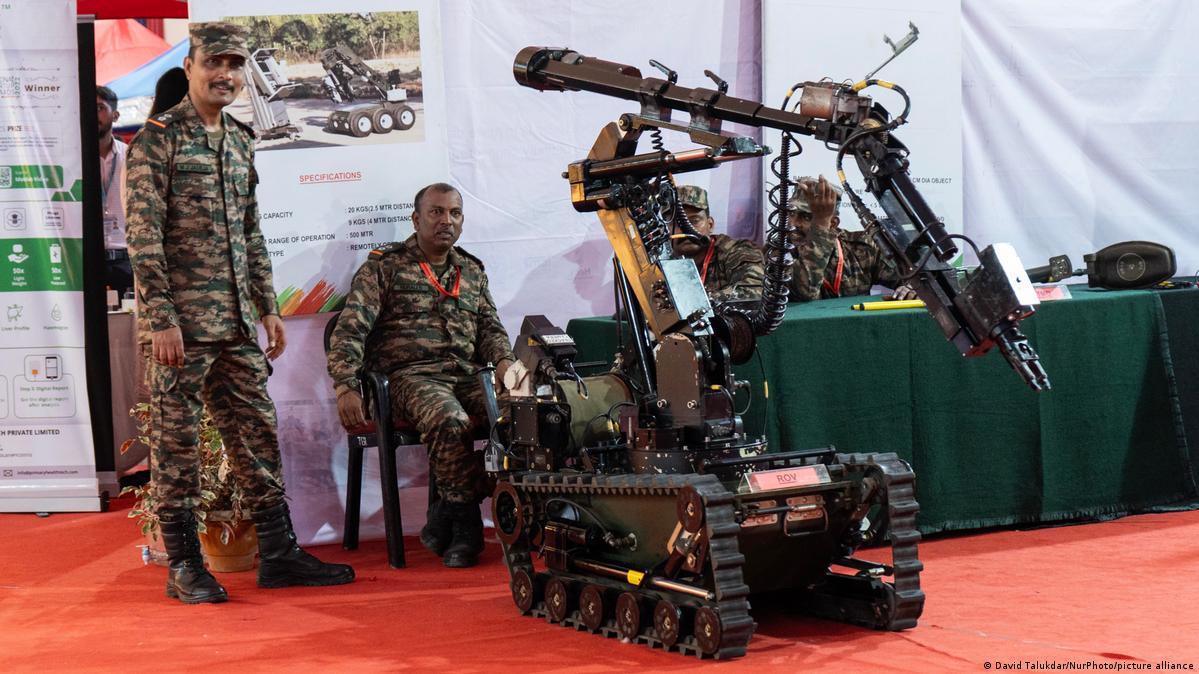
    Indian army ramps up AI, but how effective will it be? – DW – 10/18/2023

    Central idea

    The Indian military’s strategic embrace of emerging technologies, encompassing AI, cyber, and unmanned systems, reflects a forward-looking vision. While showcasing diverse initiatives, the article underscores the need for organizational shifts, jointness, and collaboration with civilians to effectively integrate these technologies

    Key Highlights:

    • Diverse Initiatives: Indian military strategically adopts AI, cyber, and unmanned systems, with each service branch leading initiatives.
    • Strategic Vision: Reflects a forward-looking approach, leveraging technology for operational and strategic advantages.
    • AIDef Showcases: Defence Ministry’s ‘AIDef’ presents Defence AI Council and Project Agency, showcasing a commitment to integrate AI across allied organizations.
    • Indigenous Emphasis: Highlights a push for indigenization, aligning with national goals of self-reliance in defence.

    Challenges:

    • Organizational Shift Needed: Warns against viewing technology as a ‘plug and play,’ stressing the need for organizational and doctrinal changes.
    • Data-sharing Imperative: Advocates for a cultural shift, urging military to share data with civilians for technology to reach its full potential.
    • Crucial Interconnectedness: Identifies jointness and interoperability challenges, crucial for effective integration of emerging technologies.
    • Need for Unified Commands: Stresses the urgency of joint theatre commands to streamline operations and enhance coordination.

    Key Phrases:

    • Civil-Military Partnerships: Emphasizes collaborative defence, necessitating partnerships with scientists, academics, and technologists.
    • Shared Responsibility: Highlights the shared responsibility of the military and civilians in navigating the complexities of emerging technologies.
    • Historical Challenge: Explores the perpetual military challenge of adapting to change, underlining the complexity of integrating emerging technologies.
    • Strategic Evolution: Recognizes the need for a strategic evolution to effectively incorporate emerging technologies into military operations.

    How AI Strengthens the Indian Army | ESDS

    Analysis:

    • Operational Synergy: Advocates for joint theatre commands to achieve operational synergy and seamless integration of emerging technologies.
    • Unified Strategy: Stresses the importance of a unified strategy for joint operations, minimizing challenges related to technology integration.
    • Specialization Advocacy: Urges a shift towards specialization in human resources practices, aligning officer expertise with the demands of emerging technologies.
    • Intellectual Inclination: Recommends extended tenures for officers inclined towards technological domains, fostering intellectual capabilities.
    Value addition box from Civilsdaily


    The U.S. Department of Defense (DoD) actively engages with private tech companies through initiatives like the Defense Innovation Unit (DIU) and In-Q-Tel to leverage cutting-edge technologies.


    The U.S. prioritizes collaboration between defense agencies and civilian entities, exemplified by the establishment of the Defense Innovation Board, composed of experts from various industries.


    The U.S. military emphasizes jointness through unified combatant commands, promoting interoperability in the application of emerging technologies across different branches.


    Key Data:

    • ‘UDAAN’ Initiative: The Indian Air Force is utilizing AI, cyber, and virtual reality under ‘UDAAN’ to address operational, logistical, and training needs.
    • Integrated Unmanned Roadmap: The Navy is progressing with emerging technologies, including an Integrated Unmanned Roadmap, as part of project ‘Swavlamban.’
    • Defence Cyber Agency: Established in 2018, the Defence Cyber Agency addresses threats in the cyber domain.
    • Defence Space Agency: Launched in 2018, it focuses on threats and capabilities related to space.
    • Comprehensive Approach: Reveals the military’s comprehensive approach, identifying 45 niche technologies for diverse military applications.
    • Strategic Preparedness: Illustrates a strategic preparedness to harness a spectrum of technologies for operational superiority.
    • Communication Enhancements: Mentions GSAT-7 and GSAT-7A launches, highlighting advancements in military communication capabilities through satellite technology.
    • Space for Defence: Showcases India’s utilization of space capabilities for defence purposes, marking a significant leap in technological applications.

    Way Forward:

    • Integrated Planning: Calls for integrated planning to address challenges in jointness and interoperability, laying the groundwork for successful technology integration.
    • Cross-Service Collaboration: Advocates for cross-service collaboration, emphasizing the need for unified efforts to maximize the potential of emerging technologies.
    • Private Sector Integration: Recommends openness to technocrats from the private sector, fostering innovation and expertise infusion for defence.
    • Innovation Ecosystem: Calls for the creation of an innovation ecosystem, encouraging collaboration between defence and civilian talent for holistic technological advancements.

    This transformative journey requires a multi-faceted approach, encompassing strategic vision, organizational adaptability, collaborative partnerships, and talent infusion to fully realize the potential of emerging technologies in the military landscape.

  • Amal Kumar Raychaudhuri and the Raychaudhuri Equation

    Raychaudhuri

    Central Idea

    • Amal Kumar Raychaudhuri, an Indian physicist, overcame obstacles and restrictions to make a profound contribution to the field of general relativity.

    A.K. Raychaudhuri: Early Life  

    • Born in Barisal, now in Bangladesh, in 1923.
    • Educated in Kolkata.
    • Developed a deep interest in general relativity during his time at the Indian Association of Cultivation of Science (IACS).

    Challenges Faced

    • While passionate about general relativity, Raychaudhuri was instructed by the director of IACS, Meghnad Saha, to work on topics of the director’s choosing or leave.
    • Raychaudhuri, with limited career options, complied with Saha’s directive but continued to explore the mysteries of gravity in his spare time.

    Theoretical Breakthrough: The Raychaudhuri Equation

    • Raychaudhuri focused on the problem of singularities in general relativity, specifically points where gravity could become infinitely strong.
    • Developed a unique approach that bypassed complex mathematical challenges.
    • Introduced the Raychaudhuri equation, a simple and elegant formula that showed the inevitable convergence of matter in curved spacetime.
    • The equation hinted strongly at the existence of singularities, a critical aspect of general relativity.

    Influence on Renowned Physicists

    • Raychaudhuri’s equation played a pivotal role in the work of Stephen Hawking and Roger Penrose.
    • Hawking’s area theorem, demonstrating that the surface area of black holes never decreases, relied on the Raychaudhuri equation.

    Recognition and Legacy

    • Despite his groundbreaking work, Raychaudhuri received limited recognition in India.
    • He faced obstacles in career advancement, including rejection by Calcutta University.
    • Raychaudhuri eventually joined Presidency College, Kolkata, where he became a revered teacher, inspiring future generations of physicists.
  • NASA-ISRO NISAR Mission Prepares for Launch

    nisar

    Central Idea

    • The NASA-ISRO Synthetic Aperture Radar (NISAR) mission, a collaborative effort between NASA and ISRO, is on track for its scheduled launch in the first quarter of 2024.

    About the NISAR Mission

    • Collaboration: NISAR is a Low Earth Orbit observatory developed jointly by NASA and ISRO, highlighting international collaboration in space exploration.
    • Launch Vehicle: The mission is set to launch from the Satish Dhawan Space Centre in Sriharikota onboard ISRO’s GSLV Mark-II launch vehicle.
    • Data Utility: NISAR data will offer unprecedented detail and assist researchers in various ways, including monitoring volcanic activity, tracking groundwater use effects, measuring ice sheet melt rates, and observing changes in global vegetation distribution.
    • Mission Duration: The $1.5-billion NISAR mission has a planned mission life of three years and will survey Earth’s land and ice-covered surfaces every 12 days following a 90-day commissioning period.

    Advanced SAR Technology

    • Dual-Band SAR: NISAR carries L and S dual-band Synthetic Aperture Radar (SAR) using the Sweep SAR technique, providing both wide coverage and high-resolution data.
    • Observatory Structure: The SAR payloads are mounted on the Integrated Radar Instrument Structure (IRIS) along with the spacecraft bus, forming an observatory.
    • Contributions: NASA’s Jet Propulsion Laboratory (JPL) provides the L-band SAR and several key components, while ISRO’s U R Rao Satellite Centre contributes the spacecraft bus, S-band SAR electronics, launch vehicle, and mission operations.

    Key milestones achieved

    • Thermal Vacuum Testing: The thermal vacuum testing, a critical system-level test, was successfully completed in Bengaluru. This test ensures that the spacecraft can operate effectively under extreme temperature conditions.
    • EMI and EMC Testing: Electromagnetic interference (EMI) and electromagnetic compatibility (EMC) testing have also been successfully accomplished.
    • Upcoming Vibration Tests: The next phase involves conducting vibration tests to simulate the harsh launch environment. This test will subject the satellite to intense vibrations while mimicking the conditions of a rocket launch.
  • Euclid Space Telescope unveils mysteries of Dark Universe

    euclid

    Central Idea

    • European astronomers have unveiled the first images captured by the newly launched Euclid space telescope.
    • These groundbreaking images offer a glimpse into Euclid’s extraordinary capabilities, demonstrating its capacity to observe billions of galaxies situated up to 10 billion light years away.

    What is Euclid Mission?

    • Euclid’s mission, led by the European Space Agency (ESA) in partnership with NASA, aims to unravel the enigmatic forces of dark matter and dark energy, which together constitute 95% of the universe.
    • The Euclid Space Telescope is equipped with a 1.2-meter primary mirror, allowing it to capture detailed observations of galaxies.
    • It carries two main scientific instruments: the visible-wavelength camera (VIS) and the near-infrared camera and spectrometer (NISP).
    • By mapping the distribution and evolution of galaxies, Euclid aims to shed light on the fundamental forces shaping the cosmos.

    (1) Mission Scope and Duration

    • Euclid is a space-based mission, equipped with a sophisticated telescope and state-of-the-art scientific instruments.
    • The mission is expected to have a nominal operational lifetime of 6 years, during which it will conduct an extensive survey of the sky.

    (2) Launch and Spacecraft

    • Euclid was launched on July 1, 2023, from Cape Canaveral in Florida using a SpaceX Falcon 9 rocket.
    • The spacecraft carries the Euclid Space Telescope, which is designed to observe galaxies across a wide range of wavelengths.

    (3) Investigating Dark Energy and Dark Matter  

    • Dark energy, discovered in 1998, explains the unexpected acceleration of the universe’s expansion.
    • Euclid’s mission aims to provide a more precise measurement of this acceleration, potentially uncovering variations throughout cosmic history.
    • Dark matter, inferred through the gravitational effects it exerts on galaxies and clusters, plays a vital role in preserving their integrity.

    Remarkable Images taken by Euclid

    • Sharper and Clearer: These images are touted as the sharpest of their kind, showcasing Euclid’s precision and ability to capture intricate cosmic details.
    • Perseus cluster: Euclid’s observations span four regions within our relatively nearby universe, including the massive Perseus cluster, which is located just 240 million light-years away and contains over 1,000 galaxies.
    • Horseshoe Nebula: Euclid provided a unique perspective on celestial wonders like the Horsehead Nebula, a region where new stars are born.
    • Dark Matter’s Clues: Scientists believe that organized structures like the Perseus cluster could only have formed if dark matter exists. Dark matter is inferred from its gravitational influence on galaxies, including their rotation and the formation of massive cosmic structures.

    Unraveling the Dark Universe

    • 5% Visible, 95% Dark: The mission emphasizes that our understanding of the universe is limited to merely 5%—the matter we can see. The rest of the universe remains “dark” because it does not emit electromagnetic radiation, but its effects on visible matter are evident.
    • Dark Matter’s Role: Dark matter is suspected to influence galaxies’ rotation, galaxy clusters’ cohesion, and the formation of cosmic structures, further validating its existence.
    • Dark Energy’s Mystery: Dark energy, an even more enigmatic force, was proposed in the 1990s when the universe’s accelerated expansion was discovered. This mysterious energy was awarded a Nobel Prize in 2011.

    Mission Ahead

    • Creating a 3D Map: Following its initial commissioning and overcoming technical challenges, Euclid will construct a 3D map covering approximately one-third of the sky. This map will reveal subtle variations attributable to the dark universe.
    • Cosmic Web Exploration: By gaining insights into dark energy and dark matter, scientists aim to understand the formation and distribution of galaxies within the cosmic web, a network of cosmic structures that make up the universe.
  • What is Stable Auroral Arc?

    stable aurora arc

    Central Idea

    • Recently, the Indian Astronomical Observatory (IAO) in Ladakh has astounded the world with mesmerizing images of a rare red-colored aurora, known as a Stable Auroral Arc (SAR).

    What is Stable Auroral Arc (SAR)?

    • Rare Phenomenon: SAR is a unique atmospheric occurrence witnessed during a potent G3-class geomagnetic storm.
    • Unconventional Origins: Unlike typical auroras resulting from space borne charged particles colliding with the atmosphere, SAR arcs have a distinct genesis.
    • Sign of Energy Flow: SAR arcs signify the transfer of heat energy into the upper atmosphere from Earth’s ring current system, a circular pathway carrying massive electrical currents encircling our planet.
    • Geomagnetic Storm Influence: During the recent geomagnetic storm, the ring current was dynamically charged due to prolonged intense geomagnetic activity, leading to the manifestation of SAR arcs.
    • Global Impact: This celestial event left its celestial mark across several regions worldwide.

    How is it formed?

    • Solar Wind Interaction: Aurora formation begins when the sun emits charged particles from its corona, creating solar wind. Upon colliding with Earth’s ionosphere, the mesmerizing aurora takes shape.
    • Northern and Southern Counterparts: In the Northern Hemisphere, it’s recognized as the northern lights (aurora borealis), while in the Southern Hemisphere, it’s referred to as the southern lights (aurora australis).
    • Magnetic Dance: The varying appearance of auroras in different hemispheres is attributed, in part, to the intricate interplay between the sun’s magnetic field and Earth’s magnetic field.
  • Calculating Moon’s True Age

    moon age

    Central Idea

    • For years, the moon’s age was believed to be around 4.42 billion years, but recent research challenges this notion.
    • A study has used advanced technology called atom probe tomography (APT) to evaluate lunar sample 72255, which contained 4.2 billion-year-old zircon crystals.

    Unveiling the Moon’s True Age

    • Zircon’s Significance: Zircon is not only the oldest mineral on Earth but also holds crucial information about the formation of our planet.
    • Lead Clustering Analysis: Using nanoscale spatial resolution, the scientists analyzed the clustering of lead within the samples, a common method to estimate the age of zircon in rocks.
    • Revised Age: The study concludes that the moon likely formed approximately 4.46 billion years ago, within the first 110 million years of the solar system’s existence.
    • Comparing Earth’s Age: Earth is estimated to be between 4.5 and 4.6 billion years old, making the moon slightly younger at approximately 4.46 billion years old.

    Implications of Zircon and Lunar Formation

    • Giant Impact Hypothesis: The researchers propose the giant impact hypothesis, suggesting that a celestial body named Theia, possibly Mars-sized, collided with Earth during its formation. This collision ejected debris, which coalesced to form the moon.
    • Lunar Magma Ocean: This collision led to the formation of the Lunar Magma Ocean, influencing the moon’s interior composition.
    • Preserved Zircon: Subsequent lunar surface bombardments reworked the earliest crust, leaving some zircon crystals modified and others preserved. Identifying these preserved zircon crystals provided insights into the moon’s age.
  • Siena Galaxy Atlas: A Window into the Cosmos

    Siena Galaxy Atlas

    Central Idea

    • The Siena Galaxy Atlas (SGA) is an impressive digital collection showcasing approximately 400,000 galaxies located in the vicinity of our Milky Way.

    Siena Galaxy Atlas

    • The SGA was created by amalgamating data from 3 distinct astronomical surveys conducted between 2014 and 2017.
    • These surveys took place at two observatories, namely the Cerro Tololo Inter-American Observatory (CTIO) and the Kitt Peak National Observatory (KPNO).
    • These surveys are collectively known as the DESI Legacy Surveys, laid the foundation for the SGA.

    Purpose of this Cosmic Atlas

    • Cosmic atlases like the SGA play a crucial role in enabling astronomers to discern intricate patterns within the universe.
    • They assist in categorizing various celestial phenomena, including transient stars, and identifying objects that merit further in-depth studies.
    • The SGA excels in terms of precision and accuracy, ensuring that it remains aligned with the latest astronomical revelations.
    • It facilitates investigations into the birth and evolution of galaxies, the distribution of mysterious dark matter, and the transmission of gravitational waves throughout space.
  • Gaganyaan: Flight Test Vehicle Abort Mission-1

    vehicle

    Central Idea

    • ISRO detailed about Gaganyaan mission’s Test Vehicle-Demonstration 1 (TV-D1) Mission which is scheduled for tomorrow.
    • TV-D1 will demonstrate the performance of the crew escape system.

    Flight Test Vehicle Abort Mission

    • Objective: The mission involves launching a rocket to an altitude of approximately 17 km, followed by a simulated abort signal, resulting in the separation of the crew module.
    • Safety Test: The crew module will descend safely using a parachute, ultimately splashing down in the Bay of Bengal.
    • Duration: This comprehensive test mission is scheduled to last 532 seconds, from liftoff at 8 am to the crew module’s splashdown, situated about 10 km from the Sriharikota coast.
    • Empty Module: It’s important to note that the crew module will remain uncrewed during this test.

    What will be tested?

    • New Test Vehicle: This mission introduces the new Test Vehicle, aptly named Test Vehicle-Demonstration 1 (TV-D1), and designed specifically for testing systems and procedures.
    • Crew Module Functionality: A basic version of the crew module, the capsule in which astronauts will eventually journey into space, will be tested for functions such as mid-flight emergency crew module separation and astronaut escape.
    • Technical Terminology: ISRO’s technical definition of the mission is “In-flight Abort Demonstration of Crew Escape System (CES),” which simulates abort conditions during ascent corresponding to a Mach number of 1.2, a critical aspect of the Gaganyaan mission.

    About the New Test Vehicle

    • Cost-Effective Testing: The TV-D1 mission employs a low-cost Test Vehicle, optimized for system testing, instead of the more expensive GSLV Mk III rocket used in previous tests.
    • Innovations: It uses existing liquid propulsion technology but includes innovations such as the throttleable and restartable L110 Vikas engine.

    Key Feature: Crew Escape System

    • Safety Precedence: The TV-D1 mission underscores ISRO’s unwavering commitment to astronaut safety, particularly in emergencies.
    • Environmental Control Systems: ISRO is actively developing environmental control and life support systems for the crew module.
    • Integrated Vehicle Health Management: The program includes an integrated system to monitor the vehicle’s health and initiate mission-abort procedures when necessary.
    • Testing Milestones: Some of these systems were previously assessed in the Crew module Atmospheric Re-Entry Experiment (CARE) and the Pad Abort Test-PAT in 2018.

    Stages of TV-D1 Mission

    • Critical Phases: The mission involves key stages, including the separation of the Crew Escape System from the Test Vehicle and the subsequent separation of the crew module.
    • Parachute Deployment: Parachutes will be deployed for a safe descent over approximately seven minutes.
    • Navy’s Involvement: The Indian Navy will play a crucial role in recovering the crew module from the Bay of Bengal.
    • Milestone Setting: The TV-D1 mission serves as a significant milestone, marking the integration of a near-complete system for flight testing.

    Status of Preparations

    • Unmanned Mission: An unmanned mission is scheduled for early next year, followed by abort missions, with the manned mission targeted for late 2024 or early 2025.
    • Technical Readiness: The human-rated LVM 3 rocket has successfully undergone testing, and essential components such as solid rocket boosters and liquid propellant engines are ready.
    • Training: Four astronauts from the Indian Air Force have undergone training in Russia and will receive further training to prepare for the final mission.

    Conclusion

    • ISRO’s relentless pursuit of space exploration reaches a pivotal juncture with the TV-D1 mission.
    • As India inches closer to sending its astronauts into space, these planned tests and safety measures underscore ISRO’s commitment to ensuring a safe and successful Gaganyaan mission.
  • NASA’s APEP Mission: Studying Solar Eclipse’s Impact on Earth’s Ionosphere

    APEP

    Central Idea

    • NASA is set to launch on a groundbreaking mission known as Atmospheric Perturbations around the Eclipse Path (APEP).
    • The project is spearheaded by an Indian-origin engineering physics professor.

    Exploring the APEP Mission

    • Triple Rocket Launch: The APEP mission involves the deployment of three meticulously equipped rockets, each armed with an array of cutting-edge scientific instruments.
    • Objective: The primary mission objective is to unravel the enigma of how the upper atmosphere reacts during a solar eclipse, particularly during the pivotal moments of sudden light reduction.
    • Ionospheric Dynamics: Solar eclipses trigger profound transformations in the ionosphere, generating cascading waves throughout this atmospheric layer.
    • Comprehensive Measurements: The mission’s scientific instruments will meticulously measure variations in electric and magnetic fields, density, and temperature.
    • Launch Location: APEP will be launched from the White Sands Missile Range in New Mexico, with a specific focus on exploring the ionosphere.
    • Impact on Satellite Communications: NASA postulates that the ionosphere’s temperature and density will diminish during the eclipse, leading to disruptive wave-like disturbances that could affect GPS and satellite communications.

    Mission Process

    • Strategic Rocket Positioning: The three rockets will be strategically positioned just beyond the path of annularity, where the Moon directly aligns with the Sun.
    • Simultaneous Measurements: NASA’s paramount goal is to attain the first-ever simultaneous measurements from multiple locations within the ionosphere during a solar eclipse.
    • Precision of Rockets: Rockets offer precision in launching at precisely the right moment and probing lower altitudes inaccessible to orbiting satellites.
    • Sounding Rockets’ Selection: The APEP mission team opted for sounding rockets due to their unparalleled ability to pinpoint and measure specific spatial regions with exceptional accuracy.
    • Multi-Altitude Data: These rockets are adept at capturing data at varying altitudes as they ascend and descend during their suborbital flights.
    • Altitude Range: Data collection will span altitudes ranging from 45 to 200 miles (70 to 325 kilometres) above the Earth’s surface along the rockets’ flight trajectories.
  • Indian-Built ARTIP Technology Revolutionizes Astronomy

    Central Idea

    • India’s Automated Radio Telescope Image Processing Pipeline (ARTIP) technology has been instrumental in facilitating remarkable discoveries from distant galaxies observed by South Africa’s MeerKAT Telescope.
    • MeerKAT acts as a precursor to the Square Kilometre Array (SKA) Telescope, known for its outstanding sensitivity and sky survey capabilities.
    • ARTIP’s cutting-edge image data processing is vital for harnessing MeerKAT’s potential for groundbreaking research.

    What is ARTIP?

    • Development by Thoughtworks: ARTIP was developed by global technology consultancy firm Thoughtworks at its India offices in Bengaluru and Pune.
    • Automation of Data Processing: Since 2017, this collaboration has aimed to automate various critical processes, including data processing, flagging, calibration, and imaging.

    How ARTIP operates?

    • Configurability: ARTIP is highly configurable and customizable, designed to process MeerKAT-generated data. While initially configured for MeerKAT, its adaptability allows it to process data from uGMRT and VLA class telescopes.
    • Pipeline Components: It consists of four individual sub-pipelines, including calibration, cube imaging, continuum imaging, and diagnostics, each serving different stages of the data processing workflow.
    • Calibration (ARTIP-CAL): This component calibrates data against known astronomical sources and extracts the target source of interest.
    • Cube Imaging (ARTIP-CUBE): The calibrated target is then used to generate sky images using this component.
    • Continuum Imaging (ARTIP-CONT): This pipeline focuses on generating images from the calibrated data.
    • Diagnostics (ARTIP-DIAGNOSTICS): Providing analysis insights into data processing and quality, it functions as a quality assurance pipeline.

    Impactful Discoveries by ARTIP

    • Hydroxyl Radical (OH) Detection: ARTIP has contributed to significant discoveries, including the detection of the hydroxyl radical (OH), an essential chemical species found throughout the atmosphere in a distant galaxy.
    • Identification of Hydrogen Atoms: It has also played a crucial role in identifying massive hydrogen atoms (Rydberg atoms) in another distant galaxy.
    • Scientific Recognition: The MALS data processing with ARTIP has received recognition in the international astronomical journal, Proceedings of Science, for its contributions to these discoveries.