💥Join UPSC 2027,2028 Mentorship (August Batch) + XFactor Notes & Microthemes PDF

Type: Amended/Enacted

  • Parliament clears renaming of Kerala to “Keralam”

    Why in the News

    Both Houses passed a Bill to rename Kerala as “Keralam”, its name in Malayalam. The change follows two resolutions of the Kerala Assembly and routes through the constitutional process for altering a state’s name.

    How is a state renamed under the Constitution?

    1. Parliament’s power: Under Article 3, Parliament can alter the name of a state by law.
    2. Presidential referral: Such a Bill needs the President’s recommendation and the views of the affected state legislature.
    3. Simple majority: The change is passed by ordinary legislative majority, not a constitutional amendment.

    Why “Keralam”?

    1. Linguistic identity: “Keralam” is the state’s name in Malayalam, and the change aligns official usage with local usage.
    2. Assembly resolutions: The Kerala Assembly twice sought the change unanimously.

    Why does the process matter?

    1. Union primacy: Only Parliament, not the state, can effect the legal renaming.
    2. Federal courtesy: The state legislature’s view is sought, but its resolution is not binding.

    Back2Basics: Article 3 of the Constitution

    1. Scope: Formation of new states and alteration of areas, boundaries, or names of existing states.
    2. Initiation: Only on the President’s recommendation, after seeking the state legislature’s views.
    3. Nature: Treated as an ordinary law, reflecting the “indestructible states” feature of Indian federalism.

    “[2022, GS1, 15] The political and administrative reorganization of states and territories has been a continuous ongoing process since the mid-nineteenth century. Discuss with examples.”

    [2025] Consider the following pairs :
    State:Description

    1. Arunachal Pradesh: The capital is named after a fort, and the state has two National Parks
    2. Nagaland: The State came into Existence on the basis of a Constitutional Amendment Act.
    3. Tripura: Initially a Part ‘C’ State, it became a centrally administered territory with the reorganization of State in 1956 and later attained the status of a full-fledged State
    How many of the above pairs are correctly matched?

    [A] Only one

    [B] Only two

    [C] All the three

    [D] None

  • Parliament curbs states’ power to tax minerals

    Why in the News

    Parliament passed the Mines and Minerals (Development and Regulation) Amendment Bill, 2026. It bars states from imposing specified levies on mineral rights except on terms set by the Centre, reopening a fiscal federalism dispute.

    What does the Mines and Minerals (Development and Regulation) Amendment Bill, 2026 do?

    1. Levy restriction: States cannot impose specified taxes on mineral rights or mineral-bearing land except as the Centre prescribes.
    2. Dues extinguished: Pre-amendment dues estimated near 2 lakh crore rupees stand extinguished.
    3. Scope: The Bill applies to major minerals such as iron ore, coal, bauxite, manganese, and copper.

    Why is this a fiscal federalism flashpoint?

    1. 2024 ruling reversed in effect: The Supreme Court in 2024 upheld states’ power to tax mineral rights, which the Bill now constrains.
    2. Revenue dependence: Mining was 84.9% of Jharkhand’s non-tax revenue in 2024-25.
    3. Mineral-rich states hit: States holding large mineral reserves lose an expected revenue stream.

    What is the Centre’s justification?

    1. Uniform rates: The government argues uniform mineral rates prevent a patchwork of state levies.
    2. No revenue loss claim: The Centre states that states retain powers over minor minerals.
    3. Investment climate: Predictable levies are framed as protecting mining-sector investment.

    What are the major debates surrounding it?

    1. Tax versus royalty: The dispute turns on whether a levy on minerals is a tax or a royalty, which the 2024 ruling addressed.
    2. Tribal concerns: Mineral belts overlap with Scheduled Areas, raising questions of local benefit-sharing.
    3. Divisible resource control: Centralising mineral levies shifts fiscal power toward the Union.

    Conclusion

    The amendment centralises control over mineral taxation soon after the Supreme Court affirmed states’ taxing power. The immediate stage is enactment, with a likely constitutional challenge the next development.

    Back2Basics

    Constitutional Framework Governing mineral taxation

    1. Entry 50, State List: Taxes on mineral rights, subject to Parliament’s limitations relating to mineral development.
    2. Entry 54, Union List: Regulation of mines and mineral development declared expedient in public interest.
    3. Article 246: Distributes legislative power between Union and states via the Seventh Schedule.

    What did the Supreme Court hold in 2024?

    The Mineral Area Development Authority v. SAIL judgment is the constitutional backdrop to the 2026 amendment. The 9-judge Constitution Bench, by 8:1 majority, held that royalty is not a tax and that States have legislative competence to tax mineral rights under Entry 50, State List. It also recognised the States’ power to tax mineral-bearing land under Entry 49, State List.

    • Royalty ≠ Tax: Royalty paid under the MMDR Act is consideration for the right to extract minerals and is distinct from a tax.
    • State Taxing Power: States can impose taxes on mineral rights under Entry 50, List II, subject to limitations imposed by Parliament.
    • Mineral-Bearing Land: States can also levy taxes on land under Entry 49, List II.
    • MMDR Limitation: The Court held that the MMDR Act, as it then stood, did not impose a limitation on the States’ taxing power.

    Why is the 2026 Amendment significant?

    The 2026 amendment seeks to alter this position prospectively by restricting State taxation of mineral rights and mineral-bearing lands, except in accordance with conditions or restrictions prescribed by the Centre

    PYQ Relevance

    [UPSC 2025] Examine the evolving pattern of Centre-State financial relations in the context of planned development in India. How far have the recent reforms impacted the fiscal federalism in India?

    Linkage: The 2025 PYQ examines the evolution of Centre–State financial relations and their impact on fiscal federalism. The Bill raises fresh concerns over the Union’s role in restricting States’ mineral revenue powers and fiscal autonomy.

  • Parliament passes National Co-operative Development Corporation (Amendment) Bill, 2026

    Why in the News?

    Parliament passed the National Cooperative Development Corporation (Amendment) Bill, 2026, enabling the NCDC to provide loans and grants directly to cooperative societies.

    What is NCDC?

    • NCDC (National Cooperative Development Corporation) is a statutory corporation established under the National Cooperative Development Corporation Act, 1962.
    • Functions under the Ministry of Cooperation.
    • Promotes and finances cooperatives involved in production, processing, marketing, storage and trade of agricultural and allied produce.

    What does the Amendment Change?

    • Direct lending: NCDC can directly provide loans and grants to cooperative societies.
    • Wider coverage: Definition of foodstuffs expanded to include processed food and other food items notified by the Centre.
    • No additional budgetary outlay: The Bill does not provide for additional government financial assistance.

    Why is it Needed?

    • Faster flow of credit by removing intermediary delays.
    • Supports over 8 lakh cooperatives with more than 30 crore members.
    • Extends cooperative financing into value added food chains.

    Why are States Concerned?

    • Cooperation is largely a State subject.
    • Direct central lending may bypass State governments and registrars.
    • Raises concerns about cooperative federalism and centralisation.

    Key Challenges

    • Financial weakness and poor governance of PACS (Primary Agricultural Credit Societies).
    • Dual regulatory control.
    • Regional concentration of cooperatives.
    • Delayed elections and audits.
    • Limited professional management.
    • Centre State friction.

    Constitutional Framework

    • Entry 32, State List: Incorporation and regulation of cooperative societies within a State.
    • Article 43B: Promotes voluntary formation and autonomous functioning of cooperatives.
    • Part IXB, Articles 243ZH to 243ZT: Constitutional provisions on cooperatives.
    • Multi State Cooperative Societies Act, 2002: Governs cooperatives operating across multiple States.
  • Lok Sabha passes Mines and Minerals Amendment Bill, 2026; bars States from taxing mineral rights

    Why in the news?

    The Lok Sabha passed the Mines and Minerals (Development and Regulation) Amendment Bill, 2026 without debate, barring State governments from imposing additional taxes, cesses or levies on mineral rights and giving the Centre greater control over regulating mineral-laden lands. The move exposes a fiscal federalism clash, since it curtails a State taxation power the Supreme Court had upheld in 2024 and shifts fiscal authority over a Concurrent-domain resource toward the Union.

    What does the Mines and Minerals (Development and Regulation) Amendment Bill, 2026 do?

    1. Bars State levies: It prevents State governments from imposing additional taxes, cesses or levies on mineral rights.
    2. Central control: It gives the Centre greater control over regulating mineral-laden lands.
    3. Stated rationale: The Coal and Mines Minister argued that divergent fiscal levies by States had created uncertainty in the mineral sector.
    4. Feared effects cited: The government said such divergence could raise costs, encourage imports and undermine domestic supply chains.

    What is the Mines and Minerals (Development and Regulation) Act, 1957?

    1. Purpose: The MMDR Act, 1957 is the principal law regulating the mining sector, governing the grant of mineral concessions, leases and the development and regulation of mines.
    2. Federal scheme: It empowers the Centre to frame rules for major minerals, while States frame rules for minor minerals and grant concessions for minerals in their territory.

    Current Status of State taxation power over minerals in India

    1. State entitlement: States levy royalty on extracted minerals and, since a 2024 Supreme Court ruling, hold constitutional competence to tax mineral rights and mineral-bearing lands.
    2. The 2024 judgment: A nine-judge Bench held that royalty is not a tax and that States have legislative power to tax mineral rights, a power the present Bill now seeks to restrict.
    3. Revenue stakes: Mineral-rich States such as Jharkhand, Odisha and Chhattisgarh rely on mining royalties and cesses as a significant own-revenue source.

    Constitutional Provisions related to mineral regulation and fiscal federalism

    1. Entry 54, Union List: Regulation of mines and mineral development to the extent Parliament declares expedient in the public interest.
    2. Entry 23, State List: Regulation of mines and mineral development subject to the Union List entry.
    3. Entry 50, State List: Taxes on mineral rights subject to any limitations imposed by Parliament relating to mineral development.
    4. Entry 49, State List: Taxes on lands and buildings, the basis on which States tax mineral-bearing land.
    5. Article 246 and Seventh Schedule: Distribute legislative competence between the Union and the States across the three Lists.
    6. Article 265: No tax shall be levied or collected except by authority of law.

    Why does the Centre want to bar State levies?

    1. Uniformity: A single fiscal regime is intended to remove the uncertainty created by State-by-State levies.
    2. Cost competitiveness: The government links divergent levies to higher input costs for downstream industry and greater import dependence.
    3. Supply chain security: Uniform charges are framed as protection for domestic mineral supply chains, including critical minerals.

    Why do States and the Opposition see this as an assault on federalism?

    1. Overriding the Court: The Bill legislatively narrows a taxation power the Supreme Court affirmed for States in 2024.
    2. Erosion of own-revenue: Barring cesses and levies removes a fiscal lever that mineral-rich States use to fund local development.
    3. Centralising trend: Critics place it within a wider pattern of the Union tightening control over resources located in State territories.
    4. Process objection: The Bill was passed without debate amid protests, which the Opposition cited as a denial of scrutiny on a federalism-sensitive measure.

    Major debates surrounding mineral taxation federalism

    1. Royalty versus tax: Whether royalty is a tax and where the line lies between Union regulation of mineral development and State taxation of mineral rights.
    2. Parliamentary limitation: How far Parliament’s power under Entry 50 to limit State mineral taxation can extend before it hollows out the State entry.
    3. Distributive justice: Whether mineral-bearing States should retain fiscal upside from resources extracted within their borders.
    4. Investment climate: Whether uniform central levies genuinely lower costs or merely redistribute fiscal space from States to industry.

    Challenges to a centralised mineral fiscal regime

    1. Vertical fiscal imbalance: Reduced own-revenue deepens State dependence on central transfers.
    2. Litigation risk: A statutory override of a constitutional ruling invites fresh challenges before the Supreme Court.
    3. Regional equity: Resource-rich but income-poor States lose a development financing tool.
    4. Cooperative federalism strain: Bypassing State consent on a shared-domain subject weakens negotiated federalism.
    5. Compliance uncertainty: Transition from varied State levies to a single regime creates short-term ambiguity for operators.

    Conclusion

    The Lok Sabha has cleared a Bill that removes the States’ power to levy additional taxes on mineral rights and centralises regulatory control over mineral lands. The current status is passage in the Lower House amid Opposition protest; the next milestone is its consideration in the Rajya Sabha and likely constitutional scrutiny given its tension with the 2024 Supreme Court ruling on State taxation of minerals.

    What is Fiscal Federalism? (Foundational Context)

    1. About: Fiscal federalism is the division of taxation powers, expenditure responsibilities and transfers between the Union and the States.
    2. Rationale: It exists to match revenue-raising capacity with spending needs across tiers of government.
    3. Named typology: It addresses vertical imbalance between the Union and States, horizontal imbalance across States, and weak third-tier finances at the local level.

    Key Concerns Regarding Fiscal Federalism

    1. Shrinking divisible pool: Rising cesses and surcharges reduce the shareable tax pool with States.
    2. Eroded State autonomy: GST and central levies have narrowed independent State taxation.
    3. Resource control: Central assertion over minerals and land in State territories limits State fiscal levers.
    4. Weak local finances: Third-tier bodies remain underfunded and dependent.

    Constitutional Framework Governing Mineral Regulation

    1. Entry 54 (List I): Union regulation of mines and mineral development in the public interest.
    2. Entry 23 (List II): State regulation of mines subject to the Union entry.
    3. Entry 50 (List II): State taxes on mineral rights subject to parliamentary limitation.
    4. Article 246: Allocation of legislative competence across the three Lists.
    5. Article 265: Taxation only by authority of law.

    Way Forward

    1. Consultative design: Frame mineral fiscal policy through the GST Council model of negotiated federalism.
    2. Revenue neutrality: Compensate mineral-rich States for lost cesses through predictable transfers.
    3. Legal clarity: Reconcile the amendment with the 2024 ruling to avoid protracted litigation.
    4. District mineral funds: Strengthen use of mining revenues for affected local communities.

    “[2025] Consider the following statements:

    Statement I: In India, State Governments have no power for making rules for grant of concessions in respect of extraction of minor minerals even though such minerals are located in their territories.

    Statement II: In India, the Central Government has the power to notify minor minerals under the relevant law.

    Which one of the following is correct in respect of the above statements?

    (a) Both Statement I and Statement II are correct and Statement II explains Statement I

    (b) Both Statement I and Statement II are correct but Statement II does not explain Statement I

    (c) Statement I is correct but Statement II is incorrect

    (d) Statement I is incorrect but Statement II is correct

  • Centre relaxes construction hurdles in Ganga flood plain

    Why in the News?

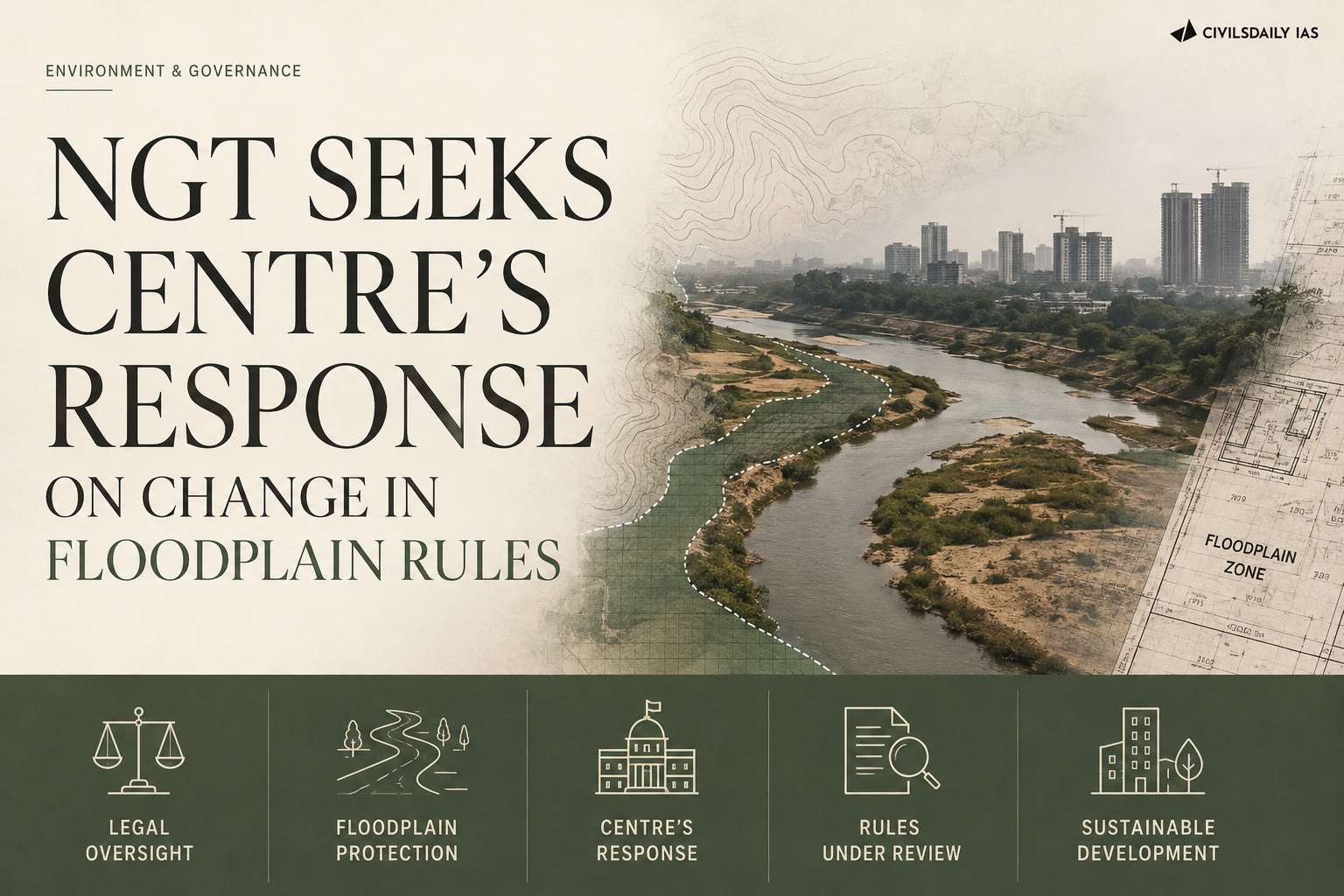
    A gazette order of 10 August from the National Mission for Clean Ganga (NMCG) has removed the blanket declaration in the 2016 law that the Ganga flood plain is a construction free zone, replacing the total ban with a stratified, approval based regime. The change exposes the tension between protecting the river’s ecology and permitting development in areas subject only to moderate or rare flooding.

    What is the River Ganga Authorities Order that was amended?

    1. Instrument: The River Ganga (Rejuvenation, Protection and Management) Authorities Order, 2016, notified under the Environment (Protection) Act, 1986, governs protection and management of the river.
    2. Original ban: The 2016 order declared the bank of the river and its flood plain a construction free zone to reduce pollution and preserve natural groundwater recharge.
    3. What the amendment does: The 10 August order deletes the no construction clause and replaces the total ban with a regulated system in which some construction is permissible after official clearances.

    How does the new stratified definition of a flood plain work?

    1. Active flood plain: The zone immediately along the channel that submerges at least once every five years, where strict building prohibitions continue, with minor exceptions for temporary set ups such as religious events.
    2. Regulatory zone: The middle band subject to moderate flooding once every five to 25 years, where construction is now permissible subject to clearances.
    3. Warning zone: The outer periphery that floods only during severe events of 25 to 100 year frequency, where construction is also now permissible subject to clearances.
    4. Earlier gap: The 2016 order banned construction in the active flood plain but never defined what active meant, an inconsistency the amendment claims to correct.

    Why did the government amend the order?

    1. Stated rationale: A senior official said the amendment does not dilute standards but corrects an inconsistency in the law between the flood plain definition and the construction ban.
    2. Litigation pressure: Litigants had routinely cited the blanket construction free zone mandate against riverfront roads, embankments and sewage treatment plants before the National Green Tribunal.
    3. Scope limit: The new order does not grant blanket permission for development and keeps a regulated approval process in place.

    Does the change protect the river or dilute safeguards?

    1. The protection case: Confining strict prohibition to the active flood plain leaves the ecologically most sensitive channel margin protected while allowing regulated use elsewhere.
    2. The dilution concern: Opening the regulatory and warning zones to construction reduces the natural groundwater recharge and pollution buffer the 2016 order sought to preserve.
    3. Enforcement risk: An approval based system shifts protection from a clear legal bar to case by case clearances that depend on administrative capacity and vigilance.

    What are the challenges to regulating the Ganga flood plain?

    1. Encroachment pressure: Dense settlement and commercial demand along the river make flood plains attractive for construction.
    2. Weak demarcation: Flood plain zoning requires accurate hydrological mapping that is incomplete across the basin.
    3. Fragmented jurisdiction: Multiple states, municipal bodies and agencies share authority over the river, complicating uniform enforcement.
    4. Climate variability: Changing flood frequencies undermine fixed five, 25 and 100 year return period assumptions.
    5. Pollution load: Untreated sewage and industrial effluent continue to enter the river despite protection orders.

    Conclusion

    The amendment ends the 2016 blanket ban on flood plain construction and installs a three zone regime that permits regulated building beyond the five year flood line after clearances. The government frames this as correcting a legal inconsistency, while the ecological question is whether an approval based system can protect the river’s recharge and pollution buffer as effectively as an outright prohibition did. The next test lies in how clearances are granted and whether active flood plain protection holds against development pressure.

    Back2Basics:

    Foundational Context: Ganga Rejuvenation in India

    1. About: Ganga rejuvenation is a national programme to abate pollution and conserve and rejuvenate the river through sewage treatment, riverfront management and flow protection.
    2. Scale: The Ganga basin covers roughly one fourth of India’s land area and supports a large share of the population.
    3. Institutional design: The effort is coordinated by the National Mission for Clean Ganga under the National Ganga Council, with the Jal Shakti Ministry as the nodal ministry.
    4. Approach: It combines infrastructure such as sewage treatment plants with regulatory tools such as flood plain zoning and construction control.

    Statutory Framework Governing the Ganga

    1. Environment (Protection) Act, 1986: The parent statute under which the 2016 River Ganga Authorities Order and its amendment are notified.
    2. Water (Prevention and Control of Pollution) Act, 1974: Establishes pollution control boards that regulate effluent discharge into the river.
    3. River Ganga (Rejuvenation, Protection and Management) Authorities Order, 2016: Creates the tiered institutional structure, including the National Ganga Council and NMCG, and governs flood plain regulation.
    4. National Green Tribunal Act, 2010: Constitutes the forum where flood plain and riverfront disputes are adjudicated.

    National Mission for Clean Ganga (NMCG)

    1. Nature: Implementation wing for Ganga rejuvenation and the Namami Gange programme.
    2. Governing framework: Registered as a society and given statutory backing through the River Ganga Authorities Order, 2016.
    3. Parent body: Functions under the National Ganga Council, chaired by the Prime Minister.
    4. Nodal ministry: Department of Water Resources, River Development and Ganga Rejuvenation under the Jal Shakti Ministry.
    5. Mandate: Ensures effective abatement of pollution and rejuvenation of the river by adopting a comprehensive, basin wide approach.

    Government Initiatives / Schemes for Ganga Rejuvenation

    1. Namami Gange Programme: Integrated conservation mission covering sewage treatment, riverfront development, afforestation and biodiversity.
    2. Arth Ganga: Model to build a sustainable economic bridge between the river and people through livelihoods, tourism and natural farming along the banks.
    3. Ganga Gram: Programme for sanitation and solid waste management in villages along the river.
    4. Jal Shakti Abhiyan: Water conservation campaign that supports groundwater recharge in the basin.

    Key Facts about the Ganga

    1. Length: The river runs roughly 2,525 kilometres from Gomukh to the Bay of Bengal.
    2. National River: The Ganga was declared India’s National River in 2008.
    3. Flood plain zones: The amended order recognises active, regulatory and warning zones based on five, 25 and 100 year flood frequencies.
    4. Dolphin link: The Gangetic dolphin, the National Aquatic Animal, depends on healthy river flow.

    Challenges in Ganga Conservation

    1. Sewage burden: A large volume of untreated urban sewage continues to reach the river.
    2. Industrial effluent: Tanneries and other industries discharge pollutants along the course.
    3. Reduced flow: Barrages, abstraction and diversion lower ecological flow in stretches.
    4. Flood plain encroachment: Construction and settlement erode the river’s natural buffer.
    5. Coordination gaps: Multiple states and agencies weaken uniform enforcement.
    6. Solid waste and religious use: Immersion waste and idol immersion add pollution loads.

    Way Forward

    1. Complete flood plain mapping: Finalise accurate zonation to make the three tier regime enforceable.
    2. Strengthen sewage treatment: Close the gap between sewage generated and treatment capacity.
    3. Ensure ecological flow: Mandate minimum environmental flows across barrages.
    4. Tighten clearance scrutiny: Apply strict, transparent conditions before approving construction in regulatory and warning zones.
    5. Empower basin governance: Reinforce NMCG and state bodies with clear enforcement powers.

    PYQ Relevance

    [UPSC 2015] Discuss the Namami Gange and National mission for clean Ganga (NMCG) programmes and causes of mixed results from the previous schemes. What quantum leaps can help preserve the river Ganga better than incremental inputs?

    Linkage: The PYQ directly connects with Ganga rejuvenation, conservation and the effectiveness of government interventions. The flood plain amendment highlights the challenge of balancing river conservation, pollution control and development pressures.

  • Vande Mataram Bill gets President’s assent, becomes law

    Why in the News

    The President gave assent to the Prevention of Insults to National Honour (Amendment) Bill, 2026, making it law. The amendment criminalises intentional disruption or prevention of the singing of the National Song Vande Mataram, extending to it the legal protection currently accorded to the National Anthem.

    What is the Prevention of Insults to National Honour (Amendment) Bill, 2026?

    1. Core provision: The Prevention of Insults to National Honour (Amendment) Bill, 2026, criminalises intentional disruption or prevention of the singing of the National Song Vande Mataram.
    2. Parent statute: It amends the Prevention of Insults to National Honour Act, 1971, which already penalises insults to the National Flag, the Constitution, and the National Anthem.
    3. Equal status: The legislation grants Vande Mataram the same legal protection as the National Anthem, Jana Gana Mana.
    4. Legislative passage: The Lok Sabha passed the Bill on 30 July and the Rajya Sabha cleared it a day earlier, with Presidential assent completing enactment.

    What are the concerns raised on implementation?

    1. Practicality of enforcement: A senior Opposition member questioned whether respect and patience for the song can be legislated.
    2. Duration burden: A full rendition of Vande Mataram lasts about three minutes and ten seconds, against roughly 52 seconds for Jana Gana Mana.
    3. Standing time: Where a State Song precedes both, audiences could be expected to stand for nearly six minutes before and after every official function.
    4. Counterproductive risk: The stated concern is that mandating full rendition could reduce rather than promote respect for the National Song.

    About National Symbols in India

    1. National Anthem: Jana Gana Mana, adopted by the Constituent Assembly on 24 January 1950, protected under the Prevention of Insults to National Honour Act, 1971.
    2. National Song: Vande Mataram, composed by Bankim Chandra Chatterjee, given equal status with the National Anthem by the Constituent Assembly on 24 January 1950.
    3. National Flag: The Tiranga, governed by the Flag Code of India, 2002, and the Prevention of Insults to National Honour Act, 1971.
    4. Legal duty: Article 51A(a) makes it a fundamental duty of every citizen to respect the Constitution, the National Flag, and the National Anthem.

    Statutory Framework Governing National Honour

    1. Prevention of Insults to National Honour Act, 1971: Penalises insults to the National Flag, the Constitution, and the National Anthem.
    2. 2026 Amendment: Extends protection to the National Song Vande Mataram against intentional disruption.
    3. Flag Code of India, 2002: Consolidates conventions and instructions on display and use of the National Flag.
    4. Emblems and Names (Prevention of Improper Use) Act, 1950: Restricts improper use of national emblems and names.

    Back2Basics: Vande Mataram

    1. Author: Bankim Chandra Chatterjee, who composed it and later included it in the novel Anandamath.
    2. Historical role: It became a rallying song of the freedom movement, first sung at the 1896 session of the Indian National Congress.
    3. Constitutional status: The Constituent Assembly resolved on 24 January 1950 that it shall have equal honour with the National Anthem, Jana Gana Mana.
    4. Original language: Composed largely in Sanskritised Bengali.
    5. Full rendition: A complete rendition runs about three minutes and ten seconds.
  • Parliament passes Tribunals Reforms Bill; National Tribunals Commission set up

    Why in the News?

    Parliament passed the Tribunals Reforms Bill, 2026, which establishes a National Tribunals Commission to oversee the selection and administration of tribunals. The Bill responds to a Supreme Court direction, yet it retains executive control over the commission’s appointments and finances. This exposes the tension between insulating tribunals from the ministries they review and preserving the government’s grip over the same bodies.

    What is the National Tribunals Commission (NTC)?

    1. Definition: The National Tribunals Commission (NTC) is a proposed statutory body to oversee the appointment, service conditions, and administration of tribunals under a common framework covering 16 tribunals.
    2. Composition: It is to be headed by a former Supreme Court judge or a former chief justice of a High Court, supported by two judicial members and two technical members.
    3. Selection method: Appointments to member tribunals are to be made through a search cum selection system run by the commission, supported by a dedicated NTC Secretariat.
    4. Origin: The Supreme Court first recommended an independent statutory commission of this kind in the Rojer Mathew judgment of 2019.

    Why were tribunals created in the first place?

    1. Speed and specialisation: Tribunals allow specialists to settle technical disputes faster than regular courts, in areas such as taxation, company law, securities, and the environment.
    2. Complementary role: They do not replace constitutional courts but supplement the judicial system with specialised adjudication.
    3. Economic stake: Timely resolution frees locked capital and restores investor confidence, linking ease of justice to ease of doing business.
    4. Constitutional basis: Articles 323A and 323B provide for administrative tribunals on service matters and tribunals on specified subjects respectively.

    How has tribunal jurisprudence developed?

    1. S.P. Sampath Kumar, 1987: Upheld tribunals but held that their decisions remain subject to review by constitutional courts.
    2. L. Chandra Kumar, 1997: Held that judicial review by High Courts under Article 226 is part of the basic structure and cannot be ousted by tribunals.
    3. Rojer Mathew, 2019: Recommended an independent statutory National Tribunals Commission and held that defining who is qualified to exercise judicial power is an essential legislative function that cannot be left to executive rulemaking.
    4. Madras Bar Association, 2025: Struck down provisions Parliament had reenacted, restored the earlier framework, and gave the government four months to establish the commission.
    5. Structural flaw addressed: Tribunals had historically been administered by the same ministries whose decisions they were meant to review.

    What are the other major changes the Bill introduces?

    1. Five year terms: Restores five year terms for tribunal members in place of shorter tenures the courts had rejected.
    2. Uniform service conditions: Introduces uniform service conditions across tribunals to end variation between ministries.
    3. National Tribunals Data Grid: Provides for a data grid to track pendency and disposal across tribunals.
    4. Pending appointments protected: Does not disturb appointments already in the pipeline.
    5. Rationalisation retained: Follows the earlier reduction of tribunals from 26 to 19 and then to 16.

    Where does the genuine tension in the Bill lie?

    1. Autonomy versus executive control: The commission is meant to insulate tribunals from executive control, yet the Centre still appoints its members and retains substantial influence over its finances and administration.
    2. Delegation to executive rules under Section 14: Qualifications, manner of selection, salaries, and service conditions of members are left to future executive rules, the very delegation the Rojer Mathew reasoning had resisted.
    3. Ministerial screening under Section 16: A ministry first screens a complaint against a member before it passes to the commission for inquiry.
    4. Consultation, not concurrence: The Centre consults the Chief Justice of India only for the chairperson and judicial members, retaining the decisive voice.
    5. Representation gap: Members flagged that very few tribunal members come from Scheduled Caste and Scheduled Tribe communities, with only one tribal judge recorded so far.

    What are the challenges to the tribunal system?

    1. Executive dependence: Funding, staffing, and infrastructure of many tribunals still flow from the parent ministry whose orders they review.
    2. Vacancies and pendency: Delayed appointments leave benches vacant and cases pending, defeating the promise of speedy justice.
    3. Inconsistent service conditions: Divergent tenures and salaries across tribunals weaken independence and deter qualified members.
    4. Access barriers: Concentration of benches in a few cities makes tribunals hard to reach for litigants from distant areas.
    5. Weak enforcement: Tribunal orders are sometimes not implemented, as seen in inter State water sharing disputes.

    Conclusion

    The Tribunals Reforms Bill, 2026, creates the long directed National Tribunals Commission and restores protections the Supreme Court had earlier upheld. The central weakness is that a body designed to insulate tribunals from executive control remains subject to executive appointment, removal, and finance. Genuine autonomy will require the government to surrender its power to appoint or remove members at will, a change the current text does not make.

    Back2Basics

    What is Judicial Review?

    1. About: Judicial review is the power of constitutional courts to examine the validity of legislative and executive action against the Constitution.
    2. Rationale: It protects fundamental rights and the separation of powers by preventing any organ from exceeding constitutional limits.
    3. Basic structure: In L. Chandra Kumar, the Supreme Court held that judicial review by the High Courts and the Supreme Court is part of the basic structure and cannot be excluded, including over tribunal decisions.

    Constitutional Framework Governing Tribunals

    1. Article 323A: Empowers Parliament to establish administrative tribunals for disputes over recruitment and service conditions of public servants.
    2. Article 323B: Empowers appropriate legislatures to set up tribunals for specified matters such as taxation, industrial and labour disputes, and elections.
    3. Article 226: Preserves the High Courts’ writ jurisdiction, which tribunals cannot oust.
    4. Article 227: Preserves the High Courts’ power of superintendence over tribunals within their territory.
    5. Article 136: Preserves the Supreme Court’s discretionary appellate jurisdiction over tribunal decisions.

    Way Forward

    1. Full commission autonomy: Vest appointment, removal, and finance of the commission in an independent process free of executive dominance.
    2. Statutory qualifications: Fix member qualifications and service conditions in the parent statute rather than delegated rules.
    3. Timely appointments: Ensure a search cum selection cycle that fills vacancies before benches fall idle.
    4. Inclusive representation: Widen the pool so that Scheduled Caste, Scheduled Tribe, and other under represented groups are considered for tribunal membership.
    5. Enforcement mechanism: Provide a clear route to enforce tribunal orders, including in inter State disputes.

    PYQ Relevance

    [UPSC 2025] Comment on the need for administrative tribunals as compared to the court system. Assess the impact of the recent tribal reforms through rationalisation of tribunals made in 2021.

    Linkage: The PYQ directly relates to the need, role and rationalisation of tribunals as an alternative to regular courts. The NTC debate highlights concerns of tribunal independence, executive control, vacancies and effective administration of justice.

  • Amid backlash, govt to refer FCRA Bill to JPC

    Why in the News

    The government agreed to move a resolution referring the Foreign Contribution (Regulation) Amendment Bill, 2026, to a Joint Parliamentary Committee after protests from the Opposition, State Assemblies, and Christian institutions. The referral exposes the core tension in the Bill: the State’s power to take over foreign funded assets when a registration lapses, set against the property and autonomy of charitable, educational, and religious institutions built partly on foreign donations.

    What is the Foreign Contribution (Regulation) Act, 2010 (FCRA)?

    1. Core function: The Foreign Contribution (Regulation) Act, 2010 (FCRA) regulates the acceptance and use of foreign contributions and foreign hospitality by individuals, associations, and companies to ensure such funds do not harm national interest.
    2. Registration regime: Any association receiving foreign funds must register with the Union Home Ministry or take prior permission, with registration renewable every five years.
    3. Restricted recipients: Election candidates, judges, government servants, legislators, and political parties are barred from receiving foreign contributions.
    4. Administering authority: The Act is administered by the Ministry of Home Affairs, not the Finance Ministry, which distinguishes it from foreign investment law.

    What is a Joint Parliamentary Committee (JPC)?

    1. Definition: A Joint Parliamentary Committee (JPC) is an ad hoc committee constituted to examine a specific Bill or matter in detail, with members drawn from both the Lok Sabha and the Rajya Sabha.
    2. Distinction from a Select Committee: A Select Committee is constituted by a single House and consists only of members of that House, while a JPC draws members from both Houses through motions adopted separately by each.
    3. Powers: A JPC can examine a Bill clause by clause, hear the government and stakeholders, seek evidence, and suggest amendments, though its recommendations are not binding.
    4. Precedent: Bills earlier sent to a JPC include the Waqf (Amendment) Bill, the Personal Data Protection Bill, and the One Nation One Election Bill.

    What are the major changes the Bill proposes on asset vesting?

    1. New Chapter IIIA: The Bill inserts a new chapter providing for the vesting of foreign contributions and assets created from them in a government Designated Authority in certain circumstances.
    2. Cessation of certificate under Section 14B: A certificate is deemed to have ceased if an organisation does not apply for renewal, its renewal is refused, or it is not renewed before expiry.
    3. Provisional vesting under Section 16A: On cessation, the organisation’s foreign contribution and assets created from it provisionally vest in the Designated Authority, which may take possession and manage the activities in public interest.
    4. Permanent vesting and disposal: If a fresh or restored certificate is not obtained within the prescribed period, assets permanently vest in the authority and may be transferred to a government body or sold, with proceeds credited to the Consolidated Fund of India.
    5. Whole asset coverage: An asset created partly from foreign contribution and partly from other sources vests in its entirety, with the organisation left to apply for return of a distinct or ascertainable domestic portion.

    Why do Church and civil society groups oppose the Bill?

    1. Penalising past investments: Church bodies and non governmental organisations fear that the vesting rules, read with the cessation concept, could reach assets of organisations whose registrations lapsed in the past.
    2. Retrospective reach under Section 16B: The contested Section 16B provided that assets already vested under the existing Section 15 would be deemed provisionally vested under the new regime from the date the amendment takes effect.
    3. Minority institutions at risk: The Tamil Nadu Assembly resolution warned the provisions could affect the autonomy and functioning of educational and social welfare institutions run by minority communities.
    4. Absence of judicial oversight: The Council of Churches in Mizoram objected that a designated authority would gain sweeping powers over land, buildings, and funds without judicial oversight.
    5. Federal concern: The Tamil Nadu resolution urged that any amendment preserve natural justice, proportionality, property rights, legitimate expectation, and federalism.

    Where does the genuine tension in the Bill lie?

    1. Regulating funds versus regulating recipients: Opposition members argue the Bill does not regulate the use of foreign contributions but instead regulates the organisations receiving them, shifting the target from misuse to the institution itself.
    2. Public interest versus property rights: The State frames vesting as plugging gaps in managing foreign funded assets when registration is cancelled, while institutions frame it as expropriation of property built over decades.
    3. Place of worship safeguard: For a place of worship, the authority must preserve its religious character while entrusting management to an eligible person, a safeguard critics see as insufficient against loss of control.
    4. A law outliving the government: Critics note that a law passed by Parliament will outlive the government of the day and carry far reaching consequences regardless of present assurances.

    What are the challenges to the FCRA framework

    1. Compliance burden: Frequent renewal cycles, bank account restrictions, and reporting requirements impose heavy administrative costs on small organisations.
    2. Chilling effect on civil society: Cancellation and suspension of registrations have reduced the funding available to advocacy and research bodies.
    3. Definitional vagueness: Terms such as activities prejudicial to national interest lack precise statutory definition, widening administrative discretion.
    4. Concentration of executive power: The Home Ministry combines the power to register, inspect, suspend, and cancel, with limited independent review.
    5. Federal friction: State governments and minority institutions argue they are not consulted before changes that affect welfare institutions within their jurisdiction.

    Conclusion

    The government has signalled willingness to refer the Foreign Contribution (Regulation) Amendment Bill, 2026, to a Joint Parliamentary Committee, while the Opposition continues to demand full withdrawal. The referral defers rather than resolves the central dispute over retrospective vesting and the fate of assets built from mixed foreign and domestic funds. The monsoon session is due to end on 13 August, and the JPC examination will determine whether the vesting provisions survive in their present form.

    Back2Basics:

    Statutory Framework Governing Foreign Funding of Associations

    1. FCRA, 2010: Primary statute governing acceptance and utilisation of foreign contribution by associations and individuals.
    2. Foreign Contribution (Regulation) Rules, 2011: Subordinate rules prescribing registration, renewal, reporting, and account maintenance procedures.
    3. FCRA (Amendment) Act, 2020: Barred transfer of foreign funds between registered entities, capped administrative expenses at 20 percent, and mandated a designated FCRA account at the State Bank of India main branch in New Delhi.
    4. Article 19(1)(c): Guarantees the right to form associations, the freedom that receipt of foreign funds engages.
    5. Section 25 of the Foreign Exchange Management Act, 1999: Distinguishes foreign investment routes from foreign contribution, which FCRA governs separately.

    FCRA Regulatory Framework

    1. Governing Act: Foreign Contribution (Regulation) Act, 2010, which replaced the earlier FCRA, 1976.
    2. Administering ministry: Ministry of Home Affairs, Foreigners Division.
    3. Jurisdiction: Covers all persons and associations in India receiving foreign contribution, including for definite cultural, economic, educational, religious, or social programmes.
    4. Registration validity: Five years, renewable, with prior permission route for one time or project specific receipts.
    5. Designated account: Foreign contribution must first be received in a single designated FCRA account at the State Bank of India, New Delhi main branch.

    Way Forward

    1. Statutory consultation: Undertake comprehensive consultation with State governments, minority institutions, and non governmental organisations before finalising vesting provisions.
    2. Judicial oversight: Provide for independent or judicial review before an asset permanently vests in the authority.
    3. Protect mixed assets: Frame a clear mechanism to segregate and return the domestically funded portion of institutions built from combined donations.
    4. Narrow retrospective reach: Confine the new regime to prospective lapses rather than registrations that ended before the amendment.
    5. Proportionate enforcement: Distinguish genuine diversion of funds from procedural lapses in renewal so that welfare institutions are not penalised for administrative delays.

    PYQ Relevance

    [UPSC 2015] Examine critically the recent changes in the rules governing foreign funding of NGOs under the Foreign Contribution (Regulation) Act (FCRA), 1976.

    Linkage: The PYQ directly relates to regulation of foreign funding and the functioning of NGOs under FCRA. The proposed Bill extends this debate to executive powers, asset vesting, civil society autonomy and property rights.

  • Taxation and Other Laws (Amendment) Bill and the UPI levy

    Why in the News

    The Lok Sabha passed the Taxation and Other Laws (Amendment) Bill, 2026 on 6 August 2026. The Bill gives legal backing to modify the zero charge regime on some digital payments. Analysis links the move to United States trade pressure over digital payment barriers.

    What is the zero Merchant Discount Rate regime on UPI and RuPay?

    1. Merchant Discount Rate (MDR): the fee a merchant pays to banks and card networks for processing a digital payment.
    2. Zero MDR rule: since 2020 India has barred any charge on Unified Payments Interface (UPI) and RuPay debit card transactions.
    3. Effect on users: UPI stays free at the point of payment, which drove mass adoption.
    4. Bill change: the amendment removes the link between the Payment and Settlement Systems Act, 2007 and the Income Tax Act, and lets the government modify the zero charge regime.
    5. Scope: any charge would apply to merchants, not end users, and the steering committee headed by the National Payments Corporation of India (NPCI) is yet to decide.

    What else does the Bill do?

    1. Manufacturing: it aims to promote domestic electronics manufacturing.
    2. Foreign capital: it replaces a June ordinance that exempted interest income and capital gains earned by Foreign Portfolio Investors from government securities.

    Why is the change linked to United States trade demands?

    1. Section 301 lever: the United States Trade Representative (USTR) runs a Section 301 investigation, a tool to act against foreign trade barriers.
    2. Barrier tag: in March 2026 USTR classified India’s digital payment policies as favouring domestic players.
    3. Lost business: Visa and Mastercard cite lost potential business as Indian consumers shifted to free UPI.
    4. Market cap concern: USTR flagged that two United States owned providers processed over 80 percent of UPI transactions, alongside the 30 percent cap on third party apps.
    5. Precedent: India earlier scrapped the 6 percent equalisation levy on digital services under similar pressure.

    What are the concerns around the levy?

    1. Adoption risk: charges could slow UPI use if passed to merchants and then to prices.
    2. Policy autonomy: critics read the change as a concession under trade negotiation rather than domestic reform.
    3. Revenue pool: an interoperable zero cost platform limits card network fee income, which the change could restore.

    [2026] Which one of the following best describes the key objective of India’s ‘Open Network for Digital Commerce’ (ONDC) initiative?
    (a) To allow digital government control over all digital commerce transactions
    (b) To replace private e-commerce players
    (c) To break the dominance of large e-commerce platforms by enabling interoperability across networks
    (d) To mandate UPI-based payments for all online transactions

  • Government and faculty spar over the Indian Statistical Institute Bill, 2026

    Why in the News

    The Indian Statistical Institute (ISI) Bill, 2026 seeks to restructure the governance of the Indian Statistical Institute by converting it from a registered society into a government controlled statutory body corporate. The proposal has sparked concerns over institutional autonomy.

    What is the Indian Statistical Institute (ISI)?

    • Founded: Established in 1931 by Prasanta Chandra (P.C.) Mahalanobis.
    • Premier institution: A leading centre for statistics, mathematics, data science, computer science, quantitative economics and related research.
    • Institution of National Importance: Declared under the Indian Statistical Institute Act, 1959.
    • Administrative Ministry: Ministry of Statistics and Programme Implementation (MoSPI).
    • Current governance: Functions as a registered society managed by a representative Governing Council.

    What does the Bill propose?

    • Repeals the 1959 Act: Introduces the Indian Statistical Institute Bill, 2026.
    • Body corporate: Converts ISI from a society into a statutory body corporate with perpetual succession.
    • New governance structure: Replaces the Governing Council with an 11 member Board of Governors.
    • Greater government role: The Board will have a majority of government nominated members, increasing the Centre’s role in administration.

    Why are faculty members concerned?

    • Reduced academic autonomy: Faculty argue that greater government control may affect academic freedom and institutional independence.
    • Lack of consultation: They claim the Bill was drafted without adequate consultation with ISI’s academic community.
    • Demand for scrutiny: Opposition members have sought referral of the Bill to the Standing Committee on Finance for detailed examination.

    Prelims Pointers

    • Indian Statistical Institute (ISI) was founded in 1931 by P.C. Mahalanobis.
    • P.C. Mahalanobis developed the Mahalanobis Distance and played a key role in India’s statistical system and economic planning.
    • ISI is an Institution of National Importance under the Ministry of Statistics and Programme Implementation (MoSPI).
    • The Indian Statistical Institute Bill, 2026 proposes replacing the Governing Council with an 11 member Board of Governors.

    [2023] Consider the following organizations/bodies in India:
    1. The National Commission for Backward Classes
    2. The National Human Commission Rights
    3. The National Law Commission
    4. The National Consumer Disputes Redressal Commission
    How many of the above are constitutional bodies?

    [A] Only one

    [B] Only two

    [C] Only three

    [D] All four