Why in News?
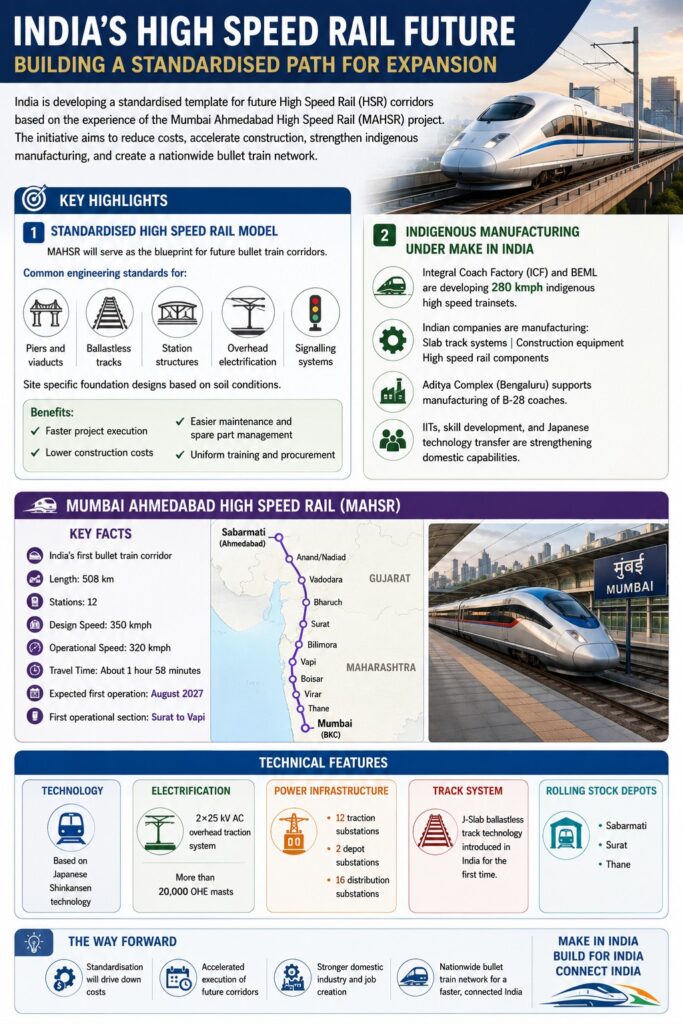
India is developing a standardised template for future High Speed Rail (HSR) corridors based on the experience of the Mumbai Ahmedabad High Speed Rail (MAHSR) project. The initiative aims to reduce costs, accelerate construction, strengthen indigenous manufacturing, and create a nationwide bullet train network.
Standardised High Speed Rail Model
- MAHSR will serve as the blueprint for future bullet train corridors.
- Common engineering standards for Piers and viaducts, Ballastless tracks, Station structures, Overhead electrification, and Signalling systems
- Site specific foundation designs based on soil conditions.
- Benefits:
- Faster project execution
- Lower construction costs
- Easier maintenance and spare part management
- Uniform training and procurement
Indigenous Manufacturing under Make in India
- Integral Coach Factory (ICF) and BEML are developing 280 kmph indigenous high speed trainsets.
- Indian companies are manufacturing Slab track systems, Construction equipment, and High speed rail components
- Aditya Complex (Bengaluru) supports manufacturing of B-28 coaches.
- IITs, skill development, and Japanese technology transfer are strengthening domestic capabilities.
Mumbai Ahmedabad High Speed Rail (MAHSR)
- India’s first bullet train corridor, Length: 508 km, Stations: 12, Design Speed: 350 kmph, Operational Speed: 320 kmph, Travel Time: About 1 hour 58 minutes, Expected first operation: August 2027, and First operational section: Surat to Vapi
Technical Features
- Technology: Based on Japanese Shinkansen technology
- Electrification: 2×25 kV AC overhead traction system. More than 20,000 OHE masts
- Power Infrastructure: 12 traction substations. 2 depot substations. 16 distribution substations
- Track System: J-Slab ballastless track technology introduced in India for the first time.
- Rolling Stock Depots: Sabarmati, Surat, and Thane
[2025] Consider the following statements:
I. Indian Railways have prepared a National Rail Plan (NRP) to create a future ready railway system by 2028.
II. Kavach’ is an Automatic Train Protection system, development in collaboration with Germany.
III. ‘Kavach’ system consists of RFID tags fitted on track in station section.
Which of the statements given above are not correct?
[A] I and II only
[B] II and III only
[C] I and III only
[D] I, II and III
