Why in News?
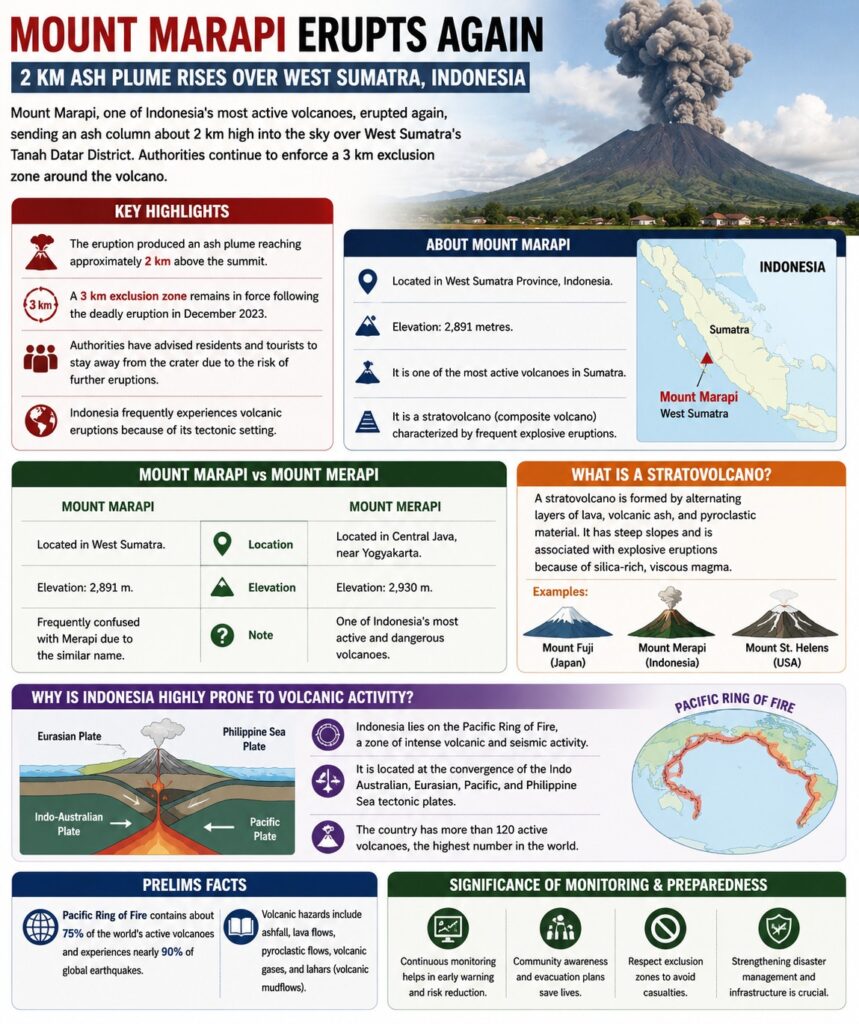
Mount Marapi, one of Indonesia’s most active volcanoes, erupted again, sending an ash column about 2 km high into the sky over West Sumatra’s Tanah Datar District. Authorities continue to enforce a 3 km exclusion zone around the volcano.
Note: This volcano is Mount Marapi (West Sumatra), not Mount Merapi (Central Java). They are two different active volcanoes in Indonesia.
Key Highlights
- The eruption produced an ash plume reaching approximately 2 km above the summit.
- A 3 km exclusion zone remains in force following the deadly eruption in December 2023.
- Authorities have advised residents and tourists to stay away from the crater due to the risk of further eruptions.
- Indonesia frequently experiences volcanic eruptions because of its tectonic setting.
About Mount Marapi
- Located in West Sumatra Province, Indonesia.
- Elevation: 2,891 metres.
- It is one of the most active volcanoes in Sumatra.
- It is a stratovolcano (composite volcano) characterized by frequent explosive eruptions.
What is a Stratovolcano?
- A stratovolcano is formed by alternating layers of lava, volcanic ash, and pyroclastic material.
- It has steep slopes and is associated with explosive eruptions because of silica-rich, viscous magma.
- Examples include Mount Fuji (Japan), Mount Merapi (Indonesia), and Mount St. Helens (USA).
Why is Indonesia Highly Prone to Volcanic Activity?
- Indonesia lies on the Pacific Ring of Fire, a zone of intense volcanic and seismic activity.
- It is located at the convergence of the Indo Australian, Eurasian, Pacific, and Philippine Sea tectonic plates.
- The country has more than 120 active volcanoes, the highest number in the world.
Prelims Facts
- Pacific Ring of Fire contains about 75% of the world’s active volcanoes and experiences nearly 90% of global earthquakes.
- Volcanic hazards include ashfall, lava flows, pyroclastic flows, volcanic gases, and lahars (volcanic mudflows).
[2024] Consider the following:
1. Pyroclastic debris
2. Ash and dust
3. Nitrogen compounds
4. Sulphur compounds
How many of the above are products of volcanic eruptions?
[A] Only one
[B] Only two
[C] Only three
[D] All four
