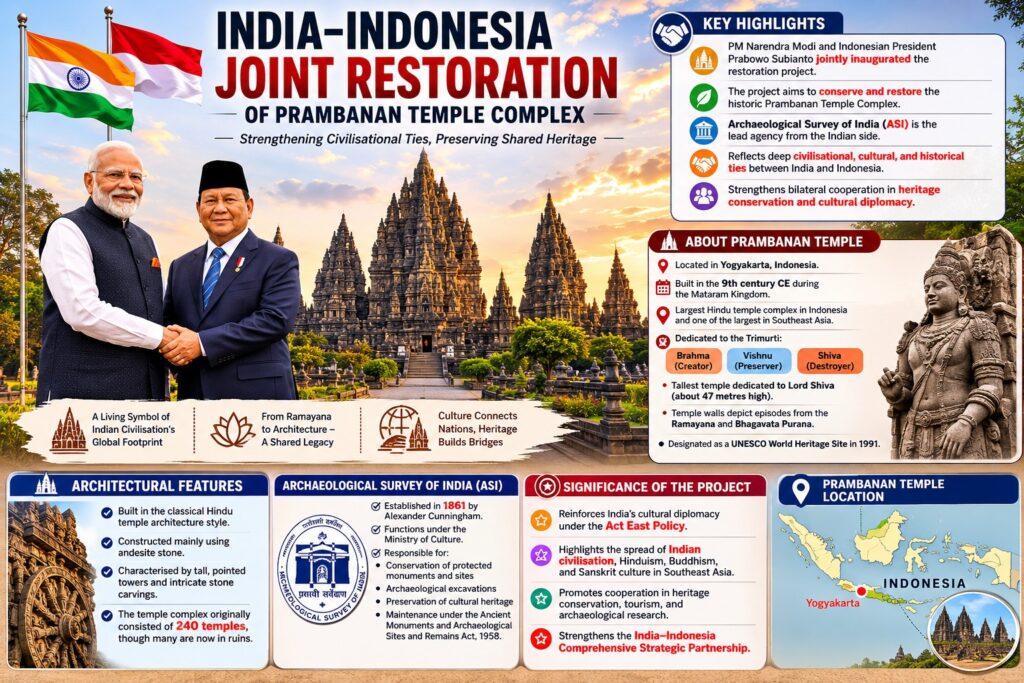
Why in News?
India and Indonesia have launched a joint conservation and restoration project at the Prambanan Temple Complex, a UNESCO World Heritage Site in Yogyakarta, Indonesia, during Prime Minister Narendra Modi’s visit to Indonesia.
Key Highlights
- Prime Minister Narendra Modi and Indonesian President Prabowo Subianto jointly inaugurated the restoration project.
- The project aims to conserve and restore the historic Prambanan Temple Complex.
- The Archaeological Survey of India (ASI) is the lead agency from the Indian side.
- The initiative reflects the deep civilisational, cultural, and historical ties between India and Indonesia.
- It also strengthens bilateral cooperation in heritage conservation and cultural diplomacy.
About Prambanan Temple
- Located in Yogyakarta, Indonesia.
- Built in the 9th century CE during the Mataram Kingdom.
- It is the largest Hindu temple complex in Indonesia and one of the largest in Southeast Asia.
- Dedicated to the Trimurti: Brahma (Creator), Vishnu (Preserver), and Shiva (Destroyer)
- The tallest temple is dedicated to Lord Shiva, standing about 47 metres high.
- The temple walls depict episodes from the Ramayana and Bhagavata Purana.
- Designated as a UNESCO World Heritage Site in 1991.
Architectural Features
- Built in the classical Hindu temple architecture style.
- Constructed mainly using andesite stone.
- Characterised by tall, pointed towers and intricate stone carvings.
- The temple complex originally consisted of 240 temples, though many are now in ruins.
Archaeological Survey of India (ASI)
- Established in 1861 by Alexander Cunningham.
- Functions under the Ministry of Culture.
- Responsible for:
- Conservation of protected monuments and archaeological sites.
- Archaeological excavations.
- Preservation of cultural heritage.
- Maintenance of ancient monuments under the Ancient Monuments and Archaeological Sites and Remains Act, 1958.
Significance of the Project
- Reinforces India’s cultural diplomacy under the Act East Policy.
- Highlights the spread of Indian civilisation, Hinduism, Buddhism, and Sanskrit culture in Southeast Asia.
- Promotes cooperation in heritage conservation, tourism, and archaeological research.
- Strengthens the India-Indonesia Comprehensive Strategic Partnership.
[2025] Who among the following led a successful military campaign against the kingdom of Srivijaya, the powerful maritime State, which ruled the Malay Peninsula, Sumatra, Java and the neighbouring islands?
[A] Amoghavarsha (Rashtrakuta)
[B] Prataparudra (Kakatiya)
[C] Rajendra 1 (Chola)
[D] Vishnuvardhana (Hoysala)
