Why in News?
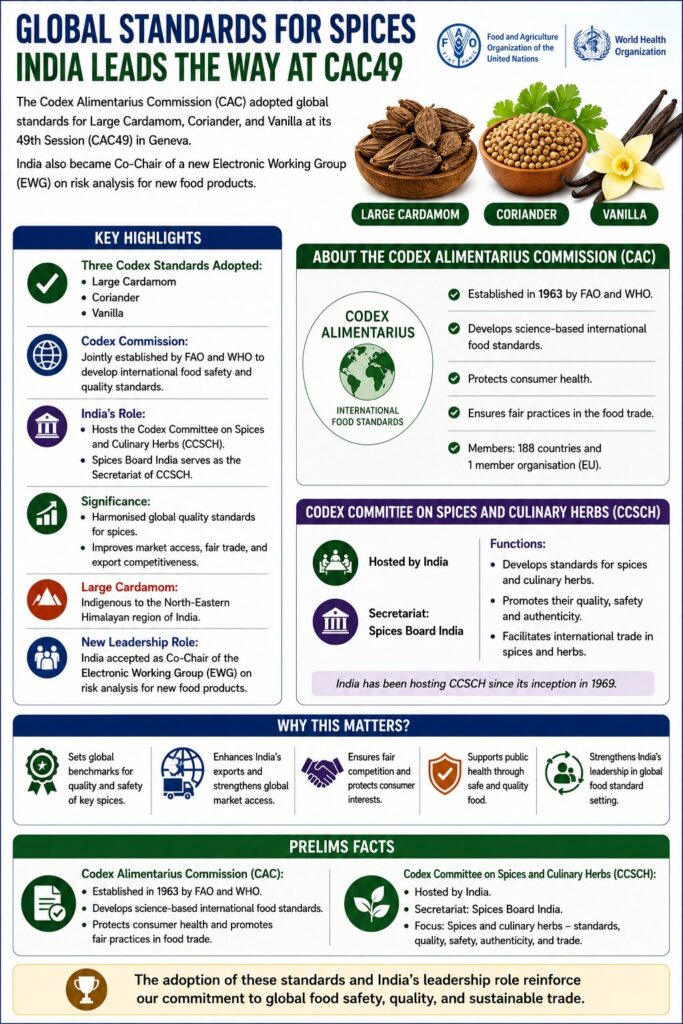
The Codex Alimentarius Commission (CAC) adopted global standards for Large Cardamom, Coriander, and Vanilla at its 49th Session (CAC49) in Geneva. India also became Co-Chair of a new Electronic Working Group (EWG) on risk analysis for new food products.
Key Highlights
- Three Codex Standards Adopted: Large Cardamom, Coriander, and Vanilla.
- Codex Commission: Jointly established by FAO and WHO to develop international food safety and quality standards.
- India’s Role:
- Hosts the Codex Committee on Spices and Culinary Herbs (CCSCH).
- Spices Board India serves as the Secretariat of CCSCH.
- Significance:
- Harmonised global quality standards for spices.
- Improves market access, fair trade, and export competitiveness.
- Large Cardamom: Indigenous to the North-Eastern Himalayan region of India.
- New Leadership Role: India accepted as Co-Chair of the Electronic Working Group (EWG) on risk analysis for new food products.
Prelims Facts
- Codex Alimentarius Commission (CAC):
- Established in 1963 by FAO and WHO.
- Develops science-based international food standards.
- Protects consumer health and promotes fair practices in food trade.
- Codex Committee on Spices and Culinary Herbs (CCSCH): Hosted by India. Secretariat: Spices Board India.
[2022] With reference to the “Tea Board” in India, consider the following statements:
1. The Tea Board is a statutory body.
2. It is a regulatory body attached to the Ministry of Agriculture and Farmers Welfare.
3. The Tea Board’s Head Office is situated in Bengaluru.
4. The Board has overseas office at Dubai and Moscow.
Which of the statements given above are correct?
[A] 1 and 3
[B] 2 and 4
[C] 3 and 4
[D] 1 and 4