Why in News?
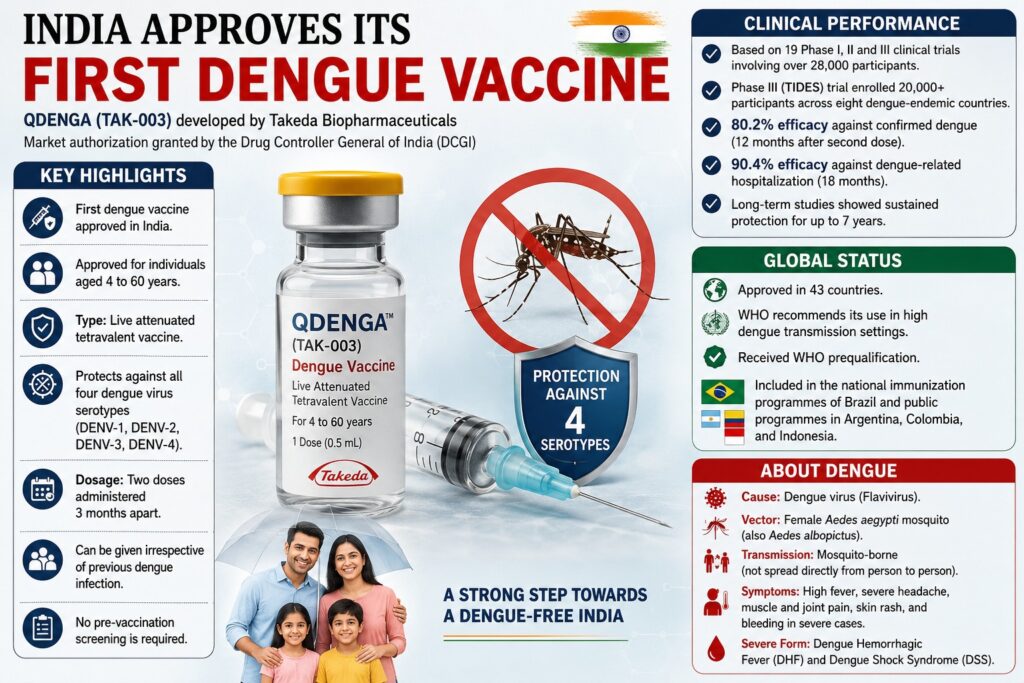
India has approved its first dengue vaccine, QDENGA (TAK-003), developed by Takeda Biopharmaceuticals, after receiving market authorization from the Drug Controller General of India (DCGI).
Key Highlights
- First dengue vaccine approved in India.
- Approved for individuals aged 4 to 60 years.
- Type: Live attenuated tetravalent vaccine.
- Protects against all four dengue virus serotypes (DENV-1, DENV-2, DENV-3, DENV-4).
- Dosage: Two doses administered 3 months apart.
- Can be given irrespective of previous dengue infection.
- No pre-vaccination screening is required.
Clinical Performance
- Based on 19 Phase I, II and III clinical trials involving over 28,000 participants.
- Phase III (TIDES) trial enrolled 20,000+ participants across eight dengue-endemic countries.
- 80.2% efficacy against confirmed dengue (12 months after second dose).
- 90.4% efficacy against dengue-related hospitalization (18 months).
- Long-term studies showed sustained protection for up to 7 years.
Global Status
- Approved in 43 countries.
- WHO recommends its use in high dengue transmission settings.
- Received WHO prequalification.
- Included in the national immunization programmes of Brazil and public programmes in Argentina, Colombia, and Indonesia.
About Dengue
- Cause: Dengue virus (Flavivirus).
- Vector: Female Aedes aegypti mosquito (also Aedes albopictus).
- Transmission: Mosquito-borne (not spread directly from person to person).
- Symptoms: High fever, severe headache, muscle and joint pain, skin rash, and bleeding in severe cases.
- Severe Form: Dengue Hemorrhagic Fever (DHF) and Dengue Shock Syndrome (DSS).
[2023] ‘Wolbachia method’ is sometimes talked about with reference to which one of the following?
[A] Controlling the viral diseases spread by mosquitoes.
[B] Converting crop residues into packing material.
[C] Producing biodegradable plastics.
[D] Producing biochar from thermo- chemical conversion of biomass