Why in the News?
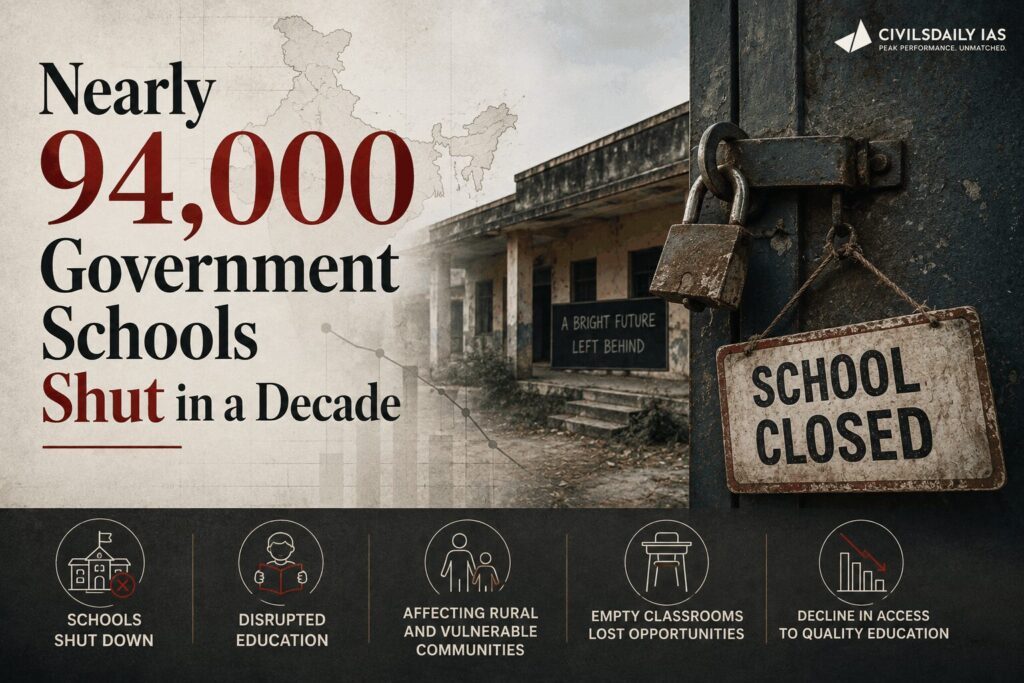
A NITI Aayog report shows that about 94,000 government schools closed over the past decade. While the government calls it school rationalisation, concerns have been raised over its impact on access to education and the Right to Education (RTE).
Key Findings
- Government school enrolment declined from 71% (2005) to 49.24% (2024-25).
- The sharpest decline was seen in Uttar Pradesh, Madhya Pradesh, and Jammu & Kashmir.
Government’s Stand vs Concerns
Government’s Rationale
- Merging low enrolment schools to improve teacher and resource utilisation.
- Supported by the NEP 2020 concept of school complexes/clusters.
Key Concerns
- Increased travel distance, especially in rural and remote areas.
- Greater impact on SC, ST, girl students and poor households.
- May push disadvantaged families towards unaffordable private schools.
Link with the Right to Education (RTE)
- The Right of Children to Free and Compulsory Education (RTE) Act, 2009 guarantees a neighbourhood school for children aged 6 to 14 years.
- School closures should not compromise this legal entitlement or equitable access.
- Unified District Information System for Education Plus (UDISE+) is India’s official school education database.
[2018] Consider the following statements:
1. As per the Right to Education (RTE) Act, to be eligible for appointment as a teacher in a State, a person would be required to possess the minimum qualification laid down by the concerned State Council of Teacher Education.
2. As per the RTE Act, for teaching primary classes, a candidate is required to pass a Teacher Eligibility Test conducted in accordance with the National Council of Teacher Education guidelines.
3. In India, more than 90% of teacher education institutions are directly under the State Governments.
Which of the statements given above is/are correct?
(a) 1 and 2
(b) 2 only
(c) 1 and 3
(d) 1, 2 and 3