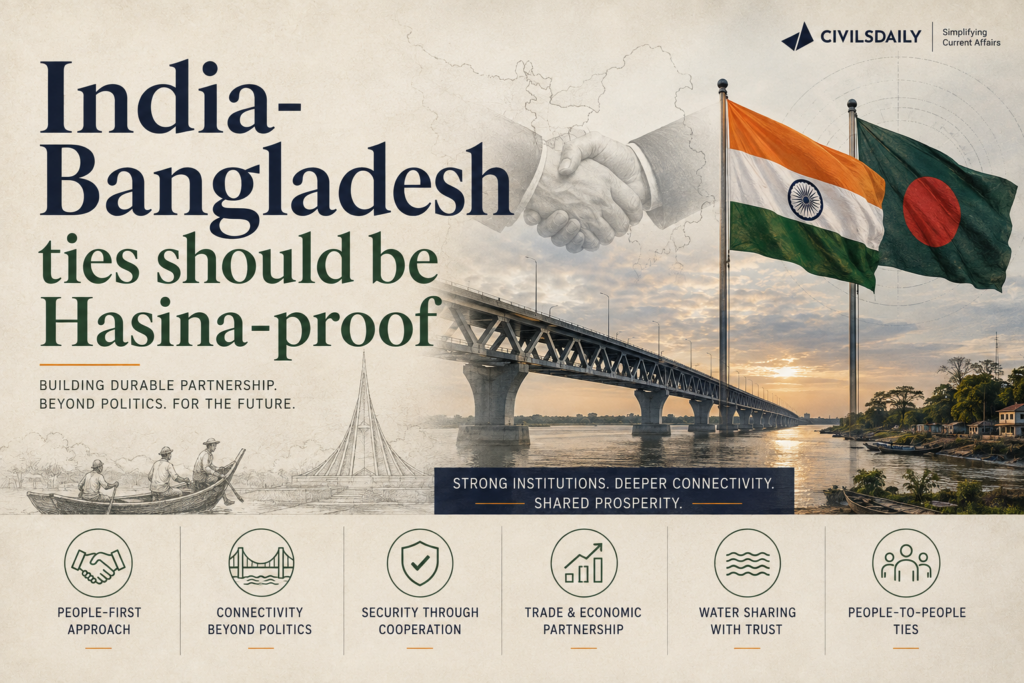
Why in the News
The former Bangladesh Prime Minister held her first question taking media interaction from exile in India. She announced a political comeback and said she would return in December. The event risks turning India’s grant of refuge into a diplomatic irritant with Dhaka’s elected government.
What is the diplomatic dilemma India faces?
- Refuge granted: India gave the former Prime Minister refuge after she fled Bangladesh on 5 August 2024 amid protests.
- Legitimacy concern: the grant was defended given the unfairness of the legal proceedings against her, including a death sentence by the International Crimes Tribunal.
- Platform risk: using the refuge as a political platform complicates ties with the elected government.
- Elected counterpart: the Bangladesh Nationalist Party (BNP) led administration under the new Prime Minister took office about six months earlier.
Why is the timing fraught?
- Reset underway: New Delhi is rebuilding ties after strained relations with the earlier Muhammad Yunus led interim government.
- Domestic backlash: a mob hurled petrol bombs at a party member’s residence after he joined the exiled leader online.
- Media bar: the statements were barred from broadcast in Bangladesh under laws the former government itself once used.
- Awami League banned: the leader’s party is barred from contesting, so the comeback call targets the incumbent government.
What unresolved issues shadow the relationship?
- Ganga treaty: the 1996 Ganga Water Treaty is due for renewal this year.
- Teesta treaty: the Teesta water sharing treaty is still to be signed.
- Migration: New Delhi views illegal immigration from Bangladesh as a major irritant.
- Trade curbs: some trade restrictions remain even after Bangladesh removed visa curbs.
- China factor: India is wary of Dhaka drifting into China’s orbit, and the new Prime Minister has visited China but not India.
Why must ties be insulated from any single individual?
- Shared border: a 4,000 kilometre border makes cooperation indispensable against trafficking and cross border extremism.
- Economic stakes: Indian investment and infrastructure financing support Bangladesh’s growth, with stakes in power and connectivity.
- Strategic caution: both governments need to insulate bilateral ties from short term compulsions.
Conclusion
India was right to shelter the former Prime Minister, but her political aspirations cannot bruise ties with the elected government. The bilateral relationship, anchored in geography and security, is too important to be held hostage by one individual. New Delhi’s task is to keep the reset with Dhaka insulated from her comeback bid.
Back2Basics
The 1996 Ganga Water Treaty is a 30-year bilateral agreement between India and Bangladesh signed on December 12, 1996. It governs the sharing of dry-season (January 1 to May 31) water flows from the Ganges River at the Farakka Barrage.
Key Provisions and Formula
- Lean Season Focus: Applies specifically to lean-season flows from January 1 through May 31.
- 50:50 Sharing Rule: If the water flow at Farakka is 70,000 cusecs or less, India and Bangladesh each receive 50% of the water.
- Fixed Allocation Windows:
- Flows of 70,000-75,000 cusecs: Bangladesh receives a fixed 35,000 cusecs, and India receives the rest.
- Flows above 75,000 cusecs: India receives 75,000 cusecs, and Bangladesh receives the balance.
- Emergency Clause: If water flow drops below 50,000 cusecs in any 10-day period, both nations must hold immediate consultations for emergency adjustments.
Administration and Oversight
- Joint Committee: An equal-representation monitoring committee measures daily flows at the Farakka feeder canal and Bangladesh’s Hardinge Bridge.
- Review Schedule: Subject to five-year reviews or earlier adjustments if requested.
PYQ Relevance
[UPSC 2013] Critically examine the compulsions which prompted India to play a decisive role in the emergence of Bangladesh.
Linkage: It examines the strategic and political foundations of India–Bangladesh relations. The article highlights how India must balance humanitarian refuge with long-term bilateral and strategic interests.
