Why in the News
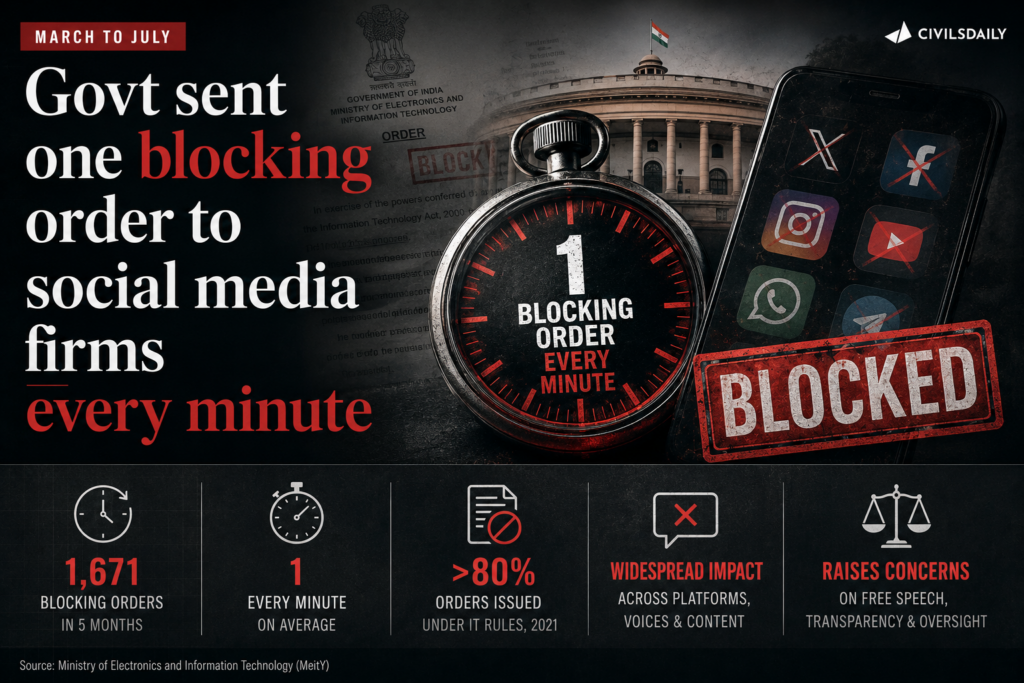
Nearly 1.95 lakh state backed content blocking orders were sent to Instagram, Facebook and YouTube between March and July 2026, an average of one every 68 seconds, against a daily average of six in the preceding year. Most were routed through the Sahyog portal of the Ministry of Home Affairs and issued under Section 79(3)(b) of the Information Technology Act, 2000, the safe harbour condition, rather than the dedicated blocking power in Section 69A. The surge, combined with automated execution by the platform, converts a conditional legal duty into unconditional compliance.
What is the Sahyog portal?
- What it is: A platform built by the Ministry of Home Affairs through which central and State agencies send content blocking notices to online intermediaries.
- Who uses it: Various central and State law enforcement and government agencies issue notices, and all three major social media companies have joined the portal.
- Legal hook: Notices are issued under Section 79(3)(b) of the Information Technology Act, 2000, the provision that conditions an intermediary’s legal immunity.
- What it replaced: It centralises what were previously scattered notices from individual police units and departments into a single automated channel.
- Scale of use: Between October 2024 and October 2025 the portal carried 2,312 blocking orders to 19 online platforms, a daily average of six.
- What one order covers: A single blocking order can cover hundreds of individual pieces of content or accounts, so the order count understates the volume removed.
What is safe harbour under Section 79 of the Information Technology Act, 2000?
- The immunity: Section 79 protects an intermediary from liability for content that its users post, provided it does not initiate, select or modify that content.
- The condition: Section 79(3)(b) withdraws that immunity if the intermediary fails to remove unlawful material after receiving actual knowledge or a government notification.
What is Section 69A of the Information Technology Act, 2000?
- The power: It allows the Union government to direct the blocking of public access to information in the interest of sovereignty, defence, security of the State, friendly relations, public order or the prevention of a cognisable offence.
- The safeguards: Blocking under it follows the Information Technology (Procedure and Safeguards for Blocking for Access of Information by Public) Rules, 2009, which require a committee review and reasons in writing.
What is actual knowledge in intermediary liability?
- The test: Actual knowledge is the point at which an intermediary is informed of specific unlawful content and becomes obliged to act on it.
- Where it comes from: The Supreme Court in Shreya Singhal v. Union of India (2015) read down Section 79(3)(b) so that actual knowledge means a court order or a government notification, not a private complaint.
What is an Application Programming Interface?
- What it is: A defined interface that allows one software system to send instructions directly to another without a person operating either end.
- Its use here: Meta has integrated its interface with the Sahyog portal, so a flagged item uploaded to the portal is removed from its platforms automatically.
What does the scale of the blocking orders show?
- Total volume: Nearly 1.95 lakh blocking orders in five months, about 1,275 a day, or one every 68 seconds.
- Instagram: Around 1,00,000 orders, just over half of the total, and the platform on which the student protests were most visible.
- Facebook: Around 80,000 orders.
- YouTube: Nearly 15,000 orders.
- Concentration: Meta owned platforms received roughly nine out of every ten orders issued to the three companies.
- The baseline: The comparable figure for October 2024 to October 2025 was 2,312 orders across 19 platforms, a daily average of six.
- Official record: The Ministry of Home Affairs annual report for 2024 and 2025 recorded a little over 1.11 lakh pieces of suspicious online content blocked until March 2025 under Section 79(3)(b).
- Comparative removals: Meta reported removing over 23 million pieces of content in Indonesia between July and December 2025 against about 41,000 in India, which had already doubled from 28,000 in the first half of that year.
- User base: India has over 600 million social media users, with an estimated 10 million to 100 million posts a day.
What changed in February 2026?
- The amendment: The Ministry of Electronics and Information Technology notified amendments to the Information Technology (Intermediary Guidelines and Digital Media Ethics Code) Rules, 2021.
- The new deadline: Content must now be removed within two to three hours, against the earlier window of 24 to 36 hours.
- Added conditions: The amended rule requires that an order come from an officer of a prescribed rank and state its reasons.
- The compliance effect: A window of two to three hours makes case by case human review commercially impossible at Indian volumes.
- The platform response: Meta integrated its interface with the Sahyog portal so removal happens machine to machine, without separate human review.
- What was removed: Automation eliminates the room for the company to review or contest a directive before complying with it.
Why does the shift from Section 69A to Section 79(3)(b) matter?
- Different purpose: Section 69A is a dedicated blocking power. Section 79(3)(b) is a condition attached to an immunity, not a power to censor.
- Different safeguards: Section 69A orders pass through a review committee under the 2009 Rules and carry recorded reasons. Section 79(3)(b) notices carry no equivalent statutory committee.
- Different issuing authority: Section 69A is exercised by the Union government. Section 79(3)(b) notices come from a wide range of central and State agencies through the portal.
- Different subject matter: Section 69A is largely confined to national security and public order. The portal route is used for a far wider category of content.
- The legal consequence: The intermediary that refuses a Section 79(3)(b) notice does not face a penalty. It loses immunity for all user content, which is a far larger risk.
- What that produces: The threat of losing safe harbour makes refusal irrational, so the conditional structure operates as a command.
What content was targeted?
- The protest period: The five month window covered the student protests against examination paper leaks at Jantar Mantar in Delhi, which began in early June and were called off on 25 July after the resignation of the Union Education Minister.
- Official acknowledgement: A senior government official stated that a considerable share of the orders were issued as the protests gathered momentum, particularly on Instagram.
- Protest content: Users reported the removal of posts supporting the student protests.
- Policy criticism: Posts criticising the government’s ethanol fuel blending policy were among those blocked.
- Electoral content: Content relating to the West Bengal Assembly elections was also removed.
- Synthetic media: Deepfakes formed a further category among the removals.
- Political speech: The national convenor of a national political party stated that some of his Instagram posts were blocked in India.
Where does automated compliance turn against the legal design?
- The doctrinal problem: Actual knowledge requires that someone at the company know of the content and assess the order. An interface that executes takedowns automatically has no knowledge at all.
- No verification of authority: Nobody at the company checks whether the order comes from an officer of the prescribed rank or states the reasons the amended rule requires.
- Conditional becomes unconditional: Machine to machine execution converts a conditional legal duty into unconditional compliance, which is the substance of the objection raised by the Internet Freedom Foundation.
- The state interest on the other side: Coordinated disinformation, deepfakes and incitement travel faster than any human review cycle, which is the case for a short deadline.
- The unequal risk: The cost of over removal falls on the user, who has no notice and no appeal. The cost of under removal falls on the company as loss of immunity for all content.
- Notice denied: Meta informs users which State authority sent a request in most markets, but not in India, citing legal obligations and regulatory considerations.
- No proportionality check: One order can cover hundreds of accounts, so a single instruction can remove speech at a scale no court has examined.
Challenges to the content blocking regime
- Absence of a review committee: Orders under Section 79(3)(b) carry none of the committee scrutiny that Section 69A orders pass through. e.g. the 2009 Blocking Rules committee has no counterpart for portal notices.
- Secrecy of orders: Blocking directions are treated as confidential, so neither the user nor the public sees the reasoning. e.g. Rule 16 of the 2009 Blocking Rules requires confidentiality of complaints and actions taken.
- No pre decisional hearing for the user: The person whose speech is removed is not heard before removal and often not informed after it. e.g. account holders learning of removal only from the platform’s generic notification.
- Chilling effect on lawful speech: Platforms over comply to protect immunity, which removes lawful criticism along with unlawful content. e.g. removal of posts criticising the ethanol blending policy during the same five month window.
- Federal multiplication of issuers: A wide set of central and State agencies can issue notices, so there is no single accountable authority. e.g. the portal carried orders to 19 platforms from multiple agencies in the previous year.
- Litigation uncertainty: Platforms that challenge the portal route face the loss of immunity while the case runs. e.g. X Corporation’s challenge to the Sahyog portal before the Karnataka High Court, dismissed in 2025.
- Encryption and traceability conflict: The traceability requirement in the 2021 Rules cannot be met without weakening end to end encryption. e.g. the pending challenge by WhatsApp to Rule 4(2) of the 2021 Rules.
- Capacity asymmetry: Smaller Indian intermediaries cannot build automated compliance systems and face the same deadlines. e.g. the two to three hour removal window applies to every significant social media intermediary.
Conclusion
The volume of blocking orders has risen from six a day to about 1,275 a day, and the legal route has moved from a dedicated blocking power with statutory safeguards to a safe harbour condition that carries none. Automation completes the shift, because a system that removes content without any person reading the order cannot satisfy the actual knowledge standard the Supreme Court built the provision around. The amended rules are in force and the orders continue. The unresolved question is whether Section 79(3)(b) can lawfully function as a general censorship channel when the Constitution requires every restriction on speech to be traced to a specific ground and a recorded reason.
“[2024, GS3, 15 marks] Social media and encrypting messaging services pose a serious security challenge. What measures have been adopted at various levels to address the security implications of social media? Also suggest any other remedies to address the problem.”
