Why in the News
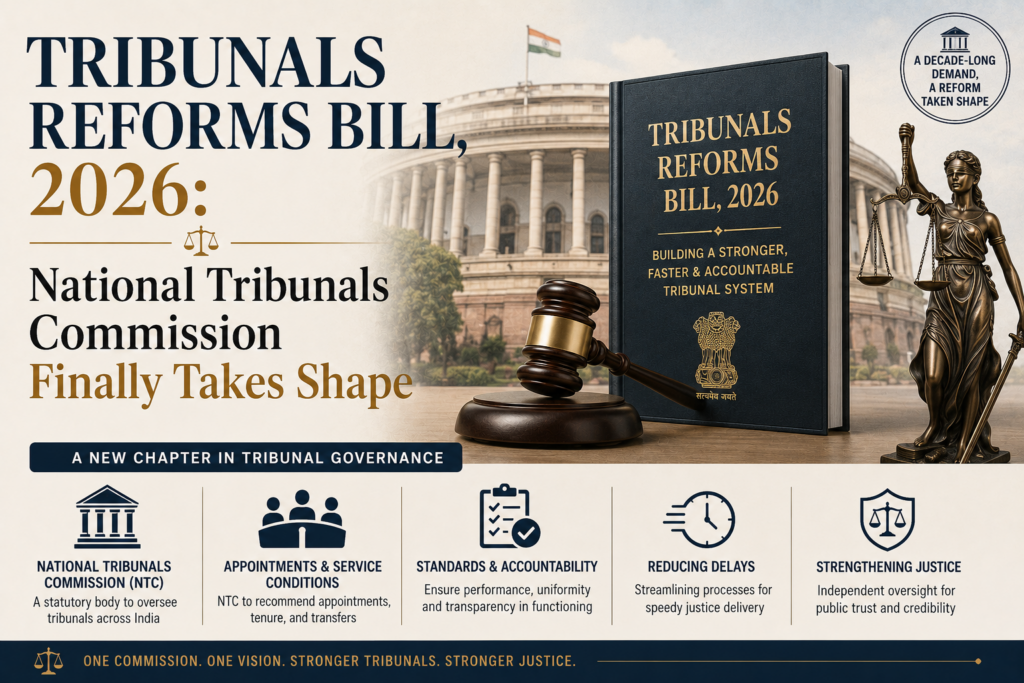
Parliament passed the Tribunals Reforms Bill, 2026, which creates a National Tribunals Commission, fixes member tenure at five years and repeals the Tribunals Reforms Act of August 2021. The measure ends a decade in which the Centre re-enacted provisions the Supreme Court had struck down, most recently in November 2025 when a Bench called the 2021 re-enactment an impermissible legislative override. It concedes the institution the Court had demanded while retaining the appointment, funding and rule making levers that produced the dispute.
What is the National Tribunals Commission?
- An independent oversight body for tribunals: The National Tribunals Commission is created to sever the dependence of tribunals on their parent government ministries for administrative and financial needs.
- Composition: It will be headed by a former Supreme Court judge or a former Chief Justice of a High Court, with two judicial members and two technical members.
- Qualification for technical members: Technical members must have at least 25 years of experience in fields such as public administration, finance or law.
- Core functions: The Commission will conduct the selection process for vacancies, review the performance of tribunals and oversee inquiries into complaints against members.
- Data function: It will maintain a National Tribunals Data Grid.
- Executive appointment retained: The Centre appoints the chairperson and members, with the chairperson and judicial members appointed after consulting the Chief Justice of India.
What is the National Tribunals Data Grid?
- A central case data repository: The National Tribunals Data Grid is the consolidated database of tribunal case and disposal data to be maintained by the Commission.
- Purpose: It supplies the performance data on which the Commission’s review of tribunal functioning will rest, mirroring the role the National Judicial Data Grid performs for courts.
What is an impermissible legislative override?
- Re-enacting a struck down provision: A legislative override is impermissible when a legislature re-enacts the same provision a court has declared unconstitutional, without removing the defect the court identified.
- The settled distinction: A legislature may cure the basis of a judgment by changing the underlying law, but it cannot simply nullify the judgment by restoring the identical text.
Why did the Centre and the Supreme Court end up in a decade long confrontation?
- Finance Act, 2017: The statute empowered the Centre to frame rules for tribunals, transferring service conditions and qualifications to executive rule making.
- Constitution Bench ruling, 2019: A Constitution Bench struck down those rules for undermining judicial independence.
- New rules and a judicial recommendation, 2020: The Centre notified fresh rules, and the Court recommended several modifications, including a five year tenure for members.
- Ordinance, April 2021: Instead of incorporating those suggestions, the Centre promulgated an Ordinance fixing tenure at four years, setting a minimum appointment age of 50, and requiring selection committees to recommend a panel of two names.
- Provisions struck down as arbitrary: The Court struck down those provisions.
- Tribunals Reforms Act, August 2021: Parliament then passed an Act re-enacting the exact provisions the Court had just declared unconstitutional.
What did the Supreme Court hold in November 2025?
- Re-enactment condemned: A two judge Bench struck down provisions of the 2021 Act, calling the re-enactment an impermissible legislative override of earlier judgments.
- Criticism of persistent non compliance: The Court criticised the government for its persistent refusal to adhere to its pronouncements.
- Four year tenure held anti merit: The Court ruled that a short four year tenure is anti-merit and increases interference by the executive, jeopardising the independence of the judiciary.
- Panel of two names rejected: It held that the government could not demand a panel of two names, since this gave the executive undue discretion in appointments.
- Direction to create the Commission: It reiterated the need for a National Tribunals Commission and directed the Centre to establish one within four months.
- Transitional protection: It protected certain existing appointments and selections while the new framework was being put in place.
What are the other major changes proposed?
- Repeal of the 2021 Act (change to an existing provision): The 2026 Bill repeals the Tribunals Reforms Act of August 2021 in its entirety.
- Tenure fixed at five years (change to an existing provision): Chairpersons and members will hold office for a term of five years, replacing the contested four year tenure.
- Age ceilings specified (change to an existing provision): The maximum age limit is set at 70 years for chairpersons and 67 years for members.
- Reappointment permitted (new provision): Chairpersons and members can be considered for reappointment.
- Search cum selection committee restructured (new provision): The committee for members will be headed by a judicial member of the Commission and will include a retired High Court judge, a government secretary, a technical member and experts.
- One name per vacancy (change to an existing provision): The committee will recommend one suitable candidate for each vacancy, with one additional name kept on a waiting list, replacing the panel of two.
- Appointment deadline imposed (new provision): The government must make the appointment within three months of receiving the recommendation.
- Stated legislative intent: The Statement of Objects and Reasons says the Bill is introduced in consonance with the directions of the Supreme Court, to improve efficiency and ensure independence, transparency and uniformity in the functioning of tribunals.
Why does the Bill not fully sever executive control?
- Appointment power retained: The Centre appoints the chairperson and members of the Commission itself, so the body meant to insulate tribunals is constituted by the executive.
- Consultation is not concurrence: The chairperson and judicial members are appointed after consulting the Chief Justice of India, a formulation that does not bind the government to the advice.
- Secretariat under the Centre: The Centre appoints the Commission’s secretary, which places the administrative machinery of the oversight body within executive reach.
- Financial dependence continues: The Centre provides grants to the Commission, reproducing at one remove the funding dependence the Court objected to.
- Rule making powers preserved: The Centre retains rule making powers over several aspects of tribunal members’ qualifications and service conditions.
- Reappointment as a pressure point: Permitting reappointment gives the appointing authority a continuing hold over a serving member’s prospects.
Challenges to the National Tribunals Commission
- Vacancies outlast reform statutes: Tribunal benches sit without presiding officers for long periods, e.g. the National Green Tribunal has functioned with single member or non functional zonal benches for extended stretches.
- Parent ministry conflict of interest persists in adjudication: A tribunal often decides cases against the very ministry that shapes its service rules, e.g. the Armed Forces Tribunal adjudicates disputes against the Ministry of Defence.
- Appeal architecture keeps burdening the Supreme Court: Several statutes provide a direct appeal from a tribunal to the Supreme Court, e.g. appeals from the Telecom Disputes Settlement and Appellate Tribunal go straight to the Supreme Court, bypassing the High Courts.
- Technical member dominance dilutes judicial character: Benches weighted toward administrative expertise weaken the adjudicatory function, e.g. the Court in the Madras Bar Association line of cases repeatedly objected to bench composition tilted against judicial members.
- Uneven infrastructure and geographic access: Litigants travel long distances because benches are concentrated in a few cities, e.g. the abolition of appellate bodies in the 2021 rationalisation pushed those appeals to High Courts already carrying large backlogs.
- Rationalisation without capacity transfer: Abolishing a tribunal shifts its docket to courts without a matching increase in judicial strength, e.g. the 2021 rationalisation abolished nine appellate tribunals including the Intellectual Property Appellate Board and moved their work to High Courts.
- Non compliance with judicial directions: The record of the last decade shows directions being met with re-enactment rather than implementation, e.g. the 2021 Act reproduced the very four year tenure the Court had struck down months earlier.
Conclusion
A decade of contest between the legislature and the Court has ended with the Centre conceding the institution, since the Bill creates the National Tribunals Commission the Court had demanded and restores the five year tenure the Court recommended in 2020. The concession stops short of independence, because the Centre still appoints the Commission’s chairperson, members and secretary, funds it through grants and retains rule making powers over qualifications and service conditions. The measure has reached the stage of passage by both Houses of Parliament as the Tribunals Reforms Bill, 2026, and awaits Presidential assent and notification before it can take effect. The next milestone named in the record is the constitution of the National Tribunals Commission, which the Supreme Court’s November 2025 judgment directed the Centre to complete within four months.
