Why in the News
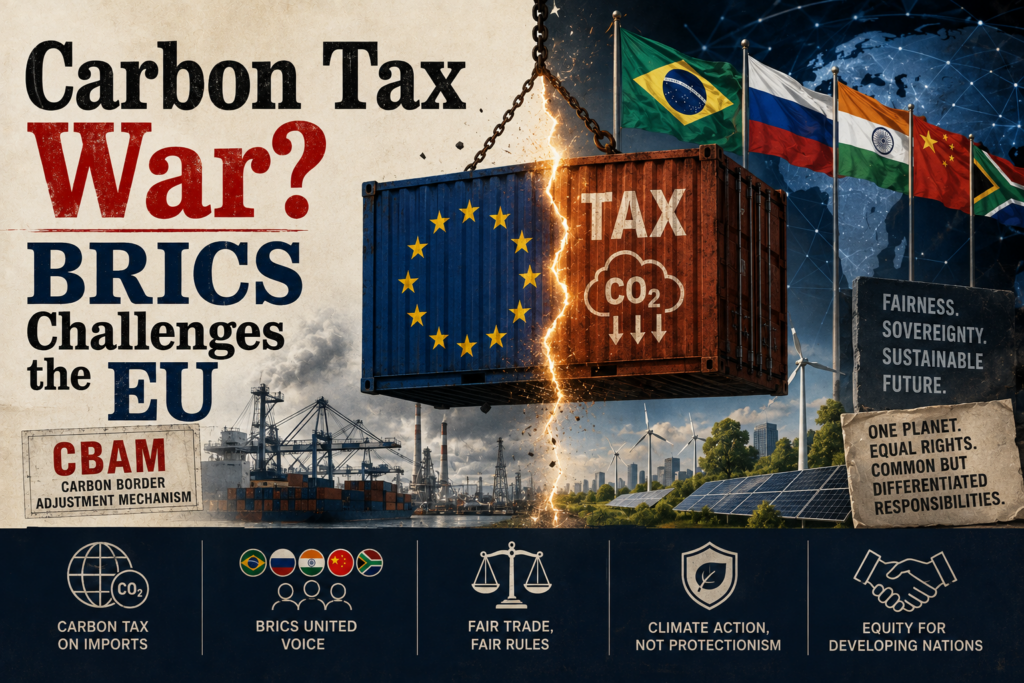
Environment and climate Ministers of the BRICS grouping adopted a joint statement opposing “unilateral, punitive, discriminatory and protectionist” climate measures, naming the European Union’s Carbon Border Adjustment Mechanism (CBAM) among them. The statement lands in the first year in which CBAM actually charges money at the border, which converts an internal European climate instrument into a live trade cost for developing country exporters. The same document demands that developed countries deliver the adaptation finance they have already promised, linking the objection on trade to a claim on money.
What is the Carbon Border Adjustment Mechanism (CBAM)?
- Definition: CBAM is an import levy on carbon intensive goods entering the European Union, priced against the emissions embedded in their production. It makes an importer pay for the carbon released abroad at the same price a European producer pays at home.
- Mechanism: Importers must purchase and surrender CBAM certificates matching the emissions embedded in each consignment. The certificate price is tied to the European carbon allowance price.
- Covered sectors: The mechanism applies to importers of iron and steel, aluminium, cement, fertilizers, hydrogen and electricity, the six sectors treated as most exposed to carbon costs.
- Timeline: CBAM was rolled out on 1 October 2023 with a reporting only phase, during which importers declared embedded emissions without paying. It entered its definitive phase from 1 January 2026, when the obligation to buy and surrender certificates began.
- Stated purpose: The European Union presents the measure as a means of preventing carbon leakage and of ensuring that its own climate ambition does not simply displace production abroad.
What is carbon leakage?
- Definition: Carbon leakage is the shifting of carbon intensive production outside a jurisdiction because that jurisdiction’s climate policy raises production costs there and not elsewhere. Global emissions do not fall, they relocate.
- Why it drives border measures: A domestic carbon price without a border charge leaves domestic producers competing against untaxed imports. The border charge is the instrument used to close that gap.
What is common but differentiated responsibilities and respective capabilities (CBDR-RC)?
- Definition: CBDR-RC is the founding principle of the international climate regime under which all countries share responsibility for the climate problem, but not equally. Obligations are calibrated to a country’s historical contribution to emissions and to its present capacity to act.
- How it was invoked here: The joint declaration used CBDR-RC to argue that all cooperation commitments, from forest fire protocols to circular economy standards, remain voluntary and calibrated to each country’s national circumstances.
What is the New Collective Quantified Goal (NCQG)?
- Definition: The New Collective Quantified Goal is the post 2025 climate finance target agreed under the climate convention, replacing the earlier annual finance commitment made to developing countries. It fixes how much money developed countries must mobilise, and for what.
- The specific commitment at issue: The Ministers urged wealthy nations to deliver on the NCQG reached at the 30th Conference of the Parties (COP30) held at Belem, Brazil, including the commitment to triple adaptation finance to developing countries by 2035.
What did the 12th BRICS Environment Ministers’ Meeting actually decide?
- Venue and chair: The 12th BRICS Environment Ministers’ Meeting was held in New Delhi under India’s chairship, and adopted its positions through a joint statement.
- Participation: Environment and climate Ministers and senior officials from eleven countries took part: Brazil, Russia, India, China, South Africa, the United Arab Emirates, Indonesia, Iran, Saudi Arabia, Egypt and Ethiopia.
- Position on border measures: Ministers recorded concern that carbon border measures such as CBAM “undermine developing countries’ efforts to address climate change and build resilience”, placing that language in the adaptation and climate resilience section of the statement.
- Quality of finance demanded: Support from developed countries must be “new, additional, predictable, adequate and accessible”, delivered through grants and concessional finance and without adding to the financial vulnerabilities of developing countries.
- Technical basis: The statement marked the culmination of a year of technical work by the BRICS Environment Working Group and its Contact Group on Climate Change and Sustainable Development.
- Handover: India formally handed hosting duties for the 13th edition to China, which will lead the meeting in 2027.
Why does the definitive phase matter so much for India’s exports?
- Concentrated exposure: Iron and steel account for about 90 percent of India’s exports to the European Union that fall within the CBAM framework, so a sectoral measure operates as a single sector measure for India.
- Evidence of behavioural change already: A June 2026 analysis in Nature Climate Change, built on shipment level trade data and facility level emissions estimates, found that high emission Indian steel firms cut their export quantities and revenues to the European Union during the reporting phase, while lower emission firms held their export levels.
- Cost now real, not notional: During the reporting phase the obligation was informational. From 1 January 2026 the exporter’s emissions intensity translates directly into a certificate purchase by the buyer.
- Collision with the trade opening: The BRICS position arrives as India and the European Union move to implement a free trade agreement negotiated earlier this year, so tariff concessions on one track sit beside a new carbon related compliance cost on the other.
- Adaptation finance is the counterweight: Adaptation finance is used to help countries and communities cope with climate impacts, including measures to strengthen water security, agriculture and infrastructure, which is the ground on which the bloc pressed its finance claim.
What do other jurisdictions’ carbon border and pricing measures show?
- United Kingdom: A UK CBAM is legislated to begin on 1 January 2027, covering aluminium, cement, fertilisers, hydrogen and iron and steel. It uses a fixed sectoral levy rate linked to the UK carbon price rather than tradable certificates, and it excludes electricity.
- European Union: The border charge is paired with the phase out of free allowances under the EU Emissions Trading System between 2026 and 2034. The design feature that matters is the pairing: the border cost rises as European industry loses its free permits.
- China: The national Emissions Trading Scheme was expanded in 2025 from power generation to steel, cement and aluminium. A domestic carbon price gives exporters a payment that can be set off against a border charge, converting revenue that would otherwise leave the country.
- Turkey: Legislation in 2025 created a national Emissions Trading System explicitly to retain carbon revenue domestically instead of surrendering it to the European border charge.
- United States: There is no federal carbon price. Proposals such as the Foreign Pollution Fee Act would levy an import charge based on emissions intensity relative to United States producers, a border measure with no domestic carbon price behind it.
Where does the BRICS position pull against its members’ own choices?
- Objection and integration run together: The bloc calls the measure protectionist while India simultaneously implements a free trade agreement with the same partner, so the objection is lodged inside a deepening trade relationship rather than outside it.
- A domestic carbon price weakens the objection: Members building their own carbon markets, including India and China, gain a set off against CBAM only by adopting the very instrument they describe as an imposition.
- The measure is producing decarbonisation, unevenly: Lower emission Indian steel firms held their European market share while high emission firms retreated, which is the outcome CBAM claims to seek and the outcome that concentrates the cost on the least prepared producers.
- Voluntary cooperation limits the bloc’s own leverage: Insisting that every cooperation commitment stays voluntary and nationally calibrated protects policy space, and it also denies the bloc a collective standard it could offer as an alternative to CBAM.
- Finance and trade are separate tracks: Tripling adaptation finance by 2035 does not compensate an exporter for a certificate cost paid in 2026, so the two demands in the statement address different constituencies.
Challenges to the Carbon Border Adjustment Mechanism
- Extraterritorial reach without representation: The charge is designed by a regulator that exposed exporters have no vote over. e.g. iron and steel form about 90 percent of India’s CBAM covered exports to the European Union, so a single foreign rulebook governs the bulk of that trade.
- Measurement and verification burden: Embedded emissions must be computed at installation level and verified, which small suppliers cannot do unaided. e.g. small Indian foundries and rolling mills supplying European buyers must commission third party verification that costs more than their margin on the consignment.
- Carbon price divergence: A domestic carbon payment offsets the certificate cost only to the extent of its price. e.g. prices under India’s Carbon Credit Trading Scheme are expected well below the European allowance price, leaving a large residual charge.
- Resource shuffling: A producer can reallocate output rather than cut emissions. e.g. a steelmaker can route its cleanest electric arc furnace line to the European Union and its blast furnace output to West Asia, lowering the reported figure without lowering total emissions.
- Downstream coverage gap: The mechanism covers raw materials but not most finished goods made from them. e.g. imported cars and machinery containing steel escape the charge while imported steel does not, creating an incentive to relocate downstream manufacturing outside the bloc.
- Trade law exposure: Developing countries argue the measure conflicts with the differentiation principle of the climate convention and with core trade disciplines. e.g. CBAM has been repeatedly contested in the World Trade Organization’s Committee on Trade and Environment by India, China, Brazil and South Africa.
- Revenue destination: The proceeds accrue to the imposing jurisdiction, not to the exposed exporter’s transition. e.g. CBAM revenue flows to the European Union budget while the BRICS statement asks for grant based adaptation finance, so the money moves in the opposite direction to the demand.
Conclusion
The definitive phase has converted a European domestic carbon price into a border cost carried largely by developing country exporters, and the BRICS statement is the first collective effort to frame that as a breach of differentiated responsibility rather than a technical trade irritant. The demand for tripled adaptation finance by 2035 sits alongside the objection because the bloc treats the two as one bargain. What remains unresolved is that neither the objection nor the finance demand reduces the certificate cost an Indian steel exporter pays in 2026, and only a credible domestic carbon price and lower emissions intensity will do that.
Question (2025, GS3): “What are the challenges before the Indian economy when the world is moving away from free trade and multilateralism to protectionism and bilateralism? How can these challenges be met?”
Linkage: The BRICS statement explicitly labels CBAM as a “protectionist” measure that converts a climate instrument into a trade cost, directly illustrating the challenge of rising protectionism.
