Why in the News
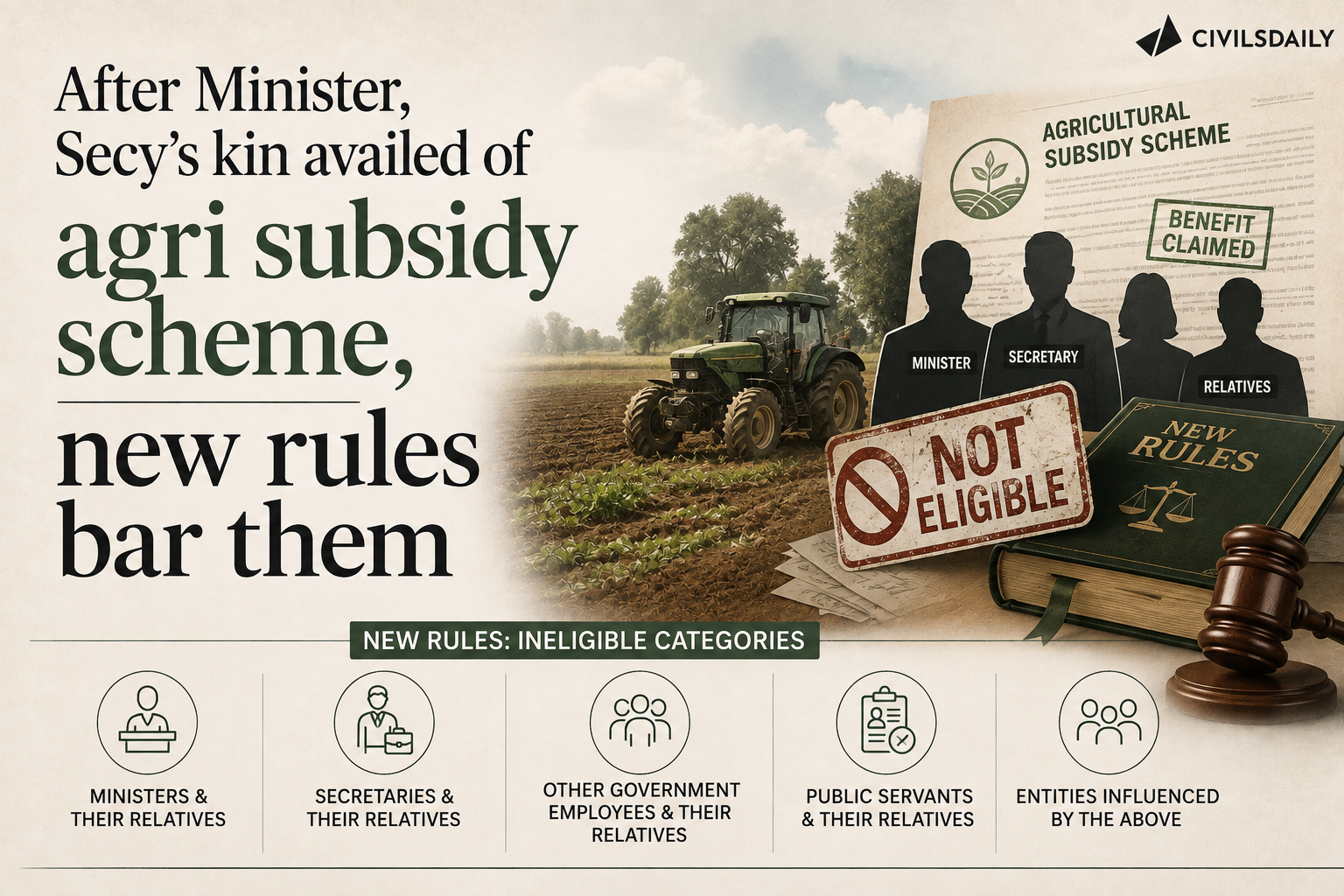
The National Horticulture Board (NHB) amended the Scheme Guidelines of the Commercial Horticulture and Cold Storage Schemes on 21 August 2026, with immediate effect. The amendment bars holders of constitutional posts, serving ministers, members of legislatures, mayors, district panchayat chiefs and government employees from financial assistance under NHB schemes, and redefines ‘family’ to cover the applicant’s spouse, father, mother, sons and daughters. It follows a 27 June 2026 investigation reporting that a Union Minister of State and the kin of a serving Central government Secretary had availed subsidy for their cucumber farms. The tension is that a scheme designed to promote large scale commercial horticulture had eligibility rules loose enough to route public subsidy to the families of the officials administering the sector.
What is the Development of Commercial Horticulture scheme?
- Purpose: The scheme, formally the Development of Commercial Horticulture through Production and Post-Harvest Management of Horticulture Crops, promotes commercial farming of horticultural crops on a large scale, meaning cultivation for profit rather than subsistence.
- Crops covered: It covers three vegetables, capsicum, cucumber and tomato, and eight varieties of flowers including rose, lilium and chrysanthemum.
- The assistance it offered: The scheme offered a maximum subsidy of 50 per cent of the project cost, capped per family.
- Who runs it: It is administered by the National Horticulture Board, an autonomous body under the Ministry of Agriculture and Farmers’ Welfare.
Who is now barred from the subsidy?
- Constitutional post holders: Present holders of constitutional posts are ineligible for financial assistance under NHB schemes.
- Elected representatives and office bearers: Present ministers and ministers of state, members of the Lok Sabha and the Rajya Sabha, members of State Legislative Assemblies and Councils, mayors of municipal corporations and chairpersons of district panchayats are ineligible.
- Serving government employees: Serving employees of Central and State government ministries and departments, public sector undertakings, autonomous bodies and local bodies are ineligible, except Multi-Tasking Staff, Class-IV and Group D employees.
- Pensioners above a threshold: Superannuated and retired pensioners receiving a monthly pension of Rs 10,000 or more are ineligible, excluding the same Multi-Tasking Staff, Class-IV and Group D categories.
- Groups of farmers: A group of farmers is the fifth barred category, closing the route by which several individuals could apply jointly.
- A single concession: Family members of persons in the barred categories may avail one-time assistance, subject to the revised definition of family.
How has the definition of ‘family’ changed?
- The new definition: For determining eligibility under NHB schemes, ‘family’ now comprises the applicant’s spouse, father, mother, sons and daughters.
- The definition it replaces: The old guidelines defined family as the husband, wife and dependent minor children, which left adult children and parents free to apply separately.
- One member per family: Only one member of a family is eligible to avail financial assistance under NHB schemes, whether individually or through a Hindu Undivided Family, a partnership or proprietorship firm, or as a director of a company.
- Assistance is attributed to the family: Financial assistance availed by any member of a family is treated as assistance availed by that family, and no further assistance is admissible to any other member under any NHB scheme or component.
- The unutilised balance is forfeited: The bar applies irrespective of any unutilised portion of the maximum admissible ceiling, and constitutes the final entitlement of the family across all NHB schemes and components.
What else did the amendment change?
- The subsidy rate was cut: The subsidy component was reduced from 50 per cent to 35 per cent for beneficiaries in general category states.
- A higher rate for hill and North Eastern states: The rate is 45 per cent in North Eastern and Himalayan states, retaining a differential for higher cost regions.
- Cold storage assistance was capped: The maximum subsidy for cold storage capacity was capped at Rs 2 crore.
- A voluntary exit route was created: A beneficiary may, during the prescribed lock-in period, voluntarily opt out by refunding the entire subsidy amount with applicable interest, and is then discharged from the obligations and restrictions arising from the assistance.
- Misrepresentation now carries recovery: Suppression, misrepresentation or furnishing of incorrect information to obtain assistance renders the applicant liable for recovery of the assistance released, along with applicable interest.
- The stated objective: The NHB circular states the amendments are meant to rationalise financial assistance, ensure equitable distribution of benefits, prevent duplication of subsidy, and make implementation more transparent and effective.
What prompted the amendment?
- The Minister’s own case: A 27 June 2026 report found that Bhagirath Choudhary, Minister of State in the Union Ministry of Agriculture and Farmers’ Welfare, availed a Rs 99 lakh subsidy for his farm in 2025 under the same scheme administered by his own ministry.
- The subsidy was returned: He returned the subsidy amount to the government a month later.
- The Secretary’s kin: The same investigation showed that the wife, son and mother of senior Indian Administrative Service officer Naresh Pal Gangwar, then serving as Secretary of the Department of Animal Husbandry and Dairying, were among the beneficiaries of the scheme.
- A posting was withdrawn: The government appointed that officer as Higher Education Secretary on 23 July 2026, and cancelled the appointment on 10 August 2026 before he joined.
- The design gap the cases exposed: Neither case required a false declaration, because the old ‘family’ definition covered only husband, wife and dependent minor children, and no category of applicant was excluded by office.
Challenges to the National Horticulture Board subsidy scheme
- Verification of family relationships is self declared: The Board has no independent database linking an applicant to parents, adult children or spouse, so the widened definition depends on the applicant disclosing it. Eg. The barred cases surfaced through a newspaper investigation rather than through scheme level scrutiny. Fix. Seed applications with Aadhaar based family linkage from the ration card or land record database, so a second application from the same family is flagged automatically.
- Corporate structures can defeat the one-member rule: The bar covers a Hindu Undivided Family, a firm and a directorship, but not shareholding through nominees or layered entities. Eg. The revised rule lists specific vehicles rather than applying a beneficial ownership test. Fix. Apply a beneficial ownership disclosure requirement above a defined shareholding threshold, on the model used for company law filings.
- A lower subsidy rate deters the small grower: The reduced rate raises the own contribution needed for a poly-house or a cold store, which is harder for a one hectare holder than for a large operator. Eg. Protected cultivation and cold storage carry high fixed setup costs regardless of holding size. Fix. Retain the higher rate for small and marginal holders and Farmer Producer Organisations while applying the reduced rate to larger project sizes.
- Cold storage assistance concentrates geographically: Capital subsidy flows to states that already have storage clusters and applicants able to raise the balance capital. Eg. Cold storage capacity in India remains concentrated in a few states, leaving wide gaps elsewhere. Fix. Ring-fence a share of the cold storage corpus for districts with no existing capacity, appraised against a mapped storage deficit.
- Lock-in monitoring is weak: The new voluntary exit and recovery provisions assume the Board can track asset use through the lock-in period, which requires physical inspection capacity it does not have. Eg. The guidelines rely on the beneficiary approaching the Board rather than on periodic verification. Fix. Mandate geo-tagged and time-stamped asset verification at fixed intervals during the lock-in, released through the scheme portal.
- No public beneficiary register exists: Without a searchable list of who received what, the same defect can recur undetected until it is reported externally. Eg. Both the Minister’s case and the Secretary’s family’s case came to light through an outside investigation. Fix. Publish a district-wise beneficiary register with name, project and sanctioned amount, on the model of the public disclosure already used for fertiliser and food subsidy transfers.
Conclusion
The scheme guidelines have been amended by an NHB circular dated 21 August 2026 and apply with immediate effect, so the barred categories and the widened family definition already govern fresh applications. The amendment also cuts the subsidy rate for general category states, caps cold storage assistance at Rs 2 crore, and creates a voluntary refund route out of the scheme. The circular sets no further date or review milestone, and the operative test will be whether the widened family definition is verified at application stage rather than after the fact.
“[2018, GS3, 15 marks] Assess the role of National Horticulture Mission (NHM) in boosting the production, productivity and income of horticulture farms. How far has it succeeded in increasing the income of farmers?”
