Why in the News
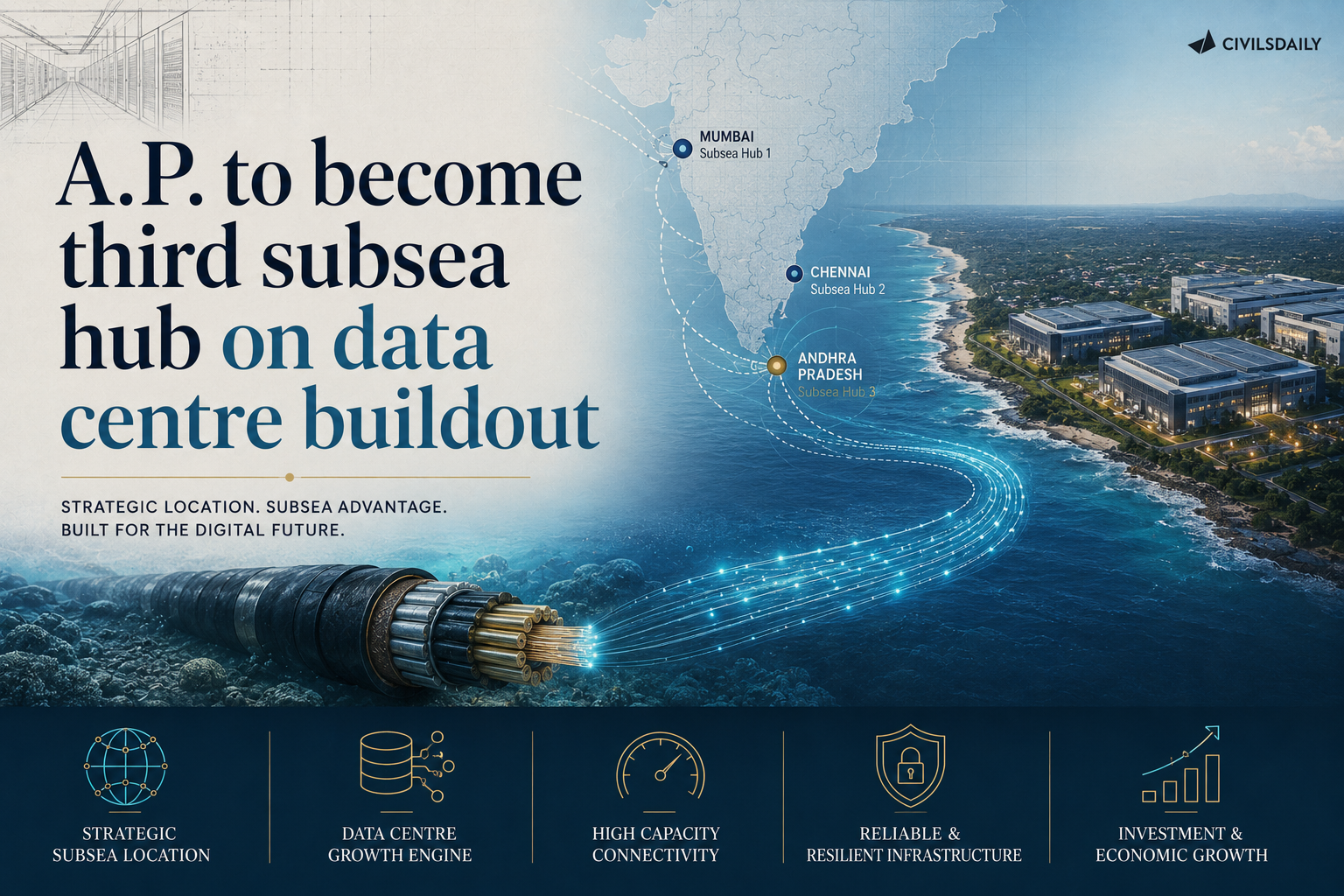
Technology majors Microsoft and Google are building new subsea cable landing stations on the coast of Andhra Pradesh as part of an artificial intelligence linked data centre buildout in the State. Microsoft is part of a consortium with Lightstorm and the Singaporean telecom operator Singtel to land the 3,600 kilometre India Southeast Asia Submarine Cable System, while Google’s globe spanning America India Connect system will land at Visakhapatnam, where the company’s own data centre complex is coming up. Once complete, the buildout will give India, after Mumbai and Chennai, a third digital international gateway, even as a global shortage of fibre threatens to slow the inland network these projects still need.
What is a subsea cable landing station?
- Definition: A subsea cable landing station is the facility where an undersea fibre optic cable comes ashore and connects to a country’s terrestrial network, carrying the bulk of international internet traffic.
- Global reliance: The overwhelming majority of the world’s international data traffic travels through such undersea cable systems rather than satellites, making landing stations critical infrastructure.
- India’s current concentration: India’s existing landing stations are concentrated in Mumbai and Chennai, leaving the country reliant on a small number of routes.
What new cable infrastructure is being built off Andhra Pradesh’s coast?
- Microsoft’s consortium project: Microsoft, alongside Lightstorm and Singtel, is landing the 3,600 kilometre India Southeast Asia Submarine Cable System, expected to be ready for service in the fourth quarter of 2029.
- Google’s own system: Google’s America India Connect system will land at Visakhapatnam, alongside the data centre complex the company is building there as part of what a Google executive described as an artificial intelligence hub.
What does this make Visakhapatnam?
- India’s third gateway: After Mumbai and Chennai, Visakhapatnam becomes India’s third digital international subsea gateway, connecting the country directly with Southeast Asia, Australia and the Middle East.
- A new corridor: Lightstorm’s chief executive has described the India Southeast Asia system, which also connects to Chennai, as providing a fresh corridor to South Asia from Singapore and Malaysia.
Why are companies building on the east coast now?
- Ageing existing infrastructure: Most cables currently connecting India’s east coast are old, are already filled to capacity and are approaching the end of their working life.
- A search for resilience: Companies are also seeking to reduce the risk of relying on a single route by adding cables on India’s east coast, citing instability in West Asia as a reason to build in an alternate location.
What inland infrastructure does this buildout require?
- A nationwide undertaking: Both projects require installing and lighting thousands of kilometres of new terrestrial fibre linking the coast to major cities, a scale one company executive described as spanning the entire country.
- A dedicated corridor: Lightstorm is expected to build a terrestrial corridor connecting Machilipatnam to Mumbai and Hyderabad, and Chennai to Hyderabad and Mumbai, with matching bandwidth.
- A global fibre shortage: Fibre, its components and its raw material are in short supply worldwide, including from Indian manufacturers, a constraint industry executives describe as unprecedented in over a decade.
What will Google’s Visakhapatnam facility do?
- Focused on inference: The facility will focus on inference work rather than power intensive training runs, serving domestic enterprises and government agencies given the deep adoption of artificial intelligence across government service delivery.
- Power and water choices: Google is seeking to source as much renewable power for the project as possible and is using air cooling technology to minimise water use.
Challenges to the subsea cable buildout
- A global fibre shortage: A worldwide shortage of fibre and its raw material, unprecedented in over a decade, could delay the inland network these projects still need. Eg. Industry executives report that fibre is out of stock across the globe, including from Indian manufacturers. Fix. Expand domestic fibre manufacturing capacity through targeted incentives so the inland rollout is not held back by global supply constraints.
- Physical vulnerability of undersea cables: Undersea cables remain exposed to accidental damage from fishing and anchoring activity and to disruption in contested waters. Eg. India’s existing east coast cables are already ageing and running close to capacity, leaving few redundant routes today. Fix. Build multiple, geographically separated landing points and routes, as the new Visakhapatnam gateway is itself intended to do, so a single cable fault cannot isolate India’s connectivity.
- Concentration of ownership with foreign firms: The new cable systems and the data centres they serve are being built and operated by foreign technology majors, so India’s expanding gateway capacity depends on the investment decisions of a small number of firms. Eg. Both the India Southeast Asia system and the America India Connect system are anchored by Microsoft and Google respectively rather than Indian carriers. Fix. Encourage Indian telecom operators to invest jointly in landing station capacity so gateway control is not concentrated entirely with foreign firms.
Conclusion
Andhra Pradesh’s coastline is emerging as India’s third major digital gateway, as Microsoft and Google build new subsea cable systems into Visakhapatnam alongside the data centres driving the region’s artificial intelligence buildout. Delivering on that promise depends on inland fibre rollout keeping pace despite a global supply crunch, and on India diversifying its cable landing points and ownership so its expanding digital infrastructure does not remain concentrated in a handful of ageing routes and foreign owned systems.
[2023] “What is the status of digitalization in the Indian economy? Examine the problems faced in this regard and suggest improvements.”
