Mentor Comment
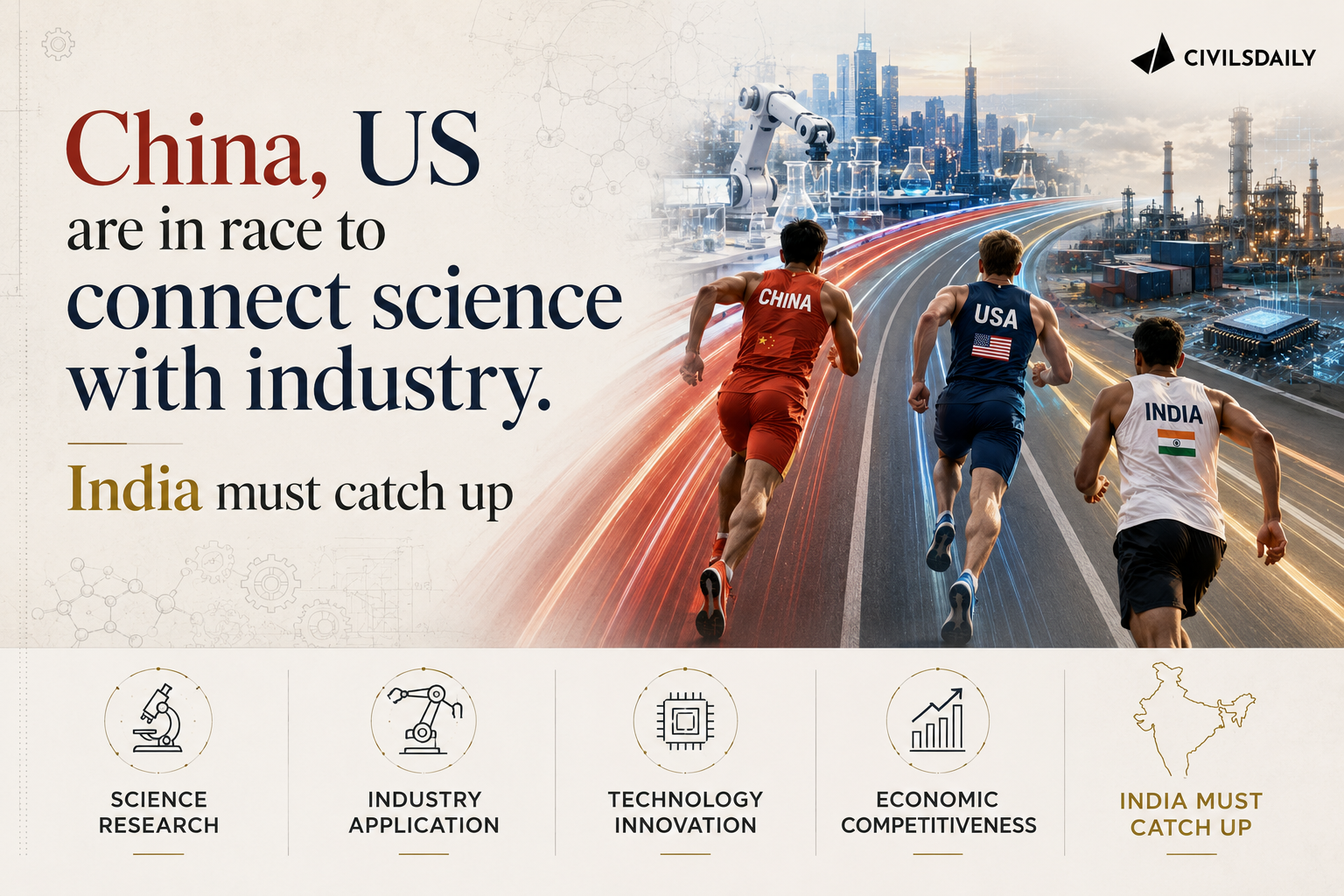
Beijing’s second World Humanoid Games has showcased a Chinese project to become the world’s leading science power, rooted in the Chinese President’s call to mobilise “new quality productive forces” released by the current revolutions in science and technology. The US administration has released Science: A New Golden Age, billed as the first major reset in US science policy since World War II, aimed at reintegrating discovery with production. Both powers are building an ecosystem that connects science with industry, from opposite starting points. India has launched missions on artificial intelligence (AI), semiconductor production and quantum technologies, but its private capital has retreated from science and its state-led scientific institutions remain unreformed.
How are China and the United States racing toward the same goal from opposite directions?
- China’s break with the old growth model: The Chinese President holds that the next phase of growth cannot rely on cheap labour, large-scale manufacturing, infrastructure and capital accumulation, and must come from innovation.
- AI diffused across the physical economy: Beijing’s objective is to diffuse AI across robotics, machine tools, automobiles, biotechnology, materials, energy, agriculture and scientific research.
- It bets that fusing digital intelligence with the world’s largest industrial ecosystem will make China the leading technological power.
- From adaptation to original discovery: For decades China absorbed foreign technology, improved it through manufacturing and dominated production. It now wants to move upstream to original discovery.
- China’s spending signal: China spent 2.8 per cent of GDP on research and development (R&D) in 2025, and its basic-research expenditure rose by 11 per cent.
- China’s four-step logic: AI accelerates discovery; discovery produces technology; technology transforms industry; industrial strength generates national power and a geopolitical edge.
- The US reset names its own weakness: Science: A New Golden Age, released in July, recognises American strengths in universities, laboratories, technology companies and capital markets. It acknowledges the erosion of the capacity to turn discoveries into production.
- How globalisation split US innovation from manufacturing: Companies designed at home, produced abroad and depended on long supply chains. That model generated wealth and also the vulnerabilities exposed by the pandemic, China’s rise and geopolitical rivalry.
- Mirror-image fears: China begins with the largest manufacturing base and moves upstream into science. The US begins with the strongest scientific system and moves downstream into manufacturing. China fears dependence on American technology; the US fears dependence on Chinese production.
What does “connecting science with industry” actually mean in this contest?
- AI as an accelerator of knowledge, not a product: Washington and Beijing see AI not merely as a general-purpose technology but as an accelerator central to the production of new knowledge that in turn transforms industry.
- Discovery made continuous with manufacturing: By making discovery continuous with design and manufacturing, AI-driven science transforms production itself and converts scientific speed into economic power and geopolitical capability.
- The ecosystem, not the model, is the prize: The contest is not about who unveils the cleverest AI model or the most sophisticated humanoid. It is about building the most effective ecosystem connecting universities, laboratories, entrepreneurs, finance, energy, factories, supply chains and markets.
Where does India stand as the race intensifies?
- Missions exist on paper: Delhi recognises the trend and has launched missions on AI, semiconductor production and quantum technologies, and has a draft robotics policy.
- The spending gap: The Economic Survey 2025-26 puts India’s R&D expenditure at 0.64 per cent of GDP, against about 2.8 per cent for China and 3.5 per cent for the US.
- The absolute gap is wider: The World Intellectual Property Organisation estimates India’s total R&D spend at $75 billion in purchasing-power-adjusted dollars, against $786 billion for China and $782 billion for the United States. In nominal dollar terms India looks even smaller.
Why does the first weakness, the retreat of private capital from science, matter most?
- Ambition lives in government declarations: Ambition and imagination are concentrated in government declarations at a time when the private sector contributes more than ever to producing knowledge in the US and China.
- Indian capital has no science project: Indian capital rarely articulates a project for mastering the new forces of production or a new project for science and basic research.
- It was not always so: Jamsetji Tata helped create the Indian Institute of Science in 1909. The Kirloskars and other western Indian business families sent their children to the Massachusetts Institute of Technology from the 1920s, recognising that independent India’s future lay in mastering modern science.
- Private philanthropy built the strategic programmes: The Sir Dorabji Tata Trust supported Homi Bhabha in establishing the Tata Institute of Fundamental Research, which formed the nucleus of India’s atomic energy and space programmes. Indian capital has retreated from that tradition.
Why does the second weakness, unreformed scientific institutions, compound the first?
- No overhaul in India’s reform era: China’s reform era, launched in the late 1970s under Deng Xiaoping, put the revitalisation of science and technology at the heart of the Four Modernisations. India’s reform era, beginning in the 1990s, produced no comparable overhaul.
- Same American training, different follow-through: India and China both benefited from access to American universities that trained their vast talent pools. China combined that opportunity with massive domestic investment in science and higher education and incentives for researchers to return.
- India does not draw talent back: India’s science sector fails to attract its trained talent home, and the shortfall is severe rather than marginal.
Can “technological sovereignty” be built without global science?
- Bureaucratisation, then cultural nationalism: The Congress era saw the steady bureaucratisation of Indian science, and the BJP era is adding cultural nationalism to it.
- Mythology is not evidence: Civilisational pride cannot make mythology a substitute for evidence, experiment and scientific temper. India’s most confident claim should be that the greatest Indian contributions lie in the future, not that all modern science was discovered in its past.
- The cost of talking tall, once before: Delhi’s radical posturing on technological “self-reliance” in the 1970s and 1980s isolated India from global technological advances. Today there is grandiose talk of “technological sovereignty”.
- Two tracks at once: India must deepen cooperation with global science, capital, technology and talent, and at the same time build domestic research, industrial and institutional capacity. Neither track substitutes for the other.
Challenges to India’s science-industry linkage
- Research sits outside the universities that supply the workforce: Most public research is done in mission agencies and Council of Scientific and Industrial Research (CSIR) laboratories, so graduates and firms rarely meet discovery where it happens. Eg. The Defence Research and Development Organisation, the Indian Space Research Organisation, the Department of Atomic Energy and CSIR absorb the bulk of central research spending, and State universities receive a marginal share.
The Fix: Route Anusandhan National Research Foundation grants preferentially to State universities with mandatory industry co-investment. - Industry does not fund its own research: The private sector contributes 36 per cent of India’s gross R&D expenditure, against 77 per cent in China and 79 per cent in the US and Japan. Eg. The weighted tax deduction on in-house R&D under Section 35(2AB) of the Income Tax Act, 1961 was cut from 200 per cent to 100 per cent from 2020-21, removing the one fiscal incentive firms used.
The Fix: Restore a weighted deduction tied to patents filed and products commercialised rather than to spending alone. - Deep technology has no patient capital: Venture funds back consumer applications that return within five years, not fabs or materials that need fifteen. Eg. Micron’s assembly and test plant at Sanand, approved in 2023, needed roughly 70 per cent of its project cost as central and Gujarat subsidy before private capital moved.
The Fix: Deploy the Research Development and Innovation scheme corpus as long tenure, low interest loans and fund-of-funds equity for private deep technology projects. - Public procurement does not buy the first unit: Government buyers demand a track record, so an Indian prototype finds no first customer and licenses abroad. Eg. The United States’ Small Business Innovation Research programme reserves a fixed share of federal agency R&D budgets for small firms’ first contracts, and India has no equivalent set-aside.
The Fix: Add a first-buyer set-aside in the General Financial Rules for Indian deep technology products validated by a designated national laboratory.
Conclusion
The contest India has to enter is an ecosystem contest, and an ecosystem cannot be declared into existence by a mission document. Two things remain unreconciled: a state-led science system that has never been restructured, and a private sector that has stopped funding discovery. Whether Indian capital returns to the tradition that built the Indian Institute of Science and the Tata Institute of Fundamental Research is the marker to watch, and the disbursal of the new research finance corpus to private laboratories is where it will first show.
About India’s Research and Innovation Ecosystem
- What the ecosystem measures: Gross expenditure on R&D (GERD) counts spending by government, industry and higher education on basic research, applied research and experimental development.
- Who does the research: Central agencies dominate, with a small set of premier institutes such as the Indian Institutes of Technology, the Indian Institute of Science and the National Institute of Immunology providing the academic base.
- Global standing: India ranked 39th of 133 economies in the World Intellectual Property Organisation’s Global Innovation Index 2024, first among lower middle income economies.
Laws and Rules Governing India’s Research and Innovation Ecosystem
- Anusandhan National Research Foundation Act, 2023: Creates an apex body to seed, grow and promote research in universities and laboratories, with a planned Rs 50,000 crore over 2023-28 of which Rs 36,000 crore is to come from non-government sources.
- The Act repealed the Science and Engineering Research Board Act, 2008 and subsumed that board into the new foundation.
- Patents Act, 1970: Governs the grant and enforcement of patents; the 2005 amendment introduced product patents in pharmaceuticals, chemicals and food to comply with the World Trade Organisation’s TRIPS agreement.
Government Initiatives for India’s Research and Innovation Ecosystem
- Research Development and Innovation scheme: Approved by the Union Cabinet in July 2025 with a Rs 1 lakh crore corpus to finance private sector research in sunrise sectors through long tenure, low or nil interest loans and equity.
- IndiaAI Mission: Launched in 2024 by the Ministry of Electronics and Information Technology, anchored in shared compute of 38,000-plus GPUs, the AI Kosh open dataset platform, and 570 FutureSkills and AI Labs in Tier 2 and Tier 3 cities.
- National Quantum Mission: Launched in April 2023 with an outlay of Rs 6,003 crore for 2023-31, building four Thematic Quantum Technology Hubs in computing, communication, sensing and metrology, and materials and devices.
- India Semiconductor Mission: Approved in December 2021 with a Rs 76,000 crore outlay to subsidise fabrication, display and assembly plants and to fund chip design startups.
- VAIBHAV Fellowship: Launched in 2023 by the Department of Science and Technology to bring diaspora scientists to Indian institutions for collaborative research stints.
Key Facts about India’s Research and Innovation Ecosystem
- National Science Day, 28 February: Marks the announcement of the Raman effect in 1928.
- National Technology Day, 11 May: Marks the Pokhran-II nuclear tests of 1998 and the first flight of the indigenous Hansa aircraft the same day.
Back2Basics
- What they were: China’s programme to modernise agriculture, industry, national defence, and science and technology.
- When adopted: First articulated by Premier Zhou Enlai in 1963 and again in 1975, and made the centrepiece of the reform era at the Third Plenum of December 1978.
- Why science was listed: Science and technology was named as the modernisation that enabled the other three, which is why the reform era began by rehabilitating scientists and reopening universities to competitive entrance examinations.
[2019, GS3, 10 marks] How was India benefited from the contributions of Sir M.Visvesvaraya and Dr. M. S. Swaminathan in the fields of water engineering and agricultural science respectively?”