Why in the News
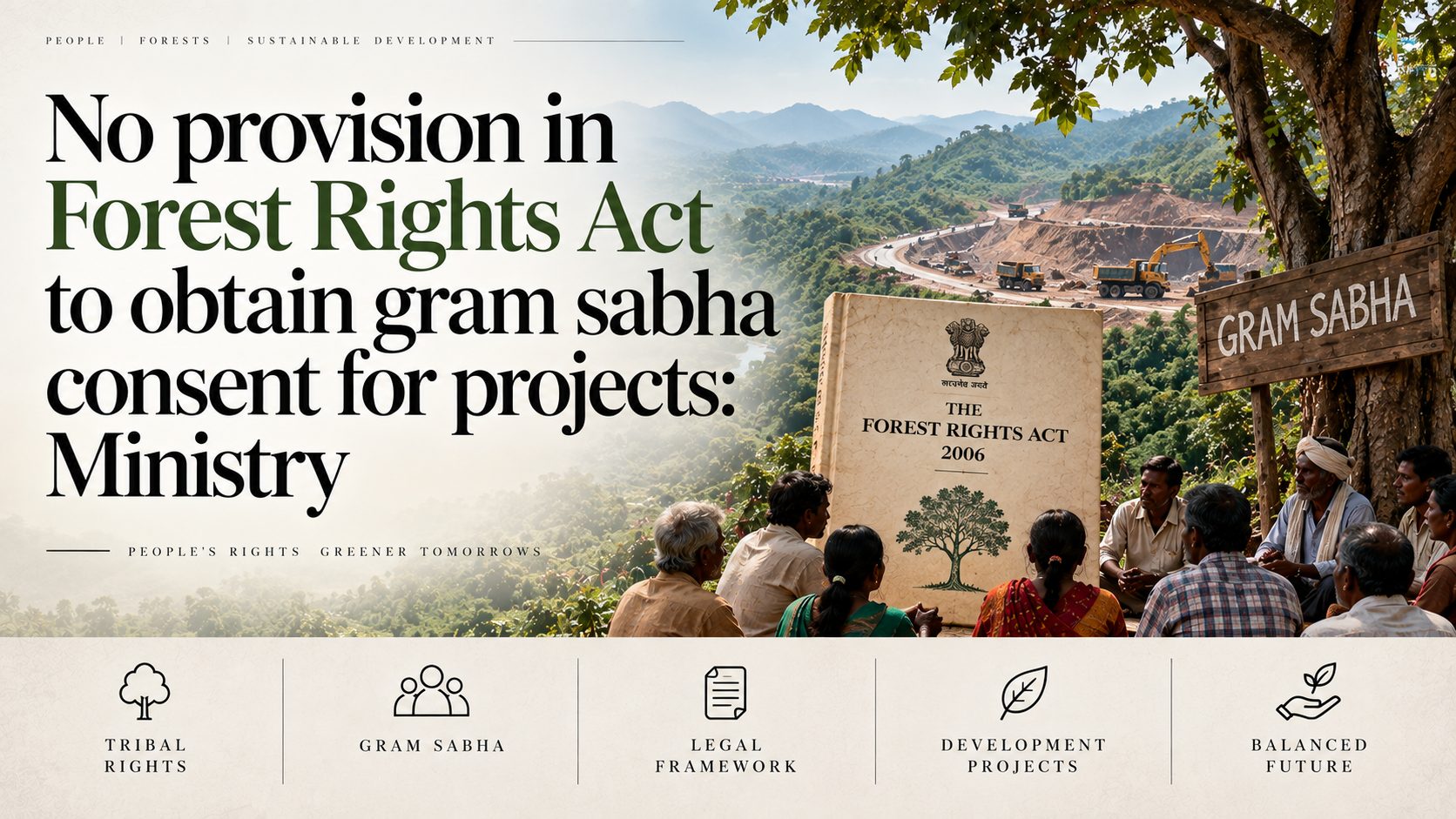
The Union Ministry of Tribal Affairs has told the Union Ministry of Power that the Scheduled Tribes and Other Traditional Forest Dwellers (Recognition of Forest Rights) Act, 2006 carries no provision for obtaining gram sabha consent for Stage-II forest clearance. It added that such matters do not fall within its purview.
How does gram sabha consent for forest clearance actually work?
- The requirement sits in the diversion rules, not in the Act: The Forest Rights Act, 2006 carries no language on gram sabha consent for diverting forest land to non-forest purposes. The Union government’s rules under the Forest (Conservation) Act, 1980 require that all processes under the Forest Rights Act be completed before a diversion certificate is issued.
- Step one, identify and recognise: The guidelines require potential claimants under the Forest Rights Act to be identified, and their rights to be recognised where they apply.
- Step two, vest the rights: Recognised rights are then vested in the holders before the diversion proposal can move.
- Step three, obtain the no-objection certificate: The concerned gram sabhas then issue a no-objection certificate on the proposal to divert that forest land for the stated purpose. This certificate is what is commonly called gram sabha consent for forest clearance.
What is the Ministry of Tribal Affairs’ stated position?
- The communication is dated and specific: The Ministry stated on 31 August that there is no provision for obtaining gram sabha consent for Stage-II forest clearance in the Forest Rights Act, 2006 or the rules made under it.
- It disclaims jurisdiction: It concluded that such matters therefore do not fall under its purview.
- The Act says otherwise on responsibility: The Forest Rights Act explicitly names the Ministry of Tribal Affairs as the nodal ministry responsible for the law’s implementation.
- The disclaimer has a record behind it: The Ministry has previously claimed no role in the Nicobar mega-infrastructure project and in Forest Rights Act implementation cases in Madhya Pradesh, Karnataka and other States, arguing that the Act assigns implementation to State and Union Territory governments.
Why is that position contested?
- The requirement is not free-standing: The no-objection certificate is demanded because the diversion rules make completion of the Forest Rights Act processes a precondition. A ministry that owns the Act’s implementation cannot disown the precondition built on it.
- No alternative authority exists: The position leaves no ministry able to settle a disputed consent, which is the objection recorded by a Supreme Court advocate who formerly advised the Ministry of Tribal Affairs under both governments.
- The timing sharpens the gap: The disclaimer was issued while a parliamentary committee proposal to lower the consent standard is live and awaiting inter-ministerial examination.
What did the parliamentary committee propose, and why?
- The report is dated: The Parliamentary Standing Committee on Public Undertakings reported on NHPC Limited on 3 August, and the Power Ministry’s deliberations with the Tribal Affairs Ministry followed from it.
- The delay figure: Based on discussions with NHPC officials, the committee recorded an average forest clearance time of 106 months for under-construction projects.
- The bottleneck it identified: It found the requirement that all concerned gram sabhas consent to be the single most critical bottleneck.
- The stalled project named: The Teesta-IV hydroelectric project is indefinitely stalled because consent from a small minority of gram panchayats remains pending.
- The proposed dilution: The committee endorsed NHPC’s recommendation for a qualified super-majority, meaning consent from 70 to 75 per cent of affected gram sabhas, for large hydropower projects of national importance. It asked the Power Ministry to examine the feasibility of that proposal with the Ministry of Tribal Affairs.
Challenges to gram sabha consent under the Forest Rights Act
- Consent can be recorded without a real assembly: Resolutions are produced without quorum or without convening the habitation actually affected. Eg. Villagers of Hariharpur, Salhi and Fatehpur alleged forged gram sabha consent for the Parsa coal block in the Hasdeo Aranya forests of Chhattisgarh.
The Fix: Require a video record and a habitation-wise attendance roll for every consent resolution, uploaded before the diversion certificate is issued. - Rights recognition lags, so the assembly may hold no title: Community forest resource rights remain unrecognised across most eligible villages, which weakens the standing of the body being asked to consent. Eg. Recognition of community forest resource rights has advanced in Maharashtra and Odisha and stalled across most other States.
The Fix: Complete community forest resource recognition across the affected district before a diversion proposal is admitted for consideration. - The rules have already moved consent later in the sequence: Consent now arrives after a project has an in-principle approval, which reduces it to a formality. Eg. The Van (Sanrakshan Evam Samvardhan) Rules, 2022 removed the gram sabha consent step from the stage preceding in-principle approval.
The Fix: Restore the consent step ahead of in-principle approval, so no project is sanctioned before the affected assembly has been heard. - Compliance is certified by the authority pushing the project: The State administration both promotes the project and certifies that the statutory process was followed. Eg. The environment ministry accepts the State’s compliance certificate at the final clearance stage without independent verification.
The Fix: Route the compliance certificate through the State tribal welfare department, accompanied by a published list of recognised claimants.
Conclusion
Two positions now stand directly against each other. The statute names one ministry as responsible for its implementation, and that ministry says the consent question is not its business. Nothing in the system supplies an alternative authority to settle a contested consent, so a disputed resolution has no forum. That gap matters most now, because a proposal to lower the consent standard is live and no ministry has claimed the authority to rule on it.
[2021] At the national level, which ministry is the nodal agency to ensure effective implementation of the Scheduled Tribes and Other Traditional Forest Dwellers (Recognition of Forest Rights) Act, 2006?
(a) Ministry of Environment, Forest and Climate Change
(b) Ministry of Panchayati Raj
(c) Ministry of Rural Development
(d) Ministry of Tribal Affairs”