Why in the News
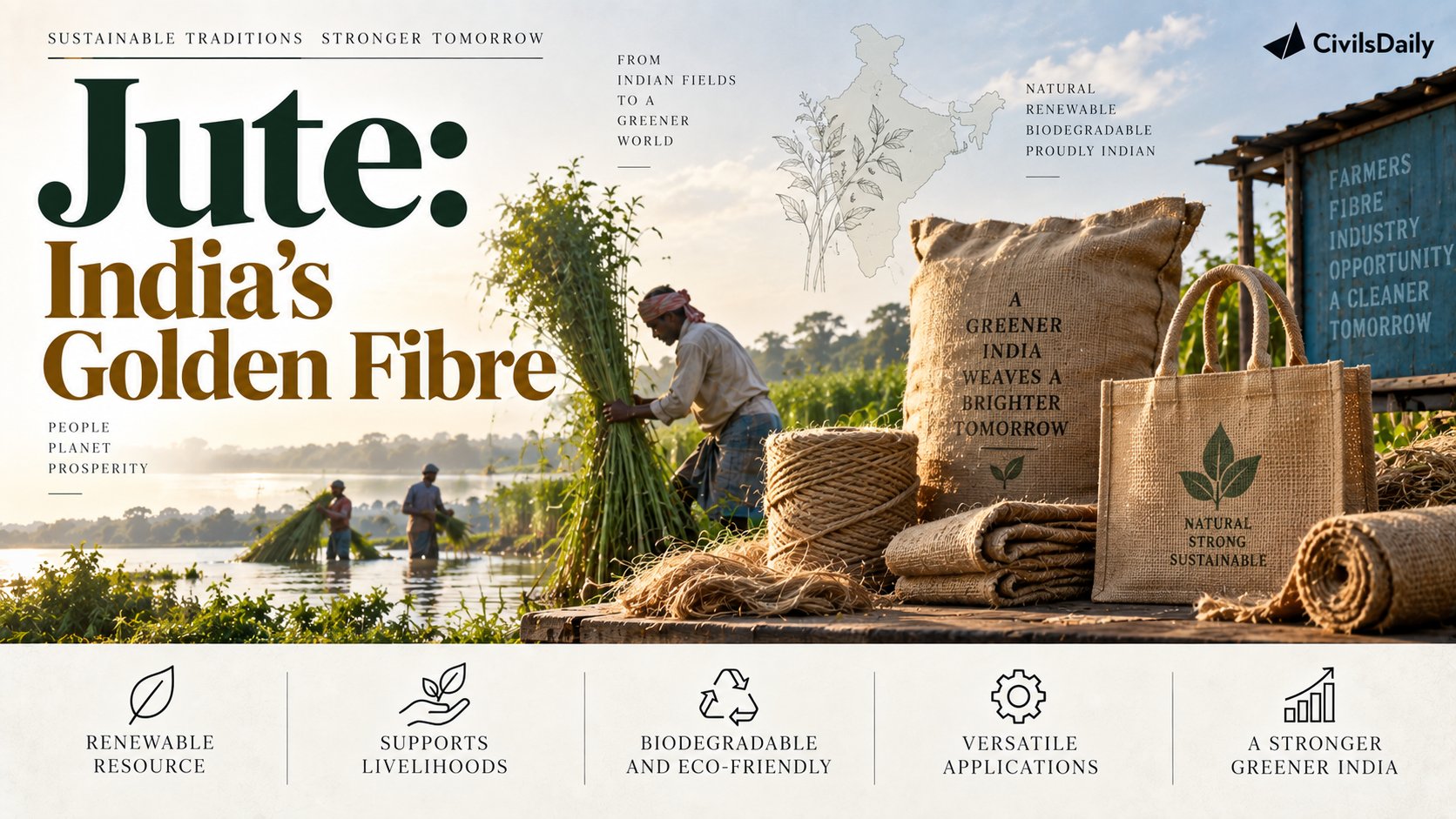
India is the world’s largest producer of raw jute. India produced 94.03 lakh bales of jute and mesta in 2025-26. India is also the leading producer of jute goods globally, accounting for around 75% of estimated world production. The sector supports nearly 40 lakh farm families and provides direct employment to around 3.70 lakh workers. Jute’s biodegradable and recyclable nature makes it an important alternative to synthetic materials.
Jute: The Golden Fibre
- Jute is called the “Golden Fibre” because of its golden colour and silky lustre.
- Jute + Mesta are collectively classified as raw jute due to their similar end uses.
- Mesta is a bast fibre crop and can serve as an alternative to jute, particularly in drier regions.
- Major producing states: West Bengal, Bihar, Assam, Odisha, and Jharkhand
- West Bengal has the largest concentration of jute mills.
Agro-climatic Conditions
- Requires hot and humid conditions.
- Rainfall: around 700-1,500 mm during the growing period.
- Generally sown during March-April.
- Harvested within 100-110 days.
- Cultivation is concentrated in eastern and northeastern India.
- Predominantly rainfed and mainly cultivated by small and marginal farmers.
Importance of Jute
- Biodegradable and recyclable natural fibre.
- Strong, durable, breathable and versatile.
- Used in: Packaging, Agriculture, Construction, Industrial textiles, Technical textiles
- Provides thermal and acoustic insulation.
- Has high moisture absorption and low static generation.
- Can be blended with natural and synthetic fibres for value-added products.
Jute Geotextiles
- Jute Geotextile (JGT) is a technical textile made from jute fibres.
- Used for: Soil erosion control, Slope and embankment protection, Riverbank and canal protection, Road construction, Railway track formation, Drainage systems, Soft-soil stabilisation
- Being biodegradable, it supports soil restoration and ecological regeneration.
- Helps regulate soil temperature and reduce surface disturbance, supporting seed germination and plant establishment.
Government Initiatives
Minimum Support Price
- MSP of raw jute for 2026-27: ₹5,925 per quintal.
- Provides a 61.8% return over the all-India weighted average cost of production.
- MSP increased from ₹2,400 per quintal in 2014-15.
Jute Corporation of India (JCI)
- Sole nodal agency for implementing MSP policy for raw jute.
- Procures directly from farmers when market prices fall below MSP.
- Operates through Departmental Purchase Centres (DPCs).
National Jute Development Programme (NJDP)
- Umbrella programme for development and promotion of the jute sector.
- Implemented by the National Jute Board (NJB).
- Focuses on:
- Increasing farm productivity and farmer incomes.
- Jute diversification.
- Market development.
- Promotion of jute as an alternative to plastics.
JUTE-ICARE
Improved Cultivation and Advanced Retting Exercise
- Launched in 2015-16.
- Promotes scientific cultivation, mechanisation and improved retting.
- Supports farmers through certified seeds and field demonstrations.
- Implemented with CRIJAF and JCI.
Jute Diversification Scheme
Promotes value addition through:
- Jute Raw Material Banks
- Jute Resource-cum-Production Centres
- Capital subsidy for machinery
- Jute retail outlets
- Export incentives for jute diversified products
Jute Packaging
- The Jute Packaging Materials (Compulsory Use in Packing Commodities) Act provides for mandatory use of jute packaging for specified commodities.
- Government mandates jute packaging for: 100% of foodgrains, and 20% of sugar
Digital Initiatives
JUTE-SMART
- End-to-end e-governance platform for procurement and supply of jute sacking bags.
- Developed by the Office of the Jute Commissioner.
- Digitises procurement, registration and compliance processes.
Jute Crop Information System
- Developed by ISRO’s National Remote Sensing Centre (NRSC) in collaboration with JCI and NJB.
- Uses remote sensing and field data to monitor jute cultivation.
- BHUVAN JUMP: Mobile application for field-level jute monitoring.
- PATSAN: Web-based platform providing near-real-time jute surveillance and analytics.
Jute and Sustainable Development
- Contributes to rural employment, environmental sustainability and green industrialisation.
- Provides an alternative to plastic and synthetic materials.
- Supports farmers, workers, artisans and MSMEs.
- Promotes technical textiles through products such as jute geotextiles.
- Creates opportunities for value addition and exports.
[2011] The lower Gangetic plain is characterized by a humid climate with high temperature throughout the year. Which one among the following pairs of crops is most suitable for this region?
(a) Paddy and cotton
(b) Wheat and Jute
(c) Paddy and Jute
(d) Wheat and cotton.