Why in the News
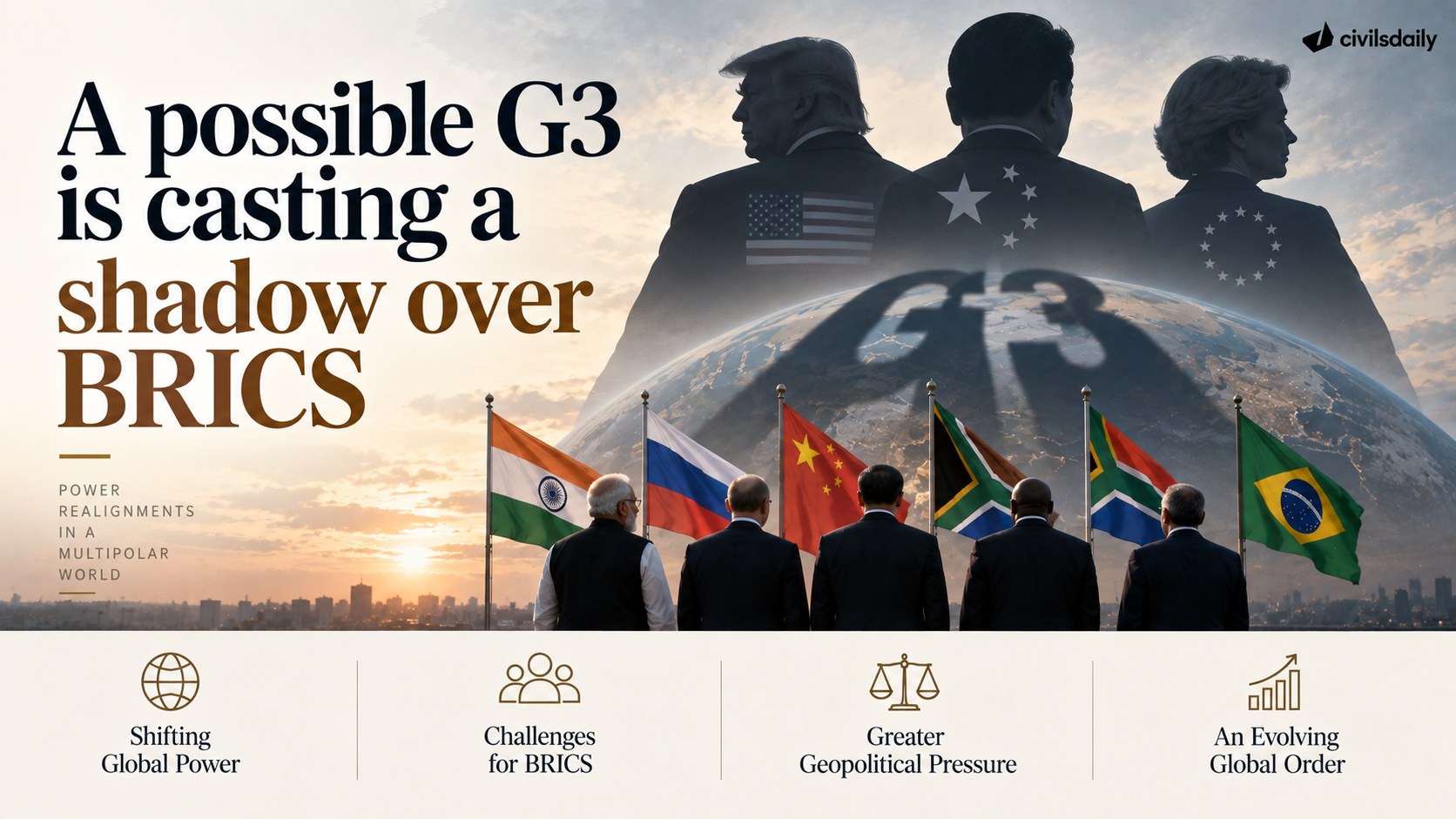
BRICS leaders meet in Delhi this week to add further layers of cooperation, ranging from agriculture, health to digitalisation. The grouping’s two principal driving forces, Russia and China, are at the same time exploring separate and joint accommodations with the United States, whose domination of the world order BRICS exists to counter.
What will the Delhi summit actually produce?
- More layers, slowly added: The summit will extend cooperation into agriculture, health and digitalisation.
- The declaration is not the draw: The last summit, at Rio de Janeiro, issued a declaration of 126 paragraphs without changing anything in the international system.
- The attraction is attendance: International interest is focused on the presence of the leaders of China, Russia and Iran.
- One bilateral carries the weight: The Chinese President is visiting India for the first time since 2019, and the two leaders are expected to stabilise the boundary situation and reset economic relations.
Why has BRICS become less coherent?
- Expansion cut both ways: Enlargement added weight to the grouping and subtracted coherence from it.
- The Iran war split two members: The conflict opened a sharp divide between Tehran and Abu Dhabi, now fellow members of the grouping.
- Two incompatible asks: Iran wants BRICS to condemn American and Israeli military action. The United Arab Emirates, which suffered Iranian attacks and disruption to commerce through the Strait of Hormuz, stresses sovereignty, protection of civilian infrastructure and freedom of navigation.
- It has already cost an outcome: Those differences prevented the BRICS foreign ministers from issuing a consensual joint statement in Delhi in May.
Why is a G3 conceivable now?
- A leader driven American approach: The US President has long held that good personal relations with the Russian and Chinese leaders could reduce global strategic tensions and produce major political and economic deals.
- Domestic and allied resistance: That instinct has repeatedly encountered resistance from the American foreign policy establishment, Congress and US allies.
- European and Asian fears differ: The Europeans worry that an accommodation with Moscow could be made at their expense. Asian allies fear that a bargain with Beijing could weaken American commitments to regional security.
- Nothing has been transformed yet: Neither relationship has been changed, and the preference for leader driven diplomacy keeps the possibility of movement open.
- The idea has been tested before: The possibility of such a meeting was explored last summer, during the 80th anniversary of the end of the Second World War.
What does Russia bring to that table?
- The war has not been won: Four and a half years of fighting have produced no decisive victory, and the front remains costly and difficult to move.
- A channel has reopened: Shuttle diplomacy by American envoys between Moscow and Kyiv has reopened the diplomatic channel, without any sign that the fundamental differences between Russia and Ukraine are narrowing.
- Both sides hedge: Moscow and Kyiv are supporting the American peace initiative and preparing for escalation at the same time.
- European security could become a chip: Russian security questions could be treated by Washington as part of a larger bargain with Beijing.
What does China bring?
- It negotiates from strength: China approaches Washington from a stronger position than Russia does.
- A sequenced diplomatic run: Its journey from the Shanghai Cooperation Organisation summit at Bishkek, through Cairo and Delhi, to the White House later this month presents China as the leader of the Global South and as a co-equal manager of the international order at the same time.
- What a second summit could yield: An extension of the trade truce, additional Chinese purchases from the United States and negotiations over technology restrictions are the available deliverables.
- The differences are structural: Washington accuses China of relying on subsidised exports and industrial overcapacity. Beijing uses rare earths, market access and its control of important supply chains as leverage.
- Taiwan is the standing ask: China will continue to press for a reduction in American support for Taiwan.
Can anti-Western rhetoric and a seat at the American table hold together?
- Alignment and hedging run together: Russia and China are closer to each other than ever and share concerns about the United States. Both also seek a workable relationship with Washington.
- Both claim the high table: For all their anti-Western rhetoric, each claims a place at the high table with the United States.
- The claim has history: Russia was once part of the G8, the group of Western industrial states, and engaged directly with NATO. China now sees itself as America’s peer.
- What a trilateral would signify: Both lay claim to shaping the global order established after 1945, and a summit of the three leaders would mark the beginning of triangular global leadership as a successor to the Yalta System.
- It is not imminent: A global directorate of three is not close, and the idea remains an exploration rather than a plan.
What are India’s three answers?
- Build national power first: The first answer is internal reform and accelerated economic development.
- Separate multipolarity from anti-American bloc politics: Russia and China use BRICS to expand their diplomatic options and to preserve the freedom to negotiate with Washington. India must approach the emerging order with the same realism.
- Widen the partnership base: India must intensify bilateral and minilateral cooperation with the Anglosphere, Brazil, Europe, Japan, Korea and other middle powers that have no enthusiasm for a G3 world.
Challenges to BRICS
- Internal rivalry limits cohesion: Friction between the two largest Asian members prevents a common strategic position inside the grouping. Eg. The unsettled India-China boundary has kept the two from a shared security line inside the same forum.
- Consensus across incompatible political systems: The membership spans vibrant democracies and autocracies, which makes agreement on human rights or democratic norms unreachable in joint declarations. Eg. The entry of Iran and Ethiopia alongside Brazil and India widened that political range further.
- De-dollarisation is slower than the rhetoric: Local currency settlement has grown, and the US dollar still settles the overwhelming share of global trade. Eg. Rupee-rouble and rupee-dirham settlement covers only a fraction of India’s external trade.
- There is no permanent secretariat: The grouping has no charter and no standing institution, so continuity depends entirely on the annual chair. Eg. Each presidency resets the agenda, and commitments lapse when the chair changes.
- Intra-group trade stays low: Members continue to rely on G7 markets for high technology imports and services exports. Eg. Most members source advanced semiconductors and aerospace components from the United States, Europe and Japan.
- Expansion risks dilution: A larger BRICS+ risks becoming a discussion forum that produces no decisions. Eg. The Non-Aligned Movement grew past 120 members and lost the ability to reach operative positions.
Way Forward
- Focus on areas of common interest: Confine joint positions to areas where members already agree, such as development finance and public health, rather than seeking a security consensus that does not exist.
- Adopt variable geometry: Move towards a variable geometry model in which subsets of members can sign issue specific instruments without binding the whole group.
- Strengthen payment infrastructure: Target payments infrastructure that lowers settlement cost and time, rather than focusing primarily on the displacement of the US dollar as a reserve currency.
- Create a permanent institutional mechanism: Establish a small standing secretariat with a limited mandate to track implementation of past declarations and maintain institutional continuity.
- Promote intra-BRICS supply chains: Direct the New Development Bank towards financing intra-group industrial supply chains, particularly in strategic sectors such as advanced technology and manufacturing.
- Formalise expansion criteria: Establish clear entry criteria for partner countries, ensuring that future expansion is based on economic complementarity rather than political alignment.
Conclusion
Multipolarity has always had two possible shapes: one distributes power across many capitals; the other concentrates it among a handful and calls the result a balance. BRICS rests on the first assumption; its two strongest members hedge towards the second. For India the operative question is not whether a three cornered directorate forms, which it may not, but whether Indian diplomacy is organised for a world in which its two largest partners in the grouping negotiate separately with Washington. That answer will show up in what India builds outside the room, not in what the room declares.
About BRICS
- What it is: BRICS is an informal grouping of major emerging economies that coordinates political and economic positions outside Western led institutions, without a founding treaty.
- Membership: Its full members are Brazil, Russia, India, China, South Africa, Egypt, Ethiopia, Indonesia, Iran, Saudi Arabia and the United Arab Emirates, with Saudi Arabia participating without having formalised its status.
- Its weight: The grouping accounts for over 45 per cent of the world’s population, about 37 per cent of global output measured at purchasing power parity, which exceeds the G7’s share, and roughly 42 per cent of global oil production and exports.
- Its stated objectives: Reform of the United Nations Security Council, the International Monetary Fund and the World Bank for more equitable representation, a multipolar order, and reduced reliance on the US dollar and on SWIFT, the messaging network banks use to instruct cross border payments.
Key Facts about BRICS
- The acronym predates the grouping: ‘BRIC’ was coined in 2001 by a Goldman Sachs economist to identify high growth emerging economies.
- From officials to leaders: The first meeting of foreign ministers was held on the margins of the United Nations General Assembly in 2006. The first formal Leaders’ Summit was held at Yekaterinburg in Russia in 2009.
- How it grew: South Africa joined in 2011. Expansion was decided at the 2023 Johannesburg Summit, with Egypt, Ethiopia, Iran and the United Arab Emirates joining in 2024 and Indonesia in 2025.
- A partner tier: A ‘Partner Country’ category was introduced in 2024 to engage states such as Malaysia, Thailand and Nigeria without granting full membership.
Initiatives under BRICS
- New Development Bank: Headquartered in Shanghai, it has approved over USD 35 billion in infrastructure lending.
- Contingent Reserve Arrangement: A USD 100 billion fund providing short term liquidity support to members.
- BRICS Pay: A cross border payment system in pilot stage, intended to work around SWIFT.
- BRICS Vaccine Research and Development Centre: Set up during the pandemic for technology transfer and vaccine equity.
- Remote Sensing Satellite Constellation: Six satellites contributed by member states, sharing data for disaster management.
- Partnership on New Industrial Revolution (PartNIR): Cooperation on artificial intelligence, digitalisation and green technology.
- BRICS Space Council: Established in 2025 to coordinate deep space exploration and lunar research.
Back2Basics: The Yalta System
- Why the term recurs: ‘Yalta System’ is used as shorthand for an international order settled among a small number of great powers rather than by the wider membership.f BRICS in projecting itself as an alternative to other groupings.”
- Where the term comes from: The Yalta Conference of February 1945 brought together the leaders of the United States, the United Kingdom and the Soviet Union to settle the shape of the post-war order.
- What it settled: It fixed the occupation and reorganisation of Europe and confirmed agreement on creating the United Nations.
- The concert it produced: It led to a Security Council with permanent seats and a veto for five powers, entrenching great power management of international peace.
[2026, GS2, 10.0 marks] “BRICS acts as a powerful counterweight in global governance, actively amplifying the voice and influence of the Global South.” Explain the role of BRICS in projecting itself as an alternative to other groupings.