Why in the News
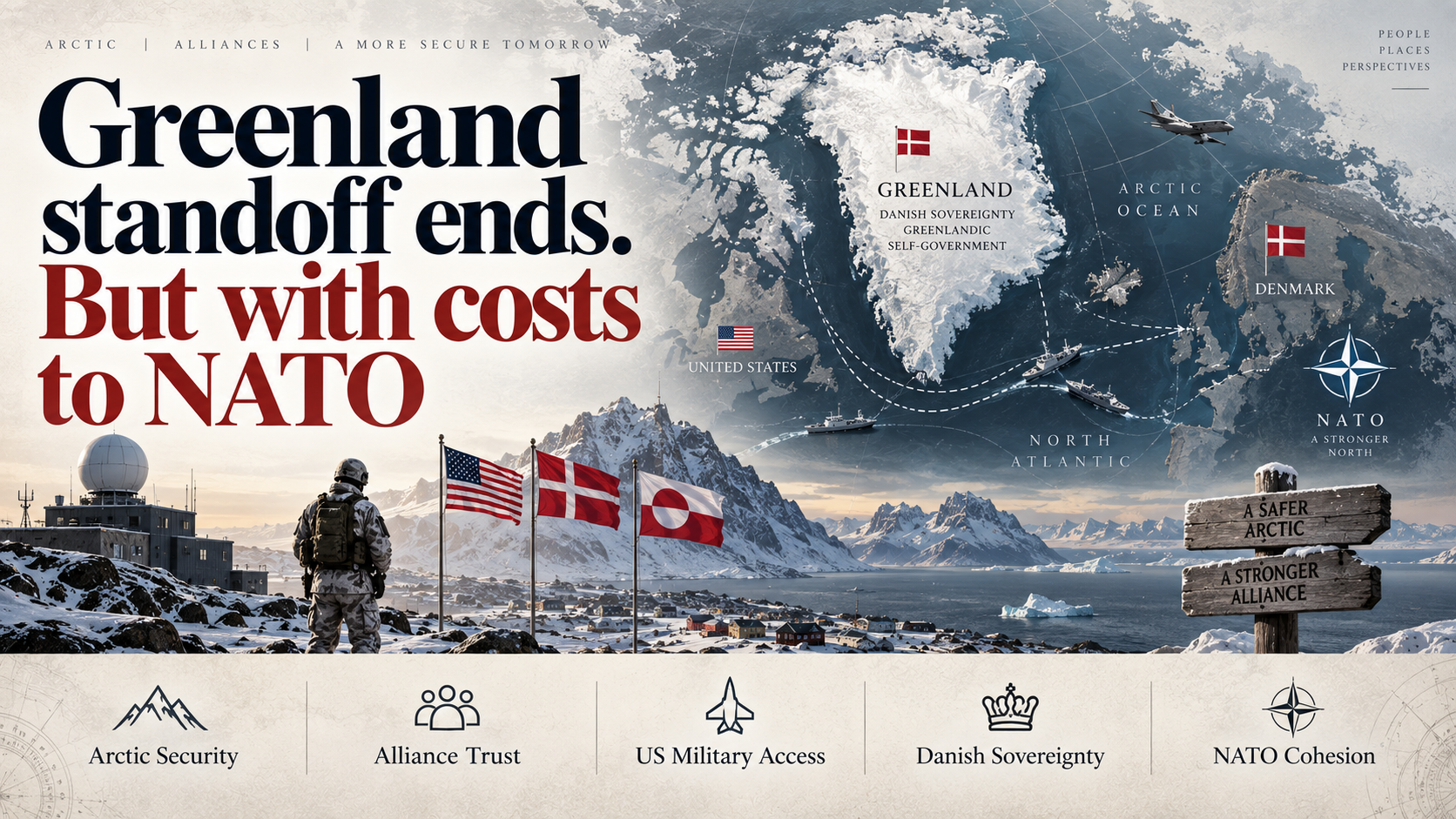
The United States, Denmark and Greenland have announced a deal on the status of Greenland, a semiautonomous territory of Denmark. The agreement expands the American military presence on the island. It also gives Washington a veto over third party military activity and over certain sensitive investments there. The deal closes a sustained episode of coercion by the United States President over a stated desire to “own” Greenland, which had driven Denmark and other North Atlantic Treaty Organization (NATO) allies to deploy troops to Greenland only nine months ago. What is now contested is whether a settlement extracted from an ally through threats leaves the mutual trust that NATO rests on intact.
What is the Greenland Defence Agreement, 1951?
- Legal basis of the American presence: The pact was signed in 1951 between the United States and Denmark against the backdrop of the emerging Soviet threat in the Arctic.
- Rights conferred: It gave the United States broad rights to construct and operate military facilities in Greenland.
- Access beyond bases: It also gave the United States access to Greenland’s airspace and waters for military purposes.
What does the new deal actually add to the 1951 arrangement?
- Expanded military footprint: The agreement widens the American military presence on the island beyond what the 1951 pact already supported.
- Veto over third party activity: Washington gains a veto over military activity by any third country in Greenland.
- Veto over investment: The same veto extends to certain sensitive investments in the territory, which converts a defence pact into an economic screening instrument.
- “Permanent control” is largely a restatement: Much of what the United States President presents as permanent control has roots in rights the 1951 agreement already conferred.
- Terms are not public: The full details of the deal have not been released, so the incremental gain cannot yet be measured against the existing pact.
Why does each party present the outcome as a win?
- American domestic politics: The United States President, with an approval rating well under water, can present the deal as a diplomatic victory to American voters ahead of the November midterm elections.
- Danish and Greenlandic relief: For Denmark and Greenland the deal removes, at least for now, the threat of an American attempt to take control of the territory.
- Scale of the threat removed: The value of that relief is measured by the fact that NATO allies had deployed troops to Greenland in response to the takeover threat.
Why does a bilateral settlement bear on NATO cohesion?
- Alliance rests on assurance, not on bases: NATO’s value to a small member is the assurance that a larger member will not turn on it, and the Greenland episode tested exactly that assurance.
- Wider pattern of signals: The overtures of the United States President to Russia and his criticism of Europe over the past 18 months form the context in which allies read the Greenland outcome.
- Timing against a live threat: Europe is bracing for the possibility of a Russian escalation on its eastern flank, so a loss of internal confidence lands at the point of maximum need.
- Precedent, not incident: A settlement reached through threat, demand and concession sets a template that any member can expect to face next.
How are allies responding to coercion within the alliance?
- Diversification as the default reply: No country accepts heavy dependence on an ally that can issue threats, demand negotiations and then extract concessions, so spreading risk becomes the rational response.
- Canada’s move to Europe: The Canadian Prime Minister has announced that Canada would seek some form of associate membership in the European Union.
- Trust is slow to rebuild: The immediate Greenland crisis is settled, and the trust lost in reaching that settlement will not be regained quickly.
Challenges to the Greenland deal
- Opacity of the terms: An agreement whose text is not public cannot be scrutinised by the legislature of any of the three parties, so its limits are unverifiable. Eg. The scope of the American veto over “sensitive investments” has not been defined in any released document.
The Fix: Publish the operative text and the investment screening criteria, so the veto’s reach is bounded by a stated standard rather than by discretion. - Greenlandic consent is thin: An arrangement negotiated chiefly between Washington and Copenhagen can bind a territory of about 57,000 people that has its own legislature. Eg. Greenland’s self government under the 2009 Self Government Act gives it authority over most domestic matters, with Denmark retaining defence and foreign affairs.
The Fix: Attach a periodic review requiring the assent of the Greenlandic legislature, so continued consent rather than a single signature carries the arrangement. - Investment veto can bite non adversaries: A screening power drafted against one rival applies equally to allied and Arctic partner capital in mining and shipping. Eg. Greenland’s rare earth and critical mineral deposits, including the Kvanefjeld project, are the main draw for outside investors.
The Fix: Carve out allied and European Union investment from the veto, leaving it scoped to entities from states the parties jointly designate. - Arctic militarisation feeds a spiral: An enlarged American footprint in the high north invites matching deployments by Russia across its Arctic coast. Eg. Russia has reopened and expanded Soviet era Arctic bases such as the Nagurskoye airbase on Franz Josef Land.
The Fix: Route the expansion through NATO’s own Arctic planning and restore military transparency talks in the Arctic Council framework. - Damage to alliance discipline: A member that wins concessions by threatening another member weakens the case for restraint by every other member. Eg. Turkey’s prolonged block on Swedish accession to NATO showed how a single member can hold alliance business hostage.
The Fix: Record an alliance level understanding that territorial claims between members are not negotiable subjects, enforced through the North Atlantic Council.
Conclusion
The Greenland dispute is settled on paper and unsettled in practice. A deal that mostly restates rights the 1951 agreement already gave has cost the alliance the assumption that members do not coerce one another. What follows is a quiet reordering of hedges, of which Canada’s approach to the European Union is the first visible instance. The marker to watch is whether other small NATO members begin seeking comparable second anchors outside the alliance.
Back2Basics: North Atlantic Treaty Organization (NATO)
- Formation: Established by the North Atlantic Treaty signed in 1949, with headquarters at Brussels.
- Collective defence: Article 5 treats an armed attack against one member as an attack against all members.
- Membership: It has 32 members following the accession of Finland in 2023 and Sweden in 2024.
- Decision making: The North Atlantic Council is its principal political decision making body and works by consensus.
Matching Previous Year Question
[2023, GS2, 15 marks] ‘The expansion and strengthening of NATO and a stronger US-Europe strategic partnership works well in India.’ What is your opinion about this statement? Give reasons and examples to support your answer.”
