đŸ’„Join UPSC 2027,2028 Mentorship (July Batch) + XFactor Notes & Microthemes PDF

Author: Access Account

  • What is a twister? Why are the majority of twisters observed in areas around the Gulf of Mexico?(GS1 2024 Question)

    A twister or tornado is a rotating column of air that forms from a thunderstorm and touches the ground, while over the sea it is known as a waterspout. Tornadoes are among the most violent and destructive natural phenomena, with wind speeds exceeding 300 km/h in extreme cases.

    Characteristics of Twister

    1. Funnel-Shaped Cloud extends from the thunderstorm to the ground, composed of condensed water, dust, and debris.
    2. Rotating Winds that can reach speeds of 100 to 300 km/h, causing significant destruction.
    3. Short Duration and Localized Impact: Twisters usually last only a few minutes to an hour and have a narrow path of destruction, affecting areas from a few meters to several kilometers wide.
    4. Varied Intensity: Rated on the Enhanced Fujita (EF) scale from EF0 (weak) to EF5 (devastating), depending on wind speed and damage.
    5. Associated with Thunderstorms: Tornadoes form in severe thunderstorms, particularly supercells, when warm and cold air masses collide.

    Formation of Twisters

    1. Warm and Cold Air Collision:This creates atmospheric instability and strong updrafts within a thunderstorm.
    2. Thunderstorm Development: A supercell thunderstorm forms, with strong updrafts and downdrafts, creating conditions for rotation within the storm.
    3. Wind shear (a change in wind direction and speed with height) causes the rising air to start spinning horizontally within the storm.
    4. Vertical Tilt of Air Rotation: The updrafts within the storm tilt the horizontally rotating air vertically, forming a rotating column of air called a mesocyclone.
    5. Tornado Formation: As the mesocyclone strengthens, a narrow funnel cloud forms. If the funnel cloud reaches the ground, it becomes a tornado or twister.
    6. Touchdown: Once the rotating air makes contact with the ground, it starts picking up debris, creating the dangerous rotating vortex associated with tornadoes.

    Why are the Majority of Twisters Observed in Areas Around the Gulf of Mexico

    1. Proximity to Warm Ocean Waters: The Gulf of Mexico provides a constant source of warm, moist air, which is a critical factor in tornado formation.
    2. Clash of Air Masses: This region frequently experiences the convergence of warm, moist air from the Gulf of Mexico and cold, dry air from the north (Canada), creating ideal conditions for severe thunderstorms and tornadoes.
    3. Frequent Low-Pressure Systems: Low-pressure systems combined with wind shear (a difference in wind speed and direction at different altitudes), can lead to the development of tornadoes.
    4. Hurricanes and Tropical Storms – tornadoes are a relatively common hazard produced by North Atlantic hurricanes, as 83% of hurricanes that made landfall along the Gulf of Mexico between 1950 and 2005 produced tornadoes 
    5. Flat Terrain: The flat landscape of the central U.S. (known as Tornado Alley) allows for the unimpeded movement of these air masses, increasing the likelihood of tornado formation.
    6. Jet stream patterns: The positioning of the jet stream in this region, especially during spring and early summer, enhances wind shear and atmospheric instability, further promoting tornado development.

    Tornadoes are powerful natural disasters that can cause devastating destruction in minutes. Climate change is increasing their frequency and intensity by altering atmospheric conditions, threatening not only concentrated regions but also other countries, requiring countries to adhere to stricter climate goals to mitigate it.
  • What are aurora australis and aurora borealis? How are these triggered?(GS1 2024 Question)

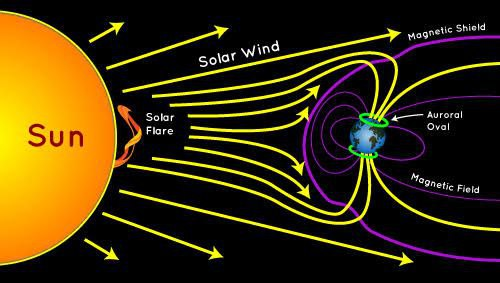
    Auroras are luminous phenomena that occur near the North (Aurora Borealis) and South Poles (Aurora Australis). They are caused by the interaction of charged particles from the Sun with the Earth’s magnetic field and atmosphere.

    Aurora Borealis: Often called the Northern Lights, it occurs in the northern hemisphere, predominantly in regions near the Arctic Circle. This includes countries like Russia, Norway, Sweden, Finland, Iceland, Canada, and Alaska.

    Aurora Australis: Also known as the Southern Lights, it occurs in the Southern Hemisphere, primarily around the Antarctic Circle. It can be seen in countries such as Australia, New Zealand, Antarctica, and parts of southern South America.

    Characteristic features of auroras

    1. Timing and Frequency:  Auroras are most visible during winter and around the equinoxes, with increased activity during periods of high solar activity, such as solar storms or solar flares
    2. Shapes and Movements: Both auroras exhibit a variety of shapes, including arcs, curtains, rays, and spirals. They often move and change shape rapidly due to interactions with Earth’s magnetic field.

    Colors of Aurora

    1. Altitude and Atmospheric Composition: Higher altitudes produce red glows from oxygen atoms, while lower altitudes result in the more common green-yellow hues.
    2. Oxygen and Nitrogen: Oxygen atoms at lower altitudes produce the familiar green-yellow hues, while reddish and bluish light in the lower fringes of auroras is created by ions striking nitrogen atoms.
    3. Rare Colors: Ions striking hydrogen and helium atoms can produce blue and purple auroras, but these colors are rarely visible to the human eye as they are outside the visible spectrum.

    Trigger and Formation of auroras

    1. Solar Wind Generation: This solar wind (primarily electrons and protons) is a result of the sun’s intense activity and consists of superheated gases.
    2. Interaction with Earth’s Magnetic Field: Most of the solar wind is deflected, but some particles become trapped within the magnetosphere and are directed towards the magnetic poles.
    3. Trapping in the Ionosphere: The trapped ions enter the ionosphere and accumulate in ring-shaped areas around the geomagnetic poles.
    4. Collisions with Atmospheric Gases like oxygen and nitrogen and transfer of energy to these atoms resulting into light.
    5. Colorful Displays: oxygen at lower altitudes produces green and yellow hues, while higher altitudes can emit red light. Nitrogen can create blue or purple shades.
    6. Influence of Solar Activity: Geomagnetic storms, triggered by solar events like coronal mass ejections (CMEs) and solar flares, enhance auroral activity.  Eg- During periods of heightened solar activity, auroras can be seen further south than usual and can exhibit more vibrant colors.

    Significance and importance of Auroras

    1. Understanding Earth’s upper atmosphere, including its density, composition, flow speeds, and the strength of electrical currents flowing in the upper atmosphere.
    2. Study of Solar Activity: Auroras are directly linked to solar activity, including solar flares and coronal mass ejections (CMEs). Monitoring auroras can help predict and mitigate the effects of solar activity on technological infrastructure like satellites and GPS systems.
    3. Cultural and Historical Importance: Auroras have been observed and revered by various cultures throughout history, often appearing in mythology and folklore. For example, the Inuit people believed auroras were the spirits of their ancestors.
    Due to 4 strong Coronal Mass Ejections (CMEs) Aurora lights in red hues were visible from Ladakh on May 10th 2024.

    Auroras are not only breathtaking natural phenomena but also help advance our understanding of Earth’s magnetosphere, solar activity, and the upper atmosphere, making them an essential subject of study.

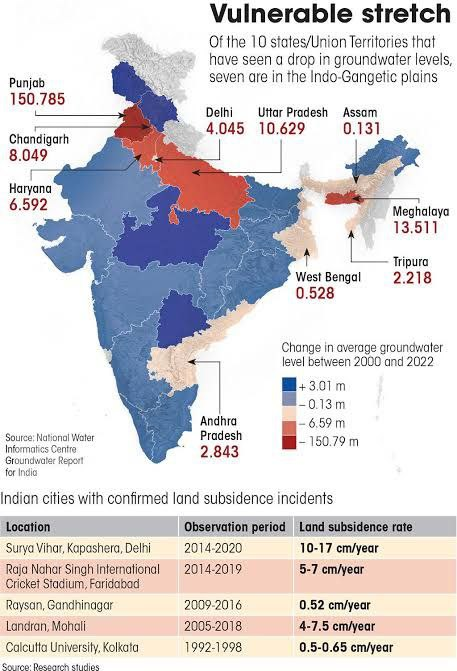
  • The groundwater potential of the Gangetic valley is on a serious decline. How may it affect the food security of India?(GS1 2024 Question)

    As per “Interconnected Disaster Risks Report 2023” of the UN, Some areas in the Indo-Gangetic basin in India have already passed the groundwater depletion tipping point and its entire northwestern region is predicted to experience critically low groundwater availability by 2025. As per CGWA, groundwater storage levels in the Ganga basin have been declining by 2.6 centimeters per year.

    Reasons for declining groundwater potential in gangetic valley 

    1. Overextraction: Eg. CGWB noted rural areas in Gangetic Valley rely 70% on groundwater leading to unsustainable extraction rates.
    2. Urbanization: has increased impermeable surfaces, reducing natural groundwater recharge and increasing runoff. Eg- As per Bangalore Water Supply and Sewerage Board (BWSSB) data, city harvests only 10 percent of the rainwater while the rest 90 percent drains away wasted.
    3. Pollution: Contamination from agricultural runoff, industrial discharges, and inadequate waste management reduces the quality and usability of groundwater resources. 
    4. Land Use Changes: Modifications in land use, such as deforestation and conversion of land especially at Himalayan foothills for agriculture or urban development, disrupt the natural hydrological cycle and groundwater recharge processes.
    5. Climate Change: Variability in precipitation patterns due to climate change affects the natural recharge of groundwater systems, leading to periods of both drought and flooding, which make rainfall unable to recharge groundwater.

    Groundwater Decline Impact on food security 

    1. Declining food production – Punjab and Haryana produce 50 percent of the country’s rice supply and 85 percent of its wheat stocks.
    2. Declining food productivity: over 85% of Groundwater extracted is used for agriculture. Eg- 1-meter decline in groundwater from its long-term mean results in an approximately 8 percent reduction in food grain production.
    3. Shift in Cropping Patterns – Shifting from traditional crops like wheat and rice to less water-demanding options, such as millets and pulses, may not meet India’s food demand, risking staple availability and increasing prices. 
    4. Food Inflation – A decline in agricultural productivity due to groundwater depletion can lead to higher food prices, disproportionately affecting the poor and vulnerable populations, thus threatening food affordability.
    5. Increased farm distress because of reduced groundwater availablity leading to crop failures, reduced farmer income and indebtedness, leading to depeasantization further impacting food production.
    6. Land degradation and desertification due to overuse of groundwater which leads to alkaline and saline soil declining production of wheat and rice which are sensitive to alkalinity and over salinity. Eg. Lands of western UP, Haryana, Punjab 

    Way Forward to Solve Groundwater Potential’s decline


    1. micro- irrigation systems
    2.  Mandatory permits and  Metering of groundwater usage
    3. Zoning regulations: to control the density of borewells and establish ‘no-go’ zones
    4. Implementation of Mihir Shah report (2016) which seeks to unify CGWB and Central Water commission to prepare a unified national level plan to manage groundwater extraction.
    5.  Install water-efficient fixtures such as low-flow faucets, promote use of greywater recycling systems, and use treated water for non-potable purposes like irrigation and toilet flushing.
    Best Practice Case Study
    Andhra Pradesh Farmer Managed Groundwater Systems (APFAMGS) project – led to a 20-30% reduction in groundwater extractionCommunity Led Springshed Management in Kumaon Region of Uttarakhand

    The groundwater clock is ticking towards day zero. India needs a combination of strategy and investment to safeguard and revitalize the same.

  • How far was the Industrial Revolution in England responsible for the decline of handicrafts and cottage industries in India?(GS1 2024 Question)

    The Industrial Revolution in Britain, beginning in the 18th century, transformed the country into an economic powerhouse. However, this progress came at the expense of India’s local industries, which faced stagnation due to the influx of cheap British goods and exploitative colonial policies.

    Industrial revolution in Britain as responsible for decline of handicrafts and cottage industries in india

    1. Cheap industrial goods: mass production of factory made textiles which were cheaper and are of higher quality, flooded the Indian market, making it difficult for Indian handmade textiles to compete. Eg. Famous Dacca muslin suffered heavily due to cheap British textiles flooded Indian markets.
    2. Import of British goods favored due to British policies like high tariff on Indian made goods in England while there is duty free trade of British good into india.
    3. Destruction of Traditional Economy: Indian weavers, artisans, and craftsmen lost their livelihoods as their traditional industries declined, leading to the collapse of the Indian cottage industries. eg. Indian silk and cotton made goods production hampered by British machine made products.
    4. Shift in consumer preferences: as mass produced goods are available consumer preference shifted. Many people began to prefer the lower-priced, uniform products from factories over the unique but more expensive handicrafts.
    5. Disruption of Traditional Skills: The rise of industrial production undermined traditional skills and practices. Artisans who relied on their crafts for livelihood found it increasingly difficult to maintain their trades in the face of industrial competition.

    Other factors responsible for decline of handicrafts and cottage industries in India

    1. Introduction of railways facilitated movement of British manufactured goods into rural markets, making these products more accessible and affordable than locally produced handicrafts. Historian Bipan Chandra noted that railways helped integrate colonial economies, often to the detriment of local industries.
    2. Absence of Industrial Protection Policies: Unlike countries such as Germany and the United States, which implemented protectionist tariffs to nurture domestic industries, India under British rule lacked such policies. This absence left local artisans vulnerable to foreign competition.
    3. Economic critique by Dadabhai Naoroji noted British exploitation of Indian resources had devastating effects on local industries. The enforced cultivation of cash crops, such as indigo in Bengal, redirected land and resources away from traditional agriculture and handicrafts, undermining local economies.
    4. Effect of famines: British economic policies worsened famines like the Bengal Famine of 1770, causing millions to starve and local economies to collapse. Mahatma Gandhi argued that these famines stemmed from exploitative practices, devastating local industries and artisans.
    5. Decline of Traditional Patronage: Historian Irfan Habib noted that the weakening of traditional power structures left many artisans without royal patronage and financial support, resulting in the deterioration of their crafts and skills.
    6. Lack of Technological Advancement in India: The technological gap between British industries and Indian handicrafts was significant. The introduction of power looms and spinning jennies in British factories enabled mass textile production, which artisans could not compete with.

    Efforts by nationalist and freedom fighter for revival of industries

    1. Economic nationalism: Eg. swadeshi is used as symbol against oppression in Swadeshi Movement(1906) And Non Cooperation Movement(1921).
    2. Educational initiatives Eg. Tagore founded Shantiniketan in 1901.
    3. Cottage Industries Movement: Eg. The All India Spinners’ Association, formed in 1938.

    Although the Industrial Revolution in England hindered the growth of traditional industries in India, textile sector today contributes 2.3 % to the country’s GDP, 13% to industrial production and 12% to exports.

  • How far is it correct to say that the First World War was fought essentially for the preservation of balance of power?(GS1 2024 Question)

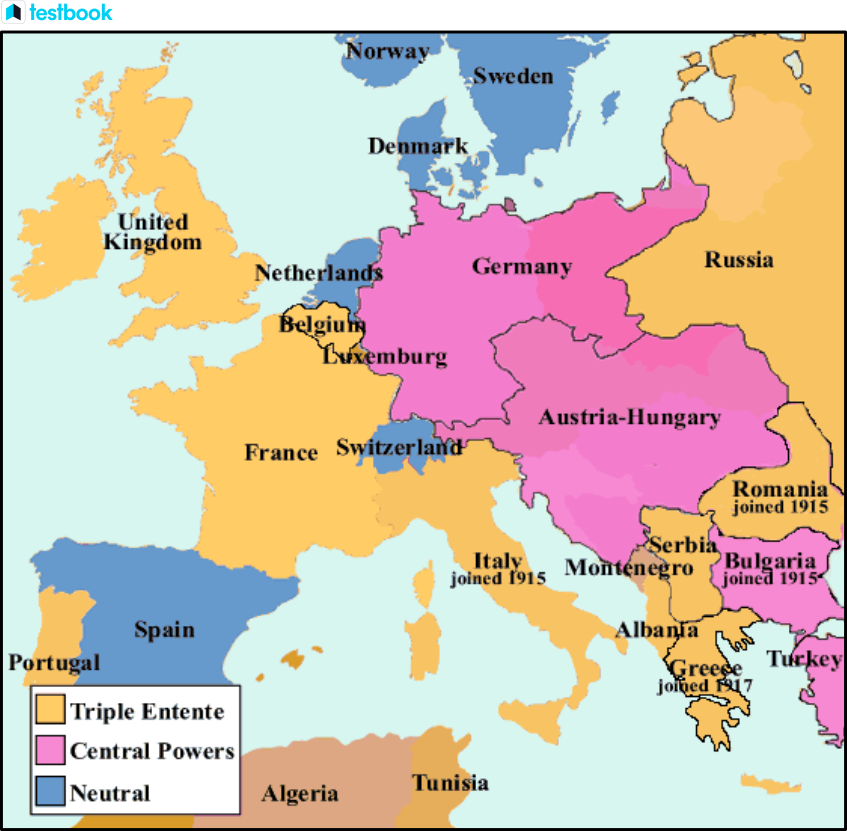
    The First World War, often referred to as the Great War, was a worldwide conflict that spanned from 1914 to 1918. It involved numerous major powers and resulted in extensive loss of life and widespread destruction. A significant factor contributing to the war’s outbreak was the ambition to preserve the balance of power in Europe.


    Preservation of balance of power as the reason for first world war

    1. Formation of Alliances such as the Triple Alliance (Germany, Austria-Hungary, and Italy) and the Triple Entente (Britain, France, and Russia), was a strategic move to balance military strength in Europe. 
    2. Germany’s rapid economic and military growth was perceived as a threat by other European powers, particularly Britain. The naval arms race between Britain and Germany exemplified this power struggle, escalating tensions that contributed to the outbreak of war.
    3. Colonial Rivalries: Competition for colonies and global influence intensified rivalries among European nations. Incidents such as the Moroccan Crises (1905 and 1911) highlighted these tensions, as conflicts over African territories further strained relationships between France and Germany.
    4. Austro-Hungarian and Russian Rivalry in the Balkans: The Bosnian Crisis of 1908, when Austria-Hungary annexed Bosnia, angered Russia and Serbia, exacerbating existing tensions in the Balkans. This rivalry played a crucial role in destabilizing the region and contributing to the war’s outbreak.
    5. France’s Desire for Revenge: After losing Alsace-Lorraine to Germany in the Franco-Prussian War, France sought alliances with Russia and Britain to contain Germany’s growing power. This desire for revenge fueled France’s involvement in the conflict.
    6. Preservation of Empires: The fear of losing imperial influence motivated British involvement, highlighting how imperial ambitions were intertwined with the balance of power considerations.

    Other Reasons of First World War

    1. Nationalism and ethnic tensions: rising nationalism in the Balkans and killing of Franz Ferdinand was rooted in serbian nationalism, which had less to do with European balance of power struggle. 
    2. Economic rivalry,desire for market dominance and resource control particularly between Britain and Germany especially in Africa and Asia was also a key reason for world war.
    3. Imperialism: war was essentially fought over retention and expansion of colonies. Scramble for Africa and control over Asian colonies led to long standing tensions between these imperial powers.
    4. Militarism in pre pre-war environments like Germany’s Schlieffen Plan, which aimed for a rapid attack on France from Belgium. Arm race among European powers fostered an environment of distrust and war.
    5. Diplomatic failures as initial alliances like the Franco-Russian alliance of 1894 created an environment of mistrust and escalated confrontations against germany.

    While the First World War was primarily fought to preserve the balance of power, it was not the sole cause. Nationalism, imperialism, economic rivalry, and domestic pressures also played significant roles, making the balance of power a central but not exclusive factor in the conflict.

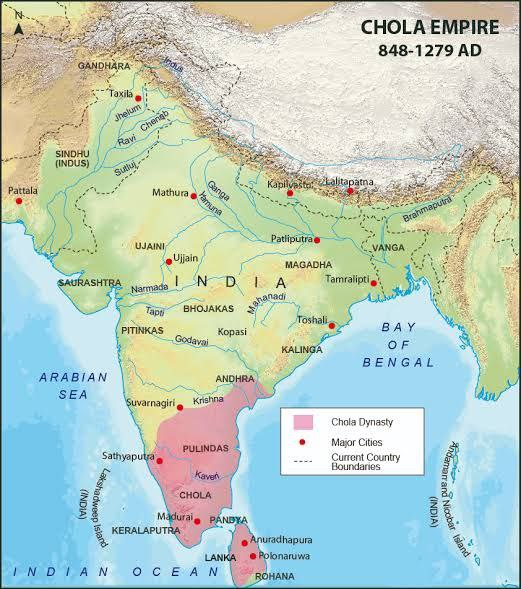
  • “Though the great Cholas are no more yet their name is still remembered with great pride because of their highest achievements in the domain of art and architecture.” Comment.

    “The Cholas (9th–13th century CE), under great rulers like Rajaraja Chola I and Rajendra Chola I, were not just conquerors; they were also great patrons of art, whose temples and sculptures still stand as a testament to their artistic excellence.”


    Achievements of Cholas in Art and architecture 

    Temple architecture 

    1. Boundary walls: Eg. Airavatesvara temple at Darasuram in Tamil Nadu.
    2. Vimana: The vimanas rose above the sanctum sanctorum (garbhagriha) of the temple in the form of a stepped pyramid that rises up linearly rather than curved. Eg- Brihadeshwara temple at Tanjore has highest vimana of any temple.
    3. Gopuram: The front wall had a high entrance gateway known as gopuram. Eg. Nageshwarswamy temple in Tamilnadu has one of the highest gopurams.
    4. Shikhara: The crowning element is shaped like an octagon and is known as shikhara. Eg. Raja rajeswara temple has largest shikhara stone in the world.
    5. Sculptures: The entrance of the garbhagriha had statues of Dwaarpal, Mithun and Yaksha. Eg. UNESCO site of Gangaikonda chola puram temple has  Some of the stone sculptures on the niches – Nataraja, Dakshinamurthy, Harahari, Lingodbhava, Vishnu, Brahma, Mahishasura Mardini, Gnana Saraswathi, Chandes anugraha murti

    Painting

    1. Medium: Eg. The walls of the Chola temples, such as the Tanjore and Gangaikondacholapuram temples, contain numerous icons of large size with fine execution.
    2. Uniqueness: careful attention to facial expressions and hand gestures. eg. The painting of Rajaraja Chola I, listening to his preceptor Karuvur Devar.
    3. Themes revolved around deities such as Shiva and Vishnu. 

    Bronze sculptures

    1. The image of Nataraja (Lord Shiva as the cosmic dancer) – This masterpiece is admired for its balance, grace, and artistic depth.

    Achievements of Cholas in literature 

    1. Patronage of Literature: advanced Tamil literature, fostering notable poets like Kalladanar, Kambana, and Avvaiyar.
    2. Key Works: Kalladanar’s Kalladam celebrated Lord Shiva, while Thiruttakkadevar’s Seevagasinthamani introduced Jainism to Tamil audiences.
    3. Sanskrit Influence: Despite the Chola rulers’ support for Sanskrit, original Tamil works thrived, with Kambana notably translating the Ramayana, enriching Tamil literature’s evolution

    Bhakti movement under Cholas reign

    1. Vaishnavite Alwars and Shaivite Nayanars got patronage under Chola Rulers.
    2. In the beginning of 10th century a Nayanara saint Nambi-andar-nambi wrote a song which was named as ‘Tiruktatotar tiruvantati’ which produces a detailed information about the lives of the 63 Nayanara saints.
    3. In 11th century Nambi-ander-nambi the court poet of Raja Raj Chola compiled the songs of the Nayanara saint in 11 Tirumurai. Which is considered to be one of the greatest text of Nayanara saints.
    4. Tamil veda- Nalayira Divya prabandham composed by alwar poigai during Chola period.

    Coinage of Cholas 

    1. Standardized and culturally fine tuned coins – Coins minted in fine gold with potrait of king with his insignia or emblems like tiger and fish on one side and portrait of sitted goddess on other side.
    2. Rajendra 1 Chola has issued one of most famous coins inscribing ‘ Gangaikonda chola’ after his victory in Bengal, on java and Sumatra islands.

    Performing arts under Cholas

    1. Classical dances like Bharatnatyam flourished during Chola period because of Devdasi system.
    2. Cholas also patronized staff fencing marital art Silambam.
    3. Rajaraja I  was instrumental in bringing back tevaram music to temples.
    4. The representation of Nataraja or Adal Vallan (king of dance) in the form of the idol was the motif of Tamil music, dance and drama with hymns composed by Nayanmars. eg. Oduvars and Padikam Paduvars: They were appointed to sing in the temples to recite Thirumurai (The Saiva canon). 

    Other Achievements of Cholas

    1. Administrative Reforms: The Cholas decentralized administration, allowing local leaders and village assemblies (sabhas) to exercise autonomy. This allowed the empire to maintain control over vast territories while fostering strong local governance.
    2. Military Conquests: They expanded their influence across the Indian Ocean, launching successful naval expeditions to Sri Lanka, the Maldives, and parts of Southeast Asia (e.g., Srivijaya in present-day Indonesia and Malaysia).
    3. Trade and Economic Growth:Ports like Nagapattinam became thriving centers for international trade, with the Cholas exporting textiles, spices, and jewels.

    The Chola dynasty may have faded from history, but their contributions to art and architecture endure as a symbol of India’s cultural and artistic zenith continuing to inspire pride and admiration, solidifying their eternal legacy in Indian history.

  • What type of cooperation between the government, NGOs, and private sectors would be most effective in tackling socio-economic issues of development?(GS1 2024 Question)

    Socio-economic issues are complex, multifaceted challenges that require leveraging the complementary strengths and combined efforts of various stakeholders. 

    “Alone we can do so little, together we can do so much” – Helen Keller

    Socio-Economic Issues of Development 

    1. Poverty and Income Inequality: 27.9% of India’s population experiences multidimensional poverty (MPI). The top 10% holds 57% of the national income, while the bottom 50% holds 13% (World Inequality Report 2022).
    2. Unemployment and Underemployment: Unemployment rate is 7.8% (NSO, 2022), with youth unemployment at 22.74% for ages 20-24 (CMIE, 2022).
    3. Healthcare Access and Inequalities: Rural India (70% of the population) has only 40% of hospital beds. Doctor-patient ratio is 1:1456 (WHO recommends 1:1000).
    4. Gender Inequality: India ranks 140/156 in gender parity (Global Gender Gap Report). Female labor participation fell to 19.9% in 2021 from 26% in 2005.
    5. Environmental Degradation and Climate Change: Delhi’s PM2.5 level was 85.8 ”g/mÂł in 2022, 17 times higher than WHO guidelines.
    6. Food Security and Malnutrition: India ranked 107/121 on the Global Hunger Index 2022. 34.7% of children under five are stunted, 17.3% are wasted.

    Cooperation between the government, NGOs, and private sectors 

    1. Collaborative Policy-Making: Government leads the policy development, with input from NGOs to ensure inclusivity and private sector expertise for innovation. Eg- National Education Policy (NEP) involved contributions from NGOs like Pratham
    2. Public-Private Partnerships (PPPs) – Eg- Pradhan Mantri Awas Yojana (PMAY) collaborates with private developers to provide affordable housing, with NGOs facilitating community engagement and awareness.
    3. Resource Pooling: Eg: Under the Pradhan Mantri Kaushal Vikas Yojana (PMKVY), the government partners with companies like Tata Motors to offer vocational training, while NGOs like SEWA mobilize rural women to participate.
    4. Policy Implementation: Eg-  Under the Samagra Shiksha Abhiyan, NGOs like Pratham partner with the government to improve learning outcomes, while companies provide digital tools and infrastructure.
    5. Enhancing reach: Eg- Ayushman Bharat collaborates with private hospitals to provide healthcare, and NGOs like CARE India ensure healthcare services reach rural and vulnerable populations.
    6. CSR-Driven Programs: Eg- The government’s Beti Bachao Beti Padhao initiative works with NGOs like SEWA to promote women’s education and entrepreneurship, with CSR funding from companies like Infosys
    7. Food Security and Nutrition Programs: Eg- The Mid-Day Meal Scheme involves the government providing meals with CSR funding from companies for infrastructure and NGOs like Akshaya Patra ensuring smooth delivery.
    8. Monitoring and Accountability – Type of Cooperation: Joint monitoring mechanisms where the government ensures regulatory oversight, private sector stakeholders provide data and technology, and NGOs ensure community feedback and inclusivity.
    IssuesWay Forward
    Coordination and Alignment of ObjectivesEstablishing Clear Objectives and Roles: Joint planning sessions to align goals, responsibilities, and timelines.
    Bureaucratic Red TapeSimplifying Bureaucratic Processes: single-window clearances
    Lack of Accountability and Transparency – leading to mismanagement, resource leakage, or corruption.Ensuring Accountability and Transparency: regular public reporting, third-party audits, and social audits
    Cultural and Institutional Differences – profit-oriented businesses and mission-driven NGOs can create friction, slowing down progressLeveraging Technology for Better Coordination: Utilize cloud-based project management tools for real-time data sharing and project tracking, improving transparency and trust.

    By leveraging the strengths of each sector—policy support from the government, grassroots engagement from NGOs, and financing and innovation from the private sector—development initiatives can be sustainable, inclusive, and impactful, driving long-term socio-economic progress.

  • Intercaste marriages between castes which have socio-economic parity have increased, to some extent, but this is less true of interreligious marriages. Discuss(GS1 2024 Question)

    Inter-caste marriages occur between individuals from different castes of same religion, while interreligious marriages involve individuals from different religions. According to the National Family Health Survey, the overall rate of inter-religious marriage in India is 2.1% and 10% of marriages in India were inter-caste.

    Increase in Intercaste Marriages with Socio-economic Parity

    1. Urbanization and Modernization: Eg. NFHS-3 notes urban areas especially cities like Mumbai and Bangalore show 20% instances of intercaste marriages, well above that of rural areas.
    2. Educational Attainment: Educated individuals are generally more liberal and open to marrying outside their caste. Eg. A study by sociologist Kapadia, notes 51% of parents of university graduates are supportive of their children marrying outside caste.
    3. Economic independence: with greater economic mobility among women, there is growing trend of seeking partners with more compatibility than caste compulsions. 
    4. Social networks expand with increased socio-economic parity. Eg. Punjab, where there is increased social networks especially post green revolution, witnessed more intercaste marriages(22.36%).
    5. Family attitudes socio-economic status have become important for social interaction, rather than purely caste based interaction. Preference is given to economic security and stability over caste

    Lower interreligious marriages despite socio-economic parity

    1. Strict religious identity and tradition: Castes in particular religion has same customs, but this is not the case for two different religions hence this barrier discourages marriage despite having socio-economic parity.
    2. Fear of social exclusion and community pressureAs per NCRB there are more incidents of honor killing in interreligious marriages than in intercaste marriages
    3. Cultural and Social Differences: Religious identity is often intertwined with cultural values, customs, and social norms. Marrying outside one’s religion is perceived as a challenge to family traditions and may involve significant cultural adjustments, making it less common.
    4. Limited support system: unlike intercaste marriages which is supported by progressive and liberal segments, there is less support and talk about interreligious marriages.
    5. Historical tensions and communal riots between religions like Hindu and Muslim, Hindu and Buddhist, Muslim and Christians, etc. left a long lasting scars and continue to influence decisions about marriages between them. 
    6. Legal barriers like compulsory declaration and registration of interreligious marriages under Special Marriage Act, 1954, harming their privacy, right to choice and potentially threatening their life, deter couples from different religions to go for marriage.
    7. Religious Conversions: Some families resist interreligious marriages because they do not want their children to convert or take on a new religious identity. Eg- Love Jihad controversy in Kerala and UP

    By taking a proactive approach through education and community engagement, society can move toward greater acceptance of both intercaste and interreligious marriages, fostering social cohesion and promoting individual choice in personal relationships.

  • Distinguish between gender equality, gender equity, and women’s empowerment. Why is it important to take gender concerns into account in program design and implementation?(GS1 2024 Question)

    “I measure the progress of a community by the degree of progress which women have achieved.”  – Dr. B.R. Ambedkar

    Gender equalityGender equityWomen empowerment
    1. refers to the equal rights, responsibilities, and opportunities of all genders 

    2. Men, women and other genders enjoy the same rights across all sectors of society including economic participation, and decision-making.

    3. Focus is on Equal treatment and access for all genders without bias or discrimination.

    4. Genders are equally valued, respected, and favored.

    5. Example: Equal pay for equal work.
    1. recognizes that different genders may require different resources and support to achieve equality.

    2. Focuses on fairness and justice and Recognizes the historical and social disadvantages faced by women.

    3. It employs targeted measures to achieve the desired outcomes.

    4. Focus is on Addressing systemic inequalities by providing resources based on specific needs to achieve fairness.

    5. Example: 1/3rd reservation of seats for women in panchayatraj.
    1. Enhancing women’s agency, autonomy, and control over decisions that impact their lives.

    2. It enables women to recognise- self worth, access to opportunities & resources, ability to influence direction of social change.

    3. Focus is on empowering women to make their own choices and assert their rights in all areas of life.

    4. Example: Self-help groups like SEWA in Gujarat.

    Importance of taking gender concerns into account in program design and implementation

    Program Design:

    1. Addressing Inequality: Designing programs that explicitly target gender-based disparities ensures that women and other marginalized groups have equal access to resources. Eg: In PM Awas Yojana (Housing for All), houses are registered in the names of women or jointly with men.
    2. Ensuring Inclusivity: to consider the different needs of men, women, and non-binary individuals, ensuring equal opportunities and access. Eg: The National Rural Livelihood Mission (NRLM) focuses on empowering rural women through self-help groups (SHGs).
    3. Meeting Legal and Policy MandatesEg: Beti Bachao Beti Padhao aims to improve the gender ratio and ensure equal opportunities for girls in education to achieve targets under RTE.
    4. Better Resource Allocation: Gender mainstreaming ensures that resources are distributed equitably based on the specific needs of men and women. Eg- In PM Ujjwala Yojana, directly improving women’s health and reducing indoor air pollution.
    5. Promoting Sustainable Development by addressing long-term societal needs and promoting balanced growth. Eg: Mahila Kisan Sashaktikaran Pariyojana (MKSP) under the National Rural Livelihoods Mission promotes women’s roles in agriculture, contributing to sustainable agricultural practices and gender equality in rural economies.
    6. Aligning with human rights principles such as non-discrimination and equality. By doing so, programmes can work towards fulfilling the rights of all individuals, regardless of gender.

    Program Implementation:

    1. Better Outcomes such as improved health, education, and economic growth for all. Eg: Kudumbashree scheme of Kerala.
    2. Empowering Women and Marginalized Groups: Implementation strategies that prioritize women’s participation and decision-making empower them economically and socially. Eg: The MUDRA Yojana
    3. Enhancing Social Cohesion: Eg: Mission Shakti in Odisha works towards creating a network of women’s self-help groups, fostering social cohesion through collective action and community participation.
    4. Prevents Reinforcement of Gender Stereotypes: Gender-focused implementation helps adjust and correct strategies to avoid reinforcing harmful gender norms or adding burdens on specific groups.
    5. Adapting to Ground Realities: Eg: National Rural Drinking Water Programme (NRDWP) adapted water schemes to reduce the burden on women, who traditionally fetched water, by bringing water sources closer to rural homes.
    Best Practices
    Sweden – Gender Budgeting – Improved access to social services and accountability in government spending related to gender equality.Rwanda – gender quota ensuring over 60% female representation in parliament.Canada – Gender-Based Analysis Plus (GBA+): to assess the impact of policies on gender and other factors like race.

    Gender mainstreaming is imperative for achieving SDG – 5 and upholding human rights globally.

  • What is the concept of a ‘demographic Winter’? Is the world moving towards such a situation? Elaborate.(GS1 2024 Question)

    The term “demographic winter” refers to a situation where birth rates fall significantly below the replacement level, leading to an aging population, a shrinking workforce, and economic challenges. By 2022, there were 771 million people aged 65 and older, making up about 10% of the global population. This figure is expected to rise to 16% by 2050, with further increases projected as life expectancy grows and fertility rates decline​.

    Reasons behind demographic winter

    1. Changing Family Dynamics: Delayed marriages, fewer children, and the rise of single-person households are leading to lower birth rates.
    2. Low Religious Observance:  as per World Population Prospects 2024, Countries with low religious observance like Sweden, Denmark, Russia see lower birth rates and higher abortion rates.
    3. Modernization Effects: Urbanization and economic changes often shift societal values away from family-oriented lifestyles, discouraging childbirth. 
    4. Economic Factors: High living costs and economic instability make raising children less feasible for many families, resulting in delayed or reduced family planning. Eg. cost of living index in Mumbai is approximately 30% higher than the national average.
    5. Changing socio-cultural norms like prioritizing individualism, education and career over family. Eg. In USA, TFR declined to 1.8 as compared to 4.5 in 1950 because of more women are pursuing education and career over marriage.
    6. Advancements in Health: While modern medicine has extended life expectancy, contributing to aging populations, fertility treatments and contraception allow for better control of reproductive choices, often leading to fewer children.

    Countries showing signs of Demographic Winter

    While not every region is experiencing demographic winter, many parts of the world—especially in developed countries—are showing signs of this phenomenon.

    1. Europe: fertility rates in  Spain, Germany, Italy, Russia, and Japan are all around 1.4, and Latvia’s and Poland’s are near 1.3 – well below 2.1.
    2. East Asia: Japan’s population is already shrinking, with fertility rates around 1.3, and South Korea has one of the lowest fertility rates in the world at just 0.8. 
    3. North America: The U.S. birth rate is below replacement level, though it is partly offset by immigration. Without sufficient immigration, the U.S. would also face a demographic winter.
    4. China: After decades of the one-child policy, China is now facing a declining birth rate and a rapidly aging population. 
    5. India – As per the fifth NFHS 2019-21, the TFR in India has declined to 2.0 children per woman
    6. However in many developing countries in Africa like Nigeria, Ethiopia,etc. And in Bangladesh, Pakistan TFR is still above 4.0
    ImpactWay Forward
    Shortage of working age population Increase and index the retirement age
    Increased Burden on Social Welfare Systems – Eg- WHO noted that out of total social security spending by Japan 50% is on pensions for elderly.Pro-Natalist Policies – Eg- paid parental leave for both parents, 
    Less ‘brain pool’ for innovationUniversal Childcare and Education as seen in Sweden and Denmark.
    Potential social imbalances– Eg- Son Meta PreferencePromote Active Aging – Eg- Japan’s Silver Human Resource Centers,

    Addressing ‘Depopulation threat’ requires a multifaceted approach that prioritizes sustainable population growth and economic stability.