According to the India Meteorological Department (IMD), 100 mm of rain in one hour is called a cloudburst. Usually, cloudbursts occur over a small geographical region of 20 to 30 square kilometers. Ministry of Earth Science reported(2021) that due to climate change from 1969 there is increased incidence of 5 cloudburst per decade especially on Westcoast and Himalayan region.
Mechanism of Cloudbursts
Clouds condense – When moisture-carrying air climbs a mountainous terrain, it forms vertical columns of clouds called cumulonimbus clouds. These clouds produce rain, thunder, and lightning
orographic lift – The unstable clouds generate a strong deluge over a constrained region after becoming heavy enough and locking in the valleys and ridges between the hills
The air’s upward momentum provides the cloudburst with the energy it needs to occur. Most cloudbursts take place between 1,000 and 2,500 metres above sea level, and they are followed by significant flooding and landslides.
Atmospheric disturbances: Low-pressure systems lead to the rapid development of convective clouds and heavy rain. Eg- cloud bursts and heavy rainfall during cyclonic events in Odisha
Convergence of air masses: The collision of warm, moist air with cooler, denser air lead to rapid upward movement of warm air causing Cloudbrust
High Humidity Levels: Eg- Mumbai (2005) experienced a cloudburst due to extremely high humidity levels coupled with monsoon winds. Over 944 mm of rain fell in a single day, leading to severe flooding and disruption.
Consequences of cloudbursts
Flash Floods triggered by severe thunderstorms, dam failures, or rapid snowmelt. Eg- Himachal Pradesh and Uttarakhand Flash Floods in August 2022
Landslides: involving the downward movement of rock, earth, or debris. Eg- Landslide in Pithoragarh district of Uttarakhand
Spread of communicable diseases – Waterborne diseases (cholera, typhoid fever etc.,), vector-borne diseases (dengue, malaria etc.,) spreads rapidly during floods.
Disruption of communication – It damages transportation links such as bridges, rail, and power plants thus causing communication disruption.
Coastal cities- flash floods make the conventional stormwater and flood management policies in these cities dysfunctional. Eg- Chennai floods
NDMA Guidelines for Effective Mitigation of the Impact of Cloud Bursts
Early warning systems
Disaster preparedness: emergency plans involving evacuation routes and safe locations.
Infrastructure improvement: drainage systems, embankments etc.
Deploying Multiple Doppler weather radars to monitor moving cloud droplets and to provide forecast for the next 3 hours along with Proper community sensitisation regarding the causes, effects and safety precautions of cloudbursts is the need of the hour.
Urban migration refers to the movement of people from rural areas to cities, primarily in search of better employment opportunities and improved living standards. As per Periodic Labour Force Survey, rural-to-urban migration, represents 18.9% of total internal migration in India. World migration report 2024 indicates that urban migration, especially to larger tier 1 and 2 cities becoming common skipping smaller towns with 750 million people migrating to urban areas.
Pull Factors for large cities attracting more migrants than smaller towns
Economic Opportunities: large cities offer wide range of jobs and higher wages in manufacturing and services sectors as compared to smaller towns.
Access to Better Services: superior healthcare, education facilities in large cities compared to rural and small town make way for more ease of living. Eg. JNU in Delhi
Superior Infrastructure: better transportation, utilities, and amenities in large cities that enhance quality of life, making them appealing destinations for migrants. Eg- Nairobi has advanced hospitals and public transport compared to rural Kenyan towns.
Political and institutional support: large cities like Ho Chi Minh City in Vietnam, shanghai in China or Chittagong in Bangladesh are focus of government policies, investments and FDI, making them hub of economic activities attracting migrants.
Social Reasons:
Presence of Social Networks: established migrant communities in large cities provide support and resources for newcomers, facilitating their integration and job searches.
Cultural and Social Mobility – Cities offer a modern lifestyle. In São Paulo, Brazil, migrants are attracted to the cosmopolitan environment and entertainment options that smaller towns lack.
Perceptions about growth, prosperity and modernity attract more migrants to large cities rather than smaller towns. Eg. mumbai’s image as city of dreams.
However, smaller cities are also attracting migrants in recent years
Lower Cost of Living: For example, in India, living in a smaller town like Coimbatore is far cheaper than in Mumbai.
Less Congestion and Pollution: Smaller towns offer a cleaner environment with less traffic congestion and pollution compared to big cities.
Closer Community and Social Ties: Smaller towns often have stronger community bonds, where individuals feel more connected and supported by local networks, unlike the anonymity of big cities. This appeals to migrants looking for a close-knit society.
Decreasing Urban Job Opportunities: As big cities face saturation of jobs, smaller towns have become attractive due to the rise of industries and remote working opportunities. For example, the growth of IT hubs in smaller cities like Kochi in India.
Initiatives like Smart Cities Mission should be extended to smaller towns, while rural job programs like MGNREGA need to be strengthened to make rural living more viable and ensure decentralized development.
Sea surface temperature (SST) rise refers to the increase in the temperature of the uppermost layer of the ocean, primarily caused by global warming due to greenhouse gas emissions. According to Copernicus Climate Change Service, the average global SST for February 2024 was 21.06 degrees Celsius, the highest level since 1979.
Factors leading to rise in sea surface temperature
Emissions of greenhouse gases – the average global temperature has risen at least 1.2 degree Celsius above pre-industrial times. Almost 90% of the extra heat trapped by GHGs has been absorbed by the oceans
El Niño Events: The El Niño–Southern Oscillation (ENSO) leads to periodic warming of the central and eastern Pacific Ocean.
Ice Melt: The melting of polar ice caps and glaciers reduces the reflection of sunlight (albedo effect), causing more heat to be absorbed by the ocean, raising sea surface temperatures.
Natural Variability: While human activities are the primary driver of recent ocean warming, natural factors such as volcanic eruptions, changes in solar radiation, and ocean currents also play a role in short-term variations in ocean temperature, however these effects intensified by anthropogenic emissions.
How does rising of sea surface temperature leads to formation of Tropical Cyclones
Sea surface temperature rise leading to the formation of cyclones
Cyclones are caused by atmospheric disturbances around a low-pressure area distinguished by swift and often destructive air circulation. Cyclones are usually accompanied by violent storms and bad weather.
Tropical cyclones derive their source of energy—heat and moisture—from the warm waters of the ocean.
High sea surface temperatures (SSTs) of magnitude 28–29°C and above provide favorable conditions for the genesis and evolution of cyclones, Eg. Sea surface temperatures (SSTs) leading to cyclogenesis in the Arabian Sea are 1.2–1.4°C higher in recent decades, compared to SSTs four decades ago.
Rising Warm Air: Warm, moist air near the ocean surface rises, creating a low-pressure area that draws in cooler surrounding air.
More intense storms – The difference in temperature between the ocean’s surface and the upper air energizes tropical storms. Warmer SSTs increase this difference, which can lead to larger, faster, and more powerful storms.
More category 4 and 5 storms – The IPCC predicts that as the world warms, a higher proportion of tropical cyclones will reach Category 4 and 5, the most intense categories.
Adopting a Six-Sector Solution, developed by UNEP to reduce GHG Emissions and achieve Paris Agreement commitments is the need of an hour.
The Quit India Movement, launched on 8th August 1942, was a critical moment in India’s struggle for independence. Led by Mahatma Gandhi, it aimed to attain complete independence through mass civil disobedience, signaling a final push against colonial rule.
Events Leading to the Quit India Movement
Failure of the Cripps Mission (1942): The Cripps Mission offered limited autonomy post-WWII, which was rejected by Indian leaders, with Gandhi calling it a “post-dated cheque.”
World War II Impact: India’s forced involvement in the war led to economic distress, including the Bengal Famine of 1943, causing mass discontent.
Frustration Among Nationalists: Congress leaders grew impatient with British delays on granting autonomy, especially after failed efforts like the Simon Commission.
Repressive Laws – With the declaration of war, Britain reinstated the Defense of India Act (1915) and essentially declared martial law in the colony.
Fear of Japanese Invasion: Gandhi led a faction demanding immediate independence to avoid Japan attacking India due to British presence, advocating for nonviolent resistance and self-determined peace.
Gandhi’s Call for Action: At the Bombay Congress session (August 1942), Gandhi urged mass non-cooperation with his famous slogan, “Do or Die”.
Results of the Quit India Movement
Positive Results
Limitations
Strengthened National Unity: Mass participation in Bombay, Bengal, and Bihar from all sections of society.
Failure to Achieve Immediate Independence: British rule continued for 5 more years.
Increased Global Awareness: Eg- FDR pressed Churchill for reforms, international media covered India’s plight.
Lack of support from Muslim League and Communists
Weakened British Authority: British had to deploy troops to suppress uprisings in Bombay and Ahmedabad.
Repression and Arrests: Key leaders like Gandhi, Nehru, and Patel were arrested.
Laid Groundwork for Negotiations: Eg- Movements like Simla Conference (1945) and Cabinet Mission Plan (1946).
Limited Organizational Success: Movement lacked coordination due to leadership arrests.
Rise of Local Leadership: Leaders like Jayaprakash Narayan and Aruna Asaf Ali gained prominence.
Economic Disruption: Strikes and protests led to economic disruptions across India. Eg- Strikes in Bombay mills and railway workers caused widespread economic strain.
Parallel Governments in Ballia, in East U.P., under the leadership of Chittu Pande, Jatiya Sarkar in Tamluk etc.
Strengthening of Muslim League – While Congress Party leaders were in jail and membership was effectively frozen during the war, the Muslim League grew from about 100,000 members in 1941 to over 2,000,000 in 1944.
The spirit of resistance and sacrifice shown during the movement inspired future generations, making it a critical turning point in India’s journey toward self-rule.
The Pallavas were a prominent power in India for more than four centuries between the 6th and 9th centuries. During this time, art and literature in South India witnessed unprecedented growth.
Development of Art:
The rock-cut temples and later structural temples laid the foundation of Dravidian architecture. It is divided into four different stages or styles, viz. Mahendra Style, Mamalla Style, Rajasimha Style, Nandivarman Style.
Pancha Rathas and Shore Temple in Mahabalipuram, are UNESCO World Heritage Sites.
Kailasanathar Temple (Kanchipuram): Built by Narasimhavarman II, this is one of the earliest structural temples in South India.
Sculpture: Shift from basic rock-cut techniques to intricate and refined carvings. Eg- the Descent of the Ganges (Arjuna’s Penance) at Mahabalipuram and cave temples at places like Mahendravadi and Mamallapuram.
Mahendravarman Iwas an exponent of music, as noted by rock inscriptions in Kudumiyanmalai. Musical instruments such as the yaazhai, mridangam and murasu were introduced.
Painting: Mahendravarman was known as Chittirakkarapuli. Frescoes in the Sittanavasal caves.
Contribution to Literature:
The Pallavas were ardent patrons of Sanskrit and Tamil literature. The literature was primarily religious.
Dandin, author of the Dashakumaracharita, was associated with the Pallava court.
Mahendravarman I’s work Mattavilasa Prahasana is a satirical play written in Sanskrit.
The devotional songs of Nayanmars and Alwars –
Nalariya Divya Prabandham, also known as the Dravida Veda or the Fifth Veda, consisted of 4,000 Tamil verses and was written by 12 Alvars.
Tirumurai, a key Shaivite text, has 12 books. The first seven, called Tevaram, were authored by Sundarar, Sambandar, and Appar.
Kanchipuram was an important center of Sanskrit learning. Mayur Sarman, the founder of the Kadamba dynasty, studied the Vedas at Kanchipuram.
Other Influence
Political and Cultural Influence in Southeast Asia, particularly to Cambodia and Vietnam. Eg- Angkor Wat
Religious Tolerance: While the Pallavas were primarily Shaivites, Buddhism and Jainism coexisted under their rule. Eg- Buddhist Caves at Mamandur
Pallavas left a lasting legacy that not only influenced the succeeding Chola and Vijayanagara dynasties but also spread their cultural influence to Southeast Asia, making them a pivotal force in the history of South Indian civilisation.
The Vedic period (1500-600 BCE) saw significant shifts from the Rig
Vedic (1500-1000 BCE) pastoral society to the Later Vedic (1000-
600 BCE) agrarian-based economy, along with growing social strati
fication and complex rituals. These changes laid the foundation for
early Indian civilization.
Changes in Society from Rig Vedic to Later Vedic Period
Aspect
Rig Vedic Period
Later Vedic Period
Social Stratification
Varna system was fluid with mini mal hierarchy.
Varna system became rigid, leading to a well-defined hierarchy with Brahmins and Kshatriyas at the top.
Position of Women
Women enjoyed higher status, par ticipated in religious life, education, and had rights in family matters. Eg Women like Gargi and Maitreyi par ticipated in debates
Status of women declined, with restrictions on religious roles, education, and increasing patri archal norms like child marriage.
Religious Practices
Simple rituals and prayers, focusing on natural elements and personal sacrifices. Eg- In the Rig Veda, the focus was on personal prayers and fire rituals
Complex rituals, including large-scale sacrifices like Ashvamedha and Rajasuya, with increas ing dominance of Brahmins in religious mat ters.
Social Mobility
Fluid movement between varnas and roles in society. Eg- Vishwam itra moved from a Kshatriya to a Brahmin role
Limited social mobility due to the rigidification of the caste system.
Governance
The kingship during this period was not absolute, as rulers were elect ed for a specific term by the local assembly known as the Samiti.
With urbanization, the need for stable lead ership grew, leading to the rise of absolute kingship as the dominant form of governance.
Cultural Role
Emphasis on oral traditions and recitation of hymns from the Rig Veda.
Development of Sanskrit literature and further expansion of religious texts like the Brahmanas and Upanishads.
Changes in Economy from Rig Vedic to Later Vedic Period
Aspect
Rig Vedic Period
Later Vedic Period
Primary Occupation
Pastoralism, with cattle (gavish ti) being the primary measure of wealth.
Transition to agriculture as the main economic activity, with the use of iron tools enhancing productivity.
Land Ownership
Communal land ownership, no clear concept of private property.
Emergence of private land ownership, with land grants to Brahmins and warriors.
Trade and Com merce
Limited trade, with a barter system based on cattle exchange.
Expansion of trade networks, use of coins like Nishka for transactions, and rise of specialized crafts.
Wealth Measure ment
Wealth measured in terms of cat tle and other livestock.
Wealth increasingly measured in terms of land ownership and agricultural output.
Urbanization
Mostly rural society with scattered tribal settlements.
Emergence of towns and market centers, leading to the early stages of urbanization.
Economic Exchange
Exchange of goods largely within the community or neighboring tribes.
Greater economic integration and trade across regions, linking settlements with urban mar kets.
The legacy of vedic period is apparent in many aspects of Modern Indian society like caste system, mythology and religious practices.
Anthropology is the most popular optional subject in the UPSC Civils exam for the exam aspirants. The reasons are its overlap with GS (General Studies) and relatively less syllabus. It has one of the highest success rates in UPSC. However, scoring high will not be possible without knowing the Anthropology syllabus for UPSC. That’s the topic of discussion today.
Anthropology optional is divided into two papers in mains. It consists of 21 major topics in the syllabus– 12 in Paper I and 9 in Paper II. Learn more about the Anthropology syllabus for UPSC, success rates, anthropology UPSC optional syllabus books, and more in this article.
Anthropology Syllabus for UPSC
The anthropology syllabus for UPSC is rather less compared to that of other optional subjects in the UPSC Civils. Find the detailed topics below.
Anthropology Paper I
1.1 Meaning, Scope and Development of Anthropology.
1.2 Relationships with other disciplines: Social Sciences, Behavioural Sciences, Life Sciences, Medical Sciences, Earth Sciences and Humanities.
1.3 Main branches of Anthropology, their scope and relevance:
(a) Social-cultural Anthropology.
(b) Biological Anthropology.
(c) Archaeological Anthropology.
(d) Linguistic Anthropology.
1.4 Human Evolution and Emergence of Man:
(a) Biological and Cultural factors in human evolution.
(b) Theories of Organic Evolution (Pre-Darwinian, Darwinian and Post-Darwinian).
(c) Synthetic theory of evolution; Brief outline of terms and concepts of evolutionary biology (Doll’s rule, Cope’s rule, Gause’s rule, parallelism, convergence, adaptive radiation, and mosaic evolution).
1.5 Characteristics of Primates; Evolutionary Trend and Primate Taxonomy; Primate Adaptations; (Arboreal and Terrestrial) Primate Taxonomy; Primate Behaviour; Tertiary and Quaternary fossil primates; Living Major Primates; Comparative Anatomy of Man and Apes; Skeletal changes due to erect posture and its implications.
1.6 Phylogenetic status, characteristics and geographical distribution of the following:
(a) Plio-Pleistocene hominids in South and East Africa—Australopithecines.
(b) Homo erectus: Africa (Paranthropus), Europe (Homo erectus (heidelbergensis), Asia (Homo erectus javanicus, Homo erectus pekinensis.
(e) Homo sapiens—Cromagnon, Grimaldi and Chancelade.
1.7 The biological basis of Life: The Cell, DNA structure and replication, Protein Synthesis, Gene, Mutation, Chromosomes, and Cell Division.
1.8 (a) Principles of Prehistoric Archaeology. Chronology: Relative and Absolute Dating methods.
(b) Cultural Evolution—Broad Outlines of Prehistoric Cultures:
(i) Paleolithic
(ii) Mesolithic
(iii) Neolithic
(iv) Chalcolithic
(v) Copper-Bronze Age
(vi) Iron Age
2.1. The Nature of Culture: The Concept and Characteristics of culture and Civilization; Ethnocentrism vis-a-vis Cultural Relativism.
2.2. The Nature of Society: Concept of Society; Society and Culture; Social Institution; Social groups; and Social stratification.
2.3. Marriage: Definition and universality; Laws of marriage (endogamy, exogamy, hypergamy, hypogamy, incest taboo); Type of marriage (monogamy, polygamy, polyandry, group marriage). Functions of marriage; Marriage regulations (preferential, prescriptive and proscriptive); Marriage payments (bride wealth and dowry).
2.4. Family: Definition and universality; Family, household and domestic groups; functions of family; Types of family (from the perspectives of structure, blood relation, marriage, residence and succession); Impact of urbanisation, industrialization and feminist movements on family.
2.5. Kinship: Consanguinity and Affinity; Principles and types of descent (Unilineal, Double, Bilateral Ambilineal); Forms of descent groups (lineage, clan, phratry, moiety and kindred); Kinship terminology (descriptive and classificatory); Descent, Filiation and Complementary Filiation; Descent and Alliance.
3. Economic Organisation: Meaning, scope and relevance of economic anthropology; Formalist and Substantive debate; Principles governing production, distribution and exchange (reciprocity, redistribution and market), in communities, subsisting on hunting and gathering, fishing, swiddening, pastoralism, horticulture, and agriculture; globalisation and indigenous economic systems.
4. Political Organization and Social Control: Band, tribe, chiefdom, kingdom and state; concepts of power, authority and legitimacy; social control, law and justice in simple Societies.
5. Religion: Anthropological approaches to the study of religion (evolutionary, psychological and functional); monotheism and polytheism; sacred and profane; myths and rituals; forms of religion in tribal and peasant Societies (animism, animatism, fetishism, naturism and totemism); religion, magic and science distinguished; magico-religious functionaries (priest, shaman, medicine man, sorcerer and witch).
6. Anthropological theories:
(a) Classical evolutionism (Tylor, Morgan and Frazer)
(b) Historical particularism (Boas) Diffusionism (British, German and American)
(e) Culture and personality (Benedict, Mead, Linton, Kardiner and Cora-du Bois)
(f) Neo—Neo-evolutionism (Childe, White, Steward, Sahlins and Service)
(g) Cultural materialism (Harris)
(h) Symbolic and interpretive theories (Turner, Schneider and Geertz)
(i) Cognitive theories (Tyler, Conklin)
(j) Postmodernism in anthropology.
7. Culture, Language and Communication: Nature, origin and characteristics of language; verbal and non-verbal communication; social context of language use.
8. Research Methods in Anthropology
(a) Fieldwork tradition in anthropology
(b) Distinction between technique, method and methodology
(c) Tools of data collection: observation, interview, schedules, questionnaire, case study, genealogy, life history, oral history, secondary sources of information, and participatory methods.
(d) Analysis, interpretation and presentation of data.
9.1. Human Genetics: Methods and Application: Methods for the study of genetic principles in the man-family study (pedigree analysis, twin study, foster child, co-twin method, cytogenetic method, chromosome and karyotype analysis), biochemical methods, immunological methods, D.N.A. technology and recombinant technologies.
9.2. Mendelian genetics in man-family study, single factor, multifactor, lethal, sub-lethal and polygenic inheritance in man.
9.3. Concept of genetic polymorphism and selection, Mendelian population, Hardy-Weinberg law; causes and changes which bring down frequency-mutation, isolation, migration, selection, inbreeding and genetic drift. Consanguineous and non-consanguineous mating, genetic load, genetic effect of consanguineous and cousin marriages.
9.4. Chromosomes and chromosomal aberrations in man, methodology.
(a) Numerical and structural aberrations (disorders).
(b) Sex chromosomal aberration- Klinefelter (XXY), Turner (XO), Super female (XXX), intersex and other syndromic disorders.
(c) Autosomal aberrations- Down syndrome, Patau, Edward and Cri-du-chat syndromes.
(d) Genetic imprints in human disease, genetic screening, genetic counselling, human DNA profiling, gene mapping and genome study.
9.5. Race and racism, biological basis of morphological variation of non-metric and characters. Racial criteria, racial traits in relation to heredity and environment; biological basis of racial classification, racial differentiation and race crossing in man.
9.6. Age, sex and population variation as genetic markers: ABO, Rh blood groups, HLA Hp, transferring, Gm, blood enzymes. Physiological characteristics level, body fat, pulse rate, respiratory functions and sensory perceptions in different cultural and socio-economic groups.
9.7. Concepts and methods of Ecological Anthropology: Bio-cultural Adaptations—Genetic and Non-genetic factors. Man’s physiological responses to environmental stresses: hot desert, cold, high altitude climate.
9.8. Epidemiological Anthropology: Health and disease. Infectious and non-infectious diseases, Nutritional deficiency-related diseases.
10. Concept of human growth and Development: Stages of growth—prenatal, natal, infant, childhood, adolescence, maturity, senescence.
—Factors affecting growth and development genetic, environmental, biochemical, nutritional, cultural and socio-economic.
—Ageing and senescence. Theories and observations
—Biological and chronological longevity. Human physique and somatotypes. Methodologies for growth studies.
11.1. Relevance of menarche, menopause and other bio-events to fertility. Fertility patterns and differentials.
11.2. Demographic theories-biological, social and cultural.
11.3. Biological and socio-ecological factors influencing fecundity, fertility, natality and mortality.
12. Applications of Anthropology: Anthropology of sports, Nutritional anthropology, Anthropology in designing of defence and other equipment, Forensic Anthropology, Methods and principles of personal identification and reconstruction, Applied human genetics—Paternity diagnosis, genetic counselling and eugenics, DNA technology in diseases and medicine, sero-genetics and cytogenetics in reproductive biology.
Anthropology Paper II
1.1. Evolution of Indian Culture and Civilization— Prehistoric (Palaeolithic, Mesolithic, Neolithic and Neolithic-Chalcolithic), Protohistoric (Indus Civilization). Pre-Harappan, Harappan and post- Harappan cultures. Contributions of the tribal cultures to Indian civilization.
1.2. Palaeo—Anthropological evidence from India with special reference to Siwaliks and Narmada basin (Ramapithecus, Sivapithecus and Narmada Man).
1.3. Ethno-archaeology in India: The concept of ethno-archaeology; Survivals and Parallels among the hunting, foraging, fishing, pastoral and peasant communities including arts and crafts producing communities.
2. Demographic profile of India—Ethnic and linguistic elements in the Indian population and their distribution. Indian population—factors influencing its structure and growth.
3.1. The structure and nature of the traditional Indian social system—Varnashrama, Purushartha, Karma, Rina and Rebirth.
3.2. Caste system in India— Structure and characteristics Varna and caste, Theories of origin of caste system, Dominant caste, Caste mobility, Future of caste system, Jajmani system. Tribe-caste continuum.
3.3. Sacred Complex and Nature-Man-Spirit Complex.
3.4. Impact of Buddhism, Jainism, Islam and Christianity on Indian society.
4. Emergence, growth and development in India— Contributions of the 18th, 19th and early 20th Century scholar-administrators. Contributions of Indian anthropologists to tribal and caste studies.
5.1. Indian Village—Significance of village study in India; Indian village as a social system; Traditional and changing patterns of settlement and inter-caste relations; Agrarian relations in Indian villages; Impact of globalisation on Indian villages.
5.2. Linguistic and religious minorities and their social, political and economic status.
5.3. Indigenous and exogenous processes of socio-cultural change in Indian society: Sanskritization, Westernization, Modernization; Inter-play of little and great traditions; Panchayati Raj and social change; Media and Social Change.
6.1. Tribal situation in India—Bio-genetic variability, linguistic and socio-economic characteristics of the tribal populations and their distribution.
6.2. Problems of the tribal Communities—Land alienation, poverty, indebtedness, low literacy, poor educational facilities, unemployment, under-employment, health and nutrition.
6.3. Developmental projects and their impact on tribal displacement and problems of rehabilitation. Development of forest policy and tribals. Impact of urbanisation and industrialisation on tribal populations.
7.1. Problems of exploitation and deprivation of Scheduled Castes, Scheduled Tribes and Other Backward Classes. Constitutional safeguards for Scheduled Tribes and Scheduled Castes.
7.2. Social change and contemporary tribal societies: Impact of modern democratic institutions, development programmes and welfare measures on tribals and weaker sections.
7.3. The concept of ethnicity; Ethnic conflicts and political developments; Unrest among tribal communities; Regionalism and demand for autonomy; Pseudo-tribalism. Social change among the tribes during colonial and post-independent India.
8.1. Impact of Hinduism, Buddhism, Christianity, Islam and other religions on tribal societies.
8.2. Tribe and nation-state—a comparative study of tribal communities in India and other countries.
9.1. History of administration of tribal areas, tribal policies, plans, programmes of tribal development and their implementation. The concept of PTGs (Primitive Tribal Groups), their distribution, and special programmes for their development. Role of N.G.O.s in tribal development.
9.2. Role of anthropology in tribal and rural development.
9.3. Contributions of anthropology to the understanding of regionalism, communalism and ethnic and political movements.
Anthropology Optional Success Rates in Civils Exam
Year
Number of Candidates
Number of Candidates Selected
Success Rate (%)
2020
1211
100
8.30
2019
1189
108
9.1
2018
797
65
8.2
2017
880
85
9.7
Anthropology Books for UPSC
There are plenty of good books to prepare for UPSC Anthropology. But choose only one or two at any point in time. The best way is to take the advice of toppers if possible.
Paper I
An Introduction to Social-Cultural Anthropology – N.K. Vaid.
Biology NCERT Class XII.
Measuring Time (Chapter 2) of Indian Prehistory – D.K. Bhattacharya.
Physical Anthropology – P. Nath.
Sociology NCERT Class XI.
IGNOU MA Course for Anthropology.
An Introduction to Social Anthropology – D.N. Majumdar and T.N. Madan.
Anthropological Theories – Makhan Jha.
Biology NCERT book for Class XII (Chapters 5, 6, 7).
Paper II
The Tribal Culture of India – L.P. Vidyarthi
Anthropology Simplified – Vivek Bhasme
Xaxa Report
January 2014 edition of Yojana – Tribal and Marginalised Communities
Indian Society – NCERT Class XII
Tribal India – Nadeem Hasnain
History of Anthropology Thought – Gaya Pandey & Vijay S. Upadhyay
Indian Society – NCERT Class XII
Indian Anthropology – Nadeem Hasnain
Points to Remember
Anthropology as an optional subject in the UPSC Civil Services Examination has some interesting aspects to it. Here are a few:
Interdisciplinary Nature: While many see Anthropology as primarily about human evolution and tribal studies, it’s highly interdisciplinary, incorporating elements of biology, sociology, psychology, and even economics.
Overlap with GS papers: Anthropology syllabus for UPSC has significant overlap with General Studies papers, especially in areas like social issues, Indian society, and world cultures. This can be advantageous for overall preparation.
Recent Additions: The anthropology syllabus for UPSC has been updated to include more contemporary topics like medical anthropology, developmental anthropology, and anthropology of tourism.
Regional Focus: There’s a strong emphasis on Indian anthropology. It can be beneficial for candidates already familiar with India’s diverse cultural landscape.
Diagram Advantage: The subject allows for and often rewards the use of diagrams and illustrations in answers, which can help in scoring better.
Evolving Field: Anthropology is a rapidly evolving field, requiring candidates to stay updated with recent research and discoveries.
Conclusion
To excel in the Anthropology syllabus for UPSC, candidates should focus on developing a holistic understanding by connecting theories to real-world examples and staying updated on current research. Analysing previous years’ questions and joining study groups can enhance preparation.
Anthropology’s unique perspectives on human societies make it valuable beyond just UPSC preparation. You can apply the concepts in various aspects of public service and policy-making. So, study with long-term benefits.
FAQs
What is Anthropology?
Anthropology is the scientific study of human beings, their behaviour, and societies, both past and present. It explores human diversity, culture, evolution, and social relationships across time and space.q
Is Anthropology a good optional for UPSC?
Yes, Anthropology optional for UPSC has one of the highest success rates. Selecting this subject is even more beneficial if you come from a Biology background. With minimal preparation, you can maximise your UPSC Civils score.
Are there any changes in the Anthropology UPSC syllabus recently?
Yes, there have been some changes in the Anthropology syllabus for UPSC. New topics like digital and medical anthropology have been added, alongside an increased focus on interdisciplinary approaches and contemporary issues such as globalisation and climate change. The syllabus now emphasises diverse research methodologies and the application of anthropological concepts to current global challenges.
What is the easiest optional in UPSC Civils?
There’s no universally “easiest” optional in UPSC Civil Services. The best choice depends on individual background, interests, and strengths. Popular options include Public Administration, Anthropology, Sociology, Geography, and Political Science.
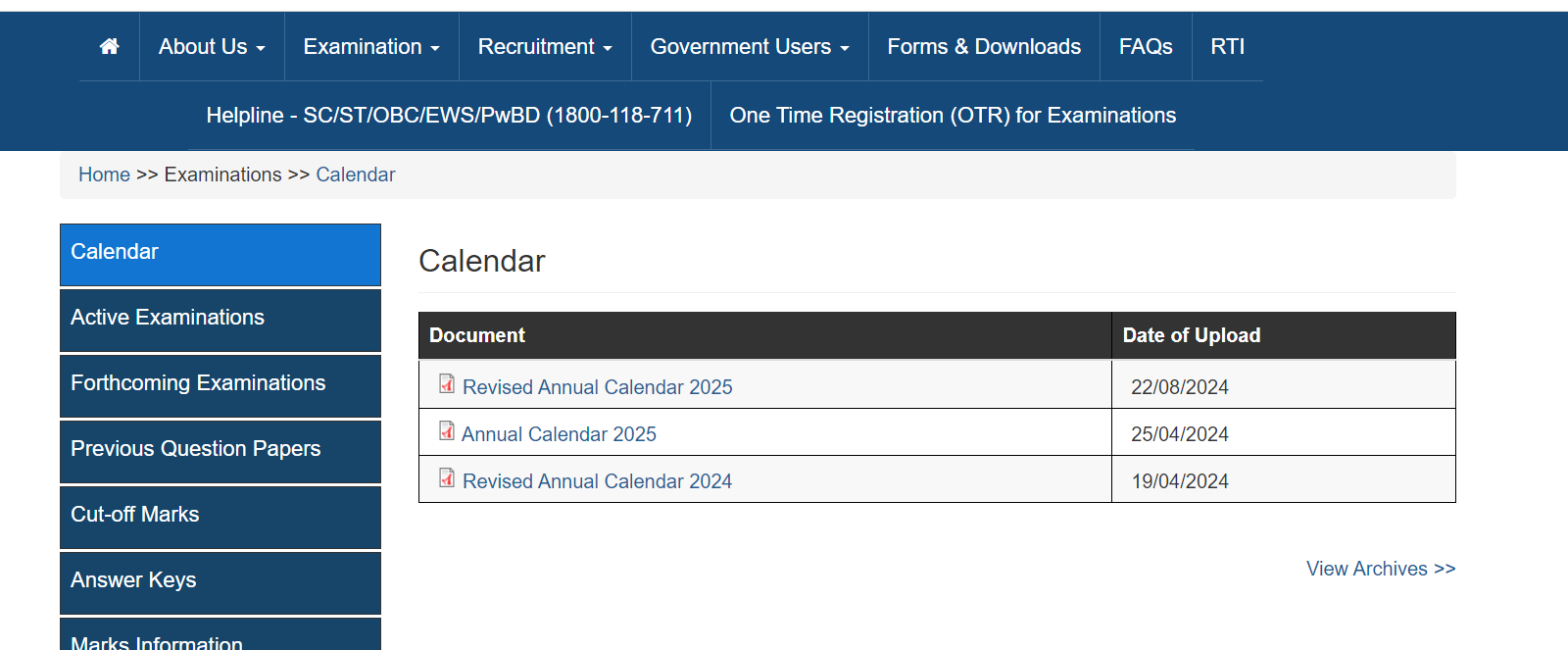
UPSC (Union Public Service Commission)India released a revised 2025 calendar on August 22, 2024. The first calendar for 2025 was released on April 25, 2024. Now it is an updated calendar. There are no major changes in the revised UPSC calendar 2025 except a proposed new date for the CBI (DSP) LDCE exam. Among all the dates, UPSC Civil Service exam dates are the most important for civil service aspirants. Note that the IAS exam dates haven’t changed.
UPSC Civils Prelims is scheduled on 25th May 2025 (Sunday) and Mains commences on 22nd August 2025 (Friday). Read the full article to know more about UPSC 2025 exam dates.
Indian Forest Service (Preliminary) Examination, 2025 through CS(P) Examination 2025
–
–
–
–
10
Reserved for UPSC RT/ Examination
14.06.2025
–
–
2 DAYS
11
I.E.S./I.S.S. Examination, 2025
12.02.2025
04.03.2025
20.06.2025
3 DAYS
12
Combined Geo-Scientist (Main) Examination, 2025
21.06.2025
–
–
2 DAYS
13
Engineering Services (Main) Examination, 2025
22.06.2025
–
–
1 DAY
14
Reserved for UPSC RT/ Examination
05.07.2025
–
–
2 DAYS
15
Combined Medical Services Examination, 2025
19.02.2025
11.03.2025
20.07.2025
1 DAY
16
Central Armed Police Forces (ACs) Examination, 2025
05.03.2025
25.03.2025
03.08.2025
1 DAY
17
Reserved for UPSC RT/ Examination
09.08.2025
–
–
2 DAYS
18
Civil Services (Main) Examination, 2025
22.08.2025
–
–
5 DAYS
19
N.D.A. & N.A. Examination (II), 2025
28.05.2025
17.06.2025
14.09.2025
1 DAY
20
C.D.S. Examination (II), 2025
–
–
–
–
21
Reserved for UPSC RT/ Examination
04.10.2025
–
–
2 DAYS
22
Reserved for UPSC RT/ Examination
01.11.2025
–
–
2 DAYS
23
Indian Forest Service (Main) Examination, 2025
16.11.2025
–
–
7 DAYS
24
S.O./Steno (GD-B/GD-I) LDCE
17.09.2025
07.10.2025
13.12.2025
2 DAYS
25
Reserved for UPSC RT/ Examination
20.12.2025
–
–
2 DAYS
Source: Official
Important Notes:
The dates for notifications, application deadlines, and exam commencement are subject to change if required by unforeseen circumstances.
Candidates are advised to regularly check the official UPSC website for any updates.
What is New
In the revised UPSC 2025 calendar, the CBI (DSP) LDCE’s notification date has been moved to January 1, 2025, and the application deadline is now January 14, 2025. Except that, there are no major changes in the revised UPSC 2025 exam dates.
UPSC 2025 Exam Date for Civil Services
Civil Services refers to the IAS (Indian Administrative Service), IPS (Indian Police Service), IFS (Indian Foreign Service), and IRS (Indian Revenue Service). Among the UPSC examinations, Civils is the most sought-after by graduate aspirants across India.
The examination for Civil Services is conducted through two stages: Preliminary and Main. The dates for the same are given below:
Civil Services (Preliminary) Examination, 2025
Notification Date: 22nd January 2025
Last Date to Apply: 11th February 2025
UPSC Prelims 2025 Date: 25th May 2025 (Sunday)
Duration: 1 Day
Civil Services (Main) Examination, 2025
Exam Date: 22nd August 2025 (Friday)
Duration: 5 Days
Download the Official UPSC Calendar 2025
The official notification of the UPSC 2025 exam date is available at upsc.gov.in. You can download it, along with archives by following the below steps:
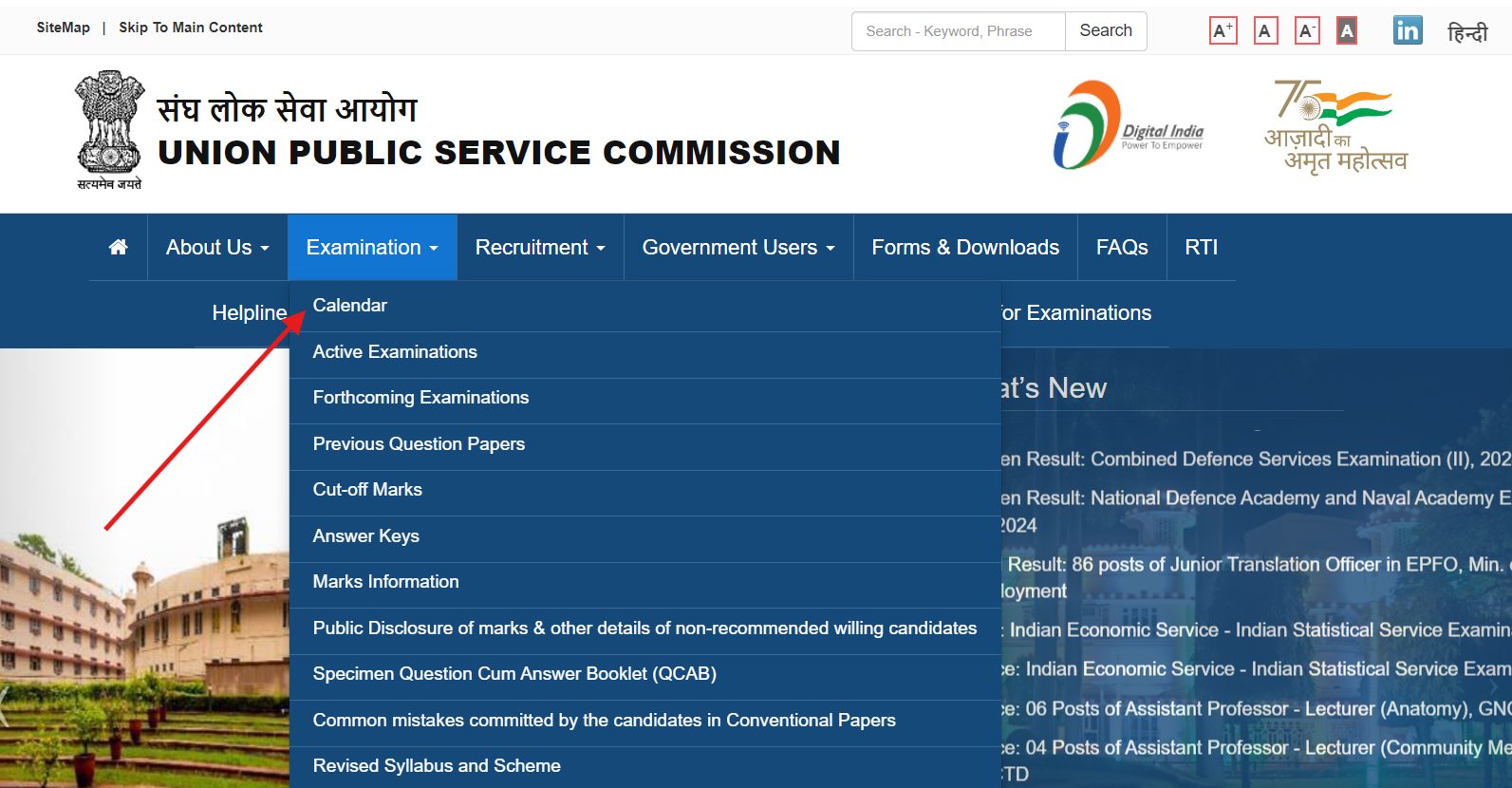
Visit the official UPSC website and click on the home page.
Now find the “Examination” tab in the top menu and select the “Calendar” option.
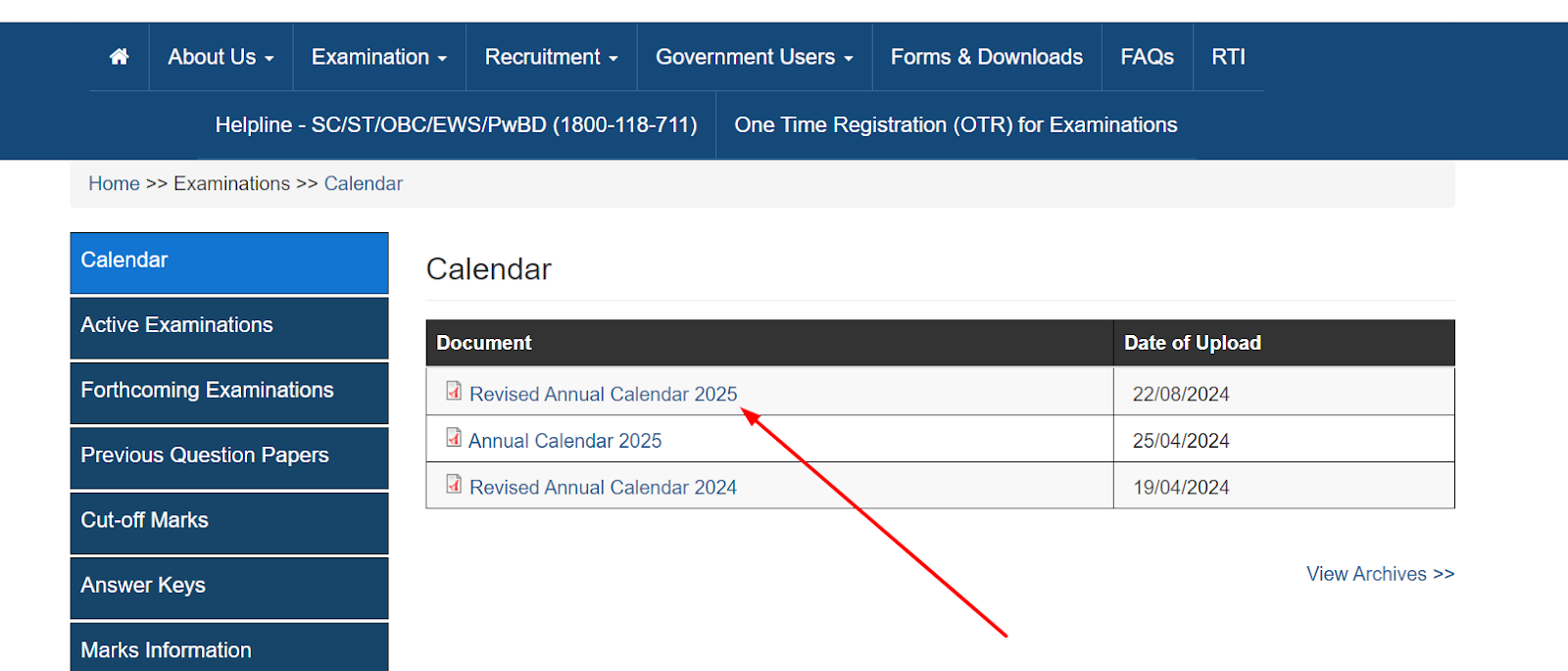
This will take you to the section with PDF links for the annual calendars from the past three years.
Click on the “UPSC Annual Calendar 2025” link to download the PDF.
Posts Recruited through UPSC
Indian Administrative Service (IAS).
Indian Foreign Service (IFS).
Indian Police Service (IPS).
Indian P & T Accounts & Finance Service– Group ‘A’.
Indian Audit and Accounts Service– Group ‘A’.
Indian Revenue Service (Customs and Central Excise)– Group ‘A’.
Indian Defence Accounts Service– Group ‘A’.
Indian Revenue Service (I.T.)– Group ‘A’.
Armed Forces Headquarters Civil Service– Group ‘B’ (Section Officer’s Grade).
Delhi, Andaman & Nicobar Islands, Lakshadweep, Daman & Diu and Dadra & Nagar Haveli Civil Service– Group ‘B’.
Delhi, Andaman & Nicobar Islands, Lakshadweep, Daman & Diu and Dadra & Nagar Haveli Police Service– Group ‘B’.
UPSC 2025 Calendar: Points to Remember
When going through the UPSC 2025 exam dates, there are a few lesser-known points that candidates often overlook:
Rolling Updates: The UPSC 2025 calendar is subject to change throughout the year. While major exam dates are usually fixed, smaller changes or additional notifications can be added.
Exam Cycles Overlap: Different exams preparation cycles often overlap. For example, while preparing for one year’s Prelims, you might also need to focus on the previous year’s Mains or Interview stages. Plan accordingly.
State PSC alignment: Some state Public Service Commissions align their exam schedules with UPSC. Be aware of potential conflicts if you’re appearing for multiple exams.
Holidays and Working Days: The UPSC 2025 calendar includes information about UPSC office working days and holidays, which should be underlined if you’re seeking document submission or query resolution. You won’t be able to access services on holidays, so submit your documents early.
Non-Exam notifications: Besides exam dates, the UPSC calendar 2025 also includes dates for recruitment to various posts that don’t follow the typical exam pattern.
Barred Services: Some exam notifications include information about services that are temporarily barred from recruitment that year. Check properly from your required information.
Age Relaxation Deadlines: The UPSC calendar sometimes includes critical dates related to age relaxation applications.
E-Admit Card Release Date: UPSC 2025 calendar dates may not coincide with E-Admit card release dates. Please check the official website for the latest updates on that and download the Admit card as early as possible.
UPSC exam schedule is subject to change every year. This might be useful for aspirants, as there is a common misconception about the UPSC exam dates being the same every year. But there are small changes as you can observe below table.
Exam Name
UPSC 2024 Date
UPSC 2025 Date
Engineering Services (Preliminary)
18 February 2024
9 February 2025
Combined Geo-Scientist (Preliminary)
18 February 2024
9 February 2025
CISF AC(EXE) LDCE
10 March 2024
9 March 2025
N.D.A. & N.A. Examination (I)
21 April 2024
13 April 2025
CBI (DSP) LDCE
16 March 2024
8 March 2025
Civil Services (Preliminary)
16 June 2024
25 May 2025
I.E.S./I.S.S. Examination
21 June 2024
20 June 2025
Combined Medical Services Examination
14 July 2024
20 July 2025
Central Armed Police Forces (ACs) Examination
4 August 2024
3 August 2025
Civil Services (Main)
20 September 2024
22 August 2025
Indian Forest Service (Main)
24 November 2024
16 November 2025
S.O./Steno (GD-B/GD-I) LDCE
7 December 2024
13 December 2025
Conclusion
In addition to learning UPSC 2025 exam dates and starting exam preparation, candidates should focus on mental well-being and time management. Engaging in regular physical activity and mindfulness practices can enhance focus and reduce stress, ultimately improving performance. Building a supportive study group can also provide motivation and accountability during this demanding preparation journey.
Yes, UPSC (Union Public Service Commission) has announced UPSC exam dates 2025 on August 22, 2024. All the proposed examinations including Civil Services are scheduled to be conducted in 2025.
What is new in the revised UPSC 2025 exam date?
In the revised UPSC 2025 calendar, the CBI (DSP) LDCE’s notification date has been moved to January 1, 2025. The application deadline for the same is now January 14, 2025. There are no other major changes noted.
Do UPSC Civil Services exam dates change every year?
Yes, UPSC civil services exam dates are subject to change every year, even within the same year depending on the circumstances. Aspirants are advised to keep visiting the UPSC official website (upsc.gov.in) for regular updates.
When should I start preparing for UPSC prelims?
Start preparing for the UPSC prelims at least six to eight months in advance. One year is even better. Focus on the syllabus and current affairs. Consistent revision is key to building a strong foundation.
Are you looking for the UPSC Mains 2024 General Studies Paper II? You’ve come to the right place! This page offers a direct download link for the GS Paper II along with expert insights to help you navigate your preparation effectively.
The Importance of General Studies Paper 2
General Studies Paper II, also known as the “Governance, Constitution, Polity, Social Justice and International Relations” paper, carries 250 marks in the UPSC Mains Examination. It tests your knowledge of the Indian polity, governance mechanisms, and the broader socio-political landscape. Mastering this paper requires an in-depth understanding of the Constitution, government policies, and current affairs.
Download UPSC Mains 2024 General Studies Paper 2
Access the official UPSC Mains 2024 GS Paper II by clicking the link below:
Note: The download link provides the complete question paper as presented in the actual examination.
Expert Insights and Analysis Video
To help you decode the complexities of GS Paper II, we have an in-depth analysis video that breaks down each question, discusses core concepts, and offers strategic tips for answer writing.
UPSC Mains 2024 GS Paper II Detailed Analysis
https://youtu.be/r96kkU8WE-A
In this video, our experts delve into the paper’s nuances, providing valuable insights on how to approach each section, tackle challenging questions, and improve your score.
Access All UPSC Mains 2024 Question Papers
Looking for other papers from the UPSC Mains 2024? Access the complete set here:
This comprehensive resource includes the Essay paper, other General Studies papers, Optional subjects, and more, all available for download.
How to Make the Most of GS Paper II
Understand the Syllabus Thoroughly: Be well-versed with the syllabus to ensure no topic is overlooked during preparation.
Focus on Key Areas: Pay special attention to the Indian Constitution, governance issues, and current policies.
Relate to Current Affairs: Integrate contemporary issues with core concepts to present well-rounded answers.
Practice Answer Writing: Regularly write answers to previous years’ questions to refine your expression and structure.
Use Data and Reports: Citing relevant data and reports in your answers can add value and credibility to your arguments.
Review and Revise Regularly: Regular revision is crucial to retaining facts, figures, and concepts.
Topics Covered in GS Paper II
Constitution and Polity: Features, amendments, and functioning of the Indian Constitution; significant provisions and basic structure.
Governance: Important aspects of governance, transparency, accountability, e-governance, and role of civil services.
Social Justice: Welfare schemes, policies for vulnerable sections, mechanisms for the protection of the marginalized.
International Relations: Bilateral, regional, and global groupings and agreements; India’s foreign policy and international organizations.
Tips for Excelling in General Studies Paper II
Stay Updated: Keep track of current events, government policies, and constitutional developments.
Structure Your Answers Well: Begin with an introduction, followed by a logical argument, and conclude with a balanced perspective.
Incorporate Data and Examples: Use statistics, reports, and case studies to substantiate your arguments.
Work on Time Management: Practice completing answers within the stipulated time to ensure you can cover all questions in the exam.
Use Simple Language: Avoid jargon and overly complex sentences. Clarity and precision are key.
Frequently Asked Questions (FAQs)
1. How important is GS Paper II for the overall UPSC ranking?
GS Paper II carries 250 marks and is crucial for a high rank in the Mains Examination. A strong performance in this paper can significantly boost your total score.
2. Can I write answers in bullet points?
While bullet points can be used for clarity, ensure that the flow of your answer is not disrupted. Use paragraphs where detailed explanations are required.
3. How should I incorporate current affairs in my answers?
Link current issues with constitutional provisions, governance mechanisms, or international relations topics to demonstrate a comprehensive understanding.
4. What should be the ideal word limit for each answer?
Typically, 150 to 200 words for shorter answers and around 250 words for longer questions is a good benchmark.
5. How can I improve my performance in GS Paper II?
Regular practice, thorough understanding of concepts, and integrating current affairs with your answers are essential to excel in GS Paper II.
Conclusion
General Studies Paper II is a test of your knowledge and analytical skills across governance, polity, and international relations. By downloading the UPSC Mains 2024 GS Paper II and utilizing our expert analysis, you can refine your preparation strategy and improve your chances of success.
Remember, a disciplined approach, consistent practice, and effective resource utilization are key to excelling in this paper.
Are you preparing for the UPSC Civil Services Examination and looking for the UPSC Mains 2024 General Studies Paper I? You’re in the right place! This page provides a direct download link for the GS Paper I and offers expert insights to help you excel in your preparation.
The Importance of General Studies Paper 1
General Studies Paper I is a crucial component of the UPSC Mains Examination, carrying 250 marks. It assesses a candidate’s understanding of Indian Heritage and Culture, History, Geography of the World and Society. Excelling in this paper requires a comprehensive grasp of diverse subjects and the ability to interlink concepts effectively.
Download UPSC Mains 2024 General Studies Paper 1
Access the official UPSC Mains 2024 GS Paper I by clicking the link below:
Note: The download link provides the complete question paper as presented in the actual examination.
Expert Insights and Analysis Video
To help you navigate the complexities of GS Paper I, we have an in-depth analysis video that breaks down each question, discusses key themes, and offers strategic tips for answer writing.
UPSC Mains 2024 GS Paper I Detailed Analysis
https://youtu.be/AHARZRUtJe4
In this video, our experts delve into the nuances of the paper, providing valuable insights on how to approach each section and maximize your score.
Access All UPSC Mains 2024 Question Papers
Looking for other papers from the UPSC Mains 2024? Access the complete set here:
This comprehensive resource includes the Essay paper, other General Studies papers, Optional subjects, and more, all available for download.
How to Make the Most of GS Paper I
Understand the Syllabus: Familiarize yourself with each topic outlined in the syllabus to ensure comprehensive coverage.
Analyze Previous Years’ Questions: Identify patterns and frequently asked topics to prioritize your preparation.
Incorporate Current Affairs: Relate historical and geographical concepts to contemporary events for enriched answers.
Practice Answer Writing: Regular writing practice enhances articulation and time management skills.
Use Diagrams and Maps: Visual aids can effectively illustrate your points and fetch extra marks.
Review and Revise: Regular revision solidifies your knowledge base and boosts confidence.
Topics Covered in GS Paper 1
Indian Heritage and Culture: Art forms, literature, architecture from ancient to modern times.
History: Modern Indian history, significant events, personalities, and issues; the Freedom Struggle and its various stages.
World History: Events from the 18th century, including industrial revolution, world wars, redrawal of national boundaries.
Society: Salient features of Indian society, diversity, globalization, and social empowerment.
Geography: Physical geography, natural resources distribution, and factors responsible for the location of primary, secondary, and tertiary sector industries.
Tips for Excelling in General Studies Paper 1
Integrate Interdisciplinary Knowledge: Link concepts across history, geography, and culture for a multidimensional answer.
Stay Updated: Regularly read newspapers and journals to incorporate recent developments in your answers.
Practice Diagrams: Neat and labeled diagrams can enhance the quality of your answers in geography.
Time Management: Allocate appropriate time to each question to ensure all are answered satisfactorily.
Balanced Perspectives: Present well-rounded views, especially on societal issues, to showcase analytical depth.
Conclusion
General Studies Paper I is a test of your knowledge breadth and depth across multiple disciplines. By downloading the UPSC Mains 2024 GS Paper I and leveraging our expert analysis, you can refine your preparation strategy and enhance your chances of success.
Remember, consistent effort, strategic planning, and effective utilization of resources are key to excelling in this paper.
Frequently Asked Questions (FAQs)
1. How crucial is GS Paper I for the overall UPSC ranking?
GS Paper I significantly impacts your total score, contributing 250 marks to the Mains Examination. A strong performance can elevate your ranking considerably.
2. Can I write answers in bullet points or paragraphs?
A mix of both is advisable. Use bullet points for clarity and paragraphs for detailed explanations, ensuring a coherent flow.
3. Should I include current events in my answers?
Yes, linking historical and geographical concepts to current events demonstrates analytical ability and a contemporary understanding.
4. Is it necessary to draw diagrams in every geography question?
While not mandatory, diagrams can enhance your answers where applicable and make complex information more accessible.
5. How can I improve my answer-writing skills for GS Paper I?
Regular practice, timed mock tests, and seeking feedback from mentors or peers can significantly improve your writing skills.
Conclusion
General Studies Paper I is a test of your knowledge breadth and depth across multiple disciplines. By downloading the UPSC Mains 2024 GS Paper I and leveraging our expert analysis, you can refine your preparation strategy and enhance your chances of success.
Remember, consistent effort, strategic planning, and effective utilization of resources are key to excelling in this paper.