💥Join UPSC 2027,2028 Mentorship (July Batch) + XFactor Notes & Microthemes PDF

Author: B2B

  • International Org. | Part 4 | BRICS and India


    Brazil, Russia, India, China and South Africa (BRICS) are leading emerging economies and political powers at the regional and international level.

    When? 2008. They had their first official meeting in 2009

    Origin:

    • The acronym, BRIC, was coined by Jim O’Neill of Goldman Sachs way back in 2001
    • He predicted that by year 2050, Brazil, Russia, India and China would become bigger than the 6 most industrialized nations in dollar terms and would completely change the power dynamics of the last 300 years
    • It was pointed out that high growth rates, economic potential and demographic development were going to put BRICS further in a lead position

    Why is BRICS suddenly so important?

    The idea of development bank (NDB) and Contingency Reserve Arrangement (CRA) has strengthen BRICS as a grouping

    Both of these concepts were formalised over in 2015 (@BRICS summit at Fortaleza and Brasilia) and this was seen as a strong signal to the challenge of western dominated discourses in some forums (IMF, WB)

    We will get to these details in a short while but since these developments happened in 2015, the IAS aspirants from 2016 onwards are required to sweat blood in order to be on top of this theme (kidding!)

    What prompted the need for emergence of BRICS? 

    Most multilateral institutions were designed in the era when the West dominated the world. The US and Europe are over-represented in the IMF and the World Bank. Together with Japan, they control most regional development banks as well! That’s a big bad bully in making, right?

    The main reason for co-operation to start among the BRICs nation was the financial crises of 2008

    The crises raised scepticism on the dollar dominated monetary system and the need for participation by non-G7 countries became evident. If you don’t know about G7, click this wiki page to know the countries involved

    What reform did BRICS want out of the multilateral institutions?

    Since their inception in 1944, the Bretton Woods institutions (IMF and World Bank) had not reformed their governance structure, to give more voting and voice to emerging economies. Both dominated by USA and developed countries. Both were out of sync with the new dynamics of world economy

    The BRICs called for the “the reform of multilateral institutions in order that they reflect the structural changes in the world economy and the increasingly central role that emerging markets now play

    BRICS managed to push for institutional reform which led to International Monetary Fund (IMF) quota reform in 2010 (although, it met with limited success as United States Congress did not ratify)!

    Three new terms? Bretton Woods, Quota reforms, 2008 financial crisis. We will get to them later.

    So, essentially, BRICS opened up a possibility for countries of the global South to challenge the global North. When the quota reforms were quashed in 2010, BRICS moved towards enlarging their spheres of cooperation. We will talk about the BRICS bank at a later stage.

    Advantage India?

    Now that NAM (Non-alignment) is almost defunct and very little wealth is left in the Commonwealth, BRICS provide a great alternate for India to build its global profile.

    But don’t we have a G 20 group to further India’s interest in the global arena? Yes, that’s another big one (besides UN).

    G 20 is a bloc of developing nations established on 20 August 2003. The G-20 accounts for – 60% of the world’s population, 70% of its farmers and 26% of world’s agricultural exports.

    India has tried to use BRICS as a forum to engage China as the latter has become the largest market for the fast-industrializing countries of East Asia. India wants to resolve the age-old mis trust and complicated relationship between the two countries since the 1962 war between them.

    What are the factors that will bolster co-operation among BRICS members?

    Firstly, the common need among developing countries to construct economic order that reflects current situation will drive the BRICS’ efforts. In this matter, the idea of NDB and CRA are defining and will have a huge geo-economic and geopolitical impact

    Secondly, the BRICS alternative idea in the landscape of global governance will attract support from other countries. There have been suggestions by political analysts that BRICS may expand its member quota

    Thirdly, the expansion of BRICS interaction to other sector will make it more strong partnership

    Lastly, Chinese support to BRICS will make sure that group remains a force to reckon with in the future

    Chinese support – interesting point. Some would say that a lot depends on how China carries its might behind BRICS for the time to come.

    Some concerns regarding the future of BRICS

    1. Competition within themselves – The BRICS countries aspire to be regional powers and hence at some point will compete with each other
    2. Different forms of governance – They have different political systems with Brazil, India and South Africa being democracies while Russia and China having authoritarian characteristics. It would be interesting to see how policy consensus is brought about!
    3. Trade conflicts, maybe? Brazil and Russia are commodity exporting countries and thus benefit from high commodity prices while India and China are commodity importers that benefit from low commodity prices
    4. Territorial Issues – China and India have outstanding territorial issues to resolve and India looks askance to any institution that has Chinese domination. Russia looks suspiciously at China’s interest in its sparsely populated far eastern of Siberia
    5. The big daddy China – China spearheads three other major initiatives in this region – One Belt One Road (OBOR), Asian Infrastructure Investment Bank (AIIB) and SCO. You should know that the 7th BRICS summit was held as a joint summit with SCO. BRICS has to find a reckoning space among them to keep china’s interests alive!

    Parting words on BRICS (more mirch masala)

    All that UPSC want from an IAS aspirant is: Analysis, analysis, analysis. These are some of the fodder points that you can use in any answer involving BRICS and world arena.

    Engaging China has been one of the important components of India’s foreign policy in recent years, considering that co-operation and negotiations with China is imperative to clearing the mistrust between the two countries.

    Geostrategically, BRICS are now represented on all continents of the global south. In bilateral and regional agreements, the BRICS emphasize south-south solidarity and horizontal cooperation in contrast to western dominance.

    Yet, in global fora such as G20, UN Security Council or World Climate Conferences, BRICS claim to speak on behalf of the developing world (whether they actually do represent these countries is disputable) and gradually challenge western supremacy in international politics.


    Phew. This was a long one! Did we cover everything? Nope. We will cover later

    1. Latest BRICS summit
    2. All about the BRICS Bank (NDB) & Contingency Reserve Arrangement (CRA)
    3. Comparison of BRICS Bank with AIIB (another master stroke by China)

    Want to read more?


    UPSC ke sawaal

    #1. With reference to a grouping of countries known as BRICS, consider the following statements: (IAS Prelims 2014)

    1. The First Summit of BRICS was held in Rio de Janeiro in 2009.
    2. South Africa was the last to join the BRICS grouping.

    Which of the statements given above is / are correct?

    (a) 1 only
    (b) 2 only
    (c) Both 1 and 2
    (d) Neither 1 nor 2
    #2. The ‘Fortaleza Declaration’, recently in the news, is related to the affairs of ((IAS Prelims 2015)
    (a) ASEAN
    (b) BRICS
    (c) OECD
    (d) WTO

    #3. With reference to BRIC countries, consider the following statements (IAS Prelims 2010)
    1. At present, China’s GDP is more than the combined GDP of all the three other countries.
    2. China’s population is more than the combined population of any two other countries.
    Which of the statements given above is/are correct?

    A. 1 only
    B. 2 only
    C. Both 1 and 2
    D. Neither 1 nor 2


  • International Org. | Part 3 | SCO & India

    This post is a part of an ongoing series to help IAS aspirants prepare for International Relations.

    As of July 2015, India has been accorded full membership of the Shanghai Cooperation Organisation (SCO) along with Pakistan at its Ufa summit held in Russia.

    • SCO is a Eurasian economic, political and military organisation
    • HQ: Beijing, China
    • Established: 2001 in Shanghai by the leaders 6 countries viz. China, Kyrgyzstan, Kazakhstan, Russia, Tajikistan, and Uzbekistan
    • Since 2005, India was having an Observer status of SCO and had applied for full membership in 2014. India would be finally ratified in the member list by 2016

    Connecting the dots with SCO

    Per Chinese and Russian scholars, creation of SCO helped address the security problems and enhance economic cooperation in the Central Asia region. The Western discourse, however, has tended to see the SCO as a mechanism to counter-balance the influence of the United States in the region. Both are correct!

    SCO is considered and tagged as anti-west. Behind the veils, it is alleged that SCO is going to be a NATO like military alliance in East. You might expect a question on that line and be asked to put India’s context in place.

    However, China exaggeratedly says that the SCO was founded on a principle of non-alignment and functions as an effective stabilizer for regional security and peace. China has always maintained that the focus of SCO is on combating the “three evil forces” – terrorism, separatism, and extremism – and other unconventional security menaces.

    Advantage India?

    There are multiple benefits for India as well as the SCO which is concerned with security and stability in the Eurasian space.

    1. India’s presence will help moderate the anti-West bias of the grouping, which will calm Washington’s nerves to a considerable extent
    2. Greater engagement with India will also aid the organisation’s capability to improve regional economic prosperity and security
    3. Membership will give India an opportunity to play an active role in China’s Silk Road initiative which plans to link a new set of routes from the north and east of the country to an old network of routes in the greater Eurasian region.
    4. Indian interest in International North-South Transport Corridor to connect Mumbai with Abbas port in Iran. This route is shorter than the existing Suez Canal and the Mediterranean Sea
    5. SCO may also serve as guarantor for projects such as the Turkmenistan-Afghanistan-Pakistan-India (TAPI) and Iran-Pakistan-India (IPI) pipelines, which are held by India due to security concerns.

    India’s entry is also likely to tip the balance of power in favor of peace and stability in Afghanistan.

    Challenges ahead for SCO?

    It is naive to expect that India’s differences with China regarding the border or its ties with Pakistan will magically disappear. The inclusion of Pakistan in the SCO will also make it difficult for India to enjoy a level playing field.

    Pakistan, which is embroiled in a domestic political crisis, may not be so willing to challenge hardliners in its country, and go along with India in promoting peace and stability in the Eurasian space. We have seen how Indo-Pak presence in SAARC makes it difficult to ink key pacts.

    The clash of interests in a post – 2014 Afghanistan makes prospects of cooperation difficult. There is also a possibility that China may collude with Pakistan to suffocate India’s voice in the decision making process.

    Other than that, India will have to balance the geopolitical ambitions of China and Russia to evolve a mutually beneficial framework.


    Further readings:

    SCO becomes a reasonably hot topic post India’s accession to the member status. If you are comfortable with IR, try these articles  –

  • International Org. | Part 2 | SAARC (30+ years in existence)

    We discussed MGC and BIMSTEC in the last post here. We covered both of them in one single post and there is a reason for it.

    Rule of thumb for assigning importance to an organisation (for IAS Mains or Pre)

    • Who are the participating countries? Are they heavyweights?
    • Any observers? When an international organisation catches interest, lot of countries line up for an observer status. This is a litmus test for the growing importance and credibility of an organisation because the world is starting to take notice!
    • Was the organisation in news recently? A mild yes? Prelims worthy. If embroiled in some controversies (prolonged dialogues), then Mains worthy!

    As of Feb 2016, MGC has 6 member countries & 0 observers. BIMSTEC has 7 member countries & 0 observers.

    But our next guest – SAARC, has  8 member countries and 9 observers (including China, US, EU, Japan).

    The South Asian Association of Regional Cooperation (SAARC) completed 3 decades of its existence in 2015. While it is impossible to compress its evolution in a single post, we will do well to get you upto speed and be aware of the major controversies surrounding SAARC (analysis, analysis and more analysis).

    When? 1985

    Origins:

    Member countries – Bangladesh, Bhutan, India, Maldives, Nepal, Pakistan, and Sri Lanka. Afghanistan joined SAARC as its eighth member state in April 2007.

    Observers – States with observer status include Australia, China, the European Union, Iran, Japan, Mauritius, Myanmar, South Korea and the United States

    After independence, the countries of South Asia, which under British colonial rule, functioned like a composite whole that had both transport linkages and economic inter-dependence, wanted to portray a more independent image.

    They began functioning as autonomous economic units with protective trade regimes for the fear of political, economic autonomy in the region. These countries were often mired in bilateral conflicts (Indo – Pak, Pak – B.Desh) and that took a toll on region’s growth and prosperity. Hence, SAARC charter was build around a common goal of improving the foreign relations within the region.

    As a founding philosophy, SAARC prudently kept bilateral contentious issues out of the scope of the regional cooperation. It was believed that the inclusion of bilateral issues would hamper multilateral initiatives. SAARC was not set up as a bilateral dispute settlement mechanism. Did that really help evolve SAARC into a better organisation? We shall see.

    Why do nations come together to form groupings?

    Short answer – Economics & power struggle!

    Long answer

    1. Nepal – had difficulties with India on various issues. Harnessing Nepal’s river water was one of the key considerations. Nepal wanted to diversify technical cooperation on hydroelectricity with other countries (to avoid complete dependence on India)
    2. Bangladesh – Another country which was suspicious of India and wanted to diversify its foreign relations. At that time Bangladesh had serious problems with India on the issue of the sharing of the Ganga water. Even though bilateral struggles were kept outside the purview of SAARC, Bangladesh had a hope to become a major player in the region
    3. Sri Lanka – was initially reluctant to join SAARC. However, due to its own ethnic crisis it became interested in the association expecting it would help assuage some of its apprehensions regarding India
    4. Pakistan – Only one goal – counter India’s influence
    5. Bhutan & Afghanistan – Let’s leave them for time being!

    Feel good about India’s overarching influence in the region for a moment.

    What were the mandates for SAARC and how far has it come to fulfill them?

    The SAARC Charter clearly lays down that cooperation among member-states will be based on sovereign equality, territorial integrity, political independence and non-interference in internal affairs.

    The Charter further states that such cooperation will not be an obstacle to other bilateral or multilateral cooperation or be inconsistent with them.

    Brings us back to the point that SAARC chose to keep bilateral disputes out of discussion and focus on the multilateral (economic, strategic) issues. This did not always work in its favour. Smaller member countries often found it difficult to overcome their political goals and limited national agendas. This often stalled progress.

    Want to read about one such issue with SAARC?

    How does SAARC carries on with its activities?

    On the administration side, the SAARC Secretariat established in Kathmandu is supported by Regional Centres established in Member States. They are quite a few and not so relevant for your exam prep. Suffice to say that, SAARC members are supposed to meet every year (Annual Summits).

    In the last 30 years, we have witnessed 18 summits. The last one was held at Kathmandu in 2014 and the motto was – ‘Deeper Integration for Peace and Prosperity’.

     The 19th SAARC summit is to be held in Pakistan sometime in 2016.

    How did the 18th Summit (2014) go?

    1. The theme of the summit was “Deeper Integration for peace and prosperity.” But member countries failed to sign two major agreements on rail and road connectivity
    2. The pact on energy was signed though! This will enable greater cooperation in the power sector
    3. Why were the rail and road connectivity agreements not signed? Pakistan held back, saying it still had to complete its “internal processes” regarding these pacts
    4. Any new initiative proposed by India? 
      • India promised to launch a satellite for the region by SAARC Day in 2016
      • Set up a Special Purpose facility in India to finance infrastructure projects in the region
      • Ease business visas by launching a SAARC business traveller card
      • Suggestions for establishing a SAARC regional Supra Reference laboratory to fight common diseases (TB, HIV)

    China’s intrusion into SAARC?

    1. Pakistan called for a more prominent role for observers in the future—mostly China
    2. Nepal and Sri Lanka also support this, and China itself is actively seeking a greater role in SAARC
    3. India responded by saying that economic cooperation between the existing members must be strengthened before expanding membership. Close shave!

    Comparing ASEAN with SAARC

    #1. SAARC is a lost cause – The motivation for launching these two forums – ASEAN (for south east asia) & SAARC (for south asia) were almost similar. Both were guided by a common hope to resolve disputes and a thirst for economic growth.

    Asean members had serious interstate disputes which they decided to forget. On the other hand, Saarc members insisted that disputes be resolved first, before economic cooperation could start. Asean nations were inclined to be trading nations; Saarc nations were inclined to be warlike. Asean moved to conflict-avoidance mechanisms; Saarc refused to discuss bilateral disputes.

    Saarc had to suffer an Indo-Pakistan war at Kargil started by Pakistan in 1999, which prevented three Saarc summits from taking place. India has given Pakistan the most favoured nation status but Pakistan has not reciprocated.

    #2. It’s unfair to compare SAARC with ASEAN – The ASEAN countries did not have contested ideologies, such as the one based on two-nation theory (Indo-Pak). The countries comprising ASEAN came together to defend themselves from the communist threat. Such external threat was absent in the case of SAARC. Rather as you see above, India was considered as a threat by some member countries.

    Fair enough! Let’s move to the economics of SAARC.

    South Asia Free Trade Agreement (SAFTA) and the complexities surrounding it

    New to FTAs/ PTAs/ trade agreements in general? Read about the different types of trade agreements.

    Safta was signed by the South Asian Association of Regional Cooperation (SAARC) countries in January 2004, in Islamabad. The agreement was a migration from SAPTA to SAFTA (Preferential to Free).

    India allows duty-free access to goods from Sri Lanka, Nepal, Bhutan and Bangladesh.We also reduced the ‘sensitive list’ it maintains for these countries to 25 items.

    South Asian countries in general have competitive economies. The trade structure is mostly tilted towards primary goods. The countries of the region in general target their finished goods to foreign markets. Primary products are goods that are available from cultivating raw materials without a manufacturing process.

    SAFTA was expected to bring down illegal trade

    It was expected that SAFTA would bring much of the illegal trade in the region to the official level boosting all-round regional trade figures. Due to the lowering of tariff, many of the high custom duty items that are smuggled would become part of official trade. But that did not happen (to the satisfaction).

    As reality would have it, SAFTA faces an existential dilemma

    1. The volume of trade in actual terms (between SAARC nations) could is very small
    2. Intra-regional trade is still at a dismal 5% — compared to 66% for the EU and about 25% for the ASEAN. Read more – here
    3. The countries of South Asia have long negative lists and their protective trade regimes inhibit free flow of goods. Negative lists = lists of items kept outside the purview of agreement
    4. Such obstacles and restrictions have given rise to smuggling and unofficial trade
    5. The ‘rule of origin’ is a problematic clause since there are no efficient mechanisms to monitor and certify goods originating from the member countries

    What’s the silver lining for SAARC?

    Thankfully, with India pursuing its “Act East policy” with a new vigour, all is not lost. If you have been a regular with the Civilsdaily App’s Newscards, we have been closely following Indo-SAARC updates:

    If you have 20 minutes to spare, watch this RSTV sponsored discourse on 30 years of SAARC


    This post is a part of an ongoing series – An IAS Aspirant’s guide to cracking International Relations

  • International Org. | Part 1 | Mekong Ganga Cooperation and BIMSTEC

    This post continues from the series on International Relations for IAS Prep. Read the essential posts here –

    Of late, UPSC has developed a knack of asking factual questions involving India’s membership status/ important reports/ foundation year etc. Here’s a quick mind map to set you up with bare basics of the asia region. We will cover each and every one of them in great detail to help you understand their origins and evolutions (wrt. India).


    #1. Mekong Ganga Cooperation (MGC)

    When? 2000

    Origins: An initiative by 6 countries – India and 5 ASEAN countries, namely, Cambodia, Lao PDR, Myanmar, Thailand and Vietnam

    Relevance and Evolution

    Both the Ganga and the Mekong are civilizational rivers, and the MGC initiative aims to facilitate closer contacts among the people inhabiting these two major river basins. Key areas of cooperation under MGC were tourism, culture, education, and transport & communications.

    Despite ASEAN’s rhetoric and posturing, it remains a weak organisation incapable of handling serious challenges, economic or strategic. There has been a proliferation of trade groups carrying many (confusing!) acronyms.

    With India’s elevated status in ASEAN by 2012, the time is ripe to enter the Mekong Region. Apart from reinforcing India’s security, it will remove economic isolation of the North East Region (NER).

    There is a lack of connectivity between India, Myanmar and beyond and hence a need to build connecting corridors. Unlike the European Union, with nascent Asian economies we have to follow the “hub and spoke” process which impedes in the trade process.

    Latest developments:

    India hosted the 6th MGC Ministerial Meeting on September 4, 2012. New Areas of Cooperation added in the 6th MGC –

    1. Conservation of Rice GermPlasm – A new area of mutually beneficial cooperation in rice production techniques and downstream processing projects
    2. Enhancing cooperation among SME – India circulated a concept paper
    3. Health – Aim is to strengthen the region’s capacity to respond to the menace of drug resistant malaria and other such emerging public health threats
    4. Common Archival Resource Centre (CARC) at Nalanda University

    #2. Bay of Bengal Initiative for Multi-Sectoral Technical and Economic Cooperation (BIMSTEC)

    When? 1997 | HQ: Dhaka, Bangladesh

    Origins: BIMSTEC started off as the Bangladesh, India, Sri Lanka, Thailand Economic Cooperation Group in 1997. Myanmar joined in 1997, while Nepal and Bhutan joined in 2004 when the first summit was held in Bangkok.

    Relevance and Evolution

    BIMSTEC is said to have been encouraged by India’s Look East Policy (LEP) and Thailand’s Look West Policy.

    BIMSTEC was seen as a vital bridge between SAARC and ASEAN. Myanmar and Thailand are already in ASEAN while Japan is Thailand’s second-biggest export destination.

    But in the present context, when the members of BIMSTEC have acquired memberships in various other regional/sub-regional organisations which also promote cooperation at different levels, it might not end up being that fruitful an organisation (that it was intended up to be).

    BIMSTEC identified 14 priority areas where a member country takes lead. India is lead country for – 

    • Transport & Communication
    • Tourism
    • Environment & Disaster Management
    • Counter Terrorism & Transnational Crime

    Advantage India?

    Pakistan and China do not form member countries and this grouping provides India an opportunity to increase its sphere of influence.

    India should be more proactive towards BIMSTEC to make its LEP 3.0 a success. BIMSTEC could help India to further increase its cooperation with countries located around the Bay of Bengal along with two of its adjuncts, namely Malacca Straits and Andaman Sea.

    Transport & Communication being one of the priority focus areas – Better integration with North East region & East Asian economies is a theme to look forward to.

    What has India done for BIMSTEC?

    India and Thailand are the two main (rich) partners of BIMSTEC. With Thailand mostly embroiled in controversies, India is looked upon to take a lead and act as a catalyst. Remember the lead areas with India? Transport, Tourism, Environment  & Terrorism.

    The last meeting (3rd Summit) @Nay Pyi Taw (New Capital of Myanmar) did not see any major outcomes, but a few of worth of mentioning here are –

    1. 2015 was declared as the Year of BIMSTEC Tourism
    2. The framework agreement on the BIMSTEC FTA was signed in 2004, but it is not yet fully operational. Read more here
    3. Ratify conventions related to other areas of responsibilities

    TIP: Whenever you think about the advantage of our associations with our north eastern neighbouring countries, think of two things –

    1. Transportation woes
    2. Fighting crime syndicates (terrorism, smuggling, narcotics and what not)

    Consequently, our associations with them will look to establish new roads, routes and pacts to counter them. Of course, there is a lot in common with culture and agricultural produce etc etc. but you get the bigger picture right?

    One such project is Kaladan Multi-modal Transit Transport Project in Myanmar. It was supposed to be completed by 2015, but sigh.

    Time to Energize BIMSTEC

    How long can SAARC (30+ year old organisation) wait for India and Pakistan to sort out their bilateral issues and push forward for the broader agenda of regional economic cooperation?

    Given the current state of India-Pakistan relations, it is unlikely that Pakistan will agree to even a minimal set of economic cooperation arrangements within the SAARC framework, as was evident in Kathmandu when it refused to sign the multi-modal road and rail transport agreement. (Source – The Diplomat).

    The most important driver is going to be the BIMSTEC Free Trade Area. While a Framework Agreement has been signed, it has yet to come into force. What is FTA? Read this post on trade agreement first. 

    Point being that India needs to reallocate its priority with the new surge @ Act East and get the best out of these regional groupings where it can play a natural leader.


    UPSC ke sawaal

    #1. In the Mekong-Ganga Cooperation, an initiative of six countries, which of the following is/are not a participant/ participants? (Pre 2015)

    1. Bangladesh 
    2. Cambodia 
    3. China 
    4. Myanmar 
    5. Thailand

    Select the correct answer using the code given below.

    (a) 1 only  (b) 2, 3 and 4  (c) 1 and 3  (d) 1, 2 and 5

    #2. “Compared to the South Asian Trade Area (SAFTA), the Bay of Bengal Initiative for Multisectoral Technical and Economic Cooperation Free Trade Area (BIMSTEC FTA) seems to be more promising.” Critically evaluate. (Mains 2011)


  • Economics | Current Account Deficit Explained

    Countries trade with one another to buy goods not produced in domestic economy. With the advent of globalization, investment to and fro have also increased many fold. A country’s trade and other economic exchanges with the world are recorded on its external account in the form of balance of payment (BoP) transactions.

    There are two components of BoP

    1.  Current Account
    2.  Capital Account

    Let’s understand about these 2 accounts in detail and analyse what happens in case of deficit or surplus in any of the accounts.

    #1. Current Account – It deals with current, ongoing, short term transactions like trade in goods, services (invisible) etc. It reflects the nation’s net income.

    For instance, if you a buy a laptop from US, it will be a current account transaction and it will be debit on current account as you have to pay to US.

    There are 4 components of Current Account-

    1. Goods – trade in goods
    2. Services (invisible) – trade in services eg. tourism
    3. Income – investment income
    4. Current unilateral transfers – donations, gifts, grants, remittances

    Note that grants might appear as component of capital account but are included in current account as they are unilateral, create no liability. Recipient does not have to give anything back in return.

    #2. Capital Account – It deal with capital transactions i.e. those transactions which create assets or liabilities. It reflects the net changes in the ownership of national assets.

    For instance, if you buy a stocks or property in US, it will be a capital account transaction and it will be debit on capital account as you have to pay to US to buy the asset.

    Components of Capital Account

    1. Foreign Direct Investment (FDI)
    2. Foreign Portfolio Investment (FPI)
    3. External Borrowings such as ECB
    4. Reserve Account with the Central Bank

    Note here that foreign investment is under capital account but dividends and income from investment comes under current account in the category income from abroad as dividend is transferred periodically, does not result in creation of asset or liability.

    Balance of Payment (BoP) = Current Account + Capital Account = 0

    Why?

    Current Account and Capital Account always balance each other because a country always has to pay for its imports. It does so by exports or other two components of current account. If it can not, it runs deficit on current account and has to pay off by drawing off on its assets i.e. running capital account surplus.

    What is Current Account Deficit?

    • It’s simply deficit on all 4 components of current account.
    • (Export – Import) + Net income from abroad + Net Transfers
    • (Export – Import) is trade deficit
    • CAD = Trade Deficit + Net Income From Abroad + Net transfers

    Note that Trade Deficit and CAD are not one and the same. Trade deficit is only a component of CAD.

    What does deficit on Current Account imply?

    If we forget income and transfers for a moment, what it means is that we import more than what we export.

    How do we pay for that extra import?

    Either we get more foreign investment (FDI & FII) and pay via that or we borrow from foreign banks (ECB) or we will have to dip into our external reserves to pay for that amount and in the process our forex reserves come down. When forex reserves come down below a critical level, country appears on the brink of BoP crisis.

    So, is CAD such a bad thing?

    Depends on what you do with those extra imports and how you finance the deficit!

    CAD is bad because –

    1. If a CAD is financed through borrowing, it is unsustainable because borrowing lead to high interest payments in the future
    2. Attracting capital flows (hot money, FII) to finance the deficit is risky as when confidence falls, hot money flows dry up, leading to a rapid devaluation and crisis of confidence. Eg. East Asian Crisis
    3. Run a CAD necessarily means running a surplus on the capital account. This means foreigners have an increasing claim on your assets, which they could redeem any time

    However a current account deficit is not necessarily harmful

    1. CAD during a period of inward investment particularly stable long term FDI may not be a bad things as investment can create jobs. Investments will lead to higher growth will be able to pay debts back
    2. Developing countries may use CAD to buy Capital goods and later export consumer goods and thus repay the debt

    Moderate current account deficit (2% of GDP) financed mainly by stable foreign investments which creates jobs and infrastructure in the economy can be helpful in the long run as it improves productivity.

    What is this twin deficits?

    Current Account Deficit and Fiscal Deficit together are knows as twin deficits and often both reinforce each other i.e. High fiscal deficit leads to higher CAD and vice versa.

    Now it’s time to answer a few questions-

    #1. which of the following constitutes/constitute the Current Account?

    1. Balance of trade
    2. Foreign assets
    3. Balance of invisibles
    4. Special Drawing Right

    Select the correct answer using the code given below.

    1. 1 only
    2. 2 and 3
    3. 1 and 3
    4. 1, 2 and 4

    #2. The balance of payments of a country is a systematic record of

    1. all import and export transactions of a country during a given period of time, normally a year
    2. goods exported from a country during a year
    3. economic transaction between the government of one country to another
    4. capital movements from one country to another

    #3. Which of the following constitute Capital Account?

    1. Foreign Loans
    2. Foreign Direct Investment
    3. Private Remittances
    4. Portfolio Investment

    Select the correct answer using the codes given below.

    1. 1, 2 and 3
    2. 1, 2 and 4
    3. 2, 3 and 4
    4. 1, 3 and 4

    Want to read more –

    1. Budget Deficits Explained 
    2. GDP Calculation 
    3. Beggar thy neighbour
  • Different levels of Diplomacy | Track 1, Track 2, Track 3

    The Ministerial Session of the eighth edition of Delhi Dialogue, the pre-eminent annual Track 1.5 dialogue process for brainstorming on all aspects of the ASEAN-India relationship, took place in the evening of 18 February 2016 at New Delhi.

    We will talk at lengths on the ASEAN-India relationship as we develop our introductory series on IR for IAS further, but today let’s understand diplomacy in its tracks!

    Traditionally, the term “diplomacy” referred to interaction between nation-states. More recently, however, scholars have delineated several levels of diplomacy. Tracks 1 and 2 are the most frequently used terms.

    CLICK:-REGISTER & DISCUSS ETHICS CASE STUDIES & YOUR UPSC PREPARATION WITH CD MENTORS FOR FREE

    #1. Track 1 Diplomacy:

    Official discussions typically involving high-level political and military leaders and focusing on cease-fires, peace talks, and treaties and other agreements. Heads of states meet, have hi-tea, discuss issues and release joint statements etc.


    #2. Track 2 Diplomacy:

    Unofficial dialogue and problem-solving activities aimed at building relationships and encouraging new thinking that can inform the official process.

    Since it is unofficial –  you can expect to see influential academic, religious, and NGO leaders and other civil society actors who can interact more freely than high-ranking officials. Think of Baba Ramdev and Amir Khan trying to chit chat with officials of Pak Foreign ministry, cajoling them into buying an idea (hopefully for more peace and er. yoga!)

    Here’s where we see the emergence of term – Track 1.5 to denote a situation in which official and non-official actors work together to resolve conflicts. Read this press release from MEA in the light of this definition – Ministerial Session of Delhi Dialogue VIII


    #3. Track 3 Diplomacy:

    People-to-people diplomacy undertaken by individuals and private groups. It would not be further from truth if we say that the “aam aadmi” of India does not really hate his counterpart at Pakistan. Beyond the media and political blur, there are a lot of initiatives which get people closer (do we hear bollywood).

    Pakistan loves our films and actors, we love their cuisine and musicians!

    Normally focused at the grassroots level, this type of diplomacy often involves organizing meetings and conferences, generating media exposure, and political and legal advocacy for marginalized people and communities.


    #4. Multitrack Diplomacy:

    A term for operating on several tracks simultaneously, including official and unofficial conflict resolution efforts, citizen and scientific exchanges, international business negotiations, international cultural and athletic activities, and other cooperative efforts.


    Reference – UNITED STATES INSTITUTE OF PEACE

    CLICK:-REGISTER & DISCUSS ETHICS CASE STUDIES & YOUR UPSC PREPARATION WITH CD MENTORS FOR FREE
  • What is economic integration and what are the different types of trade agreements?

    This is an oft confused sphere of economics and often impedes with your understanding of the world affairs. We often read terms like FTA, PTA, Economic Union in articles related to WTO, bilateral talks etc etc. and breeze past them with a rough understanding or what they might mean.

    • FTA (Free Trade Agreement) – Free mein trade? Possibly no money to be paid for trade barriers etc etc.
    • PTA (Preferential)? Some kind of preference, maybe
    • CEPA, CECA – God knows what!

    This rough understanding may not be always correct. To give you an example – PTA is almost similar to FTA (every PTA eventually becomes an FTA), CECA and CEPA are quite similar.

    What is economic integration & why go for it?

    Economic integration refers to trade unification between different states by the partial or full abolishing of customs tariffs on trade taking place within the borders of each state.

    1. The objective of this integration is to increase the combined economic productivity of the countries – easier access of goods and services
    2. Other by-product of integration is competitiveness. If 4-5 countries come together to form a closely knit family (of sorts), they would create barriers to entry of an external (possibly much larger player) to disrupt the region with cheaper goods

    What is a trade agreement?

    A trade agreement is a contract/agreement/pact between two or more nations that outlines how they will work together to ensure mutual benefit in the field of trade and investment.

    This can be bilateral (2 countries) or multilateral (2+ countries). 

    Once a trade agreement is finalised, we get to read about these Trade Blocs – a type of intergovernmental agreement, where regional barriers to trade, (tariffs and non-tariff barriers) are reduced or eliminated among the participating states.


    All the gyan about FTA, PTA, CECA/PA, EU!


    #1. PTA – Preferential trade agreement

    A preferential trade agreement, is a trading bloc that gives preferential access to certain products from the participating countries.

    This is done by reducing tariffs but not by abolishing them completely. A PTA can be established through a trade pact. It is the first stage of economic integration. 

    Some examples:

    • Asia-Pacific Trade Agreement (APTA): formerly known as the Bangkok Agreement, was signed on 31st of July 1975 as an initiative of the United Nations Economic and Social Commission for Asia and the Pacific (ESCAP). ESCAP is the regional development arm of the United Nations for the Asia-Pacific region.
    • India-Mercosur Preferential Trade Agreement (PTA): Mercosur is a sub-regional blogs with its member countries – full members are Argentina, Brazil, Paraguay, Uruguay and Venezuela.

    #2. FTA – Free trade agreement

    A free-trade area is a trade bloc whose member countries have signed a free-trade agreement (FTA), which eliminates tariffs, import quotas, and preferences on most (if not all) goods and services traded between them.

    Please note that you cannot distinct PTA and FTA by just saying that the former has fewer barriers and later has no barriers at all. FTA does not mean everything is free! PTA closely follows FTA.

    • Evolution of SAPTA to SAFTA (South Asian PTA to FTA)
    • ASEAN FTA (Trade agreement within the Southeast asian nations)

    What would happen if countries want to move more closer (beyond material trade)?

    When the countries go beyond FTA and agree for a greater degree of economic integration which includes improving the attractiveness to capital and human resources, and to expand trade and investment, it would result in CECA or CEPA.

    • CEPA = Comprehensive Economic partnership Agreement
    • CECA = Comprehensive Economic Cooperation Agreement

    CECA and CEPA have very minor differences, if you will. While CECA comes first with elimination of tariffs, CEPA comes later including trade in services and investments. CEPA has a bit wider scope than CECA.


    #3. Customs Union

    An agreement among countries to have free trade among themselves and to adopt common external barriers against any other country interested in exporting to these countries.

    Some examples:

    • Southern Common Market – Mercosur (Argentina; Bolivia; Brazil; Paraguay; Uruguay; and Venezuela)
    • Gulf Cooperation Council (GCC) – Its member states are Bahrain, Kuwait, Oman, Qatar, Saudi Arabia, and the United Arab Emirates
    • East African Community (EAC) – composed of 5 countries in the African Great Lakes region in eastern Africa: Burundi, Kenya, Rwanda, Tanzania, and Uganda

    #4. Common Market

    A type of custom union where there are common policies on product regulation, and free movement of goods and services, capital and labour.


    #5. Economic Union

    An economic union is a type of trade bloc which is composed of a common market with a customs union. The participant countries have both common policies on product regulation, freedom of movement of goods, services and the factors of production (capital and labour) and a common external trade policy.


    #6. Economic and monetary union

    When an economic union involves unifying currency it becomes a economic and monetary union. Eg – Euro!

  • Geography | Water in the Atmosphere

    Its important to analyze the role of water in the atmosphere. Water is present in 3 forms – namely gaseous, liquid and solid.

    Lets go through some simple but important definitions

    1. Humidity : A generic term to refer to the amount of water vapour present in the atmosphere.
    2. Absolute Humidity : Its the actual weight of the water vapour(grams) present per unit volume(cubic meter m^3) of the atmosphere. This gives us an estimate of the actual amount of water present in a given atmosphere.
    3. Relative Humidity : The % of water vapour present in the atmosphere compared to its full capacity at a given temperature is called Relative Humidity.
    4. Condensation : Transformation of water vapour into water is called condensation. It releases heat.
    5. Sublimation : When the water vapour directly condenses into solid form, it is called sublimation.

    Now, you would’ve guessed, water vapour in the atmosphere is a function of temperature. As you increase the temperature of the air, you increase its water holding capacity. This relationship is best described by the graph below. You can make out, its not linear.

    02d

    We come to the most important concept of this topic – SATURATION. We will be required to understand what it means, what it can do and most importantly what are the different ways it can happen.

    Water in the atmosphere is mostly lying idle. However all the magic happens when saturation point is reached. By Saturation we mean air, at that temperature is incapable of holding any additional moisture. The temperature at which saturation occurs in a given sample of air is known as dew point.

    How can we bring about saturation? Well, the most logical thing to say here would be by increasing the amount of water vapour. Thats correct. Another important method would be to bring down the maximum holding capacity of the air by bringing down the temperature of the atmosphere to dew point. The next section will explain why the second method is the most preferred one.


    CONDENSATION

    After Saturation, Condensation takes place. And when it happens, one of the following will be formed – dew, frost, fog and clouds. Lets see how –

    1. Add Moisture – Pretty obvious. You add more moisture, the relative humidity increases till the saturation point reaches.
    1. Cooling by removing heat – If I remove heat from the atmosphere, I’ll most certainly bring down the temperature to dew point and saturate the air. When condensation takes place within itself on dust particles, its called fog.
      • Radiation Fog : Occurs on clear nights on land. As we’ve studied earlier, during the night we have relatively cool earth because its not being heated by the sun and much of its infrared radiation can escape to space. Thus fog if formed near the earth’s surface.RadiationFog
      • Advection Fog : Occurs over cold ocean currents. When we have an already cold surface and moisture laden winds pass through it, they condense. The only difference between Advection and Radiation is the method of cooling. In the first case, we had the surface that was getting cooled while in the second we already had a cool surface to begin with.  All cold currents of the world with warm air blowing over them will experience this.  Also remember, sea-smoke is almost the opposite of this – when we have cold air and warm water. AdvectionFog
      • Dew : Mostly observed in early morning. When the saturated air comes in contact with cold surfaces like that of leaves, trees, grass, etc.
      • Frost : Same as above, but in this case the Due Point is below 0^C. This leads to the formation of ice-crystals instead of droplets.
    1. Cooling by adiabatic expansion – If we make the air just rise, it will expand, lose heat and saturate.
      • Leads to the formation of clouds
      • Vortices
      • Supersonic flight

    Lets come to one of the most interesting topics – Clouds. Repeating what we’ve already established – adiabatic cooling is responsible for the formation of clouds. Clouds will always have water. If they don’t then its just air, its not a cloud. Its interesting to note that though all clouds have water, they might not rain(precipitate would be a more correct term to use). However for every rainfall there has to be a corresponding cloud.

    CLASSIFICATION OF CLOUDS

    The general classification of clouds was proposed by Luke Howard in 1803. It was descriptive based on shape and height.

    A. On the basis of Shape

    Cumulus – A heap or a pile of cotton mass. They look like cotton wool. They are formed at a height of 4K-7K m. They exist is patches and have a flat base.

    There’s an timelapse video where you can observe the process happening. The air doesn’t rise much higher than the ground, forms clouds and descends. And these clouds appear and disappear.

    Stratus – As the name implies they are layered clouds covering large portions of the sky. Formed due to loss of heat of mixing of air masses.  They are spread out and mostly found in the lower heights (as shown in the video).

    Cirrus – Cirrus clouds are formed at high altitudes (8K-12K m). They are thin and detached clouds having a feathery appearance.


    B. On the basis of Height

    As low clouds, middle clouds and high clouds.

    In this classification, Luke Howard very intelligently re-uses the terms defined in A. How ?? He notices that all low clouds are generally Stratus and all high clouds are generally Cirrus. Meaning he didn’t have to look for separate words for low and high clouds. Eg. A high Cumulus cloud becomes – cirrocumulus. Similarly a low cumulus cloud becomes stratocumulus.

    He, however had to coin a term for middle – ‘Alto’. Eg. Altostratus, Altocumulus implies clouds of middle height.


    Nimbus : It is used as an adjective to the above clouds to indicate that these clouds are black or grey suggesting they are rain-bearing. Eg. cumulonimbus clouds are those huge clouds that lead to thunderstorm and lightening.


    PRECIPITATION

    As we had earlier pointed out, clouds alone cannot give precipitation. While the theory behind cloud formation is understood in science, what happens after cloud formation to result in precipitation is not so clearly understood.

    We know one thing for sure, for precipitation to take place, the cloud droplets (10 microns) need to grow in size. A raindrop has 100 times the radius of a cloud droplet. So the cloud droplets have to grow that large in order to overpower the force of gravity and upward turbulence and finally come down.

    There are 2 theories proposed in this regard :

    I. Collision Coalescence : It assumes that you have differently sized droplets where the large ones collide with the small ones and form bigger particles. Why? the larger ones will be moving at a different pace, hence they are bound to collide with the smaller ones coming in their way. It’s not a very efficient process most of the time, because more often that not, you will have similar cloud droplets, not varying too much in size. There’s not enough of a range of large to small particles to get this going. But on occasion, especially over tropical oceans, this mechanism is thought to dominate.

    II. Ice Crystal Formation Theory : Before we discuss this in detail, lets see the different forms in which water exists.

    T>0 : Water

    -40<T<0 : Supercooled water (This is water thats not frozen but will freeze as soon as it comes in contact with a nuclei)

    T<-40 : Ice

    This theory assumes that you have supercooled water droplets in the cloud. This could happen because lets say the whole of the cloud or a part of it is below the freezing point. Now some of this supercooled water freezes and becomes ice crystals. Now these ice crystals have the tendency to attract water droplets.

    Supercooled water condenses on these ice crystals. This forms the snowflakes. Once this starts falling, it may collide with other water droplets or ice crystals forming Hail. Similarly as they fall and experience a warmer atmosphere, they may melt and convert to rain.

    winter-graphic


    FORMS OF PRECIPITATION

    As we noted above, after condensation, the release of moisture is known as precipitation. It can occur in the following forms.

    1. Rain : Precipitation in form of water is called rain.
    2. Drizzle : Is spray like rainfall which is very slow with water droplets having .mm diameter. They mostly happen via stratus clouds.
    3. Snow : As discussed above, when ice crystals come down.
    4. Sleet : When the falling water experiences a cool atmosphere just before touching the earth and freezes forming a sheet.Screen-Shot-2014-11-13-at-10.03.53-PM
    5. Hail : Is the most complex of all precipitation. It mostly originates from the cumulonimbus clouds as a result of active turbulence and vertical air currents.


    RAINFALL

    We will study in detail, the most common form of precipitation – Rainfall.

    Rainfall can be classified on the basis of its origin.

    1. Convectional : When air is being heated, it rises up and cools adiabatically. When such cooling appears, it saturates. This leads to cloud formation which may in turn lead to shedding of excess moisture in form of Rain. Such rain doesn’t last long. As you saw, the precondition for such rainfall was the air being heated. Hence this type of rainfall is mainly a feature of equatorial regions particularly in the Northern Hemisphere.
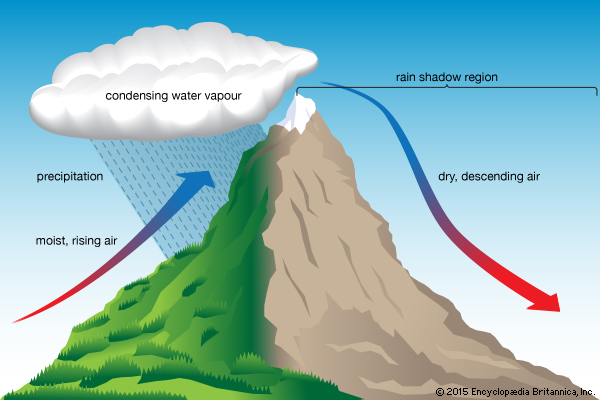
    1. Orographic : It is due to a topographic barrier. When the moist air hits the windward side of a mountain, it is forced to rise which cause it to adiabatically cool and saturate. Hence the windward side receives rain. The cool air descends towards the leeward side making that area dry.

    images

    1. Frontal : Frontal rainfall is a feature of middle latitudes. It will be more clear when we’ve gone through what fronts are in the topic Atmospheric circulations. Just for some conceptual clarity, we say fronts are boundary of two different air masses say warm air mass and cold air mass. When these two airs masses meet, rain might occur. This type of rainfall is called frontal rains.
  • Rule of Law v/s Rule by Law

    This article focuses on bringing clarity to the two very different concepts which look similar at face value.  Sir Ivor Jennings, the famous constitutional historian, characterized the Rule of Law as ‘an unruly horse’.

    First, let’s be clear about what the Rule of Law is not.

    Rule of Law should not be equated with law and order. The breakdown of law and order is a temporary phenomenon.

    Breakdown of the Rule of Law means the collapse of good governance and the breakdown of constitutional machinery in a State.

    Now, let’s see what the Rule of Law is.

    It may be difficult to define the concept with precision but in essence, it signifies a commitment to certain principles and values. Generally, the rule of law is the principle that no one is above the law and treated equally among citizens.

    The Rule of Law symbolizes the quest of civilized democratic societies to combine that degree of liberty without which law is tyranny with that degree of law without which liberty becomes license.

    However high you may be, the law is above you.

    For instance, One may be the Prime Minister or the Speaker or the Imam or the Archbishop or a judge or the Sankaracharya or whoever, all are equally subject to the law. That imparts the element of non-discrimination in the concept of the Rule of Law.

    What are the principles of the Rule of Law?

    It was A.V. Dicey, the English Professor and Constitutional expert, who developed this concept. He defined 3 principles that govern the rule of law.

    1. Supremacy of Law
      No man shall be punished or made to suffer in body or goods except for the violation of the law. Such a violation must be established in an ordinary court of the land and in an ordinary legal manner.
    2. Equality before Law
      No man is above the law and everyone, whatever his condition or rank is, is subject to the ordinary laws of the land. <It means a person can sue or be sued in a court of law>
    3. Predominance of Legal Spirit
      The result of the ordinary law of the land is Constitution. It indicates that the general principles of the constitution are the result of judicial decisions of the courts in England. <However, this principle does not apply in the case of a written constitution. It stands modified in India, where it reads that the constitution is the supreme law of the land & all other laws in order to be legally valid shall conform to the constitution>

    What is the importance of Rule of Law?

    Rule of Law is essential for the protection of human rights.

    This concept changed the mode of administration from “King was Law” to “Law is King”. It is quite essential for the healthy functioning of democracy.

    In its path-breaking judgment in Keshavanand Bharti’s case, our Supreme Court ruled that the Rule of Law is part of the Basic Structure of the Constitution.

    The Constitution in order to preserve the rule of law, has conferred the writ jurisdiction under Art. 32 and Art. 226 on Supreme Court and High Court respectively.

    How Rule of Law is different from Rule of Law?

    It is important not to confuse Rule of Law with rule by law.

    The existence of a law is necessary but that is not sufficient. The law must have a certain core component that guarantees the basic human rights and the human dignity of every person.

    Rule by law can become an instrument of oppression and it can give legitimacy to the enactment of laws that may grossly violate basic human rights.

    Let’s see with examples, how rule by law can be misused

    Nazi Germany put Jews in concentration camps and thereafter sent them to the gas chambers. The justification offered was that there was a law that empowered such acts to be done. But that was rule by law, not the Rule of Law.

    During the apartheid regime in South Africa, repressive and racially discriminatory laws against the black majority were sought to be justified on the basis of enacted laws.

    Let’s see the relevance of the Rule of Law in India

    In India, this concept is implicitly mentioned in the fundamental rights of our constitution. The equality before law (Article 14) includes Rule of Law in itself.

    Indian Constitution grants some exceptions to the Rule of Law.

    What are the exceptions to the Rule of Law in India?

    1. The President/Governor is not answerable to court of law in discharge of his executive functions.
    2. No criminal proceedings whatsoever can be instituted against the President or Governor of the state, while he is in office.
    3. No civil proceedings in which relief is claimed can be filed against President or Governor except after the expiration of a 2-month notice that is served on him.

    Under International laws, the visiting heads of state, heads of govt, ministers, officials, and foreign diplomats who are posted in the country are not subjected to the jurisdiction of local courts in the discharge of their official functions.

    What are the concerns regarding the Rule of Law in India?

    Legal experts have raised their concerns regarding the implementation of the Rule of Law in India. A free democratic society like India cannot have recourse to measures that violate the very essence of the rule of law.

    For instance, a law that permits the killing of suspected terrorists or enables indefinite detention without prior hearing at the absolute discretion of the executive is destructive of the rule of law. Fake encounters have no place in a govt professedly based on the rule of law.

    Therefore, we should strive to instill the rule of law temperament and culture at home and in educational institutions. The aim should be that rule of law becomes the secular religion of all nations based on tolerance and mutual respect.

  • Indian Polity | Timeline : States and UT Reorganization

    After India became independent, its constituent units were classified into 4 distinct categories – Part A, Part B, Part C, Part D. Their composition is as follows

    Part A statesFormer British provincesAn elected governor and state legislature9 states: Assam, Bihar, Bombay, East Punjab, Madhya Pradesh, Madras, Orissa, Uttar Pradesh, and West Bengal
    Part B statesFormer princely states or groups of Covenanting statesRajpramukh (former princes)9 states: Hyderabad, Jammu and Kashmir, Madhya Bharat, Mysore, Patiala and East Punjab States Union (PEPSU), Rajasthan, Saurashtra, Travancore-Cochin, and Vindhya Pradesh
    Part CFormer princely states and provincesChief commissioner10 states: Ajmer, Coorg, Cooch-Behar, Bhopal, Bilaspur, Delhi, Himachal Pradesh, Kutch, Manipur, and Tripura
    Part DUnion TerritoryGovernor appointed by the Indian presidentAndaman and Nicobar Islands
    Part C states were administered by the President through a Chief Commissioner or Lieutenant-Governor.

    1956: States Reorganization Act. Abolished the above 4-fold classification. Part A and Part B were merged. Part C territories – HP(including Bilaspur), Delhi, Manipur, and Tripura were made UTs and the rest merged with their adjoining states. Part D(Andaman & Nicobar Islands) was made a UT.

    Total States: 14
    UT Count: 6

    1960: Bilingual state of Bombay was divided into Maharashtra and Gujrat.

    Gujrat becomes the 15th State.

    Total States: 15
    UT Count: 6

    1961: Dadra and Nagar Haveli, Portuguese colony till 1954 was converted into a UT by the 10th Constitutional Amendment Act. Dadra and Nagar Haveli becomes the 7th UT.

    Total States: 15
    UT Count: 7

    1962: Goa, Daman and Diu were acquired from Portuguese by means of police action in 1961. Constituted as UT by the 12th Constitutional Amendment Act in 1962. They come 8th and 9th UT respectively.

    Total States: 15
    UT Count: 9

    1962: State of Nagaland carved out from the state of Assam by 13th Constitutional Amendment Act in 1962. Nagaland becomes the 16th State.

    Total States: 16
    UT Count: 9

    1962: 4 French establishments – Puducherry, Karaikal, Mahe and Yanam where handed over to India in 1954. Made a UT by the 14th Constitutional Amendment Act in 1962. Puducherry becomes the 10th UT.

    Total States: 16
    UT Count: 10

    1966: Punjab was bifurcated to create Haryana. UT of Chandigargh was formed. Hilly Areas of Punjab were merged with Himachal Pradesh. Haryana becomes the 17th State. Chandigargh becomes the 11th UT.

    Total States: 17
    UT Count: 11

    1970: HP elevated from the status of UT to the status of state. HP becomes the 18th State. The total UT count comes down to 10.

    Total States: 18
    UT Count: 10

    1971: Political Map of NE underwent a Major Change. Manipur, Tripura and Meghayala elevated to the status of state. The total State-count becomes 21.

    Total States: 21
    UT Count: 10

    1975: Referendum held in Sikkim and Sikkim became an integral part of India. 36th Constitutional Amendment made it the 22nd full-fledged state.

    Total States: 22
    UT Count: 10

    1986: Mizoram and Arunachal Pradesh elevated from status of UT to the status of state. The total State-count becomes 24. The total UT-count comes down to 8.

    Total States: 24
    UT Count: 8

    1987: Goa elevated from status of UT to the status of state. Becomes the 25th State. The total UT count comes down to 7.

    Total States: 25
    UT Count: 7

    1991: Delhi becomes the National Capital Territory of Delhi.

    2000: Chhattisgargh(from MP), Uttarakhand(from UP) and Jharkhand(from Bihar) carved out to form independent states. The total State-count is 28.

    Total States: 28
    UT Count: 7

    2014: Andhra Pradesh bifurcated to form Telangana. Becomes the 29th State.

    Total States: 29
    UT Count: 7