💥Join UPSC 2027,2028 Mentorship (July Batch) + XFactor Notes & Microthemes PDF

Author: B2B

  • History | Gandhiji’s 4 Satyagraha

    After his successful stint in South Africa, it was time for Gandhiji to try his tactics in his homeland, India. He tries to experiment with Satyagraha at a smaller scale before he goes for a mass movement. All his experiments were a huge success and thus lay the foundation of the Non-Cooperation movement which shook the British Raj.

    CLICK:-REGISTER & DISCUSS ETHICS CASE STUDIES & YOUR UPSC PREPARATION WITH CD MENTORS FOR FREE
    1. Champaran Satyagraha – 1917

    Gandhiji was persuaded by Raj Kumar Shukla to study the conditions of the Indigo Plantation workers in Champaran, a district in Bihar.

    The system prevalent in the Indigo Plantations was the Tinkathia System*. In this system, the peasants were required to mandatorily cultivate indigo in 3/20th of their land holdings.

    Gandhiji did his research. At the same time, the Govt. appointed a Commission of Inquiry to go into the whole issue and nominated Gandhiji as one of its members. Needless to say, it found the Planters guilty of exploitation. A compromise was reached and Planters were ordered to refund 25% of the amount they had illegally taken.

    1. Ahmedabad Satyagraha – 1918

    This time Gandhiji was dealing with the workers. Due to plague, the mill owners had increased the pay to 75% to attract workers. However, once the plague conditions subsided, the mill owners wanted to bring down the pay to 20%. The workers didn’t agree with this reduction and wanted 50% of the pay to remain. The logic they sited was that WW1 had increased the prices. Gandhiji didn’t want the interest of the industrialist class to be hurt. He tried hard to persuade Ambalal Sarabhai who was his friend but failed. Left with no option, he asked workers to go on a strike. When Gandhiji saw the strike subsiding, he went on a fast. This put pressure on the mill owners who agreed for the 35% increment.

    1. Kheda Satyagraha – 1918

    This is where Gandhiji teams up with Sardar Vallabhbhai Patel to help the cause of peasants. The peasants were in extreme distress as their crop produce had been 1/4th of the original. As per the revenue code, they were entitled for a full concession. However, the Govt. wasn’t willing to let go of their revenues and kept pressurizing the peasants.

    Gandhiji urged all farmers to fight unto death against this injustice of the British. He appealed the rich farmers to support to the poor farmers by not paying revenues despite having the capability. Later the British came out with a policy asking the rich farmers to pay their due voluntarily. (which backfired as no rich farmer willingly wanted to pay revenue)

    1. Rowlatt Satyagraha – 1919

    British, in the name of curbing terrorist violence, had introduced a Bill that severely curtailed the liberties of the Indians. It had provisions for arrest without warrant and detention for 2 years. Gandhiji called for a nation-wide hartal accompanied by fasting and praying. The Movement went in a different direction than what was expected. There were events of violent outbreaks which feared the Govt.

    The Rowlatt Satyagraha was withdrawn on 18th April, 1919 because of the Jaliawala Bagh Massacre that happened on 13th April 1919.

    Gandhiji called it a ‘Himalayan Blunder’. It should be noted that NCM was not the first Nationwide Movement, it was the Rowlatt Satyagraha.

    CLICK:-REGISTER & DISCUSS ETHICS CASE STUDIES & YOUR UPSC PREPARATION WITH CD MENTORS FOR FREE

    *There were two main systems of indigo cultivation – nij and ryoti. A detailed explanation of the same is given in NCERT.

    Ref : http://www.ncert.nic.in/ncerts/l/hess103.pdf
  • History | Our Legislature through the ages

    What we know as the Parliament today had humble beginnings as the Governor General’s Council.

    Regulating Act of 1773 : The Gov of Bengal was made Gov General of Bengal. He was assisted by 4 people. This 4+1 becomes became Supreme Council of Bengal (source), also known as the GG’s Exec Council.

    Pitt’s India Act of 784 : We see a shrinking of the Council from 4 members to 3 members. Hence 3+1 is the renewed GG’s Executive Council. Can you tell us why? 

    Charter Act of 1833 : Gov General of Bengal became the Gov General of India. The Supreme Council of Bengal became the Council of India. This Act. was the first law to distinguish between the executive and legislative powers of the Gov General. A 4th member was introduced who could only discuss and vote only on legislative matter.

    Council of India = [(3+1) +  1(4th member also called the Law Member)]

    The first such Law Member was Macaulay. This Council of India was, to a certain extent, the Legislature. Strength of the Executive remained 3+1 .

    Charter Act of 1853 : From here on, we see a gradual increase in the membership of the Council and further separation of powers. The 4th member (Law Member)was included as a full-time Member in the GG’s Executive Council. His position was taken by 6 Members referred to as Legislative Councillors.

    Council of India = [(4+1) + 6(Legislative Councillors) + 1 Commander-in-Chief]

    6 Councillors were,

    • 1 Chief Judge of SC of Calcutta.
    • 1 Judge of SC of Calcutta
    • 4 members of the ICS

    Q. Who was the Commander-in-Chief?

    Indian Councils Act of 1861 : After 1861, the Council was called Imperial Legislative Council(ILC) or Indian Legislative Council(ILC). The Executive was further enhanced by 1 member. The Viceroy now had the power to Nominate 6 – 12 Non-Official members in the Legislature who would be holding the office for 2 years.

    ILC = [(5+1) + (Additional Members -> Minimum 6, Maximum 12)]

    The composition of Additional Members was as follows:

    • 50% Nominated Official Members
    • 50% Nominated Non-Official Members

    The Act thus sowed the seed  for the future Legislative as an independent entity separate from the Executive Council.

    Indian Councils Act of 1892 : Due to the excessive demand of the Congress, the Additional Members were increased. Additional Members -> Minimum 10, Maximum 12.

    ILC = [(5+1) + (Additional Members -> Minimum 10, Maximum 16)]

    The composition of Additional Members was as follows:

    • Nominated official members (those nominated by the Governor General and were government officials)
    • 5 Nominated Non-Officials (nominated by the Governor General but were not government officials)
    • 4 Nominated by the Provincial Legislative Councils of Bengal Presidency, Bombay Presidency, Madras Presidency and North-Western Provinces.
    • 1 Nominated by the Chamber of Commerce in Calcutta.

    Indian Councils Act of 1909 : The Morley-Minto reforms. It introduced for the first time the method of election.

    The additional members of the Governor-General Council were  increased from 16 to a maximum of 60.

    The composition of Additional Members was as follows:

    • Nominated official members (those nominated by the Governor General and were government officials)
    • Nominated non-official members (nominated by the Governor General but were not government officials)
    • Elected Members (elected by different categories of Indian people)

    Indian Councils Act of 1919 : The Montagu-Chelmsford Reforms. Central Legislature thereafter called the Indian Legislature was reconstituted on enlarged and more representative character.  It consisted of the Council of State consisted of 60 members of whom 34 members were elected and the Legislative Assembly  consisted of about 145 members, of whom about 104 were elected and the rest nominated.  Of the nominated members about 26 were officials.  The powers of both the Chambers of the Indian Legislature were identical except that the power to vote supply was granted only to the Legislative Assembly.

    The Government of India Act 1935: It marked the next great stride in the evolution of the Legislatures.  The Federal Legislature was to consist of two Houses, the House of Assembly called the Federal  Assembly and the Council of States.  The Federal Assembly was to consist of 375 members, 250 to represent Provinces and 125 to represent the Indian States, nominated by the Rulers.  The representatives of the Provinces were to be elected not directly but indirectly by the Provincial Assemblies. The term of the Assembly was fixed as five years.  The Council of State was to be a permanent body not subject to dissolution, but one-third of the members should   retire   every   three   years.  It was to consist of 260 members.  104 representatives of Indian States, six to be nominated by the Governor-General, 128 to be directly elected by territorial communal constituencies and 22 to be set apart for smaller minorities, women and depressed classes.  The two Houses had in general equal powers but demands for supply votes and financial Bills were to originate in the Assembly.


    • The information has been compiled from various sources, in case you find any discrepancy, please note it in comments.
  • Internal Security | Assam Riots and Demand of Bodoland

    As we move forward to cover up Internal Security topics, we should have look for North-eastern region. So, we will see various linkages between developments and demands from North-eastern region. Let’s know Assam Riots and Bodoland demand in brief!

    Let’s know historical timeline of events?

    • In 1960s, Bodos started demanding autonomy, varying from separate statehood to outright sovereign status.
    • In 1980s and 1990s, militant Bodo movement peaked during this period large scale killings and human displacement.
    • In 2003, the signing of the Bodo Territorial Council (BTC) Accord between Militant Bodo Liberation Tigers (BLT) led by leadership of Hagrama Mohilary on one side and Centre-state government on the other side.
    • Under this accord, Bodo Liberation Tigers surrendered their weapons, and Hagrama was made the Chief Executive Member (CEM) of the Bodo Territorial council (BTC).
    • Nowadays, violence in bodoland is become a common feature in region.
    • In past 5 years some 3,500 riots have been reported, most recent being the December 2014 Violence by NDFB (songbijit) against adivasis and retaliatory violence.
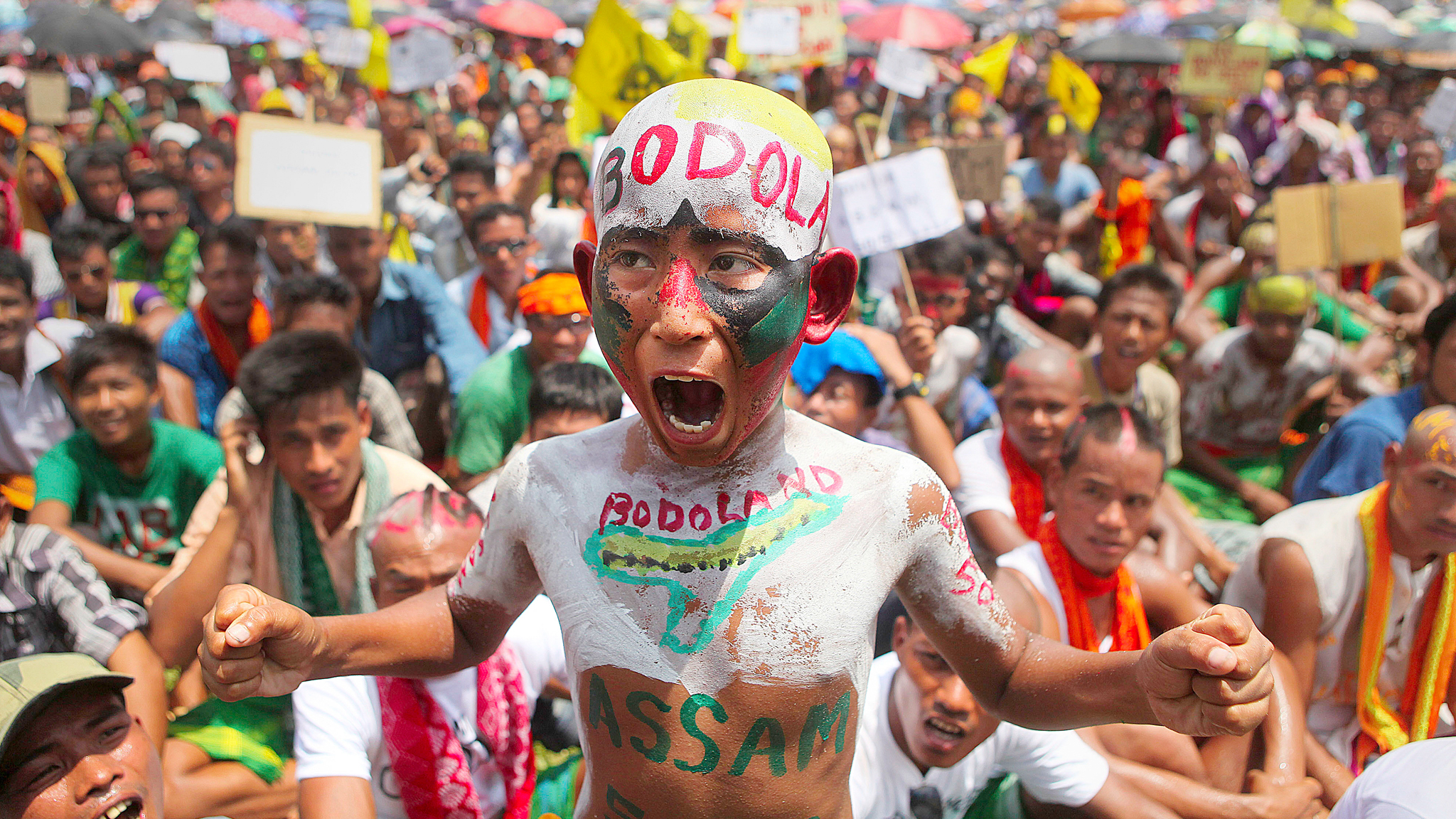
    A Bodo student with painted face shouts as hundreds of thousands of Bodo tribal people gather demanding the creation of a new state of Bodoland during a mass rally at Ghoramara in Somitpur district of Assam state, India, Aug. 20, 2013. India’s ruling coalition recently endorsed the creation of a new state called Telangana to be carved out of Andhra Pradesh state. The endorsement triggered other regions with the same demand in the country to stand up for their own states as well, including Bodo tribals. (AP Photo/Anupam Nath)
    A Bodo student with painted face shouts as hundreds of thousands of Bodo tribal people gather demanding the creation of a new state of Bodoland during a mass rally at Ghoramara in Somitpur district of Assam state, India, Aug. 20, 2013. (AP Photo/Anupam Nath)

    Then, what comprises BTC or Bodo Accord?

    It consists of 4 districts of Assam –

    • Kokrajhar
    • Chirang
    • Baksa
    • Udalguri. (Total 35% area of Assam.)

    [ Demography of bodoland: 30 % of the population is Bodos (who are STs) and rest comprises of tribals, Bengali Muslims and Hindus and Assamese.]

    BTAD


    Why were there resentment outbreaks among Bodos and Non Bodos?

    Bodos side’s demands –

    • The Bodos, constitute the largest tribal community out of a total of 34 tribal communities in Assam.
    • They feel they have been neglected, exploited and discriminated against for decades, look at this accord as a historic opportunity to fulfil their longstanding demands.
    • But due to the changing demographics of the BTAD and the consequent land alienation, they fear they may become a minority in their own state and in hitherto Bodo-dominated areas.

    Non-Bodos and Muslims side’s demands –

    • They resents the fact that Bodos constitute a meagre 25 per cent of the total population in the BTC area and believe that Bodos should not be given the right to rule over the other three-fourths.
    • Number of villages with minority Bodo population were included in the BTAD to make it a contiguous area.
    • The non-Bodos want such villages to be taken out of BTAD so that they do not feel insecure where they are clearly in the majority.

    So, was there any problem in the Bodo Accord?

    • The Bodo Accord, seeks to protect the land rights of the indigenous Bodos while allowing settler Muslims (both legal and illegal) to freely acquire land at the same time.
    • The Bangladeshi migrants easily sneak in the area, illegally procure relevant documents like ration cards to establish Indian nationality.
    • Taking advantage of the provisions in the BTC Act, such migrants are freely procuring land in the BTAD, which only adds to the woes of indigenous Bodos.
    • Both sides are demanding the review / revocation of BTC act because on one hand, Bodos feel their rights are not protected.
    • On the other hand, Non-bodos feel that Bodos are getting way too many benefits.

    Are there some concrete reason behind violence?

    • Demand for a separate state of bodoland.
    • Occupation of their land by illegal Bangladeshi migrants.
    • Illegal migration from Bangladesh who have settled on their land (loss of land rights).

    Adivasis demand to be included in ST list –

    • They argue that 34 of the 40 seats of BTC are reserved for STs. Now bodos having ST status dominates it, although they are only 34% of population.
    • This is opposed by Bodos who don’t want to lose power.

    Can we have some solutions on a table?

    Security measures

    • Have permanent security forces here.
    • Intensify operations against the militants.
    • Curb the proliferation of illegal weapons.
    • Seek amicable and strategic cooperation from Bhutan and Bangladesh.

    Solve underlying reasons

    • Stop illegal migration and update land records – [e.g. National Population Register, Aadhaar / similar biometric cards.]
    • Ensure equal rights and opportunities to all socio-religious and ethnic communities in the area.
    • If need arises then review the BTAD model, where the minority Bodos rule over the majority non-Bodos.

    Way forward

    Union and State Government need to solve it en masse and take proactive action against violence in this conflict region, unless proactive action with political will of leaders in region should come into action, there is no way out for hope to resettle from such domino effect.

    Have a look to Domino effect happened all over the country following the spirit for statehood.

    Domino_effect_statehood


    What do you think on domino effect and spirit of statehood? Let us know!


    Published with inputs from Arun | Image: BTAD
  • Internal Security | Salwa Judum 2.0

    Let’s move to our next topic of Internal security.

    In may 2015, formers leaders of Salwa Judum formed Vikas Sangharsh Samiti in Dantewada of Chhattisgarh to carry forward the work of salwa judum in bastar. i.e. to finish Maoism in Bastar and bring development. Let’s know it in brief!

    Let’s first know about Naxalism?

    • Naxalism originated as a rebellion against marginalisation of the poor forest dwellers and gradually against the lack of development and poverty at local level in rural parts of eastern India.
    • It began in 1967 with an armed peasant uprising in Naxalbari village in West Bengal. The term ‘Naxal’ came from the name of the village.
    • The origin of the Naxals was a result of the split that took place in the Communist Party of India (Marxist) in 1967.
    • It led to the formation of Communist Party of India (Marxist and Leninist).
    • West Bengal being the centre of the movement initially, Naxalism spread to the lesser developed areas like Jharkhand, Odisha, Chhattisgarh and Andhra Pradesh.

    Now, Let’s clear some air from – Salwa Judum?

    SalwaJudumhubs


    • Senior Indian National Congress (INC) party leader Mahendra Karma launched the Salwa Judum in 2005 as a counterinsurgency measure to tackle the Maoist threat.
    • Salwa Judum meaning “Peace March” or “Purification Hunt” in Gondi language.
    • It is a militia mobilised and deployed as part of anti-insurgency operations in Chhattisgarh, aimed at countering Naxalite violence in the region.
    • It was started as a people’s resistance movement against the Naxalites.
    • The militia, consisting of local tribal youth, received support and training from the Chhattisgarh state government.
    • Salwa Judum was followed in 2009 by Operation Green Hunt – which was actually just a more organised version of the Judum, minus the mass rallies and the forcible regrouping.

    Then, Why did Supreme Court intervene in campaign?

    • In 2011, Nandini Sundar v/s State of Chhattisgarh case, SC declared it illegal and unconstitutional and ordered its disbandment.
    • The petitioner had alleged that the State of Chhattisgarh was actively encouraging a group called Salwa Judum, a civil vigilante structure, to counter Maoist insurgency, and that had resulted in violation of human rights.
    • The SC had declared that the recruitment and arming of tribal people as Special Police Officers (SPOs), as a counter-insurgency measure, was illegal and unconstitutional.
    • The SC forbade the state government from supporting any civilian vigilante force and declared that it was the responsibility of the state to prevent the operation of any such group.

    How did Salwa Judum version 2.0 or Vikas sangharsh samiti (VSS) came into picture?

    • Chhavindra Karma, former leader of anti-Maoist militia Salwa Judum and son of the founder of the militia, Mahendra Karma, has formed Vikas Sangharsh Samiti in Dantewada district of Chhattisgarh on 25 May, 2015.
    • Vikas Sangharsh Samiti or Salwa Judum-2 born in Bastar again. [Yes, it is Salwa Judum version 2.0]
    • The Samiti carry forward the work of Salwa Judum in Bastar.
    • Today, the Vikas Sangharsh Samiti is offering the same justification that was given by the state of Chhattisgarh earlier, that tribal volunteered to fight against the Maoists.

    Is there any Way forward to Salwa Judum 2.0?

    • A Salwa Judum 2.0 could survive constitutional challenge only if its role is restricted to helping out the state machinery during natural and manmade disasters, and to the regulation of traffic.
    • The employing and arming of untrained tribals in the fight against Maoists is unconstitutional and illegal — it doesn’t matter whether it goes by the name “Salwa Judum”, “Vikas Sangharsh Samiti” or any other.

    Is Left Wing Extremism (LWE) Division of Home Ministry helpful?

    • LWE Division was created w.e.f. October 19, 2006 in the Ministry of Home Affairs to effectively address the Left Wing Extremist insurgency in a holistic manner.
    • The LWE Division implements security related schemes aimed at capacity building in the LWE affected States.
    • The States of Chhattisgarh, Jharkhand, Odisha, Bihar, West Bengal, Andhra Pradesh, Telangana, Maharashtra, Madhya Pradesh and Uttar Pradesh are considered LWE affected, although in varying degrees.

    What concrete steps should be taken by Government in such Naxalites area?

    • The Central government should form a separate ministry which will undertake the development of areas affected by Naxal activities.
    • Ensure the safety of the civilians by stopping the Salwa Judum campaign and ensuring that no counter insurgency measures are taken by risking the lives of the civilians.
    • Checking instances of human rights violation by the security forces and the Salwa Judum.
    • Registering the crimes perpetrated by the security forces, Salwa Judum and the Maoists and bringing them to justice.
    • Banning of Bal Mandal (The child division of Naxalites) with immediate effect.
    • Ensuring safety of those who surrendered and those who lived in camps or were related with Salwa Judum activities.

    Do you find any solutions on such impasse? Let us know!


    Published with inputs from Arun | Image: Salwa Judum Hub
  • Indian Polity | Speaker of the Lok Sabha

    The office of the Speaker is more than merely a presiding officer of the LS. One thing you will notice is that you will not find an exhaustive list of rules and procedures for the Officers of Lok Sabha and Rajya Sabha. That’s because these are offices of trust. We take for granted that when a Member is appointed a speaker, he/she keeps his party allegiance aside and acts in an impartial manner.

    Powers of the Speaker

    The Office of the Speaker is a very powerful one. He derives his powers from three sources – a. The Constitution, b. The Rules of Procedures and Conduct of Business of Lok Sabha and c. The Parliamentary Convention(residuary powers that are unwritten or unspecified).

    1. He is the sole authority to decide whether a Bill is a Money Bill or not. This decision of his cannot be challenged.

    The present Parliament is the best example to demonstrate how important this power can be. The Govt. enjoys a majority in the LS but not in the RS. Hence they are unable to get a lot of Bills passed. Our FM remarked that certifying the Bills as Money Bills are the only way to get them passed.

    *The Speaker has to consult Article 110 to mark a Bill as Money Bill. So it’s not entirely his discretion.

    1. He presides over the joint setting of the two houses. This privilege doesn’t belong to the Chairman of the RS. If the Speaker is absent, it goes to the Dy. Speaker of the LS. If the Dy. Speaker is absent, it goes to the Vice Chairman of the RS.
    2. The Speaker enjoys a special relationship with the Parliamentary Committees. All the Joint Parliamentary Committees are appointed by the Speaker and they report to him directly. Further, the Speaker nominates various members to these committees. If the Speaker himself is a Member, he becomes the ex-officio Chairman.
    3. The Office of the Speaker is retained till the 1st meeting of the next LS. All other Members cease to be in office once the LS dissolves.
    4. Special Role in Anti-Defection law. The Speaker has to accept the resignation of any Member of the House. This is to ensure that the resignation is voluntary. This decision is final but is open to Judicial Review. Ref: PRS India
  • Internal Security| National Intelligence Grid (NATGRID)

    It’s time to learn some basics from GS-IV paper as its Internal security part is significant to score. We will cover series of articles on Internal security with some contemporary topics.

    What’s the NATGRID?

    The National Intelligence Grid or NATGRID is the integrated intelligence grid connecting databases of core security agencies of the Government of India to collect comprehensive patterns of intelligence that can be readily accessed by intelligence agencies.

    Why do we need NATGRID ?

    • 26/11 attacks on Mumbai led to the exposure of several weaknesses in India’s intelligence gathering and action networks.
    • “NATGRID” data transfer system unveiled by Home Minister P. Chidambaram in December 2009 and operational now.

    How does it work?

    NATGRID will integrate 21 categories of data from agencies like

    • Banks,
    • Railways and airlines,
    • Income tax department,
    • Credit card companies etc.
    • Visa and immigration
    • This combined data will be made available to 11 central agencies including the R&AW, the National Investigation Agency(NIA), the CBI, the Directorate of Revenue Intelligence, the Intelligence Bureau(IB), the Narcotics Control Bureau(NCB) and the Enforcement Directorate(ED) to help them prevent terrorist attacks and criminal activities.

    Is there any Privacy and misuse issue?

    • Some people are concerned about the protection of individual privacy and misuse of information by law enforcement agencies.
    • NATGRID is only the technical interface for intelligence agencies and not an organization in itself. If the agency initiating the inquiry is not authorized to get that information, it cannot get it.
    • It has strong information protection technology and external audits Security and intelligence agencies will not be able to use the
    • NATGRID system to access information for any purpose other than that of countering terror.
    • It will not “store” any personal data, but only facilitate transfer.

    Will it be a concerning thing as Wikileaks does?

    • SIPRNET is a computer network connecting US Defense and State Departments (similar to our NATGRID).
    • One Soldier Bradly Mannins, accessed the SIPRNET, copied all the US diplomatic documents and sent them to Wikileaks founder Julian Assange.
    • Similar fiasco could happen with India’s NATGRID.

    Published with inputs from Arun
  • Internal Security | National Counter Terrorism Center (NCTC)

    Let’s move to a next topic of Internal security –National Counter Terrorism Center (NCTC).

    Why there was a need of NCTC ?

    • After the 26/11 attacks, Government felt the need to setup a separate body to deal with terrorism.
    • NCTC will derive its powers from the Unlawful Activities Prevention Act(UAPA), 1967.
    • The basic idea is to prevent confusion regarding intelligence inputs and also ensure that none of the police forces from the states enter into a blame game regarding intelligence sharing as one got to see during the 26/11 attacks in Mumbai.
    • The standing council of the NCTC will consist of anti-terror agencies in states.
    • The body will have 3 divisions dealing with collection and dissemination of intelligence, analysis and operations.

    How did the proposal to set up the NCTC originate?

    • The NCTC has been designed on the lines of the American NCTC and UK’s “Joint Terrorism Analysis Centre”.
    • Home Minister P. Chidambaram and former National Security Adviser (NSA) M.K. Narayanan visited USA in 2009 to study the working of the American NCTC.

    What will NCTC do?

    • It will have the power to conduct searches and arrests in any part of India.
    • It will collect, collate and disseminate data on terrorism.
    • It will also maintain a database on terrorist and their associates including their families.
    • In short, NCTC will serve as a single and effective point of control and coordination of all counter terrorism measures.

    But, What is the Multi-Agency Centre (MAC)?

    It is platform to share varied intelligence inputs coming from various agencies like –

    • Directorate of Revenue Intelligence (DRI)
    • Economic Intelligence Agency (EIA)
    • Enforcement Directorate (ED)

    How is it different from US and UK model?

    • USA’s NCTC which deals only with strategic planning and integration of intelligence without any operational involvement.
    • UK‘s Joint Terrorism Analysis Centre, which too plays a purely coordinating role.
    • But the Indian NCTC will have not only intelligence functions but also powers to conduct operations, raids and arrests in any part of India.

    What is the problem with NCTC?

    NCTC was to start working from March 2012, but it could not be launched due to opposition from a group of Non-Congress chief ministers who say that NCTC is against the federal structure of the country.

    Power to Arrest without informing State Government

    • Non-Congress CM’s allege that the NCTC has been empowered to search and arrest people without informing the state government, police or anti-terror squad in the loop.
    • The role of the state becomes redundant with such powers and states would have no say or role to play in the fight against terrorism.
    • This would have a bearing on the rights and privileges of the states as enshrined in the Constitution.
    • To curb this fear, Home Ministry had altered the rules.
    • Now, the senior most police officers in all states – the Director Generals of Police and the chiefs of anti-terror squads of all states will be members of the Standing Council of the NCTC.

    Overlapping with NIA

    • National Investigation Agency (NIA) was established after the 26/11 attacks.
    • So, the establishment of a new NCTC would only add to the bureaucratic tangle in intelligence sharing and counter terrorist action.
    • However, Mr. Chidambaram had assured that NIA is merely a predecessor of NCTC. (so, once NCTC comes into operation, the NIA will function under it or will be submerged into NCTC)

    What is the Centre’s stance on this?

    • The UPA, however, has defended the setting up NCTC arguing that it will not trample on the rights of the states.
    • Congress spokesperson Manish Tewari said that terror is a real threat and “it is necessary to bring together all elements of national power in real in order to surmount a formidable challenge to it.”

    Published with inputs from Arun
  • Indian Polity | Types of Majorities

    There are 4 main types of Majority. The last one is Special Majority which has 3 sub-types.

    The most important Majorities will be Simple Majority and Special Majority of the 2nd kind. We will use the current strength of the Lok Sabha = 545 in the examples to explain.

    1. Absolute – More than 50% of the Total Strength of the House. Meaning

    1/2 x 545 = 273 or more. 

    This majority is never used anywhere but has a huge significance. If a political party has an Absolute Majority, it means it gets to form the govt., there is stability in the house.  

    1. Simple – Also called functional majority. It means a Majority of more than 50% of members present and voting.

    Let’s assume the members present and voting is 300 (out of 545). We have –

    1/2 X 300 = 150 or more

    Usage

    • When not stated what type of Majority in the Constitution, this majority is assumed.
    • Passage of Ordinary, Money, and Financial Bills.
    • Passage of No-Confidence Motion, Confidence Motion, Vote of Thanks to the President, Censure Motion, Adjournment Motion, Calling Attention Motion.
    • Election of the Speaker, Dy. Speaker, Dy. Chairman of RS.
    • Passage of approval to President’s Rule and Financial Emergency.
    • Approval by LS for discontinuance of Emergency.
    1. Effective – Means Majority of the Effective Strength of the House where Effective Strength is defined as Total Strength – No. of Vacancies. Vacancies arise due to 3 reasons – Death, Disqualification, and Resignation. Some sources mention Absenteeism as a vacancy but that is incorrect.

    Let’s assume the Number of Vacancies is 6. We have

    1/2 X (545-6) = 270 or more

    Usage

    • Removal of the VP. Initiated by the RS, requires an Effective Majority in the RS, thereafter Simple Majority in the LS. (this procedure is assumed since the Constitution doesn’t explicitly state it. Actual text available here)
    • Removal of the Speaker, Dy. Speaker and Dy. Chairman of the Rajya Sabha.
    1. Special – This majority has 3 sub-types that require some attention.

    1st kindNot less than 2/3 of the Members present and voting.

    Usage (only in 2 conditions)

    • Passage of Resolution under Art. 249 and Art. 312. What are they and when have they been used? 

    2nd kind: Fulfills the following criteria

    i) Not less than 2/3 of the Members present and voting.

    ii) Majority of the Total Strength of the House.

    Eg. Out of 545, 450 Members are present and 300 vote in favor. Both the above conditions are satisfied – 300 is more than 2/3 of 450 and 300 is more than 1/2 of 545.

    To make it simpler to remember, it is Special Majority of First kind + Absolute Majority.

    Usage

    • Passage of Constitutional Amendment Bills under Art. 368.
    • Approval by both Houses for the continuance of Emergency.
    • Removal of Judges of SC, High Court, CAG, CEC.
    • Approval for the creation of the State Legislative Council of a State under Art. 169.

    3rd kind:  This is used only once – during the impeachment of the President of India. Is mentioned in Art. 61 of the Constitution.

    2/3rd Majority of the Total Strength of the House.

    2/3 X 545 = 364 or more

    As a rule of thumb, you should never mention Special Majority in any answer as it could mean any of the 3 Special Majorities. 

  • Indian Polity | A Quick Brush up with Our Emergency Provisions

    Indian Polity | A Quick Brush up with Our Emergency Provisions

    Very quickly then, most of us are familiar with the 3 types of emergencies.

    We will study them under 3 heads –

    #a. When can they be imposed?

    #b. Features

    #c. Effects


    #1. Art. 352 – National Emergency

    a. When can it be imposed?

    3 conditions – War, External Aggression, Armed Rebellion

    Note1: Armed Rebellion was changed from Internal Disturbance on the recommendation of the Shah Commission. Internal Disturbance was a vague term prone to misuse.

    Q1: What’s the difference between War and External Aggression?

    No technical difference! The President makes a “Proclamation of Emergency”. If it says its a war, its a war likewise of external aggression.

    b. Features

    Flashback : Lets go back to the time of the Emergency. All it took then was an oral instruction by the then PM Indira Gandhi to President Fakhruddin Ali Ahmed (who received a lot of criticism).

    To understand National Emergency, we need to examine the 44th Amendment Provisions whose sole purpose was to put a check on such powers of the President.

    • Can only be proclaimed on the written advice of the Union Cabinet (not the PM). Perhaps, this is the only place where Union Cabinet has a role.
    • Expires in 1 month from its issue unless approved by a Special Majority (of the second kind*) – Not less than 2/3rd of the Members present and voting + Absolute Majority – in both the houses of the Parliament.
    • If the LS is dissolved, then RS shall approve it within 1 month and the re-constituted LS shall ratify within 30 days.
    • Once approved, the proclamation is extended for 6 months, which can be extended again for 6 more months.
    • Not less than 1/10th of the Members of the LS(this can only be initiated in the LS) may give notice in writing to the Speaker or President (when LS is not in session). If there is no session, a special sitting of the LS shall be held within 14 days. If the resolution, the President has to revoke the Emergency.

    c. Effects

    • Executive : State Govt. is not suspended. Union Govt. can issue orders to the State Govt. on subjects on the State List (something that it can’t normally do).
    • Legislature : State Legislature is not suspended. However, Parliament can make laws on the State subjects. Such laws remain valid for 6 months after the Emergency ceases to be.
    • Financial : Distribution as per the President’s will subject to approval by the Parliament.

    Effect on FR (2 clauses here)

    • Art. 19 automatically suspended (only in case of War and External Aggression)
    • President by a further order can specify other FRs that wont be operative, excepting Art. 20 and 21.

    Art. 20 and 21 are fundamental of the FRs and cannot be suspended. Interested readers can read the story of Judge Khanna’s courage here.


    #2. Art. 356 – President’s Rule

    a. When can it be imposed?

    If the President is satisfied that there exists a situation where the State Admin. cannot be carried in accordance with the provisions of the Constitution, he can make a Proclamation of Failure of Constitutional Machinery in a State.

    Ambedkar had envisaged Art. 356 to remain a dead letter in the Constitution. Much to his surprise it has been used not less than 119 times during the first 63 years.

    b. Features

    Such a proclamation lapses after 2 months, unless approved by the Parliament by a simple majority. Once approved, it lasts for 6 months which can again be extended for 6 more months subjected to maximum of 3 years.

    To extend it beyond 1 year, 2 conditions must be fulfilled

    • National Emergency should be in operation (in whole of India or whole or any part of the State).
    • ECI certifies that elections cannot be conducted in the state.

    c. Effect

    The President can

    • declare Executive powers of the State rest with him. He can also delegate the same to any other authority (like the Governor) as per his liking.
    • dissolve or suspend the State Legislature. If suspended, the Parliament can exercise its legislative powers. (or delegate it to any other authority)

    Effect on FR : No Effect


    #3. Art. 360 – Financial Emergency (^Never imposed till date)

    a. When can it be imposed? 

    If the President is satisfied that a situation has arisen whereby the financial stability or credit of India or of any part of the territory thereof is threatened, he may by a Proclamation make a declaration to that effect.

    b. Features

    It will ordinarily remain in force for 2 months, unless its is approved by both the houses. If LS is dissolved in this period, similar clause as that of the National Emergency applies.

    c. Effect

    The financial autonomy of the states is transferred. The President can

    • suspend distribution of financial resources.
    • issue directions to follow canons of finance.
    • direct the State Govt. to reduce the Salaries of their employees.
    • direct the governors to reserve all financial and money bills for his consideration.

    Effect on FR : No Effect


    Now is the time for 2 quick questions

    1. Attempt the following table. You need to give me the dates corresponding to A,B,C,D,E,F.
    TypeDate of IssueLast Date of ApprovalLast Date of Validity
    3521/1/2016AB
    3561/1/2016CD
    3601/1/2016EF
    1. Mention that checks and balances put in place to curb the improper use of Art. 356.

    Hint : R. Bommai vs Union Of India

    Additional Reads 

    1. Click here for everything on the types of Majority.
    2. Justice Khanna’s Courage 
  • PJ Nayak Committee for Governance reforms [Comic strip]

    A week back or so, we fiddled with the idea of introducing flashcards of basic theoretical terms which bug early stage aspirants when they read daily news. Here’s the post on that.

    This time, we are going in a step further. And what better way to deal with complex concepts, than with a comic strip interspersed with conversations and questions! Sounds fun? Here we go.

    The rules of this initiative. Only 2, not much! 

    1. We will introduce a module from static or current affairs in the most interesting way that we can conjure up.
    2. We will poke holes in the committee reports, suggestions, policy changes, historical blunders etc etc so that we all pitch in with clarifications and help each other understand the basics of things.

      Over to the topic at hand then…

    P J Nayak was entrusted (by none other than Raghuram Rajan) to head an RBI committee on banking governance and present a report, which he did in style:


    Do you know why banks were nationalised way back in Indira Gandhi’s time?

    And why it might still be a good idea (according to government) to keep control over them?


    For newly enthused aspirants, it might be a good idea to go figure the pros and cons of such heavy oversight of FinMin – RBI – CAG – CVC over public sector companies in general (banks or otherwise).


    If you were to represent government’s interest here, what would your rebuttal be? Take a hint from the its seven-pronged strategy called ‘Indradhanush’ to revamp public-sector banks. P J Nayak wasn’t very happy with that!