In a federal <constitutional division of power b/w centre and states> parliamentary democracy <real power vests in council of ministers which is accountable to Lower House i.e Lok Sabha> which is India, President and Governor are only ceremonial heads of state, real power lies with elected govt headed by PM and CM. President and governors have to act in accordance with the aid and advice of the council of ministers.
So, are they mere rubber stamps? Do they have any discretionary powers? What’s the nature of that discretionary power?
Art 74 and art 163 basically states that council of minister will aid and advice president and governor. In its various judgments supreme court interpreted that they have to act only upon and in accordance with the aid and advice of CoM, save in a few well known exceptional circumstances.
The infamous 42nd amendment clarified this position and added that president shall act in accordance with aid and advice which was diluted by 44th amendment so that president can return back advice for reconsideration after which advice shall be binding. No changes were made wrt governor.
So, it’s clear by constitution (for president) as well as supreme court judgment (governor) that only in exceptional circumstances can they act as per their own discretion.
Rule of thumb is, a situation where the CoM is not in a position to tender unbiased or impartial advice to the president / governor can they use their own discretion.
Situation in which discretion can be used?
When no party has clear majority– Obviously caretaker govt would tend to advice president or governor to call it’s candidate for govt formation,, they have to as per their discretion
When lower house has lost confidence in the govt– Obviously govt would not ask for dissolution, discretion has to be used
But the real power comes from the fact that there is no time limit specified within the constitution within which president/ governor have to give assent to the bill. They may simply decide to sit on the bill and do nothing (pocket veto).
In the case of governor there is more scope for discretion-
For bills– governor can reserve bills for consideration of president. Obviously no govt will ask it’s bill to be reserved, discretion has to be applied.
Recommendation of president’s rule-Again no govt would advise imposition of presidential rule.
This reconsideration of bills become sore point b/w governor and govt <against the federal spirit; president i.e union CoM taking decisions on state bills; governor is not even elected>
Let’s compare president and governor
Issue
President
Governor
Head
Head of the country, head of govt is PM
Head of a state, head of govt is CM
Executive power
All executive action in his name
Same
Oath
Preserve, protect and defend the constitution
Same
Appointment
Indirect election
Nominated by president; representative of union in states
Removal
Impeachment
President can remove him any time/ pleasure principle
Grounds of removal
Violation of constitution
No grounds mentioned
Advice of council of minster
Binding (42nd amendment), can return the advice once (44th amendment)
binding save for exceptional circumstances (various supreme court judgements)
Ordinary bill
Can be sent for reconsideration once to parliament, bound to give assent after that
same
Money bill
Can’t send for reconsideration (after all president himself recommends the bill)
same
Constitution amendment bill
Has to give his assent (24th amendment)
No role
if governor reserves the bill for president (article 200)
Can assent/ withhold assent or send the bill for reconsideration (except money bill which can’t be resent) (article 201)
No further role of governor
If house sends the bill back in the same form
Not bound to give assent <governor is bound to give assent after repassage>
No role
Clemency power
Can pardon death sentence and court martial sentences
Can’t pardon death sentence, no role in military matters
State Bills reserved for President’s consideration under the Constitution may be classified as follows:—
I. Bills which must be reserved for President’s consideration
bills derogating the powers of the High Court (art 200)
imposition of taxes on water or electricity in certain cases (Article 288)
during a Financial Emergency (art 360)
II. Bills which may be reserved for President’s consideration and assent for specific purposes
a). To secure immunity from operation of Articles 14 and 19. These are Bills for
acquisition of estates, etc. (Article 31A(I (b))
giving effect to Directive Principles of State Policy (Article 31C).
(b) A Bill relating to a subject enumerated in the Concurrent List, to ensure operation of its provisions despite their repugnancy to a Union law or an existing law, by securing President’s assent in terms of Article 254(2). <for instance Rajsthan govt took presidential consent for it’s labour law which violated union legislation>
(c) Legislation imposing restrictions on trade and commerce requiring Presidential sanction under the
III. Bills which may not specifically fall under any of the above categories yet may be reserved by the Governor for President’s consideration under Article 200.
They are reserved if the bill is deemed to be against broader national interest
But what if even 2nd advice of CoM which enjoys the confidence of house is unconstitutional and thus comes in conflict with the oath of president i.e to preserve, protect and defend the constitution?
Well, there’s no precedence. Supreme court will have to take the call if in very exceptional circumstances, president can overrule the governor.
Appendix-
The presidential election and removal
Presidential election -indirect election
Method – proportional representation by means of single transferable vote
Electoral college – All the elected members of parliament plus elected members of the legislative assembly of States and UT of Puducherry and NCT.
Value of vote of an MLA = total population of state/total elected members in LA ×1000
Value of vote of an MP= total value of votes of all MLAs of all states / total elected members of parliament
Note members of the legislative council, nominated members of Legislative assembly, Lok Sabha, Rajya Sabha does not participate <simple, how can those whom he nominates participate in his own election>
Value of all the states plus UT votes = value of all
Contrast this with the election of Vice President in which all members of parliament (nominated as well as elected) participate but members of state assemble do not.
Removal of the President– Impeachment, 2/3rd (absolute 2/3rd not present and voting) of both the houses vote for his removal.
Parliamentary v/s presidential system
In parliamentary system (India), council of minister is part of legislature<all ministers come from either LS or RS>. PM is head of govt while president is head of state.
In presidential system, President is the head of state as well as head of govt. He is not part of legislature. He chooses his own cabinet and cabinet ministers can not be part of legislature. Recall John Kerry had to resign from Senate when he was appointed secretary of state.
It’s time for attempting some previous years IAS questions
#1. Consider the following statements:
1. The President shall make rules for the more convenient transaction of the business of the Government of India, and for the allocation among Ministers of the said business.
2. All executive actions of the Government of India shall be expressed to be taken in the name of the Prime Minister.
Which of the statements given above is / are correct?
a. 1 only
b. 2 only
c. Both 1 and 2
d. Neither 1 nor 2
#2. Which of the following are the discretionary powers given to the Governor of a State?
1. Sending a report to the President of India for imposing the President’s rule
2. Appointing the Ministers
3. Reserving certain bills passed by the State Legislature for consideration of the President of India
4. Making the rules to conduct the business of the State Government
Select the correct answer using the code given below.
a. 1 and 2 only
b. 1 and 3 only.
c. 2, 3 and 4 only.
d. 1, 2, 3 and 4
#3. In the context of India, which of the following principles is/are implied institutionally in the parliamentary government?
1. Members of the Cabinet are Members of the Parliament.
2. Ministers hold the office till they enjoy confidence in the Parliament.
3. Cabinet is headed by the Head of the State.
Select the correct answer using the codes given below.
a. 1 and 2 only
b. 3 only
c. 2 and 3 only
d. 1, 2 and 3
#5. Which one of the following statements is correct?
a. In India, the same person cannot be appointed as Governor for two or more States at the same time
b. The Judges of the High Court of the States in India are appointed by the Governor of the State just as the Judges of the Supreme Court are appointed by the President
c. No procedure has been laid down in the Constitution of India for the removal of a Governor from his/her post
d. In the case of a Union Territory having a legislative setup, the Chief Minister is appointed by the Lt. Governor on the basis of majority support
#5. Consider the following statements:
1. The Executive Power of the union of India is vested in the Prime Minister.
2. The Prime Minister is the ex officio Chairman of the Civil Services Board.
Which of the statements given above is/are correct?
(a) 1 only
(b) 2 only
(c) Both 1 and 2
(d) Neither 1 nor 2
#6. There is a Parliamentary System of Government in India because the
(a) Lok Sabha is elected directly by the people
(b) Parliament can amend the constitution
(c) Rajya Sabha cannot be dissolved
(d) Council of Ministers is responsible to the Lok Sabha
This marathon article follows article on inflation and monetary policy. If you haven’t read them, read them first by clicking here. Inflation explained, monetary policy explained. This article is very important for exam and essential to understand subsequent economic survey cahpters.
In the last article we saw role of RBI in controlling money supply and interest rates and thus influencing growth- inflation dynamics. Government similarly affects this dynamics through its policy known as fiscal policy.
Source-econ100-powers
What is fiscal policy?
fiscal policy is the use of government revenue collection (mainly taxes but also non tax revenues such as divestment, loans) and expenditure (spending) to influence the economy.
Fiscal policy thus contains essentially two components-
Revenue Collection- (primarily taxation)- Govt collect taxes which are of two types
Source- Quora
1. Direct tax -A direct tax is generally a tax paid directly to the government by the person on whom it is imposed. Eg-. Income tax<your income, you pay tax>, corporation tax<Corporate profits, they directly pay tax>, wealth tax<your wealth, you directly pay tax>, capital gains tax<value of your asset increases, you pay tax>, securities transaction tax<you trade, you pay>
2. Indirect tax-An indirect tax is indirectly paid by consumers. Govt taxes goods and services # manufacturer/ seller/ service provider pay the taxes # he increases the prices to recover taxes # indirectly consumers end up paying taxes. In effect, tax is shifted from one taxpayer to another, by way of an increase in the price of the goods and services. Eg. Excise duty<union tax on manufacturing>, custom duty<union tax on imports and exports>, service tax<union tax on services>, sales tax or VAT<state level tax on sale of goods, that’s why price of petrol is different in all the states>, central sales tax<tax levied by union but given to states on interstate movement of goods>
Q. What Is Minimum Alternative Tax (MAT)? Is it a direct or indirect tax? What is the rationale for imposing it?
Indirect tax is generally considered regressive in natureas tax remains the same no matter how much you earn. So, for instance, if tax on diesel is 20%, a poor farmer would have to pay the same tax to run his tube-well as Ambani has to pay to drive his Audi. On the other hand, in direct taxes, less you earn, less you have ti pay<Brackets in income tax>.
Of course, governments try to make indirect tax structure a bit less regressive by taxing luxury products more. For instance, taxes on SUVs are higher than taxes of small cars. Also, govt by way of higher taxes try to shift consumption away from some product such as cigarette, tobacco etc.<sin tax>.
Source-differencebtw.com
What would happen if govt increased taxes?
When government increases taxes, it basically leaves less money in the hands of people # less money # less consumer demand # apply demand supply principle # less demand for goods # prices fall # corporate will delay investment # job loss # slowdown in the economy
As we saw when RBI raises rates or sucks out liquidity through open market sales of government securities, it tightens money supply and reduces demand resulting in prices fall. It is said to be following dear or contractionary monetary policy.
Similarly when government raises taxes, it reduces consumption demand and it is known as contractionary fiscal policy. On the other hand when government slashes rates to stimulate consumption to kick start the economy, it is known as expansionary fiscal policy.
Expenditure (spending)- Government spend money which also provides demand to the economy. If government decides to spend more by borrowing, it increases aggregate demand and it is known as expansionary fiscal policy.
Basically contractionary policy- increase taxes, slash spending is followed when inflation is high to bring down demand and thus cool down prices and expansionary policies to pump prime the economy by creating the demand through decreased taxes and higher spending.
Estimates of spending and taxation are presented in budget which also mentions various deficits like fiscal deficit, revenue deficit, effective revenue deficit. Want to know more about them, click here
Plan v/s non plan expenditure
Plan expenditure– expenditure on schemes and projects covered by the five-year Plans (road construction, railway line construction etc.)
Non-plan expenditure: Ongoing expenditure by the government not covered by the Plans <routine expenditure to run the govt>. Eg. Interest payment, Subsidies, salaries, pension, defense expenditure etc.
Please note that bot plan and non plan expenditure includes revenue and capital expenditure. It’s not that the plan expenditure is equivalent to capital expenditure while non plan is revenue expenditure. To know the difference b/w revenue and capital expenditure, click here
Q. Plan v/s non plan classification of expenditure should be scrapped. Comment.
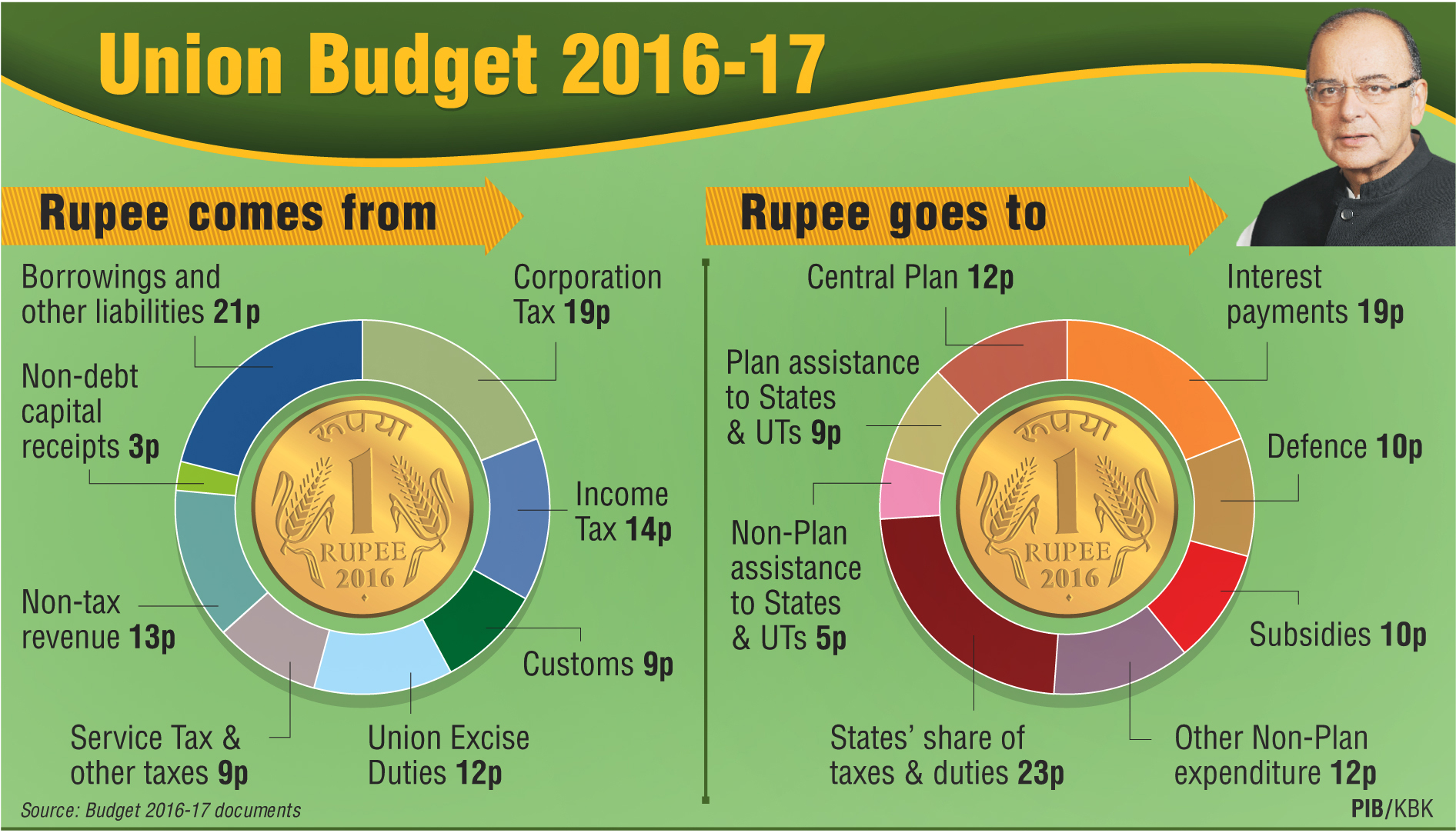
Budget is an important part of fiscal policy as revenue and expenditure statements are presented during the budget. Let’s understand in brief, where all the revenue comes from and where all the money goes.
Source-PIB
We can clearly see, among non debt creating receipts (not borrowings), maximum earning is from corporate tax followed by income tax.
Always remember these facts on revenue and expenditure side by heart
Non plan expenditure> Plan expenditure (more than double)
Interest payment>>subsidies and defense<subsidies and defense are almost equal. Every year including this year defense is budget higher amount but eventually, subsidies turn out to be higher during revised estimates>
Clearly it can be achieved in two ways, reduce spending or increase taxes or combination of two. Here we discuss one component of spending known as subsidy in some detail. Everyday we read about subsidy rationalization, cutting or increasing subsidies and passionate arguments on both sides.
So, What is subsidy?
In a layman’s term, it can be understood as converse of a tax in that using taxation government takes money from consumers while subsidy in effect transfer money from government to consumers.
For instance, taxes on grain would increase their market price from say 10 rs a kg to 12 rs a kg, in effect taking 2 rs from you for every kg of grain you buy. On the other hand subsidy under PDS would reduce price of grain from 10 rs to say 2rs in effect transferring 8 rs to your pocket. In this way, they are converse of indirect taxes.
When government directly transfers money in your bank account without any condition i.e. unconditional direct benefit transfer, subsidy becomes converse of direct taxes.
In India government (central and state) subsidize a lot of things from food to fertilizer to kerosene and LPG etc. Tax concessions can also be considered as implicit subsidy. Subsidies increase government spending and thus puts pressure on government finances.
So what’s the rationale for subsidy?
Like indirect taxes, subsidies can alter relative prices and budget constraints and thereby affect decisions concerning production, consumption and allocation of resources.
So purpose of subsidies is two fold-
Increasing consumption of items government considers important such as health, education, nutritious food etc or renewable energy in modern times.
Redistributive effect i.e. to provide minimum level of protection to the poor <welfare function, tax the rich, distribute in poor>
For objective one to be fulfilled government should subsidize merit goods.
What are merit goods?
A good which would be under-consumed (and under-produced) in the free market economy
But why are they under-consumed?
They are associated with positive externality i.e. they also benefit public but since consumers and producers will take account of only private benefits, they are likely to consume less than desired. For instance, consider education, not only a person is educated and earns more <private benefit> but more productive individual would also benefit society in the form of higher taxes <societal benefit>
For objective two (redistribution) to be achieved, subsidies should be well targeted i.e. reach the poor with minimal leakages. This requires proper targeting without which there would be inclusion errors (rich getting subsidy and exclusion errors (poor not getting subsidy). Exclusion errors are the worst since they direct affect the poor <kerosene meant for poor not reaching him, how will she light her house>
Subsidy rationalisation is this process of better targeting to weed out unintended beneficiaries as well as phasing out subsidies on non merit goods.
So, what are the adverse consequences of bad subsidies (non merit, not well targeted)?
Fiscal effects– directly increase fiscal deficit and thus total government debt <10% of total govt spending is for subsidies> <While golden rule of borrowing is, borrow to invest >
Allocative effects– result in inefficient resource allocation <producers will produce more of subsidized good even when not required>
perverse distributional effects endowing greater benefits on the better off people <subsidized diesel being used to run SUVs>
Shortages and black marketing <subsidized urea being diverted to non agricultural uses, scarcity leading to black marketing harms the poorest farmers the most>
Tendency to self-perpetuate. They create vested interests and acquire political hues <Exit problem discussed in economic survey chapter two, click here to read>
For instance, High MSP for wheat and rice and subsidized water and electricity illustrates all such effects, an example of bad bad subsidy.
Perverse distributional effects– better off farmers of Punjab and Haryana getting benefited<no procurement from eastern belt, poor farmers of Bihar, Jharkhand not getting benefits>
Fiscal effects– finances of central as well as state govt getting stretched, discoms in debt <high deficit # high debt # high interest cost # high deficit = vicious circle>
Allocative effects– pulses and oilseeds are not grown resulting in shortages <procurment only of grains, no incentive to produce pulses>
environmental effect– water table going down, soil getting salty and arid
Health effect– Groundwater pollution due to high fertilizer use, burning of husks resulting in air pollution
How subsidies distort the market (in a comical way) is best understood by Railway subsidies <Example from last year’s economic survey>
Govt subsidizes passenger fares resulting in losses. Railways cannot generate sufficient internal resources to finance capacity expansion investments;Result-Trains always run late, very slow services, whole economy becomes unproductive
Of course the passenger fare is cross subsidized by high freight tariffs . It results in diversion of freight traffic to road transport which is costlier. Result- not only financial and efficiency costs but also acute costs associated with emissions, traffic congestion, and road traffic accident (RTA) <And we all know passengers on two wheeler or those walking die the most in the RTA i.e. poorer segments of society>
High freight cost raises the cost of manufactured goods that all households, including the poor, consume. <subsidized passenger fare but costly goods, no one knows who gains who losses but these distortions decreases the overall efficiency and thus whole economy suffers.>
What’s the solution?
End perverse subsidies while investing in state capacity to deliver basic goods and merit goods such as health, education, skills etc. Incentivize research and development, environment friendly technologies etc. Borrow only to invest. Adhere to FRBM targets of zero revenue deficit.
JanDhan i.e. Bank accounts, Adhar i.e biometric identification and mobile i.e. mobile banking
It will result in direct transfer of money to bank account of beneficiaries and cut down leakages as intermediaries are removed.
Biometric authentication will remove ghost accounts i.e same person getting subsidy twice from two different names.
Mobile banking will give access to bank accounts for easy deposit and withdrawal
But problem of identification of beneficiaries still remains and it requires better and more robust data collection, publishing names of beneficiaries at gram panchayat level for people to raise objections, jan sunwai (public hearing),social audits and such transparency mechanisms
Pitfalls of DBT
Where transfers are unconditional, people may just spend money on desi liquor <objective of changing consumption pattern defeated>. For instance, if govt transferred 6000 rs to every pregnant women it’s possible that money will go in the bank account of husband and instead of better nutrition for pregnant lady, he will buy desi liquor.
solution- transfer money in the hand of oldest woman and provide her information so that she can take informed decision in the best interest of family
Conditional transfers might give rise to its own kind of corruption. For instance if money is transferred for check up by a nurse, she might demand bribe for certifying you indeed showed up for check up.
Private market may not exists for people to buy goods and services from the market. For instance, if PDS shops are closed, where would people buy ration from?
Banking infrastructure poor <as we saw in the JAM article, last mile banking access is jamming the JAM>
Real value of subsidy amount will be eroded with inflation. solution- link subsidy with CPI inflation. But generally food inflation higher than CPI, then what?
There is concern that biometric fingerprinting may not work for rural manual labourers.
what happens to corporate tax breaks and subsidies going to not so poor?Government decision to phase out corporate tax exemption while simultaneously bringing down tax rates down to 25% level is welcome in this regard.
It will remove major distortions and end favours to select few corporate groups
Government should rationalize subsidies so they are targeted better and use money thus made available to invest in physical and social infrastructure.In this way by rationalizing subsidies government can bring down fiscal deficit and overall debt level. Bringing fiscal deficit under control, reduces aggregate demand, this cooling down prices.
Now it’s time to solve some previous year IAS prelims questions
#1. The sales tax you pay while purchasing a toothpaste is a
tax imposed by the Central Government.
tax imposed by the Central Government but collected by the State Government
tax imposed by the State Government but collected by the Central Government
tax imposed and collected by the State Government
#2.To obtain full benefits of demographic dividend, what should India do?
Promoting skill development
Introducing more social security schemes
Reducing infant mortality rate
Privatization of higher education
#3. In India, deficit financing is used for raising resources for
economic development
redemption of public debt
adjusting the balance of payments
reducing the foreign debt
#4. There has been a persistent deficit budget year after year. Which of the following actions can be taken by the government to reduce the deficit?
Source-India.com
Actually I formulate monetary policy
In the last article we understood, although both inflation and deflation are bad for economy, deflation is worse and policymakers always have to guard against possible deflationary tendencies. In this respect, inflation becomes a necessaryevil. One of the major adverse effect of inflation is due to uncertainty it creates in the minds of investors and risk of hyperinflation. Policymakers therefore want low and stable inflation in the economy.
What that target level should be is decided either by parliament by law or informally by govt and central bank. As we saw inflation helps in labour market adjustment and as emerging economies undergo rapid transition, slightly higher inflation helps in that adjustment. For this reason. while inflation target is about 2% in developed economies, it is 4-5% in developing economies.
In India RBI and govt signed an agreement for long term inflation target of 4% with 2% range either side i.e. 2-6% inflation.
Earlier, there was no explicit target for inflation (no inflation targeting), RBI used to target multiple indicators as objectives of monetary policy
Source-financialeducation.greycaps.com
Inflation has been a perennial problem for India. As we saw inflation is due to demand supply mismatch i.e. demand for goods being higher than supply. To control inflation, monetary authority i.e. RBI formulates monetary policy.
What is monetary policy?
As the name suggests it is policy formulated by monetary authority i.e. central bank which happens to be RBI in case of India.
It deals with monetary i.e money matters i.e. affects money supply in the economy.
Eg. CRR,SLR,OMO,REPO etc
What is fiscal policy then?
It is formulated by finance ministry i.e. government. It deals with fiscal matters i.e. matters related to government revenues and expenditure.
Revenue matters- tax policies, non tax matters such as divestment, raising of loans, service charge etc
Expenditure matters– subsidies, salaries, pensions, money spent on creation of capital assets such as roads, bridges etc.
Monetary policy and fiscal policy together deal with inflation.
Source-econ100-powers
Demand pull inflation is when people have more money to buy goods. It is easier for RBI to control as it can decrease the money supply in the economy, less money would lead to fall in prices.
But supply side inflation can not be dealt with by RBI. RBI can’t build roads or change agri policies to ensure smooth movement of grains. It does not control prices of oil or other commodities. Here role of government through fiscal policy becomes important.
Let us now understand how RBI formulates monetary policy to control inflation
It’s clear from what we have learnt so far that to control inflation, RBI will have to decrease money supply or increase cost of fund so that people do not demand goods and services.
Tools available with RBI
Monetary Policy Tools
Quantitative tools or general tools- they affect money supply in entire economy- housing, automobile, manufacturing, agriculture- everything.
Reserve ratio- Banks have to set aside certain percentage of reserves as cash or RBI approved assets.
They are of two types
Cash Reserve Ratio (CRR)– as the name suggests, banks have to keep this proportion as cash with the RBI. Bank cannot lend it to anyone. Bank earns no interest rate or profit on this.Bank cannot lend it to anyone.
Statutory Liquidity Ratio (SLR)- As the name indicates banks have to set aside this much money into liquid assets such as gold or RBI approved securities mostly government securities. Banks earn interest on securities but as yield on govt securities is much lower banks earn that much less interest.
This reserve requirement is calculated on bank’s net demand (current and savings account) and time liabilities (Fixed deposits) which is roughly equivalent to total bank deposits.
At present CRR is 4% and SLR is 21.50% . But what if RBI tomorrow raised CRR or SLR, what would be it’s impact.
Consider this-
Total deposits
CRR (parking with RBI) No interest here
SLR (Investment in liquid assets mainly govt securities)
Amount available for lending
100
4
21.50
74.50
100
5
21.50
73.50
100
4
22.50
73.50
Consider interest rate as price for a commodity called money/ cash and apply demand supply principle of less commodity, higher prices i.e less money, higher interest rates
Less money with the banks # demand for money same # apply demand supply principle # interest rate will rise # costlier for you and I to borrow money to buy car # demand for car down # apply demand supply principle # cost of car will come down
Similarly business will borrow less # less expansion of business activity # wages will come down # less money with people # less demand for goods # prices wall
Net effect is that interest rate rises and prices fall.
What is dear money policy or contractionary monetary policy?
Money becomes costlier when interest rate rises and when RBI makes money to become costlier or dearer, it is said to be following dear money policy. As money supply decreases in the economy, i.e. contraction in money supply, it is also known as contractionary monetary policy.
What are the negative effects of dear money policy?
Businesses postpone expansion due to high cost of credit and investment comes down in the economy which drags down growth rates and hurts employment. That’s the reason why corporates and government always clamour for policies which lead to interest rate cuts such as reduction in CRR, SLR. Investment is thus negatively correlated with higher interest rates.
2. Open market operations (OMO)– As the name indicates this refers to operations conducted by the RBI in open market i.e. RBI does not directly ask banks to do anything. In this policy, RBI buys and sells government securities in the open market to control money supply.
We talked about government security in SLR as well, what is this government security?
Govt security is a type of debt instrument on which govt pays regular interest. As chances of default on govt securities is practically zero, they are also called gilt-edges securities.
What happens when RBI sells government securities?
Consider this-
Total deposits at present
OMO
Banks govt securities worth
Amount available for lending
100
none
20
80
100
RBI sells secuties worth 10 rs, banks buy
20+10
100-(20+10) =70
100
RBI buys govt securities worth 10rs
20-10
90
You can clearly observe that amount available for lending has come down i.e. money supply has contracted.
money going from the banks to the RBI # less money with the banks # dear money # higher interest rates # costlier for us to borrow to buy cars # less demand for cars # prices decrease
In effect, govt securities increases with banks when RBI sells govt securities.
Doesn’t this look eerily similar to phenomenon when RBI raises SLR, only difference being then banks were forced to raise their holding of securities. This way RBI suck out liquidity from the market.
Opposite happens when RBI buy securities, it then injects liquidity in the market.
So basically to control inflation, RBI will sell securities and suck out liquidity from the market.
OMOs are used more to control temporary mismatches in liquidity due to foreign capital flow, a policy known as sterilization.
Let’s understand sterilization
Consider this-
Total money supply at present
Net Foreign Investment
Investors convert $ into rs to invest in INDIA
Eventual money supply
1000
0
0
0
1000
1$ = 67rs
67
1000+67=1067
When foreign investors invest in Indian economy, they buy rupees and sell dollars. RBI absorbs dollars and issues rupees. Net effect is that rupee supply or liquidity is increased in the economy. Higher liquidity or money supply chasing similar amount of goods will lead to inflation. RBI has to suck out excess liquidity from the market i.e. sterilize economy from capital flows.
What RBI would do
Undertake OMOs and sell government securities.
Total money supply before foreign investment
Net Foreign Investment
Money supply after foreign investment
RBI’s response
Money supply
1000
1$ = 67rs
1067
Sell govt securities
Less than 1067
Note that I didn’t mention RBI would bring money supply to 1000 as with FDI, productive capacity would rise and to that extent goods worth say 1020 may be manufactured in INDIA and in that scenario to keep inflation stable, RBI needs to sell securities worth 20rs only. What would be the actual growth is essentially a data dependent judgement call.
When investors bring back their money, they will sell rupees and buy dollars. RBI will absorb rupees resulting in less liquidity in the market. To adjust this RBI will buy govt securities and inject liquidity in the market.
RBI uses another instrument to keep the liquidity intact, it is known as Market Stabilization Scheme (MSS).
3.Policy rates
Bank rate– When banks borrow long term funds from RBI. They’ve to pay this much interest rate to RBI.
At present bank rate is 7.75%. Bank rate is not the main tool to control money supply these days. Nowadays, RBI uses LAF ( liquidity adjustment facility) Repo rate as the main tool, to control money supply.
What’s the use of Bank rate then?
Penal rates are linked with Bank rate. For example, If a bank doesn’t maintain CRR, SLR as per the prescribed limit, penalty is prescribed as per bank rate.
It’s clear if RBI raises bank rate, costlier for banks to borrow from RBI # interest rate rises # repeat same story # costlier for you and I to borrow money to buy car # demand for car down # apply demand supply principle # cost of car will come down
What is Liquidity Adjustment Facility (LAF)
It’s evident from the name that RBI uses such instruments to adjust liquidity and money supply.
#1. REPO rate – REpurcahse OBligation
Rate at which banks buy from RBI on a short term basis.
What do they have to repurchase?
Banks have to put govt. securities as collateral and buy those securities back at the end of prescribed period, generally overnight
Banks can not use securities from SLR as collateral
On the Urjit Patel Committee’s recommendation — that the RBI stop fixing the repo rate in its quarterly reviews, and instead move to rate-setting on an ongoing basis, RBI started auctioning 7 day and 14 days term repo. In term repo, rate is market determined unlike overnight repo where RBI decides rate. Also RBI has restricted access to overnight repo to .25% on NDTL.
Clearly if RBI raises repo # costlier for banks to borrow # interest rate rises # repeat same story # costlier for you and I to borrow money to buy car # demand for car down # apply demand supply principle # cost of car will come down
#2. Reverse Repo as the name suggests is reverse of repo i.e. rate RBI pays to banks to park excess funds into RBI.
Reverse repo is linked to repo with,
Reverse repo = repo – 1
#3. Marginal Standing facility–
Penal rate at which banks can borrow money from the central bank over and above what is available to them through the rep window.
It is penal rate, hence REPO + 1
Reverse Repo + 1 = REPO; REPO + 1 = MSF
Under MSF banks can use up to 1% of securities from SLR.
Let’s recap all this. To control inflation RBI will follow dear or contractionary monetary policy to reduce money supply in the economy. It will increase reserve ratios (CRR,SLR), sell government securities under OMOs or raise various rates such as REPO, MSF, Bank rates etc.
But we see in India, even when RBI decreases rates banks don’t pass on the benefits to consumers and when banks raise interest rates when RBI raises rates, inflation does not come down. This suggest monetary policy is highly ineffective in India.
Monetary Policy Transmission Conundrum
Why banks don’t pass on the benefits of rate cut to consumers?
RBI cut repo rate by 125bp last year but banks decreased lending rate only by 60bp.
RBI is not the main or even prominent money supplier for banks but Retail savers are so RBI rate cuts do not affect cost of funds much for the banks
Deposits rates are mostly fixed and can not be reduced, only subsequent deposit rates can be reduced. i.e. If i have deposited 100 rs in FD for 5 years, banks will have to pay me 8% interest for next 5 years no matter whether RBI cuts rates or not
Small saving instruments such as PPF, Post office accounts have highadministered interest rates. If banks cut deposit rates below those rates, customers will shift to those instruments and banks will lose out on funds
Banks as we all know are under stress. Keeping lending rates high increases their profit margins
No well developed corporate bond market in India. Corporate have no choice but to come to banks to borrow
Government and RBI’s response to improve monetary transmission
Government has decided to reduce interest rates on small saving accounts. Permanent solution would be to link small savings rates to bank rate
RBI has asked banks to shift methodology of calculation of base rate to marginal cost of funds from average cost of funds at present<marginal cost is the cost of every extra unit of fund> <What is base rate? How will shift to marginal cost of funding promote transparency in base rate calculation and help consumers? Answer in the comments>
But why is RBI unable to control inflation even when banks immediately raise lending rates?
Supply side issues not under RBI control- bottlenecks in agri marketing, high prices of crude oil, failure of monsoon etc.
Higher government fiscal deficit
Non-Monetized economy: in rural areas, many transactions are still of barter nature
Lack of financial inclusion. Since most people are not in the banking net. They rely on Shroffs and moneylenders. Obviously moneylenders won’t listen to RBI
Black money and cash economy
We have talked about quantitative tools so far but RBI also has some qualitative tools in its kitty which are not important for exams. So in brief
What are the qualitative tools?
They are Selective tools- can affect money supply in a specific sector of economy unlike general quantitative tools which affect money supply in the whole economy.
Margin Requirements- RBI can prescribe margin against collateral. For instance, lend only 70 rs for 100 rs value gold, margin requirement being 30%. Obviously if RBI raises margin requirement, customers will be able to borrow less.
Moral suasion– RBI persuade banks to park money in govt securities instead of certain sectors.
Selective credit control– Don’ loan to theses industries or to speculative businesses
Issue of autonomy of RBI
By now we have understood that govt and corporate are more interested in low interest rates which support investment and growth while primary task of RBI is to control inflation, keeping prices stable and thus protecting purchasingpower of money. This is not to say that govt and corporate do not want low inflation, they do but their primary focus lie elsewhere. It is in this context that autonomy of RBI to decide on monetary policy matters becomes so important.
At present sole authority vests with RBI governor who is advised by a technical expert committee whose advice is not binding. Government intends to replace it with a monetary policy committee (recommended by FSLRC and Urjit Patel committee and followed in many countries) with members both from within and outside RBI.
Two important questions arise-
Composition of such a committee- for autonomy it is important to have either RBI members majority or equal numbers from both sides with governor exercising a casting vote (just like speaker does in LokSabha). Having outside majority does seem to impinge on autonomy of RBI.
Veto of governor– If governor is given veto power, it changes nothing. Even now, there’s a committee but it’s deliberations are only academic. If governor can’t convince his own committee of desirability of policy stance he advocates, he would seem to be on a weaker wicket.
Ideal committee would be one with RBI majority or equal members with casting vote with the governor without any veto. This along with explicit inflation target would give enough autonomy to go along with accountability.
To follow the story of Monetary Policy Committee and Autonomy of RBI, click here
UPSC ke sawaal
#1. With reference to inflation in India, which of the following statements is correct?
(a) Controlling the inflation in India is the responsibility of the Government of India only
(b) The Reserve Bank of India has no role in controlling the inflation
(c) Decreased money circulation helps in controlling the inflation
(d) Increased money circulation helps in controlling the inflation
#2. Which one of the following is likely to be the most inflationary in its effect?
Repayment of public debt
Borrowing from the public to finance a budget deficit
Borrowing from banks to finance a budget deficit
Creating new money to finance a budget deficit
#3. A rise in general level of prices may be caused by
an increase in the money supply
a decrease in the aggregate level of output
an increase in the effective demand
Select the correct answer using the codes given below.
1 only
1 and 2 only
2 and 3 only
1, 2 and 3
#4. With reference to Indian economy, consider the following:
Bank rate
Open market operations
Public debt
Public revenue
Which of the above is/are component/components of Monetary Policy?
(a) 1 only
(b) 2, 3 and 4
(c) 1 and 2
(d) 1, 3 and 4
#5. When the Reserve Bank of India reduces the Statutory Liquidity Ratio by 50 basis points, which of the following is likely to happen?
(a) India’s GDP growth rate increases drastically
(b) Foreign Institutional Investors may bring more capital into our country
(c) Scheduled Commercial Banks may cut their lending rates
(d) It may drastically reduce the liquidity to the banking, system
#6. Supply of money remaining the same when there is an increase in demand for money, there will be
a fall in the level of prices
an increase in the rate of interest
a decrease in the rate of interest
an increase in the level of income and employment
#7. If the interest rate is decreased in an economy, it will
decrease the consumption expenditure in the economy
increase the tax collection of the Government
increase the investment expenditure in the economy
increase the total savings in the economy
#8. In the context of Indian economy; which of the following is/are the purpose/purposes of ‘Statutory Reserve Requirements’?
To enable the Central Bank to control the amount of advances the banks can create
To make the people’s deposits with banks safe and liquid
To prevent the commercial banks from making excessive profits
To force the banks to have sufficient vault cash to meet their day-to-day requirements
#9. An increase in the Bank Rate generally indicates that the
Market rate of interest is likely to fall
Central Bank is no longer making loans to commercial banks
Central Bank is following an easy money policy
Central Bank is following a tight money policy
#10. The Reserve Bank of India (RBI) acts as a bankers‘ bank. This would imply which of the following?
1 Other bank retains their deposits with the RBI.
2 The RBI lends funds to the commercial banks in times of need.
3 The RBI advises the commercial banks on monetary matters.
Select the correct answer using the codes given below:
a )2 and 3 only
b )1 and 2 only
c )1 and 3 only
d )1, 2 and 3
#11. Which of the following is/are long term policy tools
Repo
Reverse repo
Marginal Standing Facility
Bank rate
Select the correct response
A 1,4
B 1,3,4
C 4 only
D all
#12. Which of the following measures would result in an increase in the money supply in the economy?
Purchase of govt securities from the public by the central bank
Deposit of currency in commercial banks by the public
borrowing by the govt. from the central bank
Sale of govt. securities to the public by the central bank
World Bank is a vital source of financial and technical assistance to developing countries around the world. This is not only a bank in the ordinary sense but a unique partnership to reduce poverty and support development.
When? 1944
Headquarter: Washington, D.C.
Publications- global economic prospects, Ease of doing business index
There are 2 goals for the world to achieve by 2030 –
End extreme poverty by decreasing the percentage of people living on less than $1.90 a day to no more than 3%
Promote shared prosperity by fostering the income growth of the bottom 40% for every country
World Bank Group is not just World bank but comprises of 5 institutions managed by their member countries
These 5 institutions are as follows –
International Bank for Reconstruction and Development (IBRD)- Commonly known as the world bank. It is the single largest provider of development loans
International Development Association (IDA) – assists the poorest countries
International Finance Corporation (IFC) – supports private enterprise in developing countries.
Multilateral Investment Guarantee Agency (MIGA) – offers investors insurance against non-commercial risk and help developing country governments attract foreign investment <non commercial risks such as political instability, govt deciding to nationalise a private business etc.>
International Centre for the Settlement of Investment Disputes (ICSID) – encourages the flow of foreign investment to developing countries through arbitration and conciliation facilities
Except for ICSID, India is member of other four groups<We don’t like external interference such as arbitration in our decision making process, hence not the member of ICSID>
<India is one of the founder members of IBRD, IDA and IFC>
So, we will discuss this 3 institutions in detail, as are important for India –
International Bank for Reconstruction and Development (IBRD) (world bank)
IBRD provides loans and other assistance primarily to middle income and poor but credit worthy countries at interest rates slightly lower than that offered by other financial institutions but with long term maturity<countries which have the capacity to repay the loan amount with interest>
Members: 188
Origins: IBRD as the name suggest was created in 1944 to help Europe reconstruct/ rebuild after World War II. To be a member of IBRD, a country has t join IMF first.
Main function:
Long-term capital assistance to its member-countries for their reconstruction and development
It works closely with the rest of the World Bank Group to help developing countries reduce poverty, promote economic growth, and build prosperity.
Other functions of IBRD Bank –
Supports long-term human and social development that private creditors do not finance
Preserves borrowers’ financial strength by providing support in times of crisis, when poor people are most adversely affected
Promotes policy and institutional reforms (such as safety net or anti-corruption reforms)
Creates a favorable investment climate to catalyze the provision of private capital
Facilitates access to financial markets often at more favorable terms than members can achieve on their own
Resources of the Bank consist of the capital and borrowings.
Before granting or guaranteeing a loan, the Bank considers the following matters –
merit of the proposal
The borrower has reasonable prospect for repayment i.e. credit worthiness
The loan is meant for productive purposes and to finance foreign exchange requirements of specific projects of reconstruction and development.
How is IBRD financed?
Simple as other banks are financed; float bonds in world financial markets. In fact, in these markets, IBRD is known simply as the World Bank
shareholder are member states with governments paying in about $14 billion in capital in proportion to their IMF quota
IBRD has maintained a triple-A rating since 1959. Its high credit rating allows it to borrow at low cost and offer middle-income developing countries access to capital on favorable terms in larger volumes, with longer maturities <What is a credit rating? How is it determined? What is the effect of a good or bad credit rating on the prospects of countries and corporations? Answer in the comments.>
IBRD earns income every year from the return on its equity and from the small margin it makes on lending
This pays for IBRD’s operating expenses, goes into reserves to strengthen the balance sheet, and provides an annual transfer of funds to IDA, the fund for the poorest countries
India and the IBRD
India is the founder-banker of the Bank
Bank has not been merely a lending institution to India but has also served as a worthy counsel whom India has approached for advice in difficulties
India has been the single largest borrower of the Bank
Main sectors for which IBRD assistance of US$ 3049 million has been provided are roads & highways, energy, urban infrastructure (including water & sanitation), rural credit, disaster management and the financial services sector
The Bank has also been instrumental in the establishment of the India Development Forum, a consortium of donor nations to India.
The massive financial assistance pledged by the consortium members has been the largest aid commitment and is a landmark in the history of development aid from developed countries to developing countries.
International Development Association (IDA)
IDA is the part of the World Bank that helps the world’s poorest countries
When? 1960
Aim: To reduce poverty by providing loans (called “credits”) and grants for programs that boost economic growth, reduce inequalities, and improve people’s living conditions.
Main Functions of IDA:
IDA provides loans which are practically interest-free and for longer periods. Therefore, it is often referred to as the ‘soft loan window’ of the Bank.
Only the poorest of the poor member countries (with per capita income below $1215 in 2016) are eligible for assistance.
IDA complements the World Bank’s original lending arm, International Bank for Reconstruction and Development (IBRD)
Structure of lending and credits by IDA
IDA lends money on concessional terms. This means that IDA credits have a zero or very low interest charge and repayments are stretched over 25 to 38 years, including a 5- to 10-year grace period
IDA also provides grants to countries at risk of debt distress <grants are donations i.e. not to be rapid>
In addition to concessional loans and grants, IDA provides significant levels of debt relief through the Heavily Indebted Poor Countries (HIPC) Initiative and the Multilateral Debt Relief Initiative (MDRI)
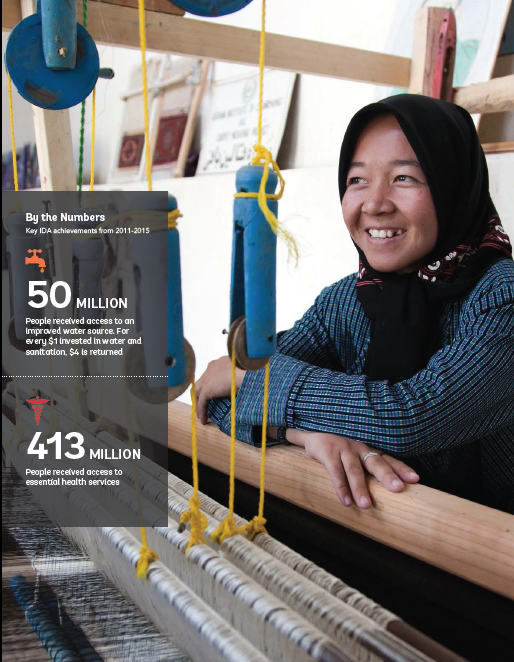
IDA is a multi-issue institution, supporting a range of development activities, such as primary education, basic health services, clean water and sanitation, agriculture, business climate improvements, infrastructure, and institutional reforms
These interventions pave the way toward equality, economic growth, job creation, higher incomes, and better living conditions
Borrowers of IDA
77 countries (plus India) are currently eligible to receive IDA resources
Eligibility for IDA support depends first and foremost on a country’s relative poverty, defined as gross national income (GNI) per capita below $1,215 in fiscal year 2016
IDA also supports a number of countries, including several small island economies, which are above the operational cutoff but lack the creditworthiness needed to borrow from IBRD
Some countries, such as Vietnam and Pakistan, are IDA-eligible based on per capita income levels, but are also creditworthy for some IBRD borrowing. They are referred to as “blend” countries <receive loans from bot IDA and IBRD; India is also one such country>
Roadmap ahead for IDA
Today’s fiscal environment presents challenges for all those involved in development from borrowing countries to donors<funds are simply not available after financial crisis>
The new Sustainable Development Goals (SDGs) present a critical opportunity to end extreme poverty. That would need strong commitment and financing to meet the goals
A number of countries are expected to exceed IDA’s per capita income threshold in the next decade, it is also clear that these countries will continue to be home to millions of poor people who will still need extensive support, particularly during the transition period from concessional to harder lending terms
As the main instrument for implementing the global goals in the poorest countries, IDA will need to shift toward increasingly innovative approaches to deliver trans-formative results
India has exceeded IDA’s per capita income threshold of 1260$ and is thus technically not eligible to tap IDA window but India campaigned to extend the tenure of India’s concessional loans by several more years (till 2022), given the country’s high poverty levels and WB decided to continue it’s IDA concessional lending in view of 300m people living below poverty line.
International Finance Corporation (IFC)
Largest global development institution focused exclusively on the private sector in developing countries
When? 1956
Members: 184
Objectives of the IFC
To further economic development by encouraging growth of private enterprise in member-countries
Invests in private enterprise in member-countries in association with private investors and without Government guarantee, in cases where sufficient private capital is not available on reasonable terms
Seeks to bring together investment opportunities, private capital of both foreign and domestic origin, and experienced management
Stimulates conditions conducive to the flow of private capital – domestic and foreign – into productive investments in member-countries
IFC investment normally does not exceed 40% of the total investment of the enterprise
In case of its investment by equity participation, it does not exceed 25% of the share capital
IFC and India
IFC makes strategic investments and advisory interventions to promote inclusive growth, help address climate change impacts, and encourage global and regional integration
In India, IFC is sharpening its focus on increasing access to energy, finance and healthcare; providing sustainable infrastructure; and boosting regional linkages
Focus Areas –
Building infrastructure
Facilitating renewable energy generation
Promoting cleaner production, energy and water efficiency
Supporting agriculture for improved food security
Creating growth opportunities for small businesses
Helping reform investment climate
Let’s take a look at India-IFC ties
Since 1956, IFC has invested in 346 companies in India, providing over $10.3 billion in financing for its own account and $2.9 billion in mobilization from external resources
IFC’s committed portfolio in India is nearly $4.7 billion<India has IFC’s largest portfolio exposure>
In FY14, IFC committed nearly $1.2 billion across 34 projects in India
IFC also has a strong advisory program in India with a total portfolio value of $62 million across 74 projects.
In FY14, three quarters of IFC’s advisory program had a footprint in India’s priority states
IFC also issue India’s first masala bonds to tap in foreign funding in local currency. similar IFC also issued first green masala bonds to raise investments to deal with climate change. Want to know what is masala bond, click here to read more
Concerns around World Bank lending and reform of World Bank
As we learnt in the earlier part on Bretton Woods institution that main concern is around conditionalities and impact of world bank funded infrastructure projects on local population<displacement, loss of jobs etc.>
The Bank’s undemocratic governance structure – which is dominated by industrialised countries – and its privileging of the private sector
the Bank’s private sector lending arm (IFC) has been criticised for its business model<increasing use of financial intermediaries such as private equity funds and funding of companies associated with tax havens>
World bank recently announced that it would not fund coal technologies for climate change reasons, it would make task of investing in clean coal technologies difficult for countries such as India
Reforms
World bank’s governing structure need to be made more democratic
Developing countries should be given a chance to shape the agenda
There should be more transparency on the issues that come to the table
More resources(increase the capital base) need to be put in so that it continue lending to poorer countries
Let’s revise World Bank in brief
Name
Main Function
Comment
IBRD (WB)
Infrastructure loan to poor middle income but credit worthy countries at just below market rates
India founder member, largest recipient of loan
IDA
Soft loan at virtually zero rate for poverty eradication to poorest countries
India founder largest recipient, has crossed the per capita threshold for funding but will continue to receive IDA funds
IFC
Private sector arm of WB group, supports private enterprises in developing countries
India founder, IFC launched India’s offshore masala bond
MIGA
Provide guarantee to investors against non-commercial political risk
India not founding member
ICSID
Resolve disputes through arbitration and conciliation
India not a member
UPSC ke Sawal
#1. Which one of the following groups of items is included in India’s foreign-exchange reserves? (IAS pre 2013)
Foreign-currency assets, Special Drawing Rights (SDRs) and loans from foreign countries
Foreign-currency assets, gold holdings of the RBI and SDRs
Foreign-currency assets, loans from the World Bank and SDRs
Foreign-currency assets, gold holdings of the RBI and loans from the World Bank
#2. ‘BioCarbon Fund Initiative for Sustain- able Forest Landscapes’ is managed by the (IAS pre 2015)
(a) Asian Development Bank
(b) International Monetary Fund
(c) United Nations Environment Programme
(d) World Bank
#3. The price of any currency in international market is decided by the (ias pre 2012)
World Bank
demand for goods/services provided by the country concerned
stability of the government of the concerned country
economic potential of the country in question
Which of the statements given above are correct?
(a) 1, 2, 3 and 4
(b) 2 and 3 only
(c) 3 and 4 only
(d) 1 and 4 only
#1. The World Bank and the IMF, collectively known as the Bretton Woods Institutions, are the two inter-governmental pillars supporting the structure of the world’s economic and financial order. Superficially, the World Bank and the IMF exhibit many common characteristics, yet their role, functions and mandate are distinctly different. Elucidate. (IAS mains 2013)
This was the first example of a fully negotiated monetary order intended to govern monetary relations among independent nation-states.
Where?
In Bretton Woods, New Hampshire in 1944 during the United Nations Monetary and Financial Conference at the Mount Washington Hotel <That’s why IMF and World Bank are known as Bretton Woods twins>
The aim was to help rebuild the shattered post-war economy ( WW2 had just finished in 1945) and to promote international economic cooperation.
Origins of Bretton Woods
Political origin lies in 2 key conditions –
Shared experiences of 2 World Wars, with the sense that failure to deal with economic problems after the first war had led to the second <Treaty of Versailles demanding massive reparation amount from Germany being the cause of collapse of German economy and Hitler’s rise to power>
The concentration of power in a small number of states (US and Western Europe)
Members of Bretton Woods Family aka Bretton Woods Twins
#1. International Monetary Fund(IMF) – To maintain global financial stability through technical assistance, training, and loans to member states to tide over short term balance of payment crisis
#2. World Bank (WB) Group – Consisting of 5 agencies which provides vital financial and technical assistance to developing countries around the world to reduce global poverty
Remember that WTO has nothing to so with Bretton Woods. It officially commenced only in 1995 under the Marrakesh agreement and replace General Agreement on Tariff and trade (GATT)
Propounder of the idea of IMF and WB group:
Trio of – US Treasury Secretary Henry Morgenthau, his chief economic advisor Harry Dexter White, and British economist John Maynard Keynes.
What are some of the concerns and criticism about Bretton Woods twins?
Critics of the World Bank and the IMF are concerned about the conditionalities imposed on borrower countries
The World Bank and the IMF often attach loan conditionalities based on what is termed the ‘Washington Consensus’, focusing on liberalisation of trade, investment and privatisation of nationalised industries <so if India asked for funds from IMF, it might ask India to allow FDI in multi brand retail, to end system of minimum support prices in agriculture, privatize coal India etc.>
Many infrastructure projects financed by the WB Group have social and environmental implications for the populations in the affected areas
For example, World Bank-funded construction of hydroelectric dams in various countries has resulted in the displacement of indigenous peoples of the area
Criticisms against the governance structures which are dominated by industrialized countries <unwritten rule that president of World Bank will be from USA and Managing Director of IMF from Europe.> Otherwise who is more qualified than Rajan Bhai to become MD of IMF
Decisions are made and policies implemented by leading industrialized countries, the G7, because they represent the largest donors without much consultation with poor and developing countries < Countries which would utilize that assistance not even consulted, you see the irony>
Let’s have a look at Bretton Woods organisations in brief
#1. International Monetary Fund (IMF)
Source-IMF
Fundamental mission is to ensure the stability of the international monetary system.
It does so in 3 ways:
Keeping track of the global economy and the economies of member countries (surveillance role)
Lending to countries with balance of payments difficulties (Lending role)
Giving practical help to members (technical assistance role)
When? 1944
Membership: 188 countries
Headquarters: Washington, D.C.
Publication- World Economic outlook, Global Financial Stability Report
Objectives:
Promote international monetary cooperation
Facilitate the expansion and balanced growth of international trade;
Promote exchange stability
Assist in the establishment of a multilateral system of payments
Make resources available (with adequate safeguards) to members
experiencing balance of payments difficulties
Functioning of IMF comes under 3 Mains types –
Surveillance –
This involves the monitoring of economic and financial developments and the provision of policy advice , aimed especially at crisis-prevention.
<Surveillance is the process of appraisal of the exchange rate policies of member countries. In the absence of surveillance, the financial volatility in the world today can become worse>
We all know, how good it’s surveillance is. It failed to predict worse it failed to even recognize the stress in the system which led to financial crisis of 2008. It again failed with the prediction of euro-zone crisis.
Lending –
The IMF also to countries with balance of payments difficulties, to provide temporary financing and to support policies aimed at correcting the underlying problems, loans to low-income countries are also aimed esp. at poverty reduction <most criticized part, riddled with commonalities we discussed above>
Technical Assistance –
The IMF provides countries with technical assistance and training in its areas of expertise, which it calls capacity development
Obviously IMF would need money to perform all these functions. Money is contributed by member states and each country’s contribution is fixed in terms of it’s quota.
Let’s learn about Member’s Quota in IMF –
Quota represents the subscription by a member country to the capital fund of the IMF i.e it’s contribution to the IMF
the quota also forms the basis for determining its drawing rights from the IMF <simple, more you contribute, more you can withdraw at the time of crisis, fair point>
But the quota also determines voting power i.e. if 10% quota, your vote will carry 10% weight <this seems very undemocratic, gives all the power to rich countries or is it just fair, private companies mein bhi to same hi hota hai, jitni equity, utna vote>
But how is quota of each country calculated?
Quota is calculated using a quota formula
The current Quota formula is a weighted average of GDP (50%), openness (30 %), economic variability (15%), and international reserves (5%)
In the GDP category, weight of GDP at market exchange rate is 60% and at purchasing power parity rate (PPP) is 40% <developing countries GDP is more in PPP terms and they want the IMF to change the formula to give greater weightage to GDP at PPP plus frequent revision of quotas as they grow faster>
The largest share of 17.5 per cent belongs to the USA, while the smallest share belongs to Palau (0.001 per cent) <now think what can tiny Palau do at IMF>
Any change in quotas must be approved by 85% voting power i.e USA with more than 15% quota holds virtual veto over all such decisions <now compare power of US with tiny Palau at IMF>
25% of a country’s quota is to be contributed in the form of SDRs or foreign exchange and 75 per cent in the country’s own currency.
What is this Special Drawing Rights or SDR?
Bretton Woods established an international monetary system of fixed exchange rates pegged to dollar which was roughly pegged to gold known as gold exchange standard i.e. for every unit of currency fixed amount of dollars could be bought and with those dollars fixed amount of gold.
But with high trade growth in world resources did not keep pace with the growth in international trade because there simply wasn’t enough gold. World needed some other asset to supplement shortfall in dollar and gold and IMF brougth in SDR. But in 1971 gold standard and dollar peg collapsed and world moved to flexible exchange rate system. Role of SDR as international reserve asset diminished.
The value of the SDR is based on a basket of key international currencies (weighted avg value). With the addition of Renminbi, 5 currencies, dollar, yen, euro and pound-sterling form the SDR basket. (Renminbi value will be taken into account from Oct 1, 2016 only)
Please remember that SDR is not a currency i.e it is not a claim on the IMF. On the other hand, SDR is a claim on the countries whose currency is included in the SDR basket.(claim as is written on your 500 rs note with Rajan’s signature: I promise to pay the bearer the sum of 500 rupees)
Now, it has primarily become a unit of account i.e. IMF record keeping is done in SDR, Quotas are allocated in SDR.
SDRs are entitlements granted to member-countries enabling them to draw from the IMF apart from their quota. It is similar to a bank granting a credit limit to the customer
When SDRs are allocated the country’s Special Drawing Account with the IMF is credited with the amount of the allotment
Originally, SDRs were to be utilised only for meeting BOP difficulties. But as a consequence of endeavours to make it an international unit of account, the use of SDRs has been liberalised
Current Position of SDR:
Now SDRs can be used directly among the members without the approval of the IMF
A country may swap SDRs with another country to acquire a currency it desires. SDRs may be utilised to pay charges to IMF
SDR has gained importance both as a reserve asset and as a unit of settlement of international transactions. Some countries have pegged their currencies to SDR.
Reforming the IMF
Role of IMF was criticized for following reasons –
One size fits all policy under which it gives the same recipe for all ills
Conditionalities that go with the loans that it disburses demand that spending on poor be curtailed <privatize your industries, stop subsidies, open up your markets etc.>
The private international flows are huge and in comparison, the IMF resource base is small and so is rendered ineffective
IMF MD is invariably from a European country, so India and other emerging markets are demanding that it should not be geographically confined and be merit – based
India wants that its economic power as it is emerging should be recognised and so is given greater voting rights
IMF failed to predict the global recession in 2008-09, let alone prevent it with its surveillance mode
IMF recently passed long standing reform of changing quota share of member countries after US Senate withdrew its virtual veto. A few points
With this structural shift, more than 6 % of the quota, including both the Fund’s capital and voting rights, have been transferred from developed to emerging economies
India’s voting rights increase to 2.6 per cent from the current 2.3 per cent, and China’s, to 6 per cent from 3.8, as per the new division.
All the directors on IMF board will now be elected and developed countries will not be able to nominate (earlier Europeans and US used to nominate up to 4 members to the board)
Total resource base of IMF has doubled
To follow the newscards related to IMF as they are pushed, follow this story, IMF and India
India and the IMF equation –
India and IMF have had an amicable relationship, which has beneficial for both. IMF has provided India with loans over the years and this has helped the country in times of Balance Of Payments (BOP) crisis pressure
India joined the IMF in 1945, as one of the original founding members
IMF credit has been instrumental in helping India respond to emerging BOP problems on 2 occasions
In 1981-82, India borrowed SDR 3.9 billion
In 1991-93, India borrowed a total 2.2 billion under 2 stand by arrangements, and in 1991 it borrowed SDR 1.4 billion under Compensatory Financing Facility
As a member of the Fund, India has derived following benefits:
Foreign Exchange for Meeting BOP Deficits:
Such drawings of foreign exchange have enabled the country to tide over the acute foreign exchange crisis and to maintain the imports of essentials goods
Oil Facility from the IMF:
India resorted to drawals from the IMF under the Oil Facility created in June, 1974 to meet larger outlays for the import of petroleum crude.
Assistance under SDRs:
The SDRs provide unconditional liquidity since the participants have access to foreign exchange resources at will.
The country has made use of the Fund’s facilities a number of time Aid from the World Bank: The country’s membership of the IMF has entitled it to become a member of the World Bank; as a member of the Bank, India has received large technical and financial assistance for the various development projects
Assistance under the Extended Credit Facility: Loan under this facility is contracted at softer terms but there is a serious conditionality clause attached to it
Preparation of Valuable Reports: The country has availed the services of the specialists in the Fund for the purpose of assessing the state of the Indian economy and for preparing valuable reports on various aspects of the economy.
<We will take World Bank group, a part of bretton woods institutions in next article of this series>
UPSC ke sawaal
#1. Which one of the following groups of items is included in India’s foreign-exchange reserves? (IAS pre 2013)
Foreign-currency assets, Special Drawing Rights (SDRs) and loans from foreign countries
Foreign-currency assets, gold holdings of the RBI and SDRs
Foreign-currency assets, loans from the World Bank and SDRs
Foreign-currency assets, gold holdings of the RBI and loans from the World Bank
#2, Regarding the international monetary fund, which one of the following statements is correct ?
(a) It can grant to any country.
(b) It can grant loans to only developed countries.
(c) It grants loans to only member countries.
(d) It can grant loans to the central bank of a country.
#3.Which of the following organizations brings out the publication known as ‘World Economic Outlook’? (IAS pre 2014)
(a) The International Monetary Fund
(b) The United Nations Development Programme
(c) The World Economic Forum
(d) The World Bank
#4. The World Bank and the IMF, collectively known as the Bretton Woods Institutions, are the two inter-governmental pillars supporting the structure of the world’s economic and financial order. Superficially, the World Bank and the IMF exhibit many common characteristics, yet their role, functions and mandate are distinctly different. Elucidate. (Mains 2013)
First established as Indian Ocean Rim Initiative in Mauritius on March 1995 and formally launched in 1997 by the conclusion of a multilateral treaty known as the Charter of the Indian Ocean Rim Association for Regional Cooperation.
It is based on the principles of Open Regionalism for strengthening Economic Cooperation particularly on Trade Facilitation and Investment, Promotion as well as Social Development of the region.
Members:
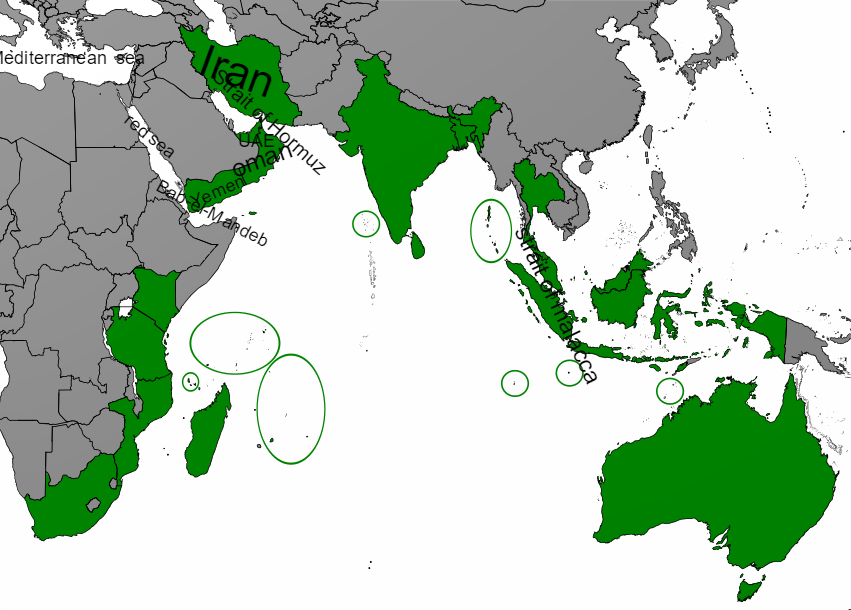
20 member states (including India) and 7 dialogue partners, the Indian Ocean Tourism Organisation and the Indian Ocean Research Group has observer status. 20th member was Comoros (latest added in 2012)
Locate all these islands and straits in your map. Source-wikipedia
Objectives:
To promote sustainable growth and balanced development of the region and member states
To focus on those areas of economic cooperation which provide maximum opportunities for development, shared interest and mutual benefits
To promote liberalisation, remove impediments and lower barriers towards a freer and enhanced flow of goods, services, investment, and technology within the Indian Ocean rim
In recent years, new and emerging issues for the better management and governance of Indian Ocean resources have begun taking shape.
Such issues include blue economy development and sectoral integration
Six priority areas:
Maritime safety and security
Trade and investment facilitation
Fisheries management
Disaster risk management
Academic science and technology cooperation
Tourism and cultural exchanges
First IORA Ministerial Blue Economy Conference –
In 2015, First IORA Ministerial Blue Economy Conference, titled as, Enhancing Blue Economy Cooperation for Sustainable Development in the IORA Region, was held in Mauritius
Blue Economy is a new comprehensive concept, incorporating the Ocean Economy, environment and sustainability to provide basic human needs such as potable water, food, jobs and habitable shelter
Conference aims to act as an ideal platform to bring together Member States and Dialogue Partners of the IORA to promote Blue Economy in the Indian Ocean region
Conference focused on 4 priority areas namely :
Fisheries & Aquaculture
Renewable Ocean Energy
Seaports & Shipping
Seabed Exploration & Minerals
China’s thrust for IORA membership: Is it push for Go Global policy?
China is the second-largest economy after the USA, among the current dialogue partners of the IORA (China, Egypt, Japan, the USA, the UK and France)
Recently, China is even reported to have expressed its interest in becoming a full member of the IORA
China’s dialogue with the IORA has been propelled by trends of globalisation and the process of regional integration, where she can play a leading role
China vigorously implements the ‘go global’ strategy by encouraging well-established Chinese enterprises to invest in and cooperate with countries in the Indian Ocean Rim region
While pushing ahead a going global strategy, China urges companies with proper capabilities to go to Indian Ocean Rim countries to invest
China would pursue active participation with the IOR-ARC in light of economic globalisation and regional economic integration
What is the real significance (geostrategic and geoeconomic) of IORA for China?
As a connector between Africa, Asia and Oceania, it is the most important transport zone, almost 80% of the global oil and liquid natural gas shipments pass through it
Three strategic chokepoints – the Strait of Hormuz, Bal-el-Mandeb and the Strait of Malacca, connect the IOR with the Persian Gulf, the Red Sea and the South China Sea resp.
They have 7 adjacent IORA member countries, namely Oman, the UAE, Iran (Strait of Hormuz), Yemen (Bal-el-Mandeb), Indonesia, Malaysia and Singapore (Strait of Malacca)
Almost 85% of China’s oil and gas supplies and most of its maritime cargo, trade and transport pass through these choke-points
Do It Yourself (DIY)– Learn more about other major choke points of the world.
Future Ahead for India
India along with IORA could transform the region, and focusing on Security and Growth for All in the Region (SAGAR), as envisioned by Prime Minister Modi during his recent visit to Mauritius.
UPSC ke Sawaal
#1. With reference to ‘Indian Ocean Rim Association for Regional Cooperation (10R-ARC)’, consider the following statements : (IAS pre 2015)
I. It was established very recently in response to incidents of piracy and accidents of oil spills.
2. It is an alliance meant for maritime security only.
Which of the statements given above is/are correct?
(a) I only
(b) 2 only
(c) Both I and 2
(d) Neither I nor 2
#2. Between India and east Asia, the navi-gation-time and distance can be greatly reduced by which of the following ? (IAS pre 2010) #importance of map marking
Deepening the Malacca straits between Malaysia and Indonesia.
Opening a new canal across the kra isthmus between the gulf of Siam and Andaman sea.
Which of the statements given above is/are correct ?
(a) 1 only. (b) 2 only. (c) Both 1 and 2. (d) Neither 1 nor 2
#3. Which one of the following can one come across if one travels through the Strait of Malacca? (IAS pre 2011) #importance of map marking
The task of integrating the tribal people into the mainstream was extremely complex. This was because of the varied conditions under which they live in different parts of the country, and their different languages and distinct cultures. The 1971 Census recorded over 400 tribal communities numbering nearly 38 million people and constituting nearly 6.9% of the Indian population.
Effects of colonialism
Colonialism brought radical transformation of the tribals.
#1. Isolation:
Their relative isolation was eroded by the penetration of market forces and they were integrated with the British and princely administrations.
#2. Debt-trap:
A large number of moneylenders, traders, revenue farmers and other middlemen and petty officials invaded the tribal areas and disrupted the tribals’ traditional way of life.
They were increasingly engulfed in debt and lost their lands to outsiders.
They were often reduced to the position of agricultural labourers, sharecroppers and rack-rented tenants.
Many were forced to retreat further into the hills.
#3. Missionaries:
Simultaneously, ‘missionaries were destroying their art, their dances, their weaving and their whole culture’.
#4. Relation with forests:
Tribals depended on the forest for food, fuel and cattle feed and for raw materials for their handicrafts.
In many parts of India, the hunger for land by the immigrant peasants from the plains led to the destruction of forests, depriving the tribals of their traditional means of livelihood.
To conserve forests and to facilitate their commercial exploitation, the colonial authorities bought large tracts of forest lands under forest laws.
Laws forbade shifting cultivation and put severe restrictions on the tribals’ use of the forest and their access to forest products.
Roots of tribal policy
Heart of the tribal integration policy = preservation of the tribal people’s rich social and cultural heritage. Jawaharlal Nehru (JLN) = the main influence in shaping the govt’s attitude towards the tribals.
Challenges in tribal integration (According to JLN):
To inspire them with confidence
To make them feel at one with India
To realise that they are part of India and have an honoured place in it
India to them should signify not only a protecting force but a liberating one
JLN thought that Indian nationalism was capable of accommodating the uniqueness of the tribal people.
Approach to tribal integration:
There were two major approaches regarding the place to be accorded to tribals in Indian society:
#1. To leave the tribal people alone, uncontaminated by modern influences & to let them stay more or less as they were.
Problem: External influences had already gone too far into tribal areas to keep them isolated. Hence it was neither desirable nor appropriate to keep them isolated. Thus this approach was rejected.
#2. Assimilating them completely and as quickly as possible into the Indian society. The disappearance of the tribal way of life was not to be regretted; it was to be welcomed because that would represent their ‘upliftment’.
Problem: Loss of the tribals’ social and cultural identity and of the many virtues they possessed. This was also rejected.
The JLN Approach
‘Making them an integral part of the Indian nation, even while maintaining their distinct identity and culture.’
Two parameters:
The tribal areas have to progress
The progress should be in their own way
The challenge was to combine these seemingly contradictory parameters. The 5 guidelines:
Tribals should develop along the lines of their own genius- There should be no imposition or compulsion from outside
Tribal rights in land and forests should be respected- No outsider should be able to take possession of tribal lands
To encourage the tribal languages
For administration, reliance should be placed on the tribal people themselves- administrators should be recruited from amongst them and trained
No over-administration of tribal areas- The effort should be to administer and develop the tribals through their own social and cultural institutions
The measures undertaken: To give shape to this policy, beginning was made in the constitution itself:
Article 46: The state should
Promote the educational and economic interests of the tribals, with special care
Protect them from social injustice and all forms of exploitation, through special legislation
Schedule V & VI:
The governors of the states in which tribal areas were situated were given special responsibility to protect tribal interests
They were also given the power to- modify central and state laws in their application to tribal areas; frame regulations for the protection of tribals’ right to land; protect them from moneylenders
Tribal Advisory Councils- In all states containing tribal areas; to advise on matters concerning the welfare of tribals.
Commissioner for SCs & STs: Appointed by the President; to investigate whether the safeguards provided for them were being observed
Political rights: Reservation of seats in the legislatures and positions in the administrative services for the STs.
Other developments
Legislative & executive action by the states- to prevent loss of tribal lands to non-tribal people and to prevent exploitation of the tribals by moneylenders
Special facilities & programmes- for the welfare and development of the tribal areas and the tribal people
Promotion of cottage and village industries and generation of employment
Large expenditures were undertaken and large sums set apart in the Five-Year Plans for the purpose
The funding for tribal welfare significantly increased after 1971
A Critical assessment of the measures
Weak execution of the well-intended measures- Due to divergence between centre and states & weak performance of Tribal Advisory Council
Administrative apathy
Lack of development of tribal languages- It led to slow spread of education among tribals
Weakness in the justice delivery mechanism & lack of awareness about legal system- It led to continued alienation of tribal land, indebtedness, bonded labour
Development of class differences among tribal societies & upper class tribals co-operating with non-tribals- This led to inter-tribal conflict and discontentment
This series is a part of How to crack the Tribal Issues for IAS Mains?. For a much detailed understanding, read up with all the post in this section as we develop this story in full.
We plan to take up two major revolts where the details can help you answer some static questions @IAS Mains. Post that, we will help you with a consolidated table on the all the major uprisings and revolts in India (leaving none!) and then will cover the revolts of North East India in a separate table.
The Santhal Uprising
Santhals: Live in Daman-i-koh= area between Bhagalpur and Rajmahal
Uprising = ‘hool’ in Santhal language
This was one of the most massive revolt
A determined attempt to expel the outsiders — the dikus
Proclaimed the complete ‘annihilation’ of the alien regime
Social conditions which drove them to insurrection
Zamindars, police, revenue & courts exercised a combined system of extortions, oppressive exactions, forcible dispossession of property, abuse & personal violence and a variety of petty tyrannies
Usurious interest on loans (50 – 500 %)
False measures at the haul and the market
Wilful and uncharitable trespass by the rich by means of their untethered cattle, tattoos, ponies and even elephants, on the growing crops of the poorer race
How did the fire broke?
By 1854, the tribal heads, the majhis and parganites, had begun to meet and discuss the possibility of revolting.
Stray cases of the robbing of zamindars and moneylenders began to occur.
30 June, 1855- tribal leaders called an assembly of 6000 Santhals, representing 400 villages, at Bhaganidihi.
They decided to raise the banner of revolt, get rid of the dikus once and for all, to usher in Satyug- ‘The Reign of Truth,’ and ‘True Justice.’
Belief in the magic
They believed that their actions had the blessings of God. Sido and Kanhu, the principal rebel leaders, claimed that Thakur (God) had communicated with them and told them to take up arms and fight for independence.
Non tribal help
Insurrection was helped by a large number of non-tribal and poor dikus.
Gwalas (milkmen) and others helped the rebels with provisions and services;
Lohars (blacksmiths) accompanied the rebel bands, keeping their weapons in good shape.
Suppression:
Government realized the scale of the rebellion & organized a major military campaign
Mobilized many regiments, declared Martial Law, offered rewards of upto Rs. 10,000 for the capture of various leaders
The rebellion was crushed ruthlessly
More than 15,000 Santhals were killed while tens of villages were destroyed.
Sido was betrayed and captured and killed in August 1855
Kanhu was arrested by accident at the tail-end of the rebellion in February 1866
‘The Rajmahal Hills were drenched with the blood of the fighting Santhal peasantry.’
The Munda Rebellion
Rebellion = ‘ulgulan’ in Munda language | Leader = Birsa Munda
Reason:
For over 30 years the Munda sardars had been struggling against the destruction of their system of common land holdings by the intrusion of jagirdar, thikadar (revenue farmers) and merchant moneylenders.
The Break Out:
Birsa had a vision of God & declared himself to be a divine messenger & possessing miraculous powers.
Thousands supported him, seeing a messiah in him.
Under the influence of the sardars, the religious movement soon acquired an agrarian and political form.
Birsa moved from village to village, organizing rallies and mobilizing his followers on religious and political grounds.
On Christmas Eve, 1899, Birsa proclaimed rebellion to establish Munda rule in the land.
The form of the revolt:
Encouraged ‘the killing of thikadars and jagirdars and Rajas and Hakims (rulers) and Christians.’
Armed with- swords, spears, battle-axes, and bows and arrows
Satyug would be established in place of the present-day Kalyug
The end:
Birsa was captured in the beginning of February 1900 and died in jail in June. The rebellion had failed. But Birsa entered the realms of legend.
This series is a part of How to crack the Tribal Issues for IAS Mains?. For a much detailed understanding, read up with all the post in this section as we develop this story in full.
In this post, you are going to read up about the events and factors which changed the tribal life with the advent of british in India. Summarising the developments under the major heads.
The territorial living
Over centuries, the Tribals have evolved an intricate custodial mode of living. Tribals belong to their territories, which are the essence of their existence. Back in history, the Tribals were in effect self-governing ‘first nations’. In general and in most parts of the pre-colonial period, they were part of the ‘unknown frontier’ where the rule of the reign in fact did not extend. Tribals governed themselves outside of the influence of the particular ruler.
The entry of Europeans and subsequent colonisation transformed the relationship between the mainstream communities and tribal communities.
Exploitation for business
They used forest produces for their business.
Trees were cut down for timber. Forestland was used for tea, rubber and coffee plantations.
Train lines and roads were built in forest areas. Routes from forest to sea coasts were built to transport goods.
Example 1: The early years of the expansion of the railway network, 1853 onwards, led to tremendous deforestation in peninsular India due to the railways’ requirements of fuel wood and construction timber.
Example 2: The Grand Trunk Road, which was built through tribal labour, helped in business, and there was an inflow of outsiders adding to the population. The so-called outsiders dominated the tribals in many ways. Most of the tribal families lost their agricultural lands and lived in a state of starvation. The tribals were also victims of a host of middlemen who operated between the new rulers and the tribals.
Private property
The introduction of the alien concept of private property began with the Permanent Settlement of the British in 1793 and the establishment of the “Zamindari” system.
It gave control over vast territories, including tribal territories, to feudal lords for the purpose of revenue collection by the British.
This started the forced restructuring of the relationship of Tribals to their territories as well as the power relationship between Tribals and ‘others’.
Missionaries
The missionaries, with the patronage of the government, spread Christianity among the tribals and helped them with health care and education.
Unlike Hinduism and Islam, Christianity spread widely in the tribal regions with the patronage of the British and established a firm footing.
The result was a feeling of discontent and unrest among the tribals.
At this stage, a number of movements took place. They raised protesting voices against the oppression and exploitation by landlords and British rulers who in general, stood by the side of the landlords.
Some notable movements are the Kherwar movement (1871 -80), the Birsa Munda Movement (1874-1901), the Bhil Rebellion (1879-80), the Sardari Movement (1881-95), the Bastar Uprising (1910-11), and the Tana Bhagat Movement (1920-35).
What happened in the North-East?
Historically the north-east was never a part of mainland India.
The colonial incorporation of north-east took place much later than the rest of the Indian subcontinent.
Assam came under British control in 1826, Bengal was annexed in 1765, Garo Hills in 1873, Naga Hills in 1879 and Mizoram in 1881-90.
Consequently, the struggles for self-determination took various forms as independence to greater autonomy.
Factors inherent in Indian system which did not work for Indian Tribals
#1. Caste based religious system:
The predominant caste-based religion sanctioned and practiced a rigid and highly discriminatory hierarchical system.
This became the natural basis for the altered perception of Tribals by the ‘others’ in determining the social, and hence, the economic and political space in the emerging larger society.
#2. Upper caste rule:
Relegating the Tribals to the lowest rung in the social ladder was but natural. And it formed the basis of social and political decision making by the largely upper caste controlled mainstream.
The ancient Indian scriptures, scripted by the upper castes, also further provided legitimacy to this.
This series is a part of How to crack the Tribal Issues for IAS Mains?. For a much detailed understanding, read up with all the post in this section as we develop this story in full.
Inflation or price rise has been a major concern of policymakers for a long long time. Common man also lists price rise among his top most concerns. Responsibility of controlling price rise lies with government and RBI. But to control something, we need data which tells us direction in which we are moving.
In India, that data or measure of inflation is Wholesale Price Index (WPI) and Consumer Price Index (CPI). But of late both these data sets are moving in opposite direction.
Then are the prices rising or falling? What explains the difference b/w these two indicators? Which one should be used for taking important policy decisions which affect the whole economy? And finally why is inflation such a bad thing and if it were such a bad thing, surely deflation should be great. who wouldn’t like cheap goods! But why is then Japan struggling with precisely such a thing and Eurozone doing its utmost to avoid deflation?
Let’s understand inflation
Inflation is a sustained increase in the general price level of goods and services in an economy over a period of time.
Note here the term general price level i.e. increase in price of only 1 or 2 commodities is not inflation but increase in prices of a basket of goods and services.
Let’s understand this with a one commodity economy first-
Suppose in India only apples are consumed and they cost 100 rs a kg in 2010
Year
Commodity
Price
Quantity (Kg)
Bill
Inflation
2010
Apple
100
1
100
No data
2011
Apple
110
1
110
110-100/100
2012
Apple
130
1
130
130-110/110
But suppose both apples are oranges are consumed in India and prices of oranges actually fell from 100 to 95 and then 90.
Inflation in oranges 95-100/100 would be -5%
so general inflation would be 10% + (-5%) = 5% right? If you think so, CSAT mein kamjor lagte ho. Consider this
Year
Commodity
Price
Quantity (kg)
Bill
Inflation
2010
1. Apple
2. Orange
100
100
1
2
100*1 + 100*2 = 300
No data
2011
1. Apple
2. Oranges
110
95
1
2
100*1 + 95*2= 300
300-300/300 =
Here, we introduce the concept of weights. When calculating general inflation, we need to assign weights to different goods and services in the proportion they are consumed and then we take weighted average to compute general inflation.
The year whose consumption level is included in creation of basket of goods and services is called base year, in this case 2010. Base Year has to be frequently revised as consumption basket keeps on changing. For instance, pizza would not have been in the consumption basket about a decade back.
Base Effect
Scenario one,
Year
Commodity
Price
inflation
2010
Apple
100
No data
2011
Apple
150
50%
2012
Apple
140
140-150/150= negative inflation
in 2012 there is negative inflation while w.r.t to 2010, prices have risen significantly.
Scenario two
Year
Commodity
Price
inflation
2010
Apple
100
No data
2011
Apple
120
20%
2012
Apple
140
140-120/120= 17%
In this scenario also prices in 2010 and 2012 are same but due to excessive inflation in 2011 in earlier case, 2012 appeared to be deflationary. This anomalous situation is being created due to base effect.
What we were calculating till now was price rise in items average citizen consume. Because we are talking about consumers this is called Consumer Price Index (CPI) inflation.
Let’s know more about CPI inflation in India
Base year- 2012
Calculated by – Central Statistical Organization (CSO) in Ministry of Statistics and Programme Implementation (MoSPI) using Laspeyres formula (basically our weighted average formula)
Source- firstpost
Basket:
These broad categories are further divided into subcategories but that’s not important. What is important is that about 46% weight is given to food items and any increase in food prices will lead to increase in CPI inflation.
Other point to note is that health, education etc services are also there in CPI basket. we shall later see services are not in WPI basket and thus CPI gauges services inflation as well.
But food prices are highly volatile as food products can’t be stored for long and prices depend on agriculture output. Also food is an essential good and people will buy food no matter what the food prices are, food inflation is not much affected by central bank policies. It’s a supply side issue.
Similar is the case with fuel prices which are highly volatile.
When we remove these components from overall inflation, we get core inflation
Core CPI =Headline CPI MINUS (food and fuel components.)
Why is overall inflation called Headline Inflation?
That is what newspaper headlines report
Because consumption basket of rural and urban areas are different, CPI inflation is calculated separately for rural and urban areas.
CPI (rural) and CPI (urban) both have same 2012 base with slightly different weightage. For instance Rural CPI doesn’t consider Housing inflation. Weightage of food items is about higher in rural areas. Weighted average of CPI(R) and CPI(U) gives overall CPI inflation.
Earlier we used to calculate 4 different categories of CPI inflation
Agricultural Labourer (AL)
Rural Labourer (RL)
Industrial Workers (IW)
Urban Non-Manual Employees (UNME)
First 3 computed by Labour bureau, as you can guess and the last one by CSO. We continue to compute these indices but focus now is on CPI (rural), CPI (Urban) and overall CPI
Why is CPI important-
It directly affects what consumers pay to buy a select basket of goods and services. It is thus better indicator of the cost of living and, hence, reflecting the welfare objective of monetary policy.
Let’s now take a look at Wholesale Price Index (WPI) inflation.
As the name suggests it computes price rise at the level of goods and services sold at wholesale level
Base Year : 2004
Calculated by Economic Adviser in the commerce ministry using same Laspeyres formula
Source- firstpost
Basket
Primary Articles include food, non food and minerals
Weightage of food items in WPI is weightage of primary food articles (cereal, pulses etc) + weightage of manufactured food items (ice cream, ghee, butter etc)
14% + 10% = 24%
Core WPI ignore Food and Fuel (volatile components)
Core WPI is WPI of Non-food manufacturing industries
Note here that WPI does not take into account inflation in services sector such as education, health etc. while 65% of our GDP comes from services sector i.e. it does not give complete picture of price rise in the economy.
In spite of that, RBI used to focus on WPI earlier as CPI basket and base year was not frequently revised and data set was not robust but after the signing of monetary policy framework RBI has decided to focus on CPI as it directly affects consumers and thus better indicator for policy formulation.
But if RBI is to focus on CPI only, what’s the importance of WPI and why so much divergence with WPI in negative and CPI 5% in positive.
WPICPI divergence Source-economic survey
Statistical difference –
inclusion of services in CPI
Different weightage to different items with food occupying highest weightage in CPI and food inflation being higher
While reduced crude prices leading to negative WPI
2. Transaction costs – Middlemen might have increased their profit margin
3. Taxes – Indirect taxes
If same item has higher inflation in CPI than WPI, possible reason could be higher margins and govt can target that area to bring down inflation.
Other measure of inflation is GDP deflator which we understood in this article
What is Produce Price Index (PPI)
PPI is inflation at producer level without any tax component
Advantage of PPI over WPI
Majority of the OECD countries measure inflation based on PPI (International Best Practice)
WPI includes taxes while PPI tracks inflation minus tax component
PPI will track average change over time in selling prices received by domestic producers for their output for both goods and services while WPI tracks transaction only at the wholesale level for goods.
Govt set up a committee headed by Professor BN Goldar to devise PPI.
Earlier two separate groups headed by Abhijit Sen and Saumitra Chaudhuri underscored the importance of PPI but felt that more work and data was needed to fully construct PPI.
Let’s understand some other terms associated with inflation
Deflation- Opposite of inflation i.e. general decline in prices. it is generally associated with contracting economy i.e. recession and is much more dangerous than inflation.
Disinflation-Slow down in the rate of inflation i.e. prices are still rising but as the lower pace. Eg. If inflation rate was 10%, 2 years back, 8% last year and, 6% this year, economy is said to be in disinflation.
Hyperinflation– Very high and accelerating inflation which cause people to severely curtail their use of the currency as currency simply becomes worthless. For instance in Germany after 1st world war or in Zimbabwe a few years back. Prices rise 10% or more month on month.
stagnation plus inflation i.e. inflation in a stagnating economy. Generally inflation is associated with a booming, high growth economy but when economy is contracting, growth rates are coming down, unemployment is rising and there is high inflation , it is called stagflation.
What are the causes of inflation?
Essentially there is more amount of money to buy limited amount of goods and services leading to rise in prices (demand supply mismatch). It could be due to following reasons-
Demand pull inflation – increases in aggregate demand due to increased private and government spending. Thus high fiscal deficits, high subsidies lead to demand pull inflation.
Cost push inflation– also called “supply shock inflation,” is caused by a drop in aggregate supply. This may be due to natural disasters, or increased prices of inputs. For example, a sudden decrease in the supply of oil, leading to increased oil prices, can cause cost-push inflation. Producers for whom oil is a part of their costs could then pass this on to consumers in the form of increased prices. Another example could be inflation due to high administered prices due to high MSP.
Monetary policy can mainly control demand pull inflation by raising interest rates, tightening liquidity thus reducing amount of money available. Supply side inflation is difficult to control by monetary authorities and in case of India main cause of inflation is high food prices which is a supply side issue due to rigidities in agriculture markets. Then why does RBI raise interest rate when inflation is due to supply side issues such as high food prices?
Here comes the role of 3rd factor-
3. Built in inflation is induced by adaptive expectations, and is often linked to the price-wage spiral. Essentially workers try to keep their wages up with prices (above the rate of inflation), and firms pass these higher labor costs on to their customers as higher prices, leading to a ‘vicious circle’.
Wage-Price Spiral Source – abahe.co.uk
RBI raises rates to break this vicious circle.
For this very reason, RBI conducts survey of inflationary expectations and latest surveys suggest in spite of inflation being down to 5%, expectations are of double digit inflation due to very high inflation for a prolonged period.
Let’s now understand effects of inflation
General Effects –
As same amount of money buys less goods, purchasing power of currency comes down, currency depreciates in international exchange rate market. How? Learn here
It benefit borrowers or debtors as in real terms they have to repay less amount in real terms while it hurts creditors or savers.
Year
Borrowed/ lent
Inflation
Apple price
Real amount Borrowed/ returned
2010
1000
No data
100
10 kg
2011
1000
10%
110
9 .1 kg
You can clearly see, borrower/ debtor has to return less in real term, thus advantage debtor/and disadvantage creditor / bond holder.
Negative effect-
Uncertainty about future rate of inflation makes it difficult to conclude business deals, affects investment.
Savers tend to park their money in fixed assets, financial savings fall. One of the reason for gold rush in India was high inflation.
Hurts poor the most as they are not able to bargain for higher wages to keep up with the rising prices
Hoarding– to take advantage of higher prices in future, this furthers inflation and vicious cycle starts. Recall the case of pulse hoarders when pulse prices were shooting up.
Finally there is always that risk of inflation going out of control resulting in hyperinflationary situation which can cripple the whole economy
Positives
1.Most important positive is that it avoids deflationary tendencies which is the worst
Effects of deflation
As we saw above, it harms borrowers resulting in inability to repay loans. Companies and banks collapse
While in inflation people start hoarding, here people postpone their purchases in the expectation of future fall in prices. If nobody buys, demand goes down and economy goes under recession resulting in job losses and high unemployment
Source-investinganswers
Labour-market adjustments- Nominal wages are slow to adjust downwards. Since inflation allows real wages to fall even if nominal wages are kept constant, moderate inflation enables labor markets to reach equilibrium faster.
Consider this, real salary has decreased but person would feel he had been awarded 8% pay hike.
Year
Nominal salary
Inflation
Apple price
Real salary in apples
2010
1000
No data
100
10 kg
2011
1080
20%
120
9 kg
But if there were no inflation, he would have resisted wage decline, though it would have been same, worth 9 kg apples.
Year
Nominal salary
Inflation
Apple price
Real salary in apples
2010
1000
No data
100
10 kg
2011
900
0
100
9 kg
In emerging economies such as India, structure of economy changes rapidly and thus more frequent churning and adjustment in labour market is required. It is for this reason that inflation level of 4-6% is considered healthy in emerging economies while most advanced economies don’t like inflation beyond 2%.
Inflation especially demand pull inflation is associated with high growth and low unemployment. As demand rises, industries increase their production leading to higher growth and employment. This holds true only for short term.
A few more terms before we wind up our discussion –
Phillips curve is a historical inverse relationship between rates of unemployment and corresponding rates of inflation.
Misery index – the sum of the inflation and unemployment rates
Modified misery index – sum of the interest, inflation, and unemployment rates, minus the year-over-year percent change in per-capita GDP growth
In the next article we shall discuss tools available with government and RBI to control inflation and why monetary policy transmission is very poor in India.
Now it’s time to solve a few questions asked in previous years IAS prelims-
#1. Which of the following brings out the ‘Consumer Price Index Number for Industrial Workers? (IAS pre 2015)
(a) The Reserve Bank of India
(b) The Department of Economic Affairs
(c) The Labour Bureau
(d) The Department of Personnel and Training
#2. A rise in general level of prices may be caused by
an increase in the money supply
a decrease in the aggregate level of output
an increase in the effective demand
Select the correct answer using the codes given below.
1 only
1 and 2 only
2 and 3 only
1, 2 and 3
#3. Consider the following statements: (IAS Pre 2014)
Inflation benefits the debtors.
Inflation benefits the bond-holders.
Which of the statements given above is/are correct?
1 only
2 only
Both 1 and 2
Neither 1 nor 2
#4. India has experienced persistent and high food inflation in the recent past. What could be the reasons?(2011)
Due to a gradual switchover to the cultivation of commercial crops, the area under the cultivation of food grains has steadily decreased in the last five years by about 30%.
As a consequence of increasing incomes, the consumption patterns of the% people have undergone a significant change.
The food supply chain has structural constraints.
Which of the statements given above are correct?
(a.) 1 and 2 only
(b.) 2 and 3 only
(c.) 1 and 3 only
(d.) 1, 2 and 3
#5. A rapid increase in the rate of inflation is sometimes attributed to the “base effect”. What is “base effect”?(2011)
(a.) It is the impact of drastic deficiency in supply due to failure of crops
(b.) It is the impact of the surge in demand due to rapid economic growth
(c.) It is the impact of the price levels of previous year on the calculation of inflation rate
(d.)None of the statements (a), (b) and (c) ‘given above is correct in this context
#6. Economic growth is usually coupled with (2011)