💥Join UPSC 2027,2028 Mentorship (July Batch) + XFactor Notes & Microthemes PDF

Author: Explains

  • IAS Mains 2015 & Beyond – Mini Quiz #4

    Here are the 5 questions for IAS Mains 2015 challenge for the week. We have given a bit of initiation into why we chose these questions so that you have some idea before you attempt them all!


    We have come across several instances of global floral and faunal pattern undergoing re-distribution. Combining it with the buzzword that is Climate Change makes a worthy combination to be there in the test!

    #1. Anthropogenic factors have emerged as the largest contributor to the climate change which has accelerated the melting of the ice sheets across the globe. Discuss the ecological and environmental consequences of the disappearance of the major ice sheets from the face of the earth.


    They have asked impact of globalization on elderly and with globalization and its impact on Indian society forming a topic from where challenging questions can be framed, this question might just serve that purpose. And remember whenever the examiner frames such questions he/she knows that candidates might just focus on the negatives, something which is common. Don’t fall for the trap! As they say, every coin has two sides!

    #2. Debates on globalization have largely leaned towards its economic impact on countries side-lining its socio-cultural impact. Discuss how globalization has affected the socio-cultural milieu in India.


    The trend shows that the questions from Modern India have been hitherto easy and common like INA or economic impact of British so here is another one in the same line.

    #3. What caused a split among the ranks of Indian national Congress in the year 1907?


    Classic questions from geography (using the names we have heard umpteen times) which everyone seems to know only to overshoot the world limit! But they say brevity pays!

    #4. Discuss the modern theory(ies) of the origin of Indian monsoon.

    #5(a). Explain the origin of ‘Deccan Traps.’
    #5(b). Explain the formation of Atacama Desert.
     

  • Roadmap For Paris Climate Talks: Part III


    This is the 3rd explainer in the series of articles on Paris Climate Talks and the underlying issues.

    Previous articles, here: Part 1 & Part 2

    In this article, we will explore the newly emerged concept of INDCs, which will shape the Paris climate change negotiations.

    What is an INDC?

    INDCs, known as Intended Nationally Determined Contributions.

    INDCs are bottom-up commitments from nations defining the extent of their emissions reduction contribution towards this global goal.

    INDCs showcase a paradigm shift from top-down approach to bottom-up system, in deciding the commitments towards climate change.

    Countries have agreed to publicly outline what post-2020 climate actions they intend to take under a new international agreement, known as their INDCs.

    Why are INDCs important for climate change?

    These INDCs will form the basis for the most awaited Paris Climate Change agreement by the end of this year, which will put in place a new protocol from 2020.

    It will largely determine whether the world achieves an ambitious 2015 agreement and is put on a path toward a low-carbon, climate-resilient future.

    Ambitious, equitable and transparent INDCs can provide the world a fighting chance to tackle climate change.

    How does the process work?

    The process for INDCs pairs national policy-setting in which countries determine their contributions in the context of their national priorities, circumstances and capabilities.

    It will be accompanied with a global framework where each country drives the collective action towards a low-carbon, climate-resilient future.

    INDCs are the primary means for govts to communicate internationally the steps they will take to address climate change in their own countries.


    What do India’s INDC look like?

    Indian INDCs are inspired by Mahatma Gandhi’s famous quote, “Earth provides enough to satisfy every man’s needs, but not every man’s greed.

    • India has promised to reduce the emissions intensity of its GDP by 33-35% by 2030 from 2005 levels. < The GHG emission intensity means the ratio between a country’s gross emissions to its gross domestic product at a particular point. >
    • To increase the share of non-fossil fuel sources in it’s energy portfolio to about 40% by 2030.
    • To create an additional carbon sink of 2.5 to 3 billion tonnes of CO2 equivalent through additional forest and tree cover by 2030.

    These emission intensity-reduction targets and adaptation to climate change will require about $2.5 trillion

    How will India mobilise funds to fulfill its INDC commitment?

    INDC data estimates spending of atleast $2.5 trillion between 2015-30 to meets its ambitious INDC target.

    India is banking on fiscal measures including fuel subsidy cuts and increased taxes on fossil fuels including diesel and petrol.

    The coal cess forms the corpus for the National Clean Environment Fund, which is used for financing clean energy, technologies, and projects related to it.


    Published with inputs from Pushpendra
  • Roadmap For Paris Climate Talks: Part II


    This is 2nd explainer in the series of articles on Paris Climate Talks and the underlying issues.

    In this article, we will explore the principles that figure during climate change discussions, which could have serious implications during Paris climate change negotiations.

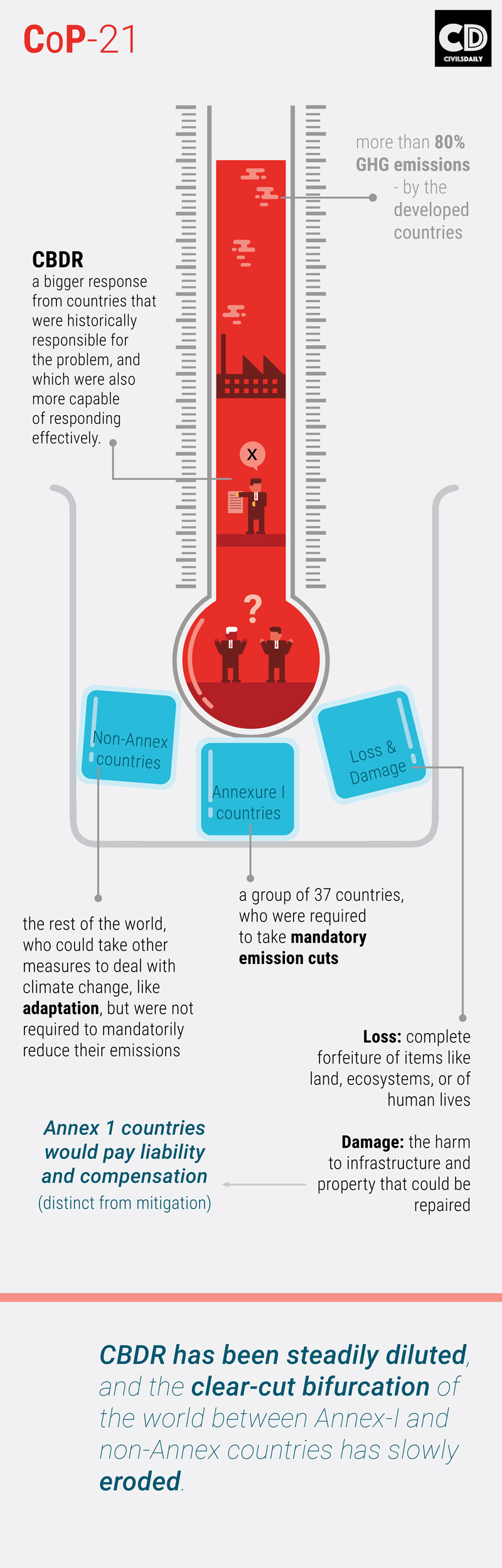
    Since more than 80% GHG emissions present in the atmosphere today have been emitted by the developed countries which underwent Industrial Revolution in last 150 years.

    Therefore, UN Framework Convention, 1994 placed the burden of mitigating climate change primarily on these countries.


    What is the principle of Common But Differentiated Responsibilities and Respective Capabilities (CBDR-RC)

    This principle demands a bigger response from countries that were historically responsible for the problem, and which were also more capable of responding effectively.

    Most of the rich and technologically advanced countries of the west fitted both criteria.

    The Convention divided the world in two clear groups:

    Annexure I countries: It was a group of 37 countries, who were required to take mandatory emission cuts.

    Non-Annex countries: It comprises the rest of the world, who could take other measures to deal with climate change, like adaptation, but were not required to mandatorily reduce their emissions.

    Where does the problem lie?

    CBDR is at the heart of the Kyoto Protocol, the existing global arrangement for fighting climate change that came into being at CoP-3 in Kyoto, and gave quantified emission cut targets to every Annex-I country.

    However, owing to persistent efforts of the rich and developed world, CBDR has been steadily diluted, and the clear-cut bifurcation of the world between Annex-I and non-Annex countries has slowly eroded.

    What is the principle of Loss and Damage ?

    It essentially tries to capture the inability of communities/countries to cope with the effects of global warming.

    At the Conference of Parties (COP19) of the UNFCCC, held in Warsaw in 2013, all parties agreed to set up a new mechanism on L&D.

    Loss: It generally refers to the complete forfeiture of items like land, ecosystems, or of human lives. The term includes both economic and non-economic losses.

    Damage: It refers to the harm to infrastructure and property that could be repaired.

    What makes Loss and Damage important and different from other mechanism?

    It is important because even after GHG emissions are reduced and communities adapt to climate change, there would still be loss and damage to people, livelihoods and infrastructure as a result of their inability to cope with climate change.

    This is distinct from mitigation, or reducing greenhouse gas emissions, and adaptation, or finding ways to live in a warmer world.

    How L&D will figure in Paris Climate Conference?

    The implementation of L&D principle would mean that Annex 1 countries would pay liability and compensation, as they are responsible for bulk of emissions.

    Recently, the Like Minded Developing Countries held a meeting in Delhi for the issues to be discussed in Paris COP and they have included Loss & Damage in their agenda.

    Published with inputs from Pushpendra
  • Roadmap For Paris Climate Talks: Part I


    We are going to publish a series of articles on Paris Climate Talks and the underlying issues.

    In this article, we will explore what is the ‘conference of parties’, and why we will hear more about it as the year-end approaches. We will also understand the how planet’s future could hinge on a deal in Paris.

    What is the CoP-21 and its origin?

    • The annual meeting is called CoP, or Conference of Parties, ‘parties’ being a reference to the 196 signatories to the UN Framework Convention on Climate Change (UNFCCC), that came into force in 1994.
    • The Paris meeting is the 21st meeting of the CoP, and hence it is being called CoP-21.

    Lets understand the objective of COP-21 

    • To deliver an agreement that will facilitate the reduction of greenhouse gas emissions, the only way to mitigate climate change.

    What are the options to achieve this objective

    • Move to processes that do not release carbon dioxide, or minimises their emission. In terms of energy, sources like solar, wind or nuclear.
    • Make use of better technology to make industrial processes more efficient, and lower carbon emissions.


    What is the quantum of emissions to be cut?

    • The purpose is to restrict the global surface temperature within 2-degree Celsius as compared to pre-industrial times.
    • The 2-degree target is a certain maximum amount of carbon dioxide that can be left accumulated in the atmosphere, often referred to as carbon budget.
    • Scientists argue that at the current rate of greenhouse gas emissions, the budget would be exhausted in the next 25 years.

    Why is it difficult to cut this quantum of emissions?

    • Almost every human/industrial activity involves the use of energy which is produced primarily by burning fossil fuels, such as coal, oil, etc; all of which have high carbon content.
    • Cutting emissions will mean slowing these activities and, thus, economic development.

    There is more serious impact on developed countries

    The emission cuts for richer and developed countries would mean

    • Altering their lifestyles
    • Giving up big private vehicles to embrace public transport
    • Reducing consumption <This would have impact on countries whose economy is based on consumption>
    Published with inputs from Pushpendra
  • IAS Mains 2015 & Beyond – Mini Quiz #3

    With special focus on GS3, here are the questions to solve for today. Model answers will be made available tomorrow.


    #1. Write a note on Green India Mission with special emphasis on its goals and current status.

    The National Mission for Green India (GIM) is one of the eight Missions outlined under the National Action Plan on Climate Change (NAPCC). It aims at protecting; restoring and enhancing India’s diminishing forest cover and responding to climate change by a combination of adaptation and mitigation measures.

    Try to consolidate your answer and keep it to the point. Do not start explaining the concept and waste words on that.

    #2. (a) What is ‘DigiLocker’? Discuss its utility.
    #2. (b) What is ‘Could Computing’? Identify its benefits.

    Factual question. Should be an easy answer. Try putting in some government of india centric points on how this can be extended to enhance participation, reach etc.

    #3. ‘Cyberspace has emerged as the biggest challenge to the national security’. Comment.

    Start your answer with an India centric viewpoint. Use a popular case (example) to establish your theory.

    #4. Discuss the environmental impact of constructing dams in Himalayan region and suggest the mitigating strategies.

    #5. Climate change has increased the frequency and intensity of the disasters/ As an administrator what steps shall you initiate to mitigate impact of flooding in the coastal and island territories of the country.

  • Google’s Project Loon: Balloon powered Internet

    What is Google’s project loon ?


    Many of us think of the Internet as a global community. But two-thirds of the world’s population does not yet have Internet access.

    Balloon powered Internet: Project Loon is a network of balloons traveling on the edge of space, designed to connect people in rural and remote areas, help fill coverage gaps, and bring people back online after disasters.

    Then, How it exactly works ?

    • Project Loon balloons travel approximately 20 km above the Earth’s surface in the stratosphere.
    • Winds in the stratosphere are stratified, and each layer of wind varies in speed and direction.
    • Project Loon uses software algorithms to determine where its balloons need to go, then moves each one into a layer of wind blowing in the right direction.
    • By moving with the wind, the balloons can be arranged to form one large communications network.

    How is the Loon designed ?

    • The inflatable part of the balloon is called a balloon envelope.
    • Each balloon’s electronics are powered by an array of solar panels.
    • The panels produce approximately 100 Watts of power in full sun, which is enough to keep Loon’s electronics running.
    • Project Loon is able to power itself using entirely renewable energy sources.


    How does it connect?

    • Each balloon can provide connectivity to a ground area about 40 km in diameter using a wireless communications technology called Long-Term Evolution (LTE).
    • With this LTE, people will be able to access the Internet everywhere directly from their phones and other LTE-enabled devices.
    • Balloons relay wireless traffic from cell phones and other devices back to the global Internet using high-speed links.

    Very quickly then, what has Loon upto all this while?

    • Project Loon began in June 2013 with an experimental pilot in New Zealand.
    • The results of the pilot test as well as subsequent tests in New Zealand, California’s Central Valley and in Northeast Brazil were analysed.
    • They were used to improve the technology in preparation for the next stages of the project.

    What are Superpressure balloons?

    • Superpressure balloons are made out of tightly sealed plastic capable of containing highly pressurised lighter-than-air gases.
    • The concept was first developed for the US Air Force in the 1950s using a stretched polyester film called Mylar.
    • More recently, Nasa has experimented with the technology and suggested superpressure balloons could one day be deployed into Mars’s atmosphere.

    What’s the way forward for Google balloons?

    • Google suggests that Project Loon would be a cheaper solution than installing fibre optic cables or building mobile phone masts across all of Indonesia’s islands, which contain jungles and mountains.
    • Google is in talks with the Indian government to deploy this wind power project here. The company hopes to begin production by 2016.

    Published with inputs from Arun
  • India-Africa Forum Summit: Old Friends – Old Family

    It’s likely to be the biggest diplomatic event in independent India’s political history. Never have more than 39 heads of states gathered in the country.


    • The India-Africa forum summit on October 29, four-day summit meeting between India and 54 African nations, aimed at deepening the spirit of partnership, strengthening international solidarity and expanding cooperation.
    • India hopes to create conditions that stimulate trade and investment flows between India and African countries.

    What is India-Africa Forum Summit and how did it start?

    • The India-Africa Forum Summit (IAFS) is a celebration of the close partnership between Africa and India, started in 2008.
    • It was decided to hold the summits every three years, alternately in India and Africa. New Delhi was the venue in 2008 and Addis Ababa in 2011.
    • The third summit, scheduled to be held in 2014, was postponed because of the Ebola outbreak, and will now be held in Delhi from October 26 to 29.


    Reasons behind such an initiative?

    • Economically, Africa is very resource-rich, and has moved from being an underdeveloped continent to having several fast-growing economies, and new democracies.
    • Strategically, there are key shared interests in battling global terrorism, and piracy in the Indian Ocean.
    • Politically, India’s ambition to become a permanent member of the UN Security Council makes it imperative that it engages with all 54 countries of the continent.
    • New Delhi would also want a stronger partnership with Africa on climate change ahead of the COP-21 in Paris.

    How did it help in the development process of the African continent?

    • In the past three years alone, 25000 Africans have been trained or educated in India.
    • The Pan Africa e-network , which now connects 48 African countries, is becoming the new highway of regional connectivity and human development.
    • Under the India Technical and Economic Cooperation (ITEC) programme, over 100 officials from sub-Saharan Africa receive training annually in India.
    • The continent’s progress will add great stability and momentum to the global economy and benefit India as well.

    Why India and Africa are important for world?

    • India and Africa constitute one-third of the world’s population. A large majority of them are in their youth.
    • Indeed, India and Africa will have a significant part of the global youth population in this century. Their future will shape the course of this world to a great extent.

    In what ways can the New Development Bank of BRICS benefit African countries?

    • It has brought together the five BRICS countries (especially South Africa) as equal partners in the establishment of the Bank, which reflects a completely new paradigm of financial structure of such institutions.
    • It would also, hopefully, have an African window or regional presence of the Bank in the future.

    Obsession with Chinese investments in Africa, Really?

    • World Bank estimates that private Chinese investment accounted for 55% of all Chinese direct investment in Africa by the end of 2011, with most of the spending in manufacturing and the service sector.
    • India seeks to challenge China’s dominance on a continent that is blessed with vast natural resources and has the world’s fastest-growing population.
    • New Delhi wants to project its soft power and historical ties to Africa, in contrast to China’s focus on resource extraction and capital investment that has sparked a backlash in some countries against Beijing’s mercantilist expansion.

    What is on the agenda of this IAFS?

    1. A forceful support for United Nations Security Council reforms.
    2. The endorsement of India’s position at the WTO with regard to agricultural subsidies.
    3. An understanding of the African position on emerging mega free trade agreements like the US-led Trans Pacific Partnership.
    4. Finally a ‘Feel Good Factor’ to deepen diplomatic relations with African governments.

    Seven of the world’s fastest growing economies are now in Africa. All of this means that Africa’s engagement with the world is an opportunity for better, more equal relations.

    The third Summit, which will see the participation of all African nations for the first time, this is an opportunity to take India’s Africa policy out of China’s shadow and truly bring foreign policy home.


    Published with inputs from Arun
  • IAS Mains 2015 & Beyond – Mini Quiz #2

    Let’s change study habits for good!


    For this week, for answer writing practice for IAS Mains 2015, we are bringing in these choicest questions from the topics that have been in news in 2015.

    #1. Discuss the concept of judicial independence in the light of the recent judgements of the SC with regard to NJAC.

    A lot has been said and debated in this topic in 2014/15. In this question, to fetch most marks – make sure you summarise and mention recent judgements and arguments put forth by either sides of the debate.

    Ref:

    • https://www.civilsdaily.com/key-points-on-njac-that-you-need-to-remember/
    • https://www.civilsdaily.com/njac-a-triumphant-verdict/

    #2. Bring out the potential of- and the bottlenecks to the ‘Start Up India, Stand Up India’ initiative.

    A classic question which looks at summarising our growing economic and political initiatives which can embolden India’s Startup initiatives. Answer in quick key points to cover this holistically.

    Ref: https://www.civilsdaily.com/story/digital-india-initiatives-whats-buzzing/

    #3. MDGs shall soon give way to the SDGs. Evaluate the performance of India on various parameters of the MDGs.

    #4. Discuss the recent political developments in Nepal. Should they be of any concern to India?

    #5. Present a case for the India’s membership to the UN Security Council.

    Imagine that you are making a case before countries with conflicting interests, how can you show the pros of putting India in the Security Council so that they agree despite not being on board with India’s ambitions. It’s a perfect question for the wannabe IFS Officer!


  • Modi, Tesla & Powerwall Battery Technology


    Recent visit of Narendra Modi’s visit to Tesla Motors plant in San Jose, caught his attention to renewable energy technology, where the company’s CEO Elon musk introduced him to Powerwall battery technology.

    <Civil service aspirants cannot afford to miss such news, as it would have caught the attention of UPSC, I hope you remember the Prelims question on NFC technology>

    What is Powerwall Technology ?

    • It is a wall-mountable, high-capacity lithium ion battery that can be charged using power generated through solar panels.
    • Dimension – 4 feet tall , 3 feet wide and 7 inches deep.
    • It stores energy for commercial or domestic use.
    • It comes in two variants – 7 kwh & 10 kwh.

    What is a Power Pack ?

    • It is a scaled- up version of the powerwall, and can provide up to 100 kwh.
    • They can be scaled to megawatt- and gigawatt-sized power solutions.

    How are these batteries special ?

    Currently, Powerwall technology would eliminate the need for cables & massive infrastructure, present in a conventional grid system.

    CEO remarked -“The Powerwall would do to the conventional grid system, what mobile phones did to fixed line phones, eliminating the need for cables and massive infrastructure“.

    What Tesla has done to Lithium-ion technology ?

    • It has improved the lithium-ion technology.
    • It has also integrated massive power capacities – up to 6 times the capacity of a common lead acid battery in a single powerwall in a small space.
    • They are built to work for a period of 10 years, while most lead acid batteries die in 3 to 4 years.


    Is there any relevance for India ?

    Can they solve the problem of power-hungry rural homes!!

    • Govt. has envisaged supply of 58W to each household, with 2 light point of 9W and a socket of 40W for gadgets, under its rural electrification programme.
    • In this scenario, Powerwall would be good for multiple households.
    • Localised micro-grids could generate electricity from solar energy for villages not connected to the main grid.
    Published with inputs from Pushpendra
  • IAS Mains 2015 & Beyond – Mini Quiz #1

    So, as promised here we begin with our “IAS Mains 2015 & Beyond – Mini Quizes”. While we expect you to attempt the questions earnestly, we also understand our responsibility to explain to you why we chose to frame these questions over some random questions as we don’t want to bulldoze you with questions just for the heck of it but to ensure that you realise the actual benefit of these “IAS Mains Mini Quizzes” which is to acclimatize you to the answer writing in a time bound manner with a set of questions which have a reason to be there.

    Sounds good?


    So this set has been prepared for GS1. The paper in 2013 and 2014 could be largely classified into Indian History, World History + Society and Geography.

    In History they framed a question on Maulana Azad on his 125th anniversary. This time around Loh Purush has been quite in limelight and hence a question.

    Newspapers had been full of eulogy to our 1965 war response but it has become all too common for UPSC to become interested in framing a question. But a little known has been the war crimes news in our neighbourhood and hence a question on a war but the one in 1971 and the associated events.

    Thaw in US-Cuba relations was something to look for and the first thing that crosses the mind is Cuban Missile Crisis. As we have maintained that UPSC roams around a news item before picking up a question, we have one here!

    The questions in Geography were picked up from the items that have literally become common parlance like heat islands, temperature inversion, fold mountains and earthquakes. Continuing in same vein we have framed the questions from Ring of fire, Bay of Bengal and the Crust.

    Continuing with our efforts to live upto your expectations and the standard that we have set for ourselves, here we present the first set. Happy writing!


    #1. Enumerate the major highlights of the Simla Agreement (1972) signed between India and Pakistan in 1972.

    #2. What were the events that precipitated the Cuban Missile Crisis (October Crisis) in 1962? How was it resolved?

    #3. Discuss the contribution of Sardar Vallabhbhai Patel to pre- and post- independent India?

    #4. Explain the occurrence of frequent earthquakes and volcanic eruptions along the Pacific Ring of Fire.

    #5. (a) Why are cyclone more common in Bay of Bengal compared to the Arabian Sea?
    #5. (b) The age of oceanic crust increases from the mid oceanic ridges towards the continental margins. Why?


    We will provide dummy answers of sorts by tomorrow evening so that you have a sense of wholesomeness!