💥Join UPSC 2027,2028 Mentorship (July Batch) + XFactor Notes & Microthemes PDF

Author: Explains

  • 26th November 2018 | Prelims Daily with Previous Year Questions

    Q.1) The term WaarsM was recently seen in news is a:

    a) Computer Virus

    b) Gene

    c) Super Galaxy

    d) None of these

    Inspired by: Researchers develop transgenic rice with reduced arsenic accumulation

    https://www.civilsdaily.com/news/researchers-develop-transgenic-rice-with-reduced-arsenic-accumulation/

    Q.2) Recently, India’s very first Open Transit Data (OTD) system portal was inaugurated in New Delhi. With reference to the OTD, which of the given statements is/are correct?

    1. It is developed by National Informatics Centre.
    2. It includes geo-coordinates of bus stops, route maps, timetable, and real time GPS feeds of bus locations every 10 seconds.

    Select the correct codes from the following options:

    a) Both 1 and 2

    b) Only 1

    c) Only 2

    d) Neither 1 nor 2

    Inspired by: Open Transit Data (OTD)

    https://www.civilsdaily.com/news/open-transit-data-otd/

    Q.3) The RIMES stands for Regional Integrated Multi-Hazard Early Warning System for Africa and Asia. Consider the following statements with respect to RIMES:

    1. It is an UN registered institution.
    2. It was set up on the aftermath of 2004 Indian Ocean Tsunami.
    3. It is headquartered in Bali, Indonesia.

    Which of the given statements is/are correct?

    a) Only 1

    b) 1 and 2

    c) 2 and 3

    d) All are correct

    Inspired by: RIMES terms Titli cyclone ‘rarest of rare’

    https://www.civilsdaily.com/news/rimes-terms-titli-cyclone-rarest-of-rare/

    Q.4) Consider the following statements with stratospheric aerosol injection (SAI):

    1. It involves spraying of sun-dimming chemicals high above the earth to slow global warming.
    2. Sulfur-rich particles are the most suitable aerosols that can be used for this purpose.
    3. Volcanoes are the only major source of aerosol particles in the stratosphere.

    Which of the given statements is/are correct?

    a) Only 1

    b) 1 and 2

    c) 2 and 3

    d) All are correct

    Inspired by:  Scientists mull stratospheric barrier to curb global warming

    https://www.civilsdaily.com/news/scientists-mull-stratospheric-barrier-to-curb-global-warming/

    Q.5) The Hantavirus Pulmonary Syndrome (HPS) recently seen in news is known to infect which system of the body?

    a) Respiratory System

    b) Nervous System

    c) Reproductive System

    d) None of the above

    Inspired by: The Hindu


    For Solutions – Click Here

    Prelims Daily Archive – Click here

  • [Video] Samachar Manthan Week 18: Stubble Burning & its Effects

    To know more about our Samachar Manthan course which deals with enhancing your Mains answer writing skills along with Current Affairs preparation, read & Subscribe here: https://www.civilsdaily.com/samachar-manthan/

  • [Burning Issue] India – Bhutan Relations after recent elections in Bhutan

    Context

    • Tshering Tobgay will be new Prime Minister of Bhutan. Druk Nyamrup Tshogpa Party has won the recent general elections in Bhutan.
    • The National Assembly is the lower house of Bhutan Parliament. This is the third general election after democracy was adopted in Bhutan in 2008.

    BHUTAN ELECTION BACKGROUND

    • Election to the House of Representatives also called the National Assembly, occurs in two rounds: the Primary Round and the General Round.
    • The first round, called the Primary Round, is contested by multiple parties. This year, four parties contested, two of which have existed from the first parliamentary elections.
    • The People Democratic Party (PDP) was led by a Harvard-educated former civil servant who was viewed as a popular political leader.
    • Opposing him was the Druk Phuensum Tshogpa (DPT), which formed the first democratic government, and was the opposition party in the last parliament.
    • The two new parties were the Druk Nyamrup Tshogpa (DNT), which was led by a popular medical doctor and social activist, and Bhutan Kuen-nyam Party (BKP), which is headed by the former chairperson of the Anti-Corruption Commission.
    • The parties did not vary substantially in terms of ideology or manifestos, but they represented their respective party leaders’ expertise and personal values.

    India Bhutan Relations

    • India and Bhutan have had long-standing diplomatic, economic and cultural relations
    • Bhutan and India relations are governed by a friendship treaty that was renegotiated only in 2007, subjecting the Himalayan nation’s security needs to supervision.
    • Treaty of Friendship in 2007, which brought into the India-Bhutan relationship “an element of equality.”
    • The Treaty provides for perpetual peace and friendship, free trade and commerce, and equal justice to each other’s citizens.

    India-Bhutan treaty of Friendship timeline

    • On August 8, 1949, Bhutan and India signed the Treaty of Friendship, calling for peace between the two nations and non-interference in each other’s internal affairs.
    • India re-negotiated the 1949 treaty with Bhutan and signed a new treaty of friendship in 2007.
    • The new treaty replaced the provision requiring Bhutan to take India’s guidance on foreign policy with broader sovereignty and not require Bhutan to obtain India’s permission over arms imports.
    • Under the 2007 India-Bhutan Friendship Treaty, the two sides have agreed to “cooperate closely with each other on issues relating to their national interests.”
    • Neither Government shall allow the use of its territory for activities harmful to the national security and interest of the other
    • A scheme titled “Comprehensive Scheme for Establishment of Hydro-meteorological and Flood Forecasting Network on rivers Common to India and Bhutan” is in operation.
    • The network consists of 32 Hydro-meteorological/ meteorological stations located in Bhutan and being maintained by the Royal Government of Bhutan with funding from India. The data received from these stations are utilized in India for formulating flood forecasts.

    Importance of Bhutan

    • Bhutan in a buffer state between India and china. Bhutan shares a 470 km long border with China.
    • Strategic importance: The Chumbi Valley is situated at the trijunction of Bhutan, India and China and is 500 km away from the “Chicken’s neck” in North Bengal, which connects the northeast with rest of the country.
    • To contain the insurgency in North-East: Bhutan has in the past cooperated with India and helped to flush out militant groups like United Liberation Front of Asom (ULFA) and National Democratic Front of Bodoland (NDFB) from the Himalayan nation.
    • To check Chinese inroad in Bhutan: China is interested in establishing formal ties with Thimphu, where it does not yet have a diplomatic mission. Bhutan is strategically important for both India and China. Chinese territorial claims in western Bhutan are close to the Siliguri Corridor.
    • Beijing is reportedly insisting on Bhutan establishing trade and diplomatic relations as a quid pro quo for a border settlement.
    • Joint Group of Expert (JGE) on Flood Management has been constituted between India and Bhutan to discuss and assess the probable causes and effects of the recurring floods and erosion in the southern foothills of Bhutan and adjoining plains in India and recommend to both Governments appropriate and mutually acceptable remedial measures.
    • Bhutan is currently India’s only neighbour who has stayed away from joining China’s Belt and Road Initiative (BRI), but that may change if India can’t make itself an attractive ally and neighbour.
    • In the aftermath of the Doklam incident, Chinese vice foreign minister visited Thimphu to discuss a range of issues. It was at this meeting that Bhutan was invited to join the BRI and reap the “development dividends” – surely a tempting offer for a country looking to diversify its heavily India-dependent economy.

    Commercial Relations between India and Bhutan

    • India is Bhutan’s largest trading partner. India and Bhutan have signed an Agreement on Trade, Commerce and Transit on 12th November 2016, which provides for a free trade regime between the two countries aimed at boosting the bilateral trade for mutual benefit.
    • The Agreement also aims at facilitating Bhutan’s trade with countries through an improved procedure for containerised cargo, striving towards use of electronic means to facilitate the movement of transit cargo, additional entry/exit points in India, etc.
    • Imports from India were Rs5,650cr accounting for 80% of Bhutan’s total imports. Bhutan’s exports to India stood at Rs3,270 cr (including electricity) and constituted 90% of its total exportsOne-third of Bhutan’s exports to India is electricity.
    • Other items of export include minerals such as ferro-silica (the Bhutanese have been complaining that these exports have been declining), cement and dolomite.
    • The Government is planning to build a mini dry port in the border town of Phuntsholing to promote exports, that are plagued by logistical difficulties due to the difficult terrain and poor connectivity. Bhutan sources the majority of its import requirements from India.

    Impact of the election

    India not a factor this time

    • In contrast to the 2013 elections, Bhutan’s relations with India did not figure prominently during the campaign by the four parties.
    • In the run-up to the 2013 polls, Bhutan was hit suddenly by high fuel prices, after India withdrew subsidies over kerosene and cooking gas. The Indian government claimed that the withdrawal was an “unfortunate technical lapse” due to the non-renewal of an agreement.
    • Despite Indian denials, the perception persisted that New Delhi wanted to ‘punish’ the ruling DPT for taking steps like the meeting of then prime minister Jigme Thinley with Chinese premier Wen Jiabao at Rio de Janeiro in 2012.
    • During that campaign, the PDP had accused the DPT of presiding over “deteriorating” ties with India. The DPT pushed back by asserting that relations with India should be kept “beyond and above party politics at all times”.
    • Five years later, India did not figure at all in the elections, beyond the general political consensus that relations have to be strengthened. This despite Bhutan having witnessed the armies of China and India standing eye-ball to eye-ball on its border region for 73 days in 2017.
    • In the DPT’s manifesto for the 2018 elections, the separate section on foreign policy mentions that the party “remains committed to maintaining and furthering the excellent relations with the people and the Government of India”.
    • If elected, the DPT had also pledged to execute at least three hydropower projects and “pursue others with the government of India”, with an emphasis on more balanced regional distribution of the mega projects. It has proposed to ramp up electricity generation from 1606 MW to a minimum of 10,000 MW in 2030.
    • The DPT had also stated that it would explore the “feasibility of using the Brahmaputra river port in India as a third-country exports and imports route for Eastern Bhutan”.
    • The DNT’s manifesto does not have a separate section on external relations, but India gets mentioned several times, especially in the context of diversification of the economy.
    • In the section on the economy, the DNT expressed concern over the export basket, with hydropower exports dominating this sector. The party claimed that since Bhutan’s economy is “driven by investments in the hydropower sector”, economic growth remains narrowly based and unable to create jobs for a young aspiring population. The party had also pointed out over 75% of Bhutan’s expanding external debt is accounted by hydropower loans.
    • “We are determined more than any other party to diversify the economy by accelerating private sector growth and investing in agriculture, mining, manufacturing and service,” said the DNT manifesto.
    • A similar concern in parallel with trade debt is the huge external debt, which currently stands at 170 billion BTN, or Bhutanese ngultrum, as of today. Of this amount, as per the State of the Nation Report (2018), hydropower loans comprise 132 billion BTN, while the rest is non-hydropower loan of 37 billion BTN. One ngultrum is worth one Indian rupee.
    • The DNT pointed to India accounting for an 80% share of exports from Bhutan as a weak point for the economy, which made it “highly vulnerable to exogenous shocks”.
    • The party also promised to review current fuel imports from India, so as to reduce dependence on fossil fuel and improve the balance of payment situation.
    • All the parties were silent over the BBIN motor vehicles agreement in their manifestos. The PDP government had tried to pass the relevant legislation, but it was defeated in the National Council. With popular opposition against the agreement, Bhutan withdrew from the agreement.

    China factor

    • Until 2007, India had oversight over Bhutan’s relations with other countries. This changed after the two countries amended their friendship treaty, giving Bhutan full freedom to pursue ties with other countries.
    • While people in Bhutan are appreciative of the country’s close ties with India, there are those who feel that Bhutan also needs to establish diplomatic links with China, which has been trying to make inroads into the small country.
    • The debate on ties with China deepened following the Doklam crisis in June last year, which led to a standoff between India and China on the Doklam plateau.
    • The row arose when Indian border guards intervened as China was building a road in an area claimed by both it and Bhutan, close to a narrow stretch of land in India known as the Siliguri corridor.
    • The corridor connects seven north-eastern Indian states to the mainland. The issue was resolved after nearly a month.
    • China, of course, has so far been frustrated in wanting to have close diplomatic ties with Bhutan. But sooner or later Bhutan, despite the traditional friendship (with India), has to chart its own course in international affairs.
    • The sentiment echoes even today and Bhutan continues to dodge China’s courtship for formal diplomatic relations and a residential embassy in Thimphu. Bhutan’s leaders and policymakers are cautious about speaking openly about China.

    Investing in trust

    • Bhutan has always been India’s most trusted ally in South Asia and has often put India’s security at the forefront. Come to think of it, in December 2003, Bhutan’s fourth king personally led the army to throw out Indian militants living in Bhutan’s jungles.
    • Bhutan was also the only South Asian country besides India not to attend China’s Belt and Road Initiative forum in May 2017. In other words, Bhutan has held its end of the bargain.
    • Unsurprisingly then, belligerent messages from Indian officials only serve to anger the Bhutanese who are now openly questioning India’s level of trust in its so-called best friend. Indian officials who claim the Chinese influence is increasing in Bhutan are wrong.
    • Bhutan’s contact with China remain the same, mainly to discuss the border issues. Bhutan, in fact, has never been tempted by the Chinese offers of development and technical assistance.
    • What India gives Bhutan in development aid is there for all to see, but what Bhutan offers India in strategic benefit, as a buffer along the northern border, cannot be put in figures.
    • Indeed, those in the corridors of power in Delhi do understand that Bhutan has saved India billions of rupees in defence spending.
    • Yet, India has not invested in Bhutan and other smaller neighbours that modicum of trust which is critical in building genuine goodwill.
    • This means not only increasing people-to-people contact but also being sensitive to Bhutan’s desire for a wider engagement beyond India’s borders. This means respecting Bhutan as an equal, sovereign nation state.

    Conclusion

    • Bhutan’s leadership regards the Indo-Bhutan friendship as one “built on shared values and aspirations, trust and mutual respect, and a common dream of peace and prosperity for the people of the two countries”.
    • This means Bhutan’s foreign policy framework, which holds the relationship with India as being integral to its national interest, will not change no matter which party takes power in Thimphu.
    • The Indian approach to Bhutan has necessarily to be tailored while being sensitive to the growing Bhutanese aspirations of being considered as an equal.
    • The Bhutanese will also be loathed to be considered as just a pawn in the great game between India and China.
    • In the years ahead, their aspirations to have an independent strategic opinion as a sovereign state will recur more often.
    • Obviously, they will need to be treated as equals and as such integrated economically to ensure a better balance in mutual trade.
  • 24th November 2018 | Prelims Daily with Previous Year Questions

    Q.1) Consider the following statements with respect to the Sub-categorization of OBCs:

    1. Article 340 provides constitutional mandate for setting up of such committees.
    2. The Indra Sawhney and others vs. Union of India case (1992) puts constitutional bar on states for re-categorizing OBCs.

    Which of the given statements is/are correct?

    a) Only 1

    b) Only 2

    c) Both 1 and 2

    d) Neither 1 nor 2

    Inspired by: OBC sub-categorization panel gets 4th extension

    https://www.civilsdaily.com/news/obc-sub-categorization-panel-gets-4th-extension/

    Q.2) Consider the following statements with respect to Human Microbiomes:

    1. They are the harmful microbes found inside human body.
    2. They are found only in the gastrointestinal tracts.
    3. They include bacteria, archaea, fungi, protists and viruses.

    Which of the given statements is/are correct?

    a) 1 and 2

    b) 1 and 3

    c) Only 1

    d) Only 3

    Inspired by: [op-ed snap] Why India wants to study human microbiome

    https://www.civilsdaily.com/news/op-ed-snap-why-india-wants-to-study-human-microbiome/

    Q.3) If one traverses to Kartarpur Sahib in Pakistan from the Dera Baba Nanak in Indian side, he/she will cross which of the following river?

    a) Beas

    b) Sutlej

    c) Ravi

    d) Chenab

    Inspired by: [op-ed snap] Corridor of hope: On the Kartarpur proposal

    https://www.civilsdaily.com/news/op-ed-snap-corridor-of-hope-on-the-kartarpur-proposal/

    Q.4) The Doi Moi Policy recently seen in news is related to which of the following countries?

    a) Vietnam

    b) Laos

    c) Cambodia

    d) None of the above

    Inspired by: [op-ed snap] Looking beyond the optics

    https://www.civilsdaily.com/news/op-ed-snap-looking-beyond-the-optics/

    Q.5) Which one of the following statements does not apply to the system of Subsidiary Alliance introduced by Lord Wellesley?

    a) To maintain a large standing army at other’s expense

    b) To keep India safe from Napoleonic danger

    c) To secure a fixed income for the Company

    d) To establish British paramountcy over the Indian States

    Inspired by: CSP 2018


    For Solutions – Click Here

    Prelims Daily Archive – Click here

  • 23rd November 2018 | Prelims Daily with Previous Year Questions

    Q.1) The Bhudhaar Initiative recently seen in news is an initiative of:

    a) Andhra Pradesh

    b) Madhya Pradesh

    c) Karnataka

    d) Gujarat

    Inspired by: The Hindu

    Q.2) The Permanent Structured Cooperation (PESCO) recently seen in news is a security and defence policy of which of the following countries/group of countries?

    a) Australia

    b) European Union

    c) Russia

    d) Africa

    Inspired by: The Indian Express

    Q.3) The ACROSS Scheme is related to:

    a) Weather Services

    b) Artificial Intelligence

    c) Railway Crossings

    d) None of these

    Inspired by: [pib] ACROSS Scheme

    https://www.civilsdaily.com/news/pib-across-scheme/

    Q.4) Consider the following statements with respect to the Wildlife Crime Control Bureau:

    1. It is a statutory multi-disciplinary body established by the under the MoEFCC to combat organized wildlife crime in the country.
    2. It is the body for the enforcement of the provisions of the Wild Life (Protection) Act, 1972.
    3. It is also advisory body to the Government of India on issues relating to wildlife crimes having national and international ramifications, relevant policy and laws.

    Which of the given statements is/are correct?

    a) 1 and 3

    b) 2 and 3

    c) Only 3

    d) All are correct

    Inspired by: [pib] India gets UN Environment award for combating transboundary environmental crime

    https://www.civilsdaily.com/news/pib-india-gets-un-environment-award-for-combating-transboundary-environmental-crime/

    Q.5) The ‘Manipur Sangai Festival’, the biggest tourism festival of the state was recently inaugurated in Imphal. With recent to the Sangai antelope, consider the following statement:

    1. The deer is found in its natural habitat only at Keibul Lamjao National Park.
    2. They mostly habitat over floating biomass locally called “phumdi” in the south eastern part of Loktak Lake.
    3. IUCN conservation status of the Sangai deer is Critically Endangered.

    Which of the given statements is/are correct?

    a) 1 and 2

    b) 1 and 3

    c) 2 and 3

    d) All are correct

    Inspired by: Manipur Sangai Festival

    https://www.civilsdaily.com/news/manipur-sangai-festival/


    For Solutions – Click Here

    Prelims Daily Archive – Click here
  • 22nd November 2018 | Prelims Daily with Previous Year Questions

    Q.1) The Institution’s Innovation Council (IIC) is an initiative of:

    a) University Grants Commission

    b) NITI Aayog

    c) Innovation Cell, Ministry of HRD

    d) Ministry of Science and Technology

    Inspired by: [pib] Union HRD Ministry launches Institution’s Innovation Council (IIC)

    https://www.civilsdaily.com/news/pib-union-hrd-ministry-launches-institutions-innovation-council-iic/

    Q.2) With reference to Witnesses Protection in India, consider the following statements:

    1. Only the National Investigation Agency (NIA) Act has provisions for Witnesses protection in India.
    2. The draft Witnesses Protection Scheme shall extend to the whole of the India except the State of Jammu & Kashmir.

    Which of the given statements is/are correct?

    a) Only 1

    b) Only 2

    c) Both 1 and 2

    d) Neither 1 nor 2

    Inspired by: Supreme Court to direct states to implement draft witness protection scheme

    https://www.civilsdaily.com/news/supreme-court-to-direct-states-to-implement-draft-witness-protection-scheme/

    Q.3) Which article of the Indian Constitution declares that trade, commerce and intercourse throughout the territory of India shall be free?

    a) Article 301

    b) Article 302

    c) Article 269A

    d) None of these

    Inspired by: GST, a game-changer reform for logistics sector

    https://www.civilsdaily.com/news/gst-a-game-changer-reform-for-logistics-sector/

    Q.4) The Ten Degree Channel separates:

    a) Little Andaman and Car Nicobar Islands

    b) Little Andaman and Greater Nicobar

    c) Kavaratti and Minicoy Islands

    d) None of these

    Inspired by: Who are the Sentinelese?

    https://www.civilsdaily.com/news/who-are-the-sentinelese/

    Q.5) Consider the following statements:

    1. UAE employs largest number of Indians in the Gulf.
    2. Kerala is the largest labour send state to the Gulf.

    Which of the given statements is/are correct?

    a) Only 1

    b) Only 2

    c) Both 1 and 2

    d) Neither 1 nor 2

    Inspired by: E-registration must for jobs in 18 countries

    https://www.civilsdaily.com/news/e-registration-must-for-jobs-in-18-countries/


    For Solutions – Click Here

    Prelims Daily Archive – Click here

  • [Burning Issue] A change in the Maldives

    http://www.insightsonindia.com/wp-content/uploads/2018/09/editorial-10.png

    Context

    • Voters in the Maldives delivered a stunning defeat for President Abdulla Yameen in a contentious presidential election, an outcome regarded as a victory for democracy over authoritarianism in the Indian Ocean island nation.
    • The people of the small archipelago in the Indian Ocean voted for change and brought to power the Opposition candidate, Ibrahim Mohamed Solih. They came out in huge numbers with the turnout being 89.2%.

    BACKGROUND

    Crisis in the Maldives 

    • In October 2008, a popular opposition movement instigated by a coalition of parties challenged the power of incumbent leader Maumoon Abdul Gayoom (half-brother of Yameen Abdul Gayoom), forcing him to hold the Maldives’ first multiparty presidential vote.

     In the country’s first free elections, Mohamed Nasheed, backed by a coalition of opposition parties, defeated Gayoom in a runoff and became the Maldives’ first freely elected president in 2008. Two years later, the international watchdog Freedom House listed the country as an electoral democracy for the first time.

     However, in 2012, Nasheed was forced to resign from the office following a police mutiny and a political turmoil in the country better known for its exotic honeymoon resorts.

    • It was Yameen Abdul Gayoom’s election as President in 2013 that ended the political turmoil. However, this trouble only intensified under Yameen.

     Recently in February 2018, Yameen declared a 45-day state of emergency in the country, ordering security forces into the Supreme Court and got former president Maumoon Abdul Gayoom arrested. On his orders, Maldives police arrested Chief Justice Abdulla Saeed and another Supreme Court judge Ali Hameed.

    • He had pulled the Maldives out of the Commonwealth in 2016 and fostered closer ties with China and Saudi Arabia over traditional allies India and the United Kingdom.

    Importance of Maldives

    • The Maldives, long a popular tourist destination, has grown in strategic importance in recent years as China and India to establish their influence in the region, and as Beijing pushes ahead with its global trade and infrastructure plan.
    • Spread over nearly 1,200 islands spanning more than 90,000 sq km, key shipping lanes where Beijing and New Delhi compete to pursue their often-conflicting maritime strategies pass through this tiny Indian Ocean nation.
    • Though small, the Maldives is India’s important neighbour. India’s Prime Minister Narendra Modi called the Maldives “a valued partner in the Indian Ocean neighbourhood”.
    • India-Maldives “ties are built on a very strong foundation” the contours of which are defined by shared strategic, security, economic and developmental goals.

    However, the bilateral ties are not without irritants, which can be seen in two broad areas: political and strategic.

    How is China engaging with the Maldives?

    • Beijing has made large investments in infrastructure projects in the Maldives during Yameen’s time in office.
    • They include a US$830 million investment to upgrade the Maldives airport and build a 2km bridge to link the airport island with the capital Male, according to the Centre for Global Development.
    • Chinese are also building a 25-storey apartment complex and hospital in the Maldives.
    • Meanwhile, some 306,000 Chinese tourists visited the Maldives last year accounting for 21 per cent of the country’s total number of visitors. When three Chinese naval ships docked in Male in August last year, it only amplified India’s concerns.

    The tilt towards China

    • Mr.Yameen’s China visit last year, the two nations signed 12 pacts, including a free trade agreement (FTA).
    • Mr. Yameen not only fully endorsed China’s ambitious Maritime Silk Road initiative but also made the Maldives the second country in South Asia, after Pakistan, to enter into an FTA with China.
    • The Yameen government pushed the FTA through the nation’s Parliament, the Majlis, stealthily, with the opposition not attending the parliamentary session.

    Chinese Investments: Massive Debt trap, according to the opposition

    • The opposition accused the Yameen government of allowing a Chinese ‘land grab’ of Maldivian islands, key infrastructure, and even essential utilities, which “not only undermines the independence of the Maldives, but the security of the entire Indian Ocean region.
    • The massive infrastructure growth funded by Chinese debt was a key part of Mr. Yameen’s election campaign but the massive debt trap made it a difficult proposition to be accepted.

    How have the Maldives ties with India fared under Yameen?

    • Bilateral ties between India and the Maldives have deteriorated during Yameen’s time in power.
    • In March 2015, Indian Prime Minister Narendra Modi cancelled his state visit to the island nation over the treatment of Mohamed Nasheed, the former pro-India Maldivian president who had been jailed.
    • The Maldives also declined India’s invitation to take part in its biennial eight-day naval exercise, Milan, this year.
    • Yameen’s government has also rejected visa renewals for Indians who were legally working in the Maldives, without giving any explanation.

    Concern areas that need to be improved between India and Maldives 

    • No FTA with India: Maldives and India do not have a Free Trade Agreement. However Maldives and China entered into Free Trade Agreement.
    • Maldives growing “closeness” with China: Both China and Pakistan stepping up their strategic inroads into the Maldives
    • Religious radicalization: The Maldives is being radicalized by the Saudi funds and influence
    • ISIS threat: Growing Islamic radicalisation in the tiny island-nation of about four lakh people once known for its tolerant practices has many foreign governments, including India, deeply concerned.
    • Yameen government had asked India to remove its Dhruv advanced light helicopters from Maldives(which India had gifted in 2013).
    • Yameen government has alleged that tensions over the presence of the two Indian helicopters in two strategically important locations in the Laamu and Addu atolls have been growing.
    • Work permits are not currently being issued to Indian Nationals.

    By changing to more democratic form of government in Maldives, India can engage with Maldives to establish much more friendly relations than previous government era to protect the safety and security of entire Indian Ocean region. During his inaugural address, Solih outlined priorities-

    1. On foreign policy, Solih said that he would work to “fortify” Male’s existing relationship with India, which had grown strained under Yameen, but has historically been strong.
    2. The geopolitical overtones of the change in leadership in the Maldives were clear during the inaugural address, when Solih referenced the cause for the government’s poor fiscal state as the previous’ government’s decision to pursue “reckless mega development projects undertaken purely for political gains.”
    3. Modi and Solih met, with Solih asking for Indian assistance on infrastructure development in the country.

    What Solih means to India?

    1. Ibrahim Mohamed Solih and Mohamed Nasheed are considered as brothers in arms in Maldivian politics. Nasheed is seen as pro-India unlike Yameen Abdul Gayoom, under whose reign, China has outpaced India in the island nation.
    2. China was seen as dictating the foreign policy of Maldives under Yameen Abdul Gayoom making India’s strategic position vulnerable in the Indian Ocean.
    3. During his door-to-door campaign, Ibrahim Mohamed Solih promised that he would repair relations with the neighbours and India First foreign policy would be reinstated.
    4. His campaign was getting traction days ahead of the Sunday polls forcing Yameen Abdul Gayoom to say in his interviews that Maldives still maintained India First policy. Maldives was just opening up to other countries, Yameen Abdul Gayoom argued.
    5. India has been critical of the Yameen Abdul Gayoom administration for suppressing human rights and crushing the opposition political forces. During his campaign, Solih said that he would promote human rights and follow the rule of law if elected to the office of the president.
    6. India’s relations Maldives received a blow when Yameen Abdul Gayoom declared Emergency in the country in February this year.
    7. The Maldivian Supreme Court had ordered the release of jailed Opposition leaders calling the trials as a sham. Yameen Abdul Gayoom refused to execute the Supreme Court order.
    8. The Emergency was lifted 45 days later but the relations with India have suffered a lot since. With Ibrahim Mohamed Solih winning the majority in Maldives, the bilateral relations with India are expected to be restored and hawkish Chinese influence wane.

    Way Forward

    • Many of the challenges the Maldives faces linger. The opposition may have been united in its desire to oust Mr. Yameen but this unity will be tested in governance.
    • Democratic institutions have been weakened and a fragile democracy can also be susceptible to radical ideologies if not effectively governed. Its economic presence in the Maldives is a reality that all governments will have to contend with.
    • Mr. Yameen’s defeat has certainly produced a favourable outcome for New Delhi and it should seize the moment to rebuild ties with Male.
    • If there is one lesson out of the Maldives crisis, it is that political elites in India’s neighbours will come and go.
    • But if India can stand together with the aspirations of citizens of neighbouring countries, then the prospects of a long-term sustainable relationship will be much brighter.
  • [Burning Issue] India’s Nuclear Triad

    http://www.iasparliament.com/uploads/files/ins-arihant.jpg

    CONTEXT

    • India has declared that its nuclear triad, stated in its nuclear doctrine, is operational
    • This was after indigenous ballistic missile nuclear submarine INS Arihant achieved a milestone by conducting its first deterrence patrol
    • It essentially means that Arihant is now prowling the deep seas carrying ballistic missiles equipped with nuclear warheads
    • The second submarine in the series, Arighat is now undergoing sea trials after which it will be inducted into service

    Introduction

    • Nuclear Triad means the capability of delivering nuclear weapons by aircraft, land based ballistic missiles and submarine launched missiles.
    • Specifically, these components are land-based intercontinental ballistic missiles (ICBMs), submarine-launched ballistic missiles (SLBMs), and strategic bombers.
    • The purpose of having this three-branched nuclear capability is to significantly reduce the possibility that an enemy can destroy all of a nation’s nuclear forces in a first-strike attack. This, in turn, ensures a credible threat, and capability, of a retaliatory second strike, thus increasing a nation’s nuclear deterrence.

    Nuclear Command

    • India has put in place a robust nuclear command and control structure, effective safety assurance architecture and strict political control, under its Nuclear Command Authority.
    • Operationally, the Command is headed by a three-star military officer, but the authority to launch it rests with the Prime Minister, the Head of the Government.
    • It also means that the Prime Minister – and his Office – has the capability 24 x 7 to be in touch with the nuclear submarines irrespective of where they are, on India’s East or West coasts.
    • However, India remains committed to the doctrine of credible minimum deterrence and No First Use, as enshrined in the decision taken by the Cabinet Committee on Security (CCS) in its meeting chaired by the then Prime Minister Vajpayee on January 04, 2003.

    INS Arihant

    • The Arihant is the lead ship of India’s Arihant class of nuclear-powered ballistic missile submarines.
    • These will form a potent and formidable weapons system which will ensure national security.
    • Arihant is India’s first indigenously designed and built nuclear-powered submarine.
    • Arihant is armed with K-15 Sagarika missiles with a range of 750 km.
    • It will carry the longer 3,500 km range K-4 missiles being developed by the Defence Research and Development Organisation (DRDO).
    • This is the longest in the Navy’s fleet of submarines.
    • The second submarine in the series, Arighat is now undergoing sea trials after which it will be inducted into service.
    • INS Arihant is India’s first indigenous nuclear submarine. The Arihant was launched on 26 July 2009, the anniversary of Vijay Diwas (Kargil War Victory Day) by former Prime Minister Dr Manmohan Singh’s wife Gursharan Kaur.
    • Russia has provided extensive design assistance in the development of the INS Arihant.
    • INS Arihant is a part of Indian Navy’s secretive Advanced Technology Vessel (ATV) project operated under the supervision of the Prime Minister’s Office and closely monitored by agencies such as the Department of Atomic Energy and the Submarine Design Group of the Directorate of Naval Design.
    • India has now become part of an elite club of countries – Russia, the US, China, France and the UK that possess nuclear ballistic missile submarines.

    Reliability of INS Arihant

    1. It comes directly under the Nuclear Command Authority headed by the Prime Minister
    2. Given India’s stated position of ‘No-First-Use’ (NFU) in launching nuclear weapons, the SSBN is the most dependable platform for a second-strike
    3. Because they are powered by nuclear reactors, these submarines can stay underwater indefinitely without the adversary detecting it. The other two platforms — land-based and air-launched are far easier to detect
    4. This places India in the league of the few countries that can design, construct and operate SSBN

    Significance

    • INS Arihant, which is equipped with nuclear-tipped ballistic missiles completed a nearly month-long nuclear deterrence patrol.
    • INS Arihant will enable India to assert its rights on water, besides land and air.
    • It now joins a small group of countries — the United States, Russia, China, France and the United Kingdom — that have this capability.
    • Arihant’s successful nuclear deterrence patrol signifies India’s attainment of complete mastery over all the highly complex systems and procedures.
    • India’s nuclear deterrence 20 years after the country went nuclear is now secure as it rests on a triad of land, air and undersea vectors.
    • The success of INS Arihant enhances India’s security needs.
    • Given India’s ‘No-First-Use’ (NFU) in launching nuclear weapons, the SSBN is the most dependable platform for a second-strike.
    • SSBNs are designed to prowl the deep ocean waters and carry nuclear weapons.
    • Because they are powered by nuclear reactors, these submarines can stay underwater indefinitely without the adversary detecting it.
    • The other two platforms — land-based and air-launched are far easier to detect.

    Landmark Development

    • It demonstrates that India, apart from its capability to deliver nuclear weapons both from land and from air, can now also do so from under water.
    • It provides the ultimate credibility to nuclear deterrence.
    • It sends out an unambiguous message that nuclear blackmail will not work.
    • The nuclear deterrence patrol signifies India having come off age as a mature nuclear-armed state.
    • This exercise is testimony to India’s technological prowess.
    • It shows a high degree of engineering skill and workmanship with substantial indigenous component.

    India’s Approach To Nuclear Weapons

    • Arihant’s nuclear deterrence patrol does not constitute any shift in India’s approach towards nuclear weapons.
    • India remains committed to “the goal of a nuclear weapon free world, through global, verifiable and non-discriminatory nuclear disarmament”.
    • India follows no first use of nuclear weapons, and non-use of nuclear weapons against non-nuclear weapon states.
    • In the absence of a nuclear-free world, India continues to regard nuclear weapons as a deterrent designed to prevent a nuclear attack against it.
    • Accordingly, as per its doctrine, India has sought to ensure that its deterrent is “credible”.

    NFU POLICY

    • No first use (NFU) refers to a pledge or a policy by a nuclear power not to use nuclear weapons as a means of warfare unless first attacked by an adversary using nuclear weapons. Earlier, the concept had also been applied to chemical and biological warfare.
    • India’s Nuclear Doctrine
    1. Building and maintaining a credible minimum deterrent
    2. Posture of ‘No First Use’, nuclear weapons will only be used in retaliation against a nuclear attack on Indian Territory or on Indian forces anywhere
    3. Nuclear retaliation to a first strike will be massive and designed to inflict unacceptable damage d) Non-use of nuclear weapons against non-nuclear weapon states e) In the event of a major attack against India, or Indian forces anywhere, by biological or chemical weapons, India will retain the option of retaliating with nuclear weapons
    4. “Credible minimum deterrent” and “no first use” — were first articulated by Prime Minister Atal Bihari Vajpayee on May 27, 1998, days after India had undertaken a series of five nuclear tests in Pokhran and declared it a nuclear weapon state.
    5. India did not see nuclear weapons as weapons of war; that their role was to ensure that India is not subjected to nuclear threats or coercion

    ISSUES

    1. However, India’s nuclear sub is equipped to carry short-range missiles, which limits its deterrence potential. Clearly, subsequent additions to the navy’s arsenal will focus on longer-range missiles and larger submarines capable of carrying them. Augmenting capability, however, will require higher allocation of funds.
    2. Even if the defence gets more funds, rejigging the defence budget is inevitable. Too much of the defence budget goes to manpower costs: salaries and pensions. Defence allocation in Budget 2018-19 was to the tune of Rs 4,04,365 crore, of this, defence pensions accounted for Rs 1,08,853 crore.
    3. It is imperative that the government revisit manpower costs, particularly pensions and benefits, if it is to increase funding for defence research and development. Indigenising defence production is another way to get more bang for every defence rupee.
    • India needs to address serious issues on the archaic structure of the Ministry of Defence.
    • E.g. the key military figure in the Nuclear Command structure, the Chairman of the Joint Chiefs of Staff Committee, generally holds office for less than a year
    • This is hardly the time adequate to become fully familiar with the complexities of India’s Strategic Nuclear Command.
    • There have been repeated proposals for appointment of a full time “Chief or Defence Staff”, or “Chairman Chiefs of Staff Committee”.
    • S/he will hold charge of the Nuclear “Strategic Forces Command” and report to the political authority.
    • But the proposals have gathered dust for years in the offices of the generalist bureaucracy of the Defence Ministry.
    • Recommendations for such change even from the Parliament Standing Committee of Defence lie unimplemented.
    • The present set up of the Defence Ministry thus needs to be drastically reorganised.

    Way Forward

    • Augmenting naval strategic capabilities is an imperative for India, especially considering the strategic importance of the Indian Ocean region.
    • It is imperative that the government revisit manpower costs, particularly pensions and benefits, if it is to increase funding for defence research and development.
    • Experts believe a real sea-based deterrence requires at least three atomic-powered submarines.
    • India now needs to focus ahead and move fast, if it is to fully secure and advance its cherished strategic autonomy.
    • The submarines will also need to be armed with missiles with a range of up to 5,000 km to give India the wherewithal to counter regional powers; China has a force of more than 60 undersea vessels, including SSBNs.
    • The distance between India officially unveiling its plans for a nuclear triad and the first deterrence patrol took 15 years. Other milestones in this important programme shouldn’t take as long.

    CONCLUSION

    • Augmenting naval strategic capabilities is imperative for India, especially considering the strategic importance of the Indian Ocean region. The region is central from a strategic and security point of view, given China’s growing ambitions and activities, as well as from India’s own rise as a key player in the region, in Africa and as a strategic partner to other key countries.
    • INS Arihant is a major achievement, but India now needs to focus ahead and move fast, if it is to fully secure and advance its cherished strategic autonomy.
  • 21st November 2018 | Prelims Daily with Previous Year Questions

    Q.1) The Russian IGLA-S (SA-24) recently seen in news is a:

    a) Artillery Gun

    b) Anti-Tank Missile

    c) Surface to Air Missile

    d) None of the above

    Inspired by: Indian Army zeroes in on Russian Igla-S missile

    https://www.civilsdaily.com/news/indian-army-zeroes-in-on-russian-igla-s-missile/

    Q.2) Consider the following statements with respect to the Eco-sensitive Zones (ESZ):

    1. ESZ have been explicitly finds mention and is defined by Environment Protection Act, 1986.
    2. Any State Govt. can declare a particular area as ESZ under its territory.

    Which of the given statements is/are correct?

    a) Both 1 and 2

    b) Only 1

    c) Only 2

    d) Neither 1 nor 2

    Inspired by: Make elephant corridors eco-sensitive zones, says NGT

    https://www.civilsdaily.com/news/make-elephant-corridors-eco-sensitive-zones-says-ngt/

    Q.3) Recently the 27th BASIC Ministerial Meeting on Climate Change was held in New Delhi. With reference to the BASIC, consider the following statements:

    1. The BASIC countries are a bloc of large industrialized countries – Brazil, South Africa, India, China and Australia.
    2. The group was aimed to act jointly at the Copenhagen summit for common minimum position on emission reduction and public finance on Climate Change.

    Which of the given statements is/are correct?

    a) Only 1

    b) Only 2

    c) Both 1 and 2

    d) Neither 1 nor 2

    Inspired by: BASIC nations push for ‘climate finance’

    https://www.civilsdaily.com/news/basic-nations-push-for-climate-finance/

    Q.4) Consider the following statements:

    1. 7th edition of the International Tourism Mart was recently held in Agartala, Tripura.
    2. It is an annual event organised only in the North Eastern region on rotation basis.

    Which of the given statements is/are correct?

    a) Only 1

    b) Only 2

    c) Both 1 and 2

    d) Neither 1 nor 2

    Inspired by: Press Information Bureau

    Q.5) Consider the following statements with respect to Treasury Bills in India:

    1. T-bills are zero coupon securities that pay no interest and are issued at a discount and redeemed at the face value at maturity.
    2. T-Bills can be issued for a maximum period of 90 days.

    Which of the given statements is/are correct?

    a) Only 1

    b) Only 2

    c) Both 1 and 2

    d) Neither 1 nor 2

    Inspired by: Financial Express


    For Solutions – Click Here

    Prelims Daily Archive – Click here

  • [Burning Issue] National Policy on Biofuels 2018

    Related image

    Why in News?

    • In May 2018, Union Cabinet approved a National Policy on Biofuels – 2018.
    • It replaces earlier policy made by Ministry of New and Renewable Energy in 2009.

    What are Biofuels?

    • A biofuel is a fuel that is produced through contemporary biological processes, such as agriculture and anaerobic digestion, rather than a fuel produced by geological processes such as those involved in the formation of fossil fuels, such as coal and petroleum, from prehistoric biological matter.
    • Biofuels can be derived directly from plants, or indirectly from agricultural, commercial, domestic, and/or industrial wastes.

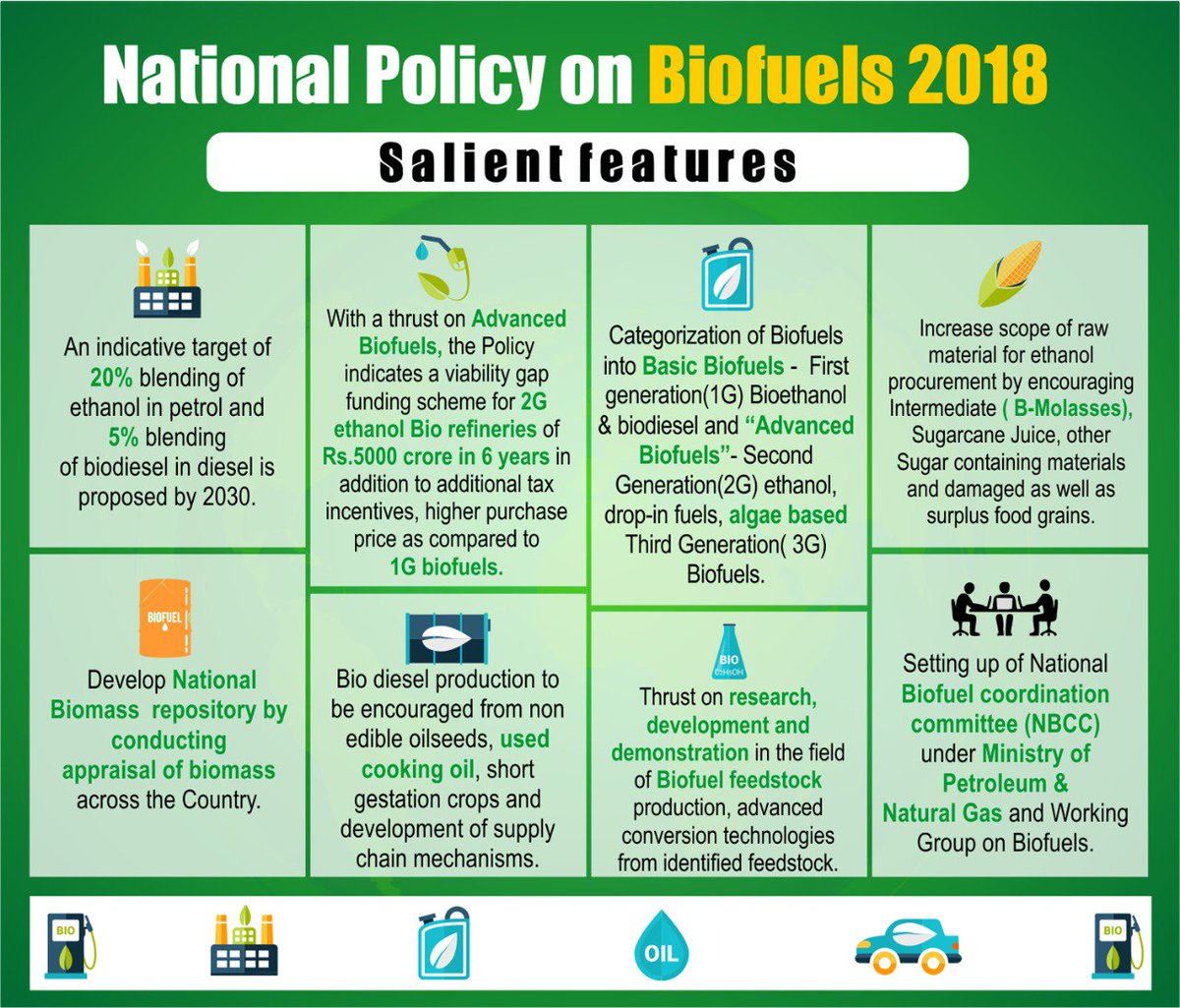
    Salient Features of the Policy

    • The policy categories biofuels into the following 3 categories :-
      • First Generation (1G) : Also called as ‘basic fuels’, it includes bioethanol and biodiesel
      • Second Generation(2G): It includes ethanol, Municipal Solid Waste (MSW) to drop-in fuels and is also known as ‘advanced fuels’
      • Third Generation(3G) : Biofuels like bio-CNG

    The categorization is done to enable the extension of appropriate financial and fiscal incentives under each category.

    • Expands the scope of raw material: The policy allows the use of Sugarcane Juice, Sugar-containing materials like Sugar Beet, starch containing materials like Corn, Cassava, Damaged food grains like wheat, Rotten Potatoes, unfit for human consumption for ethanol production.
    • Use of surplus food grains : To avoid wastage and to provide farmers appropriate prices, the policy proposes the use of surplus food grains for production of ethanol for blending with petrol with the approval of National Biofuel Coordination Committee.
    • Viability Gap Funding : Policy indicates a viability gap funding scheme for 2G ethanol Bio refineries of Rs.5000 crore in 6 years.
    • It encourages setting up of supply chain mechanisms for biodiesel production from non-edible oil seeds, Used Cooking Oil, short gestation crops.

    Expected Benefits

    • With the upswing in the oil price putting pressure on the economy, even small steps to encourage the use of biofuels are welcome.
    • Reduced Import Dependency : The ethanol supply for year 2017-18 is expected to be around 150 crore liters of ethanol which will result in savings of over Rs.4000 crore of forex.
    • Cleaner Environment : By reducing crop burning & conversion of agricultural residues/wastes to biofuels it will help in abetting Greenhouse Gas emissions.
    • Municipal Solid Waste(MSW) management : Around 62 MMT of MSW is generated in India annually. With existing technology, there is potential to provide around 20% of drop in biofuels from one ton of MSW waste.
    • Additional Income to Farmers: The otherwise burnt agricultural residues/waste can be commercialized augmenting the farmers’ income.

    Implementation Challenges

    • Technical Challenges : The technology for production of biofuels is still in its nascent stage and further research is needed for making it more economically viable.
    • Supply Chain Management : For streamlining the movement of agricultural waste and other raw material for biofuel from source to industrial gates, robust supply chain is required which is still not well-developed.
    • Limited Private Sector investment : Accelerated investment is needed in the sector which can only be achieved with the involvement of private sector whose participation has been hampered because of financial constraints and lack of cohesive support from central to local level.
    • Food vs Fuel Challenge :There is the risk of diverting farmland or crops for biofuels production in detriment of the food supply which can lead to food inflation.
    • Environmental Challenges : There is a risk of farmers opting for mono cropping preferring crops used for biofuel production which can disbalance local ecology as well.

    Conclusion

    • The Policy has the potential to transform India’s fuel market, mitigating environmental pollution, diversify farmers income and much more.
    • However, the government need to take steps to remove policy barriers that have discouraged private investment in building supply chains and also need to channelise more research in new technology so as to make the production of biofuels more economically viable.