💥Join UPSC 2027,2028 Mentorship (July Batch) + XFactor Notes & Microthemes PDF

Author: CD Staff

  • [RSTV Archive] Normal Monsoon and Economy

    UPSC 2022 countdown has begun! Get your personal guidance plan now! (Click here)

    IMD had predicted normal monsoon for 2021. However, initial estimates show that some states may not get enough rain.

    In this article, we shall learn how this will impact economic growth, especially when other sectors are still reeling under Covid-19 impact.

    What is Monsoon?

    • Monsoon is traditionally a seasonal reversing wind accompanied by corresponding changes in precipitation.
    • It is now being used to describe seasonal changes in atmospheric circulation and precipitation associated with annual latitudinal oscillation of the Intertropical Convergence Zone between its limits to the north and south of the equator.
    • Usually, the term monsoon is used to refer to the rainy phase of a seasonally changing pattern, although technically there is also a dry phase.
    • The term is also sometimes used to describe locally heavy but short-term rains.

    What defines a Normal Monsoon?

    The Indian Meteorological Department (IMD) calls a monsoon season:

    • ‘Normal’ when the total amount of rainfall in the country between June and September is within 10 per cent (plus or minus) of the average rain over a long period.
    • ‘Deficit rainfall’ is when it drops below the margin of 10 per cent of the average.
    • ‘Excess rainfall’ is when it exceeds the average by more than 10 per cent.

    What is the LPA method?

    • The IMD uses long period average (LPA) method to forecast the monsoon.
    • LPA represents the average annual rainfall received by India during the southwest monsoon over the five decades from 1961 to 2010.

    Why is it so important to have Normal Monsoon?

    A good monsoon usually brings renewal and recovery, especially when times are grim. The right amount of rainfall brings the promise of a bumper harvest, boosting rural incomes and demand, driving an essential economic cycle.

    (1) Crop success

    • The monsoon is critical for agriculture in the country since nearly 60% of India’s net arable land lacks irrigation.
    • The monsoon delivers about 70% of India’s annual rainfall and determines the yield of several grains and pulses, including rice, wheat, and sugarcane.
    • India is the world’s biggest producer of sugar, cotton and pulses, and the second-biggest producer of wheat and rice. 

    (2) Food inflation

    • More importantly, higher agriculture yield would mean lower pressure on food prices and the overall retail inflation.
    • A normal south-west monsoon should help to contain food price pressures, especially in cereals and pulses.
    • It is also crucial to keep up the rural demand.

    (3) Drinking water

    • The rains also replenish nearly 100 large reservoirs critical for drinking water and power generation across the country.
    • In the event of deficient rains, cities such as Chennai, Mumbai, and Hyderabad will be forced to cut water supplies.

    (4) Demand spur in the economy

    • Most major sectors of the economy like to base their sales and distribution activities on the monsoon’s behavior.
    • For example, if the monsoon fails, lower production of foodgrain would mean lower demand for diesel to transport goods.
    • A company involved in sales and distribution of automotive fuels would like to cut down production before the demand plummets.
    • From share markets and betting houses to the collections at temples and sales of vegetables, the monsoon affects everything.

    (5) Hydro Energy

    • A normal monsoon will also lead to reservoirs across India, which are responsible for water supply in cities, filling up.
    • Thus it  will also lead to an increase in production of hydro power which is a cleaner form of energy.

    Importance of Monsoon for the Agriculture

    • When the first wave of Covid-19 cases ravaged the economy in 2020, it was the agriculture sector, powered by an above-average monsoon, that saved the economy and millions who depend on agriculture, both directly and indirectly.
    • Nearly half of India’s farmland has no irrigation and is dependent on monsoon rains, which account for 70-90 per cent of annual rainfall.
    • Farming accounts for almost 15 per cent of India’s GDP and employs nearly 42.6 per cent of the workforce.
    • While the share of Indians employed in the sector is declining, it remains a critical sector.

    Public sentiments associated

    • Normal monsoon will also improve the sentiment in rural India which has witnessed many coronavirus cases and deaths.
    • It will lead to an increase in income of farmers and provide a boost to rural demand which has been facing pressure in the second wave.

    Significance for post COVID recovery

    • A normal monsoon would ensure that inflation remains in the band of 4%-6% as targeted by the Reserve Bank of India.
    • Low inflation will help the Reserve Bank of India to continue with its stance of keeping interest rates low. Generally, central banks resort to an increase in interest rates to tackle high inflation.
    • Low rate scenario is required at a time when Indian economy is battling from the economic fallout of the pandemic.

    Issues in Monsoon Prediction

    • One may complain about the “unreliability and uncertainty of rainfall prediction in India.
    • In recent times, the unpredictability of monsoons has increased significantly with the impact of global warming that has resulted in climate change all over the world.
    • For climate scientists, determining the location, extent, and intensity of the ITCZ is the biggest challenge and in recent times it has become more difficult due to climate change and other factors like El Nino, a global climate cycle that disrupts the path of trade winds.
  • Important Traditional Crafts, Music, Dance schools, Paintings and Handicrafts in India

    14th Sept 2021


    UPSC 2022 countdown has begun! Get your personal guidance plan now! (Click here)


    Indian Festivals

    Kumbha MelaHeld at all 4 places every 3 years by rotation (Allahabad, Haridwar, Nashik, Ujjain) Associated rivers : Ganga at Haridwar, the Sangam of the Ganga, Yamuna and the mythical Saraswati at Allahabad,  Godawari at Nashik, and Shipra at Ujjain Ardha Kumbh Mela  : Haridwar and Prayag every 6 years Purna Kumbh Mela  : Prayag every 12 years Maha Kumbh Mela  : Prayag every 144 years
    Holilast full moon day of  Phalguna
    Maha Shivaratri13th night in Krishna Paksha of Phalguna
    Navaratri9 forms of Shakti are worshipped on 9 nights
    Vinayaga ChaturthiOn occasion of birth of Ganesha
    Vasant PanchamiWorshiping Saraswati –  the goddess of knowledge, music and art Children are taught to write their first words; Brahmins are fed ; ancestral worship is performed; the god of love- Kamadeva is worshipped People usually wear yellow garments
    RamzanMuslims refrain from eating, drinking and sexual relations from dawn until sunset Intended to teach Muslims about patience, humility & spirituality
    Guru PurnimaBuddhists in the honour of Lord Buddha who gave his first sermon on this day at Sarnath Hindus on this day offer Puja or pay respect to their Guru
    Buddha PoornimaBirth anniversary of Lord Buddha
    ChristmasCommemorate the birth of Jesus
    EasterOldest and holiest Christian festival – the day when Jesus Christ was crucified On this day Jesus Christ rose from the dead and ascended into heaven
    Thai PongalHarvest festival celebrated in Tamil Nadu, Puducherry and Sri Lanka To thank the Sun God and farmstead livestock Boiling of milk in clay pot symbolize material abundance for household
    MuharramCelebrated on the 1st  month of the Islamic calendar unlawful to fight during this month
    Dree Festivalan agricultural rite, which is observed by Apatanis in Arunachal Pradesh involves a sacrifice of fowls, eggs and animals to the sun & moon god to appease these Gods to avoid feminine

    Indian Dances

    Indian Folk Music
    • Baul : It is a type of Bengali music and a religious sect. The lyrics carry influence from Bhakti movement as well as Sufi movement.
    • Wanawan : Folk music from Kashmir which is sung during wedding ceremonies.
    • Padwani : This music is based on Mahabharata and uses both singing and playing instruments.
    • Alha : Song is from Madhya Pradesh and is a heroic ballad song.
    • Paani hari : Song is from the state of Rajasthan and is thematically related to water. Songs are generally about women fetching water from nearby well.
    • Ovi : Maharashtra and Goan women sing such songs during leisure time.
    • Pai song : Songs are mostly from Madhya Pradesh sung during festivals.
    • Lavani : Popular folk song from Maharashtra. Music has a powerful rhythm and beats and is suitable for dancing.
    • Maand : Developed in the royal circles
    • Dandiya raas : Performed in Gujarat and is associated with Holi and Lila of Krishna and Radha at Vrindavan
    • Powada : Folk type emerging from Maharashtra
    • Khongjom Parva : Important folk music from the state of Manipur.
    • Bhagwati : Popular amongst masses of Karnataka and Maharashtra. Musically they are close to ghazals and are sung on a slower pitch.
    Classical Dances

    The classical dance forms recognised by the Sangeet Natak Akademi and the Ministry of Culture are

    • Bharatanatyam, from Tamil Nadu
    • Kathak, from Uttar Pradesh and western India
    • Kathakali, from Kerala
    • Kuchipudi, from Andhra Pradesh
    • Odissi, from Odisha
    • Sattriya, from Assam
    • Manipuri, from Manipur
    • Mohiniyattam, from Kerala

    Indian Music

    The two main traditions of classical music in India are Carnatic music and Hindustani Music. Carnatic Music is found predominantly in the peninsular regions and Hindustani music are found in the northern and central regions.

    Hindustani Music

    Hindustani music was not only influenced by ancient Hindu musical traditions but also enriched by the Persian performance practices of the Mughals.

    Dhrupad is an old style of Hindustani singing, traditionally performed by male singers. The great Indian musician Tansen sang in the Dhrupad style. Dhrupad was the main form of northern Indian classical music but has now given way to Khyal.

    Khyal is a form of vocal music in Hindustani music. It was adopted from medieval Persian music It is special as it is based on improvising and expressing emotion.

    Another vocal form Tarana are medium to fast-paced songs that are usually performed towards the end of the concert. They consist of a few lines of poetry with rhythmic syllables.

    Tappa is a form of Indian semi-classical vocal music. It originated from the folk songs of the camel riders of Punjab and was developed as a form of classical music by Mian Ghulam Nabi Shori.

    Thumri is a semi-classical vocal form said to have begun in Uttar Pradesh. The lyrics are typically in Brij Bhasha and are usually romantic.

    Ghazal is an originally Persian form of Poetry. In India, Ghazal became the most common form of poetry in the  Urdu language.

    Although Hindustani music clearly is focused on vocal performance, recently instrumental Hindustani music is very popular than vocal music especially outside South Asia.

    Carnatic Music

    Carnatic music is a system of music commonly associated with the southern part of  India especially. Andhra Pradesh, Karnataka, Kerala and Tamil Nadu. Carnatic music is completely melodic with improvised variations. Purandara Dasa is credited with having founded today’s Carnatic music. He is credited with having elevated Carnatic music from religious and devotional music into the realm of performing art. Carnatic music is usually performed by a small ensemble of musicians consist ing of a principal performer (vocalist ) a violin, mridanga ,and a tamburu. Today Carnatic music is presented by musicians in concerts or recordings either vocally or through instruments.

    Important Indian Crafts

    ZARI

    •  Zari is an even thread traditionally made offine gold or silver used in traditional Indian, Pakistani and Persian garments and curtains, etc. Four types of zari are produced in India, namely, real zari, semi real zari, imitation zari and plastic zari.
    •  Real zari is made of silver and electroplated with gold, whereas semi real zari has a composition of copper coated with silver and gold electroplating. Surat is the home of zari industry in India. Other clusters producing zari are Bareilly, Varanasi, Agra, Hyderabad, Lucknow, Vadodara, Lathur, Jaipur, Barmer, etc.

    Coir Twisting

    •  Coir is a natural, eco-friendly, waterproof and exceptionally tensile fibre extracted from the nuts of coconut palms.
    •  It is found in abundance and is used for manufacturing a wide range of eco-friendly toys, mats, brushes, mattresses, wall hangings, key rings, pen stands and other home decoratives.
    •  This craft is primarily produced in Odisha (Sakhigopal, Puri, Pipli, Bhubaneswar, Batamangala and Kendrapara). It is also produced in Kerala (Ernakulam).

    Folk Painting

    •  Indian folk paintings are pictorial expressions of village painters which are marked by the subjects chosen from epics like Ramayana and Mahabharata, Indian Puranas as well as daily events. There are several vibrant folk painting types in India in different stages.
    •  The Gond tribe of Madhya Pradesh is engaged in floor and wall painting. Warli is a vivid expression of daily and social events of Warli tribe in Maharashtra. Rajasthan is famous for Phad painting done on cloth.
    •  Other types of paintings arc Pilhora painting in Gujarat and Madhya Pradesh, Madhubani painting of Bihar, Chitrakar painting of West Bengal, Patachitras in Odisha, and Kalamkar Srikalahasti, Andhra Pradesh.

    Metal Ware

    •  The metal crafts of India display intricate craftsmanship and fine art in shaping gold, silver, brass, copper into exquisitely designed images, idols, jewellery, and utility items. Different categories of handicrafts that come under metal ware are brass metalware of Moradabad, metal bidri work and bell metal in Madhya Pradesh, Odisha, and so on.
    •  India is the largest brassware producer in the world. Major clusters of brassware are Moradabad, Murshidabad, Madurai, Salem, Cuttack and Haryana.
    •  Bidriware is a metal handicraft that originatedinBidar, Karnataka. The term
      ‘Bidriware’ originates from the township of Bidar, which is still the main centre of the unique metalware. It is a form of encrusted metalware, where one metal is inlaid on to another.
    •  Bidri products include a diverse range of objects including hukka bases, bowls, boxes, candle stands, trays, jewellery and buttons. It travelled from Iran to Ajmer in Rajasthan in the 13th century AD, and from there to Bijapur and flourished during the reign of the Deccan Sultanate.Itis also practised in Aurangabad district in the state of Maharashtra and Hyderabad in Andhra Pradesh. The basic metal used for Bidri is the alloy of zinc and copper.

    Filigree and Silverware

    •  Filigree is an extremely ancient technique dating back to 4000 years ago. Filigree work is performed on silver and involves significant precision and technicality. Two major clusters of silver filigree in India are Karimnagar in Andhra Pradesh and Cuttack in Odisha.
    •  The practice in Karimnagar is about two centuries old. However, it is also practised in Warangal in Andhra Pradesh. Key raw materials used are silver wire, tracing sheet, copper, charcoal, dilute sulphuric acid.

    Textile Hand Embroidery

    •  In textile hand embroidery, embellishment is made on fabric with threads and sometimes with other materials.
    •  There are many popular embroidery clusters such as chikankari and zardozi of Lucknow, katha of Bengal pulkari of Punjab. kutchi embroidery of Gujarat and kashidakari of Kashmir. Zardozi has been traditionally prevalent in Lucknow and the six surrounding districts ofBarabanki, Unnao, Sitapur, Rae Bareli, Hardoi and Amethi.

    Textile Hand Printing

    •  Hand-printed textiles is a craft in which cloth is dyed with hand or printed using shapes. Various types of hand printing practiced in India are block printing, batik, kalamkari (hand printing by pen) and bandhani (tie and die).
    •  Some of the important centres of this craft are in Hyderabad, Machalipattnam, Varanasi, Farrukabad, Bagh, Behrongarh, Indore, Mandsar, Burhanpur, Ahmedabad, Rajkot, Kutch, Bagru, Chittroli, Sanganer, Jaipur and Jodhpur.

    Indian Paintings

    Prehistoric Cave Paintings

    • Painted rock shelters by prehistoric cave dwellers
    • Notable example →  Bhimbetka caves in the Kaimur Range, MP (biggest prehistoric art depositoryin India)

    Genres of Indian Painting

    • Indian paintings can be broadly classified as murals and miniatures.
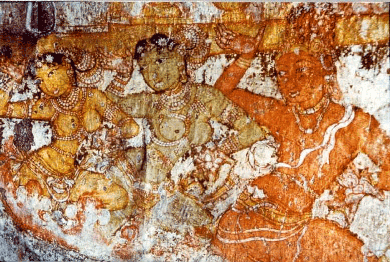
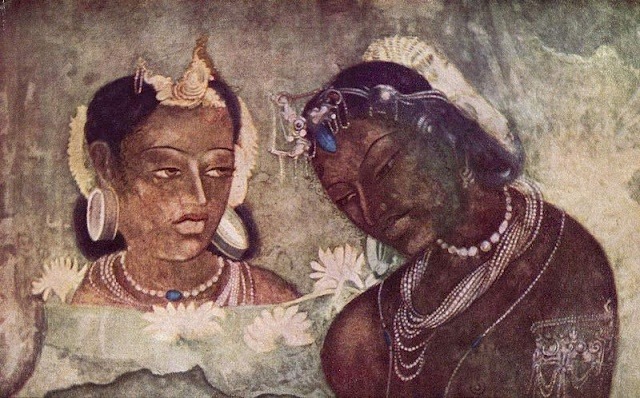
    • Murals are large works executed on the walls of solid structures directly, as in the Ajanta Caves & Kailash temple (Ellora)
    • Miniature paintings are executed on a very small scale for books or albums on perishable material such as paper and cloth.

    Mural Paintings

    • Mural is the only form of painting that is truly three-dimensional, since it modifies and partakes of a given space.
    • Mural paintings are applied on dry wall with the major use of egg, yolk, oil, etc.
    Mural Paintings
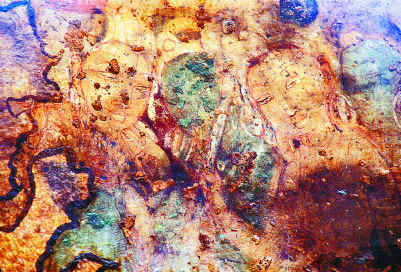
    • Notable examples → Ajanta Caves, Bagh Caves, Sittanavasal Caves, Armamalai Cave (Tamil Nadu), Kailasa temple (Ellora Caves)
    • Murals from this period depict mainly religious themes of Buddhist, Jain and Hindu

    Ajanta Murals Paintings

    • Depict a large number of incidents from the life of the Buddha (Jataka Tales)
    • Exclusively Buddhist, excepting decorative patterns on the ceilings and the pillars.

    Ellora Murals Paintings

    • Painted in rectangular panels with thick borders with following
    • Prominent features →  Sharp twist of the head + painted angular bents of the arms + sharp projected nose + long drawn open eyes + concave curve of the close limbs

    Badami Mural Paintings

    • A cave site in Karnataka, patronized by chalukya king, Manglesha
    • Depictions in the caves show Vaishnava affiliation, Therefore, the cave is popularly known as Vishnu cave.
    Badami Mural Paintings

    Murals under the Pallava, Pandava and Cholas

    • Paintings at the Kanchipuram temple were patronised by Pallava king, Rajsimha
    • Paintings at Tirumalaipuram caves & Jaina caves at Sittanvasal were patronised by Padayas
    • Paintings at Nartamalai & Brihadeswara temple were patronized by Cholas
    Murals under the Pallava, Pandava and Cholas

    Vijayanagara murals (13th century)

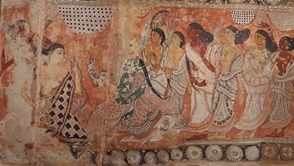
    • Paintings at Virupaksha temple (Hamphi) & Lepakshi temple (Andhra Pradesh) were patronised by Vijayanagara Kings
    Vijayanagara murals

    Miniature Paintings

    • The Palas of Bengal were the pioneers of miniature painting in India.
    • The art of miniature painting reached its glory during the Mughal period.

    The Pala School (11th – 12th century)

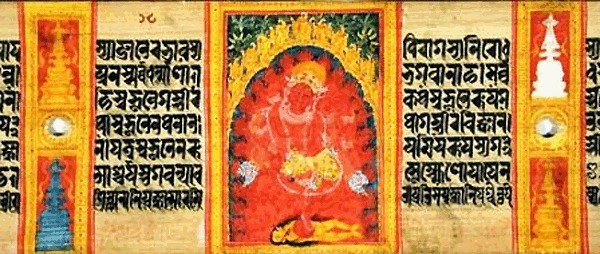
    • Exist in the form of illustrations to the religious texts on Buddhism executed under the Palas of the eastern India & the Jain texts executed in western India
    • The Buddhist monasteries of Nalanda, Odantapuri, Vikramsila & Somarupa were great centers of Buddhist learning and art.
    • A large number of manuscripts on palm-leaf relating to the Buddhist themes were written, illustrated with the images of Buddhist deities at these centers
    Pala School
    • The Pala painting is characterized by sinuous line and subdued tones of colour

    Western Indian School of Painting

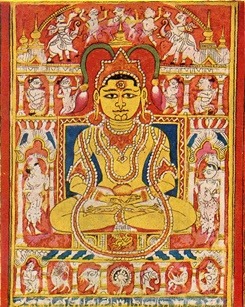
    • Also called Jaina Painting, largely devoted to the illustration of Jaina religious texts of the 12th–16th century
    • Notable sites → Gujrat, Uttar Pradesh, Central India & Orissa
    • Characterized by simple, bright colours, highly conventionalized figures, and wiry, angular drawing
    Western Indian School of Painting

    Mughal Paintings (16th – 19th century)

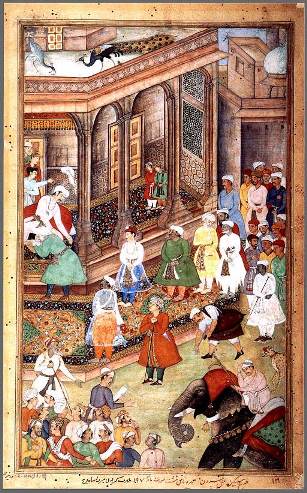
    • Mainly confined to miniature illustrations on the books or as single works to be kept in an album
    • Mughal paintings were a unique blend of Indian, Persian (Safavi) and Islamic styles
    • Marked by supple naturalism →  Primarily aristocratic and secular
    • Tried to paint the classical ragas and Seasons or baramasa
    • Tuti-nama – first art work of the Mughal School.
    • Akbar’s reign (1556–1605) ushered a new era in Indian miniature painting.
    • At Zenith under Jahangir who himself was a famous painter
    • Jahangir encouraged artists to paint portraits and durbar scenes.
    • Shah Jahan (1627–1658) continued the patronage of painting.
    • Aurangzeb had no taste for fine arts.
    Mughal Paintings
    • Most significant are Hamza Nama, Razm-Nama or “The Book of War”, Akbar Nama
    • Finest example of this school includes Hamzanama series, started in 1567 & completed in 1582
    • Hamzanama →  Stories of Amir Hamza, illustrated by Mir Sayyid Ali
    • 1200 paintings on themes of Changeznama, Zafarnama Ramayana
    • The paintings of the Hamzanama are of large size, 20” x 27″ and were painted on cloth.
    • They are in the Persian safavi style with dominating colours being red, blue and green
    • Indian tones appear in later work, when Indian artists were employed

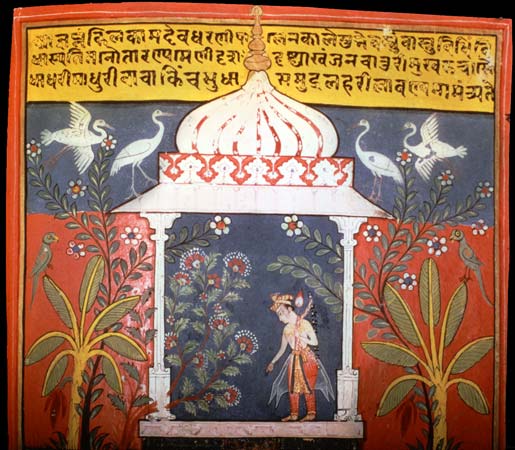
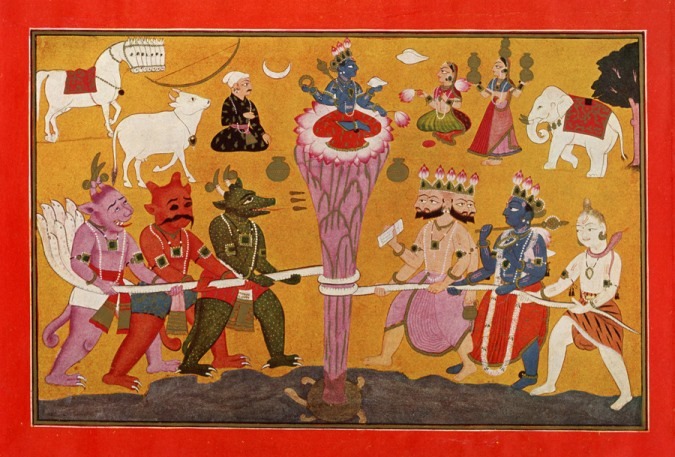
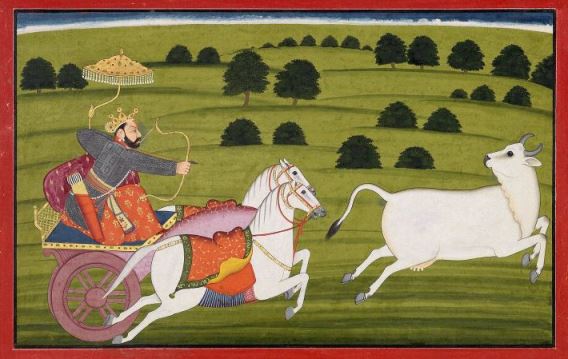
    Rajput Painting (16th – 19th century)

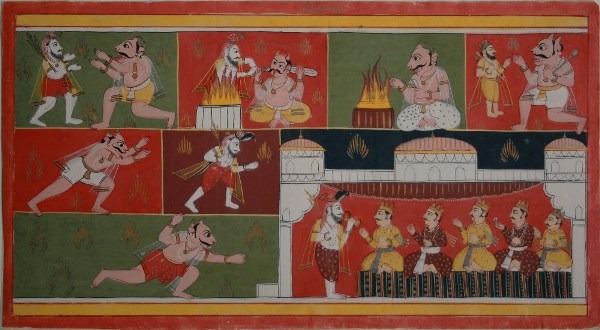
    • the art of the independent Hindu feudal states in India
    • Unlike Mughal paintings which were contemporary in style, Rajput paintings were traditional & romantic
    • Rajput painting is further divided into Rajasthani painting and Pahari painting (art of the Himalayan kingdoms)
    Central Indian and Rajasthani Schools (17th – 19th Century)
    • Deeply rooted in the Indian traditions, taking inspiration from Indian epics, Puranas, love poems & Indian folk-lore
    • Mughal artists of inferior merit who were no longer required by the Mughal Emperors, migrated to Rajasthan
    Malwa paintings (17th century)
    • Centred largely in Malwa and Bundelkhand (MP); sometimes referred as Central Indian painting due to its geographical distribution.
    Malwa paintings
    • This school’s most appealing features is its primitive charm & a simple childlike vision
    Kishangarh paintings (18th century)
    • Distinguished by its individualistic facial type and its religious intensity
    • Developed under the patronage of Raja Savant Singh (1748-1757 AD) by master artist Nihal Chand
    Kishangarh paintings
    Mewar (Udaipur) Paintings (17th – 18th century)
    • Characterized by bold bright contrasting colours and direct emotional appeal
    • The earliest-dated examples come from Ragmala (musical modes) series painted in 1605
    Mewar Paintings
    • Reflects portraiture & life of the ruler, along with religious themes
    Marwar (Jodhpur) Paintings
    • Executed in a primitive and vigorous folk style
    • Completely uninfluenced by the Mughal style.
    • Portrays court scenes, series of Ragamala & Baramasa
    Bundi paintings (Late 17th century)
    • Very close to the Mewar style, but the former excels the latter in quality
    • Prominent features → Rich and glowing colours, the rising sun in golden colour, crimson-red horizon, border in brilliant red colour (in Rasikpriya series)
    • Notable examples → Bhairavi Ragini (Allahabad Museum), illustrated manuscript of the Bhagawata Purana (Kota Museum) & a series of the Rasikapriya (National Museum, Delhi)
    Kota paintings (18th – 19th century)
    • Very similar to Bundi style of paintings
    • Themes of tiger and bear hunt were popular
    • Most of the space in painting is occupied by the hilly jungle
    The Pahari Schools (17th – 19th Century)

    Comprises the present State of Himachal Pradesh, some adjoining areas of the Punjab, the area of Jammu, & Garhwal in Uttarakhand

    Basohli Paintings (17th – 18th century)
    • known for its bold vitality of colour, lines & red borders
    • Emotional scenes from a text called “Rasamanjari” →  Krishna legend
    • Favoured oblong format, with the picture space usually delineated by architectural detail, which often breaks into the characteristic red borders
    • Stylized facial type, shown in profile, is dominated by the large, intense eyes
    Basohli Paintings
    Guler painting (Jammu)
    • Mainly consisting of portraits of Raja Balwant Singh of Jasrota (Jammu) designed by Nainsukh
    • Colours used are soft and cool unlike Basohli school
    Guler painting
    • Style appears to have been inspired by the naturalistic style of the Mughal painting
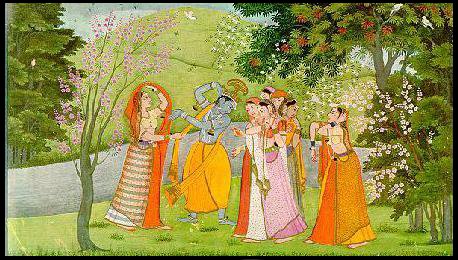
    Kangra painting (Late 18th century)
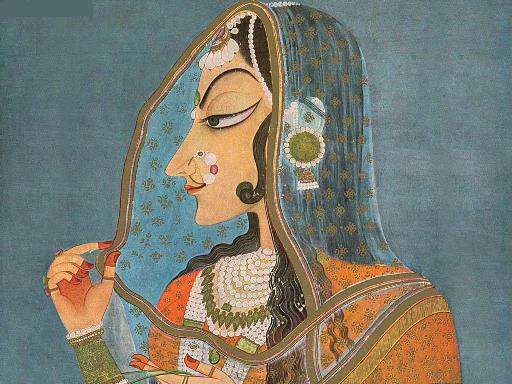
    • The Kangra style is developed out of the Guler style & possesses its main characteristics, like the delicacy of drawing & naturalism
    • The Kangra style continued to flourish at various places namely Kangra, GuIer, Basohli, Chamba, Jammu, Nurpur and Garhwal etc.
    • However, Named as Kangra style as they are identical in style to the portraits of Raja Sansar Chand of Kangra
    • In these paintings, the faces of women in profile have the nose almost in line with the forehead, the eyes are long & narrow, & chin is sharp.
    Kangra painting
    • There is, however, no modelling of figures and hair is treated as a flat mass.
    • Paintings of the Kangra style are attributed mainly to the Nainsukh family.
    Kullu – Mandi painting
    • A folk style of painting in the Kulu-Mandi area, mainly inspired by the local tradition
    • The style is marked by bold drawing and the use of dark and dull colours

    Independent Paintings

    Kalighat Paintings (Kolkata – 19th century)
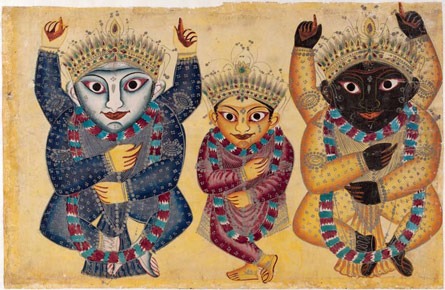
    • Patua painters from rural Bengal came and settled in Kalighat to make images of gods and goddesses in the early 19th century
    • They evolved a quick method of painting on mill-made paper
    • Used brush and ink from the lampblack
    Kalighat Paintings
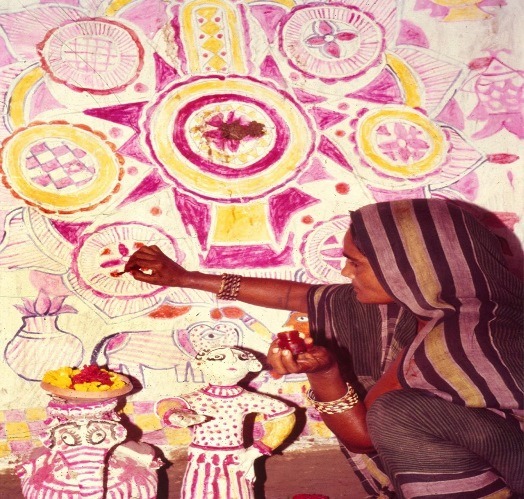
    Madhubani Paintings (Mithila – Bihar)
    • Colorful auspicious images on the interior walls of homes on the occasion of rituals & festivity → painted by women
    • This ancient tradition, especially elaborated for marriages, continues today.
    • Used to paint the walls of room, known as KOHBAR GHAR in which the newly wedded couple meets for the first time
    • Very conceptual, first, the painter thinks & then “draws her thought”
    Madhubani Paintings
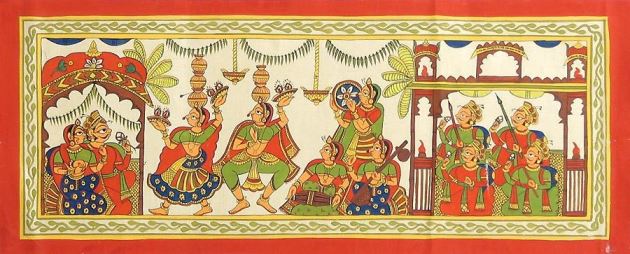
    Phad paintings (Bhilwada, Rajasthan)
    • Phad is a painted scroll, which depicts stories of epic dimensions about local deities and legendary heroes.
    • Bhopas (local priests) carry these scrolls on their shoulders from village to village for a performance.
    Phad paintings
    • Represents the moving shrine of the deity and is an object of worship
    • Most popular & largest Phad – local deities Devnarayanji and Pabuji
    Kalamkari Paintings (Andhra Pradesh)
    • Literal meaning is painting done by kalam (pen) , Mainly in Andhra Pradesh (developed under Vijaynagar rulers)
    • Stories from the epics Ramayana, Mahabharata and the Puranas are painted as continuous narratives
    • Mainly to decorate temple interiors with painted cloth panels scene after scene; Every scene is surrounded by floral decorative patterns
    Warli painting
    • Practiced in tribal regions of Maharashtra with subjects, predominantly religious
    • decorative paintings on floors & walls of ‘gond’ and ‘kol’ tribes homes and places of worship
    • made in a geometric patterns like squares, triangles, and circles
    • Unlike other tribal art forms, Warli paintings do not employ religious iconography and is a more secular art form.

    Handicrafts

    KashmirEmbroidered shawls, carpets, namdar silk and walnut wood furniture
    Rajasthanprecious stone and jems + tie & dye (Bandhani) fabric + minakari work
    Andhra PradeshBidri work and Pochampad saris
    Tamil Nadubronze sculpture and Kajeevaram silk saris
    Mysoresilk, sandalwood items
    Keralaivory carvings and rosewood furniture
    Assamcane furniture
    BengalBankura terracotta modelling and handloom items
    BenarasBrocade & silk saris
    Madhya PradeshChanderi and kosa silk
    Lucknowchikan work  (Zardozi Embroidery – Muslims in Lucknow)
    PunjabPhulkari embroidery
    BengalKantha embroidery
    OrissaPatola embroidery
    BudhhistsThangka painting

    Samanvaya: Free 1-to-1 mentorship for UPSC IAS

    Fill up this form to schedule a free on-call discussion with senior mentor from Civilsdaily. Once submitted we will call you within 24 hours.

    Civilsdaily Samanvaya 1-On-1 Mentorship Form

    Field will not be visible to web visitor

  • 13th Sept 2021 | Environment Test 02

    [WpProQuiz 778]


    [WpProQuiz_toplist 775]

  • Historical and Archaeological Findings in News

    13th Sept 2021


    UPSC 2022 countdown has begun! Get your personal guidance plan now! (Click here)


    1.Excavations in Kutch shed light on early Harappan custom

    • Archaeological excavations undertaken by a group of researchers have shed light on the custom and burial rituals that were prevalent during the early Harappan phase.
    • The team which camped in Khatiya village of Kutch unearthed several skeletal remains from a cemetery-like burial site where 26 graves out of the nearly 300-odd ones were excavated.

    2.Chalukyan sculpture of Siva found in Andhra Pradesh

    • A rare sculpture of Lord Siva and Goddess Parvati dating back to the 7th century was discovered at a Chalukyan temple in Satyavolu village of Prakasam district, Andhra Pradesh.
    • The red sandstone sculpture portrays Lord Siva as the therapeutic physician (Rudra Bhaishajana) — as described in Rigveda — in which he holds a bowl in his left hand, which contains medicine from herbs to revive the ailing horse lying at his feet.
    • Siva was fairly represented in sculptural art of ancient India in many forms right from the Indus Valley civilization to the late medieval period.

    Chalukyan Architecture (5th – 8th CE)

    1. The temples under the Chalukyas are a good example of the Vesara style of architecture.
    2. This is also called the Deccan style or Karnataka Dravida or Chalukyan style. It is a combination of Dravida and Nagara styles.
    3. The building material they used was reddish-golden Sandstone found locally.
    4. The temples had beautiful mural paintings also.
    5. The temples are located on the banks of River Tungabhadra and Malprabaha in Karnataka and Alampur in Andhra Pradesh.
    6. Aihole temples: Ladh Khan temple (Surya Temple), Durga temple, Huchimalligudi temple, Jain temple at Meguti by Ravikirti..
    7. Badami temples: Virupaksha temple and Sangameshwara Temple are in Dravida style. Papanatha temple is in Nagara style.
    8. Pattadakkal: is a UNESCO World Heritage site. There are ten temples here – 4 in Nagar style and 6 in Dravida style.

    3.Archaeologists find pre-Columbian mass child sacrifice site in Peru

    • A group of archaeologists has discovered the remains of more than 50 children who were ritually sacrificed by the pre-Columbian Chimu culture on the northern coast of what is now Peru
    • The new sacrifice site was discovered in the Pamapa La Cruz area in Huanchaco, a coastal district of Trujillo, Peru’s third-largest city

    Other similar places

    • In Huanchaquito, the remains of over 140 children and 200 llamas slain some 550 years ago were discovered
    • It reinforces the idea that Huanchaco was a place where massive sacrifices of children were made during the Chimu culture

    Pre-Columbian Chimu culture

    • The Chimú culture was centred on Chimor with the capital city of Chan Chan, a large adobe city in the Moche Valley of present-day Trujillo, Peru
    • The culture arose about 900 AD, succeeding the Moche culture
    • The Chimú people are best known for their distinctive monochromatic pottery and fine metal working of copper, gold, silver, bronze, and tumbaga (copper and gold)
    • The pottery is often in the shape of a creature or has a human figure sitting or standing on a cuboid bottle

    4.India gets its 37th UNESCO World Heritage Site

    • India’s nomination of the “Victorian and Art Deco Ensembles of Mumbai” has been inscribed on UNESCO’s World Heritage list.
    • The decision was taken at the 42nd session of the World Heritage Committee of UNESCO at Manama in Bahrain today.
    • This achievement is especially remarkable in the view of the successive inscription of another Indian city after Ahmedabad last year

    About the Ensembles

    • Together, this architectural ensemble represents the most remarkable collection of Victorian and Art Deco buildings in the world which forms the unique character of this urban setting, unparalleled in the world.
    • The Ensemble consists of 94 buildings primarily of 19th century Victorian Gothic revival and early 20th century Art Deco style of architecture with the Oval Maidan in the centre.
    • The 19th century Victorian buildings form part of the larger Fort precinct situated to the east of the Oval Maidan.
    • These public buildings include the Old Secretariat (1857-74), University Library and Convention Hall (1874-78), the Bombay High Court (1878), the Public Works Department Office (1872), Watson’s Hotel (1869), David Sasoon Library (1870), the Elphinstone College(1888), etc.
    • The Art Deco styled buildings to the west of the Oval Maidan were raised in early 20th century on the newly reclaimed lands at Marine Drive and symbolised the shift in expression to represent contemporary aspirations.

    UNESCO World Heritage Properties in India

    • In the past 5 years alone, India has managed to get inscribed seven of its properties/sites on the World Heritage List of UNESCO.
    • India now has overall 37 World Heritage Inscriptions with 29 Cultural, 07 Natural and 01 Mixed sites.
    • While India stands second largest in number after China in terms of number of World Heritage properties in ASPAC (Asia and Pacific) region, it is overall sixth in the world.

    5.Thanjavur Paintings

    Thanjavur Paintings

    • It is a classical South Indian painting style, which was inaugurated from the town of Thanjavur and spread across the adjoining and geographically contiguous old Tamil country.
    • The art form draws its immediate resources and inspiration from way back about 1600 AD, a period when the Nayakas of Thanjavur under the suzerainty of the Vijayanagara Rayas.
    • It is distinguished by its famous gold coating.
    • However, it can safely be surmised that Thanjavur painting, as we know it now, originated in the Maratha court of Thanjavur (1676 – 1855).
    • It has been recognized as a Geographical indication by the Government of India in 2007-08.

    6.Ancient rocks in India give clues to early life

    Cambrian Explosion

    • It refers to the sudden appearance in the fossil record of complex animals with mineralized skeletal remains 541 million years ago.
    • Researchers have found the oldest clue to the mystery of animal life in ancient rocks and oils dating back at least 100 million years before the famous Cambrian explosion of animal fossils.
    • Researchers at the University of California tracked molecular signs of animal life, called biomarkers, as far back as 660-635 million years ago during the Neoproterozoic era.
    • In ancient rocks and oils from India, Oman, Siberia, they found a steroid compound produced only by sponges, which are among the earliest forms of animal life.

    Demosponge

    • A sponge is a member of the phylum Porifera.
    • It is a simple marine animal with many cells, but no mouth, muscles, heart or brain.
    • Demosponges is a class that contains most of the sponges.
    • The sponges in this class make their skeleton from Spongin, a special protein.

    7.Buddhist site museum at Lalitgiri Odisha

    • One of the earliest Buddhist settlements in Odisha, Lalitgiri (Located in Cuttack district), where excavations have yielded ancient seals and inscriptions, has been converted into a museum.

    Lalitgiri Museum

    • Located in Cuttack district, it will be the third site museum of the Bhubaneswar circle of the ASI after Ratnagiri and Udaygiri.
    • The three sites together form the Diamond Triangle of Buddhism in Odisha.
    • The museum complex is spread over 4,750 sq. m. The building and auditorium are built over 1,310 sq. m. The complex has been constructed at a cost of ₹10 crore.

    Historical importance of Lalitgiri

    • Excavations at Lalitgiri have yielded the remains of four monasteries, showing cultural continuity from the post-Mauryan period till the 13th century CE.
    • Tantric Buddhism was practiced at this site.
    • The centre of attraction is a relic casket containing corporal remains found inside the Mahastupta.
    • Huge sculptures of Buddha, architectural fragments of Viharas and Chaityas are arranged period-wise.
    • The central gallery is designed after a Buddha Mandala with a colossal Buddha image at the centre and six Bodhisattva images surrounding it.

    8.Reconstitution of Indian Council of Historical Research (ICHR)

    • The Government has reconstituted the Indian Council of Historical Research (ICHR), New Delhi for a period of three years till 2022.

    Indian Council of Historical Research

    • The ICHR is an autonomous body of the HRD Ministry, which had been established by an Administrative Order of the then Ministry of Education.
    • The body has provided financial assistance to the historians and direction to the research scholars in their multifarious topics of historical research through established historians and scholars of the country.
    • ICHR disburses funds for carrying out research to Indian as well as foreign scholars on their applications for fellowships, grants, and symposia.

    9.The Indian Museum of the Earth (TIME)

    • India has set in motion an ambitious plan to create Indianised version of the world-famous Smithsonian Museum, showcasing Indian subcontinent’s evolutionary history.

    The Indian Museum of the Earth (TIME)

    • This museum will be modelled on the American Museum of Natural History, or the Smithsonian museum in the U.S.
    • The museum, which will be set up as a public-private partnership, would be located somewhere in NCR.
    • Unlike static museums that are commonplace, the proposed Earth museum would be a dynamic place to encourage fossil research, student activity, public outreach besides driving policy decisions.
    • The museum would be having a repository where individual collectors and researchers can submit their life long collection for safekeeping and allowing future generation researchers to study those samples.

    10. Development of Rakhi Garhi Archaeological Site

    Rakhi Garhi

    Rakhi Garhi is being developed as one of the five Identified Iconic Archaeological Sites, informed the Minister of Culture and Tourism.
    The ancient site of Rakhi-Khas and Rakhi-Shahpur are collectively known as Rakhigarhi, located on the right bank of the now dried up Palaeo-channel of Drishadvati.
    It is located in the Ghaggar-Hakra river plain in the Hissar district of Haryana.
    Seven mounds are located here.
    The site has yielded various stages of Harappan culture and is by far one of the largest Harappan sites in India.
    The site shows the sequential development of the Indus culture in the now dried up Saraswati basin.

    Major findings at Rakhi Garhi

    • Findings confirm both early and mature Harappan phases and include 4,600-year-old human skeletons, fortification and bricks.
      Digging so far reveals a well-planned city with 1.92 m wide roads, a bit wider than in Kalibangan.
    • The pottery is similar to Kalibangan and Banawali.
      Pits surrounded by walls have been found, which are thought to be for sacrificial or some religious ceremonies.
    • There are brick-lined drains to handle sewage from the houses.
      Terracotta statues, weights, bronze artefacts, comb, copper fish hooks, needles and terracotta seals have also been found.
    • A bronze vessel has been found which is decorated with gold and silver.
    • A granary belonging to the mature Harappan phase has been found here.
    • Fire altars structures were revealed in Rakhigarhi.

    Five Iconic Archaeological Sites

    The government has proposed to develop five archaeological sites as “iconic sites” with onsite museums in Rakhigarhi (Haryana), Hastinapur (Uttar Pradesh), Sivsagar (Assam), Dholavira (Gujarat) and Adichanallur (Tamil Nadu) in the Union Budget 2020-21.

    (1) Rakhigari (Discussed above)

    (2) Hastinapur

    Hastinapur in the Meerut district of Uttar Pradesh finds mention in the Mahabharata and the Puranas. One of the most significant discoveries made at this site was of the “new ceramic industry”, which was named the Painted Grey Ware, which as per the report represented the relics of the early Indo-Aryans.

    (3) Sivasagar

    In Sivasagar (Assam), excavations at the Karenghar (Talatalghar) complex between 2000 and 2003 led to the discovery of buried structures in the north-western and north-eastern side of the complex. Among the structural remains found at the site were ceramic assemblages including vases, vessels, dishes, and bowls, etc. Terracotta smoking pipes were also found.

    (4) Dholavira

    Dholavira in Gujarat is located in the Khadir island of the Rann of Kutch, and like Rakhigarhi is one of the sites where the remains of the Harappan civilization have been found. It is unique because the remains of a complete water system have been found here.

    (5) Adichnallur

    Adichnallur lies in the Thoothukudi district of Tamil Nadu. The urn-burial site was first brought to light during a “haphazard excavation” by a German archaeologist in 1876. Following this, an Englishman Alexander Rae excavated the site between 1889 and 1905.

    11. 10th century Buddhist Monastery uncovered in Jharkhand’s Hazaribagh

    Details of the excavation

    • The findings were significant since the monastery is on the old route to Varanasi, 10 km from Sarnath, where the Buddha gave his first sermon.
    • Archaeologists found four statues of the deity Tara in Varad Mudra and six statues of the Buddha in bhumisparsa Mudra
    • So it is a significant finding as deity Tara’s statues mean this was an important centre of the Vajrayana sect of Buddhism.
    • Vajrayana is a form of Tantric Buddhism, which flourished in India from the 6th to 11th century.

    Inscription on Krishnadevaraya’s death discovered

    • The first-ever epigraphical reference to the date of death of Vijayanagara king Krishnadevaraya has been discovered in the Tumakuru district of Karnataka.
    • Krishna Devaraya was the emperor of the Vijayanagara Empire during 1509–1529. He was the third ruler of the Tuluva Dynasty and is considered to be its greatest ruler.
    • He possessed the largest empire in India after the decline of the Delhi Sultanate.
    • Krishnadevaraya earned the titles Kannada Rajya Rama Ramana (lit, “Lord of the Kannada empire”), Andhra Bhoja (lit, “Andhra Bhoja(Scholar) King”) and Mooru Rayara Ganda (lit, “King of Three Kings”).
    • He became the dominant ruler of the peninsula of India by defeating the Sultans of Bijapur, Golconda, the Bahmani Sultanate and the Gajapatis of Odisha, and was one of the most powerful Hindu rulers in India.
    • Indeed, when the Mughal Emperor Babur was taking stock of the potentates of north India, Krishnadevaraya was rated the most powerful and had the most extensive empire in the subcontinent.
    • Portuguese travellers Domingo Paes and Fernao Nuniz also visited the Vijayanagara Empire during his reign.

    His literary work

    • The rule of Krishnadevaraya was an age of prolific literature in many languages, although it is also known as a golden age of Telugu literature.
    • He was fluent in many languages like Kannada, Marathi, Sanskrit, Telugu and Tamil.
    • Eight Telugu poets were regarded as eight pillars of his literary assembly and known as Ashtadiggajas. He himself composed an epic Telugu poem Amuktamalyada.
    • He took the title of Abhinava-Bhoja and Sakala-Kala-Bhoja (“Bhoja of all the arts”) in honour of Parmara emperor Bhoja who was a polymath, a master of 64 arts and a military genius.

    What does the inscription say?

    • As per the inscription, Krishnadevaraya died on October 17, 1529, Sunday.
    • Incidentally, this day was marked by a lunar eclipse.
    • The inscription also registers the gift of village Honnenahalli in
    • Tumakuru for conducting worship to the god Veeraprasanna Hanumantha of Tumakuru.
    • The Kalahasti inscription refers to the date of Achyutaraya’s (his successor) coronation as October 21, 1529 AD.

    Dickinsonia fossil discovered in Bhimbetka

    Researchers have found the first-ever fossil in India of a Dickinsonia —the Earth’s ‘oldest animal’, dating back 570 million years — on the roof of what’s called the ‘Auditorium Cave’ at Bhimbetka.

    Dickinsonia

    • Dickinsonia is an extinct genus of basal animal that lived during the late Ediacaran period in what is now Australia, Russia and Ukraine.
    • The individual Dickinsonia typically resembles a bilaterally symmetrical ribbed oval.
    • Its affinities are presently unknown; its mode of growth is consistent with a stem-group bilaterian affinity, though some have suggested that it belongs to the fungi or even an “extinct kingdom”.
    • The discovery of cholesterol molecules in fossils of Dickinsonia lends support to the idea that Dickinsonia was an animal.

    What are the new findings?

    • Like the awe-inspiring rock shelters themselves, this fossil was discovered by chance.
    • Dickinsonia fossils have shown that they could exceed four feet in length but the one found in Bhimbetka is 17 inches long.
    • Eleven feet above the ground, almost blending with the rock and easily mistaken by laymen for prehistoric rock art, they found imprints of the Dickinsonia.
    • It is believed to be one of the key links between the early, simple organisms and the explosion of life in the Cambrian Period, about 541 million years ago.

    Cambrian Explosion and Dickinsonia

    • The ‘Cambrian Explosion’ is the term given to the period of time in history when complex animals and other macroscopic organisms such as molluscs, worms, arthropods and sponges began to dominate the fossil record.
    • Researchers from Australian found the Dickinsonia fossil since its tissue contained molecules of cholesterol a type of fat that is the hallmark of animal life.

    Sulawesi Cave Paintings

    • The cave painting depicts a wild boar endemic to the Sulawesi island of Indonesia, where the painting was found.
    • The central Indonesian island, which occupies an area of over 174,000 sq. km, is situated between Asia and Australia.
    • It has a long history of human occupation.

    Significance of the painting

    • The archaeologists’ note that the dated painting of the Sulawesi warty pig seems to be the world’s oldest surviving representational image of an animal.
    • The painting was made using red ochre pigment and depicts a pig with a short crest of upright hairs and a pair of horn-like facial warts in front of the eyes.
    • These pigs have been hunted by humans for tens of thousands of years and are the most commonly depicted animal in the ice age rock art of the island.
    • It suggests that they have long been used as food and form a “focus of creative thinking and artistic expression” for people of that time.

    Annapurna Idol

    • Annapurna, also spelt Annapoorna, is the goddess of food.
      This 18th-century idol, carved in the Benares was stolen from a temple of Varanasi and smuggled out around 100 years ago somewhere around 1913.
    • Now is part of the University of Regina, Canada’s collection at the MacKenzie Art Gallery.
    • The idol holds a bowl of kheer in one hand and a spoon in the other.

    Dairy production in the Indus Valley Civilization

    • By analysing residues on ancient pots, researchers show the earliest direct evidence of dairy product processing, thus throwing fresh light on the rural economy of the civilization.
    • The studies were carried out on 59 shards of pottery from Kotada Bhadli, a small archaeological site in present-day Gujarat.

    A significant outcome of the study

    • The study has found residues in a bowl showing that either heated milk or curd could have been served.
    • There are also remains of a perforated vessel, and similar vessels were used in Europe to make cheese.
    • The Harappans did not just use dairy for their household.
    • The large herd indicates that milk was produced in surplus so that it could be exchanged and there could have been some kind of trade between settlements.
    • This could have given rise to an industrial level of dairy exploitation.

    Sawantwadi Toy

    • Sawantwadi toys refers to hand made works of art made of wood in Sawantwadi a town in Sindhudurg district of Maharashtra. Most of these toys are made in the village of Kolgaon in Sawantwadi taluka.
    • These toys are made from the wood of the Indian Coral tree (Erythrina variegata).
    • Craftsmen who make these toys belong to the Chittari community who came to Sawantwadi from Karwar and Goa.

    Renati Chola Era Inscription

    Who are the Renati Cholas?

    • The Telugu Cholas of Renadu (also called as Renati Cholas) ruled over Renadu region, the present-day Kadapa district.
    • They were originally independent, later forced to the suzerainty of the Eastern Chalukyas.
    • They had the unique honour of using the Telugu language in their inscriptions belonging to the 6th and 8th centuries.
    • The earliest of this family was Nandivarman (500 AD) who claimed descent from the family of Karikala and the Kasyapa gotra.
    • He had three sons Simhavishnu, Sundarananda and Dhananjaya, all of whom were ruling different territories simultaneously.
    • The family seems to have had its origin in Erigal in the Tunmkur district, situated in the border between Pallava and Kadamba regions.

    About the inscription

    • The inscription so found was engraved on a dolomite slab and shale.
      The inscription was written in archaic Telugu which is readable in 25 lines — the first side with eleven lines and the remaining on the other side.
    • It was assigned to the 8th Century A.D. when the region was under the rule of Chola Maharaja of Renadu.
    • The inscription seems to throw light on the record of a gift of six Marttus (a measuring unit) of land gifted to a person Sidyamayu, one of the Brahmins serving the temple at Pidukula village.
    • It says the people who safeguard this inscription for future generations will acquire the status of conducting Aswamedha Yajna and those destroying it will incur sin equivalent to causing death in Varanasi.

    Samanvaya: Free 1-to-1 mentorship for UPSC IAS

    Fill up this form to schedule a free on-call discussion with senior mentor from Civilsdaily. Once submitted we will call you within 24 hours.

    Civilsdaily Samanvaya 1-On-1 Mentorship Form

    Field will not be visible to web visitor

  • Last 30-Days Revision Plan to crack UPSC/UPPCS Prelims 2021 | Free Webinar With Parth Sir

    Last 30-Days Revision Plan to crack UPSC/UPPCS Prelims 2021 | Free Webinar With Parth Sir

    Dear Aspirants

    Most people give up just when they’re about to achieve success. And this holds true for Civil Services Aspirants. Most of you are in that last-minute hustle for the upcoming prelims examinations for UPSC Civil Services as well as UPPSC Upper Subordinate Examinations (popularly called UPPCS Exam!). And in this time, getting nervous or losing track of your hard work for the last 12-18 months is quite natural. But do not get bogged down with these examinations. Let’s get on a webinar together, this Sunday, to allay these fears and nervousness and get your preparation back on track.

    What We Will Be Covering In This Webinar?

    1. 30 Days Routine for the upcoming UPSC and UPPCS Prelims.
    2. How to go with the revision of static subjects for each prelim.
    3. How to cover Current Affairs in a limited time in the most efficient manner.
    4. The importance of giving mock tests in these last 30 days.
    5. How to take up the mock test challenge and get the most out of each test that you are going to give.
    6. What are the important topics and themes in static subjects to look after in revision in these 30 days?

    Do not miss this opportunity to get in the apt mode of Prelims for UPSC and UPPCS and score above the cut-off. The webinar is absolutely free. 

    Date: 12/9/2021 (Sunday)

    Time: 7.00 P.M.

    Limited slots are available. Please register immediately.

    About Mentor:

    Parth Verma is a senior faculty of Civilsdaily and for the last 3 and half years, he is actively engaged with team CD in all verticals. He has given all 6 UPSC Mains, always clearing Prelims with a score of more than 135+ marks. He has also given 2 UPPCS Interviews and 4 UPPCS Mains and has scored one of the highest marks in UPPCS 2018 Interviews.

  • Important Temples/Monasteries/Stupas/Caves

    11th Sept 2021

    UPSC 2022 countdown has begun! Get your personal guidance plan now! (Click here)

    1. Important Temples/Monasteries/Stupa/Caves- Click2view

    2. Important Historical Sculptures- Click2view


    Samanvaya: Free 1-to-1 mentorship for UPSC IAS

    Fill up this form to schedule a free on-call discussion with senior mentor from Civilsdaily. Once submitted we will call you within 24 hours.

    Civilsdaily Samanvaya 1-On-1 Mentorship Form

    Field will not be visible to web visitor

  • Last 30-Days Revision Plan to crack UPSC/UPPCS Prelims 2021 | Free Webinar With Parth Sir

    Last 30-Days Revision Plan to crack UPSC/UPPCS Prelims 2021 | Free Webinar With Parth Sir

    Dear Aspirants

    Most people give up just when they’re about to achieve success. And this holds true for Civil Services Aspirants. Most of you are in that last-minute hustle for the upcoming prelims examinations for UPSC Civil Services as well as UPPSC Upper Subordinate Examinations (popularly called UPPCS Exam!). And in this time, getting nervous or losing track of your hard work for the last 12-18 months is quite natural. But do not get bogged down with these examinations. Let’s get on a webinar together, this Sunday, to allay these fears and nervousness and get your preparation back on track.

    What We Will Be Covering In This Webinar?

    1. 30 Days Routine for the upcoming UPSC and UPPCS Prelims.
    2. How to go with the revision of static subjects for each prelim.
    3. How to cover Current Affairs in a limited time in the most efficient manner.
    4. The importance of giving mock tests in these last 30 days.
    5. How to take up the mock test challenge and get the most out of each test that you are going to give.
    6. What are the important topics and themes in static subjects to look after in revision in these 30 days?

    Do not miss this opportunity to get in the apt mode of Prelims for UPSC and UPPCS and score above the cut-off. The webinar is absolutely free. 

    Date: 12/9/2021 (Sunday)

    Time: 7.00 P.M.

    Limited slots are available. Please register immediately.

    About Mentor:

    Parth Verma is a senior faculty of Civilsdaily and for the last 3 and half years, he is actively engaged with team CD in all verticals. He has given all 6 UPSC Mains, always clearing Prelims with a score of more than 135+ marks. He has also given 2 UPPCS Interviews and 4 UPPCS Mains and has scored one of the highest marks in UPPCS 2018 Interviews.

  • [Burning Issue] Tribunal Reforms Bill, 2021 and Inherent Issues with Indian Judiciary

    UPSC 2022 countdown has begun! Get your personal guidance plan now! (Click here)

    “Justice delayed is democracy denied”

    —John F Kennedy, US president

    Recently, Parliament passed the Tribunal Reforms Bill, 2021, which seeks to lay down terms for service and tenure of members of various tribunals. The new law contained the same provisions as the Tribunal Reforms (Rationalization and Conditions of Service) Ordinance, 2021, which the Supreme Court struck down last month in a 2:1 verdict in Madras Bar Association versus Union of India saying it as unconstitutional as it interferes with the independence of the judiciary. This has triggered a fresh stand-off between the legislature and the judiciary over the powers of and limitations on lawmaking.

    What are Tribunals?

    • Tribunals are specialist judicial bodies that decide disputes in a particular area of law.
    • They are institutions established for discharging judicial or quasi-judicial duties.
    • The objective may be to reduce the caseload of the judiciary or to bring in subject expertise for technical matters.

    Creation of Tribunals

    In 1976, Articles 323A and 323B were inserted in the Constitution of India through the 42nd Amendment.

    • Article 323A: This empowered Parliament to constitute administrative Tribunals (both at central and state level) for adjudication of matters related to recruitment and conditions of service of public servants.
    • Article 323B: This specified certain subjects (such as taxation and land reforms) for which Parliament or state legislatures may constitute tribunals by enacting a law.
    • Article 262: The Indian Constitution provides a role for the Central government in adjudicating conflicts surrounding inter-state rivers that arise among the state/regional governments.
    • In 2010, the Supreme Court clarified that the subject matters under Article 323B are not exclusive, and legislatures are empowered to create tribunals on any subject matters under their purview as specified in the Seventh Schedule.

    Tribunal Reforms Bill, 2021

    (1) Dissolution of Existing Bodies

    • The Bill seeks to dissolve certain appellate bodies and transfer their functions to other existing judicial bodies.

    (2) Merging of Existing Bodies

    • The Finance Act, 2017 merged tribunals based on domain.

    (3) Search-cum-selection Committees

    • The Chairperson and Members of the Tribunals will be appointed by the central government on the recommendation of a Search-cum-Selection Committee.
    • The Committee will consist of:
      1. The Chief Justice of India, or a Supreme Court Judge nominated by him, as the Chairperson (with casting vote).
      2. Two Secretaries nominated by the central governments.
      3. The sitting or a retired Supreme Court Judge, or a retired Chief Justice of a High Court, and
      4. The Secretary of the Ministry under which the Tribunal is constituted (with no voting right).

    (4) State Administrative Tribunals

    • It will have separate search-cum-selection committees with the Chief Justice of the High Court of the concerned state, as the Chairman (with a casting vote).

    (5) Eligibility and Term of Office

    • The Bill provides for a four-year term of office (subject to the upper age limit of 70 years for the Chairperson, and 67 years for members).
    • Minimum age requirement of 50 years for appointment of a chairperson or a member.

    (6) Removal of Tribunal Members

    • The central government shall, on the recommendation of the Search-cum-Selection Committee, remove from office any Chairperson or a Member.

    To summarize the transfer of functions and other provisions of the Bill, consider the following table:

    Transfer of functions of key appellate bodies as proposed under the Bill

    ActsAppellate BodyProposed Entity
    The Cinematograph Act, 1952Appellate TribunalHigh Court
    The Trade Marks Act, 1999Appellate BoardHigh Court
    The Copyright Act, 1957Appellate BoardCommercial Court or the Commercial Division of a High Court*
    The Customs Act, 1962Authority for Advance RulingsHigh Court
    The Patents Act, 1970Appellate BoardHigh Court
    The Airports Authority of India Act, 1994Airport Appellate TribunalThe central government, for disputes arising from the disposal of properties left on airport premises by unauthorized occupants. High Court, for appeals against orders of an eviction officer.
    The Control of National Highways (Land and Traffic) Act, 2002Airport Appellate TribunalCivil Court#
    The Geographical Indications of Goods (Registration and Protection) Act, 1999Appellate BoardHigh Court

    Amendments to the Finance Act, 2017:

    • The Finance Act, 2017 merged tribunals based on domain.
    • It also empowered the central government to notify rules on:

    (i) Composition of search-cum-selection committees,

    (ii) Qualifications of tribunal members, and

    (iii) Their terms and conditions of service (such as their removal and salaries).

    • The Bill removes these provisions from the Finance Act, 2017.
    • Provisions on the composition of selection committees and term of office have been included in the Bill.
    • Qualification of members and other terms and conditions of service will be notified by the central government.

    What are the issues raised by the Supreme Court?

    (1) Bypassing the usual legislative process

    • The government has re-enacted the very same provisions struck down by the Court in the Madras Bar association case (2021).
    • There was no discussion over the bill in the Parliament.
    • It amounts to “unconstitutional legislative overriding” of the judgment passed by the SC.

    (2) Government not following repetitive directions issued by the Court

    • The Centre is not following the repeated directions issued by the Court to ensure the proper functioning of the Tribunals.
    • The provisions in the ordinance regarding conditions of service and tenure of Tribunal Members and Chairpersons were already struck down by the Supreme Court.

    (3) Issue over the Security of Tenure

    • The Tribunals Reforms Act, 2021 bars appointments to tribunals of persons below 50 years of age.
    • It undermines the length/security of tenure.

    (4) Violates the principles of separation of powers and judicial independence

    • Central Government can take a decision on the recommendations made by the selection Committee within three months from the date of such recommendations.
    • Section 3(7) of the bill mandates the recommendation of a panel of two names by the search-cum selection committee.
    • This violates the principles of separation of powers and judicial independence.

    (5) Existence of a large number of vacancies in the Tribunals

    • Currently, India has 16 tribunals including the National Green Tribunal, the Armed Forces Appellate Tribunal, and the Debt Recovery Tribunal, etc.
    • Many of these tribunals suffer from crippling vacancies.
    • Existence of large number of vacancies of Members and Chairpersons and the inordinate delay caused in filling them up has resulted in weakening of the tribunals.

    (6) Detrimental to the Decision-making Process

    • These cases will be transferred to High Courts or commercial civil courts immediately.
    • The lack of specialization in regular courts could be detrimental to the decision-making process.

    Government is yet to constitute the National Tribunals Commission (NTC)

    • Further, the Centre is yet to constitute a National Tribunals Commission (NTC), an independent umbrella body to supervise the functioning of tribunals, appointment of and disciplinary proceedings against members, and to take care of administrative and infrastructural needs of the tribunals.
    • The idea of an NTC was first mooted in L. Chandra Kumar v. Union of India (1997).
    • Developing an independent oversight body for accountable governance requires a legal framework that protects its independence and impartiality.
    • Therefore, the NTC must be established vide a constitutional amendment or be backed by a statute that guarantees it functional, operational and financial independence.
    • As the Finance Ministry has been vested with the responsibility for tribunals until the NTC is constituted, it should come up with a transition plan. 

     Advantages of NTC

    • The NTC would ideally take on some duties relating to administration and oversight.
    • It could set performance standards for the efficiency of tribunals and their own administrative processes.
    • It could function as an independent recruitment body to develop and operationalise the procedure for disciplinary proceedings and appointment of tribunal members.
    • Giving the NTC the authority to set members’ salaries, allowances, and other service conditions, subject to regulations, would help maintain tribunals’ independence.

    Inherent Issues with Indian Judiciary

    The Constitution of India, through its Preamble, has guaranteed its citizens ‘ Justice’’—economic, political, and social. But even after 70 years of independence, achieving substantive justice for the vast majority of the citizens has remained a distant dream. In the specific area of the justice delivery system, India is faced with several problems relating to large backlogs and pendency of cases.

    Despite the independence of the judiciary from the executive and legislative bodies, the Indian judicial system faces a lot of problems.

    The major issues that the system faces are:

    1. The pendency of cases.
    2. Corruption.
    3. Lack of transparency (particularly in the appointment of judges).
    4. Under trials of the accused.
    5. Lack of information and interaction among people and courts.

    1) Pendency of cases

    • India’s legal system has the largest backlog of pending cases in the world – as many as 30 million pending cases. Of them, over four million are High Court cases, 65,000 Supreme Court cases.
    • This number is continuously increasing and this itself shows the inadequacy of the legal system.
    • And also due to this backlog, most of the prisoners in India’s prisons are detainees awaiting trial.
    • It is also reported that in Mumbai, India’s financial hub, the courts are burdened with age-old land disputes, which act as a hurdle in the city’s industrial development.

    What led to the underperformance of the Indian Judiciary?

    The issue of heavy arrears pending in the various courts of the country has been a matter of concern since the time of independence. The primary factors contributing to docket explosion and arrears as highlighted by Justice Malimath Committee report are as follows:

    1. Population explosion
    2. Litigation explosion
    3. Hasty and imperfect drafting of legislation
    4. Plurality and accumulation of appeals (Multiple appeals for the same issue)
    5. Inadequacy of judge strength
    6. Failure to provide adequate forums of appeal against quasi-judicial orders
    7. Lack of priority for disposal of old cases (due to the improper constitution of benches)

    2) Corruption in the judiciary

    • Like any other institution of the Government, the Indian judicial system is also allegedly corrupt.
    • There is no system of accountability. The media also do not give a clear picture on account of the fear of contempt.

    3) Lack of transparency

    • Another problem facing the Indian judicial system is the lack of transparency. It is seen that the Right to Information (RTI) Act is totally out of the ambit of the legal system.
    • Thus, in the functioning of the judiciary, the substantial issues like the quality of justice and accountability are not known properly.
    • In the recent past, there have been many debates regarding the Collegium system and the new system that the government wanted to introduce for the appointment of judges, the NJAC.

    4) Hardships of the undertrials

    • Right to a speedy trial is an integral part of the principles of fair trial and is fundamental to the international human rights discourse.
    • In Indian jails, most of the prisoners are undertrials, which are confined to the jails until their case comes to a definite conclusion.
    • In most of the cases, they end up spending more time in the jail than the actual term that might have had been awarded to them had the case been decided on a time and, assuming, against them.
    • Plus, the expenses and pain and agony of defending themselves in courts is worse than serving the actual sentence. Undertrials are not guilty till convicted.

    5) No interaction with society

    • It is very essential that the judiciary of any country should be an integral part of the society and its interactions with society must be made regular and relevant.
    • Lack of faith in a fair and swift judicial system creates a low-trust society.
    • The rule of law and trust are central to enable people in large societies, who do not personally know each other, to live together peacefully and collaborate.

    The inherent issues can be addressed with some simple measures like:

    • For pendency, time-limits should be prescribed for all cases based on priorities. So setting time-standards is essential and it will vary for different cases, and also for different courts depending on their disposal-capacity. Alternative disputes resolution  (ADR) mechanisms should be promoted for out of court settlements.
    • To imbibe transparency, a thorough understanding of the principle of independence of the judiciary and ensuring its accountability is the sole prerogative of the Supreme Court itself. The judiciary should come up with its own solution for transparent functioning and judicial appointments.
    • To make trials speedy, the judiciary must scrutinize the sensitivity of a particular case before taking up for hearing. Fast track courts must be established for varieties of cases.

    Way Forward

    • Impartiality, independence, fairness and reasonableness in decision-making are the hallmarks of the judiciary.
    • Speedy trial and quick justice are a fundamental right implicit in the guarantee of life and personal liberty enshrined in Article 21 of the Constitution.
    • The effort to fast-track the judicial process is in a major policy tangle. The need for a new policy framework and governmental and judicial initiative are need of the hour.
    • The executive and judiciary are the two pillars of Indian democracy and their independence is the most important thing for nation to grow and democracy to flourish and live long.
    • Tribunals have shown immense potential in the past and to make most out of it, the government should look to strengthen them giving them more powers and resolving the issues faced by them like insufficient staff.
    • The rapidly evolving field of “legal tech” enables us to use emerging technologies like digitization, process automation, data and analytics, AI to completely reimaging how a 21st century, the citizen-centric legal system should work.

    UPSC 2022 countdown has begun! Get your personal guidance plan now! (Click here)

  • Last 30-Days Revision Plan to crack UPSC/UPPCS Prelims 2021 | Free Webinar With Parth Sir

    Last 30-Days Revision Plan to crack UPSC/UPPCS Prelims 2021 | Free Webinar With Parth Sir

    Dear Aspirants

    Most people give up just when they’re about to achieve success. And this holds true for Civil Services Aspirants. Most of you are in that last-minute hustle for the upcoming prelims examinations for UPSC Civil Services as well as UPPSC Upper Subordinate Examinations (popularly called UPPCS Exam!). And in this time, getting nervous or losing track of your hard work for the last 12-18 months is quite natural. But do not get bogged down with these examinations. Let’s get on a webinar together, this Sunday, to allay these fears and nervousness and get your preparation back on track.

    What We Will Be Covering In This Webinar?

    1. 30 Days Routine for the upcoming UPSC and UPPCS Prelims.
    2. How to go with the revision of static subjects for each prelim.
    3. How to cover Current Affairs in a limited time in the most efficient manner.
    4. The importance of giving mock tests in these last 30 days.
    5. How to take up the mock test challenge and get the most out of each test that you are going to give.
    6. What are the important topics and themes in static subjects to look after in revision in these 30 days?

    Do not miss this opportunity to get in the apt mode of Prelims for UPSC and UPPCS and score above the cut-off. The webinar is absolutely free. 

    Date: 12/9/2021 (Sunday)

    Time: 7.00 P.M.

    Limited slots are available. Please register immediately.

    About Mentor:

    Parth Verma is a senior faculty of Civilsdaily and for the last 3 and half years, he is actively engaged with team CD in all verticals. He has given all 6 UPSC Mains, always clearing Prelims with a score of more than 135+ marks. He has also given 2 UPPCS Interviews and 4 UPPCS Mains and has scored one of the highest marks in UPPCS 2018 Interviews.

  • 10th Sept 2021 | Current Affairs Test 07

    [WpProQuiz 775]


    [WpProQuiz_toplist 773]